PRESENTED BY: TARIQ GILL
1
3
ILMIYA INSTITUTE OF NURSING
Tariq Javed Gill. Post RN B.Sc.N
Objectives
In this session, all the participants will able to :
 Define Epidemiology.
 Define Epidemiologic Transition.
 Explain the theory of Abdel Omran and its main points
 Explain the stages of Epidemiologic Transitions.
4
What is epidemiology?
 Epidemiology, branch of medical SCIENCE that
studies the distribution of DISEASE in human
populations and the factors determining that
distribution, chiefly by the use of STATISTICS.
5
ACCORDING TO
THE EPIDEMIOLOGIC TRANSITION
 The Epidemiologic transition is that process by
which the pattern of mortality and disease is
transformed from one of high mortality among
infants and children and episodic famine and
epidemic affecting all age groups to one of
degenerative and man-made diseases (such as those
attributed to smoking) affecting principally the
elderly.
6
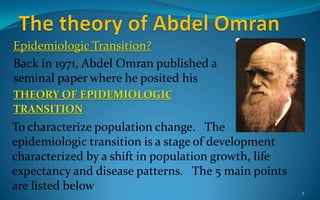
Epidemiologic Transition?
Back in 1971, Abdel Omran published a
seminal paper where he posited his
THEORY OF EPIDEMIOLOGIC
TRANSITION
7
To characterize population change. The
epidemiologic transition is a stage of development
characterized by a shift in population growth, life
expectancy and disease patterns. The 5 main points
are listed below
THEORY OF EPIDEMIOLOGIC TRANSITION
 Proposition One. The theory of epidemiologic
transition begins with the major premise that
mortality is a fundamental factor in population
dynamics
 Proposition Two. During the transition, a long-term
shift occurs in mortality and disease patterns whereby
pandemics of infection are gradually displaced by
degenerative and man-made diseases as the chief form
of morbidity and primary cause of death.
8
THEORY OF EPIDEMIOLOGIC TRANSITION
 Proposition Three. During the epidemiologic
transition the most profound changes in health and
disease patterns obtain among children and young
women
 Proposition Four. The shifts in health and disease
patterns that characterize the epidemiologic transition
are closely associated with the demographic and
socioeconomic transitions that constitute the
modernization complex
9
THEORY OF EPIDEMIOLOGIC TRANSITION
 Proposition Five. Peculiar variations in the pattern,
the pace, the determinants and the consequences of
population change differentiate three basic models
of the epidemiologic transition: the classical or
western model, the accelerated model and the
contemporary or delayed mode (Basically there are
differences in the rates of the transition depending
on a number of different factors)
10
11
Stage I: Pestilence and Famine
 Infectious and parasite diseases were principle causes of
death along with accidents and attacks by animals and
other humans. Thomas Malthus called these caused of
death “natural checks”
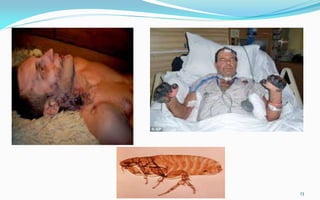
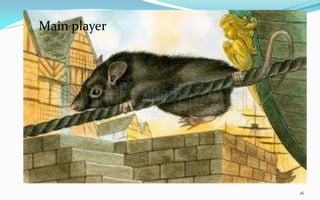
 Most violent Stage I epidemic was the Black
Plague(bubonic plague or black death) probably
transferred to humans by fleas from infected rats
12
13
Black Plague
 Originated among Tatars in present day Kyrgyzstan
 Diffused to present day Ukraine when Tatar army attacked
an Italian trading post on the Black Sea
 Italians fleeing carried the infected rats on ships west to
major coastal cities of Southeastern Europe in 1347
14
continued
 The plague diffused from the coast to inland towns and
then to rural areas
 It reaches Western Europe in 1348 and Northern Europe in
1349
 25 million Europeans died from 1347 to 1350. This was
one-half of the continents population.
 In China, 13 million died from the plague in 1380.
15
16
Main player
Stage II: Receding Pandemics
 Improved sanitation, nutrition, and medicine during the
Industrial Revolution reduced the spread of infectious
diseases.
 Death rates did not improve immediately and universally
during the early years of the Industrial Revolution.
 Poor people who crowded into Industrial Cities had high
death rates due to Cholera
17
Stage III: Degenerative Diseases
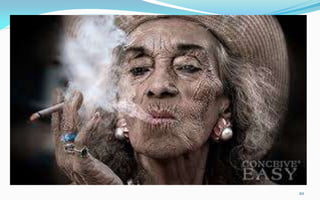
 Associated with the chronic diseases of aging
 Heart disease and cancer
 Sub-Saharan Africa and South Asia have low incidences of
cancer primarily because of low life expectancy.
18
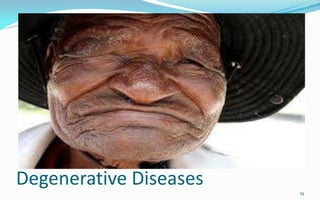
Degenerative Diseases 19
20
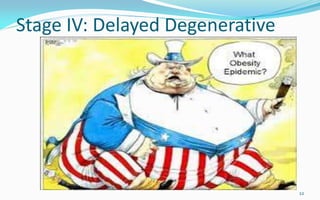
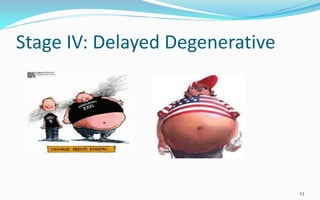
Stage IV: Delayed Degenerative
 Life expectancy of older people is extended through
medical advances.
 Cancer medicines, bypass surgery, better diet, reduced use
of tobacco, and alcohol
 However, consumption of non-nutritious food and
sedentary behavior have resulted in an increase in obesity
in this stage.
21
Stage IV: Delayed Degenerative
22
Stage IV: Delayed Degenerative
23
24
THANK YOU
25

Epidemiologic Transition

  • 1.
  • 3.
    3 ILMIYA INSTITUTE OFNURSING Tariq Javed Gill. Post RN B.Sc.N
  • 4.
    Objectives In this session,all the participants will able to :  Define Epidemiology.  Define Epidemiologic Transition.  Explain the theory of Abdel Omran and its main points  Explain the stages of Epidemiologic Transitions. 4
  • 5.
    What is epidemiology? Epidemiology, branch of medical SCIENCE that studies the distribution of DISEASE in human populations and the factors determining that distribution, chiefly by the use of STATISTICS. 5 ACCORDING TO
  • 6.
    THE EPIDEMIOLOGIC TRANSITION The Epidemiologic transition is that process by which the pattern of mortality and disease is transformed from one of high mortality among infants and children and episodic famine and epidemic affecting all age groups to one of degenerative and man-made diseases (such as those attributed to smoking) affecting principally the elderly. 6
  • 7.
    Epidemiologic Transition? Back in1971, Abdel Omran published a seminal paper where he posited his THEORY OF EPIDEMIOLOGIC TRANSITION 7 To characterize population change. The epidemiologic transition is a stage of development characterized by a shift in population growth, life expectancy and disease patterns. The 5 main points are listed below
  • 8.
    THEORY OF EPIDEMIOLOGICTRANSITION  Proposition One. The theory of epidemiologic transition begins with the major premise that mortality is a fundamental factor in population dynamics  Proposition Two. During the transition, a long-term shift occurs in mortality and disease patterns whereby pandemics of infection are gradually displaced by degenerative and man-made diseases as the chief form of morbidity and primary cause of death. 8
  • 9.
    THEORY OF EPIDEMIOLOGICTRANSITION  Proposition Three. During the epidemiologic transition the most profound changes in health and disease patterns obtain among children and young women  Proposition Four. The shifts in health and disease patterns that characterize the epidemiologic transition are closely associated with the demographic and socioeconomic transitions that constitute the modernization complex 9
  • 10.
    THEORY OF EPIDEMIOLOGICTRANSITION  Proposition Five. Peculiar variations in the pattern, the pace, the determinants and the consequences of population change differentiate three basic models of the epidemiologic transition: the classical or western model, the accelerated model and the contemporary or delayed mode (Basically there are differences in the rates of the transition depending on a number of different factors) 10
  • 11.
  • 12.
    Stage I: Pestilenceand Famine  Infectious and parasite diseases were principle causes of death along with accidents and attacks by animals and other humans. Thomas Malthus called these caused of death “natural checks”  Most violent Stage I epidemic was the Black Plague(bubonic plague or black death) probably transferred to humans by fleas from infected rats 12
  • 13.
  • 14.
    Black Plague  Originatedamong Tatars in present day Kyrgyzstan  Diffused to present day Ukraine when Tatar army attacked an Italian trading post on the Black Sea  Italians fleeing carried the infected rats on ships west to major coastal cities of Southeastern Europe in 1347 14
  • 15.
    continued  The plaguediffused from the coast to inland towns and then to rural areas  It reaches Western Europe in 1348 and Northern Europe in 1349  25 million Europeans died from 1347 to 1350. This was one-half of the continents population.  In China, 13 million died from the plague in 1380. 15
  • 16.
  • 17.
    Stage II: RecedingPandemics  Improved sanitation, nutrition, and medicine during the Industrial Revolution reduced the spread of infectious diseases.  Death rates did not improve immediately and universally during the early years of the Industrial Revolution.  Poor people who crowded into Industrial Cities had high death rates due to Cholera 17
  • 18.
    Stage III: DegenerativeDiseases  Associated with the chronic diseases of aging  Heart disease and cancer  Sub-Saharan Africa and South Asia have low incidences of cancer primarily because of low life expectancy. 18
  • 19.
  • 20.
  • 21.
    Stage IV: DelayedDegenerative  Life expectancy of older people is extended through medical advances.  Cancer medicines, bypass surgery, better diet, reduced use of tobacco, and alcohol  However, consumption of non-nutritious food and sedentary behavior have resulted in an increase in obesity in this stage. 21
  • 22.
    Stage IV: DelayedDegenerative 22
  • 23.
    Stage IV: DelayedDegenerative 23
  • 24.
  • 25.