Globalisation and
    Health
Starting points
Starting points
 Although globalisation is not just about economics it is
worth taking a couple of minutes to consider some basic
                   economic ideas.
Starting points
 Although globalisation is not just about economics it is
worth taking a couple of minutes to consider some basic
                   economic ideas.

 Economic markets- the environments and systems by
which we trade an do business with each other can be
            divided into two basic types.
Regulated Markets
Regulated Markets


In a regulated market the price and cost of
 goods sold in the market is controlled by
               governments.
Regulated Markets
Almost all economies have some form of
               regulation.
Regulated Markets
 Almost all economies have some form of
                regulation.

Some parts of the economy are more closely
          regulated than others.
Regulated Markets
  Almost all economies have some form of
                 regulation.

Some parts of the economy are more closely
          regulated than others.

   In many European countries, health and
education are mostly funded through taxation
      within a heavily regulated market.
Free Markets
Free Markets
A free market is the opposite of a regulated market.
Free Markets
A free market is the opposite of a regulated market.

    In a free market it is competition between
   sellers/providers which determines the price
                and cost of goods.
Free Markets
A free market is the opposite of a regulated market.

    In a free market it is competition between
   sellers/providers which determines the price
                and cost of goods.

  There are few, if any, examples of completely
      free market economies operating at a
                 significant level.
What’s the difference?
  Essentially the difference is a matter of
ideological interpretation of the degree of
regulation/non regulation within a market
What’s the difference?
   Essentially the difference is a matter of
 ideological interpretation of the degree of
 regulation/non regulation within a market

 A third proposition is the ‘mixed economy’.
In this model services and goods are offered
 by both state and private sector providers.
What’s the difference?
   Essentially the difference is a matter of
 ideological interpretation of the degree of
 regulation/non regulation within a market

 A third proposition is the ‘mixed economy’.
In this model services and goods are offered
 by both state and private sector providers.

Health services in the UK, for example, are
provided largely by the state with a small,
     but growing, private sector offer.
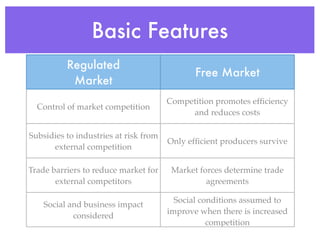
Basic Features
Basic Features
          Regulated
                                              Free Market
           Market
                                       Competition promotes efficiency
  Control of market competition
                                            and reduces costs

Subsidies to industries at risk from
                                       Only efficient producers survive
      external competition

Trade barriers to reduce market for     Market forces determine trade
       external competitors                      agreements

                                         Social conditions assumed to
    Social and business impact
                                       improve when there is increased
            considered
                                                  competition
What is globalisation?
Many people think of globalisation as the extension of
   economic markets across national boundaries.
What is globalisation?
Many people think of globalisation as the extension of
   economic markets across national boundaries.

Initial concerns focused on the extension of markets and
 the lifting of trade barriers between different countries
                        and regions
What is globalisation?
Many people think of globalisation as the extension of
   economic markets across national boundaries.

Initial concerns focused on the extension of markets and
 the lifting of trade barriers between different countries
                        and regions

 More recently attention has also focused on global
communication, cultural and demographic movements.
What is globalisation?
A couple of definitions:
What is globalisation?
 A couple of definitions:

•ʻthe flow of information, goods, capital and people across
 political and economic boundariesʼ (Daulaire 1999)
What is globalisation?
 A couple of definitions:

•ʻthe flow of information, goods, capital and people across
 political and economic boundariesʼ (Daulaire 1999)

•ʻthe process of closer interaction of human activity across a
 range of spheres, including the economic, social, political and
 cultural, experienced along three dimensions: spatial,
 temporal and cognitiveʼ (Lee, K 2002)
Benefits of Economic Globalisation


  • Increased trade opportunities for poorer
    countries
Benefits of Economic Globalisation


  • Increased trade opportunities for poorer
    countries
  • Cheaper goods for wealthy countries
Benefits of Economic Globalisation


  • Increased trade opportunities for poorer
    countries
  • Cheaper goods for wealthy countries
  • Expansion of markets
Three Dimensions
Three Dimensions
In addition to economic globalisation we can also
         think of globalisation in terms of:
Three Dimensions
In addition to economic globalisation we can also
         think of globalisation in terms of:
 • Space- travel and movement of people
Three Dimensions
In addition to economic globalisation we can also
         think of globalisation in terms of:
 • Space- travel and movement of people
 • Time- the increased ease and speed of
   communication between people living in
   different regions
Three Dimensions
In addition to economic globalisation we can also
         think of globalisation in terms of:
 • Space- travel and movement of people
 • Time- the increased ease and speed of
   communication between people living in
   different regions
 • Ideas- the exchange of ideas and
   subsequent cultural exchange that takes
   place
Economic Globalisation
      Generally involves:
Economic Globalisation
           Generally involves:

• Liberalisation of Trade Regulations
Economic Globalisation
           Generally involves:

• Liberalisation of Trade Regulations
• Increased competition between
  providers
Economic Globalisation
           Generally involves:

• Liberalisation of Trade Regulations
• Increased competition between
  providers
• Increased movement of people and
  goods
Other views
Other views
Economic globalisation generally emphasises
 the need to open up markets, moving them
       closer to the free market model
Other views
Economic globalisation generally emphasises
 the need to open up markets, moving them
       closer to the free market model

    But there are increasing numbers of
             dissenting voices.

         Even in the rich countries.
The Impact of Economic Transformation

     What happens when things go wrong?
The Impact of Economic Transformation

     What happens when things go wrong?

   • The collapse of western banking models
     as a result of poor regulation
The Impact of Economic Transformation

     What happens when things go wrong?

   • The collapse of western banking models
     as a result of poor regulation
   • Financial Volatility (Mexico, Iceland,
     Greece, SE Asia)
The Impact of Economic Transformation

     What happens when things go wrong?

   • The collapse of western banking models
     as a result of poor regulation
   • Financial Volatility (Mexico, Iceland,
     Greece, SE Asia)
   • Marginalisation of poor countries
The Impact of Economic Transformation

     What happens when things go wrong?

   • The collapse of western banking models
     as a result of poor regulation
   • Financial Volatility (Mexico, Iceland,
     Greece, SE Asia)
   • Marginalisation of poor countries
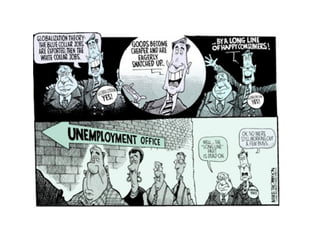
   • Employment insecurity in all regions
The health impact
The health impact
     Globalisation, in its economic, temporal,
   communicative and cultural forms can have an
influence on the social context that influences health
                       status.
The health impact
      Globalisation, in its economic, temporal,
    communicative and cultural forms can have an
influence on the social context that influences health
                        status.
   Improvements in communication, travel and the
opening up of economic markets influences local and
            regional political relations.
The health impact
      Globalisation, in its economic, temporal,
    communicative and cultural forms can have an
influence on the social context that influences health
                        status.
   Improvements in communication, travel and the
opening up of economic markets influences local and
            regional political relations.

     Here are a few examples of health related
          changes linked to globalisation
Growth in the Number of Refugees

 People displaced due to war, economic collapse or natural disaster (millions)
Growth in the Number of Refugees

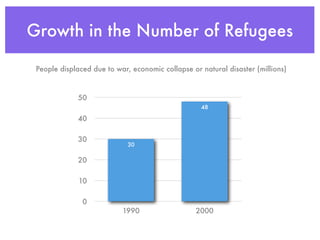
 People displaced due to war, economic collapse or natural disaster (millions)


             50
                                                   48

             40

             30
                             30

             20

              10

               0
                           1990                   2000
Availability of Toxic Goods


• Tobacco
Availability of Toxic Goods


• Tobacco
• Alcohol
Availability of Toxic Goods
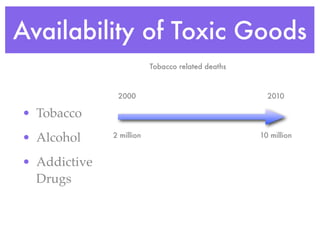
                          Tobacco related deaths


               2000                                  2010

• Tobacco
              2 million                            10 million
• Alcohol
• Addictive
  Drugs
Health and Safety Issues

 • Transnational corporations
Health and Safety Issues

 • Transnational corporations

   • Exploit
Health and Safety Issues

 • Transnational corporations

   • Exploit

      • weak health and safety regulation
Health and Safety Issues

 • Transnational corporations

   • Exploit

      • weak health and safety regulation

      • poor working conditions
Health and Safety Issues

 • Transnational corporations

   • Exploit

      • weak health and safety regulation

      • poor working conditions

      • political instability
Health and Safety Issues

 • Transnational corporations

   • Exploit

      • weak health and safety regulation

      • poor working conditions

      • political instability

      • corruption
Health and Safety Issues

 • Transnational corporations

   • Exploit

      • weak health and safety regulation

      • poor working conditions

      • political instability

      • corruption

      • conflict
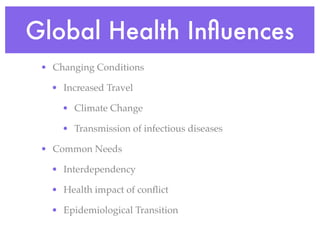
Global Health Influences
 • Changing Conditions

   • Increased Travel

     • Climate Change

     • Transmission of infectious diseases

 • Common Needs

   • Interdependency

   • Health impact of conflict

   • Epidemiological Transition
Health in Transition

 Global factors are increasingly recognised as
important influences of population health status.


We can see some of the changes taking place
                 already
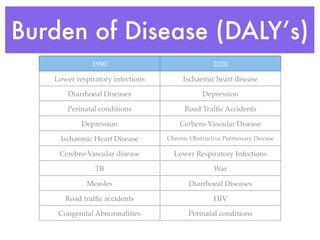
Burden of Disease (DALY’s)
              1990                                2020

   Lower respiratory infections        Ischaemic heart disease

       Diarrhoeal Diseases                    Depression

       Perinatal conditions             Road Traffic Accidents

           Depression                 Cerbero-Vascular Disease

    Ischaemic Heart Disease       Chronic Obstructive Pulmonary Disease

    Cerebro-Vascular disease        Lower Respiratory Infections

               TB                                 War

             Measles                     Diarrhoeal Diseases

      Road traffic accidents                       HIV

    Congenital Abnormalities             Perinatal conditions
Winners and Losers
Winners and Losers

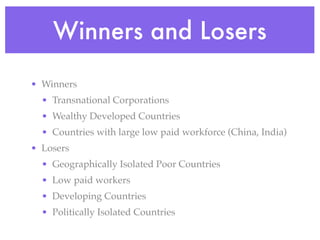
• Winners
  • Transnational Corporations
  • Wealthy Developed Countries
  • Countries with large low paid workforce (China, India)
• Losers
  • Geographically Isolated Poor Countries
  • Low paid workers
  • Developing Countries
  • Politically Isolated Countries
Bibliography


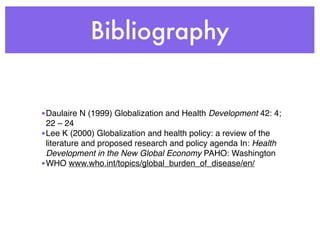
•Daulaire N (1999) Globalization and Health Development 42: 4;
 22 – 24
•Lee K (2000) Globalization and health policy: a review of the
 literature and proposed research and policy agenda In: Health
 Development in the New Global Economy PAHO: Washington
•WHO www.who.int/topics/global_burden_of_disease/en/

Globalisation and Health

  • 1.
  • 2.
  • 3.
    Starting points Althoughglobalisation is not just about economics it is worth taking a couple of minutes to consider some basic economic ideas.
  • 4.
    Starting points Althoughglobalisation is not just about economics it is worth taking a couple of minutes to consider some basic economic ideas. Economic markets- the environments and systems by which we trade an do business with each other can be divided into two basic types.
  • 5.
  • 6.
    Regulated Markets In aregulated market the price and cost of goods sold in the market is controlled by governments.
  • 7.
    Regulated Markets Almost alleconomies have some form of regulation.
  • 8.
    Regulated Markets Almostall economies have some form of regulation. Some parts of the economy are more closely regulated than others.
  • 9.
    Regulated Markets Almost all economies have some form of regulation. Some parts of the economy are more closely regulated than others. In many European countries, health and education are mostly funded through taxation within a heavily regulated market.
  • 10.
  • 11.
    Free Markets A freemarket is the opposite of a regulated market.
  • 12.
    Free Markets A freemarket is the opposite of a regulated market. In a free market it is competition between sellers/providers which determines the price and cost of goods.
  • 13.
    Free Markets A freemarket is the opposite of a regulated market. In a free market it is competition between sellers/providers which determines the price and cost of goods. There are few, if any, examples of completely free market economies operating at a significant level.
  • 14.
  • 15.
    What’s the difference? Essentially the difference is a matter of ideological interpretation of the degree of regulation/non regulation within a market
  • 16.
    What’s the difference? Essentially the difference is a matter of ideological interpretation of the degree of regulation/non regulation within a market A third proposition is the ‘mixed economy’. In this model services and goods are offered by both state and private sector providers.
  • 17.
    What’s the difference? Essentially the difference is a matter of ideological interpretation of the degree of regulation/non regulation within a market A third proposition is the ‘mixed economy’. In this model services and goods are offered by both state and private sector providers. Health services in the UK, for example, are provided largely by the state with a small, but growing, private sector offer.
  • 18.
  • 19.
    Basic Features Regulated Free Market Market Competition promotes efficiency Control of market competition and reduces costs Subsidies to industries at risk from Only efficient producers survive external competition Trade barriers to reduce market for Market forces determine trade external competitors agreements Social conditions assumed to Social and business impact improve when there is increased considered competition
  • 20.
  • 21.
    What is globalisation? Manypeople think of globalisation as the extension of economic markets across national boundaries.
  • 22.
    What is globalisation? Manypeople think of globalisation as the extension of economic markets across national boundaries. Initial concerns focused on the extension of markets and the lifting of trade barriers between different countries and regions
  • 23.
    What is globalisation? Manypeople think of globalisation as the extension of economic markets across national boundaries. Initial concerns focused on the extension of markets and the lifting of trade barriers between different countries and regions More recently attention has also focused on global communication, cultural and demographic movements.
  • 24.
  • 25.
    What is globalisation? Acouple of definitions:
  • 26.
    What is globalisation? A couple of definitions: •ʻthe flow of information, goods, capital and people across political and economic boundariesʼ (Daulaire 1999)
  • 27.
    What is globalisation? A couple of definitions: •ʻthe flow of information, goods, capital and people across political and economic boundariesʼ (Daulaire 1999) •ʻthe process of closer interaction of human activity across a range of spheres, including the economic, social, political and cultural, experienced along three dimensions: spatial, temporal and cognitiveʼ (Lee, K 2002)
  • 28.
    Benefits of EconomicGlobalisation
  • 29.
    Benefits of EconomicGlobalisation • Increased trade opportunities for poorer countries
  • 30.
    Benefits of EconomicGlobalisation • Increased trade opportunities for poorer countries • Cheaper goods for wealthy countries
  • 31.
    Benefits of EconomicGlobalisation • Increased trade opportunities for poorer countries • Cheaper goods for wealthy countries • Expansion of markets
  • 32.
  • 33.
    Three Dimensions In additionto economic globalisation we can also think of globalisation in terms of:
  • 34.
    Three Dimensions In additionto economic globalisation we can also think of globalisation in terms of: • Space- travel and movement of people
  • 35.
    Three Dimensions In additionto economic globalisation we can also think of globalisation in terms of: • Space- travel and movement of people • Time- the increased ease and speed of communication between people living in different regions
  • 36.
    Three Dimensions In additionto economic globalisation we can also think of globalisation in terms of: • Space- travel and movement of people • Time- the increased ease and speed of communication between people living in different regions • Ideas- the exchange of ideas and subsequent cultural exchange that takes place
  • 37.
  • 38.
    Economic Globalisation Generally involves:
  • 39.
    Economic Globalisation Generally involves: • Liberalisation of Trade Regulations
  • 40.
    Economic Globalisation Generally involves: • Liberalisation of Trade Regulations • Increased competition between providers
  • 41.
    Economic Globalisation Generally involves: • Liberalisation of Trade Regulations • Increased competition between providers • Increased movement of people and goods
  • 42.
  • 43.
    Other views Economic globalisationgenerally emphasises the need to open up markets, moving them closer to the free market model
  • 44.
    Other views Economic globalisationgenerally emphasises the need to open up markets, moving them closer to the free market model But there are increasing numbers of dissenting voices. Even in the rich countries.
  • 46.
    The Impact ofEconomic Transformation
  • 47.
    The Impact ofEconomic Transformation What happens when things go wrong?
  • 48.
    The Impact ofEconomic Transformation What happens when things go wrong? • The collapse of western banking models as a result of poor regulation
  • 49.
    The Impact ofEconomic Transformation What happens when things go wrong? • The collapse of western banking models as a result of poor regulation • Financial Volatility (Mexico, Iceland, Greece, SE Asia)
  • 50.
    The Impact ofEconomic Transformation What happens when things go wrong? • The collapse of western banking models as a result of poor regulation • Financial Volatility (Mexico, Iceland, Greece, SE Asia) • Marginalisation of poor countries
  • 51.
    The Impact ofEconomic Transformation What happens when things go wrong? • The collapse of western banking models as a result of poor regulation • Financial Volatility (Mexico, Iceland, Greece, SE Asia) • Marginalisation of poor countries • Employment insecurity in all regions
  • 52.
  • 53.
    The health impact Globalisation, in its economic, temporal, communicative and cultural forms can have an influence on the social context that influences health status.
  • 54.
    The health impact Globalisation, in its economic, temporal, communicative and cultural forms can have an influence on the social context that influences health status. Improvements in communication, travel and the opening up of economic markets influences local and regional political relations.
  • 55.
    The health impact Globalisation, in its economic, temporal, communicative and cultural forms can have an influence on the social context that influences health status. Improvements in communication, travel and the opening up of economic markets influences local and regional political relations. Here are a few examples of health related changes linked to globalisation
  • 56.
    Growth in theNumber of Refugees People displaced due to war, economic collapse or natural disaster (millions)
  • 57.
    Growth in theNumber of Refugees People displaced due to war, economic collapse or natural disaster (millions) 50 48 40 30 30 20 10 0 1990 2000
  • 58.
  • 59.
    Availability of ToxicGoods • Tobacco
  • 60.
    Availability of ToxicGoods • Tobacco • Alcohol
  • 61.
    Availability of ToxicGoods Tobacco related deaths 2000 2010 • Tobacco 2 million 10 million • Alcohol • Addictive Drugs
  • 62.
  • 63.
    Health and SafetyIssues • Transnational corporations
  • 64.
    Health and SafetyIssues • Transnational corporations • Exploit
  • 65.
    Health and SafetyIssues • Transnational corporations • Exploit • weak health and safety regulation
  • 66.
    Health and SafetyIssues • Transnational corporations • Exploit • weak health and safety regulation • poor working conditions
  • 67.
    Health and SafetyIssues • Transnational corporations • Exploit • weak health and safety regulation • poor working conditions • political instability
  • 68.
    Health and SafetyIssues • Transnational corporations • Exploit • weak health and safety regulation • poor working conditions • political instability • corruption
  • 69.
    Health and SafetyIssues • Transnational corporations • Exploit • weak health and safety regulation • poor working conditions • political instability • corruption • conflict
  • 70.
  • 71.
    Global Health Influences • Changing Conditions • Increased Travel • Climate Change • Transmission of infectious diseases • Common Needs • Interdependency • Health impact of conflict • Epidemiological Transition
  • 72.
    Health in Transition Global factors are increasingly recognised as important influences of population health status. We can see some of the changes taking place already
  • 73.
  • 74.
    Burden of Disease(DALY’s) 1990 2020 Lower respiratory infections Ischaemic heart disease Diarrhoeal Diseases Depression Perinatal conditions Road Traffic Accidents Depression Cerbero-Vascular Disease Ischaemic Heart Disease Chronic Obstructive Pulmonary Disease Cerebro-Vascular disease Lower Respiratory Infections TB War Measles Diarrhoeal Diseases Road traffic accidents HIV Congenital Abnormalities Perinatal conditions
  • 75.
  • 76.
    Winners and Losers •Winners • Transnational Corporations • Wealthy Developed Countries • Countries with large low paid workforce (China, India) • Losers • Geographically Isolated Poor Countries • Low paid workers • Developing Countries • Politically Isolated Countries
  • 77.
    Bibliography •Daulaire N (1999)Globalization and Health Development 42: 4; 22 – 24 •Lee K (2000) Globalization and health policy: a review of the literature and proposed research and policy agenda In: Health Development in the New Global Economy PAHO: Washington •WHO www.who.int/topics/global_burden_of_disease/en/

Editor's Notes

  • #34 More than 1 Million people a week travel between the developing and the developed world.
  • #35 More than 1 Million people a week travel between the developing and the developed world.
  • #36 More than 1 Million people a week travel between the developing and the developed world.
  • #37 More than 1 Million people a week travel between the developing and the developed world.