4-1
4-2
4
Global
Human Resource
Management
McGraw-Hill/Irwin
Human Resource Management, 10/e © 2007 The McGraw-Hill Companies, Inc. All rights reserved.
4-3
Introduction
Integration of the world’s economies and business
globalization continues unabated
 International trade is growing more rapidly than
world output
Foreign direct investment (FDI) flows are increasing
The number of cross-border, inter-firm agreements
has risen dramatically
Social, economic, and political developments
throughout the world changed the way global
business is conducted
4-4
Introduction
The external environment greatly influences HRM
activities
Each country has its own:
Laws
Business customs
Workforce characteristics
Political climate
The most difficult challenge to overcome is the
“people challenge”
4-5
Introduction
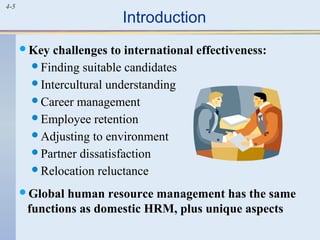
Key challenges to international effectiveness:
Finding suitable candidates
Intercultural understanding
Career management
Employee retention
Adjusting to environment
Partner dissatisfaction
Relocation reluctance
Global human resource management has the same
functions as domestic HRM, plus unique aspects
4-6
Introduction
Organizations expand beyond domestic boundaries
to achieve:
Satisfied employees
Competitive products and services
New or broader markets
New, more efficient manufacturing technology
Large, inexpensive labor forces
4-7
Introduction
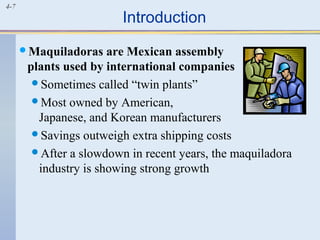
Maquiladoras are Mexican assembly
plants used by international companies
Sometimes called “twin plants”
Most owned by American,
Japanese, and Korean manufacturers
Savings outweigh extra shipping costs
After a slowdown in recent years, the maquiladora
industry is showing strong growth
4-8
Introduction
Mexico is not the only area popular with American
firms, nor is inexpensive labor the only driving force
Intel built a manufacturing facility in Ireland in
exchange for a guaranteed tax break
Foreign direct investment in developed countries has
decreased since 2001
Developing countries are seeing increases in foreign
direct investment
4-9
The Cultural Nature of Global HRM
Cultural differences between nations can influence
the effectiveness of HRM policies and practices
HRM must be congruent with the cultural orientation
of the workers
Hefstede says cultures vary in five dimensions:
Individualism versus collectivism
Power distance
Avoidance of uncertainty
Masculinity
Long-term versus short-term orientation
4-10
The Concept of “Fit” in Global HRM
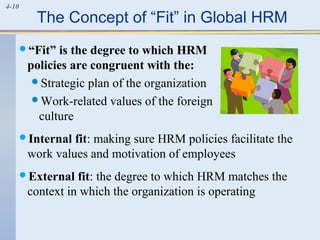
“Fit” is the degree to which HRM
policies are congruent with the:
Strategic plan of the organization
Work-related values of the foreign
culture
Internal fit: making sure HRM policies facilitate the
work values and motivation of employees
External fit: the degree to which HRM matches the
context in which the organization is operating
4-11
Multinational and Global Corporations
Multinational corporations (MNCs) are usually in
the early stages of an international strategy
Operations in many nations, but each is a separate
enterprise
Each enterprise adapts products to the local culture
Most control remains with the home office or with
an expatriate from the home country
Most employees and managers are from the home
country (polycentric staffing)
4-12
Multinational and Global Corporations
Global corporations (GC) are structured so that
national boundaries disappear
The best people are hired, regardless of national
origin (geocentric staffing)
Subsidiaries are not limited to serving the local
culture
The national affiliation of an employee becomes less
important than his/her area of expertise
GHRM in the 21st
century will be challenging for
both MNCs and GCs
4-13
Multinational and Global Corporations
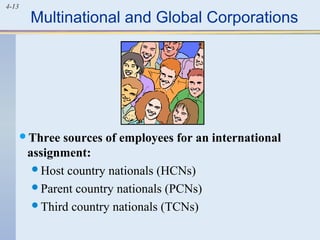
Three sources of employees for an international
assignment:
Host country nationals (HCNs)
Parent country nationals (PCNs)
Third country nationals (TCNs)
4-14
Multinational and Global Corporations
MNCs generally take an ethnocentric perspective
They use HRM policies from home with minor
adaptations
They believe key personnel should be PCNs
Ethnocentricity is strong in many foreign
organizations conducting business in the U.S.
Nearly every executive in Japanese-owned businesses
in the U.S. is a Japanese national
The geocentric organization ignores national
boundaries for staffing overseas operations
4-15
Multinational and Global Corporations
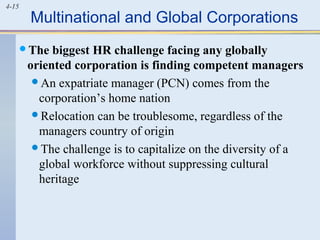
The biggest HR challenge facing any globally
oriented corporation is finding competent managers
An expatriate manager (PCN) comes from the
corporation’s home nation
Relocation can be troublesome, regardless of the
managers country of origin
The challenge is to capitalize on the diversity of a
global workforce without suppressing cultural
heritage
4-16
Multinational and Global Corporations
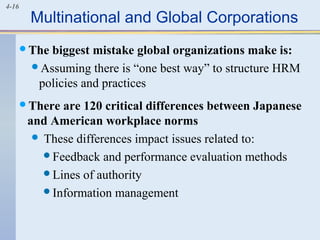
The biggest mistake global organizations make is:
Assuming there is “one best way” to structure HRM
policies and practices
There are 120 critical differences between Japanese
and American workplace norms
 These differences impact issues related to:
Feedback and performance evaluation methods
Lines of authority
Information management
4-17
The Expatriate Manager in the MNC
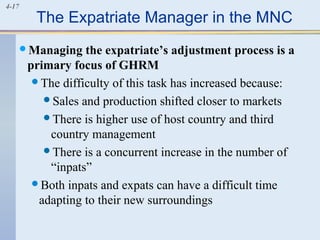
Managing the expatriate’s adjustment process is a
primary focus of GHRM
The difficulty of this task has increased because:
Sales and production shifted closer to markets
There is higher use of host country and third
country management
There is a concurrent increase in the number of
“inpats”
Both inpats and expats can have a difficult time
adapting to their new surroundings
4-18
The Expatriate Manager in the MNC
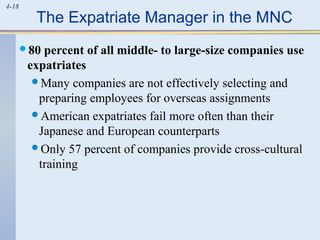
80 percent of all middle- to large-size companies use
expatriates
Many companies are not effectively selecting and
preparing employees for overseas assignments
American expatriates fail more often than their
Japanese and European counterparts
Only 57 percent of companies provide cross-cultural
training
4-19
Selecting the Expatriate Manager
Factors associated with expatriate failure:
Uncertain technical competency
Weak language skills
Unsure about going overseas
Family problems
Low spouse support
Behavioral rigidity
Inability to adapt
Poor relational ability
Weak stress management skills
4-20
Selecting the Expatriate Manager
Factors associated with expatriate success:
Good technical and language skills
Strong desire to work overseas
Specific knowledge of overseas culture
Well-adjusted family situation
Complete support of spouse
Behavioral flexibility
Adaptability and open-mindedness
Good relational ability
Good stress management skills
4-21
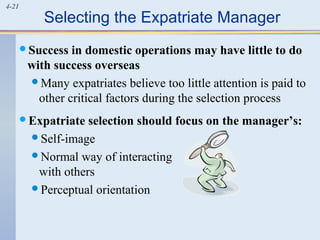
Selecting the Expatriate Manager
Success in domestic operations may have little to do
with success overseas
Many expatriates believe too little attention is paid to
other critical factors during the selection process
Expatriate selection should focus on the manager’s:
Self-image
Normal way of interacting
with others
Perceptual orientation
4-22
Selecting the Expatriate Manager
The role of the expatriate’s family should not be
underestimated
Dual career marriages are another difficult issue
4-23
Culture Shock
Exposure to a foreign culture can produce a
predictable series of reactions:
A period of fascination
Culture shock
Adaptation
Dealing with culture shock involves:
Preparation
Language skills
Preparing the host country personnel who will work
with the expatriate
4-24
Training the Expatriate Manager
Intercultural training improves the odds for success
on an overseas assignment
According to Tung, two things determine the training
an expatriate should receive:
Level of contact the person will have with the host
culture
Degree of dissimilarity between the home and host
cultures
Self-awareness is an important aspect of successfully
preparing for an international assignment
4-25
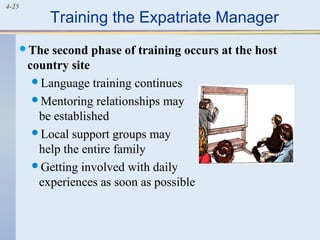
Training the Expatriate Manager
The second phase of training occurs at the host
country site
Language training continues
Mentoring relationships may
be established
Local support groups may
help the entire family
Getting involved with daily
experiences as soon as possible
4-26
Training the Expatriate Manager
The final phase occurs when the manager prepares
to return to the parent country (repatriation)
Repatriation can result in more culture shock than
was experienced while overseas
Repatriates are more likely to leave the parent
company than their domestic counterparts
Many returning managers feel they have lost ground
in terms of career advancement
4-27
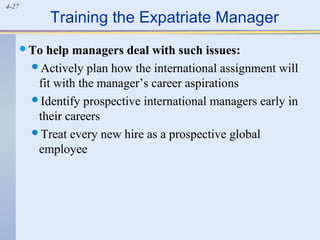
Training the Expatriate Manager
To help managers deal with such issues:
Actively plan how the international assignment will
fit with the manager’s career aspirations
Identify prospective international managers early in
their careers
Treat every new hire as a prospective global
employee
4-28
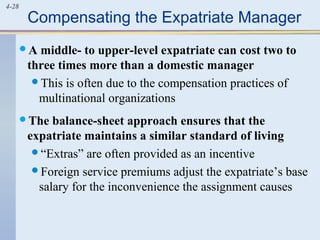
Compensating the Expatriate Manager
A middle- to upper-level expatriate can cost two to
three times more than a domestic manager
This is often due to the compensation practices of
multinational organizations
The balance-sheet approach ensures that the
expatriate maintains a similar standard of living
“Extras” are often provided as an incentive
Foreign service premiums adjust the expatriate’s base
salary for the inconvenience the assignment causes
4-29
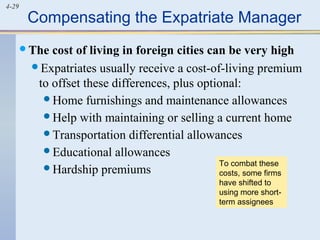
Compensating the Expatriate Manager
The cost of living in foreign cities can be very high
Expatriates usually receive a cost-of-living premium
to offset these differences, plus optional:
Home furnishings and maintenance allowances
Help with maintaining or selling a current home
Transportation differential allowances
Educational allowances
Hardship premiums
To combat these
costs, some firms
have shifted to
using more short-
term assignees
4-30
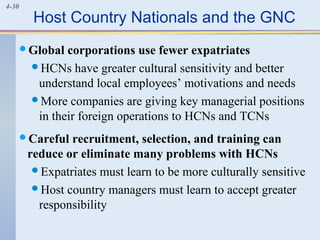
Host Country Nationals and the GNC
Global corporations use fewer expatriates
HCNs have greater cultural sensitivity and better
understand local employees’ motivations and needs
More companies are giving key managerial positions
in their foreign operations to HCNs and TCNs
Careful recruitment, selection, and training can
reduce or eliminate many problems with HCNs
Expatriates must learn to be more culturally sensitive
Host country managers must learn to accept greater
responsibility
4-31
Host Country Nationals and the GNC
When an organization recruits HCNs:
Its HRM policies must be more flexible
It must strive for a reasonable fit between HRM
policies and cultural values
Suggestions that can help:
Use the same methods/sources as host country
organizations
Use a recruiting liaison
Write job ads consistent with local custom and jargon
Allow HCNs to use native language during
interviews
4-32
Global Corporate Boards of Directors
Boards of directors of most American corporations
have been slow to include foreign members
A survey of 589 America businesses found a global
representative on these boards:
24 percent of manufacturing firms
14 percent of financial firms
9 percent of other, non-financial firms
European companies are progressing more quickly
Nestlé, Unilever, Fiat, and Volvo all have global
representation on their boards
4-33
Legal and Ethical Climate of GHRM
 International business is conducted in a maze of:
International trade agreements
Parent country laws
Host country regulations
Ethical behavior challenges
may also be encountered:
Environmental regulation
may be weaker
“Gift giving” or “greasing”
may be common practice
The Foreign Corrupt
Practices Act of 1977
(FCPA) makes it illegal
for employees of
American corporations
to offer money or other
items to foreign officials
in order to gain an unfair
competitive advantage
4-34
Legal and Ethical Climate of GHRM
Regulations regarding employment discrimination
vary from country to country
The U.S. has some of the more stringent
anti-discrimination laws
Many countries have not created this kind of
enforcement
The Civil Rights Act of 1991
applies to the overseas
operations of American
corporations
4-35
Legal and Ethical Climate of GHRM
Ethical dilemmas between profits and the
preservation of basic human rights may also exist
Example: The clash between business, morality, and
politics that occurred in South Africa during apartheid
Similar dilemmas occur around the globe in
developing countries
Resolving ethical issues is not an easy task
4-36
Legal and Ethical Climate of GHRM
The first African American on the board of General
Motors proposed his Sullivan Principles:
Non-segregation in all work facilities
Equal and fair employment practices for all
Equal pay for all employees performing equal work
Training programs to prepare blacks and other
nonwhites for supervisory and technical jobs
Increasing the number of blacks and other nonwhite
minorities in management
Improving the quality of employees’ lives outside of
the work environment
4-37
Labor Relations & the International Corp.
Labor relations issues that may arise in the
international environment:
Unions
Labor laws
Less emphasis on written contracts
How much participation employees
are entitled to in HRM policies
4-38
Labor Relations & the International Corp.
Employee participation is guaranteed in Germany
South Korea’s giant industrial firms, the chaebol,
control every aspect of worker’s lives
Government business regulations may differ
In Singapore, annual wage adjustments are set by a
national council and strikes are nearly impossible
There is no simple solution to the labor relations
problems with which MNCs and GCs are confronted
Labor has been trying to establish global labor
organizations

Chapter04

  • 1.
  • 2.
    4-2 4 Global Human Resource Management McGraw-Hill/Irwin Human ResourceManagement, 10/e © 2007 The McGraw-Hill Companies, Inc. All rights reserved.
  • 3.
    4-3 Introduction Integration of theworld’s economies and business globalization continues unabated  International trade is growing more rapidly than world output Foreign direct investment (FDI) flows are increasing The number of cross-border, inter-firm agreements has risen dramatically Social, economic, and political developments throughout the world changed the way global business is conducted
  • 4.
    4-4 Introduction The external environmentgreatly influences HRM activities Each country has its own: Laws Business customs Workforce characteristics Political climate The most difficult challenge to overcome is the “people challenge”
  • 5.
    4-5 Introduction Key challenges tointernational effectiveness: Finding suitable candidates Intercultural understanding Career management Employee retention Adjusting to environment Partner dissatisfaction Relocation reluctance Global human resource management has the same functions as domestic HRM, plus unique aspects
  • 6.
    4-6 Introduction Organizations expand beyonddomestic boundaries to achieve: Satisfied employees Competitive products and services New or broader markets New, more efficient manufacturing technology Large, inexpensive labor forces
  • 7.
    4-7 Introduction Maquiladoras are Mexicanassembly plants used by international companies Sometimes called “twin plants” Most owned by American, Japanese, and Korean manufacturers Savings outweigh extra shipping costs After a slowdown in recent years, the maquiladora industry is showing strong growth
  • 8.
    4-8 Introduction Mexico is notthe only area popular with American firms, nor is inexpensive labor the only driving force Intel built a manufacturing facility in Ireland in exchange for a guaranteed tax break Foreign direct investment in developed countries has decreased since 2001 Developing countries are seeing increases in foreign direct investment
  • 9.
    4-9 The Cultural Natureof Global HRM Cultural differences between nations can influence the effectiveness of HRM policies and practices HRM must be congruent with the cultural orientation of the workers Hefstede says cultures vary in five dimensions: Individualism versus collectivism Power distance Avoidance of uncertainty Masculinity Long-term versus short-term orientation
  • 10.
    4-10 The Concept of“Fit” in Global HRM “Fit” is the degree to which HRM policies are congruent with the: Strategic plan of the organization Work-related values of the foreign culture Internal fit: making sure HRM policies facilitate the work values and motivation of employees External fit: the degree to which HRM matches the context in which the organization is operating
  • 11.
    4-11 Multinational and GlobalCorporations Multinational corporations (MNCs) are usually in the early stages of an international strategy Operations in many nations, but each is a separate enterprise Each enterprise adapts products to the local culture Most control remains with the home office or with an expatriate from the home country Most employees and managers are from the home country (polycentric staffing)
  • 12.
    4-12 Multinational and GlobalCorporations Global corporations (GC) are structured so that national boundaries disappear The best people are hired, regardless of national origin (geocentric staffing) Subsidiaries are not limited to serving the local culture The national affiliation of an employee becomes less important than his/her area of expertise GHRM in the 21st century will be challenging for both MNCs and GCs
  • 13.
    4-13 Multinational and GlobalCorporations Three sources of employees for an international assignment: Host country nationals (HCNs) Parent country nationals (PCNs) Third country nationals (TCNs)
  • 14.
    4-14 Multinational and GlobalCorporations MNCs generally take an ethnocentric perspective They use HRM policies from home with minor adaptations They believe key personnel should be PCNs Ethnocentricity is strong in many foreign organizations conducting business in the U.S. Nearly every executive in Japanese-owned businesses in the U.S. is a Japanese national The geocentric organization ignores national boundaries for staffing overseas operations
  • 15.
    4-15 Multinational and GlobalCorporations The biggest HR challenge facing any globally oriented corporation is finding competent managers An expatriate manager (PCN) comes from the corporation’s home nation Relocation can be troublesome, regardless of the managers country of origin The challenge is to capitalize on the diversity of a global workforce without suppressing cultural heritage
  • 16.
    4-16 Multinational and GlobalCorporations The biggest mistake global organizations make is: Assuming there is “one best way” to structure HRM policies and practices There are 120 critical differences between Japanese and American workplace norms  These differences impact issues related to: Feedback and performance evaluation methods Lines of authority Information management
  • 17.
    4-17 The Expatriate Managerin the MNC Managing the expatriate’s adjustment process is a primary focus of GHRM The difficulty of this task has increased because: Sales and production shifted closer to markets There is higher use of host country and third country management There is a concurrent increase in the number of “inpats” Both inpats and expats can have a difficult time adapting to their new surroundings
  • 18.
    4-18 The Expatriate Managerin the MNC 80 percent of all middle- to large-size companies use expatriates Many companies are not effectively selecting and preparing employees for overseas assignments American expatriates fail more often than their Japanese and European counterparts Only 57 percent of companies provide cross-cultural training
  • 19.
    4-19 Selecting the ExpatriateManager Factors associated with expatriate failure: Uncertain technical competency Weak language skills Unsure about going overseas Family problems Low spouse support Behavioral rigidity Inability to adapt Poor relational ability Weak stress management skills
  • 20.
    4-20 Selecting the ExpatriateManager Factors associated with expatriate success: Good technical and language skills Strong desire to work overseas Specific knowledge of overseas culture Well-adjusted family situation Complete support of spouse Behavioral flexibility Adaptability and open-mindedness Good relational ability Good stress management skills
  • 21.
    4-21 Selecting the ExpatriateManager Success in domestic operations may have little to do with success overseas Many expatriates believe too little attention is paid to other critical factors during the selection process Expatriate selection should focus on the manager’s: Self-image Normal way of interacting with others Perceptual orientation
  • 22.
    4-22 Selecting the ExpatriateManager The role of the expatriate’s family should not be underestimated Dual career marriages are another difficult issue
  • 23.
    4-23 Culture Shock Exposure toa foreign culture can produce a predictable series of reactions: A period of fascination Culture shock Adaptation Dealing with culture shock involves: Preparation Language skills Preparing the host country personnel who will work with the expatriate
  • 24.
    4-24 Training the ExpatriateManager Intercultural training improves the odds for success on an overseas assignment According to Tung, two things determine the training an expatriate should receive: Level of contact the person will have with the host culture Degree of dissimilarity between the home and host cultures Self-awareness is an important aspect of successfully preparing for an international assignment
  • 25.
    4-25 Training the ExpatriateManager The second phase of training occurs at the host country site Language training continues Mentoring relationships may be established Local support groups may help the entire family Getting involved with daily experiences as soon as possible
  • 26.
    4-26 Training the ExpatriateManager The final phase occurs when the manager prepares to return to the parent country (repatriation) Repatriation can result in more culture shock than was experienced while overseas Repatriates are more likely to leave the parent company than their domestic counterparts Many returning managers feel they have lost ground in terms of career advancement
  • 27.
    4-27 Training the ExpatriateManager To help managers deal with such issues: Actively plan how the international assignment will fit with the manager’s career aspirations Identify prospective international managers early in their careers Treat every new hire as a prospective global employee
  • 28.
    4-28 Compensating the ExpatriateManager A middle- to upper-level expatriate can cost two to three times more than a domestic manager This is often due to the compensation practices of multinational organizations The balance-sheet approach ensures that the expatriate maintains a similar standard of living “Extras” are often provided as an incentive Foreign service premiums adjust the expatriate’s base salary for the inconvenience the assignment causes
  • 29.
    4-29 Compensating the ExpatriateManager The cost of living in foreign cities can be very high Expatriates usually receive a cost-of-living premium to offset these differences, plus optional: Home furnishings and maintenance allowances Help with maintaining or selling a current home Transportation differential allowances Educational allowances Hardship premiums To combat these costs, some firms have shifted to using more short- term assignees
  • 30.
    4-30 Host Country Nationalsand the GNC Global corporations use fewer expatriates HCNs have greater cultural sensitivity and better understand local employees’ motivations and needs More companies are giving key managerial positions in their foreign operations to HCNs and TCNs Careful recruitment, selection, and training can reduce or eliminate many problems with HCNs Expatriates must learn to be more culturally sensitive Host country managers must learn to accept greater responsibility
  • 31.
    4-31 Host Country Nationalsand the GNC When an organization recruits HCNs: Its HRM policies must be more flexible It must strive for a reasonable fit between HRM policies and cultural values Suggestions that can help: Use the same methods/sources as host country organizations Use a recruiting liaison Write job ads consistent with local custom and jargon Allow HCNs to use native language during interviews
  • 32.
    4-32 Global Corporate Boardsof Directors Boards of directors of most American corporations have been slow to include foreign members A survey of 589 America businesses found a global representative on these boards: 24 percent of manufacturing firms 14 percent of financial firms 9 percent of other, non-financial firms European companies are progressing more quickly Nestlé, Unilever, Fiat, and Volvo all have global representation on their boards
  • 33.
    4-33 Legal and EthicalClimate of GHRM  International business is conducted in a maze of: International trade agreements Parent country laws Host country regulations Ethical behavior challenges may also be encountered: Environmental regulation may be weaker “Gift giving” or “greasing” may be common practice The Foreign Corrupt Practices Act of 1977 (FCPA) makes it illegal for employees of American corporations to offer money or other items to foreign officials in order to gain an unfair competitive advantage
  • 34.
    4-34 Legal and EthicalClimate of GHRM Regulations regarding employment discrimination vary from country to country The U.S. has some of the more stringent anti-discrimination laws Many countries have not created this kind of enforcement The Civil Rights Act of 1991 applies to the overseas operations of American corporations
  • 35.
    4-35 Legal and EthicalClimate of GHRM Ethical dilemmas between profits and the preservation of basic human rights may also exist Example: The clash between business, morality, and politics that occurred in South Africa during apartheid Similar dilemmas occur around the globe in developing countries Resolving ethical issues is not an easy task
  • 36.
    4-36 Legal and EthicalClimate of GHRM The first African American on the board of General Motors proposed his Sullivan Principles: Non-segregation in all work facilities Equal and fair employment practices for all Equal pay for all employees performing equal work Training programs to prepare blacks and other nonwhites for supervisory and technical jobs Increasing the number of blacks and other nonwhite minorities in management Improving the quality of employees’ lives outside of the work environment
  • 37.
    4-37 Labor Relations &the International Corp. Labor relations issues that may arise in the international environment: Unions Labor laws Less emphasis on written contracts How much participation employees are entitled to in HRM policies
  • 38.
    4-38 Labor Relations &the International Corp. Employee participation is guaranteed in Germany South Korea’s giant industrial firms, the chaebol, control every aspect of worker’s lives Government business regulations may differ In Singapore, annual wage adjustments are set by a national council and strikes are nearly impossible There is no simple solution to the labor relations problems with which MNCs and GCs are confronted Labor has been trying to establish global labor organizations