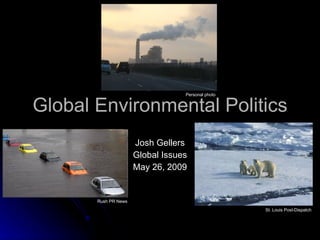
Global Environmental Politics Josh Gellers Global Issues May 26, 2009 St. Louis Post-Dispatch Rush PR News Personal photo
 
 
Agenda Climate Change Science and the IPCC Impacts and Costs Montreal Protocol Kyoto Protocol Global Environmental Policy
Climate Change Science, Impacts, and Costs
Climate Change and Global Warming Climate change  refers to any significant change in measures of climate (such as temperature, precipitation, or wind) lasting for an extended period (decades or longer). Climate change may result from: natural factors, such as changes in the sun's intensity or slow changes in the Earth's orbit around the sun;  natural processes within the climate system (e.g. changes in ocean circulation);  human activities that change the atmosphere's composition (e.g. through burning fossil fuels) and the land surface (e.g. deforestation, reforestation, urbanization, desertification, etc.)  Global warming  is an average increase in the temperature of the atmosphere near the Earth's surface and in the troposphere, which can contribute to changes in global climate patterns.  Global warming can occur from a variety of causes, both natural and human induced.  In common usage, "global warming" often refers to the warming that can occur as a result of increased emissions of greenhouse gases from human activities. (US EPA) NASA Climate Change Animation
 
 
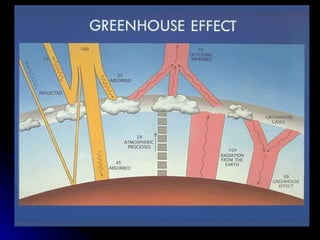
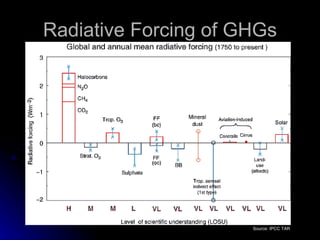
Radiative Forcing of GHGs Source: IPCC TAR
Intergovernmental Panel on Climate Change IPCC: a scientific intergovernmental body set up by the World Meteorological Organization (WMO) and by the United Nations Environment Programme (UNEP) in 1988  Composed of: Governments: the IPCC is open to all member countries of WMO and UNEP Scientists: hundreds of scientists all over the world contribute to the work of the IPCC as authors, contributors and reviewers People: as United Nations body, the IPCC work aims at the promotion of the United Nations human development goals ( http://www.ipcc.ch/about/index.htm ) Publishes comprehensive assessment reports 2007: IPCC releases Fourth Assessment Report (AR4)
 
 
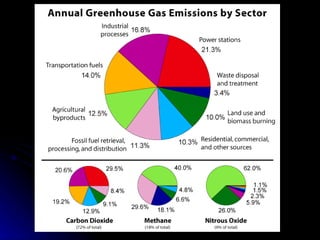
Humans and Climate Emissions  Greenhouse Gases & Aerosols Fossil fuels (Personal & Industry) Land use Land use changes Agriculture Deforestation Urbanization Water management & reservoirs
 
Climate Change and Global Warming Scientists: Fail to make a clear distinction between climate change and BAU Media: Balance, integrity, sensationalism Special Interests: Disinformation campaigns, focus on profits Public: Confused, uninterested Government: Post-9/11 withdrawal from Kyoto, Obama promises change, American Clean Energy and Security Act
Climate Change: Uncertainties Strength/tolerance of feedbacks: water vapor feedback, clouds & precipitation efficiency Rate of change: abrupt climate change Changes in magnitude of intraseasonal-to-interannual variability: ENSO, NAO Local effects: i.e. drought in California
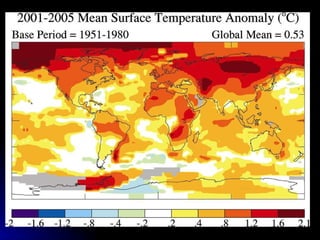
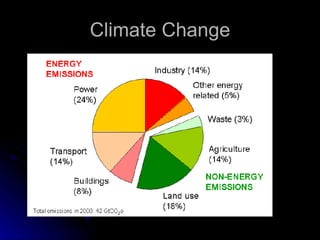
Climate Change
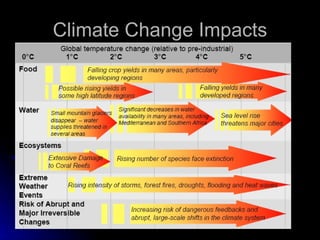
Climate Change Impacts
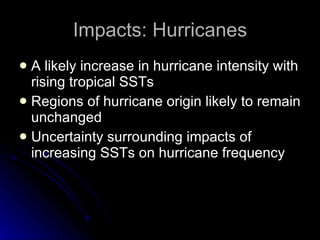
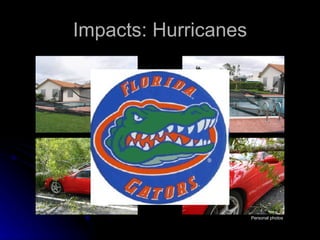
Impacts: Hurricanes A likely increase in hurricane intensity with rising tropical SSTs Regions of hurricane origin likely to remain unchanged Uncertainty surrounding impacts of increasing SSTs on hurricane frequency
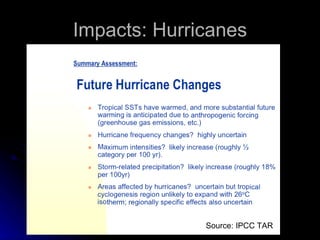
Impacts: Hurricanes Source: IPCC TAR
Impacts: Hurricanes Personal photos
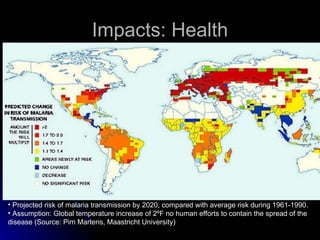
Impacts: Health Projected risk of malaria transmission by 2020, compared with average risk during 1961-1990. Assumption: Global temperature increase of 2ºF no human efforts to contain the spread of the disease (Source: Pim Martens, Maastricht University)
Impacts: Global Costs Stern Review (2001) Extreme events  (storms, hurricanes, typhoons, floods, droughts, heat waves) 0.5-1% of GDP per year by 2050 ($500 billion to $1 trillion) 5-10% increase in hurricane strength    2x U.S. annual damages ($100-$150 billion) annual U.K. flood losses could increase from 0.1% to 0.2-0.4% of GDP ($23 billion to $47-94 billion) heat waves will become common by mid-century (2003 Europe - $15 billion)
Impacts: Global Costs Direct impacts on the environment & human health 5 - 11% loss Climate feedbacks 5 - 7% Disproportionate impacts 25% greater cost TOTAL ~ 20% reduction in GDP
Impacts: Global Costs Solution? Stabilizing at 550ppm CO 2 e likely to require investment of 1% of global GDP by 2050  “the basic conclusion…is that the costs of strong and urgent action to avoid serious impacts from climate change are substantially less than the damages thereby avoided” (Stern Review, 2001)
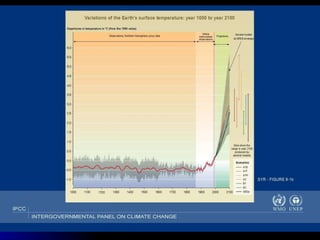
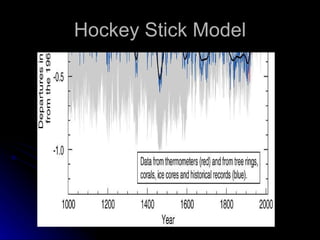
Hockey Stick Model
Hockey Stick: Affirmative View Validity Claims Overblown - Modest title - Recognition of proxy limitations Scientific Consensus - Principle endorsement of NAS Conclusion:  Uncertainties are stated and the model is undergoing continuous revision.  The Hockey Stick model does provide an adequate resource for understanding the range of warming we may face in the future.
Hockey Stick: Skeptical View Uncertainties in statistical methods: Based on insufficient data and flawed stat analysis (McKitrick and McIntyre, Wegman report) Mann concludes that higher resolution data are needed before ‘more confident conclusions can be reached’ With flaws in model corrected, curves in ‘stick’ reappear, recent temp changes no longer look extraordinary (Bob Tippee,  Oil & Gas Journal;  Jul 11, 2005)
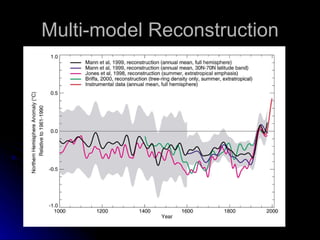
Multi-model Reconstruction
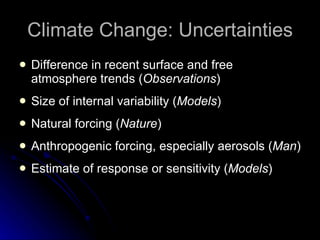
Climate Change: Uncertainties Difference in recent surface and free atmosphere trends ( Observations ) Size of internal variability ( Models ) Natural forcing ( Nature ) Anthropogenic forcing, especially aerosols ( Man ) Estimate of response or sensitivity ( Models )
Montreal Protocol The Paradigm of  Global Environmental Policy
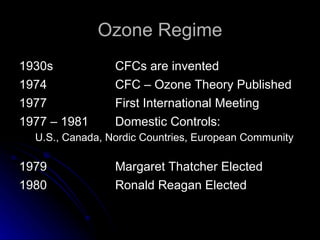
Ozone Regime 1930s CFCs are invented 1974 CFC – Ozone Theory Published 1977 First International Meeting 1977 – 1981   Domestic Controls: U.S., Canada, Nordic Countries, European Community 1979 Margaret Thatcher Elected 1980 Ronald Reagan Elected
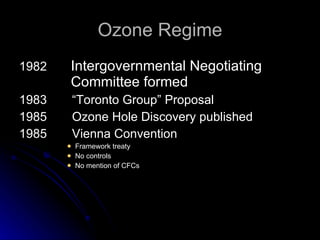
Ozone Regime 1982   Intergovernmental Negotiating    Committee formed 1983   “Toronto Group” Proposal 1985   Ozone Hole Discovery published 1985   Vienna Convention Framework treaty No controls No mention of CFCs
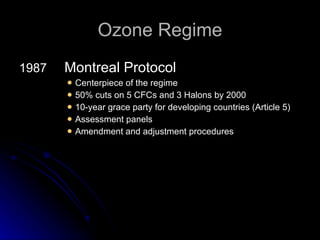
Ozone Regime 1987   Montreal Protocol Centerpiece of the regime 50% cuts on 5 CFCs and 3 Halons by 2000 10-year grace party for developing countries (Article 5) Assessment panels Amendment and adjustment procedures
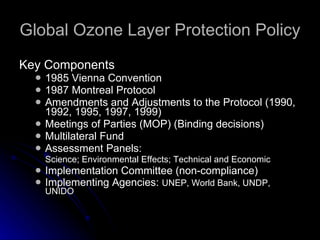
Global Ozone Layer Protection Policy Key Components 1985 Vienna Convention 1987 Montreal Protocol Amendments and Adjustments to the Protocol (1990, 1992, 1995, 1997, 1999) Meetings of Parties (MOP) (Binding decisions) Multilateral Fund Assessment Panels:  Science; Environmental Effects; Technical and Economic Implementation Committee (non-compliance) Implementing Agencies:  UNEP, World Bank, UNDP, UNIDO
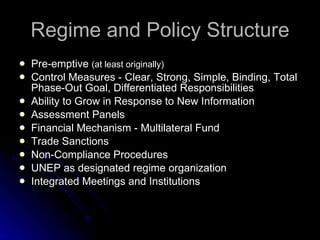
Regime and Policy Structure Pre-emptive  (at least originally) Control Measures - Clear, Strong, Simple, Binding, Total Phase-Out Goal, Differentiated Responsibilities Ability to Grow in Response to New Information Assessment Panels Financial Mechanism - Multilateral Fund Trade Sanctions Non-Compliance Procedures UNEP as designated regime organization Integrated Meetings and Institutions
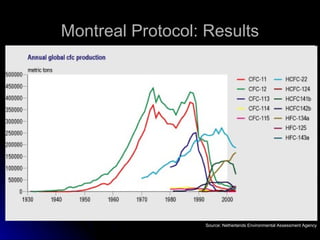
Source: Netherlands Environmental Assessment Agency Montreal Protocol: Results
The Success of the Ozone Regime Global membership Strong set of agreed upon rules and implementing institutions Production and consumption of almost all ODS (CFCs, etc.) declining on global scale Production and Consumption of CFCs and several other ODS nearly eliminated in OECD countries, as required Atmospheric concentrations of most ODS stabilized or dropping Developing countries largely met CFC freeze in 2000 and most are expected to meet future reductions Institutions working well (or well enough): Multilateral Fund; Assessment panels; Non-compliance procedures Seen as precedent for future treaties
Kyoto Protocol Towards a Climate Change Regime
Kyoto Protocol Global agreement to address global warming; entered into force in 2005 Commits countries to reducing emissions of 6 greenhouse gases (GHG) by at least 5% from 1990 levels during the 2008-2012 commitment period Covers more than 160 countries globally and over 55% of GHG emissions The United States and Australia have not ratified the Protocol
Kyoto Protocol Three categories of signatories: Annex I: All industrialized countries (OECD) and countries with economies in transition.   These have legally binding obligations to reduce GHG emissions Annex II: OECD countries only, with the obligation to: 1) Provide financial and technical resources to    developing countries 2) Transfer environmentally friendly technology to    countries with economies in transition Non-Annex I: Developing and emerging countries Includes China and India, second largest emitters in the world Least Developed Countries with special consideration
Kyoto Protocol Three innovative flexibility mechanisms to lower the overall costs of achieving emissions targets: Emissions Trading Joint Implementation (JI) Clean Development Mechanism (CDM) Mechanisms “shall be supplemental to domestic actions”  (A rt. 6 )
Joint Implementation (JI) An Annex I country may implement an emission reducing project or a project enhancing the removal by sinks of GHGs in another Annex I country After meeting the eligibility requirements and receiving approval by the host country, the project may be counted towards   Emission Reduction Units (ERUs), in compliance with the sponsor country reduction goal ERUs can be traded
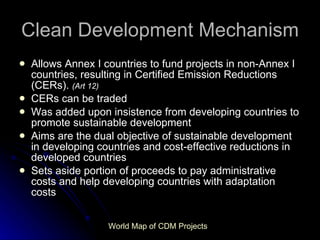
Clean Development Mechanism Allows Annex I countries to fund projects in non-Annex I countries, resulting in Certified Emission Reductions (CERs).  (Art 12) CERs can be traded Was added upon insistence from developing countries to promote sustainable development Aims   are the dual objective of sustainable development in developing countries and cost-effective reductions in developed countries Sets aside portion of proceeds to pay administrative costs and help developing countries with adaptation costs World Map of CDM Projects
Global Environmental Policy Lessons, Problems, and Prospects
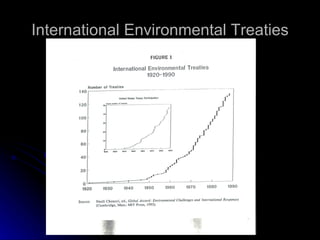
International Environmental Treaties
Actors In Int’l Environmental Politics Nation States International Organizations (IOs / IGOs) Multi-National Corporations Environmental Non-Governmental Organizations (NGOs) Scientific and Technical Bodies (Epistemic communities) People
Obstacles to Cooperation Lowest-Common Denominator Slow Development And Implementation Large Numbers Difficulty of Making Effective Treaties  High transaction costs No pre-existing treaty creation, compliance or enforcement mechanisms Scientific complexity Issue linkages Unequal adjustment costs
Fostering Cooperation Haas, Keohane and Levy argue that the process of creating and implementing effective international environmental policy requires the 3 C’s:   Concern Contractual Environment Capacity
New Environmental Policy Instruments (NEPIs): Non-regulatory tools of environmental policy 1) Market based instruments (MBIs) instruments that affect estimates of costs of alternative actions open to economic agents 2) Voluntary agreements (VAs) agreements between industry and public authorities on the achievement of environmental objectives 3) Ecolabels provide consumers with information about the environmental impact of products and services
Climate Change Ethics Who will pay? Humanity today v. future generations Who is responsible? Scientists Media Special interests Politicians Public
Climate Change Policy A “good” policy should:  - address long time horizons and market dynamics - reflect a shared understanding of long-term goals - be flexible - focus on mitigation and adaptation strategies - distribute costs equitably
Global Environmental Governance Changes to the system: Increased participation New Actors (NGOs, indigenous groups) Increased privatization Business partnerships (WBCSD, Ceres) Increased segmentation Subnational, national, regional, and global policy

Global Environmental Politics

  • 1.
    Global Environmental PoliticsJosh Gellers Global Issues May 26, 2009 St. Louis Post-Dispatch Rush PR News Personal photo
  • 2.
  • 3.
  • 4.
    Agenda Climate ChangeScience and the IPCC Impacts and Costs Montreal Protocol Kyoto Protocol Global Environmental Policy
  • 5.
    Climate Change Science,Impacts, and Costs
  • 6.
    Climate Change andGlobal Warming Climate change refers to any significant change in measures of climate (such as temperature, precipitation, or wind) lasting for an extended period (decades or longer). Climate change may result from: natural factors, such as changes in the sun's intensity or slow changes in the Earth's orbit around the sun; natural processes within the climate system (e.g. changes in ocean circulation); human activities that change the atmosphere's composition (e.g. through burning fossil fuels) and the land surface (e.g. deforestation, reforestation, urbanization, desertification, etc.) Global warming is an average increase in the temperature of the atmosphere near the Earth's surface and in the troposphere, which can contribute to changes in global climate patterns. Global warming can occur from a variety of causes, both natural and human induced. In common usage, "global warming" often refers to the warming that can occur as a result of increased emissions of greenhouse gases from human activities. (US EPA) NASA Climate Change Animation
  • 7.
  • 8.
  • 9.
    Radiative Forcing ofGHGs Source: IPCC TAR
  • 10.
    Intergovernmental Panel onClimate Change IPCC: a scientific intergovernmental body set up by the World Meteorological Organization (WMO) and by the United Nations Environment Programme (UNEP) in 1988 Composed of: Governments: the IPCC is open to all member countries of WMO and UNEP Scientists: hundreds of scientists all over the world contribute to the work of the IPCC as authors, contributors and reviewers People: as United Nations body, the IPCC work aims at the promotion of the United Nations human development goals ( http://www.ipcc.ch/about/index.htm ) Publishes comprehensive assessment reports 2007: IPCC releases Fourth Assessment Report (AR4)
  • 11.
  • 12.
  • 13.
    Humans and ClimateEmissions Greenhouse Gases & Aerosols Fossil fuels (Personal & Industry) Land use Land use changes Agriculture Deforestation Urbanization Water management & reservoirs
  • 14.
  • 15.
    Climate Change andGlobal Warming Scientists: Fail to make a clear distinction between climate change and BAU Media: Balance, integrity, sensationalism Special Interests: Disinformation campaigns, focus on profits Public: Confused, uninterested Government: Post-9/11 withdrawal from Kyoto, Obama promises change, American Clean Energy and Security Act
  • 16.
    Climate Change: UncertaintiesStrength/tolerance of feedbacks: water vapor feedback, clouds & precipitation efficiency Rate of change: abrupt climate change Changes in magnitude of intraseasonal-to-interannual variability: ENSO, NAO Local effects: i.e. drought in California
  • 17.
  • 18.
  • 19.
    Impacts: Hurricanes Alikely increase in hurricane intensity with rising tropical SSTs Regions of hurricane origin likely to remain unchanged Uncertainty surrounding impacts of increasing SSTs on hurricane frequency
  • 20.
  • 21.
  • 22.
    Impacts: Health Projectedrisk of malaria transmission by 2020, compared with average risk during 1961-1990. Assumption: Global temperature increase of 2ºF no human efforts to contain the spread of the disease (Source: Pim Martens, Maastricht University)
  • 23.
    Impacts: Global CostsStern Review (2001) Extreme events (storms, hurricanes, typhoons, floods, droughts, heat waves) 0.5-1% of GDP per year by 2050 ($500 billion to $1 trillion) 5-10% increase in hurricane strength  2x U.S. annual damages ($100-$150 billion) annual U.K. flood losses could increase from 0.1% to 0.2-0.4% of GDP ($23 billion to $47-94 billion) heat waves will become common by mid-century (2003 Europe - $15 billion)
  • 24.
    Impacts: Global CostsDirect impacts on the environment & human health 5 - 11% loss Climate feedbacks 5 - 7% Disproportionate impacts 25% greater cost TOTAL ~ 20% reduction in GDP
  • 25.
    Impacts: Global CostsSolution? Stabilizing at 550ppm CO 2 e likely to require investment of 1% of global GDP by 2050 “the basic conclusion…is that the costs of strong and urgent action to avoid serious impacts from climate change are substantially less than the damages thereby avoided” (Stern Review, 2001)
  • 26.
  • 27.
    Hockey Stick: AffirmativeView Validity Claims Overblown - Modest title - Recognition of proxy limitations Scientific Consensus - Principle endorsement of NAS Conclusion: Uncertainties are stated and the model is undergoing continuous revision. The Hockey Stick model does provide an adequate resource for understanding the range of warming we may face in the future.
  • 28.
    Hockey Stick: SkepticalView Uncertainties in statistical methods: Based on insufficient data and flawed stat analysis (McKitrick and McIntyre, Wegman report) Mann concludes that higher resolution data are needed before ‘more confident conclusions can be reached’ With flaws in model corrected, curves in ‘stick’ reappear, recent temp changes no longer look extraordinary (Bob Tippee, Oil & Gas Journal; Jul 11, 2005)
  • 29.
  • 30.
    Climate Change: UncertaintiesDifference in recent surface and free atmosphere trends ( Observations ) Size of internal variability ( Models ) Natural forcing ( Nature ) Anthropogenic forcing, especially aerosols ( Man ) Estimate of response or sensitivity ( Models )
  • 31.
    Montreal Protocol TheParadigm of Global Environmental Policy
  • 32.
    Ozone Regime 1930sCFCs are invented 1974 CFC – Ozone Theory Published 1977 First International Meeting 1977 – 1981 Domestic Controls: U.S., Canada, Nordic Countries, European Community 1979 Margaret Thatcher Elected 1980 Ronald Reagan Elected
  • 33.
    Ozone Regime 1982 Intergovernmental Negotiating Committee formed 1983 “Toronto Group” Proposal 1985 Ozone Hole Discovery published 1985 Vienna Convention Framework treaty No controls No mention of CFCs
  • 34.
    Ozone Regime 1987 Montreal Protocol Centerpiece of the regime 50% cuts on 5 CFCs and 3 Halons by 2000 10-year grace party for developing countries (Article 5) Assessment panels Amendment and adjustment procedures
  • 35.
    Global Ozone LayerProtection Policy Key Components 1985 Vienna Convention 1987 Montreal Protocol Amendments and Adjustments to the Protocol (1990, 1992, 1995, 1997, 1999) Meetings of Parties (MOP) (Binding decisions) Multilateral Fund Assessment Panels: Science; Environmental Effects; Technical and Economic Implementation Committee (non-compliance) Implementing Agencies: UNEP, World Bank, UNDP, UNIDO
  • 36.
    Regime and PolicyStructure Pre-emptive (at least originally) Control Measures - Clear, Strong, Simple, Binding, Total Phase-Out Goal, Differentiated Responsibilities Ability to Grow in Response to New Information Assessment Panels Financial Mechanism - Multilateral Fund Trade Sanctions Non-Compliance Procedures UNEP as designated regime organization Integrated Meetings and Institutions
  • 37.
    Source: Netherlands EnvironmentalAssessment Agency Montreal Protocol: Results
  • 38.
    The Success ofthe Ozone Regime Global membership Strong set of agreed upon rules and implementing institutions Production and consumption of almost all ODS (CFCs, etc.) declining on global scale Production and Consumption of CFCs and several other ODS nearly eliminated in OECD countries, as required Atmospheric concentrations of most ODS stabilized or dropping Developing countries largely met CFC freeze in 2000 and most are expected to meet future reductions Institutions working well (or well enough): Multilateral Fund; Assessment panels; Non-compliance procedures Seen as precedent for future treaties
  • 39.
    Kyoto Protocol Towardsa Climate Change Regime
  • 40.
    Kyoto Protocol Globalagreement to address global warming; entered into force in 2005 Commits countries to reducing emissions of 6 greenhouse gases (GHG) by at least 5% from 1990 levels during the 2008-2012 commitment period Covers more than 160 countries globally and over 55% of GHG emissions The United States and Australia have not ratified the Protocol
  • 41.
    Kyoto Protocol Threecategories of signatories: Annex I: All industrialized countries (OECD) and countries with economies in transition. These have legally binding obligations to reduce GHG emissions Annex II: OECD countries only, with the obligation to: 1) Provide financial and technical resources to developing countries 2) Transfer environmentally friendly technology to countries with economies in transition Non-Annex I: Developing and emerging countries Includes China and India, second largest emitters in the world Least Developed Countries with special consideration
  • 42.
    Kyoto Protocol Threeinnovative flexibility mechanisms to lower the overall costs of achieving emissions targets: Emissions Trading Joint Implementation (JI) Clean Development Mechanism (CDM) Mechanisms “shall be supplemental to domestic actions” (A rt. 6 )
  • 43.
    Joint Implementation (JI)An Annex I country may implement an emission reducing project or a project enhancing the removal by sinks of GHGs in another Annex I country After meeting the eligibility requirements and receiving approval by the host country, the project may be counted towards Emission Reduction Units (ERUs), in compliance with the sponsor country reduction goal ERUs can be traded
  • 44.
    Clean Development MechanismAllows Annex I countries to fund projects in non-Annex I countries, resulting in Certified Emission Reductions (CERs). (Art 12) CERs can be traded Was added upon insistence from developing countries to promote sustainable development Aims are the dual objective of sustainable development in developing countries and cost-effective reductions in developed countries Sets aside portion of proceeds to pay administrative costs and help developing countries with adaptation costs World Map of CDM Projects
  • 45.
    Global Environmental PolicyLessons, Problems, and Prospects
  • 46.
  • 47.
    Actors In Int’lEnvironmental Politics Nation States International Organizations (IOs / IGOs) Multi-National Corporations Environmental Non-Governmental Organizations (NGOs) Scientific and Technical Bodies (Epistemic communities) People
  • 48.
    Obstacles to CooperationLowest-Common Denominator Slow Development And Implementation Large Numbers Difficulty of Making Effective Treaties High transaction costs No pre-existing treaty creation, compliance or enforcement mechanisms Scientific complexity Issue linkages Unequal adjustment costs
  • 49.
    Fostering Cooperation Haas,Keohane and Levy argue that the process of creating and implementing effective international environmental policy requires the 3 C’s: Concern Contractual Environment Capacity
  • 50.
    New Environmental PolicyInstruments (NEPIs): Non-regulatory tools of environmental policy 1) Market based instruments (MBIs) instruments that affect estimates of costs of alternative actions open to economic agents 2) Voluntary agreements (VAs) agreements between industry and public authorities on the achievement of environmental objectives 3) Ecolabels provide consumers with information about the environmental impact of products and services
  • 51.
    Climate Change EthicsWho will pay? Humanity today v. future generations Who is responsible? Scientists Media Special interests Politicians Public
  • 52.
    Climate Change PolicyA “good” policy should: - address long time horizons and market dynamics - reflect a shared understanding of long-term goals - be flexible - focus on mitigation and adaptation strategies - distribute costs equitably
  • 53.
    Global Environmental GovernanceChanges to the system: Increased participation New Actors (NGOs, indigenous groups) Increased privatization Business partnerships (WBCSD, Ceres) Increased segmentation Subnational, national, regional, and global policy

Editor's Notes

  • #50 Sufficient, hospitable, adequate
  • #54 Changes to the system: Increased participation New actors Increased privatization Business partnership Increased segmentation Subnational, national, regional and global policy