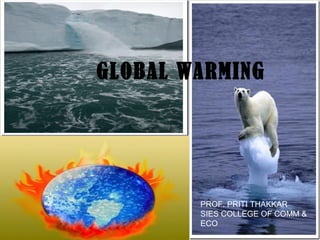
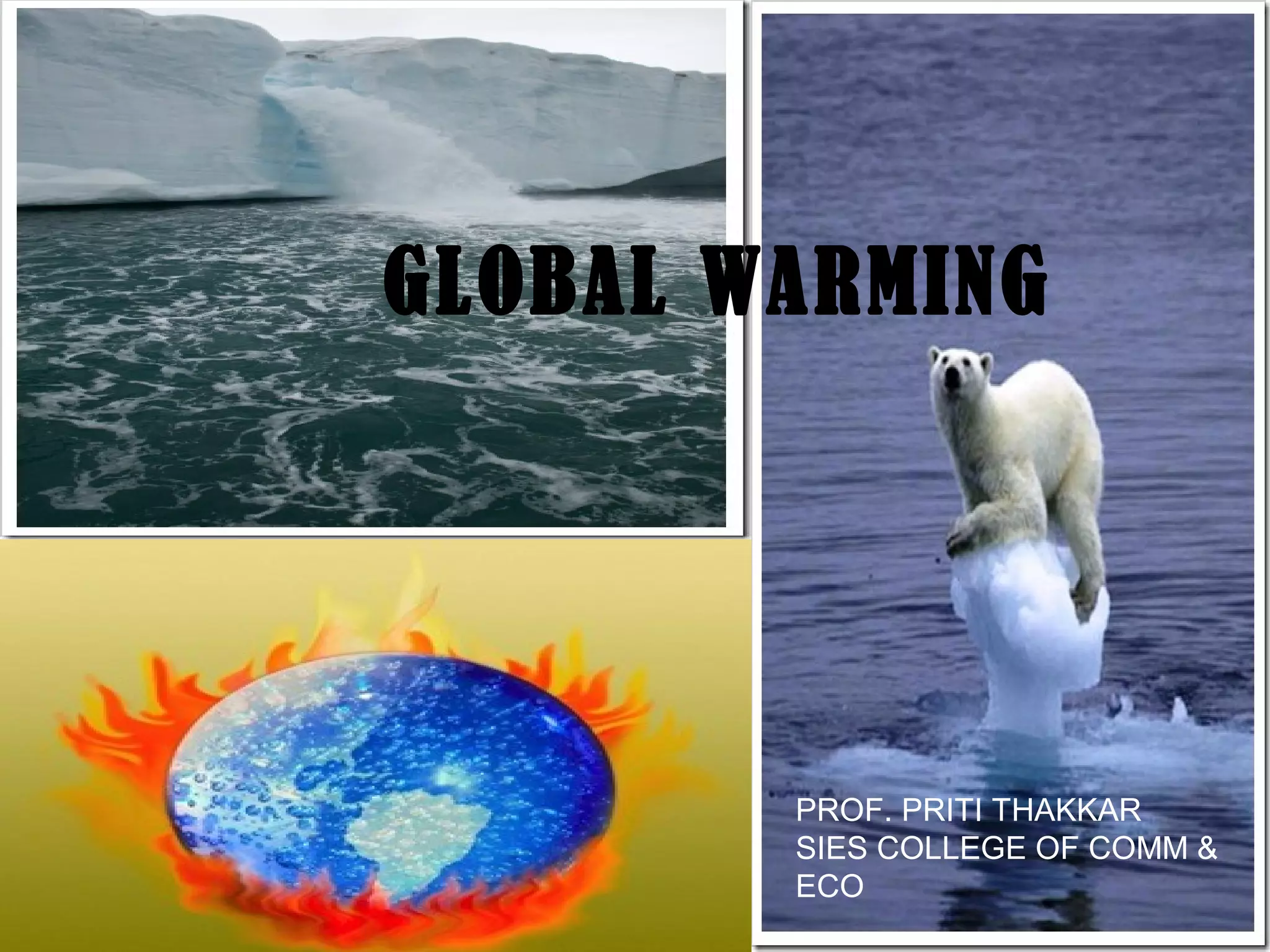
GLOBAL WARMING
PROF. PRITI THAKKAR
SIES COLLEGE OF COMM &
ECO
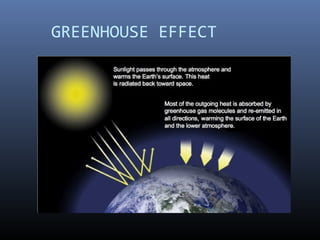
GREENHOUSE EFFECT
The Green House Gases
 Carbon Dioxide
 Methane
 Nitrous Oxide
 Chlorofluorocarbons
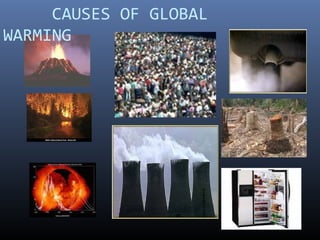
CAUSES OF GLOBAL
WARMING
EFFECTS OF GLOBAL
WARMING
 (ABIOTIC)
1.Polar Ice Caps Melting.
2.Ozone Depletion.
3.Increased probability and intensity of
droughts and heat waves and economic
loss.
4. Impact on health.
The 5 deadliest effects of global warming:
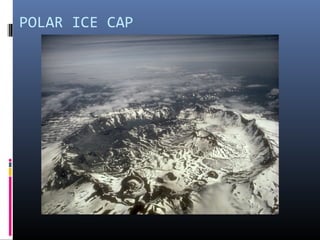
POLAR ICE CAP
Impacts in Alaska
1. Melting
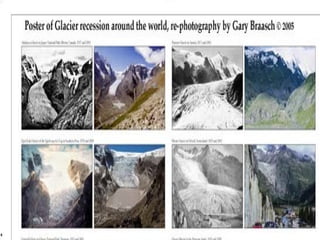
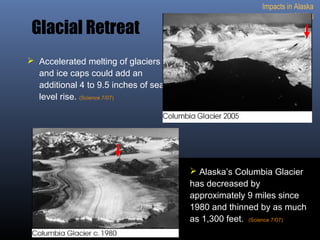
Glacial Retreat
 Accelerated melting of glaciers
and ice caps could add an
additional 4 to 9.5 inches of sea
level rise. (Science 7/07)
 Alaska’s Columbia Glacier
has decreased by
approximately 9 miles since
1980 and thinned by as much
as 1,300 feet.. (Science 7/07)
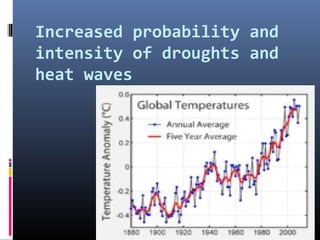
Increased probability and
intensity of droughts and
heat waves
What Climate change is the
concern?
 Global surface temperature has increased by
0.3 to 0.6 degrees Celsius since late 19th
century
 Climate change predicted to increase global
temperatures by 0.8 to 4.5 degrees Celsius by
the year 2100
Evidence:
 1. More warm days
steady rise since 1982
1995-2006 rank as warmest since 1850
 2. Melting of snow and ice
 3. Record number of icebergs
 4. Sea level rise
 5. Changes in Gulf Stream
 6. Changes in precipitation patterns
 7. Coral reef damage from algae
Effect on Biotic World
 Plants
 Animals
 Humans
HUMAN HEALTH
 People with heart problems are vulnerable, and
some respiratory problems increase.
 The 2003 European heat wave killed 22,000–
35,000 people, based on normal mortality rates
Ways to Reduce Carbon
 Constrain use (efficiency)
 Carbon offsetting
 Use of renewable energy sources as
substitutes in operations
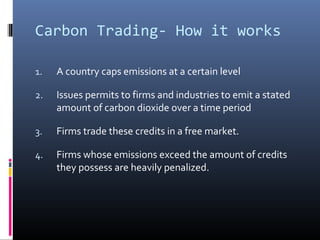
Carbon Trading- How it works
1. A country caps emissions at a certain level
2. Issues permits to firms and industries to emit a stated
amount of carbon dioxide over a time period
3. Firms trade these credits in a free market.
4. Firms whose emissions exceed the amount of credits
they possess are heavily penalized.
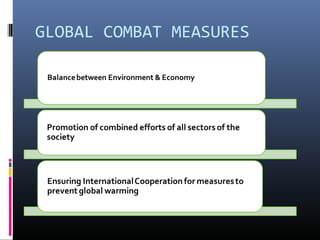
GLOBAL COMBAT MEASURES
CARBON BANK - Milestones
1972 Stockholm Declaration
1988 Intergovernmental Panel on
Climate Change
1992 UN Framework Convention on
Climate Change
1997 Byrd-Hagel Resolution
1997 Kyoto Protocol
2005 Kyoto Rulebook
Kyoto Protocol
Kyoto Protocol
to the United Nations Framework
Convention on Climate Change
negotiated in 1997
open for signature in 1998
came into force February 16,
2005
Kyoto Rule Book
December 2, 2005
 Defines how each country’s emissions and sinks (e.g.
reforestation) are accounted.
 Developed countries can invest in other developed
countries and earn carbon allowances.
 Establishes the Clean Development Mechanism
which allows developed countries to invest in
sustainable development projects in developing
countries.
JOHANNESBERG Earth
Summit (26 Aug- 4 Sept
2002).
BALI SUMMIT ON CLIMATE
(3 - 15 December 2007)
 The summit was to find an alternative after
expiry of Kyoto Protocol.
 Aimed at reduction of CO2 emissions
 Targeted developing nations to cut emissions
 Did not provide a just mechanism.
 Not enough funds and new technologies in
the developing nations.
 Did not reach any firm agreements or
targets.
:
CHALLENGES ADDRESSED BY THE
COPENHAGEN SUMMITT
 Thrash out a successor to Kyoto
Protocol.
 Targets and actions for nations.
 Financing for low carbon
development.
 Building global carbon market.
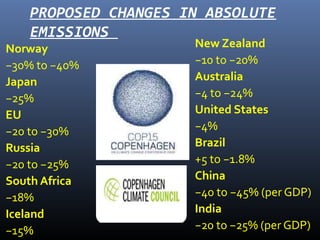
PROPOSED CHANGES IN ABSOLUTE
EMISSIONS
Norway
−30% to −40%
Japan
−25%
EU
−20 to −30%
Russia
−20 to −25%
South Africa
−18%
Iceland
−15%
New Zealand
−10 to −20%
Australia
−4 to −24%
United States
−4%
Brazil
+5 to −1.8%
China
−40 to −45% (per GDP)
India
−20 to −25% (per GDP)
BACKGROUND
 192 countries have signed the climatic
change agreement.
 US had rejected Kyoto Protocol’s
requirement to cut emissions by 5%
 China has emerged to be highest emitter of
CO2
 Developing nations believe it is responsibility
of developed nations to set a role model.
RESULTS
1. China, India, etc. have rejected
caps.
2. They emit over half of GHGs. Their
half is growing 7 times faster.
3. With quantity commitment ruled
out — Carbon Pricing remains.
INTERGOVERNMENTAL PANEL ON
CLIMATIC CHANGE- IPCC
 International body which comprehensively
assess GHGs and gives envtal reports.
 2007 Nobel Peace Prize
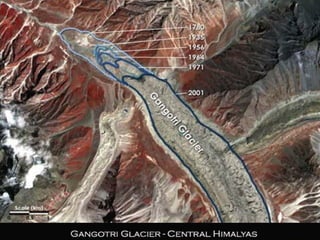
 2007 report errotically states that the
Himalayan Glaciers will be completely wiped
out by 2035
 23/2/2010 IPCC chairman R K Pachauri
apologised for it.
 But there was no ambiguity that the glaciers
were melting.
INDIA’S POSITION TO
MULTILATERAL NEGOTIATIONS
 Negotiations should proceed acc to UNFCC’s
principles and objectives.
 Shared vision for long term co-operative
action.
 Avoid deflecting the main purpose of
negotiations by trade factors.
 Long term and equitable approach to climate
change.
 Achieve specializations in technological
innovations.
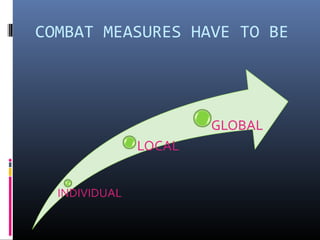
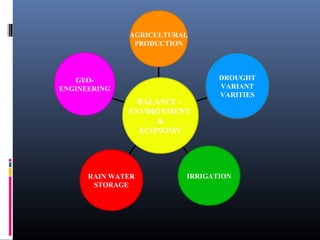
COMBAT MEASURES HAVE TO BE
GEO-
ENGINEERING
RAIN WATER
STORAGE
IRRIGATION
DROUGHT
VARIANT
VARITIES
AGRICULTURAL
PRODUCTION
BALANCE -
ENVIRONMENT
&
ECONOMY
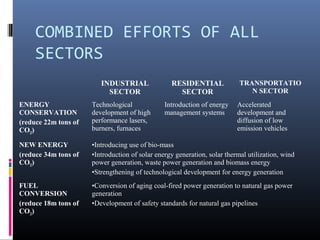
COMBINED EFFORTS OF ALL
SECTORS
INDUSTRIAL
SECTOR
RESIDENTIAL
SECTOR
TRANSPORTATIO
N SECTOR
ENERGY
CONSERVATION
(reduce 22m tons of
CO2)
Technological
development of high
performance lasers,
burners, furnaces
Introduction of energy
management systems
Accelerated
development and
diffusion of low
emission vehicles
NEW ENERGY
(reduce 34m tons of
CO2)
•Introducing use of bio-mass
•Introduction of solar energy generation, solar thermal utilization, wind
power generation, waste power generation and biomass energy
•Strengthening of technological development for energy generation
FUEL
CONVERSION
(reduce 18m tons of
CO2)
•Conversion of aging coal-fired power generation to natural gas power
generation
•Development of safety standards for natural gas pipelines
YOUR ROLE AS A TEACHER
 Spread awareness
 Train them to walk on the right path
 Motivate the youth through interactive talks
 Organize street plays with their help for the
common man
 Be a role model
What the teacher is,
is more important than what he teaches.
Karl Menninger
Global warming local and global issues

Global warming local and global issues

  • 1.
    GLOBAL WARMING PROF. PRITITHAKKAR SIES COLLEGE OF COMM & ECO
  • 2.
  • 3.
    The Green HouseGases  Carbon Dioxide  Methane  Nitrous Oxide  Chlorofluorocarbons
  • 9.
  • 13.
  • 14.
    1.Polar Ice CapsMelting. 2.Ozone Depletion. 3.Increased probability and intensity of droughts and heat waves and economic loss. 4. Impact on health. The 5 deadliest effects of global warming:
  • 15.
  • 16.
    Impacts in Alaska 1.Melting Glacial Retreat  Accelerated melting of glaciers and ice caps could add an additional 4 to 9.5 inches of sea level rise. (Science 7/07)  Alaska’s Columbia Glacier has decreased by approximately 9 miles since 1980 and thinned by as much as 1,300 feet.. (Science 7/07)
  • 18.
    Increased probability and intensityof droughts and heat waves
  • 20.
    What Climate changeis the concern?  Global surface temperature has increased by 0.3 to 0.6 degrees Celsius since late 19th century  Climate change predicted to increase global temperatures by 0.8 to 4.5 degrees Celsius by the year 2100
  • 21.
    Evidence:  1. Morewarm days steady rise since 1982 1995-2006 rank as warmest since 1850  2. Melting of snow and ice  3. Record number of icebergs  4. Sea level rise  5. Changes in Gulf Stream  6. Changes in precipitation patterns  7. Coral reef damage from algae
  • 22.
    Effect on BioticWorld  Plants  Animals  Humans
  • 23.
    HUMAN HEALTH  Peoplewith heart problems are vulnerable, and some respiratory problems increase.  The 2003 European heat wave killed 22,000– 35,000 people, based on normal mortality rates
  • 24.
    Ways to ReduceCarbon  Constrain use (efficiency)  Carbon offsetting  Use of renewable energy sources as substitutes in operations
  • 25.
    Carbon Trading- Howit works 1. A country caps emissions at a certain level 2. Issues permits to firms and industries to emit a stated amount of carbon dioxide over a time period 3. Firms trade these credits in a free market. 4. Firms whose emissions exceed the amount of credits they possess are heavily penalized.
  • 26.
  • 27.
    CARBON BANK -Milestones 1972 Stockholm Declaration 1988 Intergovernmental Panel on Climate Change 1992 UN Framework Convention on Climate Change 1997 Byrd-Hagel Resolution 1997 Kyoto Protocol 2005 Kyoto Rulebook
  • 28.
  • 29.
    Kyoto Protocol to theUnited Nations Framework Convention on Climate Change negotiated in 1997 open for signature in 1998 came into force February 16, 2005
  • 30.
    Kyoto Rule Book December2, 2005  Defines how each country’s emissions and sinks (e.g. reforestation) are accounted.  Developed countries can invest in other developed countries and earn carbon allowances.  Establishes the Clean Development Mechanism which allows developed countries to invest in sustainable development projects in developing countries.
  • 31.
  • 32.
    BALI SUMMIT ONCLIMATE (3 - 15 December 2007)  The summit was to find an alternative after expiry of Kyoto Protocol.  Aimed at reduction of CO2 emissions  Targeted developing nations to cut emissions  Did not provide a just mechanism.  Not enough funds and new technologies in the developing nations.  Did not reach any firm agreements or targets.
  • 33.
    : CHALLENGES ADDRESSED BYTHE COPENHAGEN SUMMITT  Thrash out a successor to Kyoto Protocol.  Targets and actions for nations.  Financing for low carbon development.  Building global carbon market.
  • 34.
    PROPOSED CHANGES INABSOLUTE EMISSIONS Norway −30% to −40% Japan −25% EU −20 to −30% Russia −20 to −25% South Africa −18% Iceland −15% New Zealand −10 to −20% Australia −4 to −24% United States −4% Brazil +5 to −1.8% China −40 to −45% (per GDP) India −20 to −25% (per GDP)
  • 35.
    BACKGROUND  192 countrieshave signed the climatic change agreement.  US had rejected Kyoto Protocol’s requirement to cut emissions by 5%  China has emerged to be highest emitter of CO2  Developing nations believe it is responsibility of developed nations to set a role model.
  • 36.
    RESULTS 1. China, India,etc. have rejected caps. 2. They emit over half of GHGs. Their half is growing 7 times faster. 3. With quantity commitment ruled out — Carbon Pricing remains.
  • 37.
    INTERGOVERNMENTAL PANEL ON CLIMATICCHANGE- IPCC  International body which comprehensively assess GHGs and gives envtal reports.  2007 Nobel Peace Prize  2007 report errotically states that the Himalayan Glaciers will be completely wiped out by 2035  23/2/2010 IPCC chairman R K Pachauri apologised for it.  But there was no ambiguity that the glaciers were melting.
  • 38.
    INDIA’S POSITION TO MULTILATERALNEGOTIATIONS  Negotiations should proceed acc to UNFCC’s principles and objectives.  Shared vision for long term co-operative action.  Avoid deflecting the main purpose of negotiations by trade factors.  Long term and equitable approach to climate change.  Achieve specializations in technological innovations.
  • 40.
  • 41.
  • 42.
    COMBINED EFFORTS OFALL SECTORS INDUSTRIAL SECTOR RESIDENTIAL SECTOR TRANSPORTATIO N SECTOR ENERGY CONSERVATION (reduce 22m tons of CO2) Technological development of high performance lasers, burners, furnaces Introduction of energy management systems Accelerated development and diffusion of low emission vehicles NEW ENERGY (reduce 34m tons of CO2) •Introducing use of bio-mass •Introduction of solar energy generation, solar thermal utilization, wind power generation, waste power generation and biomass energy •Strengthening of technological development for energy generation FUEL CONVERSION (reduce 18m tons of CO2) •Conversion of aging coal-fired power generation to natural gas power generation •Development of safety standards for natural gas pipelines
  • 45.
    YOUR ROLE ASA TEACHER  Spread awareness  Train them to walk on the right path  Motivate the youth through interactive talks  Organize street plays with their help for the common man  Be a role model What the teacher is, is more important than what he teaches. Karl Menninger