BIMSTEC
Introduction
 BIMSTEC is short for Bay Of Bengal Initiative for Multi-
Sectoral Technical and Economic Cooperation
 members are Bangladesh, India, Myanmar, Sri Lanka,
Thailand, Bhutan and Nepal
Background Information
 On 6 June 1997, a new sub-regional grouping was formed
in Bangkok and it was named as BIST-EC
 On 22 December 1997, when Myanmar joined it has
changed it’s name to BIMSTEC
 The objective of building such an alliance was to harness
shared and accelerated growth through mutual cooperation
in different areas of common interests
Benefits For The Members
• Members will have rapid economic development through
identification and implementation of specific cooperation
projects in the sectors of;
trade Investment &
Industry
technology
Human
resource
development
tourism agriculture energy infrastructure
transportation
Achievement & Contribution
 In 2005, BIMSTEC collaborated with Asian Development
Bank to help promote and improve transport infrastructure
and logistic among the BIMSTEC countries
Recent Projects
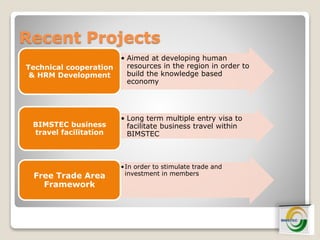
• Aimed at developing human
resources in the region in order to
build the knowledge based
economy
Technical cooperation
& HRM Development
• Long term multiple entry visa to
facilitate business travel within
BIMSTEC
BIMSTEC business
travel facilitation
•In order to stimulate trade and
investment in membersFree Trade Area
Framework
Future goals
Poverty Alleviation
• Through education and self employment, the role of
women and making poor people bankable
Protection of Biodiversity and Traditional Knowledge
(traditional medicine)
• By promoting traditional medicine and generic drugs,
so that the poor would have access to affordable
treatment
Challenges and threats
 BIMSTEC has gained so little national and regional significance
and this is one of the main challenges for them;
This challenge occurs mainly because India is by far the biggest
country in BIMSTEC. Since India did not take much interest in
BIMSTEC, other members hasn’t been influential either
• Another big challenge is the poor bilateral relationship between
the BIMSTEC countries.
Conclusion
 Although BIMSTEC started with a great purpose it lacks of proper
goals and implementation of goals. That’s why it got the lowest
priority. In order to succeed with their goals, they must include
more big economic Asian countries
References
 https://en.wikipedia.org/wiki/Bay_of_Bengal_Initiative_for_Multi-
Sectoral_Technical_and_Economic_Cooperation
 http://www.bimstec.org/index.php
 http://sameaf.mfa.go.th/en/organization/detail.php?ID=4493

BIMSTEC

  • 1.
  • 2.
    Introduction  BIMSTEC isshort for Bay Of Bengal Initiative for Multi- Sectoral Technical and Economic Cooperation  members are Bangladesh, India, Myanmar, Sri Lanka, Thailand, Bhutan and Nepal
  • 3.
    Background Information  On6 June 1997, a new sub-regional grouping was formed in Bangkok and it was named as BIST-EC  On 22 December 1997, when Myanmar joined it has changed it’s name to BIMSTEC  The objective of building such an alliance was to harness shared and accelerated growth through mutual cooperation in different areas of common interests
  • 4.
    Benefits For TheMembers • Members will have rapid economic development through identification and implementation of specific cooperation projects in the sectors of; trade Investment & Industry technology Human resource development tourism agriculture energy infrastructure transportation
  • 5.
    Achievement & Contribution In 2005, BIMSTEC collaborated with Asian Development Bank to help promote and improve transport infrastructure and logistic among the BIMSTEC countries
  • 6.
    Recent Projects • Aimedat developing human resources in the region in order to build the knowledge based economy Technical cooperation & HRM Development • Long term multiple entry visa to facilitate business travel within BIMSTEC BIMSTEC business travel facilitation •In order to stimulate trade and investment in membersFree Trade Area Framework
  • 7.
    Future goals Poverty Alleviation •Through education and self employment, the role of women and making poor people bankable Protection of Biodiversity and Traditional Knowledge (traditional medicine) • By promoting traditional medicine and generic drugs, so that the poor would have access to affordable treatment
  • 8.
    Challenges and threats BIMSTEC has gained so little national and regional significance and this is one of the main challenges for them; This challenge occurs mainly because India is by far the biggest country in BIMSTEC. Since India did not take much interest in BIMSTEC, other members hasn’t been influential either • Another big challenge is the poor bilateral relationship between the BIMSTEC countries.
  • 9.
    Conclusion  Although BIMSTECstarted with a great purpose it lacks of proper goals and implementation of goals. That’s why it got the lowest priority. In order to succeed with their goals, they must include more big economic Asian countries
  • 10.