PRESENTED BY :
AAKASH YADAV
01th DEC 2017
Global Environmental Problems
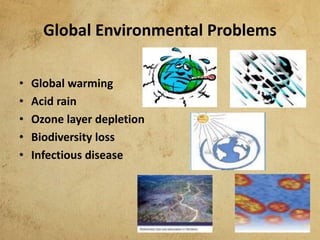
• Global warming
• Acid rain
• Ozone layer depletion
• Biodiversity loss
• Infectious disease
Global Warming
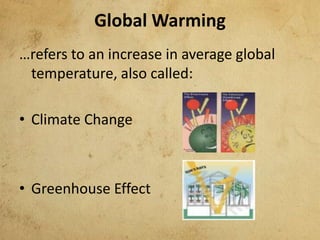
…refers to an increase in average global
temperature, also called:
• Climate Change
• Greenhouse Effect
Greenhouse Effect
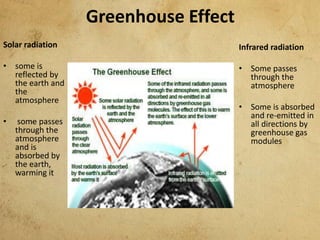
Solar radiation
• some is
reflected by
the earth and
the
atmosphere
• some passes
through the
atmosphere
and is
absorbed by
the earth,
warming it
Infrared radiation
• Some passes
through the
atmosphere
• Some is absorbed
and re-emitted in
all directions by
greenhouse gas
modules
Causes of Global Warming
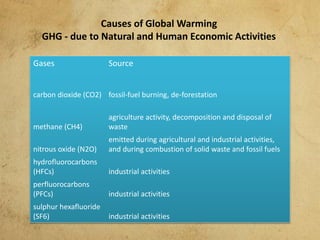
GHG - due to Natural and Human Economic Activities
Gases Source
carbon dioxide (CO2) fossil-fuel burning, de-forestation
methane (CH4)
agriculture activity, decomposition and disposal of
waste
nitrous oxide (N2O)
emitted during agricultural and industrial activities,
and during combustion of solid waste and fossil fuels
hydrofluorocarbons
(HFCs) industrial activities
perfluorocarbons
(PFCs) industrial activities
sulphur hexafluoride
(SF6) industrial activities
Characteristics of GHG
• Atmospheric life time.
• Global warming potential.
• Atmospheric concentration.
Greenhouse Gases
• Concentration vs. Emissions.
• Forecasts about emissions are very sensitive.
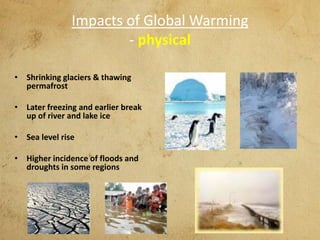
Impacts of Global Warming
- physical
• Shrinking glaciers & thawing
permafrost
• Later freezing and earlier break
up of river and lake ice
• Sea level rise
• Higher incidence of floods and
droughts in some regions
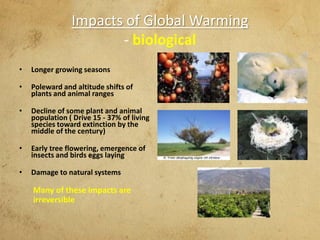
Impacts of Global Warming
- biological
• Longer growing seasons
• Poleward and altitude shifts of
plants and animal ranges
• Decline of some plant and animal
population ( Drive 15 - 37% of living
species toward extinction by the
middle of the century)
• Early tree flowering, emergence of
insects and birds eggs laying
• Damage to natural systems
Many of these impacts are
irreversible
Impacts of Global Warming
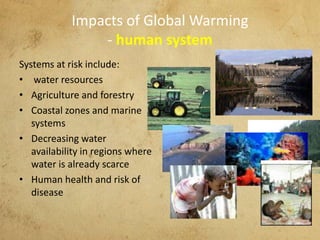
- human system
Systems at risk include:
• water resources
• Agriculture and forestry
• Coastal zones and marine
systems
• Decreasing water
availability in regions where
water is already scarce
• Human health and risk of
disease
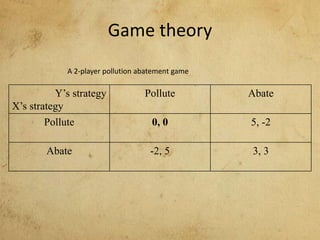
Game theory
Y’s strategy
X’s strategy
Pollute Abate
Pollute 0, 0 5, -2
Abate -2, 5 3, 3
A 2-player pollution abatement game
Toronto Conference (1988)
• Carbon dioxide targets.
• Carbon dioxide emissions.
• GHG control (quantitative incentives rather
than price incentives).
Rio de Janeiro Conference (1992)
• Plans for controlling emissions.
• No commitments on:
A particular emissions reduction.
A timetable for any such reduction.
Kyoto Protocol (1997)
• Conditions to be in force.
• Industrialized nations.
• Developing countries.
Kyoto Protocol’s
Flexible Mechanisms
1) Emissions Trading or “HOT AIR TRADING”
2) Joint Implementation (JI)
3) Clean Development Mechanism (CDM)
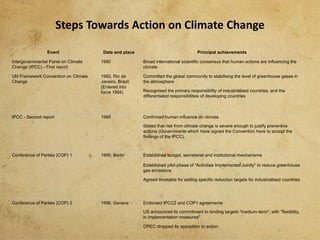
Steps Towards Action on Climate Change
Event Date and place Principal achievements
Intergovernmental Panel on Climate
Change (IPCC) - First report
1990 Broad international scientific consensus that human actions are influencing the
climate
UN Framework Convention on Climate
Change
1992, Rio de
Janeiro, Brazil.
(Entered into
force 1994)
Committed the global community to stabilising the level of greenhouse gases in
the atmosphere
Recognised the primary responsibility of industrialised countries, and the
differentiated responsibilities of developing countries
IPCC - Second report 1995 Confirmed human influence on climate
Stated that risk from climate change is severe enough to justify preventive
actions (Governments which have signed the Convention have to accept the
findings of the IPCC).
Conference of Parties (COP) 1 1995, Berlin Established budget, secretariat and institutional mechanisms
Established pilot phase of "Activities Implemented Jointly" to reduce greenhouse
gas emissions
Agreed timetable for setting specific reduction targets for industrialised countries
Conference of Parties (COP) 2 1996, Geneva Endorsed IPCC2 and COP1 agreements
US announced its commitment to binding targets "medium-term", with "flexibility,
in implementation measures"
OPEC dropped its opposition to action
Steps Towards Action on Climate Change
Event Date and place Principal achievements
Conference of Parties (COP) 3 1997, Kyoto Agreed the Kyoto Protocol, with targets for industrialised country greenhouse
gas reductions
Conference of Parties (COP) 4 1998, Buenos
Aires
Agreed a "Plan of Action" for following up on the Kyoto Protocol, including
processes for stimulating technology transfer
Conference of Parties (COP) 5 1999, Bonn Further progress on implementing the Kyoto Protocol
Conference of Parties (COP) 6 2000, The Hague
IPCC - Third report 2000/2001
“Rio plus Ten” Earth Summit 2002 Many people hope the Kyoto Protocol will be ratified and will enter into force by
this the time. [This didn't happen. It DID now come into force February 2005]
Negotiations begin for a second round of
emissions reductions
2005 This is the target date to start negotiations for the second period of the Kyoto
Protocol
Agreed cuts in greenhouse gases 2008-2012 This is the period in which emissions cuts agreed in the Kyoto Protocol have to
be achieved and measured
Global Warming will affect Egypt
(1) water resources
(2) coastal zones
Egypt is potentially one of the countries most
at risk from the effects of climate change.
Recommendation for Global Warming
Abatement
• Increase the capacity of ‘pools’ that absorb
carbon dioxide and other GHG from the
atmosphere.
• Decrease the rate of emissions of GHG
(reducing GHG inflows).
Recommendation for Global Warming
Abatement
• stop using burning fuels and changes in fuel
mix (from fossil to renewable energy)
• use the new technologies that are now
available, like better filters.
Recommendation for Global Warming
Abatement
• Stabilizing population growth worldwide.
• power stations should not be permitted to
discharge warm cooling waters into rivers and
oceans.
Recommendation for Global Warming
Abatement
• Financial and technological transfers from
developed to developing nations.
• helping low-income nations develop cleanly.
Recommendation for Global Warming
Abatement
• learn and use good ideas and solutions from
other countries that help us eliminate global
warming. For example, a country that is
fighting global warming and producing less
polluting fuels is Brazil. Instead of gasoline
Brazilians use alcohol, which is made from
sugar cane and cassava. The exhaust fumes
from this alcohol fuel are almost clean enough
to breathe.
THANK YOU

Global warming ppt by aakash yadav

  • 1.
    PRESENTED BY : AAKASHYADAV 01th DEC 2017
  • 2.
    Global Environmental Problems •Global warming • Acid rain • Ozone layer depletion • Biodiversity loss • Infectious disease
  • 3.
    Global Warming …refers toan increase in average global temperature, also called: • Climate Change • Greenhouse Effect
  • 4.
    Greenhouse Effect Solar radiation •some is reflected by the earth and the atmosphere • some passes through the atmosphere and is absorbed by the earth, warming it Infrared radiation • Some passes through the atmosphere • Some is absorbed and re-emitted in all directions by greenhouse gas modules
  • 5.
    Causes of GlobalWarming GHG - due to Natural and Human Economic Activities Gases Source carbon dioxide (CO2) fossil-fuel burning, de-forestation methane (CH4) agriculture activity, decomposition and disposal of waste nitrous oxide (N2O) emitted during agricultural and industrial activities, and during combustion of solid waste and fossil fuels hydrofluorocarbons (HFCs) industrial activities perfluorocarbons (PFCs) industrial activities sulphur hexafluoride (SF6) industrial activities
  • 6.
    Characteristics of GHG •Atmospheric life time. • Global warming potential. • Atmospheric concentration.
  • 7.
    Greenhouse Gases • Concentrationvs. Emissions. • Forecasts about emissions are very sensitive.
  • 8.
    Impacts of GlobalWarming - physical • Shrinking glaciers & thawing permafrost • Later freezing and earlier break up of river and lake ice • Sea level rise • Higher incidence of floods and droughts in some regions
  • 9.
    Impacts of GlobalWarming - biological • Longer growing seasons • Poleward and altitude shifts of plants and animal ranges • Decline of some plant and animal population ( Drive 15 - 37% of living species toward extinction by the middle of the century) • Early tree flowering, emergence of insects and birds eggs laying • Damage to natural systems Many of these impacts are irreversible
  • 10.
    Impacts of GlobalWarming - human system Systems at risk include: • water resources • Agriculture and forestry • Coastal zones and marine systems • Decreasing water availability in regions where water is already scarce • Human health and risk of disease
  • 11.
    Game theory Y’s strategy X’sstrategy Pollute Abate Pollute 0, 0 5, -2 Abate -2, 5 3, 3 A 2-player pollution abatement game
  • 12.
    Toronto Conference (1988) •Carbon dioxide targets. • Carbon dioxide emissions. • GHG control (quantitative incentives rather than price incentives).
  • 13.
    Rio de JaneiroConference (1992) • Plans for controlling emissions. • No commitments on: A particular emissions reduction. A timetable for any such reduction.
  • 14.
    Kyoto Protocol (1997) •Conditions to be in force. • Industrialized nations. • Developing countries.
  • 15.
    Kyoto Protocol’s Flexible Mechanisms 1)Emissions Trading or “HOT AIR TRADING” 2) Joint Implementation (JI) 3) Clean Development Mechanism (CDM)
  • 16.
    Steps Towards Actionon Climate Change Event Date and place Principal achievements Intergovernmental Panel on Climate Change (IPCC) - First report 1990 Broad international scientific consensus that human actions are influencing the climate UN Framework Convention on Climate Change 1992, Rio de Janeiro, Brazil. (Entered into force 1994) Committed the global community to stabilising the level of greenhouse gases in the atmosphere Recognised the primary responsibility of industrialised countries, and the differentiated responsibilities of developing countries IPCC - Second report 1995 Confirmed human influence on climate Stated that risk from climate change is severe enough to justify preventive actions (Governments which have signed the Convention have to accept the findings of the IPCC). Conference of Parties (COP) 1 1995, Berlin Established budget, secretariat and institutional mechanisms Established pilot phase of "Activities Implemented Jointly" to reduce greenhouse gas emissions Agreed timetable for setting specific reduction targets for industrialised countries Conference of Parties (COP) 2 1996, Geneva Endorsed IPCC2 and COP1 agreements US announced its commitment to binding targets "medium-term", with "flexibility, in implementation measures" OPEC dropped its opposition to action
  • 17.
    Steps Towards Actionon Climate Change Event Date and place Principal achievements Conference of Parties (COP) 3 1997, Kyoto Agreed the Kyoto Protocol, with targets for industrialised country greenhouse gas reductions Conference of Parties (COP) 4 1998, Buenos Aires Agreed a "Plan of Action" for following up on the Kyoto Protocol, including processes for stimulating technology transfer Conference of Parties (COP) 5 1999, Bonn Further progress on implementing the Kyoto Protocol Conference of Parties (COP) 6 2000, The Hague IPCC - Third report 2000/2001 “Rio plus Ten” Earth Summit 2002 Many people hope the Kyoto Protocol will be ratified and will enter into force by this the time. [This didn't happen. It DID now come into force February 2005] Negotiations begin for a second round of emissions reductions 2005 This is the target date to start negotiations for the second period of the Kyoto Protocol Agreed cuts in greenhouse gases 2008-2012 This is the period in which emissions cuts agreed in the Kyoto Protocol have to be achieved and measured
  • 18.
    Global Warming willaffect Egypt (1) water resources (2) coastal zones Egypt is potentially one of the countries most at risk from the effects of climate change.
  • 19.
    Recommendation for GlobalWarming Abatement • Increase the capacity of ‘pools’ that absorb carbon dioxide and other GHG from the atmosphere. • Decrease the rate of emissions of GHG (reducing GHG inflows).
  • 20.
    Recommendation for GlobalWarming Abatement • stop using burning fuels and changes in fuel mix (from fossil to renewable energy) • use the new technologies that are now available, like better filters.
  • 21.
    Recommendation for GlobalWarming Abatement • Stabilizing population growth worldwide. • power stations should not be permitted to discharge warm cooling waters into rivers and oceans.
  • 22.
    Recommendation for GlobalWarming Abatement • Financial and technological transfers from developed to developing nations. • helping low-income nations develop cleanly.
  • 23.
    Recommendation for GlobalWarming Abatement • learn and use good ideas and solutions from other countries that help us eliminate global warming. For example, a country that is fighting global warming and producing less polluting fuels is Brazil. Instead of gasoline Brazilians use alcohol, which is made from sugar cane and cassava. The exhaust fumes from this alcohol fuel are almost clean enough to breathe.
  • 24.