Corporate Citizenship Corporate Citizenship Professor Hector R Rodriguez School of Business Mount Ida College Business, Society & Environment
Society The Corporation and Its Stakeholders People for the Ethical Treatment of Animals Corporate Citizenship The Social Responsibility of Business The Shareholder Primacy Norm CSR, Citizenship and Sustainability Reporting Responsible Investing The Community and the Corporation Taxation and Corporate Citizenship Corporate Philanthropy Programs Employees and the Corporation Managing a Diverse Workforce Environment A Balanced Look at Climate Change Non-anthropogenic Causes of Climate Change Sulfates, Urban Warming and Permafrost Conventional Energy The Kyoto Protocol Green Building Green Information Technology Transportation, Electric Vehicles and the Environment Geo-Engineering Carbon Capture and Storage Renewable Energy Solid, Toxic and Hazardous Waste Forests, Paper and Carbon Sinks Life Cycle Analysis Water Use and Management Water Pollution Course Map – Topics Covered in Course
Understand the basic meaning of Corporate Citizenship (CC) Knowing when and where the idea of CC originated Examining the critical arguments for and against CC Investigating how business balances its responsibilities to multiple stakeholders, including its stockholders Key Learning Objectives For the purpose of this discussion, CC should be considered analogous to CSR
Current corporate design stems from the 19 th  century, where natural resources and labor seemed to be unlimited. CC aims to work through that perception to improve corporate performance on social and environmental concerns. It requires the corporation to assess the impact of its actions on people, their communities, and their environment It requires companies to balance the benefits to be gained against the costs of achieving those benefits Corporate Citizenship
These expectations are the result of: Essential function it performs for a variety of stakeholders Immense influence it has over the lives of many of its stakeholders The world’s largest 200 companies account for more than 25% of the world’s economic activity With power comes responsibility, concept for this coined the “Iron Law of Responsibility” In the long run, those who do not use power in ways society considers responsible will lose it. CC and Power
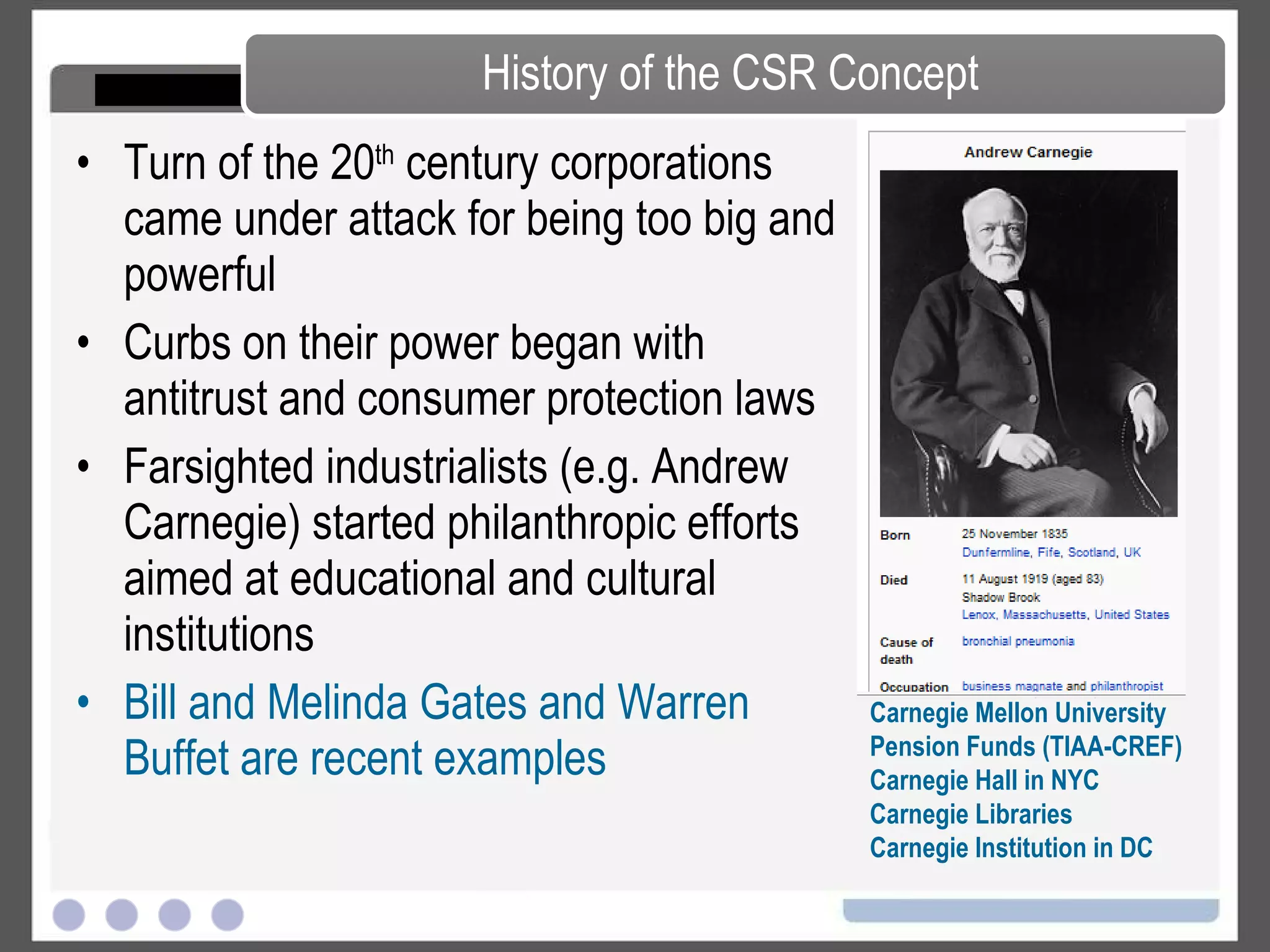
Turn of the 20 th  century corporations came under attack for being too big and powerful Curbs on their power began with antitrust and consumer protection laws Farsighted industrialists (e.g. Andrew Carnegie) started philanthropic efforts aimed at educational and cultural institutions Bill and Melinda Gates and Warren Buffet are recent examples History of the CC Concept Carnegie Mellon University Pension Funds (TIAA-CREF) Carnegie Hall in NYC Carnegie Libraries Carnegie Institution in DC
Around the 1920’s, the charitable needs of communities began to shift from just being a purview of a small group of wealthy philanthropists to business firms themselves Became more common for businesses to programs / charitable support for the needy Broader concept of business as “trustees” who work in the public interest came to be known as  “The Stewardship Principle” History of the CC Concept
Foundation Principles of CC
Economic and social goals come together in companies that practice enlightened self-interest Means firm leadership can see it is in the company’s self-interest in the long-term to provide true value to its customers, to help its employees grow and behave responsibly Scholars have debated the related question: Do socially responsible companies sacrifice profits by promoting the social good? Enlightened Self-Interest
Corporate executives and board members are constantly under pressure to produce value for owners / investors Management’s central goal is to promote the interests of the entire company, not any single stakeholder group Challenge is to put emphasis on long-term profits rather than focus on immediate returns An enlightened self-interest approach helps reconcile these challenges It’s acceptable to incur short-term costs for socially responsible activities that benefit both the company and the public in the long-term Stockholder Interests v. Other Stakeholder Interests
Despite strong support in the business community for CC, it is not universally accepted 2005 global study of corporate executives found 84% thought large corporations should “generate high returns to investors but balance this with contributions to the broader public good” Common arguments, both for and against CC, on the next slide. The CC Debate
Pros Balances corporate power with responsibility Discourages government regulation Promotes long-term profits for business Improves business value and reputation Corrects social problems caused by business Cons Lowers economic efficiency and profits Imposes unequal costs amongst competitors Imposes hidden costs passed on to stakeholders Requires skills business may lack Places responsibility on business rather than individuals The Pros and Cons of CC* *Continued on “The Social Responsibility of Business is to Increase Profits

Corporate Citizenship

  • 1.
    Corporate Citizenship CorporateCitizenship Professor Hector R Rodriguez School of Business Mount Ida College Business, Society & Environment
  • 2.
    Society The Corporationand Its Stakeholders People for the Ethical Treatment of Animals Corporate Citizenship The Social Responsibility of Business The Shareholder Primacy Norm CSR, Citizenship and Sustainability Reporting Responsible Investing The Community and the Corporation Taxation and Corporate Citizenship Corporate Philanthropy Programs Employees and the Corporation Managing a Diverse Workforce Environment A Balanced Look at Climate Change Non-anthropogenic Causes of Climate Change Sulfates, Urban Warming and Permafrost Conventional Energy The Kyoto Protocol Green Building Green Information Technology Transportation, Electric Vehicles and the Environment Geo-Engineering Carbon Capture and Storage Renewable Energy Solid, Toxic and Hazardous Waste Forests, Paper and Carbon Sinks Life Cycle Analysis Water Use and Management Water Pollution Course Map – Topics Covered in Course
  • 3.
    Understand the basicmeaning of Corporate Citizenship (CC) Knowing when and where the idea of CC originated Examining the critical arguments for and against CC Investigating how business balances its responsibilities to multiple stakeholders, including its stockholders Key Learning Objectives For the purpose of this discussion, CC should be considered analogous to CSR
  • 4.
    Current corporate designstems from the 19 th century, where natural resources and labor seemed to be unlimited. CC aims to work through that perception to improve corporate performance on social and environmental concerns. It requires the corporation to assess the impact of its actions on people, their communities, and their environment It requires companies to balance the benefits to be gained against the costs of achieving those benefits Corporate Citizenship
  • 5.
    These expectations arethe result of: Essential function it performs for a variety of stakeholders Immense influence it has over the lives of many of its stakeholders The world’s largest 200 companies account for more than 25% of the world’s economic activity With power comes responsibility, concept for this coined the “Iron Law of Responsibility” In the long run, those who do not use power in ways society considers responsible will lose it. CC and Power
  • 6.
    Turn of the20 th century corporations came under attack for being too big and powerful Curbs on their power began with antitrust and consumer protection laws Farsighted industrialists (e.g. Andrew Carnegie) started philanthropic efforts aimed at educational and cultural institutions Bill and Melinda Gates and Warren Buffet are recent examples History of the CC Concept Carnegie Mellon University Pension Funds (TIAA-CREF) Carnegie Hall in NYC Carnegie Libraries Carnegie Institution in DC
  • 7.
    Around the 1920’s,the charitable needs of communities began to shift from just being a purview of a small group of wealthy philanthropists to business firms themselves Became more common for businesses to programs / charitable support for the needy Broader concept of business as “trustees” who work in the public interest came to be known as “The Stewardship Principle” History of the CC Concept
  • 8.
  • 9.
    Economic and socialgoals come together in companies that practice enlightened self-interest Means firm leadership can see it is in the company’s self-interest in the long-term to provide true value to its customers, to help its employees grow and behave responsibly Scholars have debated the related question: Do socially responsible companies sacrifice profits by promoting the social good? Enlightened Self-Interest
  • 10.
    Corporate executives andboard members are constantly under pressure to produce value for owners / investors Management’s central goal is to promote the interests of the entire company, not any single stakeholder group Challenge is to put emphasis on long-term profits rather than focus on immediate returns An enlightened self-interest approach helps reconcile these challenges It’s acceptable to incur short-term costs for socially responsible activities that benefit both the company and the public in the long-term Stockholder Interests v. Other Stakeholder Interests
  • 11.
    Despite strong supportin the business community for CC, it is not universally accepted 2005 global study of corporate executives found 84% thought large corporations should “generate high returns to investors but balance this with contributions to the broader public good” Common arguments, both for and against CC, on the next slide. The CC Debate
  • 12.
    Pros Balances corporatepower with responsibility Discourages government regulation Promotes long-term profits for business Improves business value and reputation Corrects social problems caused by business Cons Lowers economic efficiency and profits Imposes unequal costs amongst competitors Imposes hidden costs passed on to stakeholders Requires skills business may lack Places responsibility on business rather than individuals The Pros and Cons of CC* *Continued on “The Social Responsibility of Business is to Increase Profits