Global challenges, sustainable
development, and their implications for
organization performance
Busaya Virakul, Ph.D., Associate Professor
School of Human Resource Development (HRD),
National Institute of Development Administration (NIDA)
2nd Global Risk Forum (GRF) One Health Summit 2013
One Health - One Planet - One Future: Risks and Opportunities
17 - 20 November 2013 in Davos, Switzerland
Objectives
• This paper presents an overview model of
organization performance which embeds
corporate social responsibility (CSR), corporate
governance (CG), and sustainability concepts
at the strategic level.
Key words: Global challenges
• … any major trend, shock, or development that
has the potential for serious global impacts
(OCHA-PDSB, 2010, p. 4)

Source: Geldorf, K. (2010, January). Global challenges and their impact on international
humanitarian action. Retrieved, 20 October 2013, from
https://docs.unocha.org/sites/dms/Documents/Global_Challenges_Policy_Brief_Jan10.pdf
[UN Office for the Coordination of Humanitarian Affairs (OCHA)- Policy Development and
Studies Branch (PDSB)]
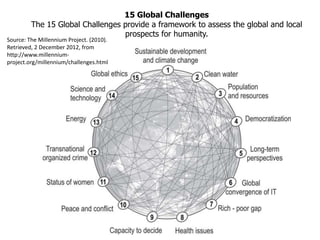
15 Global Challenges
The 15 Global Challenges provide a framework to assess the global and local
prospects for humanity.

Source: The Millennium Project. (2010).
Retrieved, 2 December 2012, from
http://www.millenniumproject.org/millennium/challenges.html
Key words: Sustainable development
• Development that meets the needs of the
present without compromising the ability of
future generations to meet their own needs.
(UNWCED,1987; the Brundtland Commission’s
report - Our Common Future)

Source: United Nations World Commission on Environment and Development
(UNWCED). (1987). Our common future. Oxford, UK: Oxford University Press.
Key words: Corporate social
responsibility (CSR)
• The continuing commitment by business to
behave ethically and contribute to economic
development while improving the quality of life
of the workforce and their families as well as of
the local community and society at large
(WBCSD, 2013, p. 3)
Source: World Business Council for Sustainable Development (WBCSD), The. (2013).
Corporate Social Responsibility: Making good business sense. Retrieved, 15 April
2013, from http://www.wbcsd.org/work-program/business-role/previouswork/corporate-social-responsibility.aspx
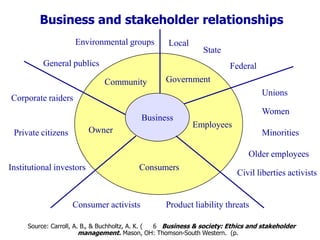
Business and stakeholder relationships
Environmental groups

Local

State

General publics

Federal
Community

Government
Unions

Corporate raiders
Business
Owner

Private citizens

Women
Employees

Minorities
Older employees

Institutional investors

Consumers

Consumer activists

Civil liberties activists

Product liability threats

Source: Carroll, A. B., & Buchholtz, A. K. (
6 Business & society: Ethics and stakeholder
management. Mason, OH: Thomson-South Western. (p.
Key words: Corporate governance
(CG) or Good governance (GG)
• The formal system of oversight, accountability, and
control for organizational decisions and resources
(Ferrell, Thorne, & Ferrell, 2011, p. 89);
• Corporate governance deals with the rights and
responsibilities of a company’s management, its
board, shareholders and various
stakeholders(OECD, 2013).
Source: (a) Ferrell, O. C., Thorne, D. M., & Ferrell, L. (2011). Social responsibility business.
Singapore: Cengage Learning. (b) Organization for Economic Co-operation and
Development, The (OECD). (2013). Corporate governance principles.
http://www.oecd.org/daf/ca/corporategovernanceprinciples/frequentlyaskedquestionsab
outtheoecdprinciplesofcorporategovernance.htm (Retrieved, 15 April 2013)
Key words: Sustainability of
organization
• An approach to business that considers
economic, environmental, and social issues in
balanced, holistic, and long-term ways that
benefit current and future generations of
concerned stakeholders (De Lange, Busch, &
Delgado-Ceballos, 2012, p. 151;
Elkington, 1999; UNWCED, 1987)
• Profits, Planet, and People – The Triple Ps
Source: De Lange, D. E., Busch, T., & Delgado-Ceballos, J..(2012, October). Sustaining
sustainability in organizations. Journal of Business Ethics, 110(2), pp. 151-156. DOI
10.1007/s10551-012-1425-0
Research framework
• Capitalism and consumerism are the current
socioeconomic forces.
• The world has finite resources. We have already
used up 30%-50% of natural resources belonged
to our younger generations’.
• If business companies emphasize capitalism and
consumerism to the fullest, the world may face
many global challenges ahead.
Research framework
• Business has enormous power in either
promoting or reducing people’s well being.
• Including interests of every stakeholder in a
balancing way is a key approach for future
business.
• Business organizations which practice such
approach could sustain their existence in the
long run.
The organization of the paper
• Global challenges as external factors impacting
organizations
• Sustainable development: An approach to rectify
major global problems
• Some selected cases pertaining to global
challenges
• CSR, CG, and sustainability: The elements of an
organization’s strategic plan
• A model of an organization’s performance
embedding CSR, CG, and sustainability at the
strategic level
Some selected cases
•
•
•
•
•

Map Ta Phut Port/Industrial Zone
Dawei Project
Xaiyaburi Dam in Loas
The Melamine Scandal in China in 2008
Extraction of natural resources in developing
countries – Thailand, India, Myanmar, Indonesia,
etc.
• The global financial crisis of 2008 and the
Barclays scandal in 2012
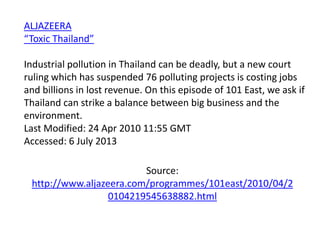
ALJAZEERA
“Toxic Thailand”
Industrial pollution in Thailand can be deadly, but a new court
ruling which has suspended 76 polluting projects is costing jobs
and billions in lost revenue. On this episode of 101 East, we ask if
Thailand can strike a balance between big business and the
environment.
Last Modified: 24 Apr 2010 11:55 GMT
Accessed: 6 July 2013
Source:
http://www.aljazeera.com/programmes/101east/2010/04/2
0104219545638882.html
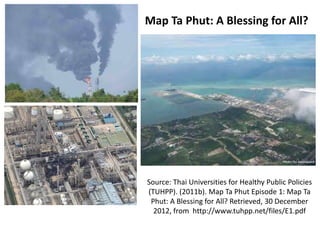
Map Ta Phut: A Blessing for All?

Source: Thai Universities for Healthy Public Policies
(TUHPP). (2011b). Map Ta Phut Episode 1: Map Ta
Phut: A Blessing for All? Retrieved, 30 December
2012, from http://www.tuhpp.net/files/E1.pdf
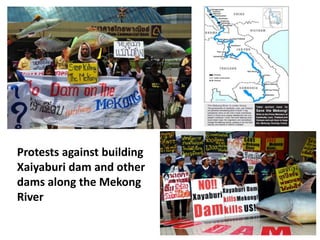
Protests against building
Xaiyaburi dam and other
dams along the Mekong
River
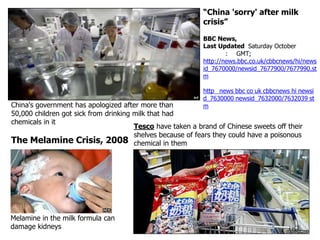
“China 'sorry' after milk
crisis”
BBC News,
Last Updated Saturday October
: GMT;
http://news.bbc.co.uk/cbbcnews/hi/news
id_7670000/newsid_7677900/7677990.st
m
http news bbc co uk cbbcnews hi newsi
d_7630000 newsid_7632000/7632039 st
m

China's government has apologized after more than
50,000 children got sick from drinking milk that had
chemicals in it
Tesco have taken a brand of Chinese sweets off their
shelves because of fears they could have a poisonous
The Melamine Crisis, 2008 chemical in them

Melamine in the milk formula can
damage kidneys
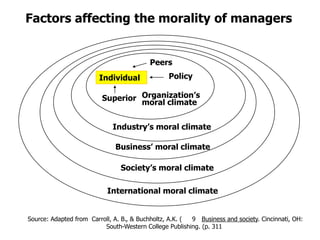
Factors affecting the morality of managers

Peers
Individual

Policy

Superior Organization’s
moral climate
Industry’s moral climate
Business’ moral climate
Society’s moral climate

International moral climate
Source: Adapted from Carroll, A. B., & Buchholtz, A.K. (
9 Business and society. Cincinnati, OH:
South-Western College Publishing. (p. 311
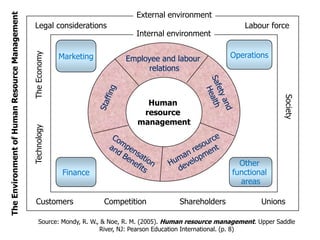
Marketing

Internal environment
Employee and labour
relations

Labour force
Operations

Human
resource
management

Technology

The Economy

Legal considerations

Society

The Environment of Human Resource Management

External environment

Other
functional
areas

Finance
Customers

Competition

Shareholders

Unions

Source: Mondy, R. W., & Noe, R. M. (2005). Human resource management. Upper Saddle
River, NJ: Pearson Education International. (p. 8)
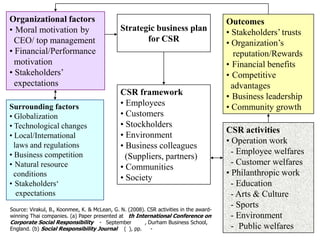
Organizational factors
• Moral motivation by
CEO/ top management
• Financial/Performance
motivation
• Stakeholders’
expectations
Surrounding factors
• Globalization
• Technological changes
• Local/International
laws and regulations
• Business competition
• Natural resource
conditions
• Stakeholders‘
expectations

Strategic business plan
for CSR

CSR framework
• Employees
• Customers
• Stockholders
• Environment
• Business colleagues
(Suppliers, partners)
• Communities
• Society

Source: Virakul, B., Koonmee, K. & McLean, G. N. (2008). CSR activities in the awardwinning Thai companies. (a) Paper presented at th International Conference on
Corporate Social Responsibility - September
, Durham Business School,
England. (b) Social Responsibility Journal ( ), pp.
-

Outcomes
• Stakeholders’ trusts
• Organization’s
reputation/Rewards
• Financial benefits
• Competitive
advantages
• Business leadership
• Community growth
CSR activities
• Operation work
- Employee welfares
- Customer welfares
• Philanthropic work
- Education
- Arts & Culture
- Sports
- Environment
- Public welfares
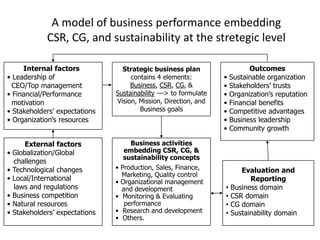
A model of business performance embedding
CSR, CG, and sustainability at the stretegic level
Internal factors
• Leadership of
CEO/Top management
• Financial/Performance
motivation
• Stakeholders’ expectations
• Organization’s resources

•

•
•
•
•
•

External factors
Globalization/Global
challenges
Technological changes
Local/International
laws and regulations
Business competition
Natural resources
Stakeholders’ expectations

Strategic business plan
contains 4 elements:
Business, CSR, CG, &
Sustainability ---> to formulate
Vision, Mission, Direction, and
Business goals

•
•
•
•
•

Business activities
embedding CSR, CG, &
sustainability concepts
Production, Sales, Finance,
Marketing, Quality control
Organizational management
and development
Monitoring & Evaluating
performance
Research and development
Others.

•
•
•
•
•
•
•

Outcomes
Sustainable organization
Stakeholders’ trusts
Organization’s reputation
Financial benefits
Competitive advantages
Business leadership
Community growth

•
•
•
•

Evaluation and
Reporting
Business domain
CSR domain
CG domain
Sustainability domain
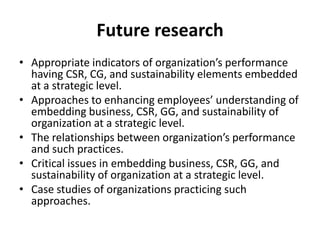
Future research
• Appropriate indicators of organization’s performance
having CSR, CG, and sustainability elements embedded
at a strategic level.
• Approaches to enhancing employees’ understanding of
embedding business, CSR, GG, and sustainability of
organization at a strategic level.
• The relationships between organization’s performance
and such practices.
• Critical issues in embedding business, CSR, GG, and
sustainability of organization at a strategic level.
• Case studies of organizations practicing such
approaches.
Global Challenges, Sustainable Development, And Their Implications For Organization Performance

Global Challenges, Sustainable Development, And Their Implications For Organization Performance

  • 1.
    Global challenges, sustainable development,and their implications for organization performance Busaya Virakul, Ph.D., Associate Professor School of Human Resource Development (HRD), National Institute of Development Administration (NIDA) 2nd Global Risk Forum (GRF) One Health Summit 2013 One Health - One Planet - One Future: Risks and Opportunities 17 - 20 November 2013 in Davos, Switzerland
  • 2.
    Objectives • This paperpresents an overview model of organization performance which embeds corporate social responsibility (CSR), corporate governance (CG), and sustainability concepts at the strategic level.
  • 3.
    Key words: Globalchallenges • … any major trend, shock, or development that has the potential for serious global impacts (OCHA-PDSB, 2010, p. 4) Source: Geldorf, K. (2010, January). Global challenges and their impact on international humanitarian action. Retrieved, 20 October 2013, from https://docs.unocha.org/sites/dms/Documents/Global_Challenges_Policy_Brief_Jan10.pdf [UN Office for the Coordination of Humanitarian Affairs (OCHA)- Policy Development and Studies Branch (PDSB)]
  • 4.
    15 Global Challenges The15 Global Challenges provide a framework to assess the global and local prospects for humanity. Source: The Millennium Project. (2010). Retrieved, 2 December 2012, from http://www.millenniumproject.org/millennium/challenges.html
  • 5.
    Key words: Sustainabledevelopment • Development that meets the needs of the present without compromising the ability of future generations to meet their own needs. (UNWCED,1987; the Brundtland Commission’s report - Our Common Future) Source: United Nations World Commission on Environment and Development (UNWCED). (1987). Our common future. Oxford, UK: Oxford University Press.
  • 6.
    Key words: Corporatesocial responsibility (CSR) • The continuing commitment by business to behave ethically and contribute to economic development while improving the quality of life of the workforce and their families as well as of the local community and society at large (WBCSD, 2013, p. 3) Source: World Business Council for Sustainable Development (WBCSD), The. (2013). Corporate Social Responsibility: Making good business sense. Retrieved, 15 April 2013, from http://www.wbcsd.org/work-program/business-role/previouswork/corporate-social-responsibility.aspx
  • 7.
    Business and stakeholderrelationships Environmental groups Local State General publics Federal Community Government Unions Corporate raiders Business Owner Private citizens Women Employees Minorities Older employees Institutional investors Consumers Consumer activists Civil liberties activists Product liability threats Source: Carroll, A. B., & Buchholtz, A. K. ( 6 Business & society: Ethics and stakeholder management. Mason, OH: Thomson-South Western. (p.
  • 8.
    Key words: Corporategovernance (CG) or Good governance (GG) • The formal system of oversight, accountability, and control for organizational decisions and resources (Ferrell, Thorne, & Ferrell, 2011, p. 89); • Corporate governance deals with the rights and responsibilities of a company’s management, its board, shareholders and various stakeholders(OECD, 2013). Source: (a) Ferrell, O. C., Thorne, D. M., & Ferrell, L. (2011). Social responsibility business. Singapore: Cengage Learning. (b) Organization for Economic Co-operation and Development, The (OECD). (2013). Corporate governance principles. http://www.oecd.org/daf/ca/corporategovernanceprinciples/frequentlyaskedquestionsab outtheoecdprinciplesofcorporategovernance.htm (Retrieved, 15 April 2013)
  • 9.
    Key words: Sustainabilityof organization • An approach to business that considers economic, environmental, and social issues in balanced, holistic, and long-term ways that benefit current and future generations of concerned stakeholders (De Lange, Busch, & Delgado-Ceballos, 2012, p. 151; Elkington, 1999; UNWCED, 1987) • Profits, Planet, and People – The Triple Ps Source: De Lange, D. E., Busch, T., & Delgado-Ceballos, J..(2012, October). Sustaining sustainability in organizations. Journal of Business Ethics, 110(2), pp. 151-156. DOI 10.1007/s10551-012-1425-0
  • 10.
    Research framework • Capitalismand consumerism are the current socioeconomic forces. • The world has finite resources. We have already used up 30%-50% of natural resources belonged to our younger generations’. • If business companies emphasize capitalism and consumerism to the fullest, the world may face many global challenges ahead.
  • 11.
    Research framework • Businesshas enormous power in either promoting or reducing people’s well being. • Including interests of every stakeholder in a balancing way is a key approach for future business. • Business organizations which practice such approach could sustain their existence in the long run.
  • 12.
    The organization ofthe paper • Global challenges as external factors impacting organizations • Sustainable development: An approach to rectify major global problems • Some selected cases pertaining to global challenges • CSR, CG, and sustainability: The elements of an organization’s strategic plan • A model of an organization’s performance embedding CSR, CG, and sustainability at the strategic level
  • 13.
    Some selected cases • • • • • MapTa Phut Port/Industrial Zone Dawei Project Xaiyaburi Dam in Loas The Melamine Scandal in China in 2008 Extraction of natural resources in developing countries – Thailand, India, Myanmar, Indonesia, etc. • The global financial crisis of 2008 and the Barclays scandal in 2012
  • 14.
    ALJAZEERA “Toxic Thailand” Industrial pollutionin Thailand can be deadly, but a new court ruling which has suspended 76 polluting projects is costing jobs and billions in lost revenue. On this episode of 101 East, we ask if Thailand can strike a balance between big business and the environment. Last Modified: 24 Apr 2010 11:55 GMT Accessed: 6 July 2013 Source: http://www.aljazeera.com/programmes/101east/2010/04/2 0104219545638882.html
  • 15.
    Map Ta Phut:A Blessing for All? Source: Thai Universities for Healthy Public Policies (TUHPP). (2011b). Map Ta Phut Episode 1: Map Ta Phut: A Blessing for All? Retrieved, 30 December 2012, from http://www.tuhpp.net/files/E1.pdf
  • 16.
    Protests against building Xaiyaburidam and other dams along the Mekong River
  • 17.
    “China 'sorry' aftermilk crisis” BBC News, Last Updated Saturday October : GMT; http://news.bbc.co.uk/cbbcnews/hi/news id_7670000/newsid_7677900/7677990.st m http news bbc co uk cbbcnews hi newsi d_7630000 newsid_7632000/7632039 st m China's government has apologized after more than 50,000 children got sick from drinking milk that had chemicals in it Tesco have taken a brand of Chinese sweets off their shelves because of fears they could have a poisonous The Melamine Crisis, 2008 chemical in them Melamine in the milk formula can damage kidneys
  • 18.
    Factors affecting themorality of managers Peers Individual Policy Superior Organization’s moral climate Industry’s moral climate Business’ moral climate Society’s moral climate International moral climate Source: Adapted from Carroll, A. B., & Buchholtz, A.K. ( 9 Business and society. Cincinnati, OH: South-Western College Publishing. (p. 311
  • 19.
    Marketing Internal environment Employee andlabour relations Labour force Operations Human resource management Technology The Economy Legal considerations Society The Environment of Human Resource Management External environment Other functional areas Finance Customers Competition Shareholders Unions Source: Mondy, R. W., & Noe, R. M. (2005). Human resource management. Upper Saddle River, NJ: Pearson Education International. (p. 8)
  • 20.
    Organizational factors • Moralmotivation by CEO/ top management • Financial/Performance motivation • Stakeholders’ expectations Surrounding factors • Globalization • Technological changes • Local/International laws and regulations • Business competition • Natural resource conditions • Stakeholders‘ expectations Strategic business plan for CSR CSR framework • Employees • Customers • Stockholders • Environment • Business colleagues (Suppliers, partners) • Communities • Society Source: Virakul, B., Koonmee, K. & McLean, G. N. (2008). CSR activities in the awardwinning Thai companies. (a) Paper presented at th International Conference on Corporate Social Responsibility - September , Durham Business School, England. (b) Social Responsibility Journal ( ), pp. - Outcomes • Stakeholders’ trusts • Organization’s reputation/Rewards • Financial benefits • Competitive advantages • Business leadership • Community growth CSR activities • Operation work - Employee welfares - Customer welfares • Philanthropic work - Education - Arts & Culture - Sports - Environment - Public welfares
  • 21.
    A model ofbusiness performance embedding CSR, CG, and sustainability at the stretegic level Internal factors • Leadership of CEO/Top management • Financial/Performance motivation • Stakeholders’ expectations • Organization’s resources • • • • • • External factors Globalization/Global challenges Technological changes Local/International laws and regulations Business competition Natural resources Stakeholders’ expectations Strategic business plan contains 4 elements: Business, CSR, CG, & Sustainability ---> to formulate Vision, Mission, Direction, and Business goals • • • • • Business activities embedding CSR, CG, & sustainability concepts Production, Sales, Finance, Marketing, Quality control Organizational management and development Monitoring & Evaluating performance Research and development Others. • • • • • • • Outcomes Sustainable organization Stakeholders’ trusts Organization’s reputation Financial benefits Competitive advantages Business leadership Community growth • • • • Evaluation and Reporting Business domain CSR domain CG domain Sustainability domain
  • 22.
    Future research • Appropriateindicators of organization’s performance having CSR, CG, and sustainability elements embedded at a strategic level. • Approaches to enhancing employees’ understanding of embedding business, CSR, GG, and sustainability of organization at a strategic level. • The relationships between organization’s performance and such practices. • Critical issues in embedding business, CSR, GG, and sustainability of organization at a strategic level. • Case studies of organizations practicing such approaches.