Sustainability Defined Sustainability Defined Hector R Rodriguez Director of Sustainability at Biogen Idec Adjunct Professor, School of Business at Mount Ida College
Objectives of this Talk – An Overview of… What is Sustainability? What is Sustainability Management? Review of tools that assist in developing and implementing a Sustainability Strategy
Challenges of this Definition Does not address resource consumption issues, nor the distinction between renewable resources and non-renewable resources.  Does not really answer the question of what sustainability means and also leaves it to our imagination to determine which “needs” are legitimate and which ones are not.  2 Part I - What is Sustainability? Traditional Definition Sustainable  development  is development that meets the  needs of the present  without compromising the ability of  future generations  to meet their own needs. 1   Philosophically, Sustainability could be thought of as the goal and Sustainable Development one of the requirements needed to achieve it… 1. “Our Common Future.”  World Commission on Environment and Development . Aug. 1987.  2. “Re-Casting the Triple Bottom Line.”  Center for Sustainable Innovation. Jun. 2007
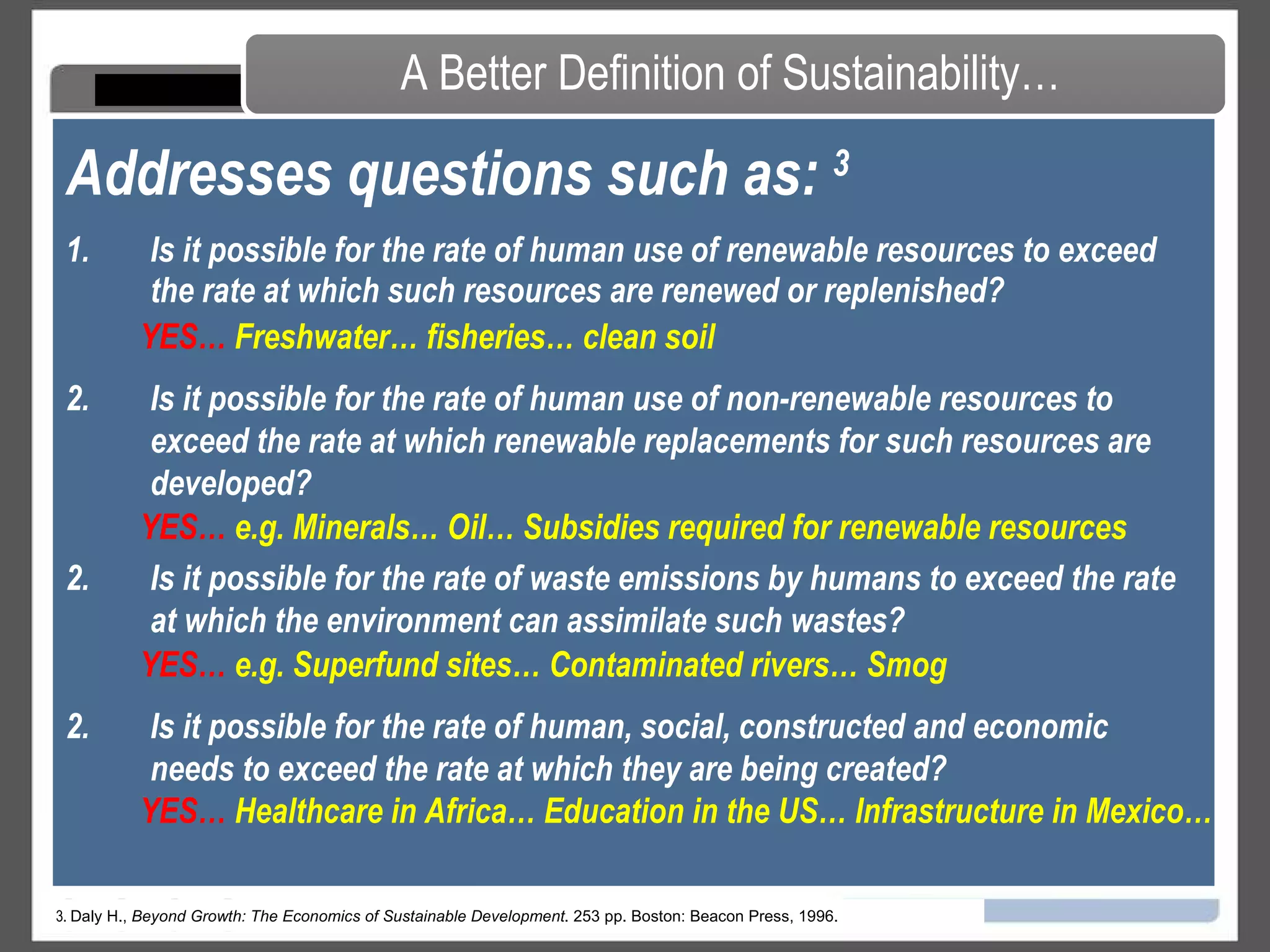
Is it possible for the rate of human use of renewable resources to exceed the rate at which such resources are renewed or replenished?  Addresses questions such as:  3 A Better Definition of Sustainability… 3.  Daly H.,  Beyond Growth: The Economics of Sustainable Development . 253 pp. Boston: Beacon Press, 1996. Is it possible for the rate of human use of non-renewable resources to exceed the rate at which renewable replacements for such resources are developed?  Is it possible for the rate of waste emissions by humans to exceed the rate at which the environment can assimilate such wastes?  Is it possible for the rate of human, social, constructed and economic needs to exceed the rate at which they are being created?  YES…   Freshwater… fisheries… clean soil YES…   e.g. Minerals… Oil… Subsidies required for renewable resources YES…   e.g. Superfund sites… Contaminated rivers… Smog  YES…   Healthcare in Africa… Education in the US… Infrastructure in Mexico…
As the answers to the questions on the previous slide can be yes, we can say that the human activities associated with them are unsustainable.  A Better Definition of Sustainability… (cont) In order to be sustainable, we must therefore address the impacts of human activity on the quality and sufficiency of  vital capitals  (renewable, non-renewable and societal) in the world.
“ Capital” is a stock of anything that yields a flow of valuable goods or services to people who need them. Sustainability must therefore address and manage the impacts of human activity on the quality and sufficiency of vital capitals in the world… What is Capital? Linking Vital Capitals and Well-Being…
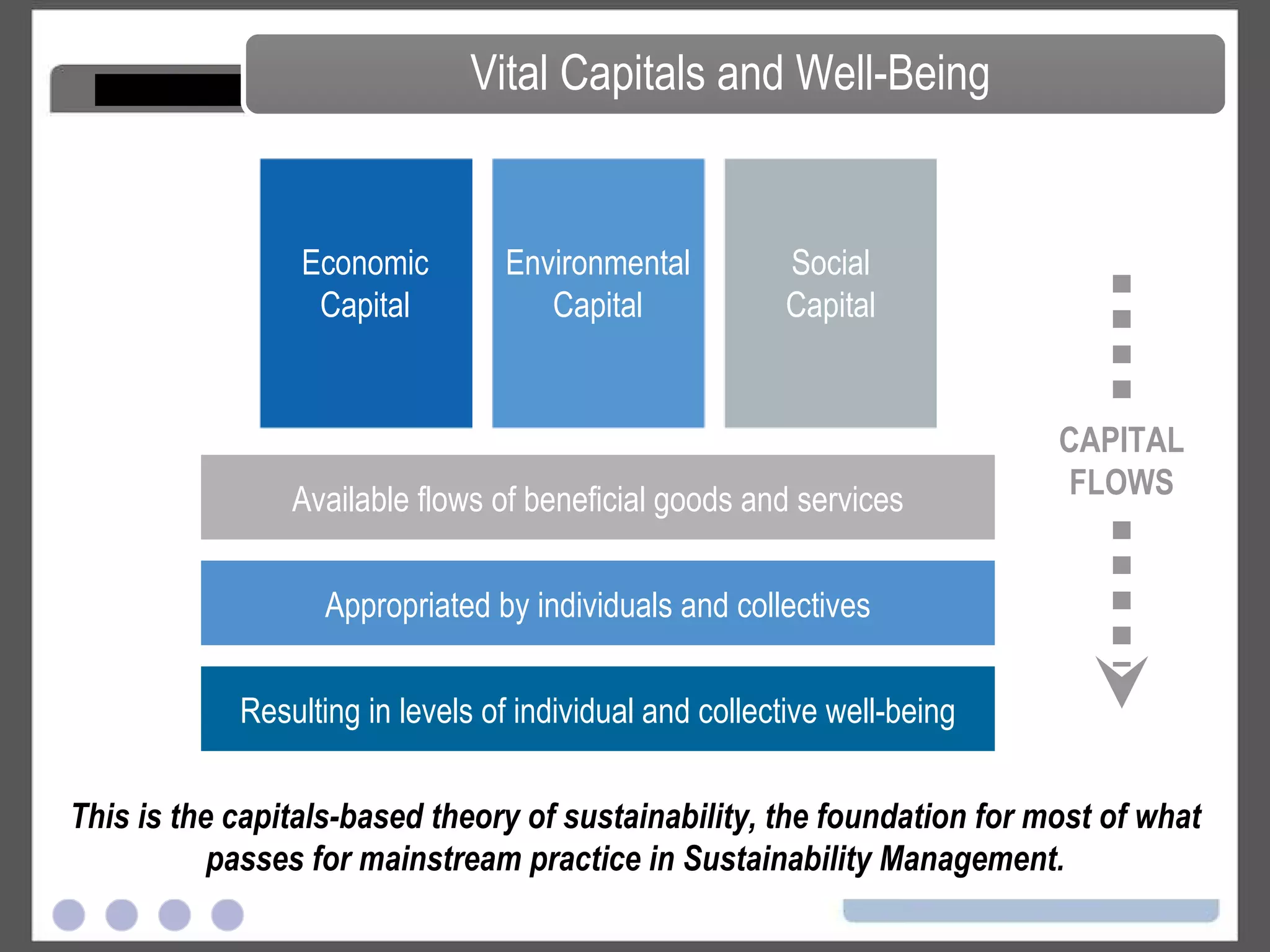
This is the capitals-based theory of sustainability, the foundation for most of what passes for mainstream practice in Sustainability Management. Vital Capitals and Well-Being Economic Capital Social Capital Environmental Capital Available flows of beneficial goods and services Appropriated by individuals and collectives Resulting in levels of individual and collective well-being CAPITAL FLOWS
Environmental Capital Is the extension of the economic notion of capital to environmental goods and services. Environmental capital is thus the stock of natural ecosystems that yields a flow of valuable ecosystem goods or services into the future. For example, a stock of trees or fish provides a flow of new trees or fish, a flow which  can be  sustainable indefinitely. Environmental capital  may also provide services  like recycling wastes, water treatment and removal of air contaminants.
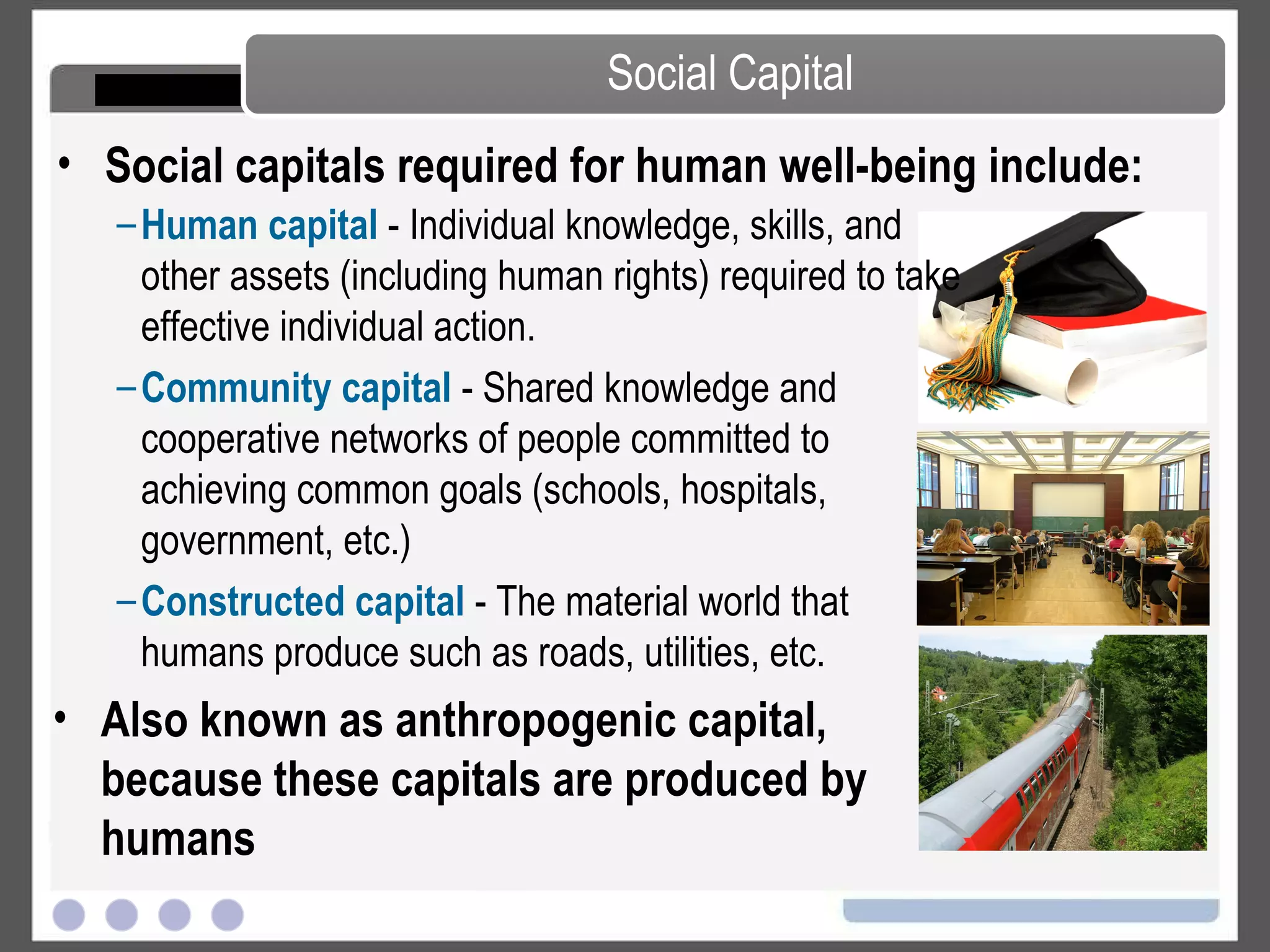
Social Capital Social capitals required for human well-being include: Human capital  - Individual knowledge, skills, and other assets (including human rights) required to take effective individual action. Community capital  - Shared knowledge and cooperative networks of people committed to achieving common goals (schools, hospitals, government, etc.) Constructed capital  - The material world that humans produce such as roads, utilities, etc. Also known as anthropogenic capital, because these capitals are produced by humans
Should not to be confused with financial capital “ So, while the economic component of the triple bottom line is often assumed to be synonymous with financial performance [i.e., with the financial bottom line], in fact, there are significant differences between the two ….[E]conomics extends beyond the boundaries of a single organization ….A company’s investment in a community can serve as an engine of growth in the economy through employment, boosting local supply chains and developing a new skills base.  The goods and services that companies produce can also contribute to a higher quality of life.”  4 Economic Capital 4.  Henriques A., Richardson J.  The Triple Bottom Line: Does It All Add Up?  London: Earthscan Publications Ltd.., 2004.
Economic Capital There are many, and could be considered variants of social capital: Employment rates Employees’ wealth Owners’ wealth Local, regional and global  commerce Trading partners Customers Community economic affairs Etc. This diagram depicts an outdated model… Economic Capital is not just about profit…
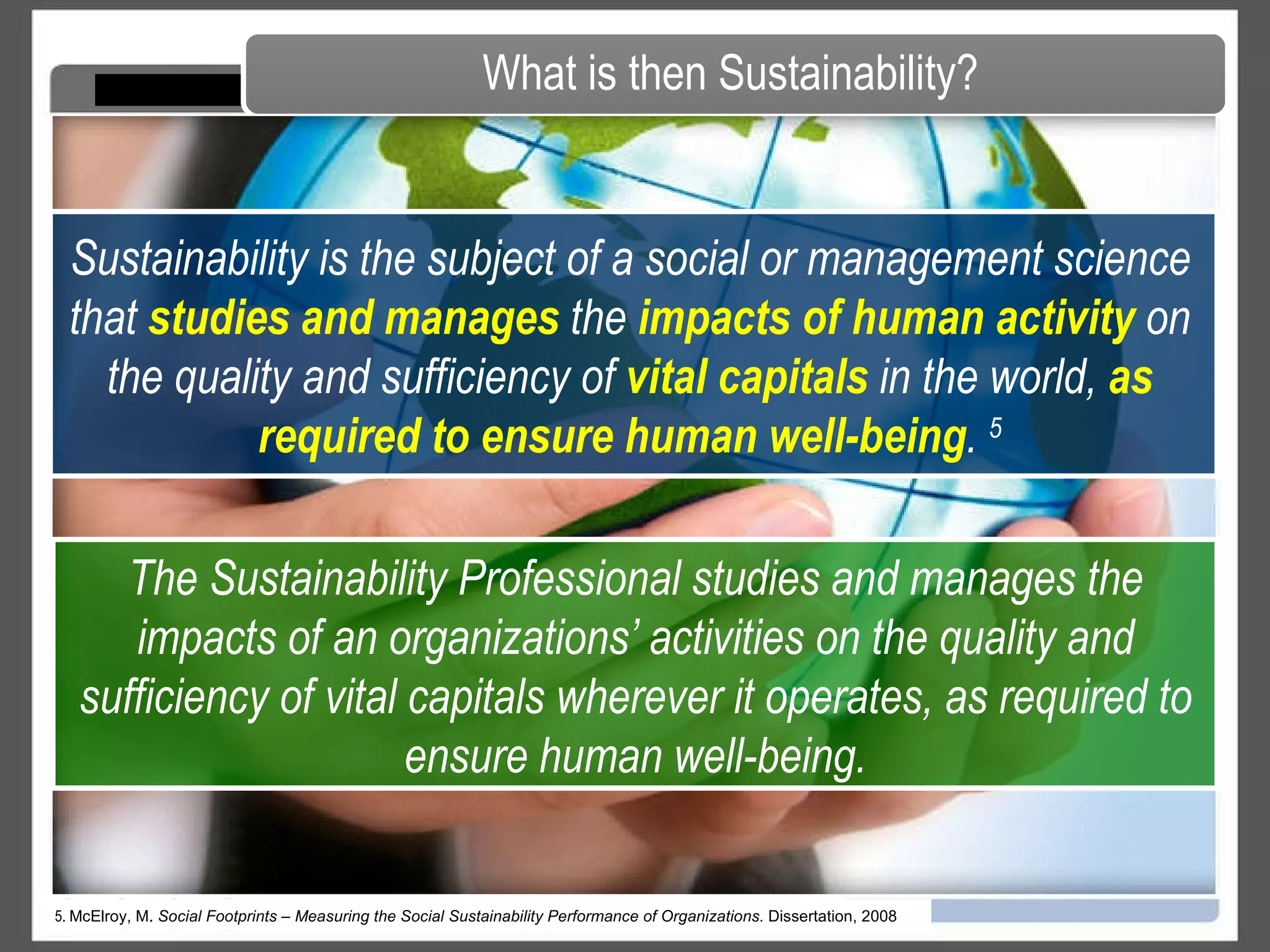
What is then Sustainability? 5.  McElroy, M.  Social Footprints – Measuring the Social Sustainability Performance of Organizations.  Dissertation, 2008 The Sustainability Professional studies and manages the impacts of an organizations’ activities on the quality and sufficiency of vital capitals wherever it operates, as required to ensure human well-being. Sustainability is the subject of a social or management science that  studies and manages  the  impacts of human activity  on the quality and sufficiency of  vital capitals  in the world,  as required to ensure human well-being .  5
Part II - What is Sustainability Management (SM)? Sustainability Management Enterprise Orientation Social Benevolence Eco-efficiency Triple  Bottom-Line Context Based Orientation Life Cycle Orientation Environmental Capital Economic Capital Social Capital LCA’s of Products and Services Environmental Capital Social Capital (Emerging) Refresher: to achieve Sustainability, SM must address all three vital capitals 1 2 3 4 5
Life-Cycle Orientation As here defined, LCA’s form an important  element  of Sustainability Management 1 Product- and life-cycle-based Takes the position that it is more important to influence the environmental impact of a product throughout its entire life cycle This approach examines the impact of a product from its inception as a raw material to its ultimate disposal following consumer use Emerging UNEP-driven initiative
Eco-efficiency Social Benevolence Triple Bottom Line Context-based Sustainability Enterprise Orientation – Four Schools of Thought
“ Industry is moving toward ‘demanufacturing’ and ‘remanufacturing’ — that is, recycling the materials in their products and thus limiting the use of raw materials and of energy to convert those raw materials…It is the more competitive and successful companies that are in the forefront of what we call ‘eco-efficiency’ ”  6 Arguably the basis of the “green” movement; also the basis of LCAs.  As eco-efficiency narrowly evaluates economic implications (profit only), and tends to ignore social concerns, it could at most be considered an  element  of Sustainability Management. Eco-Efficiency 6.  Schmidheiny S.,  Changing Course,  The MIT Press, Boston: Apr. 1992 2
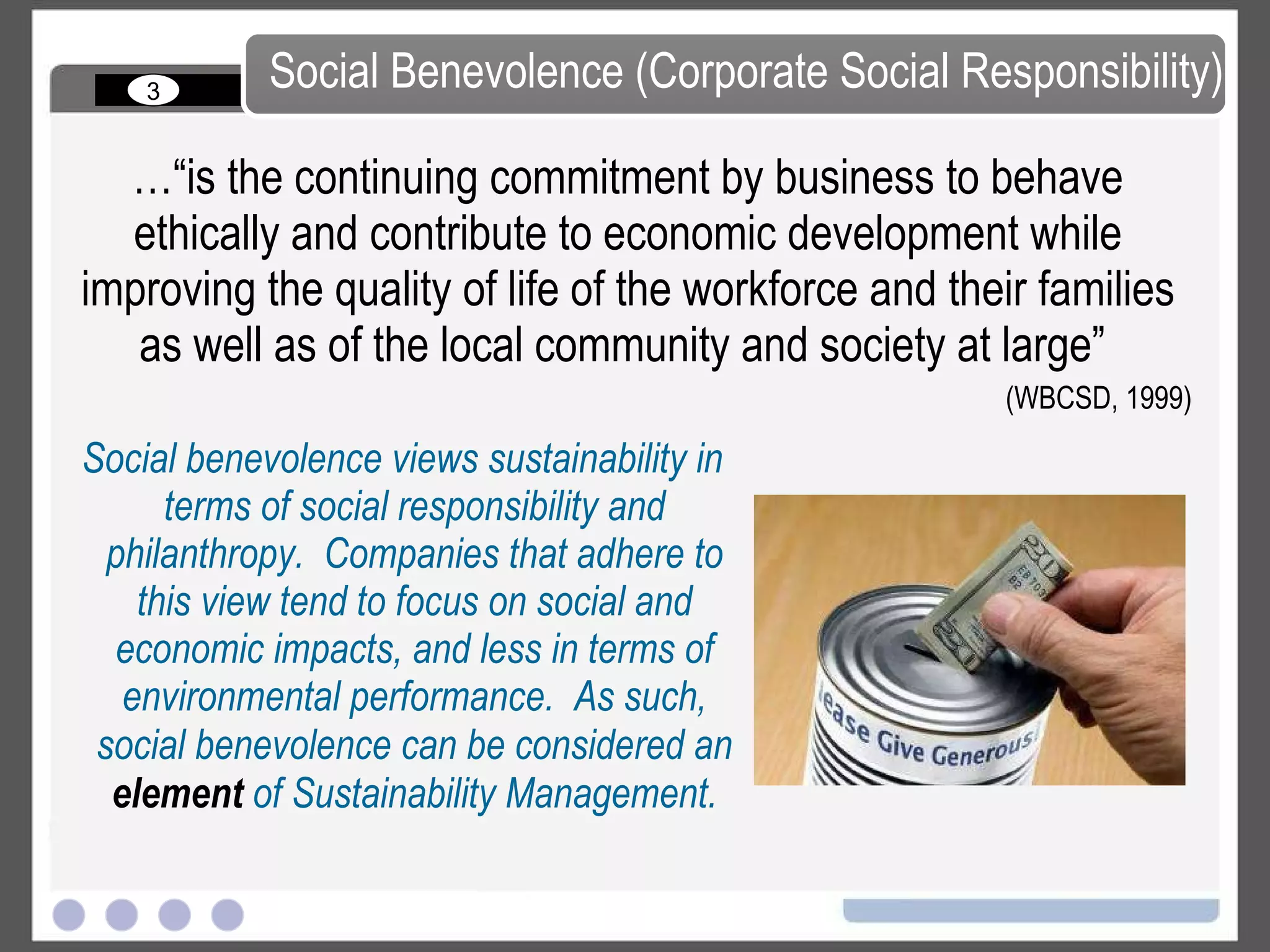
Social benevolence views sustainability in terms of social responsibility and philanthropy.  Companies that adhere to this view tend to focus on social and economic impacts, and less in terms of environmental performance.  As such, social benevolence can be considered an  element  of Sustainability Management. …“ is the continuing commitment by business to behave ethically and contribute to economic development while improving the quality of life of the workforce and their families as well as of the local community and society at large”  (WBCSD, 1999) Social Benevolence (Corporate Social Responsibility) 3
“ Today we think in terms of a ‘triple bottom line,’  focusing on economic prosperity, environmental quality, and social justice.”  7 Explicitly pluralistic in its orientation: social, economic, and environmental.  Arguably the dominant sustainability paradigm in use today, including reporting requirements under the GRI. Triple Bottom Line 7.  Elkington J.,  Cannibals with Forks,  Capstone Publishing LTD. Sep.1999. 4
Context-Based Sustainability  8 8.  McElroy M., “Sustainability Measurement and Reporting.”  Deloitte . Weston, MA. 2010  5 An approach that quantitatively express sustainability performance in the form of a quotient Numerators represent actual impacts on vital capitals Denominators represent normative impacts on the same vital capitals Most mainstream tools and methods have been  numerator only  in scope While denominators are normative, they are usually grounded in factual claims about the world Ecological limits Minimal social and/or economic conditions required for human well-being
Here’s the Company X performance with context missing Context-Based vs. Context-Free Example Source: Center for Sustainable Innovation
Sustainability Threshold (performance above threshold is unsustainable) Here’s the Company X performance with context added Context-Based vs. Context-Free Example (cont.) Source: Center for Sustainable Innovation
Another hypothetical scenario Context-Based vs. Context-Free Example (cont.) Source: Center for Sustainable Innovation Sustainability Threshold (performance above threshold is unsustainable)
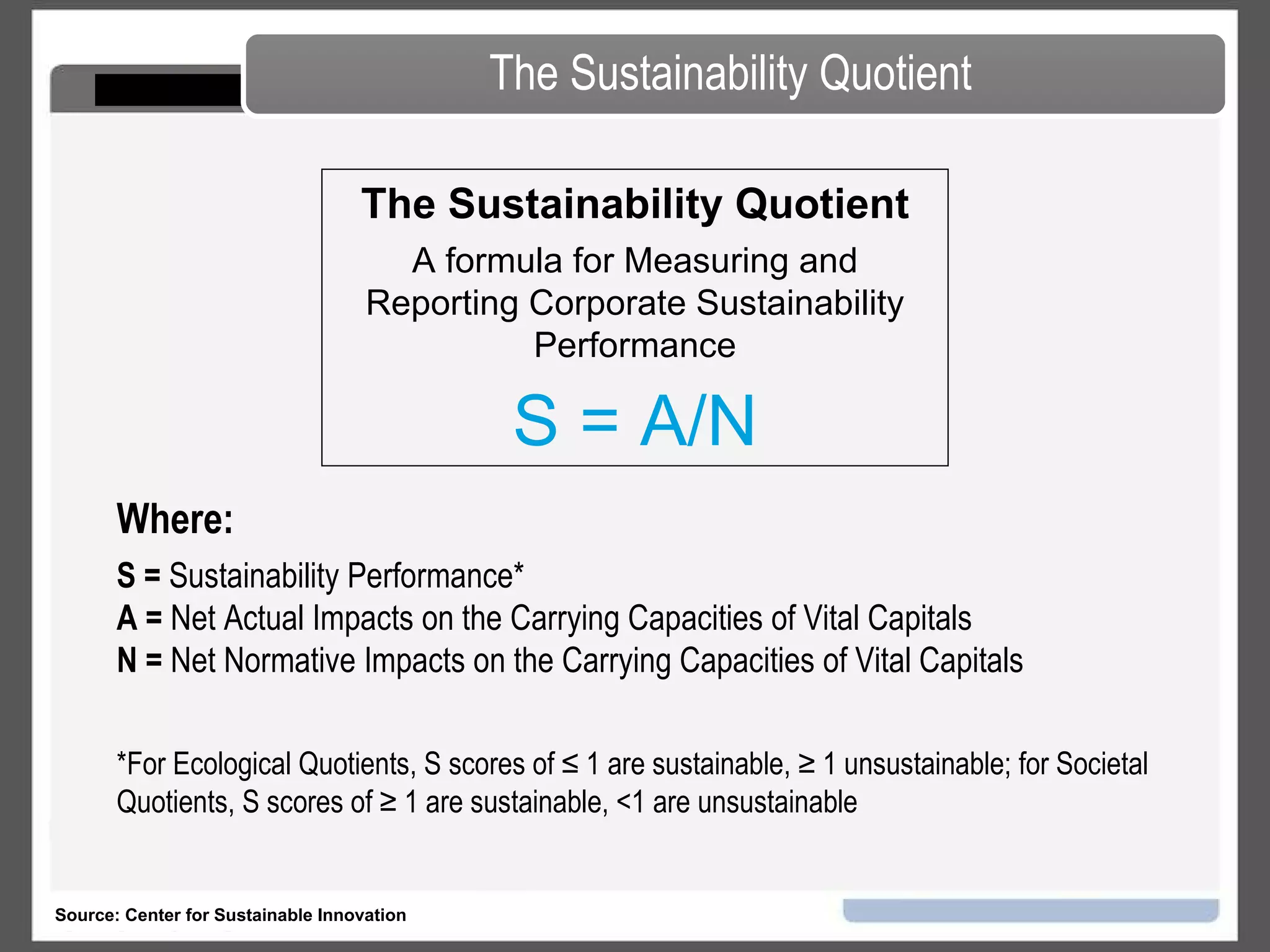
The Sustainability Quotient Source: Center for Sustainable Innovation The Sustainability Quotient A formula for Measuring and Reporting Corporate Sustainability Performance S = A/N Where: S =  Sustainability Performance* A =  Net Actual Impacts on the Carrying Capacities of Vital Capitals N =  Net Normative Impacts on the Carrying Capacities of Vital Capitals *For Ecological Quotients, S scores of ≤ 1 are sustainable, ≥ 1 unsustainable; for Societal  Quotients, S scores of ≥ 1 are sustainable, <1 are unsustainable Source: Center for Sustainable Innovation
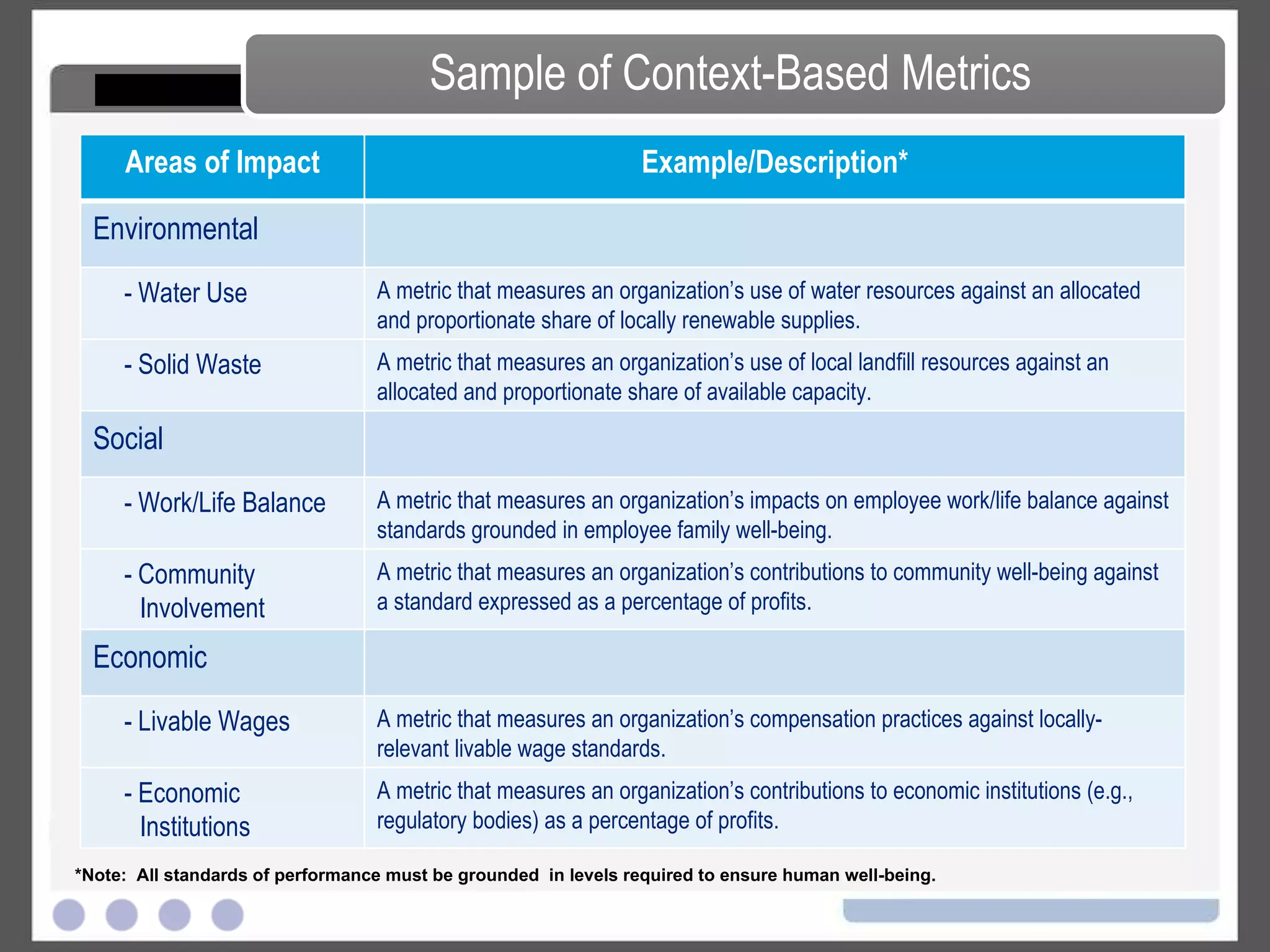
Sample of Context-Based Metrics *Note:  All standards of performance must be grounded  in levels required to ensure human well-being. Areas of Impact Example/Description* Environmental - Water Use A metric that measures an organization’s use of water resources against an allocated and proportionate share of locally renewable supplies. - Solid Waste A metric that measures an organization’s use of local landfill resources against an allocated and proportionate share of available capacity. Social - Work/Life Balance A metric that measures an organization’s impacts on employee work/life balance against standards grounded in employee family well-being. - Community Involvement A metric that measures an organization’s contributions to community well-being against a standard expressed as a percentage of profits. Economic - Livable Wages A metric that measures an organization’s compensation practices against locally-relevant livable wage standards. - Economic Institutions A metric that measures an organization’s contributions to economic institutions (e.g., regulatory bodies) as a percentage of profits.
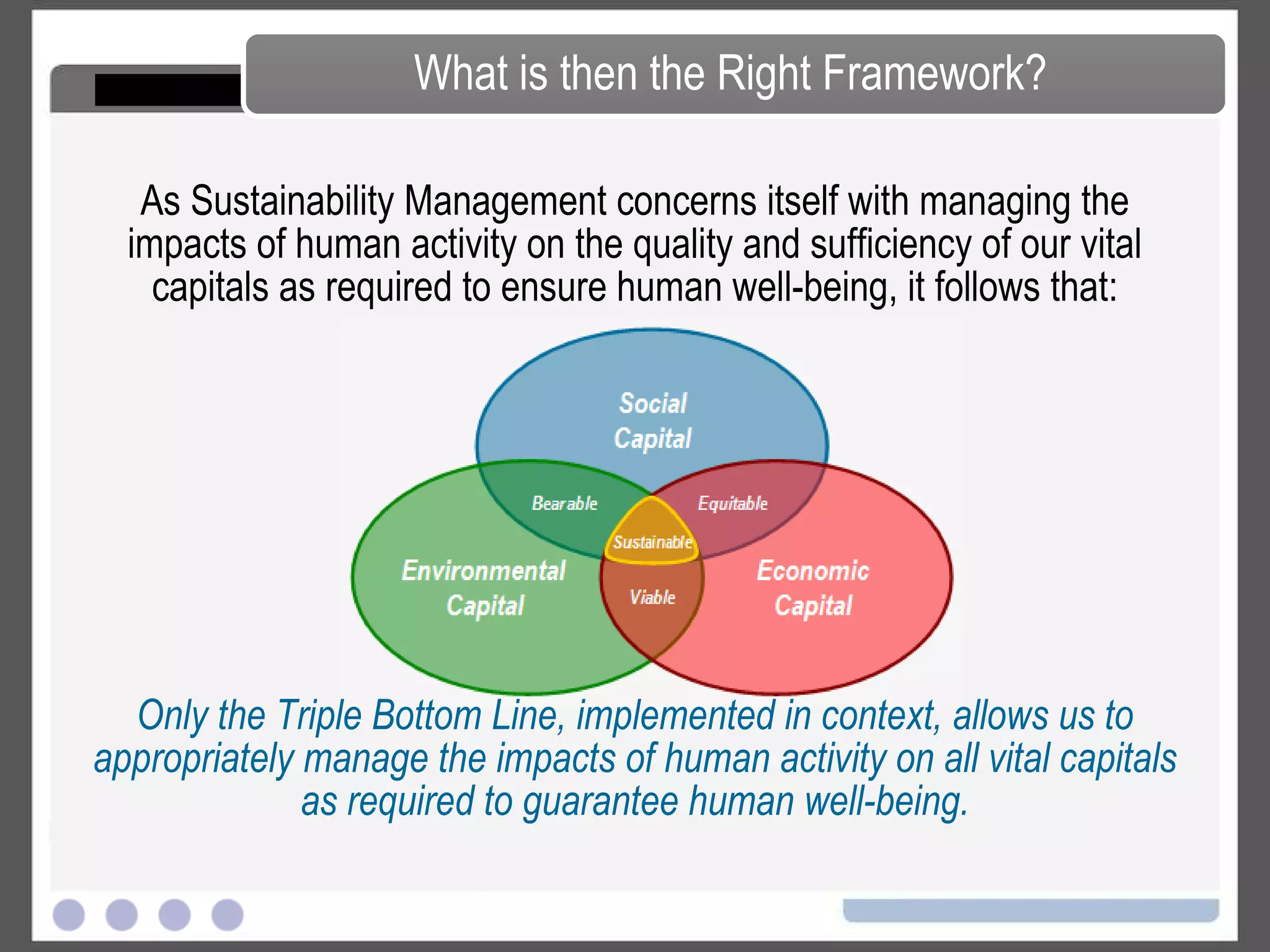
As Sustainability Management concerns itself with managing the impacts of human activity on the quality and sufficiency of our vital capitals as required to ensure human well-being, it follows that: Only the Triple Bottom Line, implemented in context, allows us to appropriately manage the impacts of human activity on all vital capitals as required to guarantee human well-being. What is then the Right Framework?
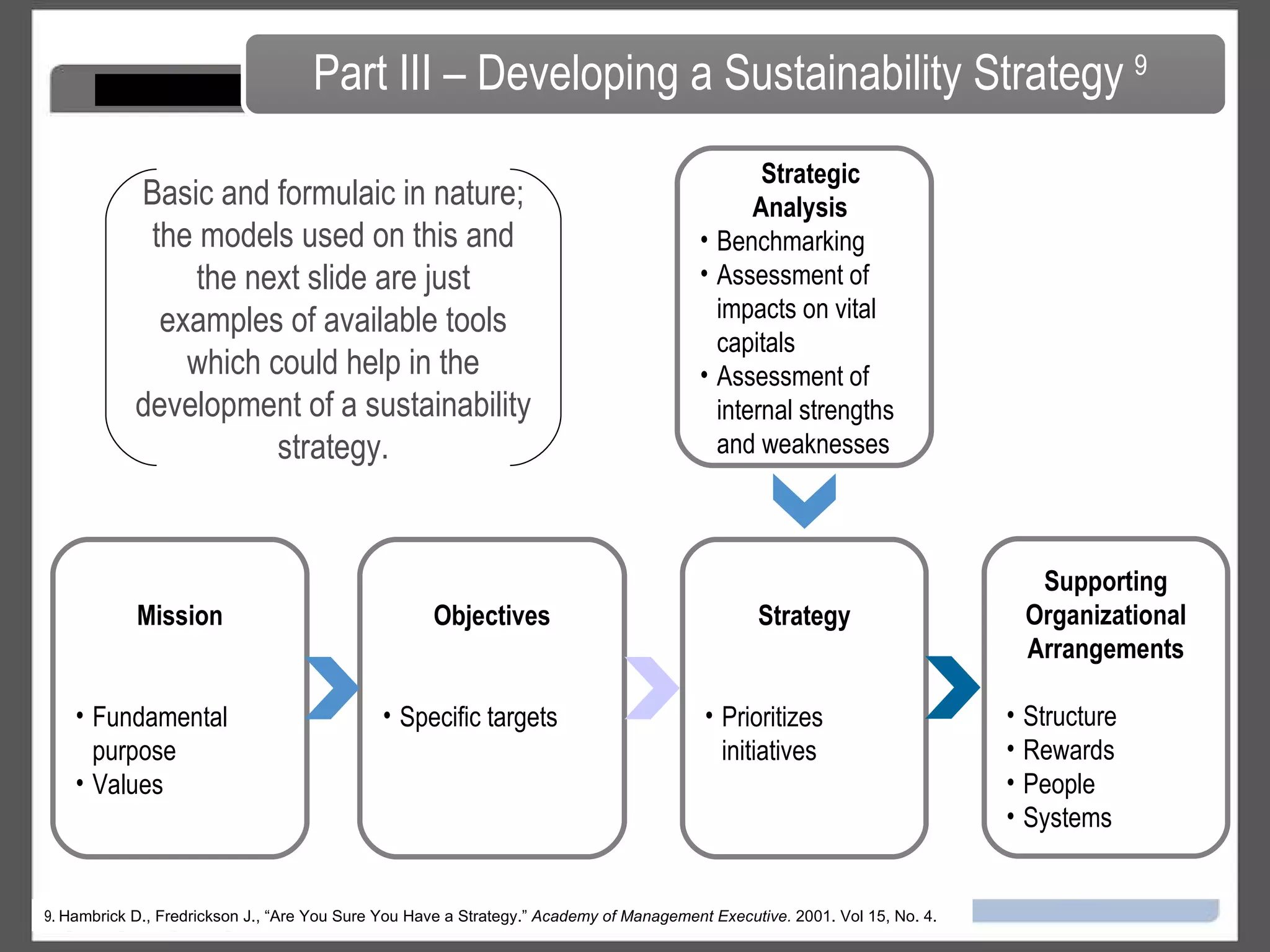
Part III – Developing a Sustainability Strategy  9 Objectives Specific targets Mission Fundamental purpose Values Strategy Prioritizes initiatives Supporting Organizational Arrangements Structure Rewards People Systems Strategic Analysis  Benchmarking Assessment of impacts on vital capitals Assessment of internal strengths and weaknesses 9.  Hambrick D., Fredrickson J., “Are You Sure You Have a Strategy.”  Academy of Management Executive.  2001. Vol 15, No. 4.  Basic and formulaic in nature; the models used on this and the next slide are just examples of available tools which could help in the development of a sustainability strategy.
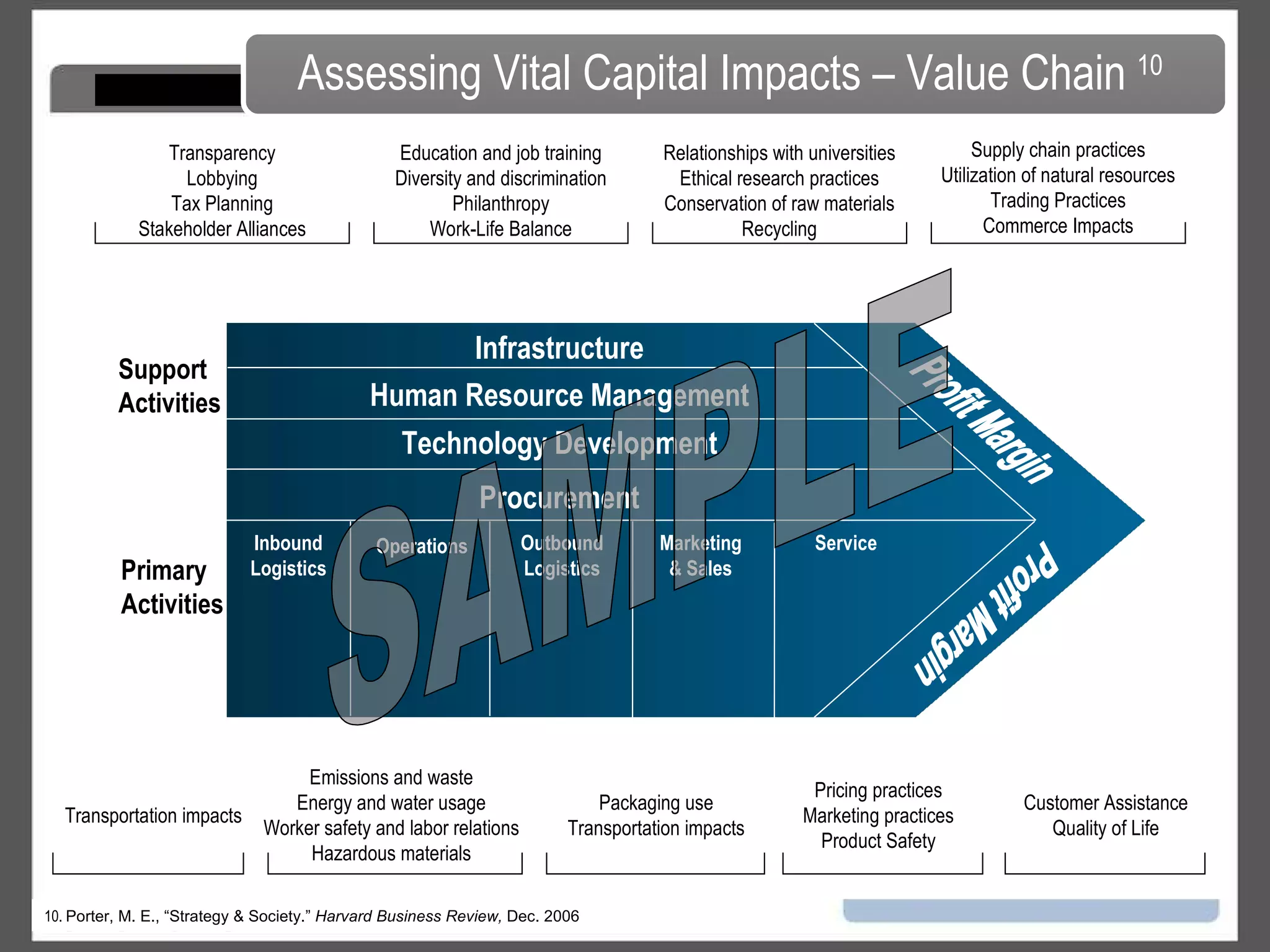
Profit Margin Profit Margin Infrastructure Human Resource Management Technology Development Procurement Inbound Logistics Operations Outbound Logistics Marketing & Sales Service Support Activities Primary Activities Education and job training Diversity and discrimination Philanthropy Work-Life Balance Transportation impacts Pricing practices Marketing practices Product Safety Transparency Lobbying Tax Planning Stakeholder Alliances Supply chain practices Utilization of natural resources Trading Practices Commerce Impacts Emissions and waste Energy and water usage Worker safety and labor relations Hazardous materials Packaging use Transportation impacts Customer Assistance Quality of Life Relationships with universities Ethical research practices Conservation of raw materials Recycling Assessing Vital Capital Impacts – Value Chain  10 10.  Porter, M. E., “Strategy & Society.”  Harvard Business Review,  Dec. 2006   SAMPLE
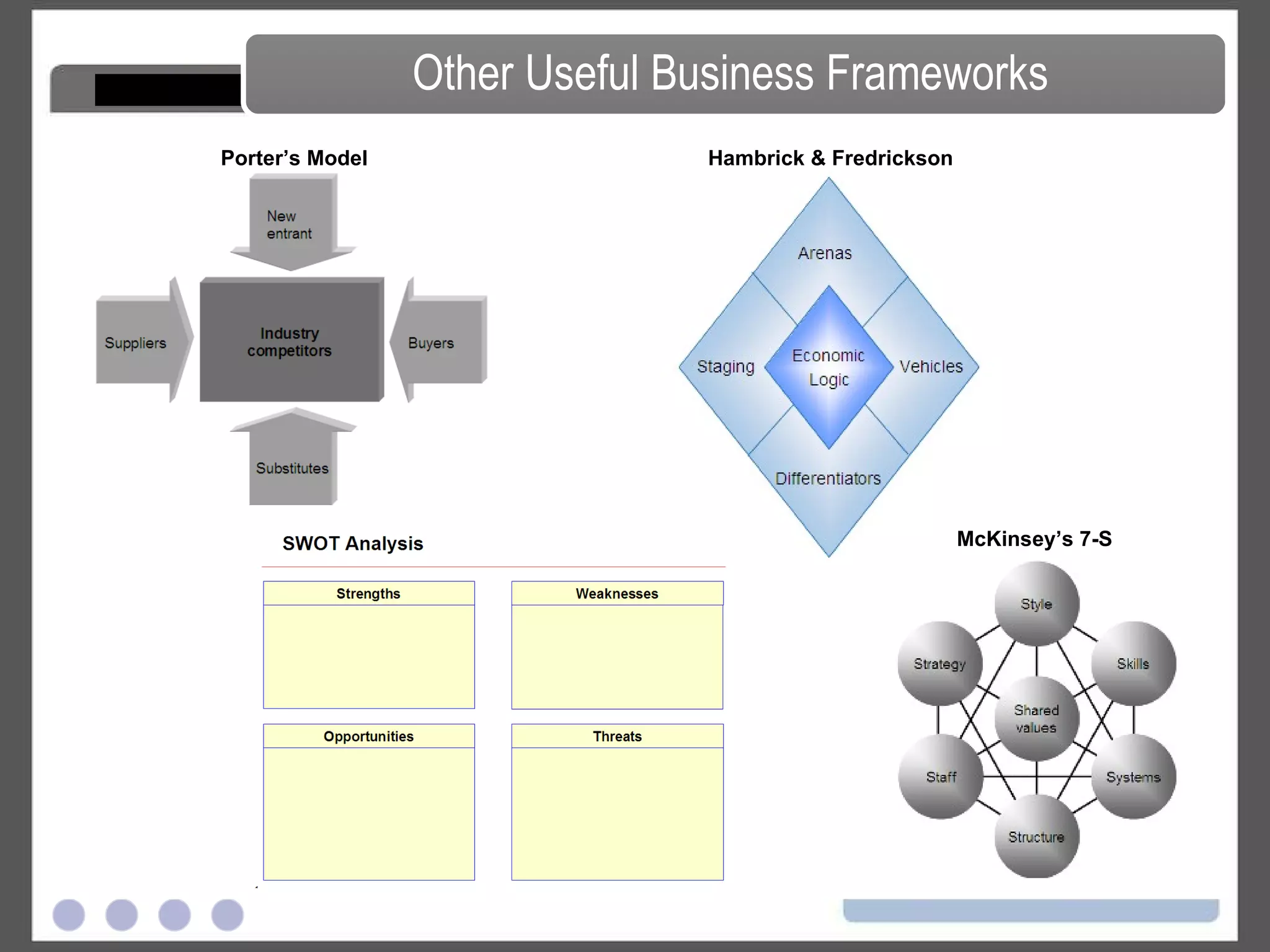
Other Useful Business Frameworks Porter’s Model Hambrick & Fredrickson McKinsey’s 7-S
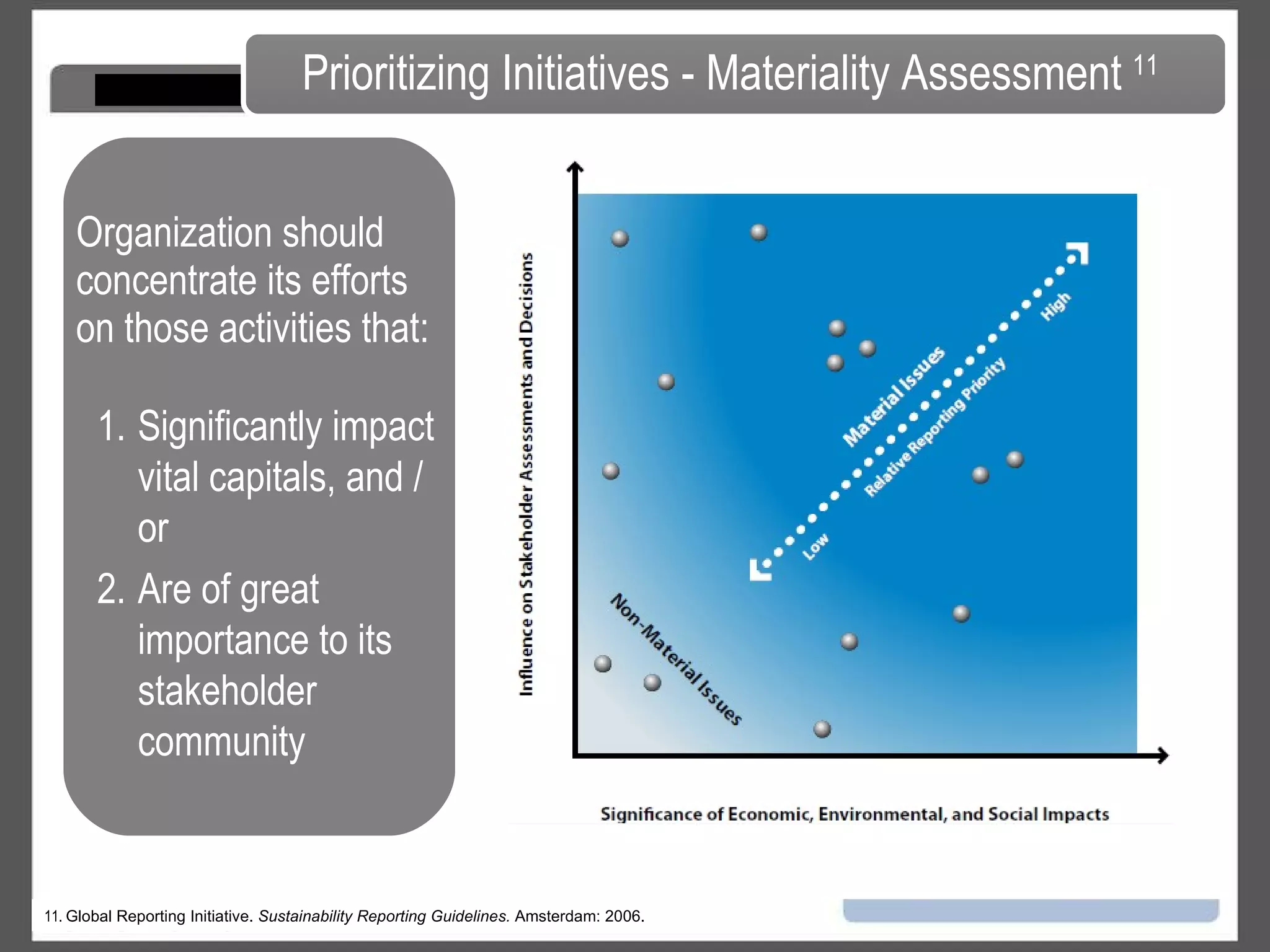
Organization should concentrate its efforts on those activities that: Prioritizing Initiatives - Materiality Assessment  11 11.  Global Reporting Initiative.  Sustainability Reporting Guidelines.  Amsterdam: 2006.  Significantly impact vital capitals, and / or Are of great importance to its stakeholder community
Summary and Conclusion Sustainability  is defined as that subject of management science that  studies  the  impacts  of human activity on the quality and sufficiency  of vital capitals  in the world  as required to ensure human well-being . The  Sustainability Professional  studies and  manages  the  impacts of corporate activities  on the quality and sufficiency of  vital capitals  wherever it operates. Vital capitals include Social, Environmental and Economic capitals .  The Triple Bottom Line approach, together with Context-Based Sustainability, is the Sustainability Management framework which most appropriately studies and manages those vital capitals Management frameworks such as the “Value Chain,” Hambrick and Fredrickson’s model, “McKinsey’s 7-S,” “Five Forces” and SWOT’s are of help in developing a Sustainability Strategy.
“ Our Common Future.”  World Commission on Environment and Development . Aug. 1987. “ Re-Casting the Triple Bottom Line.”  Center for Sustainable Innovation. Jun. 2007   Daly H.,  Beyond Growth: The Economics of Sustainable Development . 253 pp. Boston: Beacon Press, 1996. Henriques A., Richardson J.  The Triple Bottom Line: Does It All Add Up?  London: Earthscan Publications Ltd.., 2004. McElroy, M.  Social Footprints – Measuring the Social Sustainability Performance of Organizations.  Dissertation, 2008 Schmidheiny S.,  Changing Course,  The MIT Press, Boston: Apr. 1992 Elkington J.,  Cannibals with Forks,  Capstone Publishing LTD. Sep.1999. McElroy M., “Sustainability Measurement and Reporting.”  Deloitte . Weston, MA. 2010  Hambrick D., Fredrickson J., “Are You Sure You Have a Strategy.”  Academy of Management Executive.  2001. Vol 15, No. 4.  Porter, M. E., “Strategy & Society.”  Harvard Business Review,  Dec. 2006  Global Reporting Initiative.  Sustainability Reporting Guidelines.  Amsterdam: 2006.  References

Sustainability Defined

  • 1.
    Sustainability Defined SustainabilityDefined Hector R Rodriguez Director of Sustainability at Biogen Idec Adjunct Professor, School of Business at Mount Ida College
  • 2.
    Objectives of thisTalk – An Overview of… What is Sustainability? What is Sustainability Management? Review of tools that assist in developing and implementing a Sustainability Strategy
  • 3.
    Challenges of thisDefinition Does not address resource consumption issues, nor the distinction between renewable resources and non-renewable resources. Does not really answer the question of what sustainability means and also leaves it to our imagination to determine which “needs” are legitimate and which ones are not. 2 Part I - What is Sustainability? Traditional Definition Sustainable development is development that meets the needs of the present without compromising the ability of future generations to meet their own needs. 1 Philosophically, Sustainability could be thought of as the goal and Sustainable Development one of the requirements needed to achieve it… 1. “Our Common Future.” World Commission on Environment and Development . Aug. 1987. 2. “Re-Casting the Triple Bottom Line.” Center for Sustainable Innovation. Jun. 2007
  • 4.
    Is it possiblefor the rate of human use of renewable resources to exceed the rate at which such resources are renewed or replenished? Addresses questions such as: 3 A Better Definition of Sustainability… 3. Daly H., Beyond Growth: The Economics of Sustainable Development . 253 pp. Boston: Beacon Press, 1996. Is it possible for the rate of human use of non-renewable resources to exceed the rate at which renewable replacements for such resources are developed? Is it possible for the rate of waste emissions by humans to exceed the rate at which the environment can assimilate such wastes? Is it possible for the rate of human, social, constructed and economic needs to exceed the rate at which they are being created? YES… Freshwater… fisheries… clean soil YES… e.g. Minerals… Oil… Subsidies required for renewable resources YES… e.g. Superfund sites… Contaminated rivers… Smog YES… Healthcare in Africa… Education in the US… Infrastructure in Mexico…
  • 5.
    As the answersto the questions on the previous slide can be yes, we can say that the human activities associated with them are unsustainable. A Better Definition of Sustainability… (cont) In order to be sustainable, we must therefore address the impacts of human activity on the quality and sufficiency of vital capitals (renewable, non-renewable and societal) in the world.
  • 6.
    “ Capital” isa stock of anything that yields a flow of valuable goods or services to people who need them. Sustainability must therefore address and manage the impacts of human activity on the quality and sufficiency of vital capitals in the world… What is Capital? Linking Vital Capitals and Well-Being…
  • 7.
    This is thecapitals-based theory of sustainability, the foundation for most of what passes for mainstream practice in Sustainability Management. Vital Capitals and Well-Being Economic Capital Social Capital Environmental Capital Available flows of beneficial goods and services Appropriated by individuals and collectives Resulting in levels of individual and collective well-being CAPITAL FLOWS
  • 8.
    Environmental Capital Isthe extension of the economic notion of capital to environmental goods and services. Environmental capital is thus the stock of natural ecosystems that yields a flow of valuable ecosystem goods or services into the future. For example, a stock of trees or fish provides a flow of new trees or fish, a flow which can be sustainable indefinitely. Environmental capital may also provide services like recycling wastes, water treatment and removal of air contaminants.
  • 9.
    Social Capital Socialcapitals required for human well-being include: Human capital - Individual knowledge, skills, and other assets (including human rights) required to take effective individual action. Community capital - Shared knowledge and cooperative networks of people committed to achieving common goals (schools, hospitals, government, etc.) Constructed capital - The material world that humans produce such as roads, utilities, etc. Also known as anthropogenic capital, because these capitals are produced by humans
  • 10.
    Should not tobe confused with financial capital “ So, while the economic component of the triple bottom line is often assumed to be synonymous with financial performance [i.e., with the financial bottom line], in fact, there are significant differences between the two ….[E]conomics extends beyond the boundaries of a single organization ….A company’s investment in a community can serve as an engine of growth in the economy through employment, boosting local supply chains and developing a new skills base. The goods and services that companies produce can also contribute to a higher quality of life.” 4 Economic Capital 4. Henriques A., Richardson J. The Triple Bottom Line: Does It All Add Up? London: Earthscan Publications Ltd.., 2004.
  • 11.
    Economic Capital Thereare many, and could be considered variants of social capital: Employment rates Employees’ wealth Owners’ wealth Local, regional and global commerce Trading partners Customers Community economic affairs Etc. This diagram depicts an outdated model… Economic Capital is not just about profit…
  • 12.
    What is thenSustainability? 5. McElroy, M. Social Footprints – Measuring the Social Sustainability Performance of Organizations. Dissertation, 2008 The Sustainability Professional studies and manages the impacts of an organizations’ activities on the quality and sufficiency of vital capitals wherever it operates, as required to ensure human well-being. Sustainability is the subject of a social or management science that studies and manages the impacts of human activity on the quality and sufficiency of vital capitals in the world, as required to ensure human well-being . 5
  • 13.
    Part II -What is Sustainability Management (SM)? Sustainability Management Enterprise Orientation Social Benevolence Eco-efficiency Triple Bottom-Line Context Based Orientation Life Cycle Orientation Environmental Capital Economic Capital Social Capital LCA’s of Products and Services Environmental Capital Social Capital (Emerging) Refresher: to achieve Sustainability, SM must address all three vital capitals 1 2 3 4 5
  • 14.
    Life-Cycle Orientation Ashere defined, LCA’s form an important element of Sustainability Management 1 Product- and life-cycle-based Takes the position that it is more important to influence the environmental impact of a product throughout its entire life cycle This approach examines the impact of a product from its inception as a raw material to its ultimate disposal following consumer use Emerging UNEP-driven initiative
  • 15.
    Eco-efficiency Social BenevolenceTriple Bottom Line Context-based Sustainability Enterprise Orientation – Four Schools of Thought
  • 16.
    “ Industry ismoving toward ‘demanufacturing’ and ‘remanufacturing’ — that is, recycling the materials in their products and thus limiting the use of raw materials and of energy to convert those raw materials…It is the more competitive and successful companies that are in the forefront of what we call ‘eco-efficiency’ ” 6 Arguably the basis of the “green” movement; also the basis of LCAs. As eco-efficiency narrowly evaluates economic implications (profit only), and tends to ignore social concerns, it could at most be considered an element of Sustainability Management. Eco-Efficiency 6. Schmidheiny S., Changing Course, The MIT Press, Boston: Apr. 1992 2
  • 17.
    Social benevolence viewssustainability in terms of social responsibility and philanthropy. Companies that adhere to this view tend to focus on social and economic impacts, and less in terms of environmental performance. As such, social benevolence can be considered an element of Sustainability Management. …“ is the continuing commitment by business to behave ethically and contribute to economic development while improving the quality of life of the workforce and their families as well as of the local community and society at large” (WBCSD, 1999) Social Benevolence (Corporate Social Responsibility) 3
  • 18.
    “ Today wethink in terms of a ‘triple bottom line,’ focusing on economic prosperity, environmental quality, and social justice.” 7 Explicitly pluralistic in its orientation: social, economic, and environmental. Arguably the dominant sustainability paradigm in use today, including reporting requirements under the GRI. Triple Bottom Line 7. Elkington J., Cannibals with Forks, Capstone Publishing LTD. Sep.1999. 4
  • 19.
    Context-Based Sustainability 8 8. McElroy M., “Sustainability Measurement and Reporting.” Deloitte . Weston, MA. 2010 5 An approach that quantitatively express sustainability performance in the form of a quotient Numerators represent actual impacts on vital capitals Denominators represent normative impacts on the same vital capitals Most mainstream tools and methods have been numerator only in scope While denominators are normative, they are usually grounded in factual claims about the world Ecological limits Minimal social and/or economic conditions required for human well-being
  • 20.
    Here’s the CompanyX performance with context missing Context-Based vs. Context-Free Example Source: Center for Sustainable Innovation
  • 21.
    Sustainability Threshold (performanceabove threshold is unsustainable) Here’s the Company X performance with context added Context-Based vs. Context-Free Example (cont.) Source: Center for Sustainable Innovation
  • 22.
    Another hypothetical scenarioContext-Based vs. Context-Free Example (cont.) Source: Center for Sustainable Innovation Sustainability Threshold (performance above threshold is unsustainable)
  • 23.
    The Sustainability QuotientSource: Center for Sustainable Innovation The Sustainability Quotient A formula for Measuring and Reporting Corporate Sustainability Performance S = A/N Where: S = Sustainability Performance* A = Net Actual Impacts on the Carrying Capacities of Vital Capitals N = Net Normative Impacts on the Carrying Capacities of Vital Capitals *For Ecological Quotients, S scores of ≤ 1 are sustainable, ≥ 1 unsustainable; for Societal Quotients, S scores of ≥ 1 are sustainable, <1 are unsustainable Source: Center for Sustainable Innovation
  • 24.
    Sample of Context-BasedMetrics *Note: All standards of performance must be grounded in levels required to ensure human well-being. Areas of Impact Example/Description* Environmental - Water Use A metric that measures an organization’s use of water resources against an allocated and proportionate share of locally renewable supplies. - Solid Waste A metric that measures an organization’s use of local landfill resources against an allocated and proportionate share of available capacity. Social - Work/Life Balance A metric that measures an organization’s impacts on employee work/life balance against standards grounded in employee family well-being. - Community Involvement A metric that measures an organization’s contributions to community well-being against a standard expressed as a percentage of profits. Economic - Livable Wages A metric that measures an organization’s compensation practices against locally-relevant livable wage standards. - Economic Institutions A metric that measures an organization’s contributions to economic institutions (e.g., regulatory bodies) as a percentage of profits.
  • 25.
    As Sustainability Managementconcerns itself with managing the impacts of human activity on the quality and sufficiency of our vital capitals as required to ensure human well-being, it follows that: Only the Triple Bottom Line, implemented in context, allows us to appropriately manage the impacts of human activity on all vital capitals as required to guarantee human well-being. What is then the Right Framework?
  • 26.
    Part III –Developing a Sustainability Strategy 9 Objectives Specific targets Mission Fundamental purpose Values Strategy Prioritizes initiatives Supporting Organizational Arrangements Structure Rewards People Systems Strategic Analysis Benchmarking Assessment of impacts on vital capitals Assessment of internal strengths and weaknesses 9. Hambrick D., Fredrickson J., “Are You Sure You Have a Strategy.” Academy of Management Executive. 2001. Vol 15, No. 4. Basic and formulaic in nature; the models used on this and the next slide are just examples of available tools which could help in the development of a sustainability strategy.
  • 27.
    Profit Margin ProfitMargin Infrastructure Human Resource Management Technology Development Procurement Inbound Logistics Operations Outbound Logistics Marketing & Sales Service Support Activities Primary Activities Education and job training Diversity and discrimination Philanthropy Work-Life Balance Transportation impacts Pricing practices Marketing practices Product Safety Transparency Lobbying Tax Planning Stakeholder Alliances Supply chain practices Utilization of natural resources Trading Practices Commerce Impacts Emissions and waste Energy and water usage Worker safety and labor relations Hazardous materials Packaging use Transportation impacts Customer Assistance Quality of Life Relationships with universities Ethical research practices Conservation of raw materials Recycling Assessing Vital Capital Impacts – Value Chain 10 10. Porter, M. E., “Strategy & Society.” Harvard Business Review, Dec. 2006 SAMPLE
  • 28.
    Other Useful BusinessFrameworks Porter’s Model Hambrick & Fredrickson McKinsey’s 7-S
  • 29.
    Organization should concentrateits efforts on those activities that: Prioritizing Initiatives - Materiality Assessment 11 11. Global Reporting Initiative. Sustainability Reporting Guidelines. Amsterdam: 2006. Significantly impact vital capitals, and / or Are of great importance to its stakeholder community
  • 30.
    Summary and ConclusionSustainability is defined as that subject of management science that studies the impacts of human activity on the quality and sufficiency of vital capitals in the world as required to ensure human well-being . The Sustainability Professional studies and manages the impacts of corporate activities on the quality and sufficiency of vital capitals wherever it operates. Vital capitals include Social, Environmental and Economic capitals . The Triple Bottom Line approach, together with Context-Based Sustainability, is the Sustainability Management framework which most appropriately studies and manages those vital capitals Management frameworks such as the “Value Chain,” Hambrick and Fredrickson’s model, “McKinsey’s 7-S,” “Five Forces” and SWOT’s are of help in developing a Sustainability Strategy.
  • 31.
    “ Our CommonFuture.” World Commission on Environment and Development . Aug. 1987. “ Re-Casting the Triple Bottom Line.” Center for Sustainable Innovation. Jun. 2007 Daly H., Beyond Growth: The Economics of Sustainable Development . 253 pp. Boston: Beacon Press, 1996. Henriques A., Richardson J. The Triple Bottom Line: Does It All Add Up? London: Earthscan Publications Ltd.., 2004. McElroy, M. Social Footprints – Measuring the Social Sustainability Performance of Organizations. Dissertation, 2008 Schmidheiny S., Changing Course, The MIT Press, Boston: Apr. 1992 Elkington J., Cannibals with Forks, Capstone Publishing LTD. Sep.1999. McElroy M., “Sustainability Measurement and Reporting.” Deloitte . Weston, MA. 2010 Hambrick D., Fredrickson J., “Are You Sure You Have a Strategy.” Academy of Management Executive. 2001. Vol 15, No. 4. Porter, M. E., “Strategy & Society.” Harvard Business Review, Dec. 2006 Global Reporting Initiative. Sustainability Reporting Guidelines. Amsterdam: 2006. References

Editor's Notes

  • #3 In a sense it is like the story of the blindfolded individuals who were asked to describe a massive object by touch. Each explored a different part, and each described quite accurately his or her own reality. The reality of what is going on in our professions is not defined by the personal experiences of a few, but the combined wisdom of many—collectively taking off the blindfold, so to speak.