Preclinical screening methods of
Antihypertensive agents
(for MD Pharmacology)
- Dr. Advaitha M V
Introduction
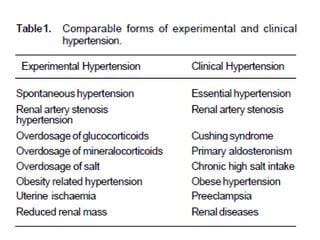
• The animal models of hypertension share many
features which are common to human
hypertension.
• Many of these models have been developed by
utilizing the etiological factors that are presumed
to be responsible for human hypertension.
Excessive salt intake.
Hyperactivity of renin-angiotensin- aldosterone
system (RAAS) and
Genetic factors.
An ideal animal model of hypertension criteria
• It should be feasible in small animals.
• Simple to perform and uniformly reproducible.
• Should be able to predict the potential
antihypertensive properties of an agent.
• Consume minimal quantities of compounds.
• It should be comparable to some form of human
hypertension.
Animals used
• In the past, most studies
on experimental hypertension were carried
out on Dogs.
• Currently, rat is the preferred animal species.
• Spontaneous hypertensive rat (SHR), the
genetic strain of hypertensive rat, is the
animal of choice.
Types of animal models of
hypertension
1. Renovascular hypertension
2. Dietary hypertension
3. Endocrine hypertension
4. Neurogenic hypertension
5. Psychogenic hypertension
6. Genetic hypertension
7. Other models
1. Renovascular Hypertension
• This is a very commonly used model of
hypertension.
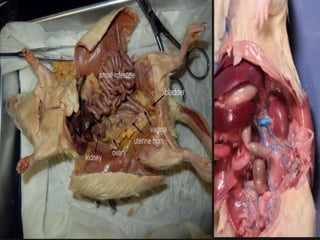
• Experimentally, renal hypertension is
produced by constriction of renal artery.
• This activates peripheral RAAS and
sympathetic nervous system.
Methods of inducing renovascular
hypertension
Goldblatt method:
Goldblatt et al (1934)
• He reported that a partial constriction of renal
arteries in dogs produced hypertension.
• This type of hypertension has also been
induced in rabbits, rats and monkeys.
• Rats weighing from 120 to 200 g are
anaesthetized with hexobarbitone sodium (40
mg/kg body weight).
• A silver clip of 0.2 mm internal diameter is
placed on the left renal artery close to the
aorta.
• The renal artery in rats can also be ligated
with 4-0 silk suture.
• Constriction of renal artery should be more
than 50%.
• The animal is considered hypertensive if
systolic BP is more than 160 mm Hg for two
consecutive days after 4 weeks of
ligation/application of clip.
• Three variants of hypertension produced by
Goldblatt method-
• Two kidney one clip (2K1C) hypertension
• One kidney one clip (1K1C) hypertension
• Two kidney two clip (2K2C) hypertension
Two kidney one clip (2K1C) hypertension
• The renal artery is constricted on only one side
with the other artery (or kidney) left untouched.
• This results in a sustained increase in BP.
• Initially , there is no salt and water retention
because of the other normal kidney being intact.
• So , the resultant hypertension at this stage is
renin-angiotensin dependent.
• After about 6 weeks, the increased angiotensin-
II releases aldosterone from adrenal cortex
leading to gradual retention of salt and water.
• Retention of salt and water leads to decreased
renin production.
• From this stage onwards, hypertension is
volume dependent.
One kidney one clip (1K1C) hypertension
• Constriction of renal artery is done on one side
and the contra lateral kidney is removed.
• There is an increase in BP within a few hours.
• Since there is no contra lateral kidney, there is
no pressure diuresis and natriuresis.
• So there is rapid salt and water retention.
• Plasma renin activity is usually normal.
• Hypertension soon becomes volume
dependent
Two kidney two clip (2K2C) hypertension
• Constriction of aorta or both renal arteries is
done.
• There is a patchy ischemic kidney tissue, which
secretes renin leading to increased BP.
• The remaining kidney tissue retains salt and
water.
• one of the most common causes of renal
hypertension in human beings is (such) a patchy
ischaemic kidney disease.
Hypertension induced by external
compression of renal parenchyma
Grollman hypertension
• In this method, kidney tissue is compressed by
securing a 'figure of 8' ligature.
• It is of two types:
• Two kidney one ligature (2K1L)
• One kidney one ligature (1K1L)
Reduced renal mass
• Reducing renal tissue to five-sixth (5/6th) by
renal mass ablation produces hypertension.
• Here , the right kidney is removed and 2 or 3
branches of left renal artery are ligated.
• This is to produce infarction of approximately
2/3rd of the left kidney.
2. Dietary hypertension:
I. Increased salt intake:
• Chronic ingestion of excess salt produces
hypertension in rats, which mimics human
hypertension morphologically.
• High salt intake hypertension has been
produced in rats, rabbits and chicks by replacing
drinking water with 1-2% sodium chloride for 9-
12 months.
• This method is also used to cause Accelerated
high pressure in renal hypertension.
3. Endocrine hypertension
DOCA-Salt induced HTN
• Selye et al was the first to demonstrate that
deoxycorticosterone acetate (DOCA) produces
hypertension in rats.
• There is increased DOCA-induced reabsorption of
salt and water leading to increased blood volume
and hence increased BP.
• There is also increased secretion of vasopressin
leading to water retention and vasoconstriction.
• In addition, altered activity of RAAS leads to
increased sympathetic activity
• Rats, especially female and young, are prone
to DOCA-salt induced hypertension.
• DOCA induced hypertension is salt dependent
(neither administration of DOCA nor partial
removal of renal mass is effective in increasing
BP when applied without salt Administration).
To produce hypertension,
• Rats weighing about 100 g are kept on a diet
high in sodium chloride and drinking water is
replaced by 2% sodium chloride solution.
• After they attain a weight of about 250 g, they
are given DOCA dissolved in sesame seed oil
at a dose of 10 mg/kg SC, twice weekly for 4
weeks.
4. Neurogenic hypertension
• One of the most important negative feedback in
the control of BP originates from baroreceptors
in the carotid sinus and aortic arch.
• Afferents of baroreceptors travel along 9th and
10th cranial nerves.
• Sectioning of the baroreceptor nerves leads to
persistent rise in BP.
• Suitable in dogs, cats and rabbits
5. Psychogenic hypertension
• Repeated exposure to stressful situation may
lead to a state of persistent hypertension.
• Borderline hypertensive rats (BHR) are useful
for psychogenic hypertension.
• BHRs that were exposed to daily sessions of
either short (20 min) or long (120 min)
duration air-jet stimulation developed
hypertension within 2 weeks.
• Stress plays an important part in development
of human hypertension.
• So, This model is also very frequently used to
study the pathophysiology of hypertension.
6. Genetic hypertension
• The so called ‘spontaneous hypertensive rat
(SHR)’ was developed by meticulous genetic
inbreeding by Okamoto and Aoki.
• This inbreeding resulted in 100% of the
progeny having naturally occurring
hypertension
How are SHR ?
• In SHRs, BP gradually increases until it is
maintained at a markedly elevated level after
approximately 12 weeks of age.
• In unrestrained male SHRs, mean arterial
pressure is approximately 190- 200 mm Hg as
compared to 115-130 mm Hg in normal rats.
• During the early stable stages and
developmental phase of hypertension-
elevated BP is maintained in large part by
enhanced central sympathetic outflow.
• In the later stages
Increased total peripheral resistance.
normal cardiac output
decreased permeability of the glomerular
membranes
Forms the basis for the long term maintenance of
the hypertension
• SHRs also develop typical complications of
hypertension.
• There are Stroke prone SHRs (SHRSP), which are
selectively bred among SHRs.
• These develop cerebrovascular lesions
spontaneously in over 80% of rats.
• Because of apparent similarities of the SHR to
essential hypertension-
SHR models are highly recommended for
screening potential drug candidates for
hypertension
• Other models
Obesity-related hypertension
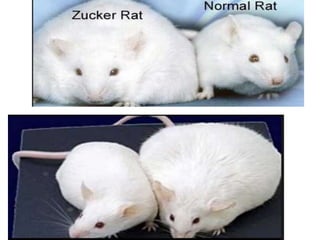
• Wistar fatty rats (WFR) are derived from cross
between obese Zucker and Wistar Kyoto rats.
• These show persistent hyperinsulinemia and
hypertension after 16 weeks of age.
• A good model to elucidate the relationship
between hyperinsulinemia and hypertension.
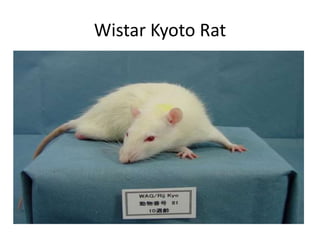
Wistar Kyoto Rat
Transgenic rat (TGR) models
• Transgenic models of hypertension have
revolutionized the experimental work on
hypertension.
• Here , an additional renin gene, the murine
Ren-2 gene, is introduced into the germ line of
rats.
• This results in transgenic hypertensive rat
strain, TGR (mREN2).
• It has an overexpression of renin.
• Linkage has been described for the
angiotensinogen gene in human hypertension.
• TGR model are also useful for studying the
role of local RAAS system in hypertension.
Others
• Angiotensin-II induced hypertension.
• Hypertension induced by cadmium
• Chronic nitric oxide inhibition-induced
hypertension.
How to measure BP ?
Direct Method :
• It is a invasive procedure.
• A week before the drug adminstration, The
animals are anesthetized.
• Femoral/Carotid Cannula is inserted.
• On the day of screening, cannula is connected to
a mercury manometer or a pressure transducer.
• BP is measured
In rats
• A week before the experiment, each rat is
anaesthetised with 40 mg/kg pentobarbital.
• Left or right carotid artery or femoral artery is
cannulated under aseptic conditions with
polyethylene cannula filled with 1% heparin in
normal saline.
• Free end of the cannula is passed under the skin
and allowed to protrude 3-4 cm from the skin
behind the ears of the rat.
• The skin incisions are sutured and a plastic
skin dressing is applied.
• After recovery from anaesthesia (2-2.5 h) each
rat is placed in an individual cage for 24 h
habituation period
• On the day of expt., Cannula is connected to
a pressure transducer then to the
pre-amplifier.
• BP is recorded on the polygraph or
physiograph.
Non-Invasive/ Indirect method :
In rats
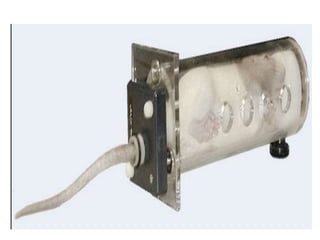
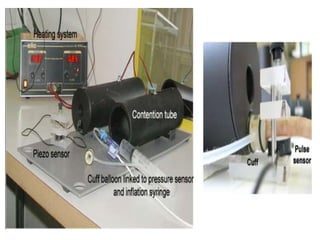
Tail cuff Method :
• It is a common and convenient method.
• Tail cuff is inflated and then deflated.
• Pulsations disappear when cuff is inflated.
• When cuff is deflated, pulsations start
appearing when pressure in the cuff equals
systolic pressure.
• The cuff is attached to a tail cuff
sphygmomano-meter or pressure transducer
and BP is recorded on a chart.
• Tail swelling method.
• Foot swelling method.
Effects of antihypertensive agents
• Antihypertensive drugs, according to their
mode of action, will affect the blood pressure
in certain types of experimental hypertension,
and not in all !
• Vasodilators like minoxidil, hydralazine and
diazoxide are effective in renal hypertensive
rats.
• CCB, ACE inhibitors and AT-1 antagonists
decrease BP in 5/6 nephrectomised SHR
• Diuretics, are active in mineralocorticoid or
salt induced hypertension.
• Sympathomimetic Drugs decrease BP in both
endocrine and neurogenic hypertension.
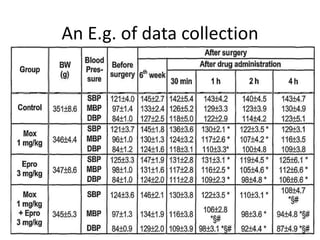
An E.g. of data collection
Invitro models
• Endocrine receptor antagonism in porcine
isolated heart
• Monocrantaline-induced pulmonary
hypertension.
References
• D.K. BADYAL, H. LATA , A.P. DADHICH. ANIMAL MODELS OF
HYPERTENSION AND EFFECT OF DRUGS. Indian Journal of
Pharmacology 2003; 35: 349-362.
• Journal of Visualized Experiments videos
Video downloads from
http://www.ncbi.nlm.nih.gov/pmc/articles/P
MC2794298/bin/jove-27-1291.flv
http://www.ncbi.nlm.nih.gov/pmc/articles/P
MC3462562/bin/jove-59-3496.mov
Thank You

Screening Methods of Antihypertensive Agents

  • 1.
    Preclinical screening methodsof Antihypertensive agents (for MD Pharmacology) - Dr. Advaitha M V
  • 2.
    Introduction • The animalmodels of hypertension share many features which are common to human hypertension. • Many of these models have been developed by utilizing the etiological factors that are presumed to be responsible for human hypertension. Excessive salt intake. Hyperactivity of renin-angiotensin- aldosterone system (RAAS) and Genetic factors.
  • 3.
    An ideal animalmodel of hypertension criteria • It should be feasible in small animals. • Simple to perform and uniformly reproducible. • Should be able to predict the potential antihypertensive properties of an agent. • Consume minimal quantities of compounds. • It should be comparable to some form of human hypertension.
  • 6.
    Animals used • Inthe past, most studies on experimental hypertension were carried out on Dogs. • Currently, rat is the preferred animal species. • Spontaneous hypertensive rat (SHR), the genetic strain of hypertensive rat, is the animal of choice.
  • 7.
    Types of animalmodels of hypertension 1. Renovascular hypertension 2. Dietary hypertension 3. Endocrine hypertension 4. Neurogenic hypertension 5. Psychogenic hypertension 6. Genetic hypertension 7. Other models
  • 8.
  • 9.
    • This isa very commonly used model of hypertension. • Experimentally, renal hypertension is produced by constriction of renal artery. • This activates peripheral RAAS and sympathetic nervous system.
  • 11.
    Methods of inducingrenovascular hypertension Goldblatt method: Goldblatt et al (1934) • He reported that a partial constriction of renal arteries in dogs produced hypertension. • This type of hypertension has also been induced in rabbits, rats and monkeys.
  • 12.
    • Rats weighingfrom 120 to 200 g are anaesthetized with hexobarbitone sodium (40 mg/kg body weight). • A silver clip of 0.2 mm internal diameter is placed on the left renal artery close to the aorta. • The renal artery in rats can also be ligated with 4-0 silk suture.
  • 13.
    • Constriction ofrenal artery should be more than 50%. • The animal is considered hypertensive if systolic BP is more than 160 mm Hg for two consecutive days after 4 weeks of ligation/application of clip.
  • 14.
    • Three variantsof hypertension produced by Goldblatt method- • Two kidney one clip (2K1C) hypertension • One kidney one clip (1K1C) hypertension • Two kidney two clip (2K2C) hypertension
  • 15.
    Two kidney oneclip (2K1C) hypertension • The renal artery is constricted on only one side with the other artery (or kidney) left untouched. • This results in a sustained increase in BP. • Initially , there is no salt and water retention because of the other normal kidney being intact. • So , the resultant hypertension at this stage is renin-angiotensin dependent.
  • 16.
    • After about6 weeks, the increased angiotensin- II releases aldosterone from adrenal cortex leading to gradual retention of salt and water. • Retention of salt and water leads to decreased renin production. • From this stage onwards, hypertension is volume dependent.
  • 17.
    One kidney oneclip (1K1C) hypertension • Constriction of renal artery is done on one side and the contra lateral kidney is removed. • There is an increase in BP within a few hours. • Since there is no contra lateral kidney, there is no pressure diuresis and natriuresis.
  • 18.
    • So thereis rapid salt and water retention. • Plasma renin activity is usually normal. • Hypertension soon becomes volume dependent
  • 19.
    Two kidney twoclip (2K2C) hypertension • Constriction of aorta or both renal arteries is done. • There is a patchy ischemic kidney tissue, which secretes renin leading to increased BP. • The remaining kidney tissue retains salt and water. • one of the most common causes of renal hypertension in human beings is (such) a patchy ischaemic kidney disease.
  • 20.
    Hypertension induced byexternal compression of renal parenchyma Grollman hypertension • In this method, kidney tissue is compressed by securing a 'figure of 8' ligature. • It is of two types: • Two kidney one ligature (2K1L) • One kidney one ligature (1K1L)
  • 21.
    Reduced renal mass •Reducing renal tissue to five-sixth (5/6th) by renal mass ablation produces hypertension. • Here , the right kidney is removed and 2 or 3 branches of left renal artery are ligated. • This is to produce infarction of approximately 2/3rd of the left kidney.
  • 22.
  • 23.
    I. Increased saltintake: • Chronic ingestion of excess salt produces hypertension in rats, which mimics human hypertension morphologically. • High salt intake hypertension has been produced in rats, rabbits and chicks by replacing drinking water with 1-2% sodium chloride for 9- 12 months.
  • 24.
    • This methodis also used to cause Accelerated high pressure in renal hypertension.
  • 25.
  • 26.
    DOCA-Salt induced HTN •Selye et al was the first to demonstrate that deoxycorticosterone acetate (DOCA) produces hypertension in rats. • There is increased DOCA-induced reabsorption of salt and water leading to increased blood volume and hence increased BP. • There is also increased secretion of vasopressin leading to water retention and vasoconstriction.
  • 27.
    • In addition,altered activity of RAAS leads to increased sympathetic activity • Rats, especially female and young, are prone to DOCA-salt induced hypertension. • DOCA induced hypertension is salt dependent (neither administration of DOCA nor partial removal of renal mass is effective in increasing BP when applied without salt Administration).
  • 28.
    To produce hypertension, •Rats weighing about 100 g are kept on a diet high in sodium chloride and drinking water is replaced by 2% sodium chloride solution. • After they attain a weight of about 250 g, they are given DOCA dissolved in sesame seed oil at a dose of 10 mg/kg SC, twice weekly for 4 weeks.
  • 29.
  • 30.
    • One ofthe most important negative feedback in the control of BP originates from baroreceptors in the carotid sinus and aortic arch. • Afferents of baroreceptors travel along 9th and 10th cranial nerves. • Sectioning of the baroreceptor nerves leads to persistent rise in BP. • Suitable in dogs, cats and rabbits
  • 31.
  • 32.
    • Repeated exposureto stressful situation may lead to a state of persistent hypertension. • Borderline hypertensive rats (BHR) are useful for psychogenic hypertension. • BHRs that were exposed to daily sessions of either short (20 min) or long (120 min) duration air-jet stimulation developed hypertension within 2 weeks.
  • 33.
    • Stress playsan important part in development of human hypertension. • So, This model is also very frequently used to study the pathophysiology of hypertension.
  • 34.
  • 35.
    • The socalled ‘spontaneous hypertensive rat (SHR)’ was developed by meticulous genetic inbreeding by Okamoto and Aoki. • This inbreeding resulted in 100% of the progeny having naturally occurring hypertension
  • 36.
    How are SHR? • In SHRs, BP gradually increases until it is maintained at a markedly elevated level after approximately 12 weeks of age. • In unrestrained male SHRs, mean arterial pressure is approximately 190- 200 mm Hg as compared to 115-130 mm Hg in normal rats.
  • 37.
    • During theearly stable stages and developmental phase of hypertension- elevated BP is maintained in large part by enhanced central sympathetic outflow. • In the later stages Increased total peripheral resistance. normal cardiac output decreased permeability of the glomerular membranes Forms the basis for the long term maintenance of the hypertension
  • 38.
    • SHRs alsodevelop typical complications of hypertension. • There are Stroke prone SHRs (SHRSP), which are selectively bred among SHRs. • These develop cerebrovascular lesions spontaneously in over 80% of rats.
  • 39.
    • Because ofapparent similarities of the SHR to essential hypertension- SHR models are highly recommended for screening potential drug candidates for hypertension
  • 40.
  • 41.
    Obesity-related hypertension • Wistarfatty rats (WFR) are derived from cross between obese Zucker and Wistar Kyoto rats. • These show persistent hyperinsulinemia and hypertension after 16 weeks of age. • A good model to elucidate the relationship between hyperinsulinemia and hypertension.
  • 43.
  • 44.
    Transgenic rat (TGR)models • Transgenic models of hypertension have revolutionized the experimental work on hypertension. • Here , an additional renin gene, the murine Ren-2 gene, is introduced into the germ line of rats. • This results in transgenic hypertensive rat strain, TGR (mREN2). • It has an overexpression of renin.
  • 45.
    • Linkage hasbeen described for the angiotensinogen gene in human hypertension. • TGR model are also useful for studying the role of local RAAS system in hypertension.
  • 46.
    Others • Angiotensin-II inducedhypertension. • Hypertension induced by cadmium • Chronic nitric oxide inhibition-induced hypertension.
  • 48.
    How to measureBP ? Direct Method : • It is a invasive procedure. • A week before the drug adminstration, The animals are anesthetized. • Femoral/Carotid Cannula is inserted. • On the day of screening, cannula is connected to a mercury manometer or a pressure transducer. • BP is measured
  • 49.
    In rats • Aweek before the experiment, each rat is anaesthetised with 40 mg/kg pentobarbital. • Left or right carotid artery or femoral artery is cannulated under aseptic conditions with polyethylene cannula filled with 1% heparin in normal saline. • Free end of the cannula is passed under the skin and allowed to protrude 3-4 cm from the skin behind the ears of the rat.
  • 50.
    • The skinincisions are sutured and a plastic skin dressing is applied. • After recovery from anaesthesia (2-2.5 h) each rat is placed in an individual cage for 24 h habituation period
  • 51.
    • On theday of expt., Cannula is connected to a pressure transducer then to the pre-amplifier. • BP is recorded on the polygraph or physiograph.
  • 52.
    Non-Invasive/ Indirect method: In rats Tail cuff Method : • It is a common and convenient method. • Tail cuff is inflated and then deflated. • Pulsations disappear when cuff is inflated. • When cuff is deflated, pulsations start appearing when pressure in the cuff equals systolic pressure.
  • 55.
    • The cuffis attached to a tail cuff sphygmomano-meter or pressure transducer and BP is recorded on a chart. • Tail swelling method. • Foot swelling method.
  • 56.
    Effects of antihypertensiveagents • Antihypertensive drugs, according to their mode of action, will affect the blood pressure in certain types of experimental hypertension, and not in all ! • Vasodilators like minoxidil, hydralazine and diazoxide are effective in renal hypertensive rats.
  • 57.
    • CCB, ACEinhibitors and AT-1 antagonists decrease BP in 5/6 nephrectomised SHR • Diuretics, are active in mineralocorticoid or salt induced hypertension. • Sympathomimetic Drugs decrease BP in both endocrine and neurogenic hypertension.
  • 58.
    An E.g. ofdata collection
  • 59.
    Invitro models • Endocrinereceptor antagonism in porcine isolated heart • Monocrantaline-induced pulmonary hypertension.
  • 60.
    References • D.K. BADYAL,H. LATA , A.P. DADHICH. ANIMAL MODELS OF HYPERTENSION AND EFFECT OF DRUGS. Indian Journal of Pharmacology 2003; 35: 349-362. • Journal of Visualized Experiments videos Video downloads from http://www.ncbi.nlm.nih.gov/pmc/articles/P MC2794298/bin/jove-27-1291.flv http://www.ncbi.nlm.nih.gov/pmc/articles/P MC3462562/bin/jove-59-3496.mov
  • 61.