When you set up 
activities, do 
your students 
sometimes look 
confused?
Task 1 : Giving instructions: 
Look at each pair of sentences and 
choose the one that is TRUE. 
1. a) You should use polite 
language otherwise students 
will get offended. 
b) You should use simple 
language so the instructions 
are clear.
Answer Key
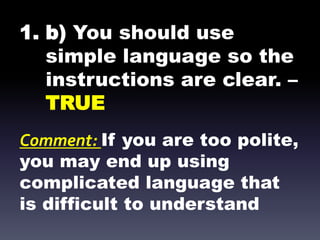
1. b) You should use 
simple language so the 
instructions are clear. – 
TRUE 
Comment: If you are too polite, 
you may end up using 
complicated language that 
is difficult to understand
2. a) You shouldn’t do a 
demonstration because it 
takes far too much time. 
b) You should do a 
demonstration so 
students can see the 
activity in action.
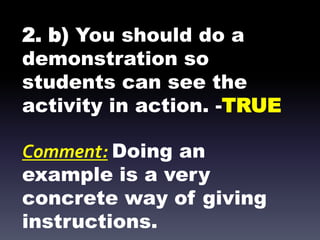
2. b) You should do a 
demonstration so 
students can see the 
activity in action. -TRUE 
Comment: Doing an 
example is a very 
concrete way of giving 
instructions.
3. a) You should use 
questions to check key 
aspects of the 
instructions. 
b) You should use 
questions to check all 
aspects of the 
instructions.
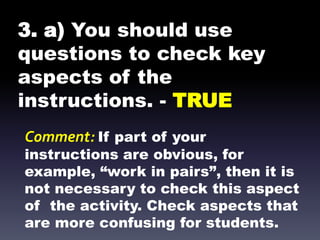
3. a) You should use 
questions to check key 
aspects of the 
instructions. - TRUE 
Comment: If part of your 
instructions are obvious, for 
example, “work in pairs”, then it is 
not necessary to check this aspect 
of the activity. Check aspects that 
are more confusing for students.
4. a) You should hold up 
worksheets when giving 
instructions so that students 
look at you. 
b) You should hand out 
worksheets and then give 
instructions so students can 
read what they have to do.
4. a) You should hold up 
worksheets when giving 
instructions so that students 
look at you.- TRUE 
Comment: If you give out 
worksheets too soon, 
students start reading them 
and stop listening to your 
instructions.
5. a) You shouldn’t use 
gesture as this will 
distract students from 
what you are saying. 
b) You should use 
gesture because visual 
information can support 
what you are saying.
5. b) You should use gesture 
because it is visual 
information that supports 
what you are saying. – TRUE 
Comment: Any visual 
information you can add 
is always useful for 
students.
Task 2 – Getting instructions in 
the right order 
Put the teacher actions a – f 
in the left-hand column in 
the correct order 
1-6, so that you create a 
clear and logical instruction 
sequence.
Teacher actions Order [1- 6] 
a. give instructions 
b. hand out the work sheet 
c. hold up the work sheet 
d. gesture the interaction pattern 
to be used (e.g. work in pairs) 
e. get the students’ attention 
f. check the instructions
Task 2 – Getting instructions 
in the right order 
Answer Key
1-e get the students’ 
attention. 
2-c hold up the work sheet. 
3-a give instructions. 
4-d gesture the interaction. 
pattern to be used (e.g. work 
in pairs) 
5-f check the instructions. 
6-b hand out the work sheet.
Task 2 – Checking instructions 
Each number below 1 – 6 is a 
learning activity. After each 
activity, there are 2 questions 
a) and b) that could be used to 
check the instructions. 
One question is effective, but 
the other is not. Choose the 
question that you think is most 
effective.
Learning activities Learning activities 
1. role play ………………………………….. a) Are you going to write or speak together 
? 
b) Who speaks first? 
2. mingle…………………………………….. a) Do you ask your partner or other 
students? 
b) Do you mingle around? 
3. gist reading……………………………….. a) Are you going to read or listen? 
b) How much time have you got? 
4. information gap activity…………………. a) Are you going to show your sheet to each 
other? 
b) So what are you going to talk about? 
5. gap fill……………………………………... a) Are you going to fill in the gap? 
b) Do you use only one word or more than 
one word? 
6. dictation…………………………………... a) How many times will I read the text? 
b) Who is going to write down the words?
Task 2 – Feedback 
1. role play b) Who speaks first? 
Comment: The first question 
is obvious.The second question 
is useful because students 
often don’t know who should 
begin a conversation in a role 
play and this question is a 
good reminder.
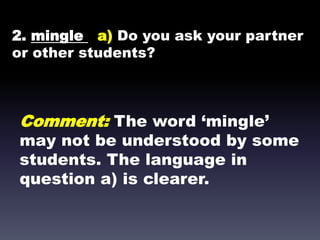
2. mingle a) Do you ask your partner 
or other students? 
Comment: The word ‘mingle’ 
may not be understood by some 
students. The language in 
question a) is clearer.
3. gist reading b) How much time 
have you got? 
Comment: The first question 
is too obvious. 
Question b) reminds students 
that they should read quickly 
for gist as they have a time 
limit.
4. information gap activity 
a) Are you going to show your 
sheet to each other ? 
Comment: Question b) is too 
open ended. 
Question a) checks a key aspect 
of information gap activities.
5. gap fill b) Do you use only one 
word or more than one word? 
Comment: 
Question a) is too obvious. 
Question b) can be an 
important instruction to check 
for a gap fill task as some of 
these tasks restrict the choice 
to one word.
Feed Back : Key Skill 
When teachers can give 
clear instructions, learners 
feel more secure in the 
lesson. It also means 
learners can begin tasks 
more quickly, which 
increases time for 
learning.
It is helpful for students if 
teachers plan their instructions. 
Good instructions use simple 
language and are often supported 
by clear gestures or 
demonstrations. The whiteboard 
or OHP may also be used to help 
give instructions. Remember to 
ask questions to check your 
students have understood the 
instructions correctly.
In class, before you begin giving 
your instructions, ensure that all 
the students are looking at and 
listening to you. It’s important not 
give out the worksheet 
too early otherwise you will lose 
your students attention. Only give 
out the worksheet once you have 
finished giving and checking your 
instructions.

Giving instructions 2

  • 1.
    When you setup activities, do your students sometimes look confused?
  • 2.
    Task 1 :Giving instructions: Look at each pair of sentences and choose the one that is TRUE. 1. a) You should use polite language otherwise students will get offended. b) You should use simple language so the instructions are clear.
  • 3.
  • 4.
    1. b) Youshould use simple language so the instructions are clear. – TRUE Comment: If you are too polite, you may end up using complicated language that is difficult to understand
  • 5.
    2. a) Youshouldn’t do a demonstration because it takes far too much time. b) You should do a demonstration so students can see the activity in action.
  • 6.
    2. b) Youshould do a demonstration so students can see the activity in action. -TRUE Comment: Doing an example is a very concrete way of giving instructions.
  • 7.
    3. a) Youshould use questions to check key aspects of the instructions. b) You should use questions to check all aspects of the instructions.
  • 8.
    3. a) Youshould use questions to check key aspects of the instructions. - TRUE Comment: If part of your instructions are obvious, for example, “work in pairs”, then it is not necessary to check this aspect of the activity. Check aspects that are more confusing for students.
  • 9.
    4. a) Youshould hold up worksheets when giving instructions so that students look at you. b) You should hand out worksheets and then give instructions so students can read what they have to do.
  • 10.
    4. a) Youshould hold up worksheets when giving instructions so that students look at you.- TRUE Comment: If you give out worksheets too soon, students start reading them and stop listening to your instructions.
  • 11.
    5. a) Youshouldn’t use gesture as this will distract students from what you are saying. b) You should use gesture because visual information can support what you are saying.
  • 12.
    5. b) Youshould use gesture because it is visual information that supports what you are saying. – TRUE Comment: Any visual information you can add is always useful for students.
  • 13.
    Task 2 –Getting instructions in the right order Put the teacher actions a – f in the left-hand column in the correct order 1-6, so that you create a clear and logical instruction sequence.
  • 14.
    Teacher actions Order[1- 6] a. give instructions b. hand out the work sheet c. hold up the work sheet d. gesture the interaction pattern to be used (e.g. work in pairs) e. get the students’ attention f. check the instructions
  • 15.
    Task 2 –Getting instructions in the right order Answer Key
  • 16.
    1-e get thestudents’ attention. 2-c hold up the work sheet. 3-a give instructions. 4-d gesture the interaction. pattern to be used (e.g. work in pairs) 5-f check the instructions. 6-b hand out the work sheet.
  • 17.
    Task 2 –Checking instructions Each number below 1 – 6 is a learning activity. After each activity, there are 2 questions a) and b) that could be used to check the instructions. One question is effective, but the other is not. Choose the question that you think is most effective.
  • 18.
    Learning activities Learningactivities 1. role play ………………………………….. a) Are you going to write or speak together ? b) Who speaks first? 2. mingle…………………………………….. a) Do you ask your partner or other students? b) Do you mingle around? 3. gist reading……………………………….. a) Are you going to read or listen? b) How much time have you got? 4. information gap activity…………………. a) Are you going to show your sheet to each other? b) So what are you going to talk about? 5. gap fill……………………………………... a) Are you going to fill in the gap? b) Do you use only one word or more than one word? 6. dictation…………………………………... a) How many times will I read the text? b) Who is going to write down the words?
  • 19.
    Task 2 –Feedback 1. role play b) Who speaks first? Comment: The first question is obvious.The second question is useful because students often don’t know who should begin a conversation in a role play and this question is a good reminder.
  • 20.
    2. mingle a)Do you ask your partner or other students? Comment: The word ‘mingle’ may not be understood by some students. The language in question a) is clearer.
  • 21.
    3. gist readingb) How much time have you got? Comment: The first question is too obvious. Question b) reminds students that they should read quickly for gist as they have a time limit.
  • 22.
    4. information gapactivity a) Are you going to show your sheet to each other ? Comment: Question b) is too open ended. Question a) checks a key aspect of information gap activities.
  • 23.
    5. gap fillb) Do you use only one word or more than one word? Comment: Question a) is too obvious. Question b) can be an important instruction to check for a gap fill task as some of these tasks restrict the choice to one word.
  • 24.
    Feed Back :Key Skill When teachers can give clear instructions, learners feel more secure in the lesson. It also means learners can begin tasks more quickly, which increases time for learning.
  • 25.
    It is helpfulfor students if teachers plan their instructions. Good instructions use simple language and are often supported by clear gestures or demonstrations. The whiteboard or OHP may also be used to help give instructions. Remember to ask questions to check your students have understood the instructions correctly.
  • 26.
    In class, beforeyou begin giving your instructions, ensure that all the students are looking at and listening to you. It’s important not give out the worksheet too early otherwise you will lose your students attention. Only give out the worksheet once you have finished giving and checking your instructions.