Kurdistan Board GEH/GIT Surgery J Club 2022
Supervised by Professor Dr. Mohamed Alshekhani.
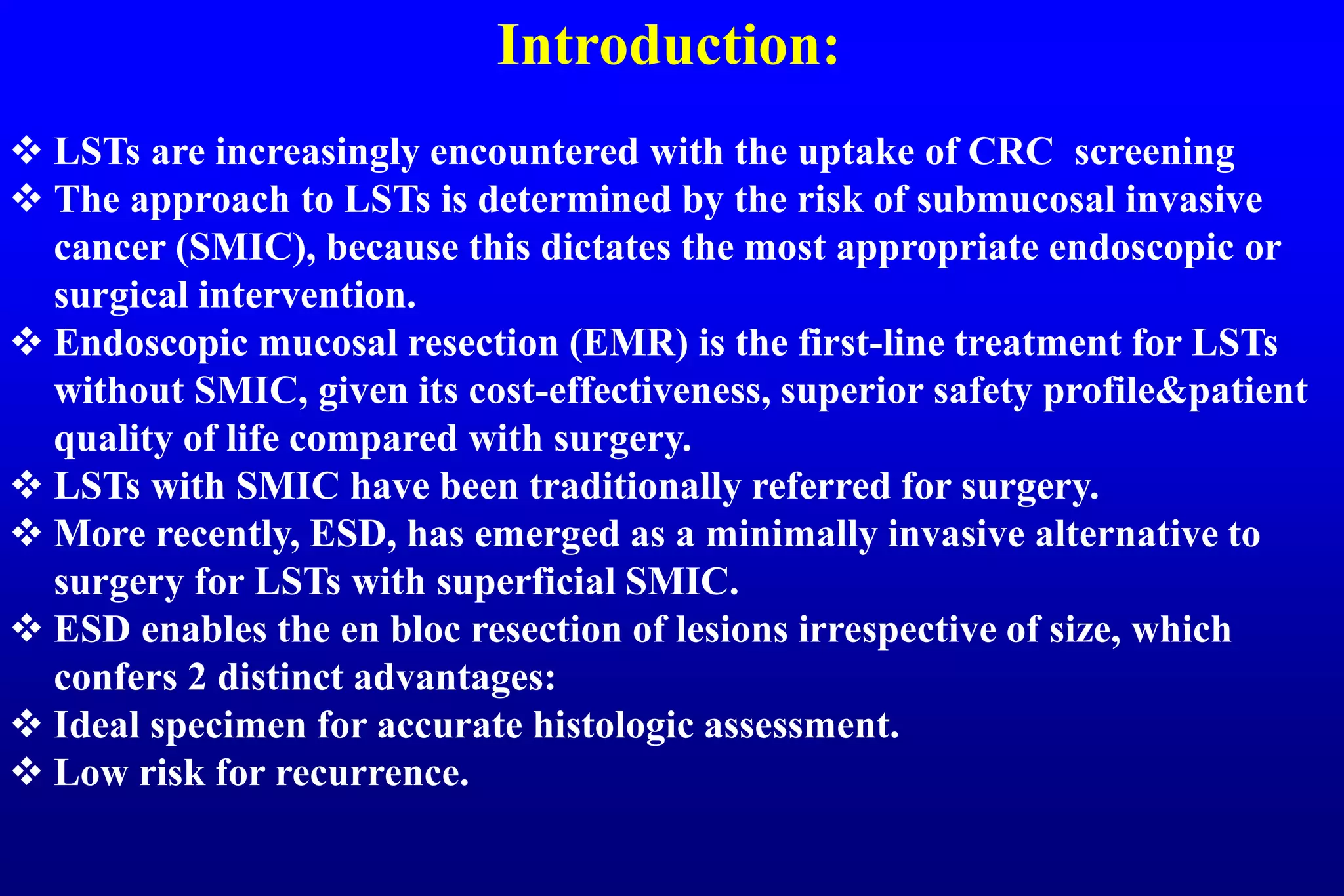
Introduction:
 LSTs are increasingly encountered with the uptake of CRC screening
 The approach to LSTs is determined by the risk of submucosal invasive
cancer (SMIC), because this dictates the most appropriate endoscopic or
surgical intervention.
 Endoscopic mucosal resection (EMR) is the first-line treatment for LSTs
without SMIC, given its cost-effectiveness, superior safety profile&patient
quality of life compared with surgery.
 LSTs with SMIC have been traditionally referred for surgery.
 More recently, ESD, has emerged as a minimally invasive alternative to
surgery for LSTs with superficial SMIC.
 ESD enables the en bloc resection of lesions irrespective of size, which
confers 2 distinct advantages:
 Ideal specimen for accurate histologic assessment.
 Low risk for recurrence.
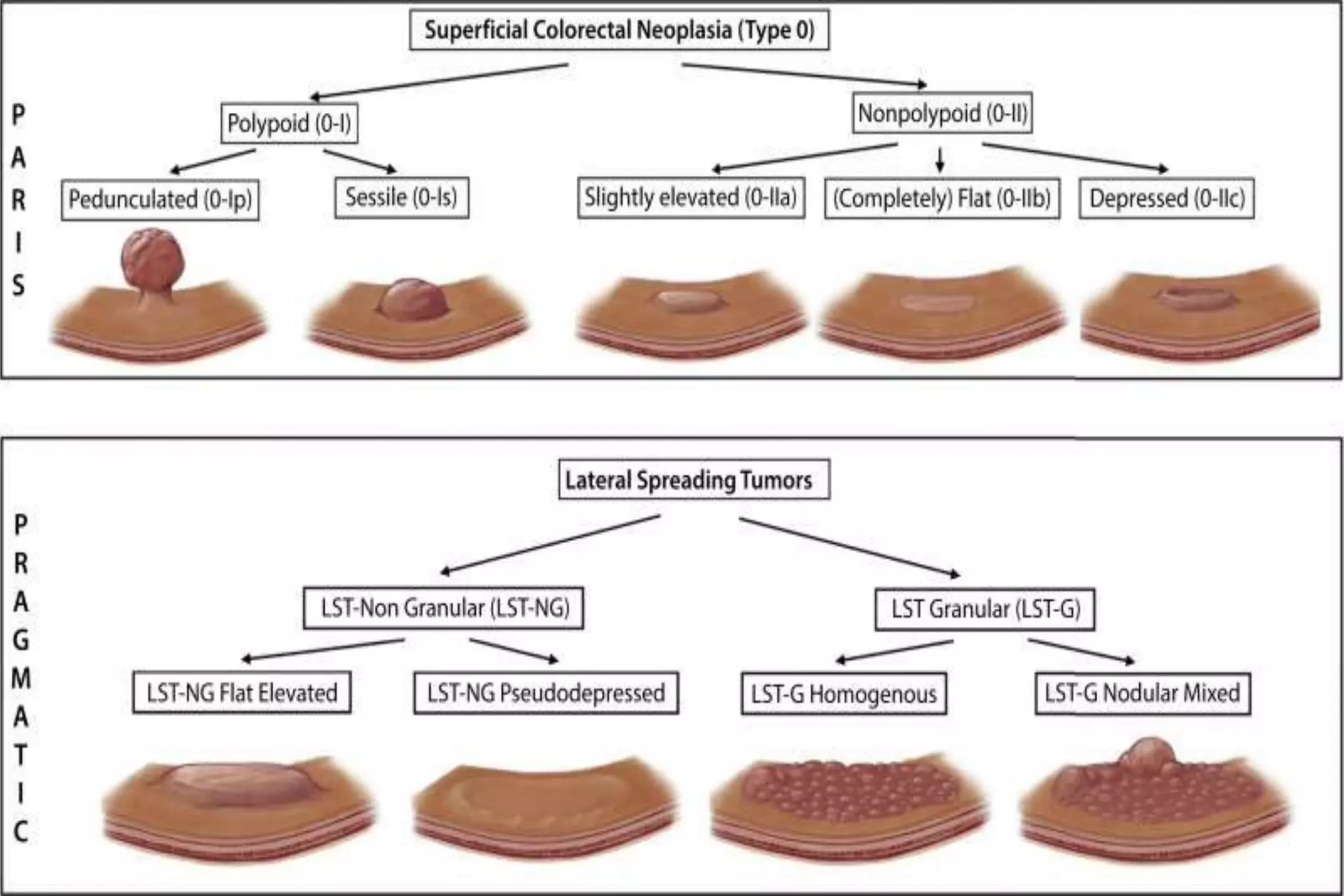
LSD:Classification&SMIC chalanges
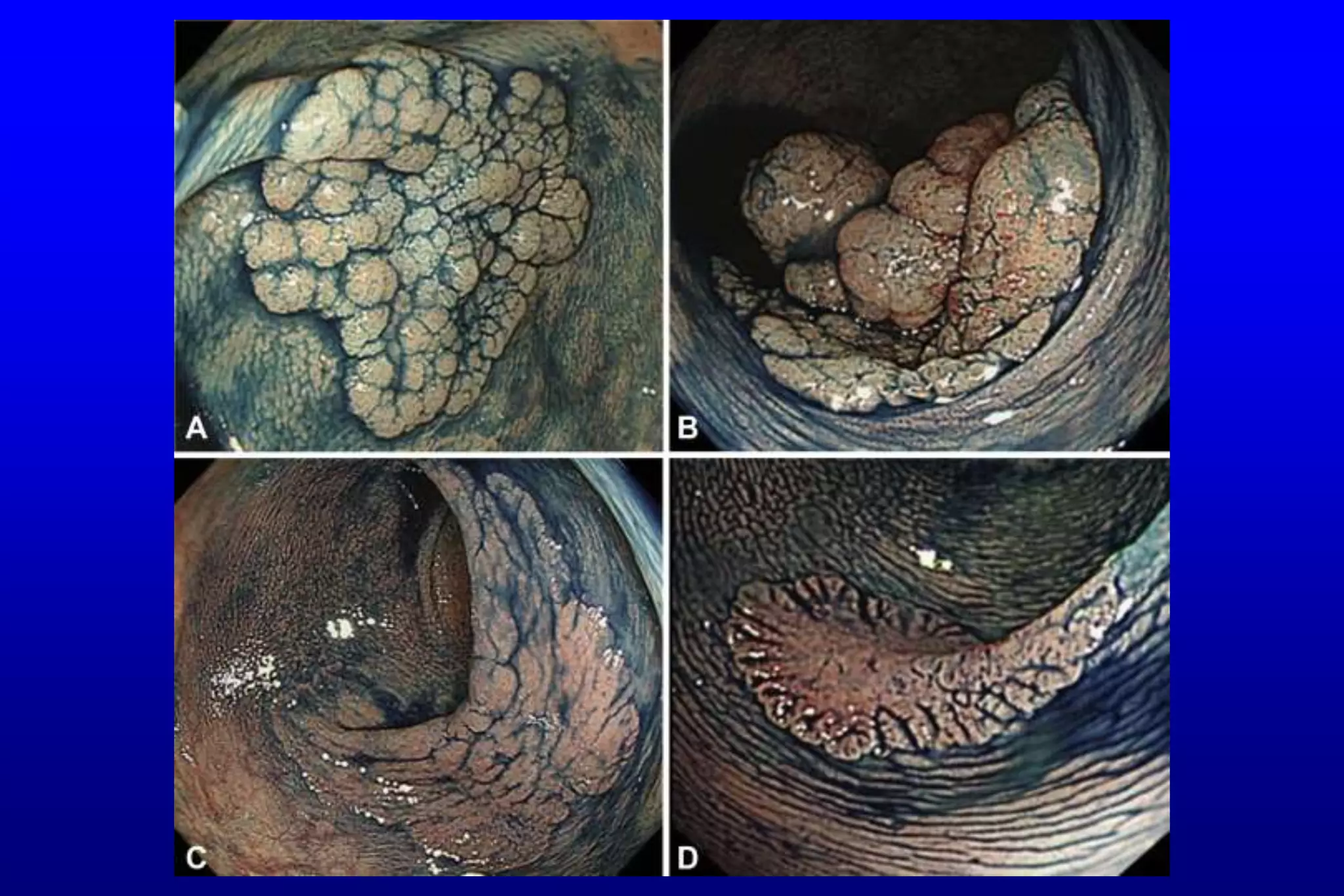
 Polyp morphology can help predict the risk of SMIC.
 Several classification systems;Kudo&Japanese NBI Expert Team (JNET),
are routinely used in Japan for lesion assessment before resection.
 Despite their accuracy in predicting SMIC, implementation limited by
complexity&need of high magnification endoscopy, not widely available.
 NBI international colorectal endoscopic (NICE) classification system is
potentially more pragmatic for polyp categorization without magnification
or dye spray,but not been widely adopted in everyday routine clin practice.
 The fact that multiple biopsies or even partial resection of LSTs for
histologic diagnosis remain a common practice suggests that we have yet to
embrace real-time optical diagnosis in the evaluation of colorectal lesions.
 The main limitation of all of these classification systems is their inability to
reliably distinguish benign neoplastic CR polyps containing HGD from
superficial SMIC.
LSD:Classification&SMIC chalanges
 This limitation is inherent to the NICE classification where high-grade
dysplasia &superficial SMIC are grouped under the same category (NICE
type 2).
 Lesions with suspected superficial SMIC should be resected en bloc for
precise histopathologic assessment for curative intent.
 Piecemeal EMR of lesions with suspected superficial SMIC leads to
pathologic uncertainty & unnecessary surgery for otherwise
endoscopically curable lesions,which can be devastating for patients,
particularly in the rectum, where post-endoscopic surgery is associated
with poor QOL.
Colonic ESD:
 Colorectal ESD has long supplanted EMR as the preferred endoscopic
resection strategy in Japan for various factors:
 The well-recognized inability to reliably identify superficial SMIC.
 The widely available ESD expertise
 Other inherent advantages of ESD(accurate histopathology, low
recurrence & ability to provide cure for selected SMICs).
 Western proponents of EMR over ESD:
 Most LSTs are benign.
 Subset that contain SMIC (10%G -32% NG)that require ESD is low.
 Can be adequately removed with piecemeal resection
 The true prevalence of SMIC in many studies may be underrepresented,
because final histologic diagnoses were primarily based on piecemeal EMR
rather than ESD or surgery,so subset of LSTs for which ESD offers a
reasonable higher chance of avoiding surgery may be higher than
anticipated.
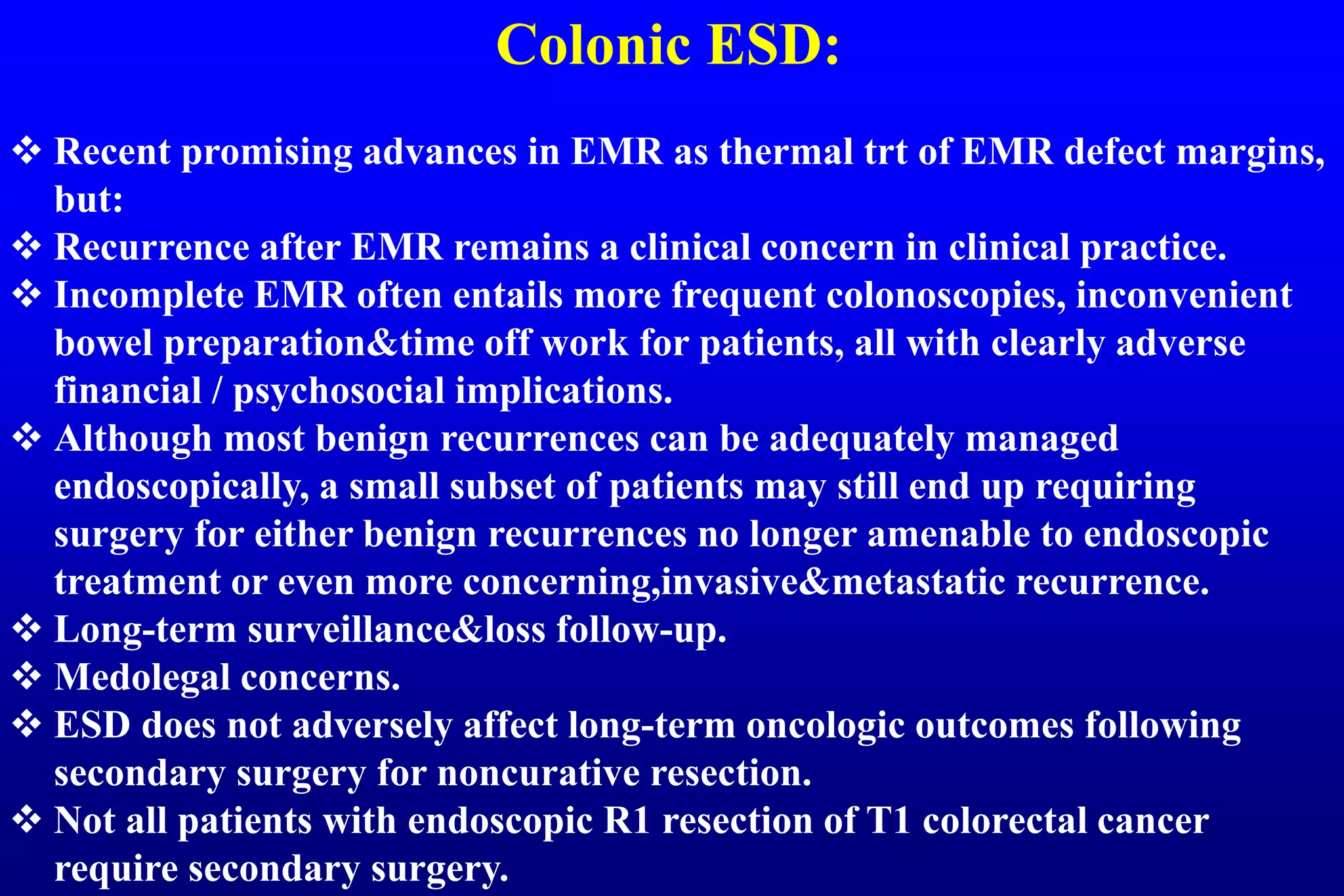
Colonic ESD:
 Recent promising advances in EMR as thermal trt of EMR defect margins,
but:
 Recurrence after EMR remains a clinical concern in clinical practice.
 Incomplete EMR often entails more frequent colonoscopies, inconvenient
bowel preparation&time off work for patients, all with clearly adverse
financial / psychosocial implications.
 Although most benign recurrences can be adequately managed
endoscopically, a small subset of patients may still end up requiring
surgery for either benign recurrences no longer amenable to endoscopic
treatment or even more concerning,invasive&metastatic recurrence.
 Long-term surveillance&loss follow-up.
 Medolegal concerns.
 ESD does not adversely affect long-term oncologic outcomes following
secondary surgery for noncurative resection.
 Not all patients with endoscopic R1 resection of T1 colorectal cancer
require secondary surgery.
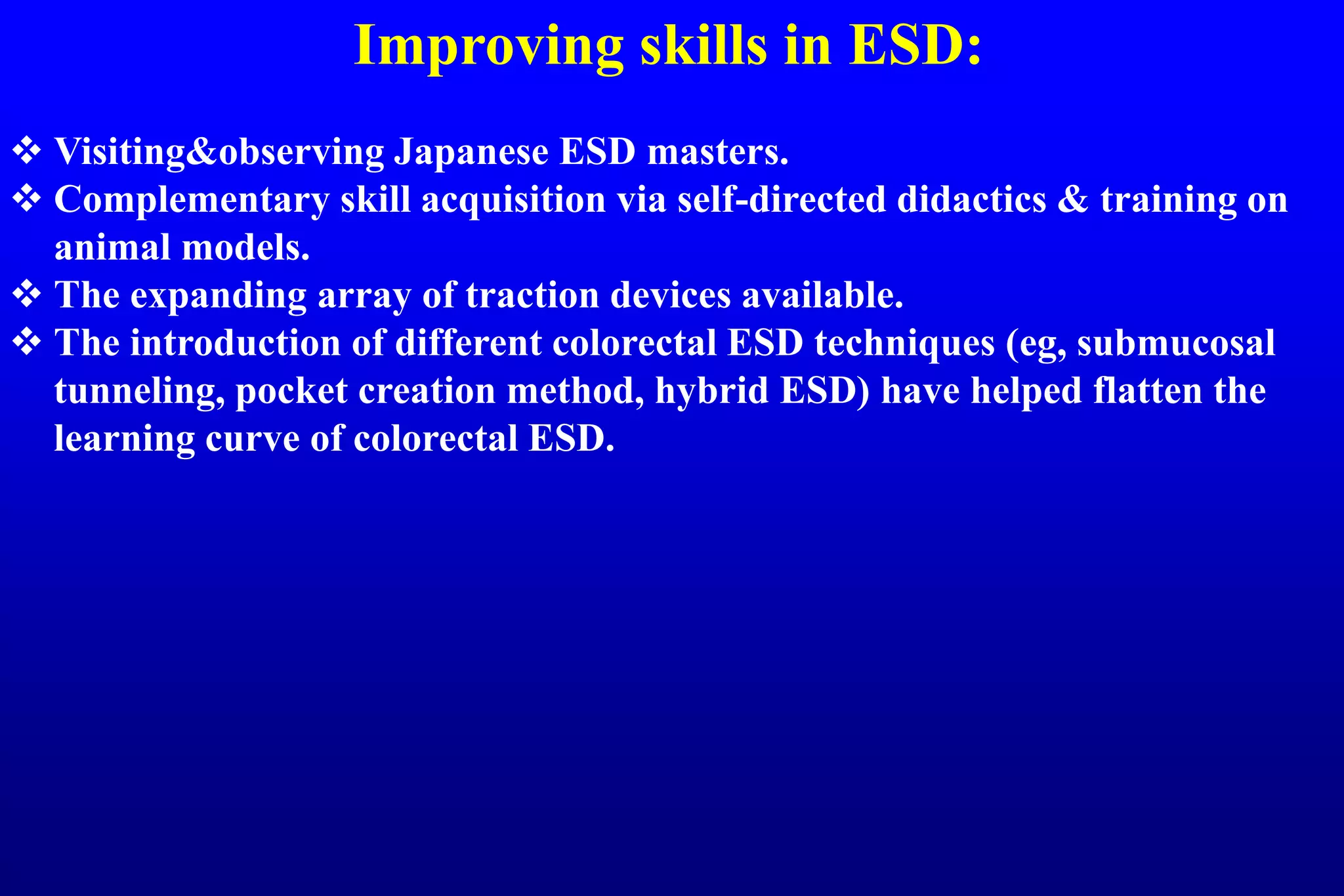
Improving skills in ESD:
 Visiting&observing Japanese ESD masters.
 Complementary skill acquisition via self-directed didactics & training on
animal models.
 The expanding array of traction devices available.
 The introduction of different colorectal ESD techniques (eg, submucosal
tunneling, pocket creation method, hybrid ESD) have helped flatten the
learning curve of colorectal ESD.
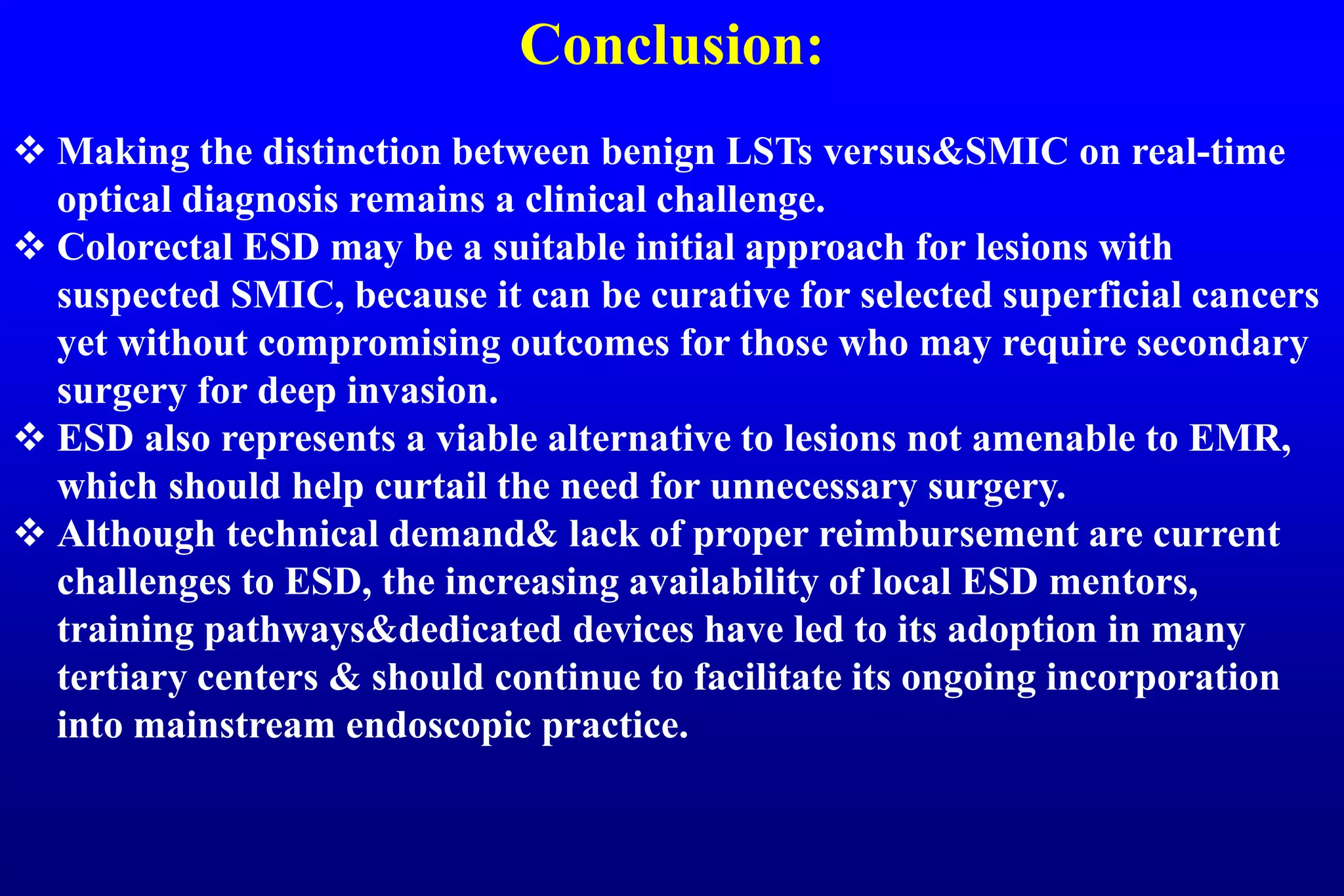
Conclusion:
 Making the distinction between benign LSTs versus&SMIC on real-time
optical diagnosis remains a clinical challenge.
 Colorectal ESD may be a suitable initial approach for lesions with
suspected SMIC, because it can be curative for selected superficial cancers
yet without compromising outcomes for those who may require secondary
surgery for deep invasion.
 ESD also represents a viable alternative to lesions not amenable to EMR,
which should help curtail the need for unnecessary surgery.
 Although technical demand& lack of proper reimbursement are current
challenges to ESD, the increasing availability of local ESD mentors,
training pathways&dedicated devices have led to its adoption in many
tertiary centers & should continue to facilitate its ongoing incorporation
into mainstream endoscopic practice.

Git j club colon esd22

  • 1.
    Kurdistan Board GEH/GITSurgery J Club 2022 Supervised by Professor Dr. Mohamed Alshekhani.
  • 2.
    Introduction:  LSTs areincreasingly encountered with the uptake of CRC screening  The approach to LSTs is determined by the risk of submucosal invasive cancer (SMIC), because this dictates the most appropriate endoscopic or surgical intervention.  Endoscopic mucosal resection (EMR) is the first-line treatment for LSTs without SMIC, given its cost-effectiveness, superior safety profile&patient quality of life compared with surgery.  LSTs with SMIC have been traditionally referred for surgery.  More recently, ESD, has emerged as a minimally invasive alternative to surgery for LSTs with superficial SMIC.  ESD enables the en bloc resection of lesions irrespective of size, which confers 2 distinct advantages:  Ideal specimen for accurate histologic assessment.  Low risk for recurrence.
  • 6.
    LSD:Classification&SMIC chalanges  Polypmorphology can help predict the risk of SMIC.  Several classification systems;Kudo&Japanese NBI Expert Team (JNET), are routinely used in Japan for lesion assessment before resection.  Despite their accuracy in predicting SMIC, implementation limited by complexity&need of high magnification endoscopy, not widely available.  NBI international colorectal endoscopic (NICE) classification system is potentially more pragmatic for polyp categorization without magnification or dye spray,but not been widely adopted in everyday routine clin practice.  The fact that multiple biopsies or even partial resection of LSTs for histologic diagnosis remain a common practice suggests that we have yet to embrace real-time optical diagnosis in the evaluation of colorectal lesions.  The main limitation of all of these classification systems is their inability to reliably distinguish benign neoplastic CR polyps containing HGD from superficial SMIC.
  • 7.
    LSD:Classification&SMIC chalanges  Thislimitation is inherent to the NICE classification where high-grade dysplasia &superficial SMIC are grouped under the same category (NICE type 2).  Lesions with suspected superficial SMIC should be resected en bloc for precise histopathologic assessment for curative intent.  Piecemeal EMR of lesions with suspected superficial SMIC leads to pathologic uncertainty & unnecessary surgery for otherwise endoscopically curable lesions,which can be devastating for patients, particularly in the rectum, where post-endoscopic surgery is associated with poor QOL.
  • 8.
    Colonic ESD:  ColorectalESD has long supplanted EMR as the preferred endoscopic resection strategy in Japan for various factors:  The well-recognized inability to reliably identify superficial SMIC.  The widely available ESD expertise  Other inherent advantages of ESD(accurate histopathology, low recurrence & ability to provide cure for selected SMICs).  Western proponents of EMR over ESD:  Most LSTs are benign.  Subset that contain SMIC (10%G -32% NG)that require ESD is low.  Can be adequately removed with piecemeal resection  The true prevalence of SMIC in many studies may be underrepresented, because final histologic diagnoses were primarily based on piecemeal EMR rather than ESD or surgery,so subset of LSTs for which ESD offers a reasonable higher chance of avoiding surgery may be higher than anticipated.
  • 9.
    Colonic ESD:  Recentpromising advances in EMR as thermal trt of EMR defect margins, but:  Recurrence after EMR remains a clinical concern in clinical practice.  Incomplete EMR often entails more frequent colonoscopies, inconvenient bowel preparation&time off work for patients, all with clearly adverse financial / psychosocial implications.  Although most benign recurrences can be adequately managed endoscopically, a small subset of patients may still end up requiring surgery for either benign recurrences no longer amenable to endoscopic treatment or even more concerning,invasive&metastatic recurrence.  Long-term surveillance&loss follow-up.  Medolegal concerns.  ESD does not adversely affect long-term oncologic outcomes following secondary surgery for noncurative resection.  Not all patients with endoscopic R1 resection of T1 colorectal cancer require secondary surgery.
  • 10.
    Improving skills inESD:  Visiting&observing Japanese ESD masters.  Complementary skill acquisition via self-directed didactics & training on animal models.  The expanding array of traction devices available.  The introduction of different colorectal ESD techniques (eg, submucosal tunneling, pocket creation method, hybrid ESD) have helped flatten the learning curve of colorectal ESD.
  • 12.
    Conclusion:  Making thedistinction between benign LSTs versus&SMIC on real-time optical diagnosis remains a clinical challenge.  Colorectal ESD may be a suitable initial approach for lesions with suspected SMIC, because it can be curative for selected superficial cancers yet without compromising outcomes for those who may require secondary surgery for deep invasion.  ESD also represents a viable alternative to lesions not amenable to EMR, which should help curtail the need for unnecessary surgery.  Although technical demand& lack of proper reimbursement are current challenges to ESD, the increasing availability of local ESD mentors, training pathways&dedicated devices have led to its adoption in many tertiary centers & should continue to facilitate its ongoing incorporation into mainstream endoscopic practice.