Kurdistan Board GEH/GIT Surgery J Club
Supervised by:
Professor Mohamed Alshekhani
MBChB-CABM-FRCP-EBGH
Introduction:
• Screening colonoscopy prevents CRC by polyp detection/removal.
• Polyp resection is not always complete resulting in post-CS cancers.
• Polyps are removed by using a biopsy forceps or polypectomy
snare,with or without electrocautery(hot or cold resection).
• Electrocautery assumed to have additive effect of tissue ablation to
promote complete resection & hemostasis,but no evidence for this:
• 1.Hot biopsy forceps removal of small polyps is often incomplete&
electrocautery artifacts may impair adequate histopathology exams.
• 2.Hot forceps resection increases complication risks &no longer
supported by endoscopy societies.
• Cold forceps is associated with a high rate of incomplete resection
even for diminutive polyps.
• Hot snare resection is the main approach for larger polyps; but
recent studies do not support the idea that the use of cautery
increases complete resection & reduces bleeding complications.
HOW OFTEN IS RESECTION INCOMPLETE?:
• Cold snare resection of diminutive polyps is superior to cold forceps
resection & should be the preferred method for all diminutive
polyps >3 mm.
• For larger polyps, electrocautery snare resection is standard of care;
but incomplete resection reported in 10% of 5–20 mm neoplastic
polyps & increases with polyp size 17% for 10–20 mm polyps.
• Recently, cold snare resection has been applied for larger polyps as
the rate of incomplete resection following cold snare removal of up
to 20 mm polyps was 4.6%, lower than reported with hot snare
resection ,but comparative studies are lacking.
WHAT IS THE RISK OF COMPLICATIONS WITH COLD SNARE RESECTION?:
• A Japan study: cold snare had lower immediate & delayed bleeding
compared with the hot snare (0 vs. 14%/ 6 vs. 23%, respectively).
• The increased risk of delayed bleeding after cautery resection is
related to sloughing of eschar & unroofing a vessel.
• Cold snare resection may minimize eschar formation& lower the
risk of delayed bleeding.
• Hot vs cold snare resection for polyps up to 8mm,reported no
immediate bleeding complications requiring hemostasis in either
group,intraprocedural bleeding was more frequent after cold snare
resection but always resolved spontaneously.
• Cold snare resection should also reduce the risk of perforation, as it
is almost impossible to cut through the muscularis propria with a
cold snare&risk for post-polypectomy syndrome should be zero, as
this syndrome is related to the use of electrocautery.
WHICH TYPE OF SNARE SHOULD BE USED FOR COLD RESECTION?:
• Standard snares for electrocautery resection have limited cutting
with thicker/ braided wire, hindering larger polyps resection.
• Dedicated cold snares have a thinner / stiffer wire &engage/ hold
healthy polyp margin during resection more easily than a standard
snare.
• A recent randomized trial supports the use of a dedicated snare for
cold resection.
• Incomplete resection of up to 10 mm polyps was significantly less
frequent when using a dedicated cold snare compared with a
standard snare (9 vs. 21%).
WHICH TYPE OF SNARE SHOULD BE USED FOR COLD RESECTION?:
• Standard snares for electrocautery resection have limited cutting
with thicker/ braided wire, hindering larger polyps resection.
• Dedicated cold snares have a thinner / stiffer wire &engage/ hold
healthy polyp margin during resection more easily than a standard
snare.
• A recent randomized trial supports the use of a dedicated snare for
cold resection.
• Incomplete resection of up to 10 mm polyps was significantly less
frequent when using a dedicated cold snare compared with a
standard snare (9 vs. 21%).
WHAT IS THE UPPER LIMIT OF POLYP SIZE FOR COLD SNARE RESECTION?:
• Recommendations were for polyps up to 60 mm in size, but larger
polyps were removed piecemeal following submucosal injection.
• Recently found that cold snare polypectomy of larger polyps (≥5
mm) can sometimes not be completed using a standard snare &
dedicated cold or stiff wire snare is required to cut through the
polyp base.
• Resection of larger lesions (>10 mm) may be facilitated by
submucosal injection &probably more often requires piecemeal
resection compared with hot snare resection.
COLD SNARE RESECTION – A DIFFERENT TECHNIQUE:
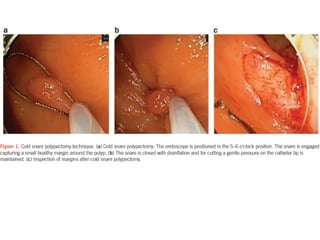
• Cold snare resection requires different technique than hot snare res
• After placing the open snare around polyp base, the tip of the snare
catheter should be positioned 1–2 mm in front of the polyp base.
• Gentle pressure of the catheter tip onto the mucosa should be
maintained when closing the snare & cutting through the polyp
base , gentle “push & cut” technique, the snare engages & removes
a small healthy tissue margin around the polyp base& resected
polyp stays at the spot & can be easily suctioned &retrieved.
• In the absence of an electrocautery artifact, the resection margin
can be well inspected for the remaining polyp tissue ,but in hot
snare resection requires lifting the polyp after it is engaged in the
snare away from the colonic wall before cutting;“lift & cut” may
lead to slippage of the snare&losing a healthy polyp margin&result
in incomplete resection&electrocautery artifact further impair
recognition of the remaining polyp tissue at the margin.
IMPLICATIONS FOR CLINICAL PRACTICE:
• Evidence on cold snare polypectomy is emerging.
• Several conclusions can currently be drawn:
• 1 . Cold forceps should be limited to small dimin polyps (≤3 mm).
• Cold snare resection may be considered as the primary resection
method for polyps up to 10 mm in size.
• 3 . A dedicate cold snare should be used for cold snare resection,
particular for polyps larger than 5 mm.
• 4 . The gentle “push & cut” technique should be used for cold
resection , instead of “lift & cut” for hot snare polypectomy.
• Now many use cold snaring for all polyps up to 10 mm.
• Cold forceps may be used for 1–2 mm polyps in a difficult position.
• Immediate bleeding is typically self-limited.
• Central tissue protrusions after cold snare resection of larger polyps
can occur, but it do not contain adenoma tissue.
Conclusion:
• Cold snare resection is as effective / safe as hot snare resection for
polyps of up to 10 mm in size.
• We suggest using dedicated cold snares & apply a “push & cut”
technique to obtain a healthy tissue margin.
• Future studies are needed to establish efficacy / safety of cold
snare resection of larger polyps.
FUTURE DIRECTION:
• Although promising, but no evidence that cold snare is superior to
hot snare polyp resection.
• RCTs are needed that compare the effiacy / safety of hot&cold
snare resection, particularly for polyps greater than 5 mm.
• The following questions are of interest:
• 1 . What is the incomplete resection rate?
• 2 . What is the upper size limit for cold snare resection?
• 3 . What is the immediate & delayed bleeding risk?
• 4 . What is the bleeding risk on anticoagulation?
• 5 . Can histopathology reliably examine the margins of removed
polyps for completeness of resection?
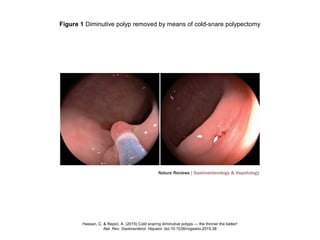
Figure 1 Diminutive polyp removed by means of cold-snare polypectomy
Hassan, C. & Repici, A. (2015) Cold snaring diminutive polyps — the thinner the better!
Nat. Rev. Gastroenterol. Hepatol. doi:10.1038/nrgastro.2015.38
GIT j club cold polyp snaring.

GIT j club cold polyp snaring.

  • 1.
    Kurdistan Board GEH/GITSurgery J Club Supervised by: Professor Mohamed Alshekhani MBChB-CABM-FRCP-EBGH
  • 2.
    Introduction: • Screening colonoscopyprevents CRC by polyp detection/removal. • Polyp resection is not always complete resulting in post-CS cancers. • Polyps are removed by using a biopsy forceps or polypectomy snare,with or without electrocautery(hot or cold resection). • Electrocautery assumed to have additive effect of tissue ablation to promote complete resection & hemostasis,but no evidence for this: • 1.Hot biopsy forceps removal of small polyps is often incomplete& electrocautery artifacts may impair adequate histopathology exams. • 2.Hot forceps resection increases complication risks &no longer supported by endoscopy societies. • Cold forceps is associated with a high rate of incomplete resection even for diminutive polyps. • Hot snare resection is the main approach for larger polyps; but recent studies do not support the idea that the use of cautery increases complete resection & reduces bleeding complications.
  • 3.
    HOW OFTEN ISRESECTION INCOMPLETE?: • Cold snare resection of diminutive polyps is superior to cold forceps resection & should be the preferred method for all diminutive polyps >3 mm. • For larger polyps, electrocautery snare resection is standard of care; but incomplete resection reported in 10% of 5–20 mm neoplastic polyps & increases with polyp size 17% for 10–20 mm polyps. • Recently, cold snare resection has been applied for larger polyps as the rate of incomplete resection following cold snare removal of up to 20 mm polyps was 4.6%, lower than reported with hot snare resection ,but comparative studies are lacking.
  • 4.
    WHAT IS THERISK OF COMPLICATIONS WITH COLD SNARE RESECTION?: • A Japan study: cold snare had lower immediate & delayed bleeding compared with the hot snare (0 vs. 14%/ 6 vs. 23%, respectively). • The increased risk of delayed bleeding after cautery resection is related to sloughing of eschar & unroofing a vessel. • Cold snare resection may minimize eschar formation& lower the risk of delayed bleeding. • Hot vs cold snare resection for polyps up to 8mm,reported no immediate bleeding complications requiring hemostasis in either group,intraprocedural bleeding was more frequent after cold snare resection but always resolved spontaneously. • Cold snare resection should also reduce the risk of perforation, as it is almost impossible to cut through the muscularis propria with a cold snare&risk for post-polypectomy syndrome should be zero, as this syndrome is related to the use of electrocautery.
  • 5.
    WHICH TYPE OFSNARE SHOULD BE USED FOR COLD RESECTION?: • Standard snares for electrocautery resection have limited cutting with thicker/ braided wire, hindering larger polyps resection. • Dedicated cold snares have a thinner / stiffer wire &engage/ hold healthy polyp margin during resection more easily than a standard snare. • A recent randomized trial supports the use of a dedicated snare for cold resection. • Incomplete resection of up to 10 mm polyps was significantly less frequent when using a dedicated cold snare compared with a standard snare (9 vs. 21%).
  • 6.
    WHICH TYPE OFSNARE SHOULD BE USED FOR COLD RESECTION?: • Standard snares for electrocautery resection have limited cutting with thicker/ braided wire, hindering larger polyps resection. • Dedicated cold snares have a thinner / stiffer wire &engage/ hold healthy polyp margin during resection more easily than a standard snare. • A recent randomized trial supports the use of a dedicated snare for cold resection. • Incomplete resection of up to 10 mm polyps was significantly less frequent when using a dedicated cold snare compared with a standard snare (9 vs. 21%).
  • 7.
    WHAT IS THEUPPER LIMIT OF POLYP SIZE FOR COLD SNARE RESECTION?: • Recommendations were for polyps up to 60 mm in size, but larger polyps were removed piecemeal following submucosal injection. • Recently found that cold snare polypectomy of larger polyps (≥5 mm) can sometimes not be completed using a standard snare & dedicated cold or stiff wire snare is required to cut through the polyp base. • Resection of larger lesions (>10 mm) may be facilitated by submucosal injection &probably more often requires piecemeal resection compared with hot snare resection.
  • 8.
    COLD SNARE RESECTION– A DIFFERENT TECHNIQUE: • Cold snare resection requires different technique than hot snare res • After placing the open snare around polyp base, the tip of the snare catheter should be positioned 1–2 mm in front of the polyp base. • Gentle pressure of the catheter tip onto the mucosa should be maintained when closing the snare & cutting through the polyp base , gentle “push & cut” technique, the snare engages & removes a small healthy tissue margin around the polyp base& resected polyp stays at the spot & can be easily suctioned &retrieved. • In the absence of an electrocautery artifact, the resection margin can be well inspected for the remaining polyp tissue ,but in hot snare resection requires lifting the polyp after it is engaged in the snare away from the colonic wall before cutting;“lift & cut” may lead to slippage of the snare&losing a healthy polyp margin&result in incomplete resection&electrocautery artifact further impair recognition of the remaining polyp tissue at the margin.
  • 9.
    IMPLICATIONS FOR CLINICALPRACTICE: • Evidence on cold snare polypectomy is emerging. • Several conclusions can currently be drawn: • 1 . Cold forceps should be limited to small dimin polyps (≤3 mm). • Cold snare resection may be considered as the primary resection method for polyps up to 10 mm in size. • 3 . A dedicate cold snare should be used for cold snare resection, particular for polyps larger than 5 mm. • 4 . The gentle “push & cut” technique should be used for cold resection , instead of “lift & cut” for hot snare polypectomy. • Now many use cold snaring for all polyps up to 10 mm. • Cold forceps may be used for 1–2 mm polyps in a difficult position. • Immediate bleeding is typically self-limited. • Central tissue protrusions after cold snare resection of larger polyps can occur, but it do not contain adenoma tissue.
  • 10.
    Conclusion: • Cold snareresection is as effective / safe as hot snare resection for polyps of up to 10 mm in size. • We suggest using dedicated cold snares & apply a “push & cut” technique to obtain a healthy tissue margin. • Future studies are needed to establish efficacy / safety of cold snare resection of larger polyps.
  • 11.
    FUTURE DIRECTION: • Althoughpromising, but no evidence that cold snare is superior to hot snare polyp resection. • RCTs are needed that compare the effiacy / safety of hot&cold snare resection, particularly for polyps greater than 5 mm. • The following questions are of interest: • 1 . What is the incomplete resection rate? • 2 . What is the upper size limit for cold snare resection? • 3 . What is the immediate & delayed bleeding risk? • 4 . What is the bleeding risk on anticoagulation? • 5 . Can histopathology reliably examine the margins of removed polyps for completeness of resection?
  • 12.
    Figure 1 Diminutivepolyp removed by means of cold-snare polypectomy Hassan, C. & Repici, A. (2015) Cold snaring diminutive polyps — the thinner the better! Nat. Rev. Gastroenterol. Hepatol. doi:10.1038/nrgastro.2015.38