
ENDOSCOPIC REMOVAL OF COLONIC POLYPS
Colorectal cancer is one of the most common causes of cancer death worldwide.
Most of the colorectal cancers are thought to arise from polypoid adenomas by
metaplasia.
It is not possible to predict which adenoma will become malignant, because even
small polyps can occasionally harbor high grade dysplasia or cancer. All polyps that
are not obviously non-neoplastic are also usually removed from otherwise healthy
patients, because the malignant potential is not known
Endoscopic polypectomy is the standard of care for the management of colonic
polyps at present. It is done as a day care procedure, is less expensive, has minimal
complications, and does not require general anaesthesia.
Two cases done recently are briefed here
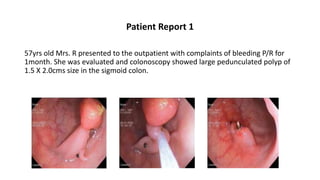
Patient Report 1
57yrs old Mrs. R presented to the outpatient with complaints of bleeding P/R for
1month. She was evaluated and colonoscopy showed large pedunculated polyp of
1.5 X 2.0cms size in the sigmoid colon.
Patient Report 2
57yrs old Mr. M presented to us with bleeding P/R for 20days. Colonoscopy showed
large sessile polyp of 1cm x1.5cms in the sigmoid colon.
Patient were subjected for endoscopic polypectomy after obtaining consent, both
the procedures were performed as outpatient. Polyps were removed using
polypectomy snare and coagulation current; both the polyps were removed intoto.
No post procedure complication.
Technique
GENERAL MEASURES: Polypoidal lesions are removed using either a snareloop or
biopsy forceps. Polypectomy should be attempted after orienting the polyp at the
six o’clock position, which corresponds to the operating channel of the endoscope.
After ensnaring, we use pure coagulation current applied in bursts.
SESSILE POLYPS: Sessile polyp larger than 2cm is resected in a piecemeal fashion to
avoid perforation. As a rule of thumb, it has been suggested that sessile polyps
occupying more than one third of the circumference of the colon, or involving two
haustral folds are too big for safe endoscopic removal. Submucosal injection of
normal saline into the submucosa prior to polypectomy is done to raise large
sessile polyps, thereby reducing the risk of perforation during subsequent snare
excision.
ARGON PLASMA COAGULATION: The APC is used as an adjunct to piecemeal
excision to remove residual adenomatous tissue. It can also be used to control
oozing following polypectomy
Other Modalities
Endoscopic Mucosal Resection
Endoscopic Sub Mucosal Dissection
Laser Ablation
PEDUNCULATED POLYPS: In patients with pedunculated polyps with a wide stalk it is
better to use prophylactic measures to avoid haemorrhage. Haemoclips are used for
thin pedicle (upto about 5mm) and an endoloop for thicker stalks. After
polypectomy, the resection site should be closely inspected for visible vessels. Even
without active bleeding visible vessels should be treated to prevent delayed
haemorrhage. Haemoclip, thermal methods or injection epinephrine is used.
COMPLICATION: Bleeding, Perforation
FOLLOW UP: Follow up examination is mandatory after endoscopic resection of large
adenomas since recurrence rate of upto 50% have been described. Most
gastroenterologists now advocate repeat colonoscopy 5yrs following complete removal
of a low risk adenomatous polyp. Colonoscopy is repeated in 3yrs if the polyp has high
risk features.
Repeat colonoscopy may be advised in 3-12 months if the adequacy of polyp removal is
a matter of substantial doubt. If no colonic polyps are found at the initial examination,
follow-up colonoscopy at approximately 5-year intervals is recommended.
Contact Info
Annaiarulhospital
No: 270, Mudichur Road
Old Perungalathur, Chennai
Pincode - 600 063.
Opening Hours:
Monday – Friday
09:00am – 09:00pm
Saturday
09:00am – 07:00pm
Sunday
12:30pm – 06:00pm

Endoscopic removal of colonic polyps

  • 1.
    ENDOSCOPIC REMOVAL OFCOLONIC POLYPS
  • 2.
    Colorectal cancer isone of the most common causes of cancer death worldwide. Most of the colorectal cancers are thought to arise from polypoid adenomas by metaplasia. It is not possible to predict which adenoma will become malignant, because even small polyps can occasionally harbor high grade dysplasia or cancer. All polyps that are not obviously non-neoplastic are also usually removed from otherwise healthy patients, because the malignant potential is not known Endoscopic polypectomy is the standard of care for the management of colonic polyps at present. It is done as a day care procedure, is less expensive, has minimal complications, and does not require general anaesthesia.
  • 3.
    Two cases donerecently are briefed here
  • 4.
    Patient Report 1 57yrsold Mrs. R presented to the outpatient with complaints of bleeding P/R for 1month. She was evaluated and colonoscopy showed large pedunculated polyp of 1.5 X 2.0cms size in the sigmoid colon.
  • 5.
    Patient Report 2 57yrsold Mr. M presented to us with bleeding P/R for 20days. Colonoscopy showed large sessile polyp of 1cm x1.5cms in the sigmoid colon. Patient were subjected for endoscopic polypectomy after obtaining consent, both the procedures were performed as outpatient. Polyps were removed using polypectomy snare and coagulation current; both the polyps were removed intoto. No post procedure complication.
  • 6.
    Technique GENERAL MEASURES: Polypoidallesions are removed using either a snareloop or biopsy forceps. Polypectomy should be attempted after orienting the polyp at the six o’clock position, which corresponds to the operating channel of the endoscope. After ensnaring, we use pure coagulation current applied in bursts. SESSILE POLYPS: Sessile polyp larger than 2cm is resected in a piecemeal fashion to avoid perforation. As a rule of thumb, it has been suggested that sessile polyps occupying more than one third of the circumference of the colon, or involving two haustral folds are too big for safe endoscopic removal. Submucosal injection of normal saline into the submucosa prior to polypectomy is done to raise large sessile polyps, thereby reducing the risk of perforation during subsequent snare excision. ARGON PLASMA COAGULATION: The APC is used as an adjunct to piecemeal excision to remove residual adenomatous tissue. It can also be used to control oozing following polypectomy
  • 7.
    Other Modalities Endoscopic MucosalResection Endoscopic Sub Mucosal Dissection Laser Ablation PEDUNCULATED POLYPS: In patients with pedunculated polyps with a wide stalk it is better to use prophylactic measures to avoid haemorrhage. Haemoclips are used for thin pedicle (upto about 5mm) and an endoloop for thicker stalks. After polypectomy, the resection site should be closely inspected for visible vessels. Even without active bleeding visible vessels should be treated to prevent delayed haemorrhage. Haemoclip, thermal methods or injection epinephrine is used.
  • 8.
    COMPLICATION: Bleeding, Perforation FOLLOWUP: Follow up examination is mandatory after endoscopic resection of large adenomas since recurrence rate of upto 50% have been described. Most gastroenterologists now advocate repeat colonoscopy 5yrs following complete removal of a low risk adenomatous polyp. Colonoscopy is repeated in 3yrs if the polyp has high risk features. Repeat colonoscopy may be advised in 3-12 months if the adequacy of polyp removal is a matter of substantial doubt. If no colonic polyps are found at the initial examination, follow-up colonoscopy at approximately 5-year intervals is recommended.
  • 9.
    Contact Info Annaiarulhospital No: 270,Mudichur Road Old Perungalathur, Chennai Pincode - 600 063. Opening Hours: Monday – Friday 09:00am – 09:00pm Saturday 09:00am – 07:00pm Sunday 12:30pm – 06:00pm