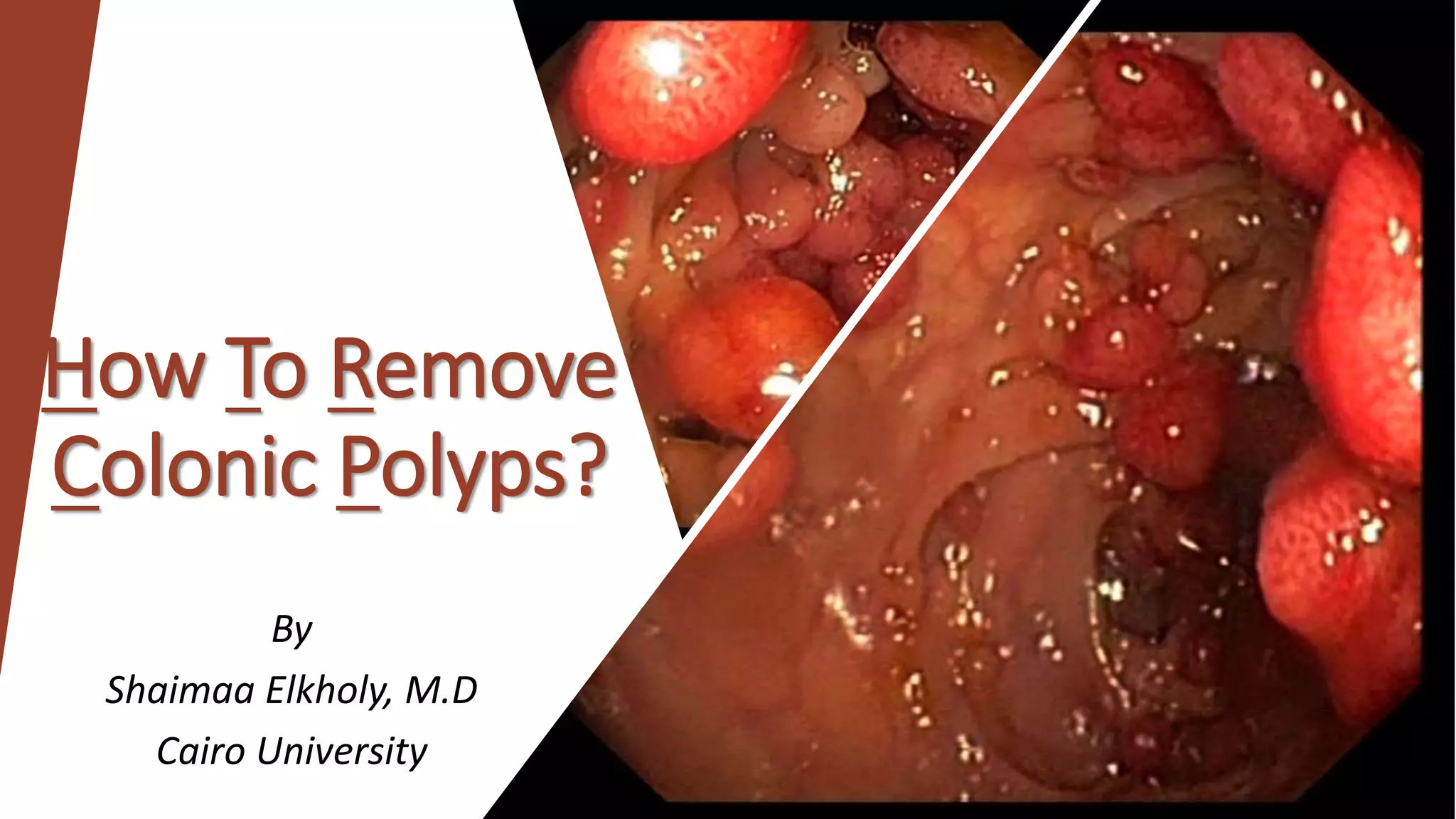





How To Remove
Colonic Polyps?
By
Shaimaa Elkholy, M.D
Cairo University
Agenda
• What do we need before polypectomy?
• What are the methods used?
• What types of snares?
• What do guidelines say?
• How to follow up?
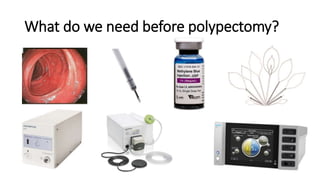
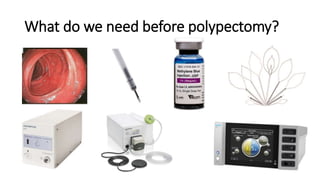
What do we need before polypectomy?
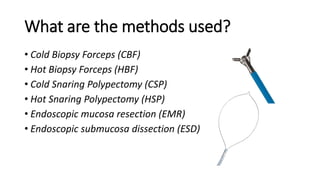
What are the methods used?
• Cold Biopsy Forceps (CBF)
• Hot Biopsy Forceps (HBF)
• Cold Snaring Polypectomy (CSP)
• Hot Snaring Polypectomy (HSP)
• Endoscopic mucosa resection (EMR)
• Endoscopic submucosa dissection (ESD)
Cold Biopsy Forceps (CBF)
video
Cold Biopsy Forceps (CBF)
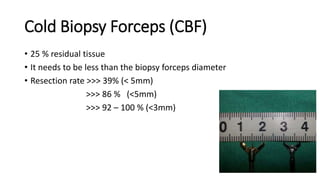
• 25 % residual tissue
• It needs to be less than the biopsy forceps diameter
• Resection rate >>> 39% (< 5mm)
>>> 86 % (<5mm)
>>> 92 – 100 % (<3mm)
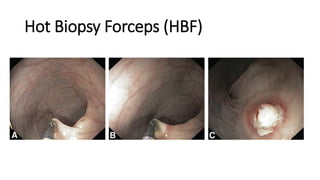
Hot Biopsy Forceps (HBF)
-High rates of incomplete resection
-Inadequate tissue sampling
-High risks of adverse events (deep thermal injury & delayed
bleeding)
Cold Snaring Polypectomy (CSP)
video
Cold Snaring Polypectomy (CSP)
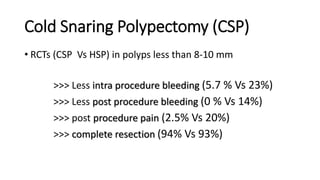
• RCTs (CSP Vs HSP) in polyps less than 8-10 mm
>>> Less intra procedure bleeding (5.7 % Vs 23%)
>>> Less post procedure bleeding (0 % Vs 14%)
>>> post procedure pain (2.5% Vs 20%)
>>> complete resection (94% Vs 93%)
Cold Snaring Polypectomy (CSP)
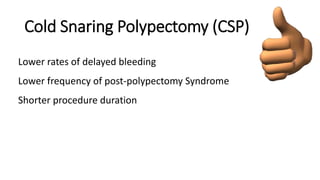
Lower rates of delayed bleeding
Lower frequency of post-polypectomy Syndrome
Shorter procedure duration
Piecemeal- CSP
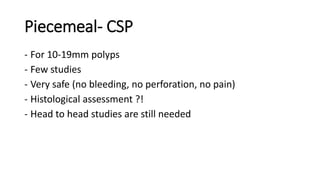
- For 10-19mm polyps
- Few studies
- Very safe (no bleeding, no perforation, no pain)
- Histological assessment ?!
- Head to head studies are still needed
Hot Snaring Polypectomy (HSP)
video
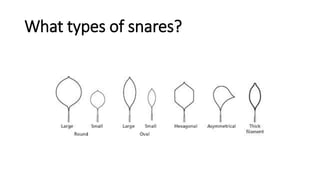
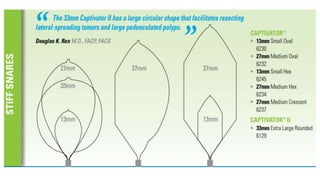
What types of snares?
• For routine sessile polyps a 15 or 20 mm snare (regular stiffness) is easiest
for
laying the snare down / tissue grasping / size relative to polyp
• Flat polyps require stiff/braided snares (and lifting)
*A lot of snares have the same handle and color within the same company
but behave very differently – read the catalog!!
What do guidelines say?
Cold Biopsy Forceps (CBF)
-ESGE recommends AGAINST the use of CBF (high rates of
incomplete resection)
-Polyp 1 –3mm & cold snaring is technically difficult or not
possible >> CBF MAY be used
(Moderate quality evidence; strong recommendation)
Hot Biopsy Forceps (HBF)
-ESGE recommends AGAINST the use of HBF
(High quality evidence; strong recommendation)
Cold Snaring Polypectomy (CSP)
ESGE suggests CSP for sessile polyps 6 –9mm in size because
of its superior safety profile, although evidence comparing
efficacy with HSP is lacking
(Moderate quality evidence; weak recommendation)
Piecemeal- CSP
There may be a role for p-CSP to reduce the risk of deep mural
injury, but further studies are needed
(Low quality evidence; wea recommendation)
Hot Snaring Polypectomy (HSP)
-ESGE suggests HSP (+ submucosal injection) for sessile polyps
10 – 19mm
-Deep thermal injury is a potential risk & thus submucosal
injection should be considered
(Low quality evidence; strong recommendation)
Hot Snaring Polypectomy (HSP)
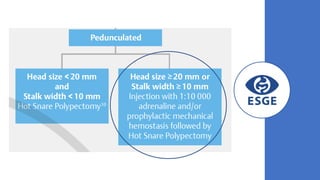
-ESGE suggests HSP for pedunculated polyps
-Head > 20mm or stalk > 10mm, prior adrenaline injection +
mechanical compression
(Moderate quality evidence; strong recommendation)
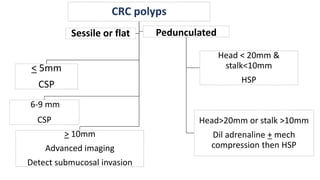
CRC polyps
< 5mm
CSP
6-9 mm
CSP
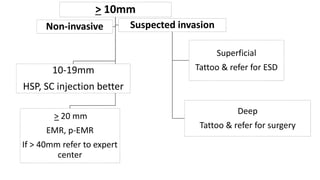
> 10mm
Advanced imaging
Detect submucosal invasion
Sessile or flat Pedunculated
Head < 20mm &
stalk<10mm
HSP
Head>20mm or stalk >10mm
Dil adrenaline + mech
compression then HSP
> 10mm
10-19mm
HSP, SC injection better
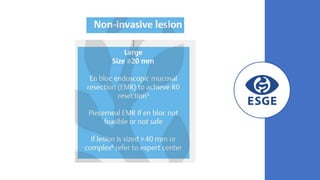
> 20 mm
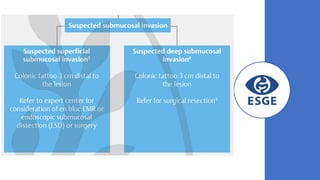
EMR, p-EMR
If > 40mm refer to expert
center
Non-invasive Suspected invasion
Superficial
Tattoo & refer for ESD
Deep
Tattoo & refer for surgery
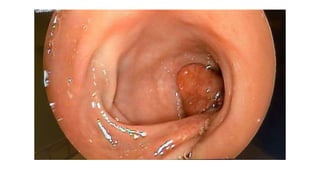
Diminutive polyps (<5mm) at recto-sigmoid
• photo
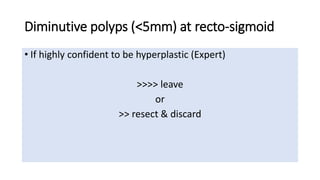
Diminutive polyps (<5mm) at recto-sigmoid
• If highly confident to be hyperplastic (Expert)
>>>> leave
or
>> resect & discard
How to follow up?
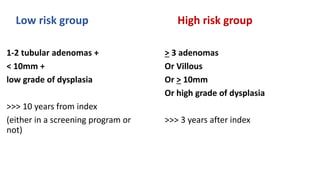
Low risk group
1-2 tubular adenomas +
< 10mm +
low grade of dysplasia
>>> 10 years from index
(either in a screening program or
not)
High risk group
> 3 adenomas
Or Villous
Or > 10mm
Or high grade of dysplasia
>>> 3 years after index
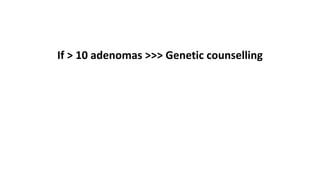
If > 10 adenomas >>> Genetic counselling
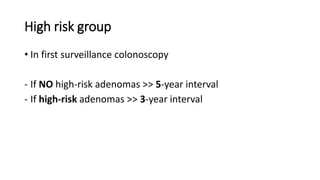
High risk group
• In first surveillance colonoscopy
- If NO high-risk adenomas >> 5-year interval
- If high-risk adenomas >> 3-year interval
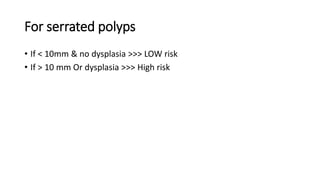
For serrated polyps
• If < 10mm & no dysplasia >>> LOW risk
• If > 10 mm Or dysplasia >>> High risk
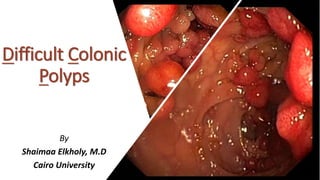
Difficult Colonic
Polyps
By
Shaimaa Elkholy, M.D
Cairo University
Objectives
•What is a Difficult polyp?
•How can we manage?
What is Difficult Polyp?
Difficult Polyp
• Size (large, long stalk, thick stalk …)
• Site (flexures, behind a fold, cecum, ileocecal valve ….)
• Type (flat, …)
• Accessibility
• Narrow lumen
• Incomplete resection
• Recurrence
No consensus or strict criteria for definition
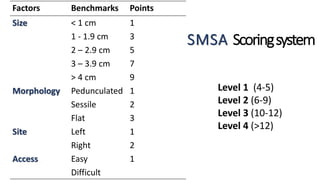
SMSA Scoringsystem
Factors Benchmarks Points
Size < 1 cm 1
1 - 1.9 cm 3
2 – 2.9 cm 5
3 – 3.9 cm 7
> 4 cm 9
Morphology Pedunculated 1
Sessile 2
Flat 3
Site Left 1
Right 2
Access Easy 1
Difficult
Level 1 (4-5)
Level 2 (6-9)
Level 3 (10-12)
Level 4 (>12)
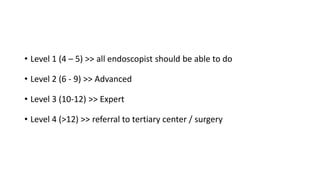
• Level 1 (4 – 5) >> all endoscopist should be able to do
• Level 2 (6 - 9) >> Advanced
• Level 3 (10-12) >> Expert
• Level 4 (>12) >> referral to tertiary center / surgery
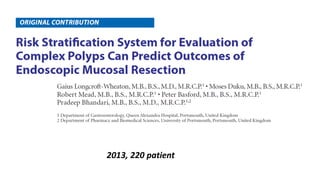
2013, 220 patient
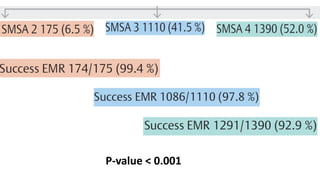
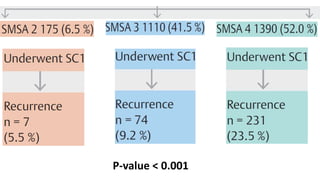
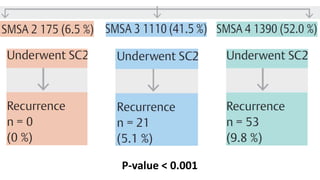
2018, 2675 patients, 9 yr
P-value < 0.001
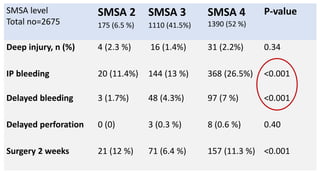
SMSA level
Total no=2675
SMSA 2
175 (6.5 %)
SMSA 3
1110 (41.5%)
SMSA 4
1390 (52 %)
P-value
Deep injury, n (%) 4 (2.3 %) 16 (1.4%) 31 (2.2%) 0.34
IP bleeding 20 (11.4%) 144 (13 %) 368 (26.5%) <0.001
Delayed bleeding 3 (1.7%) 48 (4.3%) 97 (7 %) <0.001
Delayed perforation 0 (0) 3 (0.3 %) 8 (0.6 %) 0.40
Surgery 2 weeks 21 (12 %) 71 (6.4 %) 157 (11.3 %) <0.001
P-value < 0.001
P-value < 0.001
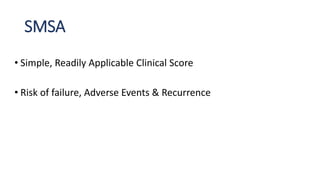
SMSA
• Simple, Readily Applicable Clinical Score
• Risk of failure, Adverse Events & Recurrence
• Not to scare the doctors
• Just to expect
• Be fully equipped
• The patient knowledge
• Better consenting
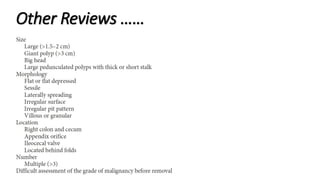
Other Reviews ……
Other Reviews ……
• Recurrent
• Incompletely resected
• Crossing two haustral folds
• Peri diverticular
• Touching dentate line
• Non – ideal situation
• In experienced endoscopist
What do we need before polypectomy?
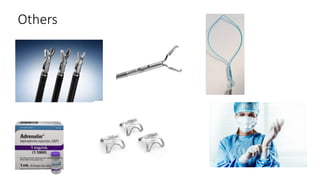
Others
First
• Locate the polyp
•Analyze polyp’s shape
•Determine the polyp’s size
•Analyze the polyps surface
•Determine the number of polyps
•Position the polyp before attempting
resection
•Estimate polyp respectability
using endoscopic methods
•Use submucosal cushion
•Choose accordingly
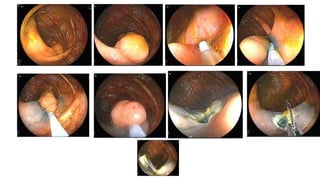
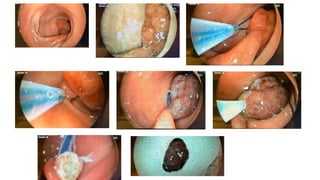
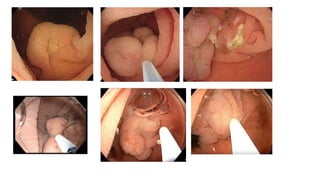
Methods for removal of difficult polyps
• Endoloop
• Clipping
• EMR
• p-EMR
• u-EMR
• ESD (conventional, pocket)
• Hybrid resection
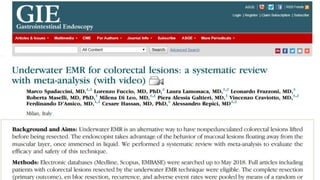
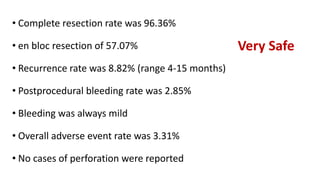
p-EMR
• Complete resection rate was 96.36%
• en bloc resection of 57.07%
• Recurrence rate was 8.82% (range 4-15 months)
• Postprocedural bleeding rate was 2.85%
• Bleeding was always mild
• Overall adverse event rate was 3.31%
• No cases of perforation were reported
Very Safe
ESD (Endoscopic Submucosal Dissection)
Features associated with incomplete resection
or recurrence include;
• Lesion size > 40mm
• ileocecal valve location
• Prior failed attempts of resection
• SMSA level 4
(Moderate quality evidence; strong recommendation)
• The majority of colonic and rectal lesions can be effectively
removed in a curative way by standard polypectomy and/or
by EMR
(Moderate quality evidence; strong recommendation)

Colonic polyps Difficult polyps

  • 1.
    How To Remove ColonicPolyps? By Shaimaa Elkholy, M.D Cairo University
  • 2.
    Agenda • What dowe need before polypectomy? • What are the methods used? • What types of snares? • What do guidelines say? • How to follow up?
  • 3.
    What do weneed before polypectomy?
  • 4.
    What are themethods used?
  • 5.
    What are themethods used? • Cold Biopsy Forceps (CBF) • Hot Biopsy Forceps (HBF) • Cold Snaring Polypectomy (CSP) • Hot Snaring Polypectomy (HSP) • Endoscopic mucosa resection (EMR) • Endoscopic submucosa dissection (ESD)
  • 6.
  • 7.
    Cold Biopsy Forceps(CBF) • 25 % residual tissue • It needs to be less than the biopsy forceps diameter • Resection rate >>> 39% (< 5mm) >>> 86 % (<5mm) >>> 92 – 100 % (<3mm)
  • 8.
  • 9.
    Hot Biopsy Forceps(HBF) -High rates of incomplete resection -Inadequate tissue sampling -High risks of adverse events (deep thermal injury & delayed bleeding)
  • 10.
  • 11.
    Cold Snaring Polypectomy(CSP) • RCTs (CSP Vs HSP) in polyps less than 8-10 mm >>> Less intra procedure bleeding (5.7 % Vs 23%) >>> Less post procedure bleeding (0 % Vs 14%) >>> post procedure pain (2.5% Vs 20%) >>> complete resection (94% Vs 93%)
  • 12.
    Cold Snaring Polypectomy(CSP) Lower rates of delayed bleeding Lower frequency of post-polypectomy Syndrome Shorter procedure duration
  • 13.
    Piecemeal- CSP - For10-19mm polyps - Few studies - Very safe (no bleeding, no perforation, no pain) - Histological assessment ?! - Head to head studies are still needed
  • 14.
  • 15.
  • 17.
    • For routinesessile polyps a 15 or 20 mm snare (regular stiffness) is easiest for laying the snare down / tissue grasping / size relative to polyp • Flat polyps require stiff/braided snares (and lifting) *A lot of snares have the same handle and color within the same company but behave very differently – read the catalog!!
  • 18.
  • 19.
    Cold Biopsy Forceps(CBF) -ESGE recommends AGAINST the use of CBF (high rates of incomplete resection) -Polyp 1 –3mm & cold snaring is technically difficult or not possible >> CBF MAY be used (Moderate quality evidence; strong recommendation)
  • 20.
    Hot Biopsy Forceps(HBF) -ESGE recommends AGAINST the use of HBF (High quality evidence; strong recommendation)
  • 21.
    Cold Snaring Polypectomy(CSP) ESGE suggests CSP for sessile polyps 6 –9mm in size because of its superior safety profile, although evidence comparing efficacy with HSP is lacking (Moderate quality evidence; weak recommendation)
  • 22.
    Piecemeal- CSP There maybe a role for p-CSP to reduce the risk of deep mural injury, but further studies are needed (Low quality evidence; wea recommendation)
  • 23.
    Hot Snaring Polypectomy(HSP) -ESGE suggests HSP (+ submucosal injection) for sessile polyps 10 – 19mm -Deep thermal injury is a potential risk & thus submucosal injection should be considered (Low quality evidence; strong recommendation)
  • 24.
    Hot Snaring Polypectomy(HSP) -ESGE suggests HSP for pedunculated polyps -Head > 20mm or stalk > 10mm, prior adrenaline injection + mechanical compression (Moderate quality evidence; strong recommendation)
  • 25.
    CRC polyps < 5mm CSP 6-9mm CSP > 10mm Advanced imaging Detect submucosal invasion Sessile or flat Pedunculated Head < 20mm & stalk<10mm HSP Head>20mm or stalk >10mm Dil adrenaline + mech compression then HSP
  • 26.
    > 10mm 10-19mm HSP, SCinjection better > 20 mm EMR, p-EMR If > 40mm refer to expert center Non-invasive Suspected invasion Superficial Tattoo & refer for ESD Deep Tattoo & refer for surgery
  • 27.
    Diminutive polyps (<5mm)at recto-sigmoid • photo
  • 28.
    Diminutive polyps (<5mm)at recto-sigmoid • If highly confident to be hyperplastic (Expert) >>>> leave or >> resect & discard
  • 29.
  • 30.
    Low risk group 1-2tubular adenomas + < 10mm + low grade of dysplasia >>> 10 years from index (either in a screening program or not) High risk group > 3 adenomas Or Villous Or > 10mm Or high grade of dysplasia >>> 3 years after index
  • 31.
    If > 10adenomas >>> Genetic counselling
  • 32.
    High risk group •In first surveillance colonoscopy - If NO high-risk adenomas >> 5-year interval - If high-risk adenomas >> 3-year interval
  • 33.
    For serrated polyps •If < 10mm & no dysplasia >>> LOW risk • If > 10 mm Or dysplasia >>> High risk
  • 35.
  • 36.
    Objectives •What is aDifficult polyp? •How can we manage?
  • 37.
  • 38.
    Difficult Polyp • Size(large, long stalk, thick stalk …) • Site (flexures, behind a fold, cecum, ileocecal valve ….) • Type (flat, …) • Accessibility • Narrow lumen • Incomplete resection • Recurrence
  • 39.
    No consensus orstrict criteria for definition
  • 41.
    SMSA Scoringsystem Factors BenchmarksPoints Size < 1 cm 1 1 - 1.9 cm 3 2 – 2.9 cm 5 3 – 3.9 cm 7 > 4 cm 9 Morphology Pedunculated 1 Sessile 2 Flat 3 Site Left 1 Right 2 Access Easy 1 Difficult Level 1 (4-5) Level 2 (6-9) Level 3 (10-12) Level 4 (>12)
  • 42.
    • Level 1(4 – 5) >> all endoscopist should be able to do • Level 2 (6 - 9) >> Advanced • Level 3 (10-12) >> Expert • Level 4 (>12) >> referral to tertiary center / surgery
  • 43.
  • 44.
  • 45.
  • 46.
    SMSA level Total no=2675 SMSA2 175 (6.5 %) SMSA 3 1110 (41.5%) SMSA 4 1390 (52 %) P-value Deep injury, n (%) 4 (2.3 %) 16 (1.4%) 31 (2.2%) 0.34 IP bleeding 20 (11.4%) 144 (13 %) 368 (26.5%) <0.001 Delayed bleeding 3 (1.7%) 48 (4.3%) 97 (7 %) <0.001 Delayed perforation 0 (0) 3 (0.3 %) 8 (0.6 %) 0.40 Surgery 2 weeks 21 (12 %) 71 (6.4 %) 157 (11.3 %) <0.001
  • 47.
  • 48.
  • 49.
    SMSA • Simple, ReadilyApplicable Clinical Score • Risk of failure, Adverse Events & Recurrence
  • 50.
    • Not toscare the doctors • Just to expect • Be fully equipped • The patient knowledge • Better consenting
  • 51.
  • 52.
    Other Reviews …… •Recurrent • Incompletely resected • Crossing two haustral folds • Peri diverticular • Touching dentate line • Non – ideal situation • In experienced endoscopist
  • 53.
    What do weneed before polypectomy?
  • 55.
  • 56.
    First • Locate thepolyp •Analyze polyp’s shape •Determine the polyp’s size •Analyze the polyps surface •Determine the number of polyps •Position the polyp before attempting resection •Estimate polyp respectability using endoscopic methods •Use submucosal cushion •Choose accordingly
  • 57.
    Methods for removalof difficult polyps • Endoloop • Clipping • EMR • p-EMR • u-EMR • ESD (conventional, pocket) • Hybrid resection
  • 62.
  • 65.
    • Complete resectionrate was 96.36% • en bloc resection of 57.07% • Recurrence rate was 8.82% (range 4-15 months) • Postprocedural bleeding rate was 2.85% • Bleeding was always mild • Overall adverse event rate was 3.31% • No cases of perforation were reported Very Safe
  • 66.
  • 71.
    Features associated withincomplete resection or recurrence include; • Lesion size > 40mm • ileocecal valve location • Prior failed attempts of resection • SMSA level 4 (Moderate quality evidence; strong recommendation)
  • 72.
    • The majorityof colonic and rectal lesions can be effectively removed in a curative way by standard polypectomy and/or by EMR (Moderate quality evidence; strong recommendation)