PERIODONTAL PATHOLOGYClinical Types of Periodontal Disease
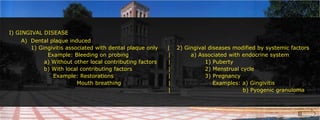
I) GINGIVAL DISEASEA)	Dental plaque induced		1) Gingivitis associated with dental plaque only     |	2) Gingival diseases modified by systemic factors			  Example: Bleeding on probing			   |		a) Associated with endocrine system			a) Without other local contributing factors	   |			1) Puberty			b) With local contributing factors			   |			2) Menstrual cycle				  Example: Restorations				   |			3) PregnancyMouth breathing			   |			    Examples: a) Gingivitis												   |					     b) Pyogenic granuloma
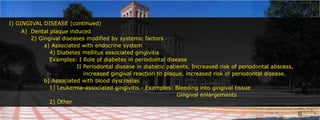
I) GINGIVAL DISEASE (continued)A)	Dental plaque induced		2) Gingival diseases modified by systemic factors			a) Associated with endocrine system				4) Diabetes mellitus associated gingivitis				Examples: I Role of diabetes in periodontal disease					       II Periodontal disease in diabetic patients. Increased risk of periodontal abscess, 						   increased gingival reaction to plaque, increased risk of periodontal disease.					b) Associated with blood dyscrasias				1) Leukemia-associated gingivitis - Examples: Bleeding into gingival tissue													Gingival enlargements				2) Other
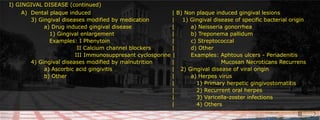
I) GINGIVAL DISEASE (continued)A)	Dental plaque induced						     | B) Non plaque induced gingival lesions		3) Gingival diseases modified by medication	     |	   1) Gingival disease of specific bacterial origin			a) Drug induced gingival disease			     |		a) Neisseria gonorrhea				1) Gingival enlargement				     |		b) Treponema pallidum				Examples: I Phenytoin				     |		c) Streptococcal					       II Calcium channel blockers	     |		d) Other					      III Immunosuppresant cyclosporine |		Examples: Aphtous ulcers - Periadenitis		4) Gingival diseases modified by malnutrition	     |				 Mucosan Necroticans Recurrens			a) Ascorbic acid gingivitis				     |	  2) Gingival disease of viral origin			b) Other							     |		a) Herpes virus												     |		   1) Primary herpetic gingivostomatitis												     |		   2) Recurrent oral herpes												     |		   3) Varicella-zoster infections												     |		   4) Others
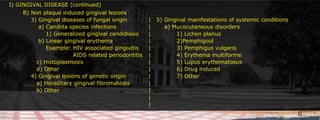
I) GINGIVAL DISEASE (continued)B) Non plaque induced gingival lesions 			     		3) Gingival diseases of fungal origin	    	|   5) Gingival manifestations of systemic conditions   		    a) Candida species infections			|	 a) Mucocutaneous disorders					 1) Generalized gingival candidiasis	|		1) Lichen planus				    b) Linear gingival erythema	   		|		2)Pemphigoid					 Example: HIV associated gingivitis	|		3) Pemphigus vulgaris						 	     AIDS related periodontitis	|  		4) Erythema multiforme				   c) Histoplasmosis					|		5) Lupus erythematosus		   d) Other							|		6) Drug induced		4) Gingival lesions of genetic origin		|		7) Other				   a) Hereditary gingival fibromatosis		|		   		   b) Other							|		   											|		   											|
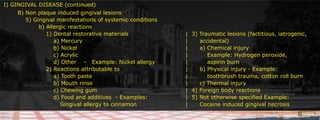
I) GINGIVAL DISEASE (continued)B) Non plaque induced gingival lesions 			     		5) Gingival manifestations of systemic conditions				    		b) Allergic reactions												 1) Dental restorative materials					|  3) Traumatic lesions (factitious, iatrogenic,				     a) Mercury								|	accidental)				     b) Nickel								|	a) Chemical injury				     c) Acrylic								|	    Example: Hydrogen peroxide,				     d) Other    -   Example: Nickel allergy			|	    aspirin burn				 2) Reactions attributable to					|	b) Physical injury - Example:				     a) Tooth paste							|	    toothbrush trauma, cotton roll burn				     b) Mouth rinse							|	c) Thermal injury				     c) Chewing gum							|  4) Foreign body reactions				     d) Food and additives  - Examples:			|  5) 	Not otherwise specified Example:					 Gingival allergy to cinnamon				|	Cocaine induced gingival necrosis
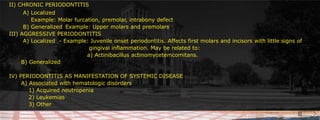
II) CHRONIC PERIODONTITIS	 A) Localized 											     		Example: Molar furcation, premolar, intrabony defect				 B) Generalized	 Example: Upper molars and premolars 		III) AGGRESSIVE PERIODONTITIS								 A) Localized  - Example: Juvenile onset periodontitis. Affects first molars and incisors with little signs of						      gingival inflammation. May be related to: 					     	 	     a) Actinibacillus actinomycetemcomitans.	B) Generalized											IV) PERIODONTITIS AS MANIFESTATION OF SYSTEMIC DISEASE			A) Associated with hematologic disorders						    1) Acquired neutropenia							 	    2) Leukemias 		 					    3) Other
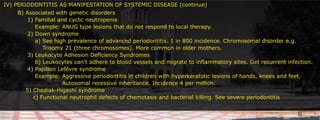
IV) PERIODONTITIS AS MANIFESTATION OF SYSTEMIC DISEASE (continue)	 B) Associated with genetic disorders 						     		 1) Familial and cyclic neutropenia		     Example: ANUG type lesions that do not respond to local therapy.		 2) Down syndrome 	    	     a) See high prevalence of advanced periodontitis. 1 in 800 incidence. Chromosomal disorder e.g.	          	  Trisomy 21 (three chromosomes). More common in older mothers.			 3) Leukocyte Adhesion Deficiency Syndromes		     b) Leukocytes can’t adhere to blood vessels and migrate to inflammatory sites. Get recurrent infection.		 4) Papillon Lefévre syndrome					     Example: Aggressive periodontitis in children with hyperkeratotic lesions of hands, knees and feet.					  Autosomal recessive inheritance. Incidence 4 per million.		5) Chediak-Higashi syndrome		    c) Functional neutrophil defects of chemotasis and bacterial killing. See severe periodontitis
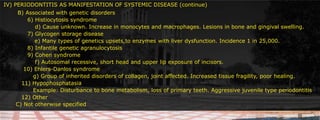
IV) PERIODONTITIS AS MANIFESTATION OF SYSTEMIC DISEASE (continue)	 B) Associated with genetic disorders 						     		 6) Histiocytosis syndrome		     d) Cause unknown. Increase in monocytes and macrophages. Lesions in bone and gingival swelling. 		 7) Glycogen storage disease	          e) Many types of genetics upsets,to enzymes with liver dysfunction. Incidence 1 in 25,000.			 8) Infantile genetic agranulocytosis		 9) Cohen syndrome		     f) Autosomal recessive, short head and upper lip exposure of incisors.				    10) Ehlers-Danlos syndrome		    g) Group of inherited disorders of collagen, joint affected. Increased tissue fragility, poor healing.	   11) Hypophosphatasia	 						    Example: Disturbance to bone metabolism, loss of primary teeth. Aggressive juvenile type periodontitis	   12) Other	C) Not otherwise specified
V) NECROTIZING PERIODONTAL DISEASES	A) Necrotizing ulcerative gingivitis 						     		 Example:	Associated with large amounts of fusiforms and spirochetes. Mainly adults. 					Only affects children that have severe systemic problems like malnutrition. 	B) Necrotizing ulcerative periodontitis			Example:	Can be associated with AIDSVI) ABSCESSES OF THE PERIODONTIUM	A) Gingival abscess		Example:	Localized to gingival tissue			B) Periodontal abscess		 Example:	Spread to involve larger area	 					C) Pericoronal abscessVII) PERIODONTITIS ASSOCIATED WITH ENDODONTIC LESIONS	A) Combined periodontic endodontic lesions		Examples:	Need to have radiologic evaluation and vitality testing
VIII) DEVELOPED OR ACQUIRED DEFORMITIES AND CONDITIONS	A) Localized tooth related factors that modify or predispose to plaque induced gingival disease, periodontitis 						     		1) Teeth anatomic factors 		     Example:  Development at groove on palatal of upper lateral incisor		2) Dental restorations			    Example:  Over contoured crowns. Poorly fitting margins		3) Root fracture        	    Example:  Longitudinal fractures have hopeless prognoses		B) Mucogingival deformities and conditions around teeth		 1) Gingival soft tissue recession	 						     a)  Facial or lingual surfaces			   Example:  Inadequate band of keratinized gingiva		     b)  Interproximal papillary			   Examples:  Loss of anterior papilla
VIII) DEVELOPED OR ACQUIRED DEFORMITIES AND CONDITIONS (Continued)	 B) Mucogingival deformities and conditions around teeth						     		2) Lack of keratinized gingiva 		3) Decreased vestibular depth			4) Aberrant frenum        	5) Gingival excess			    a) Pseudopocket		    b) Inconsistent gingival margin	 						    c) Excessive gingival display			 Example:  Poor gingival esthetics		    d) Gingival enlargement			 i) See 1A3, 1A4		    e) Abnormal color
VIII) DEVELOPED OR ACQUIRED DEFORMITIES AND CONDITIONS (Continued)	 C) Mucogingival deformities and conditions on edentulous ridges						     		1) Vertical and/or horizontal ridge deformity 		    Example:  Ridge deformities		2) Lack of gingiva keratinized tissue        	3) Gingival/soft tissue enlargements			4) Decreased vestibular depth		5) Abnormal color 					 D) Occlusal Trauma		1) Primary occlusal trauma		2) Secondary occlusal trauma
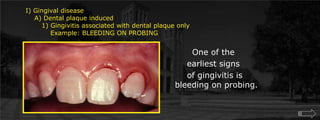
I) Gingival disease    A) Dental plaque induced	1) Gingivitis associated with dental plaque only	    Example: BLEEDING ON PROBINGOne of the earliest signs of gingivitis is bleeding on probing.
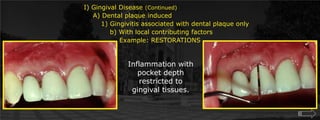
I) Gingival Disease (Continued)	A) Dental plaque induced		   1) Gingivitis associated with dental plaque only			     b) With local contributing factors				  Example: RESTORATIONSInflammation with pocket depth restricted to gingival tissues.
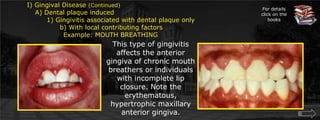
For details click on the booksI) Gingival Disease (Continued)	A) Dental plaque induced		   1) Gingivitis associated with dental plaque only			     b) With local contributing factors				  Example: MOUTH BREATHINGThis type of gingivitis affects the anterior gingiva of chronic mouth breathers or individuals with incomplete lip closure. Note the erythematous, hypertrophic maxillary anterior gingiva.
 Gingival Disease (Continued)    A) Dental plaque induced        2) Gingival diseases modified by systemic factors	     a) Associated with endocrine system		  1) Puberty	         2) Menstrual cycle	         3) Pregnancy	             Examples: a) Gingivitis             	   	     	       b) Pyogenic granuloma	The gingival tissues may have a modified reaction to dental plaque with changes in circulating estrogen and progesterone levels. These changes result in the inflammation having more vascular components and this is generally not  very obvious in puberty or with menstrual cycles but can be quite pronounced in some pregnant patients.
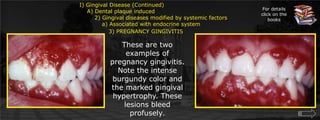
I) Gingival Disease (Continued)     A) Dental plaque induced        2) Gingival diseases modified by systemic factors		   a) Associated with endocrine system	               3) PREGNANCY GINGIVITISFor details click on the booksThese are two examples of pregnancy gingivitis. Note the intense burgundy color and the marked gingival hypertrophy. These lesions bleed profusely.
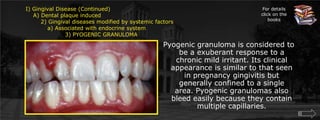
I) Gingival Disease (Continued)     A) Dental plaque induced        2) Gingival diseases modified by systemic factors		   a) Associated with endocrine system	               3) PYOGENIC GRANULOMAFor details click on the booksPyogenic granuloma is considered to be a exuberant response to a chronic mild irritant. Its clinical appearance is similar to that seen in pregnancy gingivitis but generally confined to a single area. Pyogenic granulomas also bleed easily because they contain multiple capillaries.
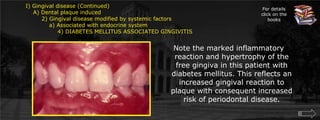
For details click on the books Gingival disease (Continued)    A) Dental plaque induced	2) Gingival disease modified by systemic factors	    a) Associated with endocrine system		4) DIABETES MELLITUS ASSOCIATED GINGIVITISNote the marked inflammatory reaction and hypertrophy of the free gingiva in this patient with diabetes mellitus. This reflects an increased gingival reaction to plaque with consequent increased risk of periodontal disease.
Periodontal disease in diabetic patientsincreased incidence of periodontal abscessesincrease gingival inflammatory reaction to plaqueincrease risk of periodontal disease 2.8 to 3.4 increaseincrease severity and rate of destruction.	Attachment and bone loss twice as much in diabetic Pima Indians compared with controls
Role of Diabetes in Periodontal diseaseReduce vasculature efficiencyPMN defectsMacrophage increase cytokines with P. Gingivalis 24 to 32 times more TNF 4 times increase in PGE and ILIIncrease collagenase	Increase in cross linked collagen by AGEs.	Delayed healing and repair
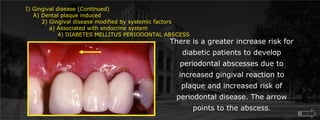
I) Gingival disease (Continued)    A) Dental plaque induced	2) Gingival disease modified by systemic factors	    a) Associated with endocrine system		4) DIABETES MELLITUS PERIODONTAL ABSCESSThere is a greater increase risk for diabetic patients to develop periodontal abscesses due to increased gingival reaction to plaque and increased risk of periodontal disease. The arrow points to the abscess.
Poor diabetic control and length of time increase risk of periodontal breakdown and increase chances of poor response to therapy.
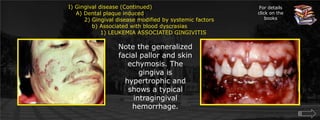
I) Gingival disease (Continued)    A) Dental plaque induced	2) Gingival disease modified by systemic factors	    b) Associated with blood dyscrasias		1) LEUKEMIA ASSOCIATED GINGIVITISFor details click on the booksNote the generalized facial pallor and skin echymosis. The gingiva is hypertrophic and shows a typical intragingival hemorrhage.
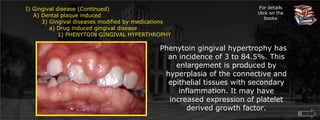
I) Gingival disease (Continued)    A) Dental plaque induced	3) Gingival diseases modified by medications	    a) Drug induced gingival disease		1) PHENYTOIN GINGIVAL HYPERTHROPHYFor details click on the booksPhenytoin gingival hypertrophy has an incidence of 3 to 84.5%. This enlargement is produced by hyperplasia of the connective and epithelial tissues with secondary inflammation. It may have increased expression of platelet derived growth factor.
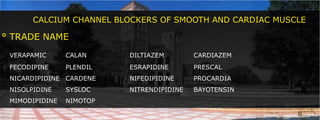
CALCIUM CHANNEL BLOCKERS OF SMOOTH AND CARDIAC MUSCLE° TRADE NAME	VERAPAMIC		CALAN			DILTIAZEM		CARDIAZEM	FECODIPINE		PLENDIL			ESRAPIDINE		PRESCAL	NICARDIPIDINE	CARDENE			NIFEDIPIDINE		PROCARDIA	NISOLPIDINE	SYSLOC			NITRENDIPIDINE	BAYOTENSIN	MIMODIPIDINE	NIMOTOP
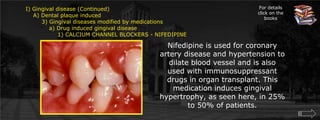
I) Gingival disease (Continued)    A) Dental plaque induced	3) Gingival diseases modified by medications	    a) Drug induced gingival disease		1) CALCIUM CHANNEL BLOCKERS - NIFEDIPINEFor details click on the books	Nifedipine is used for coronary artery disease and hypertension to dilate blood vessel and is also used with immunosuppressant drugs in organ transplant. This medication induces gingival hypertrophy, as seen here, in 25% to 50% of patients.
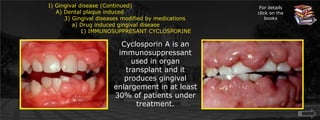
I) Gingival disease (Continued)    A) Dental plaque induced	3) Gingival diseases modified by medications	    a) Drug induced gingival disease		1) IMMUNOSUPPRESANT CYCLOSPORINEFor details click on the booksCyclosporin A is an immunosuppressant used in organ transplant and it produces gingival enlargement in at least 30% of patients under treatment.
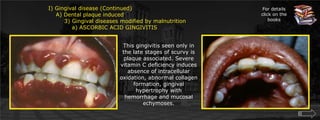
I) Gingival disease (Continued)    A) Dental plaque induced	3) Gingival diseases modified by malnutrition	    a) ASCORBIC ACID GINGIVITISFor details click on the booksThis gingivitis seen only in the late stages of scurvy is plaque associated. Severe vitamin C deficiency induces absence of intracellular oxidation, abnormal collagen formation, gingival hypertrophy with hemorrhage and mucosal echymoses.
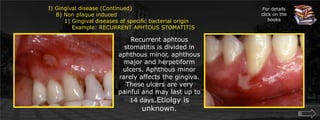
I) Gingival disease (Continued)    B) Non plaque induced	1) Gingival diseases of specific bacterial origin	    Example: RECURRENT APHTOUS STOMATITISFor details click on the booksRecurrent aphtous stomatitis is divided in aphthous minor, aphthous major and herpetiform ulcers. Aphthous minor rarely affects the gingiva. These ulcers are very painful and may last up to 14 days.Etiolgy is unknown.
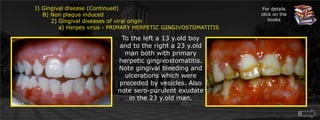
 Gingival disease (Continued)    B) Non plaque induced	2) Gingival diseases of viral origin	    a) Herpes virus - PRIMARY HERPETIC GINGIVOSTOMATITISFor details click on the booksTo the left a 13 y.old boy and to the right a 23 y.old man both with primary herpetic gingivostomatitis. Note gingival bleeding and ulcerations which were preceded by vesicles. Also note sero-purulent exudate in the 23 y.old man.
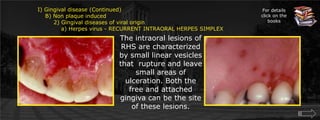
 Gingival disease (Continued)    B) Non plaque induced	2) Gingival diseases of viral origin	    a) Herpes virus - RECURRENT INTRAORAL HERPES SIMPLEXFor details click on the booksThe intraoral lesions of RHS are characterized by small linear vesicles that  rupture and leave small areas of ulceration. Both the free and attached gingiva can be the site of these lesions.
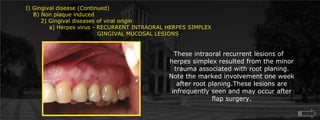
 Gingival disease (Continued)    B) Non plaque induced        2) Gingival diseases of viral origin	    a) Herpes virus - RECURRENT INTRAORAL HERPES SIMPLEX 				    GINGIVAL MUCOSAL LESIONSThese intraoral recurrent lesions of herpes simplex resulted from the minor trauma associated with root planing. Note the marked involvement one week after root planing.These lesions are infrequently seen and may occur after    flap surgery.
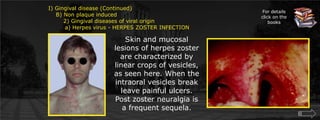
I) Gingival disease (Continued)    B) Non plaque induced        2) Gingival diseases of viral origin	    a) Herpes virus - HERPES ZOSTER INFECTIONFor details click on the booksSkin and mucosal lesions of herpes zoster are characterized by linear crops of vesicles, as seen here. When the intraoral vesicles break leave painful ulcers. Post zoster neuralgia is a frequent sequela.
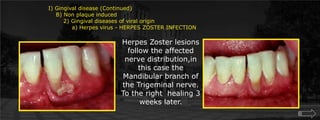
I) Gingival disease (Continued)    B) Non plaque induced        2) Gingival diseases of viral origin	    a) Herpes virus - HERPES ZOSTER INFECTIONHerpes Zoster lesions follow the affected nerve distribution,in this case the Mandibular branch of the Trigeminal nerve. To the right  healing 3 weeks later.
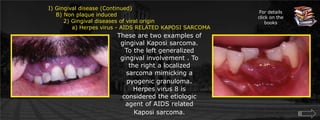
I) Gingival disease (Continued)    B) Non plaque induced        2) Gingival diseases of viral origin	    a) Herpes virus - AIDS RELATED KAPOSI SARCOMAFor details click on the booksThese are two examples of gingival Kaposi sarcoma. To the left generalized gingival involvement . To the right a localized sarcoma mimicking a pyogenic granuloma. Herpes virus 8 is considered the etiologic agent of AIDS related Kaposi sarcoma.
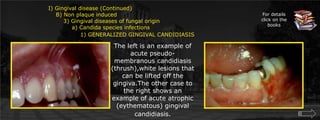
 Gingival disease (Continued)    B) Non plaque induced        3) Gingival diseases of fungal origin	    a) Candida species infections		1) GENERALIZED GINGIVAL CANDIDIASISFor details click on the booksThe left is an example of acute pseudo- membranous candidiasis (thrush),white lesions that can be lifted off the gingiva.The other case to the right shows an example of acute atrophic (eythematous) gingival candidiasis.
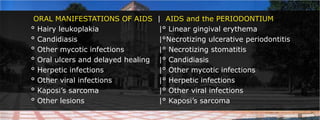
ORAL MANIFESTATIONS OF AIDS|AIDS and the PERIODONTIUM° Hairy leukoplakia				|° Linear gingival erythema° Candidiasis						|°Necrotizing ulcerative periodontitis° Other mycotic infections			|° Necrotizing stomatitis° Oral ulcers and delayed healing	|° Candidiasis° Herpetic infections				|° Other mycotic infections	° Other viral infections			|° Herpetic infections° Kaposi’s sarcoma				|° Other viral infections° Other lesions					|° Kaposi’s sarcoma
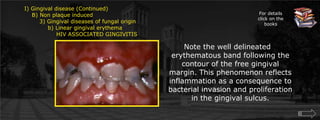
For details click on the booksI) Gingival disease (Continued)    B) Non plaque induced        3) Gingival diseases of fungal origin	    b) Linear gingival erythema		HIV ASSOCIATED GINGIVITISNote the well delineated erythematous band following the contour of the free gingival margin. This phenomenon reflects inflammation as a consequence to bacterial invasion and proliferation in the gingival sulcus.
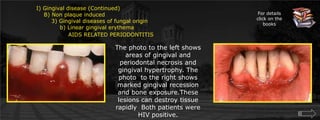
 Gingival disease (Continued)    B) Non plaque induced        3) Gingival diseases of fungal origin	    b) Linear gingival erythema		AIDS RELATED PERIODONTITISFor details click on the booksThe photo to the left shows areas of gingival and periodontal necrosis and gingival hypertrophy. The photo  to the right shows marked gingival recession and bone exposure.These lesions can destroy tissue rapidly  Both patients were HIV positive.
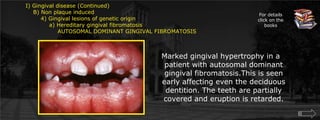
 Gingival disease (Continued)    B) Non plaque induced        4) Gingival lesions of genetic origin	    a) Hereditary gingival fibromatosis		AUTOSOMAL DOMINANT GINGIVAL FIBROMATOSISFor details click on the booksMarked gingival hypertrophy in a patient with autosomal dominant gingival fibromatosis.This is seen early affecting even the deciduous dentition. The teeth are partially covered and eruption is retarded.
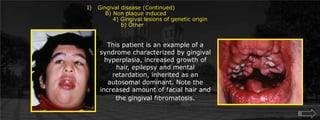
Gingival disease (Continued)    B) Non plaque induced        4) Gingival lesions of genetic origin		 b) Other 		This patient is an example of a syndrome characterized by gingival hyperplasia, increased growth of hair, epilepsy and mental retardation, inherited as an autosomal dominant. Note the increased amount of facial hair and the gingival fibromatosis.
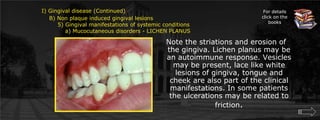
For details click on the booksI) Gingival disease (Continued)	    B) Non plaque induced gingival lesions  		5) Gingival manifestations of systemic conditions		    a) Mucocutaneous disorders - LICHEN PLANUSNote the striations and erosion of the gingiva. Lichen planus may be an autoimmune response. Vesicles may be present, lace like white lesions of gingiva, tongue and cheek are also part of the clinical manifestations. In some patients the ulcerations may be related to friction.
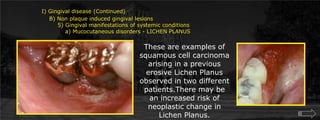
I) Gingival disease (Continued)	    B) Non plaque induced gingival lesions  		5) Gingival manifestations of systemic conditions		    a) Mucocutaneous disorders - LICHEN PLANUSThese are examples of squamous cell carcinoma arising in a previous erosive Lichen Planus observed in two different patients.There may be an increased risk of neoplastic change in Lichen Planus.
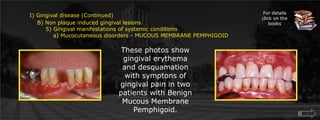
I) Gingival disease (Continued)	    B) Non plaque induced gingival lesions  		5) Gingival manifestations of systemic conditions		    a) Mucocutaneous disorders - MUCOUS MEMBRANE PEMPHIGOIDFor details click on the booksThese photos show gingival erythema and desquamation with symptons of gingival pain in two patients with Benign Mucous Membrane Pemphigoid.
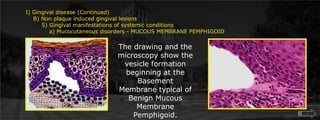
I) Gingival disease (Continued)    B) Non plaque induced gingival lesions  	5) Gingival manifestations of systemic conditions	    a) Mucocutaneous disorders - MUCOUS MEMBRANE PEMPHIGOIDThe drawing and the microscopy show the  vesicle formation beginning at the Basement Membrane typical of Benign Mucous Membrane Pemphigoid.
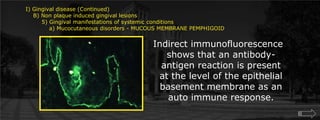
I) Gingival disease (Continued)    B) Non plaque induced gingival lesions  	5) Gingival manifestations of systemic conditions	    a) Mucocutaneous disorders - MUCOUS MEMBRANE PEMPHIGOIDIndirect immunofluorescence shows that an antibody-antigen reaction is present at the level of the epithelial basement membrane as an auto immune response.
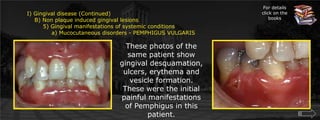
For details click on the booksI) Gingival disease (Continued)    B) Non plaque induced gingival lesions  	5) Gingival manifestations of systemic conditions             a) Mucocutaneous disorders - PEMPHIGUS VULGARISThese photos of the same patient show gingival desquamation, ulcers, erythema and vesicle formation. These were the initial painful manifestations of Pemphigus in this patient.
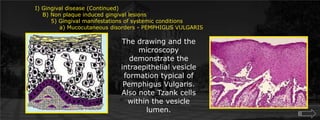
I) Gingival disease (Continued)    B) Non plaque induced gingival lesions  	5) Gingival manifestations of systemic conditions             a) Mucocutaneous disorders - PEMPHIGUS VULGARISThe drawing and the microscopy demonstrate the intraepithelial vesicle formation typical of Pemphigus Vulgaris. Also note Tzank cells within the vesicle lumen.
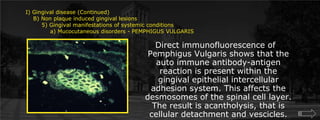
I) Gingival disease (Continued)    B) Non plaque induced gingival lesions  	5) Gingival manifestations of systemic conditions             a) Mucocutaneous disorders - PEMPHIGUS VULGARISDirect immunofluorescence of Pemphigus Vulgaris shows that the auto immune antibody-antigen reaction is present within the gingival epithelial intercellular adhesion system. This affects the desmosomes of the spinal cell layer. The result is acantholysis, that is cellular detachment and vescicles.
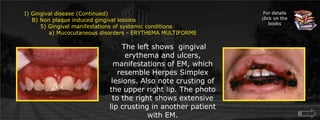
I) Gingival disease (Continued)    B) Non plaque induced gingival lesions  	5) Gingival manifestations of systemic conditions             a) Mucocutaneous disorders - ERYTHEMA MULTIFORMEFor details click on the books The left shows  gingival erythema and ulcers, manifestations of EM, which resemble Herpes Simplex lesions. Also note crusting of the upper right lip. The photo to the right shows extensive lip crusting in another patient with EM.
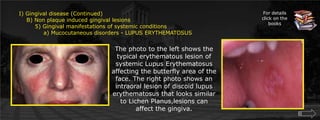
I) Gingival disease (Continued)    B) Non plaque induced gingival lesions  	5) Gingival manifestations of systemic conditions             a) Mucocutaneous disorders - LUPUS ERYTHEMATOSUSFor details click on the booksThe photo to the left shows the typical erythematous lesion of systemic Lupus Erythematosus affecting the butterfly area of the face. The right photo shows an intraoral lesion of discoid lupus erythematosus that looks similar to Lichen Planus,lesions can affect the gingiva.
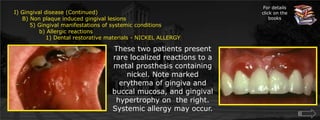
For details click on the books Gingival disease (Continued)    B) Non plaque induced gingival lesions  	5) Gingival manifestations of systemic conditions             b) Allergic reactions			1) Dental restorative materials - NICKEL ALLERGYThese two patients present rare localized reactions to a metal prosthesis containing nickel. Note marked erythema of gingiva and buccal mucosa, and gingival hypertrophy on  the right. Systemic allergy may occur.
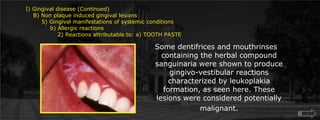
I) Gingival disease (Continued)    B) Non plaque induced gingival lesions  	5) Gingival manifestations of systemic conditions             b) Allergic reactions		2) Reactions attributable to: a) TOOTH PASTESome dentifrices and mouthrinses containing the herbal compound sanguinaria were shown to produce gingivo-vestibular reactions characterized by leukoplakia formation, as seen here. These lesions were considered potentially malignant.
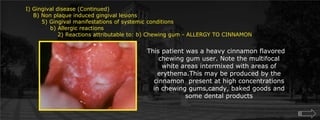
I) Gingival disease (Continued)    B) Non plaque induced gingival lesions  	5) Gingival manifestations of systemic conditions             b) Allergic reactions		2) Reactions attributable to: b) Chewing gum - ALLERGY TO CINNAMONThis patient was a heavy cinnamon flavored chewing gum user. Note the multifocal white areas intermixed with areas of erythema.This may be produced by the cinnamon  present at high concentrations in chewing gums,candy, baked goods and some dental products
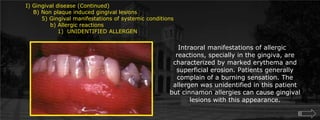
I) Gingival disease (Continued)    B) Non plaque induced gingival lesions  	5) Gingival manifestations of systemic conditions             b) Allergic reactions		1)  UNIDENTIFIED ALLERGENIntraoral manifestations of allergic reactions, specially in the gingiva, are characterized by marked erythema and superficial erosion. Patients generally complain of a burning sensation. The allergen was unidentified in this patient but cinnamon allergies can cause gingival lesions with this appearance.
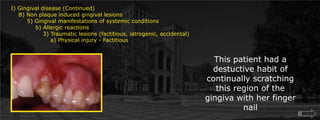
 Gingival disease (Continued)    B) Non plaque induced gingival lesions  	5) Gingival manifestations of systemic conditions             b) Allergic reactions		3) Traumatic lesions (factitious, iatrogenic, accidental)		    a) Physical injury - FactitiousThis patient had a destuctive habit of continually scratching this region of the gingiva with her finger nail
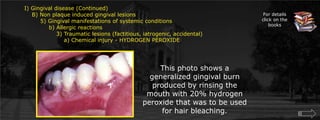
 Gingival disease (Continued)    B) Non plaque induced gingival lesions  	5) Gingival manifestations of systemic conditions             b) Allergic reactions		3) Traumatic lesions (factitious, iatrogenic, accidental)		    a) Chemical injury - HYDROGEN PEROXIDEFor details click on the booksThis photo shows a generalized gingival burn produced by rinsing the mouth with 20% hydrogen peroxide that was to be used for hair bleaching.
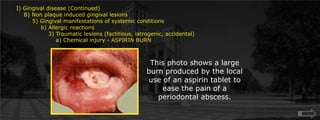
 Gingival disease (Continued)    B) Non plaque induced gingival lesions  	5) Gingival manifestations of systemic conditions             b) Allergic reactions		3) Traumatic lesions (factitious, iatrogenic, accidental)		    a) Chemical injury - ASPIRIN BURNThis photo shows a large burn produced by the local use of an aspirin tablet to ease the pain of a periodontal abscess.
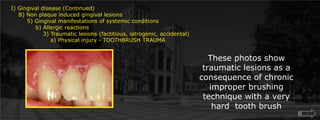
 Gingival disease (Continued)    B) Non plaque induced gingival lesions  	5) Gingival manifestations of systemic conditions             b) Allergic reactions		3) Traumatic lesions (factitious, iatrogenic, accidental)		    a) Physical injury - TOOTHBRUSH TRAUMAThese photos show traumatic lesions as a consequence of chronic improper brushing technique with a very hard  tooth brush
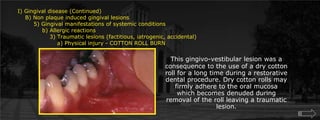
I) Gingival disease (Continued)    B) Non plaque induced gingival lesions  	5) Gingival manifestations of systemic conditions             b) Allergic reactions		3) Traumatic lesions (factitious, iatrogenic, accidental)		    a) Physical injury - COTTON ROLL BURNThis gingivo-vestibular lesion was a consequence to the use of a dry cotton roll for a long time during a restorative dental procedure. Dry cotton rolls may firmly adhere to the oral mucosa which becomes denuded during removal of the roll leaving a traumatic lesion.
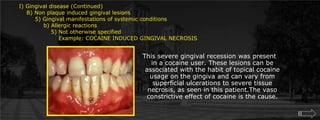
I) Gingival disease (Continued)    B) Non plaque induced gingival lesions  	5) Gingival manifestations of systemic conditions             b) Allergic reactions		5) Not otherwise specified		    Example: COCAINE INDUCED GINGIVAL NECROSISThis severe gingival recession was present in a cocaine user. These lesions can be associated with the habit of topical cocaine usage on the gingiva and can vary from superficial ulcerations to severe tissue necrosis, as seen in this patient.The vaso constrictive effect of cocaine is the cause.
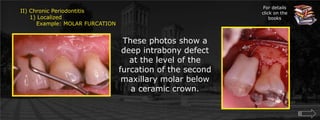
For details click on the booksII) Chronic Periodontitis     1) Localized	Example: MOLAR FURCATIONThese photos show a deep intrabony defect at the level of the furcation of the second maxillary molar below a ceramic crown.
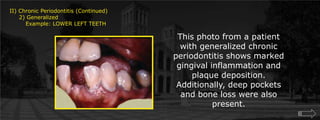
II) Chronic Periodontitis (Continued)     2) Generalized	Example: LOWER LEFT TEETHThis photo from a patient with generalized chronic periodontitis shows marked gingival inflammation and plaque deposition. Additionally, deep pockets and bone loss were also present.
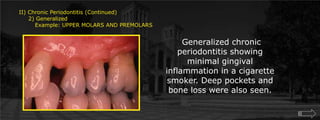
II) Chronic Periodontitis (Continued)     2) Generalized	Example: UPPER MOLARS AND PREMOLARS Generalized chronic periodontitis showing minimal gingival inflammation in a cigarette smoker. Deep pockets and bone loss were also seen.
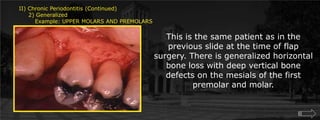
II) Chronic Periodontitis (Continued)     2) Generalized	Example: UPPER MOLARS AND PREMOLARSThis is the same patient as in the previous slide at the time of flap surgery. There is generalized horizontal bone loss with deep vertical bone defects on the mesials of the first premolar and molar.
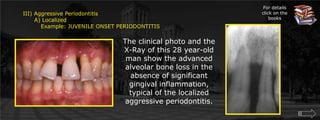
For details click on the booksIII) Aggressive Periodontitis      A) Localized	 Example: JUVENILE ONSET PERIODONTITISThe clinical photo and the X-Ray of this 28 year-old man show the advanced alveolar bone loss in the absence of significant gingival inflammation, typical of the localized aggressive periodontitis.
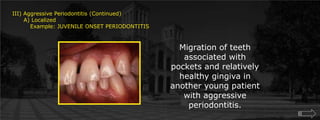
III) Aggressive Periodontitis (Continued)      A) Localized	 Example: JUVENILE ONSET PERIODONTITISMigration of teeth associated with pockets and relatively healthy gingiva in another young patient with aggressive periodontitis.
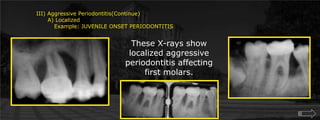
III) Aggressive Periodontitis(Continue)      A) Localized	 Example: JUVENILE ONSET PERIODONTITISThese X-rays show localized aggressive periodontitis affecting first molars.
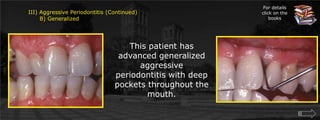
For details click on the booksIII) Aggressive Periodontitis (Continued)      B) GeneralizedThis patient has advanced generalized aggressive periodontitis with deep pockets throughout the mouth.
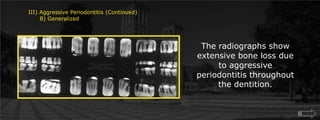
III) Aggressive Periodontitis (Continued)      B) GeneralizedThe radiographs show extensive bone loss due to aggressive periodontitis throughout the dentition.
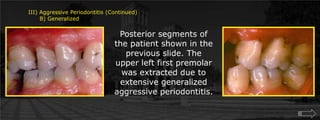
III) Aggressive Periodontitis (Continued)      B) GeneralizedPosterior segments of the patient shown in the previous slide. The upper left first premolar was extracted due to extensive generalized aggressive periodontitis.
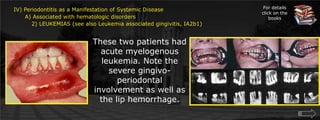
For details click on the booksIV) Periodontitis as a Manifestation of Systemic Disease      A) Associated with hematologic disorders	 2) LEUKEMIAS (see also Leukemia associated gingivitis, IA2b1)These two patients had acute myelogenous leukemia. Note the severe gingivo-periodontal involvement as well as the lip hemorrhage.
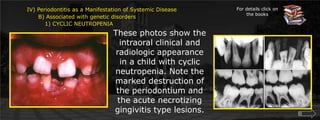
IV) Periodontitis as a Manifestation of Systemic Disease      B) Associated with genetic disorders	 1) CYCLIC NEUTROPENIAFor details click on the booksThese photos show the intraoral clinical and radiologic appearance in a child with cyclic neutropenia. Note the marked destruction of the periodontium and the acute necrotizing gingivitis type lesions.
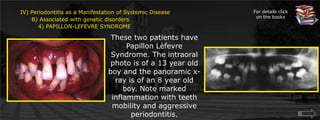
IV) Periodontitis as a Manifestation of Systemic Disease      B) Associated with genetic disorders	 4) PAPILLON-LEFEVRE SYNDROMEFor details click on the booksThese two patients have Papillon Lèfevre Syndrome. The intraoral photo is of a 13 year old boy and the panoramic x-ray is of an 8 year old boy. Note marked inflammation with teeth mobility and aggressive periodontitis.
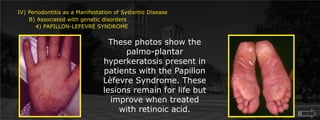
IV) Periodontitis as a Manifestation of Systemic Disease      B) Associated with genetic disorders	 4) PAPILLON-LEFEVRE SYNDROMEThese photos show the palmo-plantar hyperkeratosis present in patients with the Papillon Lèfevre Syndrome. These lesions remain for life but improve when treated with retinoic acid.
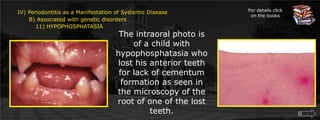
For details click on the booksIV) Periodontitis as a Manifestation of Systemic Disease      B) Associated with genetic disorders	 11) HYPOPHOSPHATASIAThe intraoral photo is of a child with hypophosphatasia who lost his anterior teeth for lack of cementum formation as seen in the microscopy of the root of one of the lost teeth.
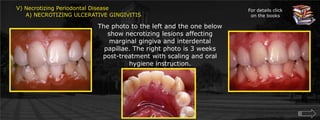
V) Necrotizing Periodontal Disease     A) NECROTIZING ULCERATIVE GINGIVITISFor details click on the booksThe photo to the left and the one below show necrotizing lesions affecting marginal gingiva and interdental papillae. The right photo is 3 weeks post-treatment with scaling and oral hygiene instruction.
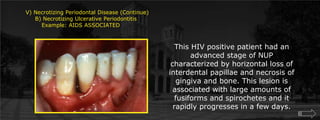
V) Necrotizing Periodontal Disease (Continue)     B) Necrotizing Ulcerative Periodontitis	Example: AIDS ASSOCIATEDThis HIV positive patient had an advanced stage of NUP characterized by horizontal loss of interdental papillae and necrosis of gingiva and bone. This lesion is associated with large amounts of fusiforms and spirochetes and it rapidly progresses in a few days.
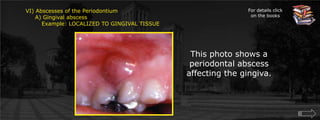
VI) Abscesses of the Periodontium     A) Gingival abscess	Example: LOCALIZED TO GINGIVAL TISSUEFor details click on the booksThis photo shows a periodontal abscess affecting the gingiva.
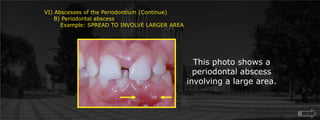
VI) Abscesses of the Periodontium (Continue)     B) Periodontal abscess	Example: SPREAD TO INVOLVE LARGER AREAThis photo shows a periodontal abscess involving a large area.
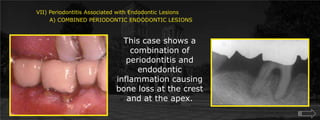
VII) Periodontitis Associated with Endodontic Lesions       A) COMBINED PERIODONTIC ENDODONTIC LESIONSThis case shows a combination of periodontitis and endodontic inflammation causing bone loss at the crest and at the apex.
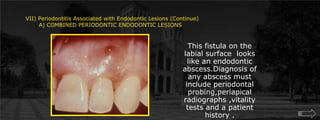
VII) Periodontitis Associated with Endodontic Lesions (Continue)       A) COMBINED PERIODONTIC ENDODONTIC LESIONS	This fistula on the labial surface  looks like an endodontic abscess.Diagnosis of any abscess must include periodontal probing,periapical radiographs ,vitality tests and a patient history .
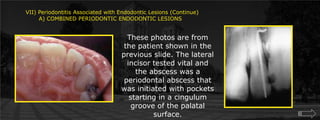
VII) Periodontitis Associated with Endodontic Lesions (Continue)       A) COMBINED PERIODONTIC ENDODONTIC LESIONSThese photos are from the patient shown in the previous slide. The lateral incisor tested vital and the abscess was a periodontal abscess that was initiated with pockets starting in a cingulum groove of the palatal surface.
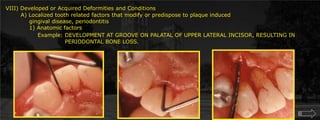
VIII) Developed or Acquired Deformities and Conditions        A) Localized tooth related factors that modify or predispose to plaque induced	    gingival disease, periodontitis	    1) Anatomic factorsExample: DEVELOPMENT AT GROOVE ON PALATAL OF UPPER LATERAL INCISOR, RESULTING IN			      PERIODONTAL BONE LOSS.
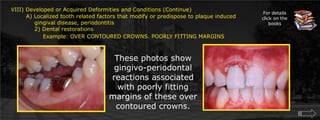
VIII) Developed or Acquired Deformities and Conditions (Continue)        A) Localized tooth related factors that modify or predispose to plaque induced	    gingival disease, periodontitis	    2) Dental restorationsExample: OVER CONTOURED CROWNS. POORLY FITTING MARGINSFor details click on the booksThese photos show gingivo-periodontal reactions associated with poorly fitting margins of these over contoured crowns.
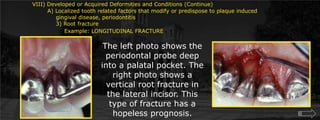
VIII) Developed or Acquired Deformities and Conditions (Continue)        A) Localized tooth related factors that modify or predispose to plaque induced	    gingival disease, periodontitis	    3) Root fractureExample: LONGITUDINAL FRACTUREThe left photo shows the periodontal probe deep into a palatal pocket. The right photo shows a vertical root fracture in the lateral incisor. This type of fracture has a hopeless prognosis.
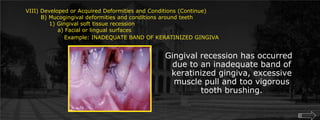
VIII) Developed or Acquired Deformities and Conditions (Continue)        B) Mucogingival deformities and conditions around teeth	    1) Gingival soft tissue recession	    	a) Facial or lingual surfacesExample: INADEQUATE BAND OF KERATINIZED GINGIVAGingival recession has occurred due to an inadequate band of keratinized gingiva, excessive muscle pull and too vigorous tooth brushing.
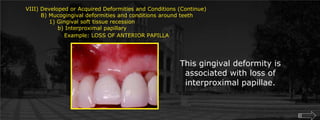
VIII) Developed or Acquired Deformities and Conditions (Continue)        B) Mucogingival deformities and conditions around teeth	    1) Gingival soft tissue recession	    	b) Interproximal papillaryExample: LOSS OF ANTERIOR PAPILLAThis gingival deformity is associated with loss of interproximal papillae.
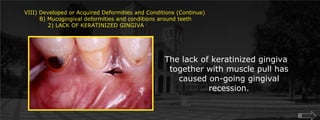
VIII) Developed or Acquired Deformities and Conditions (Continue)        B) Mucogingival deformities and conditions around teeth	    2) LACK OF KERATINIZED GINGIVAThe lack of keratinized gingiva together with muscle pull has caused on-going gingival recession.
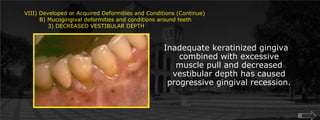
VIII) Developed or Acquired Deformities and Conditions (Continue)        B) Mucogingival deformities and conditions around teeth	    3) DECREASED VESTIBULAR DEPTHInadequate keratinized gingiva combined with excessive muscle pull and decreased vestibular depth has caused progressive gingival recession.
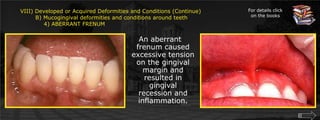
VIII) Developed or Acquired Deformities and Conditions (Continue)        B) Mucogingival deformities and conditions around teeth	    4) ABERRANT FRENUMFor details click on the booksAn aberrant frenum caused excessive tension on the gingival margin and resulted in gingival recession and inflammation.
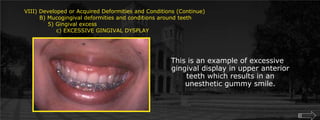
VIII) Developed or Acquired Deformities and Conditions (Continue)        B) Mucogingival deformities and conditions around teeth	    5) Gingival excess		c) EXCESSIVE GINGIVAL DYSPLAY This is an example of excessive gingival display in upper anterior teeth which results in an unesthetic gummy smile.
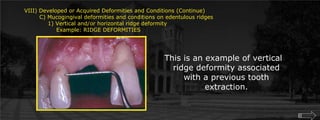
VIII) Developed or Acquired Deformities and Conditions (Continue)        C) Mucogingival deformities and conditions on edentulous ridges	    1) Vertical and/or horizontal ridge deformity		Example: RIDGE DEFORMITIESThis is an example of vertical ridge deformity associated with a previous tooth extraction.
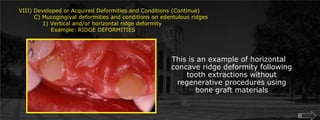
VIII) Developed or Acquired Deformities and Conditions (Continue)        C) Mucogingival deformities and conditions on edentulous ridges	    1) Vertical and/or horizontal ridge deformity		Example: RIDGE DEFORMITIESThis is an example of horizontal concave ridge deformity following tooth extractions without regenerative procedures using bone graft materials
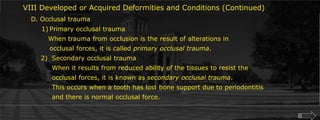
VIII Developed or Acquired Deformities and Conditions (Continued)D. Occlusal traumaPrimary occlusal trauma   When trauma from occlusion is the result of alterations in	occlusal forces, it is called primary occlusal trauma.		2)	Secondary occlusal trauma			When it results from reduced ability of the tissues to resist the		 	occlusal forces, it is known as secondary occlusal trauma.		  	This occurs when a tooth has lost bone support due to periodontitis			and there is normal occlusal force.

Gingivitis

  • 1.
  • 2.
    I) GINGIVAL DISEASEA) Dentalplaque induced 1) Gingivitis associated with dental plaque only | 2) Gingival diseases modified by systemic factors Example: Bleeding on probing | a) Associated with endocrine system a) Without other local contributing factors | 1) Puberty b) With local contributing factors | 2) Menstrual cycle Example: Restorations | 3) PregnancyMouth breathing | Examples: a) Gingivitis | b) Pyogenic granuloma
  • 3.
    I) GINGIVAL DISEASE(continued)A) Dental plaque induced 2) Gingival diseases modified by systemic factors a) Associated with endocrine system 4) Diabetes mellitus associated gingivitis Examples: I Role of diabetes in periodontal disease II Periodontal disease in diabetic patients. Increased risk of periodontal abscess, increased gingival reaction to plaque, increased risk of periodontal disease. b) Associated with blood dyscrasias 1) Leukemia-associated gingivitis - Examples: Bleeding into gingival tissue Gingival enlargements 2) Other
  • 4.
    I) GINGIVAL DISEASE(continued)A) Dental plaque induced | B) Non plaque induced gingival lesions 3) Gingival diseases modified by medication | 1) Gingival disease of specific bacterial origin a) Drug induced gingival disease | a) Neisseria gonorrhea 1) Gingival enlargement | b) Treponema pallidum Examples: I Phenytoin | c) Streptococcal II Calcium channel blockers | d) Other III Immunosuppresant cyclosporine | Examples: Aphtous ulcers - Periadenitis 4) Gingival diseases modified by malnutrition | Mucosan Necroticans Recurrens a) Ascorbic acid gingivitis | 2) Gingival disease of viral origin b) Other | a) Herpes virus | 1) Primary herpetic gingivostomatitis | 2) Recurrent oral herpes | 3) Varicella-zoster infections | 4) Others
  • 5.
    I) GINGIVAL DISEASE(continued)B) Non plaque induced gingival lesions 3) Gingival diseases of fungal origin | 5) Gingival manifestations of systemic conditions a) Candida species infections | a) Mucocutaneous disorders 1) Generalized gingival candidiasis | 1) Lichen planus b) Linear gingival erythema | 2)Pemphigoid Example: HIV associated gingivitis | 3) Pemphigus vulgaris AIDS related periodontitis | 4) Erythema multiforme c) Histoplasmosis | 5) Lupus erythematosus d) Other | 6) Drug induced 4) Gingival lesions of genetic origin | 7) Other a) Hereditary gingival fibromatosis | b) Other | | |
  • 6.
    I) GINGIVAL DISEASE(continued)B) Non plaque induced gingival lesions 5) Gingival manifestations of systemic conditions b) Allergic reactions 1) Dental restorative materials | 3) Traumatic lesions (factitious, iatrogenic, a) Mercury | accidental) b) Nickel | a) Chemical injury c) Acrylic | Example: Hydrogen peroxide, d) Other - Example: Nickel allergy | aspirin burn 2) Reactions attributable to | b) Physical injury - Example: a) Tooth paste | toothbrush trauma, cotton roll burn b) Mouth rinse | c) Thermal injury c) Chewing gum | 4) Foreign body reactions d) Food and additives - Examples: | 5) Not otherwise specified Example: Gingival allergy to cinnamon | Cocaine induced gingival necrosis
  • 7.
    II) CHRONIC PERIODONTITIS A) Localized Example: Molar furcation, premolar, intrabony defect B) Generalized Example: Upper molars and premolars III) AGGRESSIVE PERIODONTITIS A) Localized - Example: Juvenile onset periodontitis. Affects first molars and incisors with little signs of gingival inflammation. May be related to: a) Actinibacillus actinomycetemcomitans. B) Generalized IV) PERIODONTITIS AS MANIFESTATION OF SYSTEMIC DISEASE A) Associated with hematologic disorders 1) Acquired neutropenia 2) Leukemias 3) Other
  • 8.
    IV) PERIODONTITIS ASMANIFESTATION OF SYSTEMIC DISEASE (continue) B) Associated with genetic disorders 1) Familial and cyclic neutropenia Example: ANUG type lesions that do not respond to local therapy. 2) Down syndrome a) See high prevalence of advanced periodontitis. 1 in 800 incidence. Chromosomal disorder e.g. Trisomy 21 (three chromosomes). More common in older mothers. 3) Leukocyte Adhesion Deficiency Syndromes b) Leukocytes can’t adhere to blood vessels and migrate to inflammatory sites. Get recurrent infection. 4) Papillon Lefévre syndrome Example: Aggressive periodontitis in children with hyperkeratotic lesions of hands, knees and feet. Autosomal recessive inheritance. Incidence 4 per million. 5) Chediak-Higashi syndrome c) Functional neutrophil defects of chemotasis and bacterial killing. See severe periodontitis
  • 9.
    IV) PERIODONTITIS ASMANIFESTATION OF SYSTEMIC DISEASE (continue) B) Associated with genetic disorders 6) Histiocytosis syndrome d) Cause unknown. Increase in monocytes and macrophages. Lesions in bone and gingival swelling. 7) Glycogen storage disease e) Many types of genetics upsets,to enzymes with liver dysfunction. Incidence 1 in 25,000. 8) Infantile genetic agranulocytosis 9) Cohen syndrome f) Autosomal recessive, short head and upper lip exposure of incisors. 10) Ehlers-Danlos syndrome g) Group of inherited disorders of collagen, joint affected. Increased tissue fragility, poor healing. 11) Hypophosphatasia Example: Disturbance to bone metabolism, loss of primary teeth. Aggressive juvenile type periodontitis 12) Other C) Not otherwise specified
  • 10.
    V) NECROTIZING PERIODONTALDISEASES A) Necrotizing ulcerative gingivitis Example: Associated with large amounts of fusiforms and spirochetes. Mainly adults. Only affects children that have severe systemic problems like malnutrition. B) Necrotizing ulcerative periodontitis Example: Can be associated with AIDSVI) ABSCESSES OF THE PERIODONTIUM A) Gingival abscess Example: Localized to gingival tissue B) Periodontal abscess Example: Spread to involve larger area C) Pericoronal abscessVII) PERIODONTITIS ASSOCIATED WITH ENDODONTIC LESIONS A) Combined periodontic endodontic lesions Examples: Need to have radiologic evaluation and vitality testing
  • 11.
    VIII) DEVELOPED ORACQUIRED DEFORMITIES AND CONDITIONS A) Localized tooth related factors that modify or predispose to plaque induced gingival disease, periodontitis 1) Teeth anatomic factors Example: Development at groove on palatal of upper lateral incisor 2) Dental restorations Example: Over contoured crowns. Poorly fitting margins 3) Root fracture Example: Longitudinal fractures have hopeless prognoses B) Mucogingival deformities and conditions around teeth 1) Gingival soft tissue recession a) Facial or lingual surfaces Example: Inadequate band of keratinized gingiva b) Interproximal papillary Examples: Loss of anterior papilla
  • 12.
    VIII) DEVELOPED ORACQUIRED DEFORMITIES AND CONDITIONS (Continued) B) Mucogingival deformities and conditions around teeth 2) Lack of keratinized gingiva 3) Decreased vestibular depth 4) Aberrant frenum 5) Gingival excess a) Pseudopocket b) Inconsistent gingival margin c) Excessive gingival display Example: Poor gingival esthetics d) Gingival enlargement i) See 1A3, 1A4 e) Abnormal color
  • 13.
    VIII) DEVELOPED ORACQUIRED DEFORMITIES AND CONDITIONS (Continued) C) Mucogingival deformities and conditions on edentulous ridges 1) Vertical and/or horizontal ridge deformity Example: Ridge deformities 2) Lack of gingiva keratinized tissue 3) Gingival/soft tissue enlargements 4) Decreased vestibular depth 5) Abnormal color D) Occlusal Trauma 1) Primary occlusal trauma 2) Secondary occlusal trauma
  • 14.
    I) Gingival disease A) Dental plaque induced 1) Gingivitis associated with dental plaque only Example: BLEEDING ON PROBINGOne of the earliest signs of gingivitis is bleeding on probing.
  • 15.
    I) Gingival Disease(Continued) A) Dental plaque induced 1) Gingivitis associated with dental plaque only b) With local contributing factors Example: RESTORATIONSInflammation with pocket depth restricted to gingival tissues.
  • 16.
    For details clickon the booksI) Gingival Disease (Continued) A) Dental plaque induced 1) Gingivitis associated with dental plaque only b) With local contributing factors Example: MOUTH BREATHINGThis type of gingivitis affects the anterior gingiva of chronic mouth breathers or individuals with incomplete lip closure. Note the erythematous, hypertrophic maxillary anterior gingiva.
  • 17.
    Gingival Disease(Continued) A) Dental plaque induced 2) Gingival diseases modified by systemic factors a) Associated with endocrine system 1) Puberty 2) Menstrual cycle 3) Pregnancy Examples: a) Gingivitis b) Pyogenic granuloma The gingival tissues may have a modified reaction to dental plaque with changes in circulating estrogen and progesterone levels. These changes result in the inflammation having more vascular components and this is generally not very obvious in puberty or with menstrual cycles but can be quite pronounced in some pregnant patients.
  • 18.
    I) Gingival Disease(Continued) A) Dental plaque induced 2) Gingival diseases modified by systemic factors a) Associated with endocrine system 3) PREGNANCY GINGIVITISFor details click on the booksThese are two examples of pregnancy gingivitis. Note the intense burgundy color and the marked gingival hypertrophy. These lesions bleed profusely.
  • 19.
    I) Gingival Disease(Continued) A) Dental plaque induced 2) Gingival diseases modified by systemic factors a) Associated with endocrine system 3) PYOGENIC GRANULOMAFor details click on the booksPyogenic granuloma is considered to be a exuberant response to a chronic mild irritant. Its clinical appearance is similar to that seen in pregnancy gingivitis but generally confined to a single area. Pyogenic granulomas also bleed easily because they contain multiple capillaries.
  • 20.
    For details clickon the books Gingival disease (Continued) A) Dental plaque induced 2) Gingival disease modified by systemic factors a) Associated with endocrine system 4) DIABETES MELLITUS ASSOCIATED GINGIVITISNote the marked inflammatory reaction and hypertrophy of the free gingiva in this patient with diabetes mellitus. This reflects an increased gingival reaction to plaque with consequent increased risk of periodontal disease.
  • 21.
    Periodontal disease indiabetic patientsincreased incidence of periodontal abscessesincrease gingival inflammatory reaction to plaqueincrease risk of periodontal disease 2.8 to 3.4 increaseincrease severity and rate of destruction. Attachment and bone loss twice as much in diabetic Pima Indians compared with controls
  • 22.
    Role of Diabetesin Periodontal diseaseReduce vasculature efficiencyPMN defectsMacrophage increase cytokines with P. Gingivalis 24 to 32 times more TNF 4 times increase in PGE and ILIIncrease collagenase Increase in cross linked collagen by AGEs. Delayed healing and repair
  • 23.
    I) Gingival disease(Continued) A) Dental plaque induced 2) Gingival disease modified by systemic factors a) Associated with endocrine system 4) DIABETES MELLITUS PERIODONTAL ABSCESSThere is a greater increase risk for diabetic patients to develop periodontal abscesses due to increased gingival reaction to plaque and increased risk of periodontal disease. The arrow points to the abscess.
  • 24.
    Poor diabetic controland length of time increase risk of periodontal breakdown and increase chances of poor response to therapy.
  • 25.
    I) Gingival disease(Continued) A) Dental plaque induced 2) Gingival disease modified by systemic factors b) Associated with blood dyscrasias 1) LEUKEMIA ASSOCIATED GINGIVITISFor details click on the booksNote the generalized facial pallor and skin echymosis. The gingiva is hypertrophic and shows a typical intragingival hemorrhage.
  • 26.
    I) Gingival disease(Continued) A) Dental plaque induced 3) Gingival diseases modified by medications a) Drug induced gingival disease 1) PHENYTOIN GINGIVAL HYPERTHROPHYFor details click on the booksPhenytoin gingival hypertrophy has an incidence of 3 to 84.5%. This enlargement is produced by hyperplasia of the connective and epithelial tissues with secondary inflammation. It may have increased expression of platelet derived growth factor.
  • 27.
    CALCIUM CHANNEL BLOCKERSOF SMOOTH AND CARDIAC MUSCLE° TRADE NAME VERAPAMIC CALAN DILTIAZEM CARDIAZEM FECODIPINE PLENDIL ESRAPIDINE PRESCAL NICARDIPIDINE CARDENE NIFEDIPIDINE PROCARDIA NISOLPIDINE SYSLOC NITRENDIPIDINE BAYOTENSIN MIMODIPIDINE NIMOTOP
  • 28.
    I) Gingival disease(Continued) A) Dental plaque induced 3) Gingival diseases modified by medications a) Drug induced gingival disease 1) CALCIUM CHANNEL BLOCKERS - NIFEDIPINEFor details click on the books Nifedipine is used for coronary artery disease and hypertension to dilate blood vessel and is also used with immunosuppressant drugs in organ transplant. This medication induces gingival hypertrophy, as seen here, in 25% to 50% of patients.
  • 29.
    I) Gingival disease(Continued) A) Dental plaque induced 3) Gingival diseases modified by medications a) Drug induced gingival disease 1) IMMUNOSUPPRESANT CYCLOSPORINEFor details click on the booksCyclosporin A is an immunosuppressant used in organ transplant and it produces gingival enlargement in at least 30% of patients under treatment.
  • 30.
    I) Gingival disease(Continued) A) Dental plaque induced 3) Gingival diseases modified by malnutrition a) ASCORBIC ACID GINGIVITISFor details click on the booksThis gingivitis seen only in the late stages of scurvy is plaque associated. Severe vitamin C deficiency induces absence of intracellular oxidation, abnormal collagen formation, gingival hypertrophy with hemorrhage and mucosal echymoses.
  • 31.
    I) Gingival disease(Continued) B) Non plaque induced 1) Gingival diseases of specific bacterial origin Example: RECURRENT APHTOUS STOMATITISFor details click on the booksRecurrent aphtous stomatitis is divided in aphthous minor, aphthous major and herpetiform ulcers. Aphthous minor rarely affects the gingiva. These ulcers are very painful and may last up to 14 days.Etiolgy is unknown.
  • 32.
    Gingival disease(Continued) B) Non plaque induced 2) Gingival diseases of viral origin a) Herpes virus - PRIMARY HERPETIC GINGIVOSTOMATITISFor details click on the booksTo the left a 13 y.old boy and to the right a 23 y.old man both with primary herpetic gingivostomatitis. Note gingival bleeding and ulcerations which were preceded by vesicles. Also note sero-purulent exudate in the 23 y.old man.
  • 33.
    Gingival disease(Continued) B) Non plaque induced 2) Gingival diseases of viral origin a) Herpes virus - RECURRENT INTRAORAL HERPES SIMPLEXFor details click on the booksThe intraoral lesions of RHS are characterized by small linear vesicles that rupture and leave small areas of ulceration. Both the free and attached gingiva can be the site of these lesions.
  • 34.
    Gingival disease(Continued) B) Non plaque induced 2) Gingival diseases of viral origin a) Herpes virus - RECURRENT INTRAORAL HERPES SIMPLEX GINGIVAL MUCOSAL LESIONSThese intraoral recurrent lesions of herpes simplex resulted from the minor trauma associated with root planing. Note the marked involvement one week after root planing.These lesions are infrequently seen and may occur after flap surgery.
  • 35.
    I) Gingival disease(Continued) B) Non plaque induced 2) Gingival diseases of viral origin a) Herpes virus - HERPES ZOSTER INFECTIONFor details click on the booksSkin and mucosal lesions of herpes zoster are characterized by linear crops of vesicles, as seen here. When the intraoral vesicles break leave painful ulcers. Post zoster neuralgia is a frequent sequela.
  • 36.
    I) Gingival disease(Continued) B) Non plaque induced 2) Gingival diseases of viral origin a) Herpes virus - HERPES ZOSTER INFECTIONHerpes Zoster lesions follow the affected nerve distribution,in this case the Mandibular branch of the Trigeminal nerve. To the right healing 3 weeks later.
  • 37.
    I) Gingival disease(Continued) B) Non plaque induced 2) Gingival diseases of viral origin a) Herpes virus - AIDS RELATED KAPOSI SARCOMAFor details click on the booksThese are two examples of gingival Kaposi sarcoma. To the left generalized gingival involvement . To the right a localized sarcoma mimicking a pyogenic granuloma. Herpes virus 8 is considered the etiologic agent of AIDS related Kaposi sarcoma.
  • 38.
    Gingival disease(Continued) B) Non plaque induced 3) Gingival diseases of fungal origin a) Candida species infections 1) GENERALIZED GINGIVAL CANDIDIASISFor details click on the booksThe left is an example of acute pseudo- membranous candidiasis (thrush),white lesions that can be lifted off the gingiva.The other case to the right shows an example of acute atrophic (eythematous) gingival candidiasis.
  • 39.
    ORAL MANIFESTATIONS OFAIDS|AIDS and the PERIODONTIUM° Hairy leukoplakia |° Linear gingival erythema° Candidiasis |°Necrotizing ulcerative periodontitis° Other mycotic infections |° Necrotizing stomatitis° Oral ulcers and delayed healing |° Candidiasis° Herpetic infections |° Other mycotic infections ° Other viral infections |° Herpetic infections° Kaposi’s sarcoma |° Other viral infections° Other lesions |° Kaposi’s sarcoma
  • 40.
    For details clickon the booksI) Gingival disease (Continued) B) Non plaque induced 3) Gingival diseases of fungal origin b) Linear gingival erythema HIV ASSOCIATED GINGIVITISNote the well delineated erythematous band following the contour of the free gingival margin. This phenomenon reflects inflammation as a consequence to bacterial invasion and proliferation in the gingival sulcus.
  • 41.
    Gingival disease(Continued) B) Non plaque induced 3) Gingival diseases of fungal origin b) Linear gingival erythema AIDS RELATED PERIODONTITISFor details click on the booksThe photo to the left shows areas of gingival and periodontal necrosis and gingival hypertrophy. The photo to the right shows marked gingival recession and bone exposure.These lesions can destroy tissue rapidly Both patients were HIV positive.
  • 42.
    Gingival disease(Continued) B) Non plaque induced 4) Gingival lesions of genetic origin a) Hereditary gingival fibromatosis AUTOSOMAL DOMINANT GINGIVAL FIBROMATOSISFor details click on the booksMarked gingival hypertrophy in a patient with autosomal dominant gingival fibromatosis.This is seen early affecting even the deciduous dentition. The teeth are partially covered and eruption is retarded.
  • 43.
    Gingival disease (Continued) B) Non plaque induced 4) Gingival lesions of genetic origin b) Other This patient is an example of a syndrome characterized by gingival hyperplasia, increased growth of hair, epilepsy and mental retardation, inherited as an autosomal dominant. Note the increased amount of facial hair and the gingival fibromatosis.
  • 44.
    For details clickon the booksI) Gingival disease (Continued) B) Non plaque induced gingival lesions 5) Gingival manifestations of systemic conditions a) Mucocutaneous disorders - LICHEN PLANUSNote the striations and erosion of the gingiva. Lichen planus may be an autoimmune response. Vesicles may be present, lace like white lesions of gingiva, tongue and cheek are also part of the clinical manifestations. In some patients the ulcerations may be related to friction.
  • 45.
    I) Gingival disease(Continued) B) Non plaque induced gingival lesions 5) Gingival manifestations of systemic conditions a) Mucocutaneous disorders - LICHEN PLANUSThese are examples of squamous cell carcinoma arising in a previous erosive Lichen Planus observed in two different patients.There may be an increased risk of neoplastic change in Lichen Planus.
  • 46.
    I) Gingival disease(Continued) B) Non plaque induced gingival lesions 5) Gingival manifestations of systemic conditions a) Mucocutaneous disorders - MUCOUS MEMBRANE PEMPHIGOIDFor details click on the booksThese photos show gingival erythema and desquamation with symptons of gingival pain in two patients with Benign Mucous Membrane Pemphigoid.
  • 47.
    I) Gingival disease(Continued) B) Non plaque induced gingival lesions 5) Gingival manifestations of systemic conditions a) Mucocutaneous disorders - MUCOUS MEMBRANE PEMPHIGOIDThe drawing and the microscopy show the vesicle formation beginning at the Basement Membrane typical of Benign Mucous Membrane Pemphigoid.
  • 48.
    I) Gingival disease(Continued) B) Non plaque induced gingival lesions 5) Gingival manifestations of systemic conditions a) Mucocutaneous disorders - MUCOUS MEMBRANE PEMPHIGOIDIndirect immunofluorescence shows that an antibody-antigen reaction is present at the level of the epithelial basement membrane as an auto immune response.
  • 49.
    For details clickon the booksI) Gingival disease (Continued) B) Non plaque induced gingival lesions 5) Gingival manifestations of systemic conditions a) Mucocutaneous disorders - PEMPHIGUS VULGARISThese photos of the same patient show gingival desquamation, ulcers, erythema and vesicle formation. These were the initial painful manifestations of Pemphigus in this patient.
  • 50.
    I) Gingival disease(Continued) B) Non plaque induced gingival lesions 5) Gingival manifestations of systemic conditions a) Mucocutaneous disorders - PEMPHIGUS VULGARISThe drawing and the microscopy demonstrate the intraepithelial vesicle formation typical of Pemphigus Vulgaris. Also note Tzank cells within the vesicle lumen.
  • 51.
    I) Gingival disease(Continued) B) Non plaque induced gingival lesions 5) Gingival manifestations of systemic conditions a) Mucocutaneous disorders - PEMPHIGUS VULGARISDirect immunofluorescence of Pemphigus Vulgaris shows that the auto immune antibody-antigen reaction is present within the gingival epithelial intercellular adhesion system. This affects the desmosomes of the spinal cell layer. The result is acantholysis, that is cellular detachment and vescicles.
  • 52.
    I) Gingival disease(Continued) B) Non plaque induced gingival lesions 5) Gingival manifestations of systemic conditions a) Mucocutaneous disorders - ERYTHEMA MULTIFORMEFor details click on the books The left shows gingival erythema and ulcers, manifestations of EM, which resemble Herpes Simplex lesions. Also note crusting of the upper right lip. The photo to the right shows extensive lip crusting in another patient with EM.
  • 53.
    I) Gingival disease(Continued) B) Non plaque induced gingival lesions 5) Gingival manifestations of systemic conditions a) Mucocutaneous disorders - LUPUS ERYTHEMATOSUSFor details click on the booksThe photo to the left shows the typical erythematous lesion of systemic Lupus Erythematosus affecting the butterfly area of the face. The right photo shows an intraoral lesion of discoid lupus erythematosus that looks similar to Lichen Planus,lesions can affect the gingiva.
  • 54.
    For details clickon the books Gingival disease (Continued) B) Non plaque induced gingival lesions 5) Gingival manifestations of systemic conditions b) Allergic reactions 1) Dental restorative materials - NICKEL ALLERGYThese two patients present rare localized reactions to a metal prosthesis containing nickel. Note marked erythema of gingiva and buccal mucosa, and gingival hypertrophy on the right. Systemic allergy may occur.
  • 55.
    I) Gingival disease(Continued) B) Non plaque induced gingival lesions 5) Gingival manifestations of systemic conditions b) Allergic reactions 2) Reactions attributable to: a) TOOTH PASTESome dentifrices and mouthrinses containing the herbal compound sanguinaria were shown to produce gingivo-vestibular reactions characterized by leukoplakia formation, as seen here. These lesions were considered potentially malignant.
  • 56.
    I) Gingival disease(Continued) B) Non plaque induced gingival lesions 5) Gingival manifestations of systemic conditions b) Allergic reactions 2) Reactions attributable to: b) Chewing gum - ALLERGY TO CINNAMONThis patient was a heavy cinnamon flavored chewing gum user. Note the multifocal white areas intermixed with areas of erythema.This may be produced by the cinnamon present at high concentrations in chewing gums,candy, baked goods and some dental products
  • 57.
    I) Gingival disease(Continued) B) Non plaque induced gingival lesions 5) Gingival manifestations of systemic conditions b) Allergic reactions 1) UNIDENTIFIED ALLERGENIntraoral manifestations of allergic reactions, specially in the gingiva, are characterized by marked erythema and superficial erosion. Patients generally complain of a burning sensation. The allergen was unidentified in this patient but cinnamon allergies can cause gingival lesions with this appearance.
  • 58.
    Gingival disease(Continued) B) Non plaque induced gingival lesions 5) Gingival manifestations of systemic conditions b) Allergic reactions 3) Traumatic lesions (factitious, iatrogenic, accidental) a) Physical injury - FactitiousThis patient had a destuctive habit of continually scratching this region of the gingiva with her finger nail
  • 59.
    Gingival disease(Continued) B) Non plaque induced gingival lesions 5) Gingival manifestations of systemic conditions b) Allergic reactions 3) Traumatic lesions (factitious, iatrogenic, accidental) a) Chemical injury - HYDROGEN PEROXIDEFor details click on the booksThis photo shows a generalized gingival burn produced by rinsing the mouth with 20% hydrogen peroxide that was to be used for hair bleaching.
  • 60.
    Gingival disease(Continued) B) Non plaque induced gingival lesions 5) Gingival manifestations of systemic conditions b) Allergic reactions 3) Traumatic lesions (factitious, iatrogenic, accidental) a) Chemical injury - ASPIRIN BURNThis photo shows a large burn produced by the local use of an aspirin tablet to ease the pain of a periodontal abscess.
  • 61.
    Gingival disease(Continued) B) Non plaque induced gingival lesions 5) Gingival manifestations of systemic conditions b) Allergic reactions 3) Traumatic lesions (factitious, iatrogenic, accidental) a) Physical injury - TOOTHBRUSH TRAUMAThese photos show traumatic lesions as a consequence of chronic improper brushing technique with a very hard tooth brush
  • 62.
    I) Gingival disease(Continued) B) Non plaque induced gingival lesions 5) Gingival manifestations of systemic conditions b) Allergic reactions 3) Traumatic lesions (factitious, iatrogenic, accidental) a) Physical injury - COTTON ROLL BURNThis gingivo-vestibular lesion was a consequence to the use of a dry cotton roll for a long time during a restorative dental procedure. Dry cotton rolls may firmly adhere to the oral mucosa which becomes denuded during removal of the roll leaving a traumatic lesion.
  • 63.
    I) Gingival disease(Continued) B) Non plaque induced gingival lesions 5) Gingival manifestations of systemic conditions b) Allergic reactions 5) Not otherwise specified Example: COCAINE INDUCED GINGIVAL NECROSISThis severe gingival recession was present in a cocaine user. These lesions can be associated with the habit of topical cocaine usage on the gingiva and can vary from superficial ulcerations to severe tissue necrosis, as seen in this patient.The vaso constrictive effect of cocaine is the cause.
  • 64.
    For details clickon the booksII) Chronic Periodontitis 1) Localized Example: MOLAR FURCATIONThese photos show a deep intrabony defect at the level of the furcation of the second maxillary molar below a ceramic crown.
  • 65.
    II) Chronic Periodontitis(Continued) 2) Generalized Example: LOWER LEFT TEETHThis photo from a patient with generalized chronic periodontitis shows marked gingival inflammation and plaque deposition. Additionally, deep pockets and bone loss were also present.
  • 66.
    II) Chronic Periodontitis(Continued) 2) Generalized Example: UPPER MOLARS AND PREMOLARS Generalized chronic periodontitis showing minimal gingival inflammation in a cigarette smoker. Deep pockets and bone loss were also seen.
  • 67.
    II) Chronic Periodontitis(Continued) 2) Generalized Example: UPPER MOLARS AND PREMOLARSThis is the same patient as in the previous slide at the time of flap surgery. There is generalized horizontal bone loss with deep vertical bone defects on the mesials of the first premolar and molar.
  • 68.
    For details clickon the booksIII) Aggressive Periodontitis A) Localized Example: JUVENILE ONSET PERIODONTITISThe clinical photo and the X-Ray of this 28 year-old man show the advanced alveolar bone loss in the absence of significant gingival inflammation, typical of the localized aggressive periodontitis.
  • 69.
    III) Aggressive Periodontitis(Continued) A) Localized Example: JUVENILE ONSET PERIODONTITISMigration of teeth associated with pockets and relatively healthy gingiva in another young patient with aggressive periodontitis.
  • 70.
    III) Aggressive Periodontitis(Continue) A) Localized Example: JUVENILE ONSET PERIODONTITISThese X-rays show localized aggressive periodontitis affecting first molars.
  • 71.
    For details clickon the booksIII) Aggressive Periodontitis (Continued) B) GeneralizedThis patient has advanced generalized aggressive periodontitis with deep pockets throughout the mouth.
  • 72.
    III) Aggressive Periodontitis(Continued) B) GeneralizedThe radiographs show extensive bone loss due to aggressive periodontitis throughout the dentition.
  • 73.
    III) Aggressive Periodontitis(Continued) B) GeneralizedPosterior segments of the patient shown in the previous slide. The upper left first premolar was extracted due to extensive generalized aggressive periodontitis.
  • 74.
    For details clickon the booksIV) Periodontitis as a Manifestation of Systemic Disease A) Associated with hematologic disorders 2) LEUKEMIAS (see also Leukemia associated gingivitis, IA2b1)These two patients had acute myelogenous leukemia. Note the severe gingivo-periodontal involvement as well as the lip hemorrhage.
  • 75.
    IV) Periodontitis asa Manifestation of Systemic Disease B) Associated with genetic disorders 1) CYCLIC NEUTROPENIAFor details click on the booksThese photos show the intraoral clinical and radiologic appearance in a child with cyclic neutropenia. Note the marked destruction of the periodontium and the acute necrotizing gingivitis type lesions.
  • 76.
    IV) Periodontitis asa Manifestation of Systemic Disease B) Associated with genetic disorders 4) PAPILLON-LEFEVRE SYNDROMEFor details click on the booksThese two patients have Papillon Lèfevre Syndrome. The intraoral photo is of a 13 year old boy and the panoramic x-ray is of an 8 year old boy. Note marked inflammation with teeth mobility and aggressive periodontitis.
  • 77.
    IV) Periodontitis asa Manifestation of Systemic Disease B) Associated with genetic disorders 4) PAPILLON-LEFEVRE SYNDROMEThese photos show the palmo-plantar hyperkeratosis present in patients with the Papillon Lèfevre Syndrome. These lesions remain for life but improve when treated with retinoic acid.
  • 78.
    For details clickon the booksIV) Periodontitis as a Manifestation of Systemic Disease B) Associated with genetic disorders 11) HYPOPHOSPHATASIAThe intraoral photo is of a child with hypophosphatasia who lost his anterior teeth for lack of cementum formation as seen in the microscopy of the root of one of the lost teeth.
  • 79.
    V) Necrotizing PeriodontalDisease A) NECROTIZING ULCERATIVE GINGIVITISFor details click on the booksThe photo to the left and the one below show necrotizing lesions affecting marginal gingiva and interdental papillae. The right photo is 3 weeks post-treatment with scaling and oral hygiene instruction.
  • 80.
    V) Necrotizing PeriodontalDisease (Continue) B) Necrotizing Ulcerative Periodontitis Example: AIDS ASSOCIATEDThis HIV positive patient had an advanced stage of NUP characterized by horizontal loss of interdental papillae and necrosis of gingiva and bone. This lesion is associated with large amounts of fusiforms and spirochetes and it rapidly progresses in a few days.
  • 81.
    VI) Abscesses ofthe Periodontium A) Gingival abscess Example: LOCALIZED TO GINGIVAL TISSUEFor details click on the booksThis photo shows a periodontal abscess affecting the gingiva.
  • 82.
    VI) Abscesses ofthe Periodontium (Continue) B) Periodontal abscess Example: SPREAD TO INVOLVE LARGER AREAThis photo shows a periodontal abscess involving a large area.
  • 83.
    VII) Periodontitis Associatedwith Endodontic Lesions A) COMBINED PERIODONTIC ENDODONTIC LESIONSThis case shows a combination of periodontitis and endodontic inflammation causing bone loss at the crest and at the apex.
  • 84.
    VII) Periodontitis Associatedwith Endodontic Lesions (Continue) A) COMBINED PERIODONTIC ENDODONTIC LESIONS This fistula on the labial surface looks like an endodontic abscess.Diagnosis of any abscess must include periodontal probing,periapical radiographs ,vitality tests and a patient history .
  • 85.
    VII) Periodontitis Associatedwith Endodontic Lesions (Continue) A) COMBINED PERIODONTIC ENDODONTIC LESIONSThese photos are from the patient shown in the previous slide. The lateral incisor tested vital and the abscess was a periodontal abscess that was initiated with pockets starting in a cingulum groove of the palatal surface.
  • 86.
    VIII) Developed orAcquired Deformities and Conditions A) Localized tooth related factors that modify or predispose to plaque induced gingival disease, periodontitis 1) Anatomic factorsExample: DEVELOPMENT AT GROOVE ON PALATAL OF UPPER LATERAL INCISOR, RESULTING IN PERIODONTAL BONE LOSS.
  • 87.
    VIII) Developed orAcquired Deformities and Conditions (Continue) A) Localized tooth related factors that modify or predispose to plaque induced gingival disease, periodontitis 2) Dental restorationsExample: OVER CONTOURED CROWNS. POORLY FITTING MARGINSFor details click on the booksThese photos show gingivo-periodontal reactions associated with poorly fitting margins of these over contoured crowns.
  • 88.
    VIII) Developed orAcquired Deformities and Conditions (Continue) A) Localized tooth related factors that modify or predispose to plaque induced gingival disease, periodontitis 3) Root fractureExample: LONGITUDINAL FRACTUREThe left photo shows the periodontal probe deep into a palatal pocket. The right photo shows a vertical root fracture in the lateral incisor. This type of fracture has a hopeless prognosis.
  • 89.
    VIII) Developed orAcquired Deformities and Conditions (Continue) B) Mucogingival deformities and conditions around teeth 1) Gingival soft tissue recession a) Facial or lingual surfacesExample: INADEQUATE BAND OF KERATINIZED GINGIVAGingival recession has occurred due to an inadequate band of keratinized gingiva, excessive muscle pull and too vigorous tooth brushing.
  • 90.
    VIII) Developed orAcquired Deformities and Conditions (Continue) B) Mucogingival deformities and conditions around teeth 1) Gingival soft tissue recession b) Interproximal papillaryExample: LOSS OF ANTERIOR PAPILLAThis gingival deformity is associated with loss of interproximal papillae.
  • 91.
    VIII) Developed orAcquired Deformities and Conditions (Continue) B) Mucogingival deformities and conditions around teeth 2) LACK OF KERATINIZED GINGIVAThe lack of keratinized gingiva together with muscle pull has caused on-going gingival recession.
  • 92.
    VIII) Developed orAcquired Deformities and Conditions (Continue) B) Mucogingival deformities and conditions around teeth 3) DECREASED VESTIBULAR DEPTHInadequate keratinized gingiva combined with excessive muscle pull and decreased vestibular depth has caused progressive gingival recession.
  • 93.
    VIII) Developed orAcquired Deformities and Conditions (Continue) B) Mucogingival deformities and conditions around teeth 4) ABERRANT FRENUMFor details click on the booksAn aberrant frenum caused excessive tension on the gingival margin and resulted in gingival recession and inflammation.
  • 94.
    VIII) Developed orAcquired Deformities and Conditions (Continue) B) Mucogingival deformities and conditions around teeth 5) Gingival excess c) EXCESSIVE GINGIVAL DYSPLAY This is an example of excessive gingival display in upper anterior teeth which results in an unesthetic gummy smile.
  • 95.
    VIII) Developed orAcquired Deformities and Conditions (Continue) C) Mucogingival deformities and conditions on edentulous ridges 1) Vertical and/or horizontal ridge deformity Example: RIDGE DEFORMITIESThis is an example of vertical ridge deformity associated with a previous tooth extraction.
  • 96.
    VIII) Developed orAcquired Deformities and Conditions (Continue) C) Mucogingival deformities and conditions on edentulous ridges 1) Vertical and/or horizontal ridge deformity Example: RIDGE DEFORMITIESThis is an example of horizontal concave ridge deformity following tooth extractions without regenerative procedures using bone graft materials
  • 97.
    VIII Developed orAcquired Deformities and Conditions (Continued)D. Occlusal traumaPrimary occlusal trauma When trauma from occlusion is the result of alterations in occlusal forces, it is called primary occlusal trauma. 2) Secondary occlusal trauma When it results from reduced ability of the tissues to resist the occlusal forces, it is known as secondary occlusal trauma. This occurs when a tooth has lost bone support due to periodontitis and there is normal occlusal force.