Gingival crevicular fluid – a window to periodontal
disease
MIDHUN KISHOR S
I MDS
DEPARTMENT OF PERIODONTICS AND IMPLANTOLOGY
RAJAS DENTAL COLLEGE AND HOSPITAL
GINGIVAL SULCUS
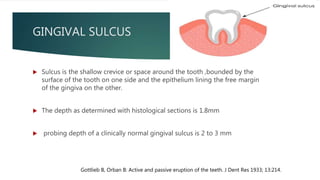
 Sulcus is the shallow crevice or space around the tooth ,bounded by the
surface of the tooth on one side and the epithelium lining the free margin
of the gingiva on the other.
 The depth as determined with histological sections is 1.8mm
 probing depth of a clinically normal gingival sulcus is 2 to 3 mm
Gottlieb B, Orban B: Active and passive eruption of the teeth. J Dent Res 1933; 13:214.
GINGIVAL CREVICE FLUID/SULCULAR
FLUID/GINGIVAL CREVICULAR FLUID
Gingival crevice fluid (GCF) is a complex
mixture of substances derived from
serum,leukocytes, structural cells of
periodontium and oral bacteria
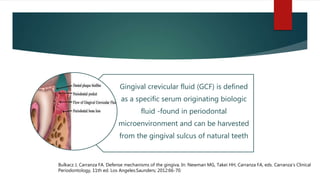
Gingival crevicular fluid (GCF) is defined
as a specific serum originating biologic
fluid -found in periodontal
microenvironment and can be harvested
from the gingival sulcus of natural teeth
Bulkacz J, Carranza FA. Defense mechanisms of the gingiva. In: Newman MG, Takei HH, Carranza FA, eds. Carranza’s Clinical
Periodontology, 11th ed. Los Angeles:Saunders; 2012:66-70.
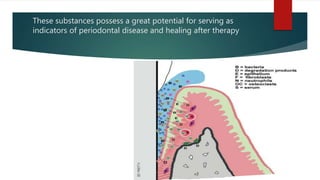
These substances possess a great potential for serving as
indicators of periodontal disease and healing after therapy
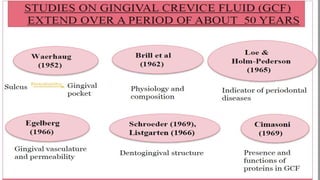
HISTORY
Studies on gingival crevice fluid
(GCF) extend over a period of
about 70 years
The pioneer research of
Waerhaug (1950) was
focused on the anatomy of
the sulcus and its
transformation into a
gingival pocket during the
course of periodontitis.
Waerhaug J. Anatomy, physiology and pathology of the gingival pocket. Rev Belge Med Dent 1966: 21: 9–15.
Studies by Brill et al. laid
the foundation for
understanding the
physiology of GCF
formation and its
composition
The studies of Loe et al.,
use of GCF as an indicator
of periodontal diseases.
Brill N. The gingival pocket fluid. Studies of its occurrence,composition and effect. Acta
Odontol Scand 1962
Egelberg continued to analyse
GCF and focused his studies
on the dentogingival blood
vessels and their permeability
as they relate to GCF flow
Attstrom R, Egelberg J. presence of leukocytes in gingival crevice during developing gingivitis in
dogs. JPR 1971 : 6; 110-114.
 The GCF studies boomed in the 1970s. The rationale for understanding
dentogingival structure and physiology was created by the outstanding
electron microscopic studies of Schroeder and Listgarten.
 In 1974 the first edition of the monograph The Crevicular Fluid by
Cimasoni was published. This comprehensive review gave a big boost to
GCF studies and the research on GCF increased dramatically.
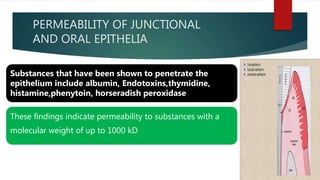
PERMEABILITY OF JUNCTIONAL
AND ORAL EPITHELIA
Substances that have been shown to penetrate the
epithelium include albumin, Endotoxins,thymidine,
histamine,phenytoin, horseradish peroxidase
These findings indicate permeability to substances with a
molecular weight of up to 1000 kD
 The main pathway for the transport of substances across the junctional
and sulcular epithelia seems to be the intercellular spaces
 Squier and johnson reviewed the mechanisms of penetration through
an intact epithelium
 Intercellular movement of molecules and ions along intercellular spaces
appears to be a possible mechanism
 Substances taking this route do not traverse the cell membranes
Squier CA, Johnson NW: Permeability of oral mucosa. Br Med Bull 1975; 31:169.
Passage From The Sulcus Into The CT
 Three routes have been described:
a) Passage Form CT Into The Sulcus
b) Passage From The Sulcus Into The CT
c) Passage Of Substances through Pathological Or Experimentally modified
Gingival Sucus
Brill N, Krasse B. The passage of tissue fluid into the clinically healthy gingival pocket. Acta
Odontol Scand 1958:16: 233–245
Passage Form CT Into The Sulcus
In a series of experiments, Brill
verified the assumption that
Interstitial fluid entered the gingival
sulcus through its epithelial wall - by
showing that the tracer material,
Sodium fluorescein administered
parenterally or per orally, could be
recovered from the gingival sulcus
but not from other oral epithelia.
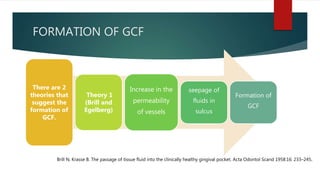
FORMATION OF GCF
There are 2
theories that
suggest the
formation of
GCF.
Theory 1
(Brill and
Egelberg)
Increase in the
permeability
of vessels
seepage of
fluids in
sulcus
Formation of
GCF
Brill N, Krasse B. The passage of tissue fluid into the clinically healthy gingival pocket. Acta Odontol Scand 1958:16: 233–245.
 THEORY 2
 Alfano (1974) and Pashley (1976) suggested that the initial fluid produced
could simply represent interstitial fluid which appears in the crevice as a result
of an osmotic gradient.
 This initial, pre-inflammatory fluid was considered to be a transudate and on
stimulation, this changed to become an inflammatory exudate
Alfano MC. The origin of gingival fluid. J Theor Biol 1974:47: 127–136.
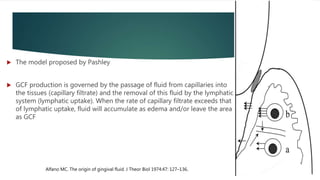
 The model proposed by Pashley
 GCF production is governed by the passage of fluid from capillaries into
the tissues (capillary filtrate) and the removal of this fluid by the lymphatic
system (lymphatic uptake). When the rate of capillary filtrate exceeds that
of lymphatic uptake, fluid will accumulate as edema and/or leave the area
as GCF
Alfano MC. The origin of gingival fluid. J Theor Biol 1974:47: 127–136.
GCF FLOW
 GCF flow (or flow rate) is the process of fluid moving into and
out of the gingival crevice or pocket
 It is a small stream, usually only a few μl/hr.
 – Shallow pockets – 3 to 8 μl/hr
 – Intermediate PD- 20 μl/hr
 – Advanced PD – 137 μl/hr
AMOUNT
Is extremely small-0.5 – 2.4μl
Cimasoni showed that a strip of paper 1.5 mm wide and inserted 1mm within the gingival
gingival sulcus of a slightly inflamed gingiva absorbs about 0.1 mg of GCF in 3 minutes
Challacombe used isotope dilution method– showed that mean GCF volume in proximal
spaces from molar teeth ranged from 0.43 to 1.56 μl
Bang J, Cimasoni G. Total protein in human crevicular fluid. J Dent Res 1971: 50: 1683.
FUNCTIONS
 Cleanse material from the sulcus
 Contain plasma proteins that may improve adhesion of the epithelium to
the tooth.
 Possess antimicrobial properties
 Exert antibody activity in defense of the gingiva.
METHODS OF COLLECTION
 1. Use of absorbing paper strips
 2. Twisted threads placed around and into the sulcus
 3. Micropipettes
 4. Intracrevicular washings
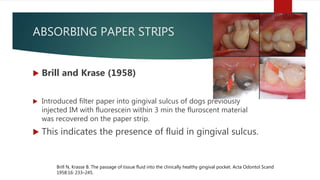
ABSORBING PAPER STRIPS
 Brill and Krase (1958)
 Introduced filter paper into gingival sulcus of dogs previously
injected IM with fluorescein within 3 min the fluroscent material
was recovered on the paper strip.
 This indicates the presence of fluid in gingival sulcus.
Brill N, Krasse B. The passage of tissue fluid into the clinically healthy gingival pocket. Acta Odontol Scand
1958:16: 233–245.
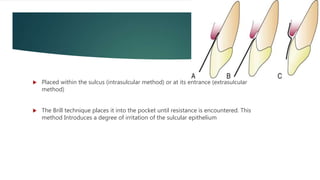
 Placed within the sulcus (intrasulcular method) or at its entrance (extrasulcular
method)
 The Brill technique places it into the pocket until resistance is encountered. This
method Introduces a degree of irritation of the sulcular epithelium
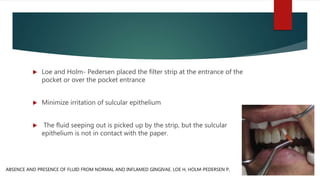
 Loe and Holm- Pedersen placed the filter strip at the entrance of the
pocket or over the pocket entrance
 Minimize irritation of sulcular epithelium
 The fluid seeping out is picked up by the strip, but the sulcular
epithelium is not in contact with the paper.
ABSENCE AND PRESENCE OF FLUID FROM NORMAL AND INFLAMED GINGIVAE. LOE H, HOLM-PEDERSEN P.
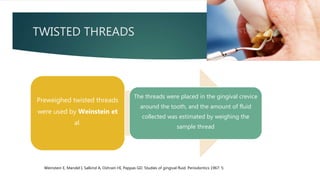
TWISTED THREADS
Preweighed twisted threads
were used by Weinstein et
al.
The threads were placed in the gingival crevice
around the tooth, and the amount of fluid
collected was estimated by weighing the
sample thread
Weinstein E, Mandel I, Salkind A, Oshrain HI, Pappas GD. Studies of gingival fluid. Periodontics 1967: 5:
CREVICULAR WASHINGS
 Oppenheim. 1970 - customized acrylic stent
uses an appliance consisting of a hard acrylic plate covering the maxilla with
soft borders and a groove following the gingival margins.
1. It is connected to four collection tubes
2. The washings are obtained by rinsing the crevicular areas from one side to
the other, using a peristaltic pump.
Oppenheim FG. Preliminary observations on the presence and origin of serum albumin in human saliva.
ADVANTAGES
Useful for longitudinal studies
Permits collection without disturbing the integrity of the
marginal tissues
Contamination is least
DISADVANTAGES
Complex procedure
Represents a dilution of crevicular fluid
 2. A modification of the method uses two injection needles
fitted one within the other. The Method Of Skapski And
Lehner
 1. During sampling, the inside, or ejection needle is at the bottom of the
pocket and the outside, or collecting, one is at the gingival margin
 2. The collection needle is drained into a sample tube by continuous
suction
ADVANTAGES
 Useful for cases of clinically normal gingival
 Useful for studying the number and state of cells and bacteria form the
crevicular area
DISADVANTAGES
 Does not permit absolute Quantitative assessment as the dilution factor
cannot be determined
Skapski H, Lehner T. A crevicular washing method for investigating immune components of crevicular fluid in man. J
Periodontal Res 1976:
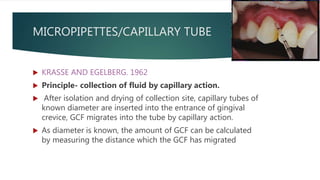
MICROPIPETTES/CAPILLARY TUBE
 KRASSE AND EGELBERG. 1962
 Principle- collection of fluid by capillary action.
 After isolation and drying of collection site, capillary tubes of
known diameter are inserted into the entrance of gingival
crevice, GCF migrates into the tube by capillary action.
 As diameter is known, the amount of GCF can be calculated
by measuring the distance which the GCF has migrated
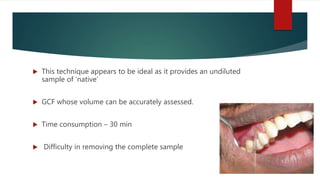
 This technique appears to be ideal as it provides an undiluted
sample of ‘native’
 GCF whose volume can be accurately assessed.
 Time consumption – 30 min
 Difficulty in removing the complete sample
PROBLEMS ASSOCIATED
WITH COLLECTION
 Contamination
The major sources of contamination of GCF sample would be blood, saliva,
or plaque.
 Sampling time
The problem with prolonged collection times is that the nature of the GCF
sample collected is likely to change with the protein concentration of the
initial GCF collected.
Skapski H, Lehner T. A crevicular washing method for investigating immune components of crevicular fluid in man. J Periodontal Res
1976:
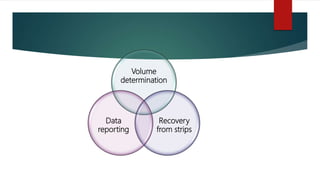
Volume
determination
Recovery
from strips
Data
reporting
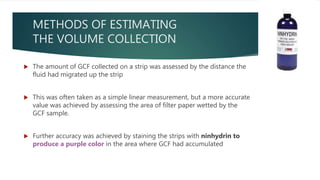
METHODS OF ESTIMATING
THE VOLUME COLLECTION
 The amount of GCF collected on a strip was assessed by the distance the
fluid had migrated up the strip
 This was often taken as a simple linear measurement, but a more accurate
value was achieved by assessing the area of filter paper wetted by the
GCF sample.
 Further accuracy was achieved by staining the strips with ninhydrin to
produce a purple color in the area where GCF had accumulated
Also 2g fluoroscein given
systemically to each patient
3hrs prior to the collection
following which the strips were
examined under UV light.
 Disadvantages of staining method
 Cannot be used chair side.
 Inevitable delay in measurement may result in increase
variation due to evaporation of the fluid.
 Staining of the strips for protein labeling prevents further lab
investigations
Challacombe used an isotope dilution method to
measure the amount of GCF present in a particular space
at any given time.
M.J.T. Milton; J.A. Wang (2002). "High Accuracy Method for Isotope Dilution Mass Spectrometry with
Application to the Measurement of Carbon Dioxide
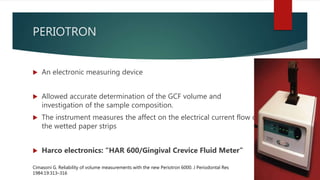
PERIOTRON
 An electronic measuring device
 Allowed accurate determination of the GCF volume and
investigation of the sample composition.
 The instrument measures the affect on the electrical current flow of
the wetted paper strips
 Harco electronics: “HAR 600/Gingival Crevice Fluid Meter”
Cimasoni G. Reliability of volume measurements with the new Periotron 6000. J Periodontal Res
1984:19:313–316
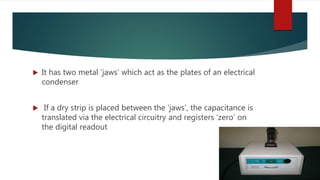
 It has two metal ‘jaws’ which act as the plates of an electrical
condenser
 If a dry strip is placed between the ‘jaws’, the capacitance is
translated via the electrical circuitry and registers ‘zero’ on
the digital readout
LIMITATIONS
 Inability to measure volumes of GCF greater than 1.0ml,
although when using filter strips such as Whatman 3MM
strips, the strips themselves are capable of absorbing much
larger volumes
 Volumes greater than 1.0ml may be recovered from severely
inflamed sites which may be the samples of most interest in
any study of volume, flow rate, or composition of GCF
Cimasoni G. Reliability of volume measurements with the new Periotron 6000. J Periodontal Res 1984: 19:313–316.
CREVICULAR FLUID AND
MATRIX DESTRUCTION
 More than 40 components in the GCF
Classified by Cimasoni (1983) into
1. Cellular elements
2. Electrocytes
3. Organic compounds
4. Bacterial products
5. Metabolic products
6. Enzymes and enzyme inhibitors
Cells
Bacteria, Epithelial cells , leukocytes
Electrocytes
calcium , sodium , fluoride , magnesium , phosphate ,potassium
Microbial plaque products
Bacterial enzymes, cytotoxic substances , metabolic end products ,
lipopolysaccharide
METABOLIC ACID END PRODUCTS
 1.LACTIC ACID
 2.HYDROXYPROLINE
 3.PROSTAGLANDINS
 4.UREA
 5.ENDOTOXINS
 6.CYTOTOXIC SUBSTANCES
 7.ANTIBACTERIAL FACTORS
BACTERIA DERIVED ENZYMES
 Acid phosphatase
 Alkaline phosphatase
 Collagenase
 Hyaluronidase
 Phospholipse-A
 Phospholipase-C
Curtis,laboratory markers from analysis of gingival crevicular fluid. J Clin Periodontol.1989;16(1):1-11
ENZYMES AND ENZYMES INHIBITORS
 ACID PHOSPHATASE
 2. ALKALINE PHOSPHATASE
 3. PYROPHOSPHATASE
 4.β – GLUCURONIDASE
 5. LYSOZYME
 6. HYALURONIDASE
 7. PROTEOLYTIC ENZYMES
 8. LACTIC DEHYDROGENASE
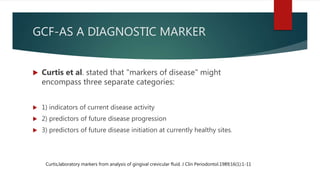
GCF-AS A DIAGNOSTIC MARKER
 Curtis et al. stated that "markers of disease" might
encompass three separate categories:
 1) indicators of current disease activity
 2) predictors of future disease progression
 3) predictors of future disease initiation at currently healthy sites.
Curtis,laboratory markers from analysis of gingival crevicular fluid. J Clin Periodontol.1989;16(1):1-11
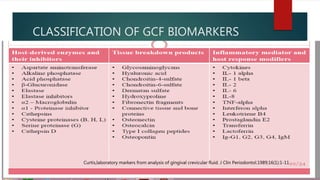
CLASSIFICATION OF GCF BIOMARKERS
Curtis,laboratory markers from analysis of gingival crevicular fluid. J Clin Periodontol.1989;16(1):1-11
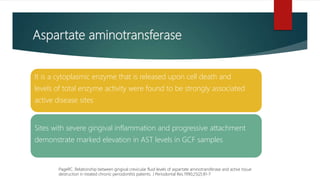
Aspartate aminotransferase
It is a cytoplasmic enzyme that is released upon cell death and
levels of total enzyme activity were found to be strongly associated
active disease sites
Sites with severe gingival inflammation and progressive attachment
demonstrate marked elevation in AST levels in GCF samples
PageRC. Relationship between gingival crevicular fluid levels of aspartate aminotransferase and active tissue
destruction in treated chronic periodontitis patients. J Periodontal Res.1990;25(2):81-7
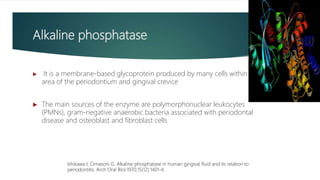
Alkaline phosphatase
 It is a membrane-based glycoprotein produced by many cells within the
area of the periodontium and gingival crevice
 The main sources of the enzyme are polymorphonuclear leukocytes
(PMNs), gram-negative anaerobic bacteria associated with periodontal
disease and osteoblast and fibroblast cells
Ishikawa I, Cimasoni G. Alkaline phosphatase in human gingival fluid and its relation to
periodontitis. Arch Oral Biol.1970;15(12):1401-4.
 Alkaline phosphatase is thought to play a role in bone metabolism and
mineralization and collagen formation
 The activity of alkaline phosphatase has been show to be correlated with
pocket depth and the percentage of bone loss
 This activity was found to be 20 times greater in GCF from active sites
than in serum.
ACID PHOSPHATASE
It has been widely investigated amongst the lysosomal
enzymes and has often been used as a lysosomal marker
Gingival fluid contains 10-20 times more acid phosphatase
than serum
The levels of acid phosphatase do not correlate with
measurements of disease severity or activity.
Journal of Medicine and Life Vol. 5, Issue 4, October‐December 2012
β –Glucuronidase
 It is one of the hydrolases found in the azurophilic or primary granules
of PMNs
 It is also positively associated with the number of Spirochetes,
Porphyromonas gingivalis, Prevotella intermedia and lactose-negative
black pigmenting bacteria in the subgingival flora
 The level of β-glucuronidase correlates significantly with attachment loss
that may subsequently occur in individuals with adult periodontitis
Baggiolini M. The enzymes of the granules of polymorphonuclear leukocytes and their functions.
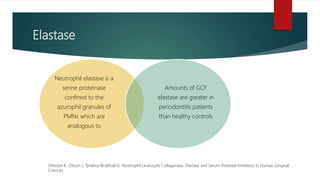
Elastase
Neutrophil elastase is a
serine proteinase
confined to the
azurophil granules of
PMNs which are
analogous to
Amounts of GCF
elastase are greater in
periodontitis patients
than healthy controls
Ohlsson K, Olsson I, Tynelius-Bratthall G. Neutrophil Leukocyte Collagenase, Elastase and Serum Protease Inhibitors in Human Gingival
Crevices.
Elastase inhibitors
 The main plasma inhibitors are α2-macroglobulin and α1-
antitrypsin, which accounts for more than 90% of the total
protease inhibiting capacity of serum.
 Cathepsin G α2- macroglobulin inhibits all three neutral
proteinases from PMN’s by a similar mechanism which
consists of irreversible trapping of the enzyme molecule by
the inhibitor.
Ohlsson K, Olsson I, Tynelius-Bratthall G. Neutrophil Leukocyte Collagenase, Elastase and Serum Protease Inhibitors in
Human Gingival Crevices.
 α1-antitrypsin inactivates mainly serine proteinases, elastase
and cathepsin G and partially mammalian collagenase
 In inflamed gingiva, GCF samples had about twice as much
α2- macroglobulin than the samples collected in the same
area after therapy
Cathepsins
It is an enzyme belonging to
the class of cysteine
proteinases.
In GCF, macrophages are the main
producers of cathepsin B
GCF concentrations of cathepsin B were found
be elevated in patients with periodontal disease,
but lower in patients with gingivitis
Cathepsins B, H and L activities in gingival crevicular fluid from chronic adult periodontitis patients
 Cathepsin D, a carboxy endopeptidase, is present at high concentration
in inflamed tissues. Its concentration is found to be 10 times higher in
GCF during periodontal destruction
 Cathepsin G ,It is also known as chymotrypsin like, because it attacks a
number of synthetic substrates typical for chymotrypsin and is inhibited
by the same inhibitors.
 It hydrolyzes haemoglobin and fibrinogen, casein, collagen and
proteoglycans
Trypsin-like enzymes
 Trypsin-like enzyme increases the potential of the P.gingivalis to mediate
destruction of periodontal tissues.
 The trypsin-like enzyme found in P. gingivalis is able to degrade collagen
directly and its GCF levels might provide useful information on the
periodontal condition
 It has to cleave peptide substrates with arginine terminal groups such as
benzoyl-arginine-2 naphthylamide (BANA)
Characterization of Bacteroides asaccharolyticus and B.melaninogenicus oral isolates JMicrobiol.1980;26(10):1178-83
Dipeptidyl Peptidases (DPP)
 They are derived from lymphocytes, macrophages, and fibroblasts.
 DPP II has been localised to macrophages and fibroblasts in gingival
tissue and in cells in GCF.
 They have the capacity to degrade collagen but their main function
most likely lies in the activation of pro-forms of other enzymes,
cytokines, and other immune mediators.
Eley and Cox monitored GCF levels of DPP II and
IV and reported higher levels of both enzymes in
sites with rapid and gradual attachment loss than
in paired sites without attachment loss.
Matrix Metalloproteinases
 Host cell-derived enzymes such as matrix metalloproteinases (MMPs) are an
important group of neutral proteinases implicated in the destructive process of
periodontal disease that can be measured in GCF
 The neutrophils are the major cells responsible for MMP release at the infected
site, specifically MMP-8 (collagenase-2) and MMP-9 (gelatinase-B)
Gingival crevicular fluid collagenase-2 (MMP-8) test stick for chair-side monitoring of periodontitis. J Periodontal
Res.2003;38(4):436-9.
 GCF collagenase and collagenase activity has been shown to increase with
increasing severity of inflammation and increasing pocket depth and alveolar
bone loss
 Stromelysins (SL) are the major MMPs of fibroblast origin,and can activate
fibroblast type collagenase
 Birkedal-Hansen et al. have also suggested that SL may act as a marker of stromal
cell involvement in the process of tissue degradation.
Myeloperoxidase
 The myeloperoxidase hydrogen peroxide-chloride system, which is part of the
innate host defence mediated by polymorphonuclear leukocytes, possesses
potent antimicrobial activity
 MPO is produced in the phagosome in excess concentrations of those that
mediate bacterial killing.
 High MPO levels in GCF from patients with progressive chronic periodontitis,
and their reduction in response to treatment have been reported by Hernandez
et al
Smith QT, Hinrichs JE, Melnyk RS. Gingival crevicular fluid myeloperoxidase at periodontitis sites. J Periodontal Res.1986;21
Lactate dehydrogenase
 It catalyses the reversible reduction of pyruvate to lactate
 GCF contains 10-20 times more LDH than blood
 No significant correlation is found between the levels of LDH in gingival
fluid and disease severity
 As such it could reflect metabolic changes, such as the increase in
anaerobic glycolysis characteristic of inflamed gingiva
Lactate dehydrogenase activity in gingival crevicular fluid collected with filter paper strips: analysis in subjects with non-inflamed and mildly inflamed
gingiva. J Clin Periodontol.1985;12(2):153-61.
Arylsulfatase
It catalyzes the release of
esterbound sulfate from a variety
of O-sulfate esters and was
to be higher in activity in GCF in
gingivitis and periodontitis
patients
Larnster and Co-workers have
examined the relationship between β-
glucuronidase and arylsulfatase and
have shown that levels in the GCF are
elevated in inflamed relative to healthy
non-inflamed sites, and that these
levels decrease following periodontal
treatment.
Connective tissue and Bone proteins
Osteonectin - Also referred to as secreted protein acidic and
rich in cysteine and basement membrane protein (BM-40)
osteonectin has been implicated in the early phases of tissue
mineralization
KM, McGarvey ML, Martin GR. Osteonectin, a bone-specific protein linking mineral to collagen.
Cell.1981;26:99-105.
 Osteocalcin - It is a small calcium-binding protein of bone, and is the
most abundant non collagenous protein of mineralized tissues
 Osteocalcin is predominantly synthesized by osteoblasts and it has an
important role in both bone resorption and mineralization
 Serum osteocalcin is presently considered a valid marker of bone
turnover when resorption and formation
Lian JB, Gundberg CM.Osteocalcin. Biochemical considerations and clinical applications
 Osteopontin (OPN) - It is a single-chain polypeptide.
 In bone matrix, OPN is highly concentrated at sites where osteoclasts are
attached to the underlying mineral surface
 OPN is produced by both osteoblasts and osteoclasts, it holds a dual
function in bone maturation and mineralization as well as bone
resorption
 Investigation of GCF OPN that its concentrations increased
with the progression of disease
Rodan GA. Osteopontin overview.Ann N Y Acad Sci.1995;760:1-5.
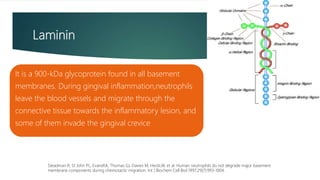
Laminin
It is a 900-kDa glycoprotein found in all basement
membranes. During gingival inflammation,neutrophils
leave the blood vessels and migrate through the
connective tissue towards the inflammatory lesion, and
some of them invade the gingival crevice
Steadman R, St John PL, EvansRA, Thomas GJ, Davies M, HeckLW, et al. Human neutrophils do not degrade major basement
membrane components during chemotactic migration. Int J Biochem Cell Biol.1997;29(7):993-1004.
Pyridinoline crosslinks (ICTP)
 They represent a class of collagen-degrading molecules that include
pyridinoline, deoxypyridinoline, N-telopeptides,and C-telopeptides
 pyridinoline cross-links represent a potentially valuable diagnostic aid in
periodontics, because biochemical markers specific for bone
degradation may be useful in differentiating the presence of gingival
inflammation from active periodontal and peri-implant bone destruction
Calvo MS, Eyre DR, Gundberg CM. Molecular basis and clinical application of biological markers of bone turnover.
Endocr Rev.1996;17(4):333-68
Methodology used for the analysis of GCF
components
 FLUOROMETRY - Detection of metalloproteinases
 ELISA - Interleukins
 RADIOIMMUNOASSAYS - Cyclooxygenase derivative
 Direct and indirect immunodot assays - Acute phase proteins
CLINICAL SIGNIFICANCE
Circadian periodicity
There is a gradual increase in gingival fluid amount from 6:00AM to 10:00PM and
a decrease afterward
 Average flow was greater in the evening and minimal early in the morning.
(Bisada et al. 1967)
 Did not find any systemic differences between the flow of fluid measured at 9
a.m. & that of the fluid collected at 3 p.m. (Suppipat et al. 1997)
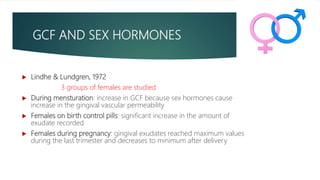
GCF AND SEX HORMONES
 Lindhe & Lundgren, 1972
3 groups of females are studied
 During mensturation: increase in GCF because sex hormones cause
increase in the gingival vascular permeability
 Females on birth control pills: significant increase in the amount of
exudate recorded
 Females during pregnancy: gingival exudates reached maximum values
during the last trimester and decreases to minimum after delivery
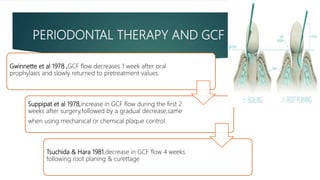
PERIODONTAL THERAPY AND GCF
Gwinnette et al 1978 ,GCF flow decreases 1 week after oral
prophylaxis and slowly returned to pretreatment values.
Suppipat et al 1978,increase in GCF flow during the first 2
weeks after surgery,followed by a gradual decrease,same
when using mechanical or chemical plaque control
Tsuchida & Hara 1981,decrease in GCF flow 4 weeks
following root planing & curettage
GCF IN DIABETIC PATIENTS
 Ringelberg et al in 1977 described a higher flow rate of gingival fluid in a
group of diabetic children, when compared to the flow rate measured in
a group of children without diabetes
 With respect to glucose conc,Increase GCF in the presence of diabetes,
they found that the exudate from diabetic patients contained
significantly more glucose than exudate from healthy subjects (Hara et
al. 1967)
DRUGS IN GCF
 Bader and Goldhaber were able to show that intravenously administered
tetracycline in dogs rapidly emerges within the sulcus
 Stephen et al (1980) measured the conc. of ampicillin, cephalexin,
tetracycline,erythromycin, clindamycin and rifampicin in serum, saliva and GCF
after a single dose administration. Except on one occasion, individual GCF
antibiotic concentration were equal to or considerably greater than those found
in saliva. But they were, however, always much lower than the concentration
found in serum.
 Metronidazole is another antibiotic that has been detected in human GCF
Eiserbeng et-al 1991
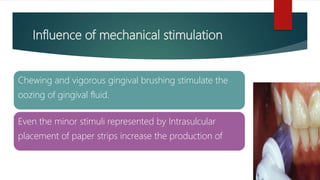
Influence of mechanical stimulation
Chewing and vigorous gingival brushing stimulate the
oozing of gingival fluid.
Even the minor stimuli represented by Intrasulcular
placement of paper strips increase the production of
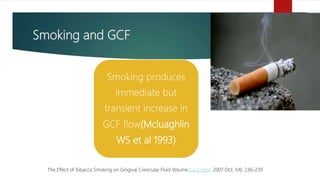
Smoking and GCF
Smoking produces
immediate but
transient increase in
GCF flow(Mcluaghlin
WS et al 1993)
The Effect of Tobacco Smoking on Gingival Crevicular Fluid Volume Eur J Dent. 2007 Oct; 1(4): 236–239
RECENT FINDINGS IN GCF
 VEGF levels in GCF increased from health to periodontitis, and
periodontal treatment resulted in a reduction in their concentrations(Devi
V. Prapulla,Pai B. Sujatha, and A.R. Pradeep jop 2007)
 GCF resistin level as a potential inflammatory marker for periodontitis
with type 2 diabetes mellitus. (Gokhale NH et al.2013)
 IL-23 level in GCF is directly proportional to the severity of periodontal
affliction suggesting its possible role in periodontal inflammation(Himani
GS 2013).
THANK YOUUU

gingival crevicular fluid

  • 1.
    Gingival crevicular fluid– a window to periodontal disease MIDHUN KISHOR S I MDS DEPARTMENT OF PERIODONTICS AND IMPLANTOLOGY RAJAS DENTAL COLLEGE AND HOSPITAL
  • 2.
    GINGIVAL SULCUS  Sulcusis the shallow crevice or space around the tooth ,bounded by the surface of the tooth on one side and the epithelium lining the free margin of the gingiva on the other.  The depth as determined with histological sections is 1.8mm  probing depth of a clinically normal gingival sulcus is 2 to 3 mm Gottlieb B, Orban B: Active and passive eruption of the teeth. J Dent Res 1933; 13:214.
  • 3.
    GINGIVAL CREVICE FLUID/SULCULAR FLUID/GINGIVALCREVICULAR FLUID Gingival crevice fluid (GCF) is a complex mixture of substances derived from serum,leukocytes, structural cells of periodontium and oral bacteria
  • 4.
    Gingival crevicular fluid(GCF) is defined as a specific serum originating biologic fluid -found in periodontal microenvironment and can be harvested from the gingival sulcus of natural teeth Bulkacz J, Carranza FA. Defense mechanisms of the gingiva. In: Newman MG, Takei HH, Carranza FA, eds. Carranza’s Clinical Periodontology, 11th ed. Los Angeles:Saunders; 2012:66-70.
  • 5.
    These substances possessa great potential for serving as indicators of periodontal disease and healing after therapy
  • 6.
    HISTORY Studies on gingivalcrevice fluid (GCF) extend over a period of about 70 years The pioneer research of Waerhaug (1950) was focused on the anatomy of the sulcus and its transformation into a gingival pocket during the course of periodontitis. Waerhaug J. Anatomy, physiology and pathology of the gingival pocket. Rev Belge Med Dent 1966: 21: 9–15.
  • 7.
    Studies by Brillet al. laid the foundation for understanding the physiology of GCF formation and its composition The studies of Loe et al., use of GCF as an indicator of periodontal diseases. Brill N. The gingival pocket fluid. Studies of its occurrence,composition and effect. Acta Odontol Scand 1962
  • 8.
    Egelberg continued toanalyse GCF and focused his studies on the dentogingival blood vessels and their permeability as they relate to GCF flow Attstrom R, Egelberg J. presence of leukocytes in gingival crevice during developing gingivitis in dogs. JPR 1971 : 6; 110-114.
  • 9.
     The GCFstudies boomed in the 1970s. The rationale for understanding dentogingival structure and physiology was created by the outstanding electron microscopic studies of Schroeder and Listgarten.  In 1974 the first edition of the monograph The Crevicular Fluid by Cimasoni was published. This comprehensive review gave a big boost to GCF studies and the research on GCF increased dramatically.
  • 11.
    PERMEABILITY OF JUNCTIONAL ANDORAL EPITHELIA Substances that have been shown to penetrate the epithelium include albumin, Endotoxins,thymidine, histamine,phenytoin, horseradish peroxidase These findings indicate permeability to substances with a molecular weight of up to 1000 kD
  • 12.
     The mainpathway for the transport of substances across the junctional and sulcular epithelia seems to be the intercellular spaces  Squier and johnson reviewed the mechanisms of penetration through an intact epithelium  Intercellular movement of molecules and ions along intercellular spaces appears to be a possible mechanism  Substances taking this route do not traverse the cell membranes Squier CA, Johnson NW: Permeability of oral mucosa. Br Med Bull 1975; 31:169.
  • 13.
    Passage From TheSulcus Into The CT  Three routes have been described: a) Passage Form CT Into The Sulcus b) Passage From The Sulcus Into The CT c) Passage Of Substances through Pathological Or Experimentally modified Gingival Sucus Brill N, Krasse B. The passage of tissue fluid into the clinically healthy gingival pocket. Acta Odontol Scand 1958:16: 233–245
  • 14.
    Passage Form CTInto The Sulcus In a series of experiments, Brill verified the assumption that Interstitial fluid entered the gingival sulcus through its epithelial wall - by showing that the tracer material, Sodium fluorescein administered parenterally or per orally, could be recovered from the gingival sulcus but not from other oral epithelia.
  • 15.
    FORMATION OF GCF Thereare 2 theories that suggest the formation of GCF. Theory 1 (Brill and Egelberg) Increase in the permeability of vessels seepage of fluids in sulcus Formation of GCF Brill N, Krasse B. The passage of tissue fluid into the clinically healthy gingival pocket. Acta Odontol Scand 1958:16: 233–245.
  • 16.
     THEORY 2 Alfano (1974) and Pashley (1976) suggested that the initial fluid produced could simply represent interstitial fluid which appears in the crevice as a result of an osmotic gradient.  This initial, pre-inflammatory fluid was considered to be a transudate and on stimulation, this changed to become an inflammatory exudate Alfano MC. The origin of gingival fluid. J Theor Biol 1974:47: 127–136.
  • 17.
     The modelproposed by Pashley  GCF production is governed by the passage of fluid from capillaries into the tissues (capillary filtrate) and the removal of this fluid by the lymphatic system (lymphatic uptake). When the rate of capillary filtrate exceeds that of lymphatic uptake, fluid will accumulate as edema and/or leave the area as GCF Alfano MC. The origin of gingival fluid. J Theor Biol 1974:47: 127–136.
  • 18.
    GCF FLOW  GCFflow (or flow rate) is the process of fluid moving into and out of the gingival crevice or pocket  It is a small stream, usually only a few μl/hr.  – Shallow pockets – 3 to 8 μl/hr  – Intermediate PD- 20 μl/hr  – Advanced PD – 137 μl/hr
  • 19.
    AMOUNT Is extremely small-0.5– 2.4μl Cimasoni showed that a strip of paper 1.5 mm wide and inserted 1mm within the gingival gingival sulcus of a slightly inflamed gingiva absorbs about 0.1 mg of GCF in 3 minutes Challacombe used isotope dilution method– showed that mean GCF volume in proximal spaces from molar teeth ranged from 0.43 to 1.56 μl Bang J, Cimasoni G. Total protein in human crevicular fluid. J Dent Res 1971: 50: 1683.
  • 20.
    FUNCTIONS  Cleanse materialfrom the sulcus  Contain plasma proteins that may improve adhesion of the epithelium to the tooth.  Possess antimicrobial properties  Exert antibody activity in defense of the gingiva.
  • 21.
    METHODS OF COLLECTION 1. Use of absorbing paper strips  2. Twisted threads placed around and into the sulcus  3. Micropipettes  4. Intracrevicular washings
  • 22.
    ABSORBING PAPER STRIPS Brill and Krase (1958)  Introduced filter paper into gingival sulcus of dogs previously injected IM with fluorescein within 3 min the fluroscent material was recovered on the paper strip.  This indicates the presence of fluid in gingival sulcus. Brill N, Krasse B. The passage of tissue fluid into the clinically healthy gingival pocket. Acta Odontol Scand 1958:16: 233–245.
  • 23.
     Placed withinthe sulcus (intrasulcular method) or at its entrance (extrasulcular method)  The Brill technique places it into the pocket until resistance is encountered. This method Introduces a degree of irritation of the sulcular epithelium
  • 24.
     Loe andHolm- Pedersen placed the filter strip at the entrance of the pocket or over the pocket entrance  Minimize irritation of sulcular epithelium  The fluid seeping out is picked up by the strip, but the sulcular epithelium is not in contact with the paper. ABSENCE AND PRESENCE OF FLUID FROM NORMAL AND INFLAMED GINGIVAE. LOE H, HOLM-PEDERSEN P.
  • 25.
    TWISTED THREADS Preweighed twistedthreads were used by Weinstein et al. The threads were placed in the gingival crevice around the tooth, and the amount of fluid collected was estimated by weighing the sample thread Weinstein E, Mandel I, Salkind A, Oshrain HI, Pappas GD. Studies of gingival fluid. Periodontics 1967: 5:
  • 26.
    CREVICULAR WASHINGS  Oppenheim.1970 - customized acrylic stent uses an appliance consisting of a hard acrylic plate covering the maxilla with soft borders and a groove following the gingival margins. 1. It is connected to four collection tubes 2. The washings are obtained by rinsing the crevicular areas from one side to the other, using a peristaltic pump. Oppenheim FG. Preliminary observations on the presence and origin of serum albumin in human saliva.
  • 27.
    ADVANTAGES Useful for longitudinalstudies Permits collection without disturbing the integrity of the marginal tissues Contamination is least DISADVANTAGES Complex procedure Represents a dilution of crevicular fluid
  • 28.
     2. Amodification of the method uses two injection needles fitted one within the other. The Method Of Skapski And Lehner  1. During sampling, the inside, or ejection needle is at the bottom of the pocket and the outside, or collecting, one is at the gingival margin  2. The collection needle is drained into a sample tube by continuous suction
  • 29.
    ADVANTAGES  Useful forcases of clinically normal gingival  Useful for studying the number and state of cells and bacteria form the crevicular area DISADVANTAGES  Does not permit absolute Quantitative assessment as the dilution factor cannot be determined Skapski H, Lehner T. A crevicular washing method for investigating immune components of crevicular fluid in man. J Periodontal Res 1976:
  • 30.
    MICROPIPETTES/CAPILLARY TUBE  KRASSEAND EGELBERG. 1962  Principle- collection of fluid by capillary action.  After isolation and drying of collection site, capillary tubes of known diameter are inserted into the entrance of gingival crevice, GCF migrates into the tube by capillary action.  As diameter is known, the amount of GCF can be calculated by measuring the distance which the GCF has migrated
  • 31.
     This techniqueappears to be ideal as it provides an undiluted sample of ‘native’  GCF whose volume can be accurately assessed.  Time consumption – 30 min  Difficulty in removing the complete sample
  • 32.
    PROBLEMS ASSOCIATED WITH COLLECTION Contamination The major sources of contamination of GCF sample would be blood, saliva, or plaque.  Sampling time The problem with prolonged collection times is that the nature of the GCF sample collected is likely to change with the protein concentration of the initial GCF collected. Skapski H, Lehner T. A crevicular washing method for investigating immune components of crevicular fluid in man. J Periodontal Res 1976:
  • 33.
  • 34.
    METHODS OF ESTIMATING THEVOLUME COLLECTION  The amount of GCF collected on a strip was assessed by the distance the fluid had migrated up the strip  This was often taken as a simple linear measurement, but a more accurate value was achieved by assessing the area of filter paper wetted by the GCF sample.  Further accuracy was achieved by staining the strips with ninhydrin to produce a purple color in the area where GCF had accumulated
  • 35.
    Also 2g fluorosceingiven systemically to each patient 3hrs prior to the collection following which the strips were examined under UV light.
  • 36.
     Disadvantages ofstaining method  Cannot be used chair side.  Inevitable delay in measurement may result in increase variation due to evaporation of the fluid.  Staining of the strips for protein labeling prevents further lab investigations
  • 37.
    Challacombe used anisotope dilution method to measure the amount of GCF present in a particular space at any given time. M.J.T. Milton; J.A. Wang (2002). "High Accuracy Method for Isotope Dilution Mass Spectrometry with Application to the Measurement of Carbon Dioxide
  • 38.
    PERIOTRON  An electronicmeasuring device  Allowed accurate determination of the GCF volume and investigation of the sample composition.  The instrument measures the affect on the electrical current flow of the wetted paper strips  Harco electronics: “HAR 600/Gingival Crevice Fluid Meter” Cimasoni G. Reliability of volume measurements with the new Periotron 6000. J Periodontal Res 1984:19:313–316
  • 39.
     It hastwo metal ‘jaws’ which act as the plates of an electrical condenser  If a dry strip is placed between the ‘jaws’, the capacitance is translated via the electrical circuitry and registers ‘zero’ on the digital readout
  • 40.
    LIMITATIONS  Inability tomeasure volumes of GCF greater than 1.0ml, although when using filter strips such as Whatman 3MM strips, the strips themselves are capable of absorbing much larger volumes  Volumes greater than 1.0ml may be recovered from severely inflamed sites which may be the samples of most interest in any study of volume, flow rate, or composition of GCF
  • 41.
    Cimasoni G. Reliabilityof volume measurements with the new Periotron 6000. J Periodontal Res 1984: 19:313–316.
  • 42.
    CREVICULAR FLUID AND MATRIXDESTRUCTION  More than 40 components in the GCF Classified by Cimasoni (1983) into 1. Cellular elements 2. Electrocytes 3. Organic compounds 4. Bacterial products 5. Metabolic products 6. Enzymes and enzyme inhibitors
  • 43.
    Cells Bacteria, Epithelial cells, leukocytes Electrocytes calcium , sodium , fluoride , magnesium , phosphate ,potassium Microbial plaque products Bacterial enzymes, cytotoxic substances , metabolic end products , lipopolysaccharide
  • 44.
    METABOLIC ACID ENDPRODUCTS  1.LACTIC ACID  2.HYDROXYPROLINE  3.PROSTAGLANDINS  4.UREA  5.ENDOTOXINS  6.CYTOTOXIC SUBSTANCES  7.ANTIBACTERIAL FACTORS
  • 45.
    BACTERIA DERIVED ENZYMES Acid phosphatase  Alkaline phosphatase  Collagenase  Hyaluronidase  Phospholipse-A  Phospholipase-C Curtis,laboratory markers from analysis of gingival crevicular fluid. J Clin Periodontol.1989;16(1):1-11
  • 46.
    ENZYMES AND ENZYMESINHIBITORS  ACID PHOSPHATASE  2. ALKALINE PHOSPHATASE  3. PYROPHOSPHATASE  4.β – GLUCURONIDASE  5. LYSOZYME  6. HYALURONIDASE  7. PROTEOLYTIC ENZYMES  8. LACTIC DEHYDROGENASE
  • 47.
    GCF-AS A DIAGNOSTICMARKER  Curtis et al. stated that "markers of disease" might encompass three separate categories:  1) indicators of current disease activity  2) predictors of future disease progression  3) predictors of future disease initiation at currently healthy sites. Curtis,laboratory markers from analysis of gingival crevicular fluid. J Clin Periodontol.1989;16(1):1-11
  • 48.
    CLASSIFICATION OF GCFBIOMARKERS Curtis,laboratory markers from analysis of gingival crevicular fluid. J Clin Periodontol.1989;16(1):1-11
  • 49.
    Aspartate aminotransferase It isa cytoplasmic enzyme that is released upon cell death and levels of total enzyme activity were found to be strongly associated active disease sites Sites with severe gingival inflammation and progressive attachment demonstrate marked elevation in AST levels in GCF samples PageRC. Relationship between gingival crevicular fluid levels of aspartate aminotransferase and active tissue destruction in treated chronic periodontitis patients. J Periodontal Res.1990;25(2):81-7
  • 50.
    Alkaline phosphatase  Itis a membrane-based glycoprotein produced by many cells within the area of the periodontium and gingival crevice  The main sources of the enzyme are polymorphonuclear leukocytes (PMNs), gram-negative anaerobic bacteria associated with periodontal disease and osteoblast and fibroblast cells Ishikawa I, Cimasoni G. Alkaline phosphatase in human gingival fluid and its relation to periodontitis. Arch Oral Biol.1970;15(12):1401-4.
  • 51.
     Alkaline phosphataseis thought to play a role in bone metabolism and mineralization and collagen formation  The activity of alkaline phosphatase has been show to be correlated with pocket depth and the percentage of bone loss  This activity was found to be 20 times greater in GCF from active sites than in serum.
  • 52.
    ACID PHOSPHATASE It hasbeen widely investigated amongst the lysosomal enzymes and has often been used as a lysosomal marker Gingival fluid contains 10-20 times more acid phosphatase than serum The levels of acid phosphatase do not correlate with measurements of disease severity or activity. Journal of Medicine and Life Vol. 5, Issue 4, October‐December 2012
  • 53.
    β –Glucuronidase  Itis one of the hydrolases found in the azurophilic or primary granules of PMNs  It is also positively associated with the number of Spirochetes, Porphyromonas gingivalis, Prevotella intermedia and lactose-negative black pigmenting bacteria in the subgingival flora  The level of β-glucuronidase correlates significantly with attachment loss that may subsequently occur in individuals with adult periodontitis Baggiolini M. The enzymes of the granules of polymorphonuclear leukocytes and their functions.
  • 54.
    Elastase Neutrophil elastase isa serine proteinase confined to the azurophil granules of PMNs which are analogous to Amounts of GCF elastase are greater in periodontitis patients than healthy controls Ohlsson K, Olsson I, Tynelius-Bratthall G. Neutrophil Leukocyte Collagenase, Elastase and Serum Protease Inhibitors in Human Gingival Crevices.
  • 55.
    Elastase inhibitors  Themain plasma inhibitors are α2-macroglobulin and α1- antitrypsin, which accounts for more than 90% of the total protease inhibiting capacity of serum.  Cathepsin G α2- macroglobulin inhibits all three neutral proteinases from PMN’s by a similar mechanism which consists of irreversible trapping of the enzyme molecule by the inhibitor. Ohlsson K, Olsson I, Tynelius-Bratthall G. Neutrophil Leukocyte Collagenase, Elastase and Serum Protease Inhibitors in Human Gingival Crevices.
  • 56.
     α1-antitrypsin inactivatesmainly serine proteinases, elastase and cathepsin G and partially mammalian collagenase  In inflamed gingiva, GCF samples had about twice as much α2- macroglobulin than the samples collected in the same area after therapy
  • 57.
    Cathepsins It is anenzyme belonging to the class of cysteine proteinases. In GCF, macrophages are the main producers of cathepsin B GCF concentrations of cathepsin B were found be elevated in patients with periodontal disease, but lower in patients with gingivitis Cathepsins B, H and L activities in gingival crevicular fluid from chronic adult periodontitis patients
  • 58.
     Cathepsin D,a carboxy endopeptidase, is present at high concentration in inflamed tissues. Its concentration is found to be 10 times higher in GCF during periodontal destruction  Cathepsin G ,It is also known as chymotrypsin like, because it attacks a number of synthetic substrates typical for chymotrypsin and is inhibited by the same inhibitors.  It hydrolyzes haemoglobin and fibrinogen, casein, collagen and proteoglycans
  • 59.
    Trypsin-like enzymes  Trypsin-likeenzyme increases the potential of the P.gingivalis to mediate destruction of periodontal tissues.  The trypsin-like enzyme found in P. gingivalis is able to degrade collagen directly and its GCF levels might provide useful information on the periodontal condition  It has to cleave peptide substrates with arginine terminal groups such as benzoyl-arginine-2 naphthylamide (BANA) Characterization of Bacteroides asaccharolyticus and B.melaninogenicus oral isolates JMicrobiol.1980;26(10):1178-83
  • 60.
    Dipeptidyl Peptidases (DPP) They are derived from lymphocytes, macrophages, and fibroblasts.  DPP II has been localised to macrophages and fibroblasts in gingival tissue and in cells in GCF.  They have the capacity to degrade collagen but their main function most likely lies in the activation of pro-forms of other enzymes, cytokines, and other immune mediators.
  • 61.
    Eley and Coxmonitored GCF levels of DPP II and IV and reported higher levels of both enzymes in sites with rapid and gradual attachment loss than in paired sites without attachment loss.
  • 62.
    Matrix Metalloproteinases  Hostcell-derived enzymes such as matrix metalloproteinases (MMPs) are an important group of neutral proteinases implicated in the destructive process of periodontal disease that can be measured in GCF  The neutrophils are the major cells responsible for MMP release at the infected site, specifically MMP-8 (collagenase-2) and MMP-9 (gelatinase-B) Gingival crevicular fluid collagenase-2 (MMP-8) test stick for chair-side monitoring of periodontitis. J Periodontal Res.2003;38(4):436-9.
  • 63.
     GCF collagenaseand collagenase activity has been shown to increase with increasing severity of inflammation and increasing pocket depth and alveolar bone loss  Stromelysins (SL) are the major MMPs of fibroblast origin,and can activate fibroblast type collagenase  Birkedal-Hansen et al. have also suggested that SL may act as a marker of stromal cell involvement in the process of tissue degradation.
  • 64.
    Myeloperoxidase  The myeloperoxidasehydrogen peroxide-chloride system, which is part of the innate host defence mediated by polymorphonuclear leukocytes, possesses potent antimicrobial activity  MPO is produced in the phagosome in excess concentrations of those that mediate bacterial killing.  High MPO levels in GCF from patients with progressive chronic periodontitis, and their reduction in response to treatment have been reported by Hernandez et al Smith QT, Hinrichs JE, Melnyk RS. Gingival crevicular fluid myeloperoxidase at periodontitis sites. J Periodontal Res.1986;21
  • 65.
    Lactate dehydrogenase  Itcatalyses the reversible reduction of pyruvate to lactate  GCF contains 10-20 times more LDH than blood  No significant correlation is found between the levels of LDH in gingival fluid and disease severity  As such it could reflect metabolic changes, such as the increase in anaerobic glycolysis characteristic of inflamed gingiva Lactate dehydrogenase activity in gingival crevicular fluid collected with filter paper strips: analysis in subjects with non-inflamed and mildly inflamed gingiva. J Clin Periodontol.1985;12(2):153-61.
  • 66.
    Arylsulfatase It catalyzes therelease of esterbound sulfate from a variety of O-sulfate esters and was to be higher in activity in GCF in gingivitis and periodontitis patients Larnster and Co-workers have examined the relationship between β- glucuronidase and arylsulfatase and have shown that levels in the GCF are elevated in inflamed relative to healthy non-inflamed sites, and that these levels decrease following periodontal treatment.
  • 67.
    Connective tissue andBone proteins Osteonectin - Also referred to as secreted protein acidic and rich in cysteine and basement membrane protein (BM-40) osteonectin has been implicated in the early phases of tissue mineralization KM, McGarvey ML, Martin GR. Osteonectin, a bone-specific protein linking mineral to collagen. Cell.1981;26:99-105.
  • 68.
     Osteocalcin -It is a small calcium-binding protein of bone, and is the most abundant non collagenous protein of mineralized tissues  Osteocalcin is predominantly synthesized by osteoblasts and it has an important role in both bone resorption and mineralization  Serum osteocalcin is presently considered a valid marker of bone turnover when resorption and formation Lian JB, Gundberg CM.Osteocalcin. Biochemical considerations and clinical applications
  • 69.
     Osteopontin (OPN)- It is a single-chain polypeptide.  In bone matrix, OPN is highly concentrated at sites where osteoclasts are attached to the underlying mineral surface  OPN is produced by both osteoblasts and osteoclasts, it holds a dual function in bone maturation and mineralization as well as bone resorption  Investigation of GCF OPN that its concentrations increased with the progression of disease Rodan GA. Osteopontin overview.Ann N Y Acad Sci.1995;760:1-5.
  • 70.
    Laminin It is a900-kDa glycoprotein found in all basement membranes. During gingival inflammation,neutrophils leave the blood vessels and migrate through the connective tissue towards the inflammatory lesion, and some of them invade the gingival crevice Steadman R, St John PL, EvansRA, Thomas GJ, Davies M, HeckLW, et al. Human neutrophils do not degrade major basement membrane components during chemotactic migration. Int J Biochem Cell Biol.1997;29(7):993-1004.
  • 71.
    Pyridinoline crosslinks (ICTP) They represent a class of collagen-degrading molecules that include pyridinoline, deoxypyridinoline, N-telopeptides,and C-telopeptides  pyridinoline cross-links represent a potentially valuable diagnostic aid in periodontics, because biochemical markers specific for bone degradation may be useful in differentiating the presence of gingival inflammation from active periodontal and peri-implant bone destruction Calvo MS, Eyre DR, Gundberg CM. Molecular basis and clinical application of biological markers of bone turnover. Endocr Rev.1996;17(4):333-68
  • 72.
    Methodology used forthe analysis of GCF components  FLUOROMETRY - Detection of metalloproteinases  ELISA - Interleukins  RADIOIMMUNOASSAYS - Cyclooxygenase derivative  Direct and indirect immunodot assays - Acute phase proteins
  • 73.
    CLINICAL SIGNIFICANCE Circadian periodicity Thereis a gradual increase in gingival fluid amount from 6:00AM to 10:00PM and a decrease afterward  Average flow was greater in the evening and minimal early in the morning. (Bisada et al. 1967)  Did not find any systemic differences between the flow of fluid measured at 9 a.m. & that of the fluid collected at 3 p.m. (Suppipat et al. 1997)
  • 74.
    GCF AND SEXHORMONES  Lindhe & Lundgren, 1972 3 groups of females are studied  During mensturation: increase in GCF because sex hormones cause increase in the gingival vascular permeability  Females on birth control pills: significant increase in the amount of exudate recorded  Females during pregnancy: gingival exudates reached maximum values during the last trimester and decreases to minimum after delivery
  • 75.
    PERIODONTAL THERAPY ANDGCF Gwinnette et al 1978 ,GCF flow decreases 1 week after oral prophylaxis and slowly returned to pretreatment values. Suppipat et al 1978,increase in GCF flow during the first 2 weeks after surgery,followed by a gradual decrease,same when using mechanical or chemical plaque control Tsuchida & Hara 1981,decrease in GCF flow 4 weeks following root planing & curettage
  • 76.
    GCF IN DIABETICPATIENTS  Ringelberg et al in 1977 described a higher flow rate of gingival fluid in a group of diabetic children, when compared to the flow rate measured in a group of children without diabetes  With respect to glucose conc,Increase GCF in the presence of diabetes, they found that the exudate from diabetic patients contained significantly more glucose than exudate from healthy subjects (Hara et al. 1967)
  • 77.
    DRUGS IN GCF Bader and Goldhaber were able to show that intravenously administered tetracycline in dogs rapidly emerges within the sulcus  Stephen et al (1980) measured the conc. of ampicillin, cephalexin, tetracycline,erythromycin, clindamycin and rifampicin in serum, saliva and GCF after a single dose administration. Except on one occasion, individual GCF antibiotic concentration were equal to or considerably greater than those found in saliva. But they were, however, always much lower than the concentration found in serum.  Metronidazole is another antibiotic that has been detected in human GCF Eiserbeng et-al 1991
  • 78.
    Influence of mechanicalstimulation Chewing and vigorous gingival brushing stimulate the oozing of gingival fluid. Even the minor stimuli represented by Intrasulcular placement of paper strips increase the production of
  • 79.
    Smoking and GCF Smokingproduces immediate but transient increase in GCF flow(Mcluaghlin WS et al 1993) The Effect of Tobacco Smoking on Gingival Crevicular Fluid Volume Eur J Dent. 2007 Oct; 1(4): 236–239
  • 80.
    RECENT FINDINGS INGCF  VEGF levels in GCF increased from health to periodontitis, and periodontal treatment resulted in a reduction in their concentrations(Devi V. Prapulla,Pai B. Sujatha, and A.R. Pradeep jop 2007)  GCF resistin level as a potential inflammatory marker for periodontitis with type 2 diabetes mellitus. (Gokhale NH et al.2013)  IL-23 level in GCF is directly proportional to the severity of periodontal affliction suggesting its possible role in periodontal inflammation(Himani GS 2013).
  • 81.