ALCOHOLIC BEVERAGES
BRANDY
BRANDY
 Session Objectives-
 After completion one would be able to
recall what is a brandy, how it is made and
know about the world famous Cognac and
Armagnac.
CONTENTS
DEFINITION
INTRODUCTION
ETYMOLOGY
HISTORY
COGNAC
ARMAGNAC
BRANDS
DEFINITION
 Brandy is a potable spirit obtained from the
distillation of wine or fermented mash of fruit
which has suitably aged in wood.
 The brandies distilled from other fruits is
called as „Fruit Brandies‟
INTRODUCTION
 It is normally consumed as an after-dinner
drink
 Brandy made from wine is generally
coloured in dark oak casks
 Pomace and fruit brandies are generally
drunk un-aged
 Most brandy is 80 proof (40% alcohol)
ETYMOLOGY
 Brandy derives it's name from the Dutch
word „brandewijn‟ meaning "burned wine"
and is a liquor distilled from wine or other
fermented fruit juices.
HISTORY
 Long before the 16th century, wine was a
popular product for trading in European
region
 Dutchman trader invented a way to ship
more wine in the limited cargo space by
removing water from the wine
HISTORY
 Then he could add the water back to the
concentrated wine at the destination port in
Holland
 They called it "bradwijn," meaning "burned
wine," and later became "brandy."
COGNAC
 As the saying goes, all Cognac is Brandy,
but all Brandy is not Cognac
 It is also called as delightful soul of wine
and “eau de vie” meaning water of life and
aged for at least two years
COGNAC
 Cognac can only originate from the town
of Cognac, France, and its six surrounding
viticulture areas
 The process of creating Cognac is
extremely controlled, and it adheres to
strict rules and regulations
COGNAC PRODUCING REGIONS
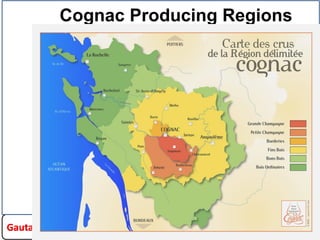
 The cognac region has chalky soil, stony
red-soiled plains and green valleys
 This zone is itself divided into different
vintage regions which have each their own
characteristics and are governed by AOC
COGNAC PRODUCING REGIONS
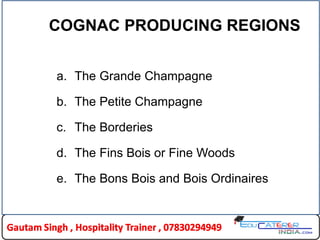
a. The Grande Champagne
b. The Petite Champagne
c. The Borderies
d. The Fins Bois or Fine Woods
e. The Bons Bois and Bois Ordinaires
Cognac Producing Regions
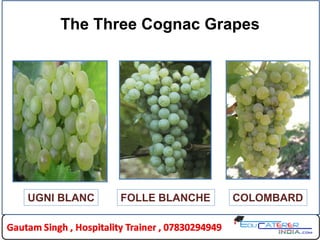
The Three Cognac Grapes
UGNI BLANC FOLLE BLANCHE COLOMBARD
APPELLATION D’ORIGINE CONTRÔLÉE
 Appellation d‟origine contrôlée (AOC),
means "controlled designation of origin”
 It is the French certification granted to
certain French geographical indications for
wines, cheeses, butters, and other
agricultural products
APPELLATION D’ORIGINE CONTRÔLÉE
 All under the auspices of the government
bureau - Institut National des Appellations
d'Origine(INAO)
 AOC products can be identified by a seal,
which is printed on the label in wines,
cognacs etc
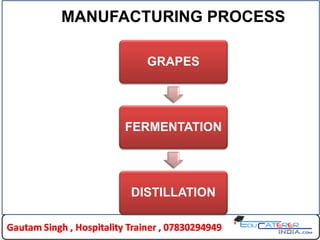
MANUFACTURING PROCESS
GRAPES
FERMENTATION
DISTILLATION
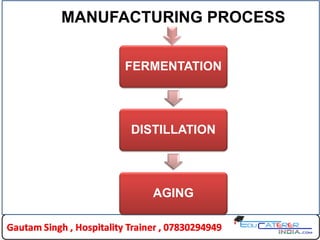
MANUFACTURING PROCESS
FERMENTATION
DISTILLATION
AGING
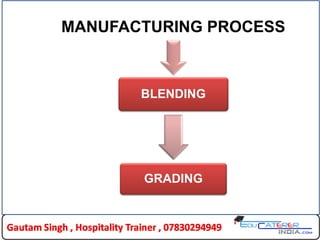
MANUFACTURING PROCESS
BLENDING
GRADING
MANUFACTURING
 It may be made only from a strict list of
grape varieties, if it is to carry the name
of one of the crus then it must be at least
90% Ugni Blanc, Folle Blanche and
Colombard although 10% of the grapes
used can be Folignan, Jurançon blanc
 The harvest takes place in early October,
by this time, the grapes have ripened
MANUFACTURING
 After harvesting & screening the grapes
are pressed in the traditional horizontal
plate presses or pneumatic presses
 Fermentation is natural, by the yeast
present on grapes during bloom
(Saccharomyces cerevisiae) takes two
to three weeks
MANUFACTURING
 Yeasts are allowed to convert the sugar
into alcohol
 Because the wine is low in alcohol,
about 7-8% ; about 10 gallons of wine is
needed to produce one gallon of
Cognac
MANUFACTURING
 Distilled by traditional pot still method that
are traditionally shaped
 The first heating is called premiere chauffe
 The first distillate is called as the „brouillis,‟
which contains an alcohol level of 28% to
32% volume
MANUFACTURING
 The „brouillis‟ is returned back to the boiler for
a second heating known as the „la bonne
chauffe.‟
 It is during this second heating that the eau-
de-vie, or the spirit, is finally extracted from
the liquid
MANUFACTURING
 Here, the distiller performs a delicate
process called „cutting‟ by separating the
„heart‟ from the „heads‟ and the „tails.‟
 The vapors that arrive first (the heads)
have too high alcoholic content, and so
they are cut off and separated from the
rest of the liquid
MANUFACTURING
 The next batch of liquid is the „heart,‟ or a
colorless delicate, pure liquid with a 70%
alcohol per volume
 The end vapour are called tails
MANUFACTURING
 The distilled wine must be aged before
becoming Cognac, for at least two years
 This ageing takes place in 270 to 450 liter
oak casks (barrels)
MANUFACTURING
 The natural level of humidity in the cellars
is one of the main influencing factors on
the ageing of the spirits due to its effect on
evaporation
MANUFACTURING
 As the cognac interacts with the oak barrel
and the air, it evaporates at the rate of
about three percent each year, slowly
losing both alcohol and water
MANUFACTURING
 Because the alcohol evaporates faster than
the water, cognac reaches the target 40%
alcohol by volume in about four or five
decades
 Lesser grades can be produced much
sooner by diluting the cognac with water
MANUFACTURING
 In order to develop all its qualities and also
to reduce its alcohol content, Cognac must
mature for many years in oaks casks
 During this ageing, Cognac loses between
3 and 4 % of its volume every year (Angels
Share)
MANUFACTURING
 Since oak barrels stop contributing to flavor
after four or five decades, cognac is then
transferred to large glass carboys called
bonbonnes, then stored for future blending
 The age of the cognac is calculated as that
of the youngest eau-de-vie used in the
blend
MANUFACTURING
 The blend is usually of different ages and
(in the case of the larger and more
commercial producers) from different local
areas
 This blending, or marriage, of different
eaux-de-vie is important to obtain a
complexity of flavors absent from an eau-
de-vie from a single distillery or vineyard
MANUFACTURING
 Each cognac house has a master taster
(maître de chai), who is responsible for
creating this delicate blend of spirits, so
that the cognac produced by a company
today will taste almost exactly the same as
a cognac produced by that same company
50 years ago, or in 50 years time
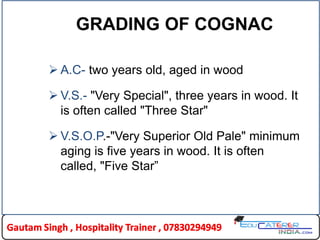
GRADING OF COGNAC
 A.C- two years old, aged in wood
 V.S.- "Very Special", three years in wood. It
is often called "Three Star"
 V.S.O.P.-"Very Superior Old Pale" minimum
aging is five years in wood. It is often
called, "Five Star”
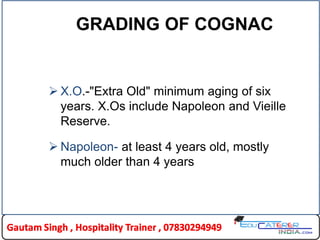
GRADING OF COGNAC
 X.O.-"Extra Old" minimum aging of six
years. X.Os include Napoleon and Vieille
Reserve.
 Napoleon- at least 4 years old, mostly
much older than 4 years
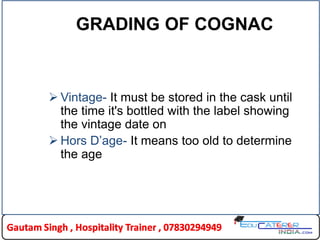
GRADING OF COGNAC
 Vintage- It must be stored in the cask until
the time it's bottled with the label showing
the vintage date on
 Hors D‟age- It means too old to determine
the age
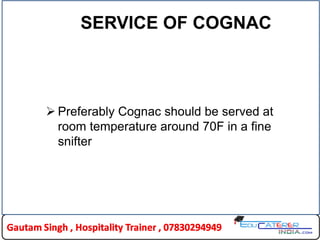
SERVICE OF COGNAC
 Preferably Cognac should be served at
room temperature around 70F in a fine
snifter
SERVICE OF COGNAC
 Brandy snifter allows to hold the stem
without warming the glass and evaporating
the brandy
SERVICE OF COGNAC
 Brandies are enjoyed after dinner with
desserts such as chocolate or apple
desserts
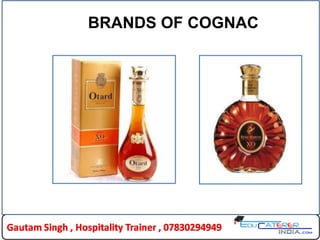
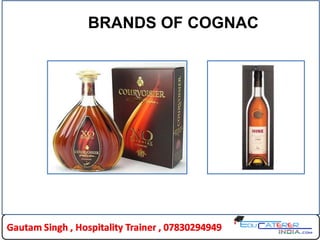
COGNAC BRANDS
 Courvoisier
 Gabriel & Andreu
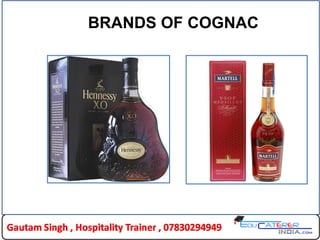
 Hennessy
 Hine Vintage Cognacs
 Martell
 Rémy Martin
 Napoleon
BRANDS OF COGNAC
BRANDS OF COGNAC
BRANDS OF COGNAC
ARMAGNAC
 Armagnac is a grape brandy from the
Gascony region of Southwestern France
 Armagnac is very different with regards to
its grapes, terroir, distillation, élevage,
blending, aromas, tastes and textures
ARMAGNAC
 Armagnac is distilled from wine using
Grapes such as Folle Blanche, Ugni Blanc,
Colombard and Baco 22A
 These grapes ultimately give different
aromas and flavors, they offer different
weights and textures on the palate
HISTORY
 Armagnac is the oldest brandy distilled in
France, and in the past was consumed for
its therapeutic benefits
 In the 14th century, Prior Vital Du Four, a
Cardinal, claimed it had 40 virtues
REGION
 The Armagnac region lies between the
Adour and Garonne rivers in the foothills of
the Pyrenees
 The region was granted AOC status in
1936
REGION
 The May 25, 1909 Falliere‟s decree
describes the three districts:
 Bas-Armagnac
 Armagnac-Ténarèze
 Haut-Armagnac
 Each of these areas is controlled by
separate appellation regulations
MANUFACTURING
 Armagnac is traditionally distilled once,
which results initially in a less polished spirit
than Cognac
 However, long aging in oak barrels (black
oak of Gascony) softens the taste and
causes the development of more complex
flavors and a brown color
MANUFACTURING
 Aging in the barrel removes a part of the
alcohol and water by evaporation (known
as part des anges—"angels' tribute" or
"angels' share") and allows more complex
aromatic compounds to appear by
oxidation, which further improves the flavor,
usually done for three years
MANUFACTURING
 When the alcohol reaches 40%, the
Armagnac can be transferred to large glass
bottles (called "Dame Jeanne") for storage
 From then on, the Armagnac does not age
or develop further and can be bottled for
sale from the next year on
GRADING / CLASSIFICATION
 Armagnac is sold under several different
classifications, mostly referring to the age of
the constituent brandies
 When brandies of different ages have been
blended, the age on the bottle refers to the
youngest component.
GRADING / CLASSIFICATION
 A three star, or "VS," Armagnac is a mix of
several Armagnacs that have seen at least
two years of aging in wood
 A three star, or "VS," Armagnac is a mix of
several Armagnacs that have seen at least
two years of aging in wood
GRADING / CLASSIFICATION
 For the VSOP, the aging is at least five
years
 For XO, at least six.
 Hors d'âge means the youngest component
in the blend is at least ten years old
GRADING / CLASSIFICATION
 Older and better Armagnacs are often sold
as vintages, with the bottles containing
Armagnac from a single year, the year
being noted on the bottle
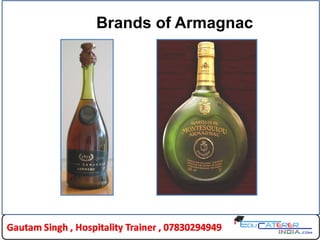
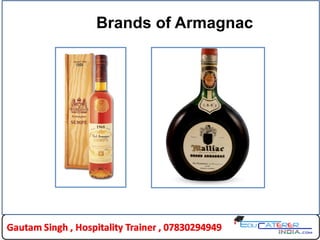
BRAND NAMES
 Janneau
 Marquis de Montesquieu
 Sempe
 Malliac
 Clavers
Brands of Armagnac
Brands of Armagnac
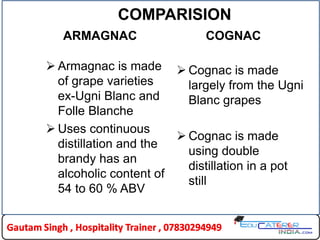
COMPARISION
ARMAGNAC
 Armagnac is made
of grape varieties
ex-Ugni Blanc and
Folle Blanche
 Uses continuous
distillation and the
brandy has an
alcoholic content of
54 to 60 % ABV
COGNAC
 Cognac is made
largely from the Ugni
Blanc grapes
 Cognac is made
using double
distillation in a pot
still
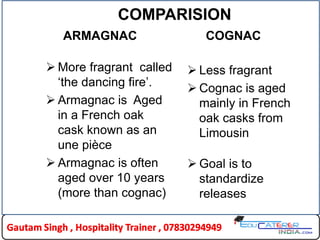
COMPARISION
ARMAGNAC
 More fragrant called
„the dancing fire‟.
 Armagnac is Aged
in a French oak
cask known as an
une pièce
 Armagnac is often
aged over 10 years
(more than cognac)
COGNAC
 Less fragrant
 Cognac is aged
mainly in French
oak casks from
Limousin
 Goal is to
standardize
releases
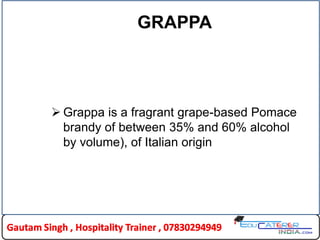
GRAPPA
 Grappa is a fragrant grape-based Pomace
brandy of between 35% and 60% alcohol
by volume), of Italian origin
GRAPPA
 Literally "grape stalk", most grappa is
made by distilling Pomace, grape residue
(mainly the skins, but also stems and
seeds) left over from winemaking after
pressing
GRAPPA
 It was originally made to prevent waste by
using leftovers at the end of the wine
season
 In Italy, grappa is primarily served as a
"digestivo" or after-dinner drinks
GRAPPA
 Grappa may also be added to
espresso coffee to create a caffè
corretto meaning corrected coffee.
REFERENCES
 www.wikipedia.com
 www.tastings.com
 www.in-the-spirit.com
 www.buzzle.com
 www.tulleho.com
 Text book of Food and Beverage Service by
Anita Sharma and S. N. Bagchi
 Food and Beverage Service by Sandeep
Chatterjee
THANK YOU

Brandy

  • 1.
  • 2.
    BRANDY  Session Objectives- After completion one would be able to recall what is a brandy, how it is made and know about the world famous Cognac and Armagnac.
  • 3.
  • 4.
    DEFINITION  Brandy isa potable spirit obtained from the distillation of wine or fermented mash of fruit which has suitably aged in wood.  The brandies distilled from other fruits is called as „Fruit Brandies‟
  • 5.
    INTRODUCTION  It isnormally consumed as an after-dinner drink  Brandy made from wine is generally coloured in dark oak casks  Pomace and fruit brandies are generally drunk un-aged  Most brandy is 80 proof (40% alcohol)
  • 6.
    ETYMOLOGY  Brandy derivesit's name from the Dutch word „brandewijn‟ meaning "burned wine" and is a liquor distilled from wine or other fermented fruit juices.
  • 7.
    HISTORY  Long beforethe 16th century, wine was a popular product for trading in European region  Dutchman trader invented a way to ship more wine in the limited cargo space by removing water from the wine
  • 8.
    HISTORY  Then hecould add the water back to the concentrated wine at the destination port in Holland  They called it "bradwijn," meaning "burned wine," and later became "brandy."
  • 9.
    COGNAC  As thesaying goes, all Cognac is Brandy, but all Brandy is not Cognac  It is also called as delightful soul of wine and “eau de vie” meaning water of life and aged for at least two years
  • 10.
    COGNAC  Cognac canonly originate from the town of Cognac, France, and its six surrounding viticulture areas  The process of creating Cognac is extremely controlled, and it adheres to strict rules and regulations
  • 11.
    COGNAC PRODUCING REGIONS The cognac region has chalky soil, stony red-soiled plains and green valleys  This zone is itself divided into different vintage regions which have each their own characteristics and are governed by AOC
  • 12.
    COGNAC PRODUCING REGIONS a.The Grande Champagne b. The Petite Champagne c. The Borderies d. The Fins Bois or Fine Woods e. The Bons Bois and Bois Ordinaires
  • 13.
  • 14.
    The Three CognacGrapes UGNI BLANC FOLLE BLANCHE COLOMBARD
  • 15.
    APPELLATION D’ORIGINE CONTRÔLÉE Appellation d‟origine contrôlée (AOC), means "controlled designation of origin”  It is the French certification granted to certain French geographical indications for wines, cheeses, butters, and other agricultural products
  • 16.
    APPELLATION D’ORIGINE CONTRÔLÉE All under the auspices of the government bureau - Institut National des Appellations d'Origine(INAO)  AOC products can be identified by a seal, which is printed on the label in wines, cognacs etc
  • 17.
  • 18.
  • 19.
  • 20.
    MANUFACTURING  It maybe made only from a strict list of grape varieties, if it is to carry the name of one of the crus then it must be at least 90% Ugni Blanc, Folle Blanche and Colombard although 10% of the grapes used can be Folignan, Jurançon blanc  The harvest takes place in early October, by this time, the grapes have ripened
  • 21.
    MANUFACTURING  After harvesting& screening the grapes are pressed in the traditional horizontal plate presses or pneumatic presses  Fermentation is natural, by the yeast present on grapes during bloom (Saccharomyces cerevisiae) takes two to three weeks
  • 22.
    MANUFACTURING  Yeasts areallowed to convert the sugar into alcohol  Because the wine is low in alcohol, about 7-8% ; about 10 gallons of wine is needed to produce one gallon of Cognac
  • 23.
    MANUFACTURING  Distilled bytraditional pot still method that are traditionally shaped  The first heating is called premiere chauffe  The first distillate is called as the „brouillis,‟ which contains an alcohol level of 28% to 32% volume
  • 24.
    MANUFACTURING  The „brouillis‟is returned back to the boiler for a second heating known as the „la bonne chauffe.‟  It is during this second heating that the eau- de-vie, or the spirit, is finally extracted from the liquid
  • 25.
    MANUFACTURING  Here, thedistiller performs a delicate process called „cutting‟ by separating the „heart‟ from the „heads‟ and the „tails.‟  The vapors that arrive first (the heads) have too high alcoholic content, and so they are cut off and separated from the rest of the liquid
  • 26.
    MANUFACTURING  The nextbatch of liquid is the „heart,‟ or a colorless delicate, pure liquid with a 70% alcohol per volume  The end vapour are called tails
  • 27.
    MANUFACTURING  The distilledwine must be aged before becoming Cognac, for at least two years  This ageing takes place in 270 to 450 liter oak casks (barrels)
  • 28.
    MANUFACTURING  The naturallevel of humidity in the cellars is one of the main influencing factors on the ageing of the spirits due to its effect on evaporation
  • 29.
    MANUFACTURING  As thecognac interacts with the oak barrel and the air, it evaporates at the rate of about three percent each year, slowly losing both alcohol and water
  • 30.
    MANUFACTURING  Because thealcohol evaporates faster than the water, cognac reaches the target 40% alcohol by volume in about four or five decades  Lesser grades can be produced much sooner by diluting the cognac with water
  • 31.
    MANUFACTURING  In orderto develop all its qualities and also to reduce its alcohol content, Cognac must mature for many years in oaks casks  During this ageing, Cognac loses between 3 and 4 % of its volume every year (Angels Share)
  • 32.
    MANUFACTURING  Since oakbarrels stop contributing to flavor after four or five decades, cognac is then transferred to large glass carboys called bonbonnes, then stored for future blending  The age of the cognac is calculated as that of the youngest eau-de-vie used in the blend
  • 33.
    MANUFACTURING  The blendis usually of different ages and (in the case of the larger and more commercial producers) from different local areas  This blending, or marriage, of different eaux-de-vie is important to obtain a complexity of flavors absent from an eau- de-vie from a single distillery or vineyard
  • 34.
    MANUFACTURING  Each cognachouse has a master taster (maître de chai), who is responsible for creating this delicate blend of spirits, so that the cognac produced by a company today will taste almost exactly the same as a cognac produced by that same company 50 years ago, or in 50 years time
  • 35.
    GRADING OF COGNAC A.C- two years old, aged in wood  V.S.- "Very Special", three years in wood. It is often called "Three Star"  V.S.O.P.-"Very Superior Old Pale" minimum aging is five years in wood. It is often called, "Five Star”
  • 36.
    GRADING OF COGNAC X.O.-"Extra Old" minimum aging of six years. X.Os include Napoleon and Vieille Reserve.  Napoleon- at least 4 years old, mostly much older than 4 years
  • 37.
    GRADING OF COGNAC Vintage- It must be stored in the cask until the time it's bottled with the label showing the vintage date on  Hors D‟age- It means too old to determine the age
  • 38.
    SERVICE OF COGNAC Preferably Cognac should be served at room temperature around 70F in a fine snifter
  • 39.
    SERVICE OF COGNAC Brandy snifter allows to hold the stem without warming the glass and evaporating the brandy
  • 40.
    SERVICE OF COGNAC Brandies are enjoyed after dinner with desserts such as chocolate or apple desserts
  • 41.
    COGNAC BRANDS  Courvoisier Gabriel & Andreu  Hennessy  Hine Vintage Cognacs  Martell  Rémy Martin  Napoleon
  • 42.
  • 43.
  • 44.
  • 45.
    ARMAGNAC  Armagnac isa grape brandy from the Gascony region of Southwestern France  Armagnac is very different with regards to its grapes, terroir, distillation, élevage, blending, aromas, tastes and textures
  • 46.
    ARMAGNAC  Armagnac isdistilled from wine using Grapes such as Folle Blanche, Ugni Blanc, Colombard and Baco 22A  These grapes ultimately give different aromas and flavors, they offer different weights and textures on the palate
  • 47.
    HISTORY  Armagnac isthe oldest brandy distilled in France, and in the past was consumed for its therapeutic benefits  In the 14th century, Prior Vital Du Four, a Cardinal, claimed it had 40 virtues
  • 48.
    REGION  The Armagnacregion lies between the Adour and Garonne rivers in the foothills of the Pyrenees  The region was granted AOC status in 1936
  • 49.
    REGION  The May25, 1909 Falliere‟s decree describes the three districts:  Bas-Armagnac  Armagnac-Ténarèze  Haut-Armagnac  Each of these areas is controlled by separate appellation regulations
  • 50.
    MANUFACTURING  Armagnac istraditionally distilled once, which results initially in a less polished spirit than Cognac  However, long aging in oak barrels (black oak of Gascony) softens the taste and causes the development of more complex flavors and a brown color
  • 51.
    MANUFACTURING  Aging inthe barrel removes a part of the alcohol and water by evaporation (known as part des anges—"angels' tribute" or "angels' share") and allows more complex aromatic compounds to appear by oxidation, which further improves the flavor, usually done for three years
  • 52.
    MANUFACTURING  When thealcohol reaches 40%, the Armagnac can be transferred to large glass bottles (called "Dame Jeanne") for storage  From then on, the Armagnac does not age or develop further and can be bottled for sale from the next year on
  • 53.
    GRADING / CLASSIFICATION Armagnac is sold under several different classifications, mostly referring to the age of the constituent brandies  When brandies of different ages have been blended, the age on the bottle refers to the youngest component.
  • 54.
    GRADING / CLASSIFICATION A three star, or "VS," Armagnac is a mix of several Armagnacs that have seen at least two years of aging in wood  A three star, or "VS," Armagnac is a mix of several Armagnacs that have seen at least two years of aging in wood
  • 55.
    GRADING / CLASSIFICATION For the VSOP, the aging is at least five years  For XO, at least six.  Hors d'âge means the youngest component in the blend is at least ten years old
  • 56.
    GRADING / CLASSIFICATION Older and better Armagnacs are often sold as vintages, with the bottles containing Armagnac from a single year, the year being noted on the bottle
  • 57.
    BRAND NAMES  Janneau Marquis de Montesquieu  Sempe  Malliac  Clavers
  • 58.
  • 59.
  • 60.
    COMPARISION ARMAGNAC  Armagnac ismade of grape varieties ex-Ugni Blanc and Folle Blanche  Uses continuous distillation and the brandy has an alcoholic content of 54 to 60 % ABV COGNAC  Cognac is made largely from the Ugni Blanc grapes  Cognac is made using double distillation in a pot still
  • 61.
    COMPARISION ARMAGNAC  More fragrantcalled „the dancing fire‟.  Armagnac is Aged in a French oak cask known as an une pièce  Armagnac is often aged over 10 years (more than cognac) COGNAC  Less fragrant  Cognac is aged mainly in French oak casks from Limousin  Goal is to standardize releases
  • 62.
    GRAPPA  Grappa isa fragrant grape-based Pomace brandy of between 35% and 60% alcohol by volume), of Italian origin
  • 63.
    GRAPPA  Literally "grapestalk", most grappa is made by distilling Pomace, grape residue (mainly the skins, but also stems and seeds) left over from winemaking after pressing
  • 64.
    GRAPPA  It wasoriginally made to prevent waste by using leftovers at the end of the wine season  In Italy, grappa is primarily served as a "digestivo" or after-dinner drinks
  • 65.
    GRAPPA  Grappa mayalso be added to espresso coffee to create a caffè corretto meaning corrected coffee.
  • 66.
    REFERENCES  www.wikipedia.com  www.tastings.com www.in-the-spirit.com  www.buzzle.com  www.tulleho.com  Text book of Food and Beverage Service by Anita Sharma and S. N. Bagchi  Food and Beverage Service by Sandeep Chatterjee
  • 67.