• Cognizant 20-20 Insights


Achieving Information Self-Sufficiency
As organizations struggle to meet the demands of the global
marketplace, a business intelligence competency center can help create
the systems and processes to synthesize all types of data, providing the
business with trustworthy, timely and actionable information.

      Executive Summary                                     variety of formats — into collaborative insights
                                                            that drive coordinated action. This needs to
      The speed of business has accelerated, thanks
                                                            happen at a lightning pace in order to retain com-
      to the commoditization of communications and
                                                            petitive advantage over others with access to the
      the ability of information to circumnavigate the
                                                            same information in today’s highly communica-
      globe. This has resulted in the need to turbo-
                                                            tive, global marketplace.
      charge the speed at which information is made
      available to business stakeholders and their          This is being accomplished through one or more
      ability to act on it. This new age of information     of the following capabilities:
      presents a number of challenges:

      •	 Finding relevant tidbits of data in the ever-      •	 A set of proven templates that help identify
        increasing deluge, with the necessary context         relevant and trustworthy information and
        of turning it into actionable information quickly     transform these tidbits into coordinated
        enough to make an impact on the global mar-           activities. This can be tabular information
        ketplace.                                             generated internally or obtained from external
                                                              sources; log-centric information (Web logs,
      •	 Derivingactionable information from coordi-          RFID logs, mobile activity logs, etc.); and doc-
        nated activities.                                     ument-centric information (Web content, news
      •	 Presenting new information from sources not          media, social media, etc.).
        yet utilized.
                                                            •	 A  consultative support organization that
      •	 Instilling confidence that the information           continually works with stakeholders to
        obtained is relevant, trustworthy and current.        translate information into captured, extracted
                                                              or created value and uses the necessary tools
      Many organizations are trying to deliver a high         and processes to ensure insights can be con-
      degree of self-service information management           tinually derived to execute action in a competi-
      to business stakeholders, or information self-          tive timeframe.
      sufficiency. This is possible when users have both
      the actionable information required to make           •	 Assurance that the full complement of just-
      informed decisions and the tools necessary for          in-time, relevant, actionable, focused and trust-
      very quickly turning newly obtained data — in a         worthy information will be made available as


      cognizant 20-20 insights | november 2012
Information Self-Sufficiency

                               Information Agility

                                                     Identify an
                                                     opportunity
                                                       or risk

                                  Measure and                        Devise a course
                                     refine                             of action


                                                      A Keen
                                 Focus                Ability                  Collaboration
                                                        to

                                                                       Determine
                                   Empower                            measurement


                                                     Collaborate


                                                                   Execution Agility


Figure 1


  a resource, with the necessary support and in                  events to register their presence in internal
  the required timeframe, to those responsible                   systems for analysis and predictive modeling.
  for creating, extracting and capturing incre-
  mental value for the organization. This will
                                                            •	 Negating the need for business stakeholders
                                                                 to become technologists to use information.
  discourage the practice of storing local copies
  for decision-making, as the shared information            •	 Managing      the entry points to analysis so
  resource will be viewed as more efficient.                     stakeholders can focus on top-of-mind business
                                                                 issues and identify disruptions to the status quo.
This white paper provides a synopsis of the major
capabilities of enterprises that enable informa-            From the Beginning
tion self-sufficiency. Organizations that have              Much has been written in recent years about the
reached this level provide business stakeholders            need to make business more self-sufficient in
with enhanced execution agility by empowering               obtaining information required for deciphering
them with information that is highly collaborative          market maneuvers, strategizing on corrective
and focused (see Figure 1).                                 actions and taking swift and decisive action, as
                                                            well as ensuring intended outcomes. However,
Enterprises that embark on this journey have                the ability to make such information available in
reduced the time it takes to use information by:            a self-service environment remains a lofty goal,
•	 Reengineering     the processes used to                  one that is out of reach for many enterprises (see
  synthesize new data sources into the informa-             Figure 2, next page). There are several reasons
  tion fabric of the enterprise.                            for this phenomenon, including but not limited to:

•	 Improving the processes used to enhance                  •	 The    sheer complexity of how information is
  the understanding of information quality and                   organized requires those intending to use it
  lineage.                                                       to become technicians or hire “translators” to
                                                                 serve as their technicians. Neither is an optimal
•	 Adopting new approaches to enable the avail-                  solution.
  ability of just-in-time information.
•	 Consolidating   the number of places that                •	 The    multitude of technologies employed to
  enterprise stewards need to interrogate, thin-                 obtain information also introduces complexities,
  ning out the barrage of information generated,                 resulting in the same scenario described above.
  both internally (introspective information) and
  from external sources. This capability takes
                                                            •	 The top-of-mind information that is actionable
                                                                 changes more rapidly than can be accommo-
  into consideration the time lag for disruptive


                       cognizant 20-20 insights              2
Barriers to Self-Sufficiency                                      •	 The   information that provides context for
                                                                      facts and figures is stored separately and
                                                                      organized much differently from the facts and
                                                                      figures used in analysis, once again requiring
                        Information
                        organization                                  the hiring of translators who can effectively
                         complexity
                                                                      bridge the gap.

      Suspect     Barriers to service        Too many
                                                                  •	 People who would benefit from the informa-
    information                             technologies              tion do not necessarily consider it to be trust-
                                                                      worthy or relevant.
                     Self-Service
                     Information                                  A technique that many enterprises have adopted is
                                                                  the concept of an information competency center
     Context                                  Rapidly             (ICC). An ICC provides a framework for elevating
    organized                                changing
    differently                                focus
                                                                  the speed at which insights can be derived from
                                                                  published information for heightened self-ser-
                        Availability
                           of only
                                                                  vice. The role of the ICC is to serve the needs of
                       introspective                              those accountable for creating, extracting and
                        information
                                                                  capturing value from information. This includes
                                                                  helping them identify the most suitable infor-
                                                                  mation and providing guidance on the tools and
Figure 2
                                                                  processes that will turn this deluge of information
                                                                  into collaborative insight and, eventually, coordi-
  dated by the technologists supporting the                       nated action.
  volumes of well-organized information.                          By now, you might be wondering how to identify
•	 The  information that is well-organized is                     whether the issues impeding the delivery of infor-
  largely introspective — not at all useful for iden-             mation self-sufficiency exist in your organization.
  tifying and reacting to market forces in time to                Some of the signals to watch for are depicted in
  have any measurable impact.                                     Figure 3.


Are You Self-Sufficient?
         Observed Activity                     Why This Occurs                             What to Address
 A large number of Excel spread-        The complexity of information           The perception that the technology arm of
 sheets and Access databases            organization leads to translators       the organization cannot deliver new infor-
 used to house data originating in      extracting information into Excel       mation at the speed required by business
 internal systems.                      and Access for use by business          stakeholders.
                                        stakeholders.
 A large number of business             It takes too long to change the         The perception of data quality issues that
 spreadsheets integrating informa-      organization of sanctioned data         must be fixed before using it for anything
 tion managed from production           sources to meet the needs of top-       meaningful.
 systems, with data extracted from      of-mind business issues.
 sanctioned data sources.
 A delay between the availability of    The information made available          The perception of low information quality.
 information and the communica-         for analysis is not considered
 tion of intended action.               trustworthy or relevant.
 Significant performance issues         Information was migrated to             The perception that performance is insuf-
 associated with recent changes to      new technologies, but it is not         ficient or that information will not be
 technologies used to access data,      optimally organized for the new         available at critical times.
 resulting in many local copies of      environment, leading to perfor-
 data used for analysis.                mance anomalies.
 The use of information available in    The basic assumptions used to           The perception that the information
 sanctioned sources for operational     organize data have likely changed,      available through sanctioned sources
 and scheduled reporting but not        making it difficult to use the infor-   represents operational reporting needs only
 for strategic purposes.                mation for analysis.                    and/or that sufficient changes have occurred
                                                                                in the business that have not been factored
                                                                                into the sanctioned information fabric.

Figure 3


                          cognizant 20-20 insights                3
Accelerating Information                                  lost because of the need to validate the rea-
Self-Sufficiency                                          sonability and lineage of data used to derive
                                                          an action plan. This results from a lack of trust
There are several ways to accelerate information
                                                          that the correct or most timely information
self-sufficiency:
                                                          was obtained or that the process was error
•	 Task a supporting organization with ensuring           prone. There are four common types of errors
  the continued relevance and focus of the infor-         that can incorrectly influence an action plan:
  mation.
                                                          >> Origination   errors (data incorrectly en-
•	 Change the focus of the supporting organiza-              tered into the system).
  tion, shifting its intent from delivery-based to
  consultative-based, with the additional ability         >> Capture  errors (inconsistent or incorrect
                                                             vintages of information captured and used).
  to perform delivery.

•	 Define and publish metrics for measuring the           >> Transformation errors (errors made when
                                                             transforming data from its source form to
  effectiveness of the supporting organization
                                                             the form captured for analysis).
  and the relevance and actionability of the infor-
  mation it supports.                                     >> Identification  errors (incorrect informa-
                                                             tion captured by identifying a system of
•	 Define and publish metrics for measuring the              record or reference that was out of synch
  relevance, trustworthiness and actionability of
                                                             with other information utilized).
  information published for self-sufficiency.

•	 Insulatethe intended audience from the             •	 Reducing the time required to provide access
  technical intricacies of using information              to new information sources deemed critical to
  published for self-sufficiency.                         business stakeholders.

•	 Ensure  that information published for self-       •	 Shortening the time required to identify key
  sufficiency is not completely introspective.            tidbits of data that will serve as the starting
                                                          point for deriving coordinated action plans
•	 Introduce methods and metrics to facilitate
                                                          using repeatable processes.
  an accelerated publication cycle for informa-
  tion aligned with the enterprise’s top-of-mind      •	 Doing the above, in a way that is repeatable
  issues.                                                 (through the use of well-orchestrated templates
                                                          that systematize information access).
•	 Implement  processes that protect the
  sanctioned sources of self-sufficient infor-        •	 Providing    a catalog as a central resource,
  mation from becoming complex information                maintained by a central body (normally an
  dumps.                                                  ICC), which typically contains the templates,
                                                          processes, business metadata, contact informa-
•	 Ensure that the organization chartered with
                                                          tion for experts and best practice guidelines to
  publishing self-sufficient information has
                                                          achieve the desired level of self-service. (A new
  permission to obtain and synthesize the infor-
                                                          family of products is emerging that provides
  mational needs of the enterprise at the speed
                                                          this catalog, as well as hot links to templates
  required to react to the market, media and
                                                          independent of the technologies used to create
  regulatory influencers of the enterprise.
                                                          the templates, thereby negating the need for
Self-Sufficiency Program Determinants                     business stakeholders to become proficient in
                                                          the family of tools used to participate in the
Self-sufficiency programs, such as an ICC, can
                                                          self-service program.)
reduce the time it takes to synthesize unexpected
information derived from internal sources (intro-     •	 A   consultative organizational arm whose
spective information) and external sources, as            primary mission is to facilitate the foundational
well as use it in action plans and massage it into        components critical to the success of the self-
coordinated activities.                                   service program.

The key foundational components critical to the
                                                      •	 A   series of key metrics specifically devised
                                                          to measure the adoption, continued viability
success of a self-service program include:
                                                          and contribution to incremental organizational
                                                          value influenced by the self-service program.
•	 Elevating the trustworthiness of informa-
  tion. Too often, time-critical opportunities are


                      cognizant 20-20 insights        4
Elevating Information Trustworthiness                                           not necessarily those that will increase incre-
A whole book could be dedicated to the topic                                    mental organizational value.
of elevating information trustworthiness and
                                                                            The more complex the processes used to convert
still only scratch the surface of the issues and
                                                                            information into an easily digested form, the more
opportunities that enterprises must tackle. A
                                                                            these processes appear as a black box to those
recent study of business stakeholders from the
                                                                            responsible for creating, extracting and capturing
Global 2000 found that business decisions were
                                                                            value for the enterprise. This image of a black box
made with either irrelevant (42% of the time) or
                                                                            causes two major challenges for the enterprise.
erroneous (50% of the time) data.1
                                                                            •	 Questions     around information trustworthi-
Three tenets drive information trustworthiness:                                 ness force users of the information to check its
                                                                                accuracy and validity before publishing it into a
•	 The more time-critical the information, the
                                                                                workflow process that will result in coordinated
  greater the need for information trustworthi-
                                                                                action. This time delay can rob the company of
  ness.
                                                                                key opportunities and turn risks into catastro-
•	 The more critical the potential action plan,                                 phes.
  the greater the level of scrutiny demanded for
  trustworthy information. This level of scrutiny
                                                                            •	 Because of the lack of trust, those account-
                                                                                able for wielding trustworthy information often
  directly impacts the time required to utilize
                                                                                store local copies of information they have
  information.
                                                                                validated themselves. The use of these local
•	 The higher the regulatory consequences for                                   copies to make decisions greatly complicates
  not having trustworthy information, the greater                               the viability of collaborative insight and coor-
  the investment in controls and programs for                                   dinated actions in the enterprise.
  institutionalizing information trustworthiness.
  It could be argued that the benefits of doing                             A new family of technologies has begun to
  this are higher for opportunistic readiness than                          surface that provide an analysis of information
  for protecting organizations from the pain of                             lineage as a means of identifying transformation
  regulatory consequences; however, the latter                              anomalies and elevating trustworthiness. Many
  is often the driving force for programs such                              of the Excel sheets and Access databases distrib-
  as data governance, which prioritize initia-                              uted across organizations orginate from business
  tives that yield elevated information trustwor-                           stakeholders doubting that the technology arm of
  thiness. This behavior results in elevating the                           the organization is capable of obtaining and syn-
  trustworthiness of mandated data items and                                thesizing information critical to the success of the


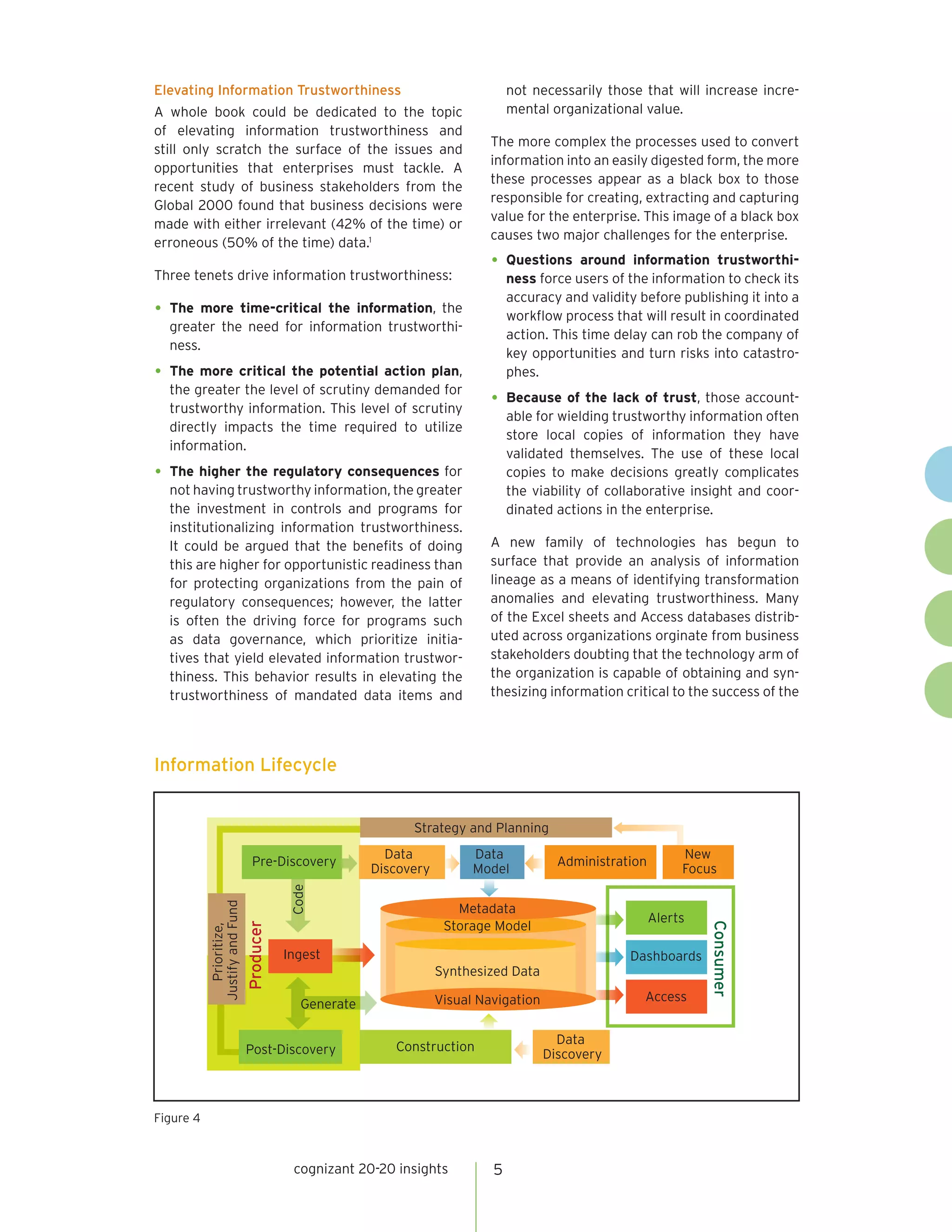
Information Lifecycle


                                                             Strategy and Planning
                                                         Data            Data                                  New
                                Pre-Discovery                                            Administration
                                                       Discovery         Model                                 Focus
                                          Code
           Justify and Fund


                                                                      Metadata
                                                                                                          Alerts
                                                                    Storage Model
                              Producer


                                                                                                                   Consumer
              Prioritize,


                                         Ingest                                                     Dashboards
                                                                   Synthesized Data

                                                                   Visual Navigation                   Access
                                            Generate

                                                                                         Data
                              Post-Discovery              Construction
                                                                                       Discovery


Figure 4


                                          cognizant 20-20 insights          5
enterprise within the time constraints demanded                     to the process of finding content on Google or
in today’s accelerated business climate.                            Yahoo.

Three ways to accelerate time to market for new                Shortening the Time to Find
information sources include:                                   Relevant Data
•	 Post-discovery, or the ability to figure out how            Much has been written on the ever increasing
  information ties into an enterprise informa-                 deluge of information available for analysis and
  tion model after it is published. This requires              how, despite this data abundance, it is becoming
  a longer-term architectural change in the way                more difficult to find relevance.
  information is made available. Information
                                                               The sheer volume of information made available
  portals such as Attivio reduce the timeline
                                                               for analysis is increasing at an ever faster rate,
  for publishing new information available for
                                                               with the amount of information doubling every
  analysis and collaborative insight by enlisting
                                                               two years and accelerating.3 Keeping up with this
  post-discovery processes.2
                                                               deluge is difficult enough; analyzing it to spot
•	 Columnar and cell-based enterprise report-                  patterns and useful information is harder still,
  ing and analysis tools, which lessen the impor-              given the pace at which information circumnavi-
  tance of the enterprise information model.                   gates the globe.
  Examples include Sybase IQ, IBM Netezza,
  Greenplum and Teradata’s columnar solution.                  There are two forms of information required for
  Columnar and cell-based solutions reduce the                 analysis:
  time it takes to make new information available
  to business stakeholders by separating the syn-
                                                               •	 Information    that meets the status quo (i.e.,
                                                                    roughly fits existing models that predict the
  thesis of new information into the enterprise                     outcome of competitive market forces).
  information model from the process of making
  the information available.                                   •	 Information     that results from market dis-
                                                                    ruptions and that will not appear in internal
•	 Information   portals, or systems that table,                    systems until it is too late.
  document and log information through a single                One way to meet the demands of market
  facility that makes finding information similar              disruption is to implement a “beacon” that looks


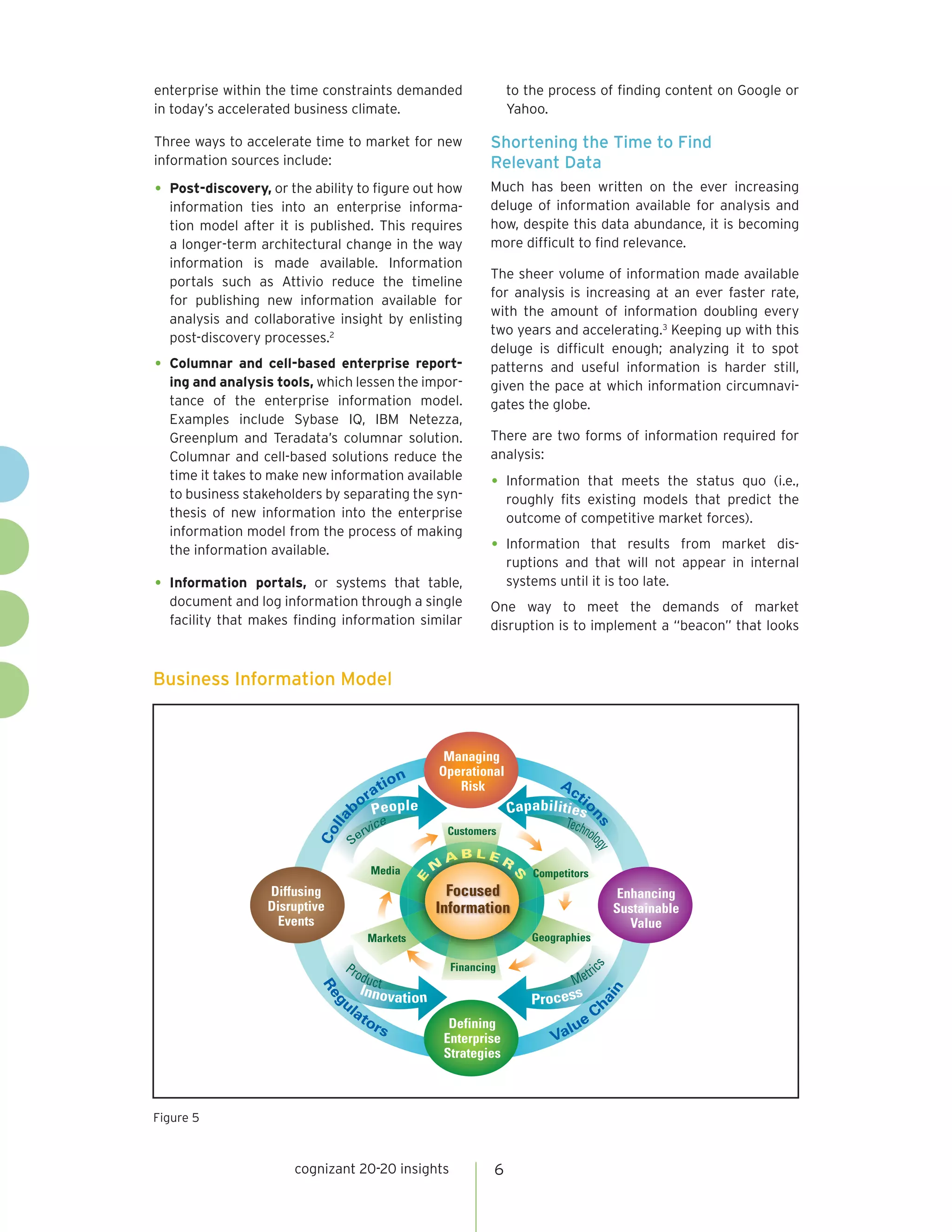
Business Information Model


                                                    Managing
                                           n       Operational
                                       tio            Risk                 Ac
                                     ra                                         ti
                                   bo People                        Capabilitieso
                                                                             Techn
                                                                                    ns
                            ll a


                                                       Customers                   olo
                          Co


                                                                                       gy


                                                       ABLER
                                     Media         N                     Competitors
                                                                    S
                                               E


                  Diffusing                          Focused                              Enhancing
                  Disruptive                       Information                           Sustainable
                    Events                                                                  Value
                                     Markets                             Geographies

                               Pro                      Financing
                                                                                 tri
                                                                                   cs


                                  duc                                         Me
                                  Innto
                           Re


                                                                        Process h
                                                                                         n


                               ul       vation
                                                                                       ai
                              g


                                 at                                                C
                                   or                   Defining               e
                                      s
                                                       Enterprise          Valu
                                                       Strategies


Figure 5


                       cognizant 20-20 insights                 6
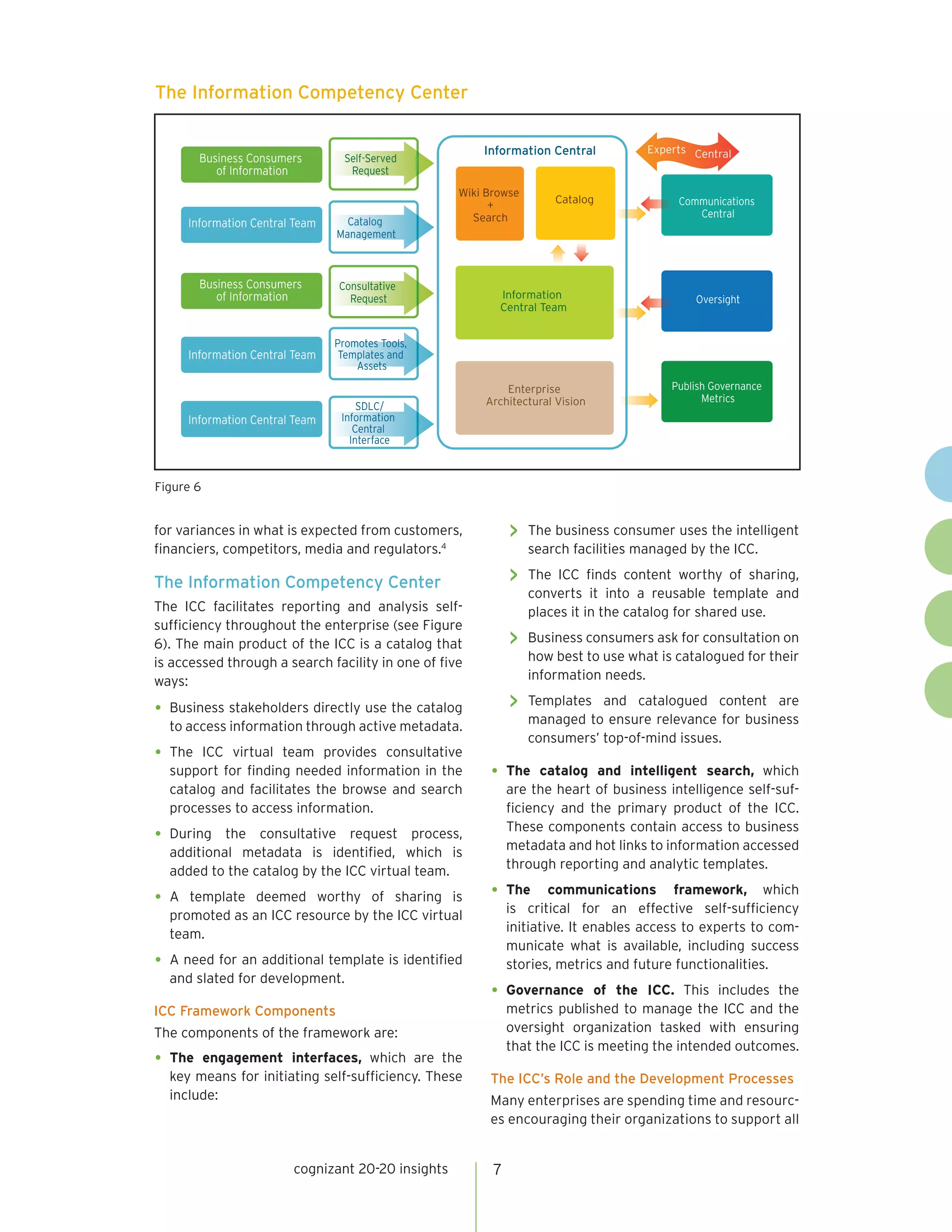
The Information Competency Center


                                                         Information Central          Experts Central
         Business Consumers         Self-Served
            of Information           Request
                                                     Wiki Browse
                                                           +            Catalog            Communications
                                                       Search                                 Central
       Information Central Team     Catalog
                                  Management


         Business Consumers       Consultative
            of Information          Request                 Information                       Oversight
                                                            Central Team


                                  Promotes Tools,
       Information Central Team    Templates and
                                      Assets

                                                             Enterprise                   Publish Governance
                                                         Architectural Vision                   Metrics
                                       SDLC/
       Information Central Team    Information
                                      Central
                                     Interface


Figure 6


for variances in what is expected from customers,              >> The business consumer uses the intelligent
financiers, competitors, media and regulators.4                    search facilities managed by the ICC.

The Information Competency Center                              >> The   ICC finds content worthy of sharing,
                                                                   converts it into a reusable template and
The ICC facilitates reporting and analysis self-                   places it in the catalog for shared use.
sufficiency throughout the enterprise (see Figure
6). The main product of the ICC is a catalog that              >> Business consumers ask for consultation on
is accessed through a search facility in one of five               how best to use what is catalogued for their
ways:                                                              information needs.

•	 Business stakeholders directly use the catalog              >> Templates   and catalogued content are
                                                                   managed to ensure relevance for business
  to access information through active metadata.
                                                                   consumers’ top-of-mind issues.
•	 The ICC virtual team provides consultative
  support for finding needed information in the           •	 The     catalog and intelligent search, which
  catalog and facilitates the browse and search                are the heart of business intelligence self-suf-
  processes to access information.                             ficiency and the primary product of the ICC.
                                                               These components contain access to business
•	 During  the consultative request process,
                                                               metadata and hot links to information accessed
  additional metadata is identified, which is
                                                               through reporting and analytic templates.
  added to the catalog by the ICC virtual team.

•	 A template deemed worthy of sharing is                 •	 The       communications framework, which
                                                               is critical for an effective self-sufficiency
  promoted as an ICC resource by the ICC virtual
                                                               initiative. It enables access to experts to com-
  team.
                                                               municate what is available, including success
•	 A need for an additional template is identified             stories, metrics and future functionalities.
  and slated for development.
                                                          •	 Governance       of the ICC. This includes the
ICC Framework Components                                       metrics published to manage the ICC and the
The components of the framework are:                           oversight organization tasked with ensuring
                                                               that the ICC is meeting the intended outcomes.
•	 The engagement interfaces, which are the
  key means for initiating self-sufficiency. These        The ICC’s Role and the Development Processes
  include:                                                Many enterprises are spending time and resourc-
                                                          es encouraging their organizations to support all


                          cognizant 20-20 insights         7
the types of clients served by their information-         normal way of doing business have grouped
centric initiatives. Supported clients typically          their consultative roles in the following ways:
reside in multiple divisions, comprise multiple
business functions and, in many cases, consti-
                                                          >> Self-serve information with no need for
                                                             consultative assistance. Consultative
tute multiple legal entities that are often spread           activities that support this self-service ca-
across multiple geographies. In many enter-                  pability are continued enrichment of the
prises, inconsistent technologies are deployed               metadata catalog used to find information
to support the conversion of large amounts of                and discern the suitability of information
data into insight, including business intelligence,          for the task at hand.
data warehousing, information portals and other
tools, making this a complex support issue.               >> A consultative need for using information
                                                             models and templates made available for
In an attempt to accelerate the conversion of data           reporting and analysis.
into insight, many enterprises have introduced
Agile development techniques as a wrapper
                                                          >> Small  delivery efforts performed in less
                                                             than “X days.” (This is normally the stick-
to their delivery processes. From an outsider’s              ing point that guidelines can help with.) In-
vantage point, however, this is an additional                terestingly, IT is much more concerned than
level of complexity added to what is already a               the business community about small deliv-
laborious, sluggish process. A different approach            ery opportunities that slip under the radar;
is required.                                                 business users generally welcome this as an
                                                             alternative to building it themselves in Excel.
Finally, the complexity of information has
introduced the necessity of data experts, or those        >> Prototyping  opportunities to help dis-
who are intimately familiar with the scope, use              cover business requirements in complex
and suitability of information made available for            delivery situations. The prototyping arm
analysis. These experts are often geographically             normally ends up in the ICC but can be lo-
dispersed and not easy to find. Many organiza-               cated anywhere.
tions have data experts who maintain cross-               >> Pure   Agile/SDLC delivery. Key metrics
reference tables in desktop tools that serve as              are required to monitor the successful ex-
the translation layer to connect two otherwise               ecution of this organizational model. These
unrelated data sources.                                      metrics will monitor the engagement of in-
                                                             formation experts, the balance of the two
Companies that have achieved information self-
                                                             prongs of the organizational model and the
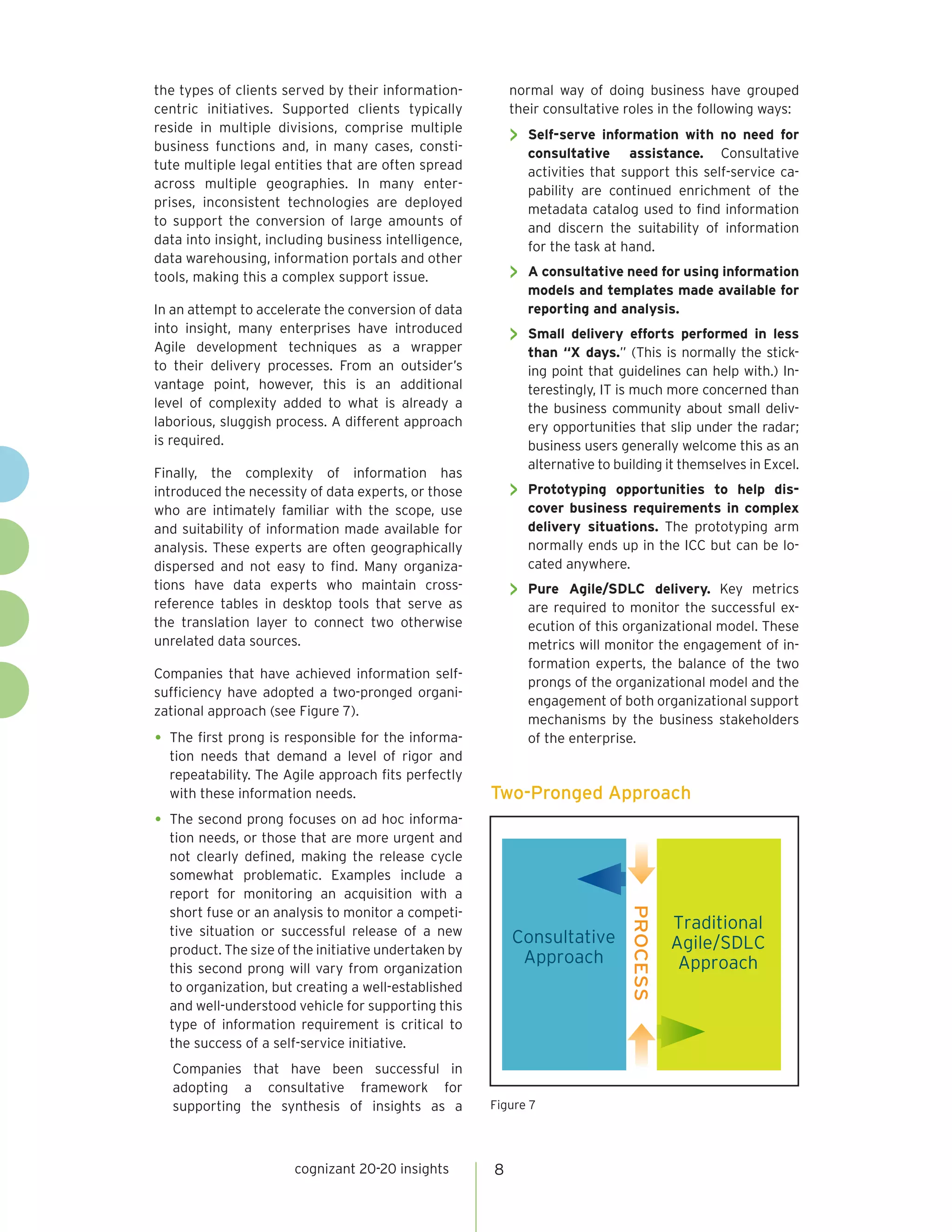
sufficiency have adopted a two-pronged organi-
                                                             engagement of both organizational support
zational approach (see Figure 7).
                                                             mechanisms by the business stakeholders
•	 The first prong is responsible for the informa-           of the enterprise.
  tion needs that demand a level of rigor and
  repeatability. The Agile approach fits perfectly
  with these information needs.                       Two-Pronged Approach
•	 The second prong focuses on ad hoc informa-
  tion needs, or those that are more urgent and
  not clearly defined, making the release cycle
  somewhat problematic. Examples include a
  report for monitoring an acquisition with a
  short fuse or an analysis to monitor a competi-
                                                                              PROCESS


  tive situation or successful release of a new
                                                                                        Traditional
                                                          Consultative                  Agile/SDLC
  product. The size of the initiative undertaken by
                                                           Approach                      Approach
  this second prong will vary from organization
  to organization, but creating a well-established
  and well-understood vehicle for supporting this
  type of information requirement is critical to
  the success of a self-service initiative.
   Companies that have been successful in
   adopting a consultative framework for
   supporting the synthesis of insights as a          Figure 7


                       cognizant 20-20 insights       8
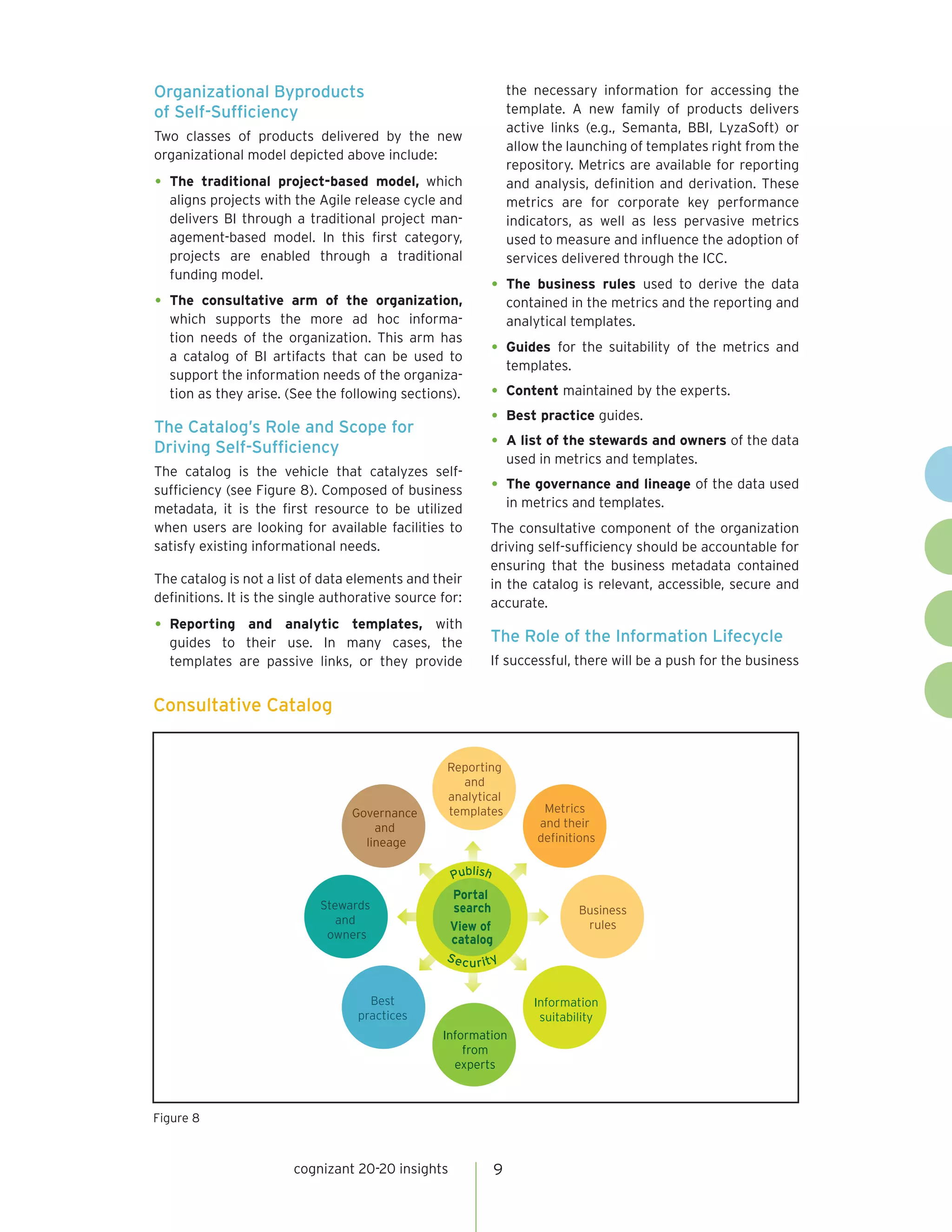
Organizational Byproducts                                        the necessary information for accessing the
of Self-Sufficiency                                              template. A new family of products delivers
                                                                 active links (e.g., Semanta, BBI, LyzaSoft) or
Two classes of products delivered by the new
                                                                 allow the launching of templates right from the
organizational model depicted above include:
                                                                 repository. Metrics are available for reporting
•	 The traditional project-based model, which                    and analysis, definition and derivation. These
  aligns projects with the Agile release cycle and               metrics are for corporate key performance
  delivers BI through a traditional project man-                 indicators, as well as less pervasive metrics
  agement-based model. In this first category,                   used to measure and influence the adoption of
  projects are enabled through a traditional                     services delivered through the ICC.
  funding model.
                                                            •	 The    business rules used to derive the data
•	 The  consultative arm of the organization,                    contained in the metrics and the reporting and
  which supports the more ad hoc informa-                        analytical templates.
  tion needs of the organization. This arm has
  a catalog of BI artifacts that can be used to             •	 Guides   for the suitability of the metrics and
                                                                 templates.
  support the information needs of the organiza-
  tion as they arise. (See the following sections).         •	 Content maintained by the experts.
The Catalog’s Role and Scope for
                                                            •	 Best practice guides.
Driving Self-Sufficiency                                    •	 A list of the stewards and owners of the data
                                                                 used in metrics and templates.
The catalog is the vehicle that catalyzes self-
sufficiency (see Figure 8). Composed of business            •	 The governance and lineage of the data used
metadata, it is the first resource to be utilized                in metrics and templates.
when users are looking for available facilities to          The consultative component of the organization
satisfy existing informational needs.                       driving self-sufficiency should be accountable for
                                                            ensuring that the business metadata contained
The catalog is not a list of data elements and their        in the catalog is relevant, accessible, secure and
definitions. It is the single authorative source for:       accurate.
•	 Reporting and analytic templates, with
                                                            The Role of the Information Lifecycle
  guides to their use. In many cases, the
  templates are passive links, or they provide              If successful, there will be a push for the business


Consultative Catalog


                                                  Reporting
                                                    and
                                                  analytical
                                  Governance      templates            Metrics
                                      and                             and their
                                    lineage                           definitions


                                                   Publish
                                                  Portal
                            Stewards              search                     Business
                               and                                            rules
                                                  View of
                             owners               catalog
                                                  Sec
                                                        u rity


                                     Best                            Information
                                   practices                          suitability
                                                 Information
                                                     from
                                                   experts


Figure 8


                       cognizant 20-20 insights              9
community to create templates and share them        tions about the storage and consumption of infor-
             for consumption through the central catalog. Two    mation not possible in general-purpose database
             types of information include:                       solutions.

             •	 Introspective,highly predictable and highly      The way many appliances represent their data
               repeatable information.                           models is more closely aligned to the structures
             •	 Less introspective information that is focused   of columnar databases, thereby diminishing
               on top-of-mind issues surfacing from competi-     the enterprise data model’s involvement with
               tive, market, innovative, regulatory and other    analysis of data. Other appliances make it feasible
               disruptors that require rapid synthesis, com-     to hide the complexities of the enterprise data
               munication and monitoring of an action plan       model from those deriving insight from it through
               to ensure that the results of these actions are   the use of massive amounts of memory and
               achieved as intended.                             computing power. In both cases, it becomes much
                                                                 more possible for those utilizing these informa-
          The main purpose of the information lifecycle is       tion stores to be self-sufficient.
          to shrink the size of the proverbial haystack. It
          needs to ensure that the nuggets of gold hidden        One of the greatest attributes of an appliance
          in the deluge of data are not buried in what used      is also its greatest downfall: its ability to access
                                to be important for deriving     vast amounts of information quickly and hide the
   The main purpose insight in the past but today                complexities of the model used to access the data

   of the information is historical trivia.is devised
                                mation lifecycle
                                                  The infor-     from the eyes of those consuming its contents.
                                                                 Because it is simple to store data in an appliance,
lifecycle is to shrink to monitor the use of infor-              it is necessary to continually ensure it does not
       the size of the mation published for self-                morph into a data dump due to lax information

proverbial haystack. service categories: it into
                                several
                                        and stratify             lifecycle management. Otherwise, the issues
                                                                 justifying investment in the appliance, such as
                                                                 performance and usability, will resurface.
             •	 Information  required for operational use.
               This information is not subject to the same       Behavioral Business Intelligence and
               scrutiny in the information lifecycle process     Self-Sufficiency
               and is generally highly introspective.
                                                                 It’s unlikely that the desire will be fulfilled for
             •	 Information  that supports key strategic,        a single reporting and analytics tool, used
               tactical and operational organizational           throughout the enterprise. Even if fully deployed,
               intents and is not covered by category one.       traditional BI and reporting tools lack the col-
                                                                 laborative, crowdsourcing and “recommenda-
             •	 Information   required for strategic, tactical
                                                                 tion engine” features that are taken for granted
               and/or operational intents that have not been
               institutionalized into category one.              in our Internet experience but usually lacking in
                                                                 corporate systems.
             •	 Information required for a short-term need
               that is expiring. Information that is expiring    Our introduction of “behavioral business intel-
               will be put on a watch list to be removed from    ligence,” or BBI for short, is a novel approach
               the pool of easily searched data once its         for making the best use of a company’s multiple
               relevance is diminished.                          reporting and BI systems, with multiple reports
                                                                 and sources, multiple opinions and numerous
             •	 Information required for a short-term need       questions seeking answers from a pool of enter-
               that has expired. This information should be
               removed immediately from the pool of easily       prise-wide expertise. BBI uses a combination of
               searched data to avoid the unintended conse-      “social media” techniques to identify recommend-
               quence of the information repository used for     ed next steps, allow annotations of insights and
               self-service being relegated to the status of a   discoveries, post questions for review and archive
               data dump.                                        the wisdom of the community. BBI attempts to
                                                                 logically harmonize the multiple BI systems and
             Appliances and Self-Sufficiency                     reports with users.
             Data warehousing appliances have stormed the
             marketplace, and for good reason. Appliances        Another approach for simplifying the complexity
             generally share nothing from the information        of reporting tools is to physically harmonize
             infrastructure, enabling them to make assump-       them with technologies that serve as a wrapper


                                   cognizant 20-20 insights      10
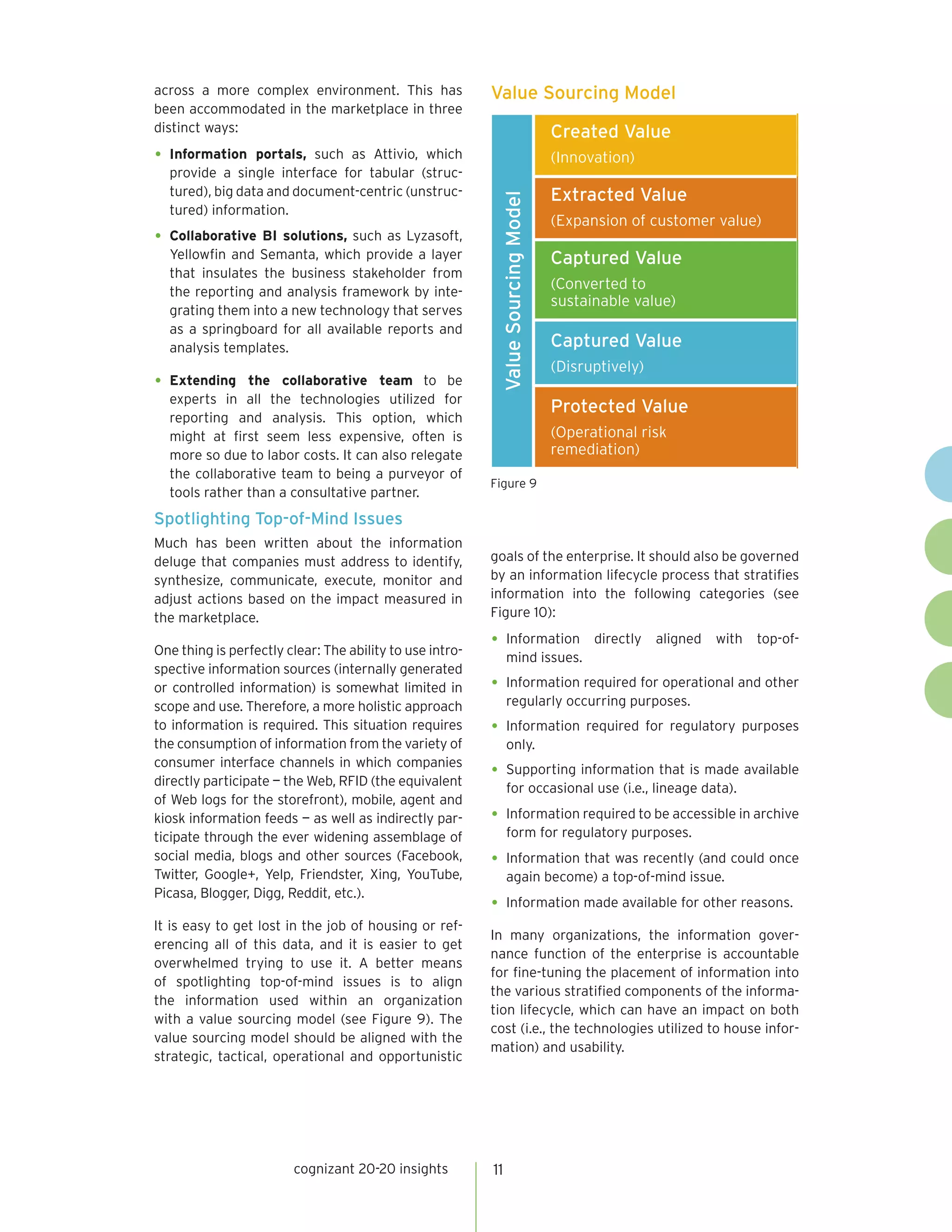
across a more complex environment. This has               Value Sourcing Model
been accommodated in the marketplace in three
distinct ways:                                                                    Created Value
•	 Information portals, such as Attivio, which                                    (Innovation)
   provide a single interface for tabular (struc-
   tured), big data and document-centric (unstruc-                                Extracted Value


                                                           Value Sourcing Model
   tured) information.
                                                                                  (Expansion of customer value)
•	 Collaborative BI solutions, such as Lyzasoft,
  Yellowfin and Semanta, which provide a layer                                    Captured Value
  that insulates the business stakeholder from
  the reporting and analysis framework by inte-
                                                                                  (Converted to
                                                                                  sustainable value)
  grating them into a new technology that serves
  as a springboard for all available reports and
  analysis templates.                                                             Captured Value
                                                                                  (Disruptively)
•	 Extending   the collaborative team to be
  experts in all the technologies utilized for
                                                                                  Protected Value
  reporting and analysis. This option, which
  might at first seem less expensive, often is                                    (Operational risk
  more so due to labor costs. It can also relegate                                remediation)
  the collaborative team to being a purveyor of
                                                          Figure 9
  tools rather than a consultative partner.
Spotlighting Top-of-Mind Issues
Much has been written about the information
deluge that companies must address to identify,           goals of the enterprise. It should also be governed
synthesize, communicate, execute, monitor and             by an information lifecycle process that stratifies
adjust actions based on the impact measured in            information into the following categories (see
the marketplace.                                          Figure 10):

One thing is perfectly clear: The ability to use intro-
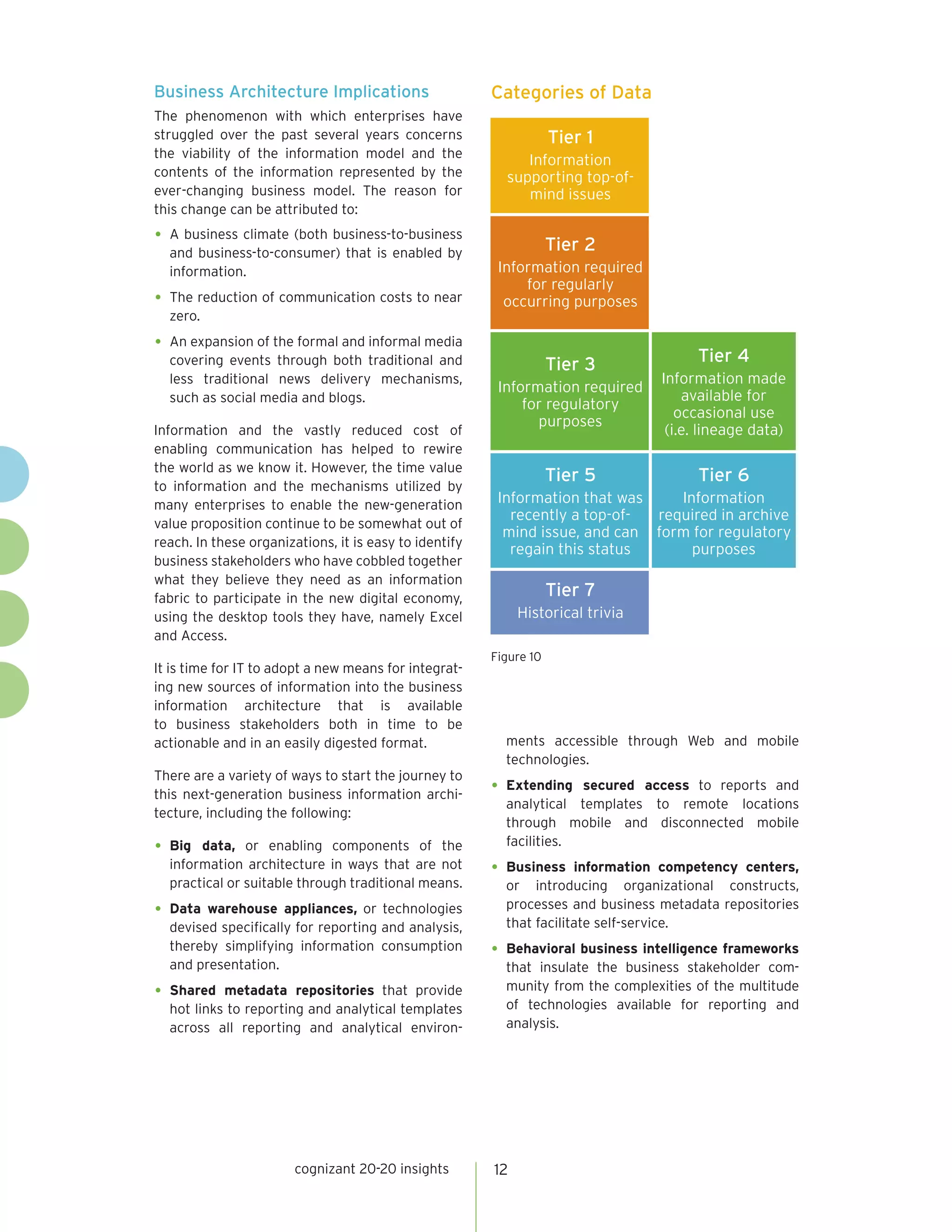
                                                          •	 Information                directly   aligned   with   top-of-
                                                               mind issues.
spective information sources (internally generated
or controlled information) is somewhat limited in         •	 Information required for operational and other
scope and use. Therefore, a more holistic approach             regularly occurring purposes.
to information is required. This situation requires       •	 Information required for regulatory purposes
the consumption of information from the variety of             only.
consumer interface channels in which companies
directly participate — the Web, RFID (the equivalent
                                                          •	 Supporting information that is made available
                                                               for occasional use (i.e., lineage data).
of Web logs for the storefront), mobile, agent and
kiosk information feeds — as well as indirectly par-      •	 Information required to be accessible in archive
ticipate through the ever widening assemblage of               form for regulatory purposes.
social media, blogs and other sources (Facebook,          •	 Information that was recently (and could once
Twitter, Google+, Yelp, Friendster, Xing, YouTube,             again become) a top-of-mind issue.
Picasa, Blogger, Digg, Reddit, etc.).
                                                          •	 Information made available for other reasons.
It is easy to get lost in the job of housing or ref-
                                                          In many organizations, the information gover-
erencing all of this data, and it is easier to get
                                                          nance function of the enterprise is accountable
overwhelmed trying to use it. A better means
                                                          for fine-tuning the placement of information into
of spotlighting top-of-mind issues is to align
                                                          the various stratified components of the informa-
the information used within an organization
                                                          tion lifecycle, which can have an impact on both
with a value sourcing model (see Figure 9). The
                                                          cost (i.e., the technologies utilized to house infor-
value sourcing model should be aligned with the
                                                          mation) and usability.
strategic, tactical, operational and opportunistic


                        cognizant 20-20 insights          11
Business Architecture Implications                      Categories of Data
The phenomenon with which enterprises have
struggled over the past several years concerns                      Tier 1
the viability of the information model and the
                                                             Information
contents of the information represented by the            supporting top-of-
ever-changing business model. The reason for                 mind issues
this change can be attributed to:

•	 A business climate (both business-to-business                    Tier 2
  and business-to-consumer) that is enabled by
  information.                                           Information required
                                                             for regularly
•	 The reduction of communication costs to near           occurring purposes
  zero.

•	 An expansion of the formal and informal media
  covering events through both traditional and                      Tier 3             Tier 4
  less traditional news delivery mechanisms,                                     Information made
                                                         Information required
  such as social media and blogs.                                                    available for
                                                             for regulatory
                                                                                    occasional use
                                                               purposes
Information and the vastly reduced cost of                                        (i.e. lineage data)
enabling communication has helped to rewire
the world as we know it. However, the time value
                                                                    Tier 5             Tier 6
to information and the mechanisms utilized by
many enterprises to enable the new-generation            Information that was    Information
                                                           recently a top-of- required in archive
value proposition continue to be somewhat out of
                                                          mind issue, and can form for regulatory
reach. In these organizations, it is easy to identify
                                                           regain this status      purposes
business stakeholders who have cobbled together
what they believe they need as an information
fabric to participate in the new digital economy,                   Tier 7
using the desktop tools they have, namely Excel              Historical trivia
and Access.
                                                        Figure 10
It is time for IT to adopt a new means for integrat-
ing new sources of information into the business
information architecture that is available
to business stakeholders both in time to be
actionable and in an easily digested format.              ments accessible through Web and mobile
                                                          technologies.
There are a variety of ways to start the journey to
this next-generation business information archi-        •	 Extending  secured access to reports and
                                                          analytical templates to remote locations
tecture, including the following:
                                                          through mobile and disconnected mobile
                                                          facilities.
•	 Big data, or enabling components of the
  information architecture in ways that are not         •	 Business   information competency centers,
  practical or suitable through traditional means.        or introducing organizational constructs,
                                                          processes and business metadata repositories
•	 Data warehouse appliances, or technologies
  devised specifically for reporting and analysis,        that facilitate self-service.
  thereby simplifying information consumption           •	 Behavioral business intelligence frameworks
  and presentation.                                       that insulate the business stakeholder com-
                                                          munity from the complexities of the multitude
•	 Shared metadata repositories that provide
   hot links to reporting and analytical templates        of technologies available for reporting and
   across all reporting and analytical environ-           analysis.


                        cognizant 20-20 insights        12
Footnotes
1	
     Information Management for Dummies, IBM Press, 2006, based on a joint study with Accenture of 250
     companies.
2	
     Mark Albala, “Post-Discovery Intelligence Applications: The Next Big Thing,” Attivio, 2009.
3	
     “The Data Deluge,” The Economist, Feb. 25, 2010.
4	
     Thomas Davenport, Competing on Analytics, Harvard Business School Press, 2007; Malcolm Gladwell,
     The Tipping Point, Back Bay Books, 2002; Mark Albala, “Enhancing Information Focus Through Partition-
     ing,” InfoSight Partners, 2009.


About the Authors
Mark Albala is a Business Consulting Practice Director of Cognizant’s North American Enterprise Infor-
mation Management (EIM) Business Unit, overseeing its Information On-Demand Group. Mark specializes
in providing solution architecture, information governance, information strategy, strategy roadmap and
governance services to companies across industries, and supports Cognizant’s enterprise information
management delivery capabilities. A graduate of Syracuse University, Mark has held senior consulting,
thought leadership, advanced technical and business development roles for organizations focused
on the disciplines of business intelligence, governance and data warehousing. He can be reached at
Mark.Albala@cognizant.com | Twitter: http://twitter.com/mcalbala | LinkedIn: http://www.linkedin.
com/in/markalbala | Google+: mcalbala@gmail.com.


About Cognizant
Cognizant (NASDAQ: CTSH) is a leading provider of information technology, consulting, and business process out-
sourcing services, dedicated to helping the world’s leading companies build stronger businesses. Headquartered in
Teaneck, New Jersey (U.S.), Cognizant combines a passion for client satisfaction, technology innovation, deep industry
and business process expertise, and a global, collaborative workforce that embodies the future of work. With over 50
delivery centers worldwide and approximately 150,400 employees as of September 30, 2012, Cognizant is a member of
the NASDAQ-100, the S&P 500, the Forbes Global 2000, and the Fortune 500 and is ranked among the top performing
and fastest growing companies in the world. Visit us online at www.cognizant.com or follow us on Twitter: Cognizant.


                                         World Headquarters                  European Headquarters                 India Operations Headquarters
                                         500 Frank W. Burr Blvd.             1 Kingdom Street                      #5/535, Old Mahabalipuram Road
                                         Teaneck, NJ 07666 USA               Paddington Central                    Okkiyam Pettai, Thoraipakkam
                                         Phone: +1 201 801 0233              London W2 6BD                         Chennai, 600 096 India
                                         Fax: +1 201 801 0243                Phone: +44 (0) 20 7297 7600           Phone: +91 (0) 44 4209 6000
                                         Toll Free: +1 888 937 3277          Fax: +44 (0) 20 7121 0102             Fax: +91 (0) 44 4209 6060
                                         Email: inquiry@cognizant.com        Email: infouk@cognizant.com           Email: inquiryindia@cognizant.com


©
­­ Copyright 2012, Cognizant. All rights reserved. No part of this document may be reproduced, stored in a retrieval system, transmitted in any form or by any
means, electronic, mechanical, photocopying, recording, or otherwise, without the express written permission from Cognizant. The information contained herein is
subject to change without notice. All other trademarks mentioned herein are the property of their respective owners.

Achieving Information Self-Sufficiency

  • 1.
    • Cognizant 20-20Insights Achieving Information Self-Sufficiency As organizations struggle to meet the demands of the global marketplace, a business intelligence competency center can help create the systems and processes to synthesize all types of data, providing the business with trustworthy, timely and actionable information. Executive Summary variety of formats — into collaborative insights that drive coordinated action. This needs to The speed of business has accelerated, thanks happen at a lightning pace in order to retain com- to the commoditization of communications and petitive advantage over others with access to the the ability of information to circumnavigate the same information in today’s highly communica- globe. This has resulted in the need to turbo- tive, global marketplace. charge the speed at which information is made available to business stakeholders and their This is being accomplished through one or more ability to act on it. This new age of information of the following capabilities: presents a number of challenges: • Finding relevant tidbits of data in the ever- • A set of proven templates that help identify increasing deluge, with the necessary context relevant and trustworthy information and of turning it into actionable information quickly transform these tidbits into coordinated enough to make an impact on the global mar- activities. This can be tabular information ketplace. generated internally or obtained from external sources; log-centric information (Web logs, • Derivingactionable information from coordi- RFID logs, mobile activity logs, etc.); and doc- nated activities. ument-centric information (Web content, news • Presenting new information from sources not media, social media, etc.). yet utilized. • A consultative support organization that • Instilling confidence that the information continually works with stakeholders to obtained is relevant, trustworthy and current. translate information into captured, extracted or created value and uses the necessary tools Many organizations are trying to deliver a high and processes to ensure insights can be con- degree of self-service information management tinually derived to execute action in a competi- to business stakeholders, or information self- tive timeframe. sufficiency. This is possible when users have both the actionable information required to make • Assurance that the full complement of just- informed decisions and the tools necessary for in-time, relevant, actionable, focused and trust- very quickly turning newly obtained data — in a worthy information will be made available as cognizant 20-20 insights | november 2012
  • 2.
    Information Self-Sufficiency Information Agility Identify an opportunity or risk Measure and Devise a course refine of action A Keen Focus Ability Collaboration to Determine Empower measurement Collaborate Execution Agility Figure 1 a resource, with the necessary support and in events to register their presence in internal the required timeframe, to those responsible systems for analysis and predictive modeling. for creating, extracting and capturing incre- mental value for the organization. This will • Negating the need for business stakeholders to become technologists to use information. discourage the practice of storing local copies for decision-making, as the shared information • Managing the entry points to analysis so resource will be viewed as more efficient. stakeholders can focus on top-of-mind business issues and identify disruptions to the status quo. This white paper provides a synopsis of the major capabilities of enterprises that enable informa- From the Beginning tion self-sufficiency. Organizations that have Much has been written in recent years about the reached this level provide business stakeholders need to make business more self-sufficient in with enhanced execution agility by empowering obtaining information required for deciphering them with information that is highly collaborative market maneuvers, strategizing on corrective and focused (see Figure 1). actions and taking swift and decisive action, as well as ensuring intended outcomes. However, Enterprises that embark on this journey have the ability to make such information available in reduced the time it takes to use information by: a self-service environment remains a lofty goal, • Reengineering the processes used to one that is out of reach for many enterprises (see synthesize new data sources into the informa- Figure 2, next page). There are several reasons tion fabric of the enterprise. for this phenomenon, including but not limited to: • Improving the processes used to enhance • The sheer complexity of how information is the understanding of information quality and organized requires those intending to use it lineage. to become technicians or hire “translators” to serve as their technicians. Neither is an optimal • Adopting new approaches to enable the avail- solution. ability of just-in-time information. • Consolidating the number of places that • The multitude of technologies employed to enterprise stewards need to interrogate, thin- obtain information also introduces complexities, ning out the barrage of information generated, resulting in the same scenario described above. both internally (introspective information) and from external sources. This capability takes • The top-of-mind information that is actionable changes more rapidly than can be accommo- into consideration the time lag for disruptive cognizant 20-20 insights 2
  • 3.
    Barriers to Self-Sufficiency • The information that provides context for facts and figures is stored separately and organized much differently from the facts and figures used in analysis, once again requiring Information organization the hiring of translators who can effectively complexity bridge the gap. Suspect Barriers to service Too many • People who would benefit from the informa- information technologies tion do not necessarily consider it to be trust- worthy or relevant. Self-Service Information A technique that many enterprises have adopted is the concept of an information competency center Context Rapidly (ICC). An ICC provides a framework for elevating organized changing differently focus the speed at which insights can be derived from published information for heightened self-ser- Availability of only vice. The role of the ICC is to serve the needs of introspective those accountable for creating, extracting and information capturing value from information. This includes helping them identify the most suitable infor- mation and providing guidance on the tools and Figure 2 processes that will turn this deluge of information into collaborative insight and, eventually, coordi- dated by the technologists supporting the nated action. volumes of well-organized information. By now, you might be wondering how to identify • The information that is well-organized is whether the issues impeding the delivery of infor- largely introspective — not at all useful for iden- mation self-sufficiency exist in your organization. tifying and reacting to market forces in time to Some of the signals to watch for are depicted in have any measurable impact. Figure 3. Are You Self-Sufficient? Observed Activity Why This Occurs What to Address A large number of Excel spread- The complexity of information The perception that the technology arm of sheets and Access databases organization leads to translators the organization cannot deliver new infor- used to house data originating in extracting information into Excel mation at the speed required by business internal systems. and Access for use by business stakeholders. stakeholders. A large number of business It takes too long to change the The perception of data quality issues that spreadsheets integrating informa- organization of sanctioned data must be fixed before using it for anything tion managed from production sources to meet the needs of top- meaningful. systems, with data extracted from of-mind business issues. sanctioned data sources. A delay between the availability of The information made available The perception of low information quality. information and the communica- for analysis is not considered tion of intended action. trustworthy or relevant. Significant performance issues Information was migrated to The perception that performance is insuf- associated with recent changes to new technologies, but it is not ficient or that information will not be technologies used to access data, optimally organized for the new available at critical times. resulting in many local copies of environment, leading to perfor- data used for analysis. mance anomalies. The use of information available in The basic assumptions used to The perception that the information sanctioned sources for operational organize data have likely changed, available through sanctioned sources and scheduled reporting but not making it difficult to use the infor- represents operational reporting needs only for strategic purposes. mation for analysis. and/or that sufficient changes have occurred in the business that have not been factored into the sanctioned information fabric. Figure 3 cognizant 20-20 insights 3
  • 4.
    Accelerating Information lost because of the need to validate the rea- Self-Sufficiency sonability and lineage of data used to derive an action plan. This results from a lack of trust There are several ways to accelerate information that the correct or most timely information self-sufficiency: was obtained or that the process was error • Task a supporting organization with ensuring prone. There are four common types of errors the continued relevance and focus of the infor- that can incorrectly influence an action plan: mation. >> Origination errors (data incorrectly en- • Change the focus of the supporting organiza- tered into the system). tion, shifting its intent from delivery-based to consultative-based, with the additional ability >> Capture errors (inconsistent or incorrect vintages of information captured and used). to perform delivery. • Define and publish metrics for measuring the >> Transformation errors (errors made when transforming data from its source form to effectiveness of the supporting organization the form captured for analysis). and the relevance and actionability of the infor- mation it supports. >> Identification errors (incorrect informa- tion captured by identifying a system of • Define and publish metrics for measuring the record or reference that was out of synch relevance, trustworthiness and actionability of with other information utilized). information published for self-sufficiency. • Insulatethe intended audience from the • Reducing the time required to provide access technical intricacies of using information to new information sources deemed critical to published for self-sufficiency. business stakeholders. • Ensure that information published for self- • Shortening the time required to identify key sufficiency is not completely introspective. tidbits of data that will serve as the starting point for deriving coordinated action plans • Introduce methods and metrics to facilitate using repeatable processes. an accelerated publication cycle for informa- tion aligned with the enterprise’s top-of-mind • Doing the above, in a way that is repeatable issues. (through the use of well-orchestrated templates that systematize information access). • Implement processes that protect the sanctioned sources of self-sufficient infor- • Providing a catalog as a central resource, mation from becoming complex information maintained by a central body (normally an dumps. ICC), which typically contains the templates, processes, business metadata, contact informa- • Ensure that the organization chartered with tion for experts and best practice guidelines to publishing self-sufficient information has achieve the desired level of self-service. (A new permission to obtain and synthesize the infor- family of products is emerging that provides mational needs of the enterprise at the speed this catalog, as well as hot links to templates required to react to the market, media and independent of the technologies used to create regulatory influencers of the enterprise. the templates, thereby negating the need for Self-Sufficiency Program Determinants business stakeholders to become proficient in the family of tools used to participate in the Self-sufficiency programs, such as an ICC, can self-service program.) reduce the time it takes to synthesize unexpected information derived from internal sources (intro- • A consultative organizational arm whose spective information) and external sources, as primary mission is to facilitate the foundational well as use it in action plans and massage it into components critical to the success of the self- coordinated activities. service program. The key foundational components critical to the • A series of key metrics specifically devised to measure the adoption, continued viability success of a self-service program include: and contribution to incremental organizational value influenced by the self-service program. • Elevating the trustworthiness of informa- tion. Too often, time-critical opportunities are cognizant 20-20 insights 4
  • 5.
    Elevating Information Trustworthiness not necessarily those that will increase incre- A whole book could be dedicated to the topic mental organizational value. of elevating information trustworthiness and The more complex the processes used to convert still only scratch the surface of the issues and information into an easily digested form, the more opportunities that enterprises must tackle. A these processes appear as a black box to those recent study of business stakeholders from the responsible for creating, extracting and capturing Global 2000 found that business decisions were value for the enterprise. This image of a black box made with either irrelevant (42% of the time) or causes two major challenges for the enterprise. erroneous (50% of the time) data.1 • Questions around information trustworthi- Three tenets drive information trustworthiness: ness force users of the information to check its accuracy and validity before publishing it into a • The more time-critical the information, the workflow process that will result in coordinated greater the need for information trustworthi- action. This time delay can rob the company of ness. key opportunities and turn risks into catastro- • The more critical the potential action plan, phes. the greater the level of scrutiny demanded for trustworthy information. This level of scrutiny • Because of the lack of trust, those account- able for wielding trustworthy information often directly impacts the time required to utilize store local copies of information they have information. validated themselves. The use of these local • The higher the regulatory consequences for copies to make decisions greatly complicates not having trustworthy information, the greater the viability of collaborative insight and coor- the investment in controls and programs for dinated actions in the enterprise. institutionalizing information trustworthiness. It could be argued that the benefits of doing A new family of technologies has begun to this are higher for opportunistic readiness than surface that provide an analysis of information for protecting organizations from the pain of lineage as a means of identifying transformation regulatory consequences; however, the latter anomalies and elevating trustworthiness. Many is often the driving force for programs such of the Excel sheets and Access databases distrib- as data governance, which prioritize initia- uted across organizations orginate from business tives that yield elevated information trustwor- stakeholders doubting that the technology arm of thiness. This behavior results in elevating the the organization is capable of obtaining and syn- trustworthiness of mandated data items and thesizing information critical to the success of the Information Lifecycle Strategy and Planning Data Data New Pre-Discovery Administration Discovery Model Focus Code Justify and Fund Metadata Alerts Storage Model Producer Consumer Prioritize, Ingest Dashboards Synthesized Data Visual Navigation Access Generate Data Post-Discovery Construction Discovery Figure 4 cognizant 20-20 insights 5
  • 6.
    enterprise within thetime constraints demanded to the process of finding content on Google or in today’s accelerated business climate. Yahoo. Three ways to accelerate time to market for new Shortening the Time to Find information sources include: Relevant Data • Post-discovery, or the ability to figure out how Much has been written on the ever increasing information ties into an enterprise informa- deluge of information available for analysis and tion model after it is published. This requires how, despite this data abundance, it is becoming a longer-term architectural change in the way more difficult to find relevance. information is made available. Information The sheer volume of information made available portals such as Attivio reduce the timeline for analysis is increasing at an ever faster rate, for publishing new information available for with the amount of information doubling every analysis and collaborative insight by enlisting two years and accelerating.3 Keeping up with this post-discovery processes.2 deluge is difficult enough; analyzing it to spot • Columnar and cell-based enterprise report- patterns and useful information is harder still, ing and analysis tools, which lessen the impor- given the pace at which information circumnavi- tance of the enterprise information model. gates the globe. Examples include Sybase IQ, IBM Netezza, Greenplum and Teradata’s columnar solution. There are two forms of information required for Columnar and cell-based solutions reduce the analysis: time it takes to make new information available to business stakeholders by separating the syn- • Information that meets the status quo (i.e., roughly fits existing models that predict the thesis of new information into the enterprise outcome of competitive market forces). information model from the process of making the information available. • Information that results from market dis- ruptions and that will not appear in internal • Information portals, or systems that table, systems until it is too late. document and log information through a single One way to meet the demands of market facility that makes finding information similar disruption is to implement a “beacon” that looks Business Information Model Managing n Operational tio Risk Ac ra ti bo People Capabilitieso Techn ns ll a Customers olo Co gy ABLER Media N Competitors S E Diffusing Focused Enhancing Disruptive Information Sustainable Events Value Markets Geographies Pro Financing tri cs duc Me Innto Re Process h n ul vation ai g at C or Defining e s Enterprise Valu Strategies Figure 5 cognizant 20-20 insights 6
  • 7.
    The Information CompetencyCenter Information Central Experts Central Business Consumers Self-Served of Information Request Wiki Browse + Catalog Communications Search Central Information Central Team Catalog Management Business Consumers Consultative of Information Request Information Oversight Central Team Promotes Tools, Information Central Team Templates and Assets Enterprise Publish Governance Architectural Vision Metrics SDLC/ Information Central Team Information Central Interface Figure 6 for variances in what is expected from customers, >> The business consumer uses the intelligent financiers, competitors, media and regulators.4 search facilities managed by the ICC. The Information Competency Center >> The ICC finds content worthy of sharing, converts it into a reusable template and The ICC facilitates reporting and analysis self- places it in the catalog for shared use. sufficiency throughout the enterprise (see Figure 6). The main product of the ICC is a catalog that >> Business consumers ask for consultation on is accessed through a search facility in one of five how best to use what is catalogued for their ways: information needs. • Business stakeholders directly use the catalog >> Templates and catalogued content are managed to ensure relevance for business to access information through active metadata. consumers’ top-of-mind issues. • The ICC virtual team provides consultative support for finding needed information in the • The catalog and intelligent search, which catalog and facilitates the browse and search are the heart of business intelligence self-suf- processes to access information. ficiency and the primary product of the ICC. These components contain access to business • During the consultative request process, metadata and hot links to information accessed additional metadata is identified, which is through reporting and analytic templates. added to the catalog by the ICC virtual team. • A template deemed worthy of sharing is • The communications framework, which is critical for an effective self-sufficiency promoted as an ICC resource by the ICC virtual initiative. It enables access to experts to com- team. municate what is available, including success • A need for an additional template is identified stories, metrics and future functionalities. and slated for development. • Governance of the ICC. This includes the ICC Framework Components metrics published to manage the ICC and the The components of the framework are: oversight organization tasked with ensuring that the ICC is meeting the intended outcomes. • The engagement interfaces, which are the key means for initiating self-sufficiency. These The ICC’s Role and the Development Processes include: Many enterprises are spending time and resourc- es encouraging their organizations to support all cognizant 20-20 insights 7
  • 8.
    the types ofclients served by their information- normal way of doing business have grouped centric initiatives. Supported clients typically their consultative roles in the following ways: reside in multiple divisions, comprise multiple business functions and, in many cases, consti- >> Self-serve information with no need for consultative assistance. Consultative tute multiple legal entities that are often spread activities that support this self-service ca- across multiple geographies. In many enter- pability are continued enrichment of the prises, inconsistent technologies are deployed metadata catalog used to find information to support the conversion of large amounts of and discern the suitability of information data into insight, including business intelligence, for the task at hand. data warehousing, information portals and other tools, making this a complex support issue. >> A consultative need for using information models and templates made available for In an attempt to accelerate the conversion of data reporting and analysis. into insight, many enterprises have introduced Agile development techniques as a wrapper >> Small delivery efforts performed in less than “X days.” (This is normally the stick- to their delivery processes. From an outsider’s ing point that guidelines can help with.) In- vantage point, however, this is an additional terestingly, IT is much more concerned than level of complexity added to what is already a the business community about small deliv- laborious, sluggish process. A different approach ery opportunities that slip under the radar; is required. business users generally welcome this as an alternative to building it themselves in Excel. Finally, the complexity of information has introduced the necessity of data experts, or those >> Prototyping opportunities to help dis- who are intimately familiar with the scope, use cover business requirements in complex and suitability of information made available for delivery situations. The prototyping arm analysis. These experts are often geographically normally ends up in the ICC but can be lo- dispersed and not easy to find. Many organiza- cated anywhere. tions have data experts who maintain cross- >> Pure Agile/SDLC delivery. Key metrics reference tables in desktop tools that serve as are required to monitor the successful ex- the translation layer to connect two otherwise ecution of this organizational model. These unrelated data sources. metrics will monitor the engagement of in- formation experts, the balance of the two Companies that have achieved information self- prongs of the organizational model and the sufficiency have adopted a two-pronged organi- engagement of both organizational support zational approach (see Figure 7). mechanisms by the business stakeholders • The first prong is responsible for the informa- of the enterprise. tion needs that demand a level of rigor and repeatability. The Agile approach fits perfectly with these information needs. Two-Pronged Approach • The second prong focuses on ad hoc informa- tion needs, or those that are more urgent and not clearly defined, making the release cycle somewhat problematic. Examples include a report for monitoring an acquisition with a short fuse or an analysis to monitor a competi- PROCESS tive situation or successful release of a new Traditional Consultative Agile/SDLC product. The size of the initiative undertaken by Approach Approach this second prong will vary from organization to organization, but creating a well-established and well-understood vehicle for supporting this type of information requirement is critical to the success of a self-service initiative. Companies that have been successful in adopting a consultative framework for supporting the synthesis of insights as a Figure 7 cognizant 20-20 insights 8
  • 9.
    Organizational Byproducts the necessary information for accessing the of Self-Sufficiency template. A new family of products delivers active links (e.g., Semanta, BBI, LyzaSoft) or Two classes of products delivered by the new allow the launching of templates right from the organizational model depicted above include: repository. Metrics are available for reporting • The traditional project-based model, which and analysis, definition and derivation. These aligns projects with the Agile release cycle and metrics are for corporate key performance delivers BI through a traditional project man- indicators, as well as less pervasive metrics agement-based model. In this first category, used to measure and influence the adoption of projects are enabled through a traditional services delivered through the ICC. funding model. • The business rules used to derive the data • The consultative arm of the organization, contained in the metrics and the reporting and which supports the more ad hoc informa- analytical templates. tion needs of the organization. This arm has a catalog of BI artifacts that can be used to • Guides for the suitability of the metrics and templates. support the information needs of the organiza- tion as they arise. (See the following sections). • Content maintained by the experts. The Catalog’s Role and Scope for • Best practice guides. Driving Self-Sufficiency • A list of the stewards and owners of the data used in metrics and templates. The catalog is the vehicle that catalyzes self- sufficiency (see Figure 8). Composed of business • The governance and lineage of the data used metadata, it is the first resource to be utilized in metrics and templates. when users are looking for available facilities to The consultative component of the organization satisfy existing informational needs. driving self-sufficiency should be accountable for ensuring that the business metadata contained The catalog is not a list of data elements and their in the catalog is relevant, accessible, secure and definitions. It is the single authorative source for: accurate. • Reporting and analytic templates, with The Role of the Information Lifecycle guides to their use. In many cases, the templates are passive links, or they provide If successful, there will be a push for the business Consultative Catalog Reporting and analytical Governance templates Metrics and and their lineage definitions Publish Portal Stewards search Business and rules View of owners catalog Sec u rity Best Information practices suitability Information from experts Figure 8 cognizant 20-20 insights 9
  • 10.
    community to createtemplates and share them tions about the storage and consumption of infor- for consumption through the central catalog. Two mation not possible in general-purpose database types of information include: solutions. • Introspective,highly predictable and highly The way many appliances represent their data repeatable information. models is more closely aligned to the structures • Less introspective information that is focused of columnar databases, thereby diminishing on top-of-mind issues surfacing from competi- the enterprise data model’s involvement with tive, market, innovative, regulatory and other analysis of data. Other appliances make it feasible disruptors that require rapid synthesis, com- to hide the complexities of the enterprise data munication and monitoring of an action plan model from those deriving insight from it through to ensure that the results of these actions are the use of massive amounts of memory and achieved as intended. computing power. In both cases, it becomes much more possible for those utilizing these informa- The main purpose of the information lifecycle is tion stores to be self-sufficient. to shrink the size of the proverbial haystack. It needs to ensure that the nuggets of gold hidden One of the greatest attributes of an appliance in the deluge of data are not buried in what used is also its greatest downfall: its ability to access to be important for deriving vast amounts of information quickly and hide the The main purpose insight in the past but today complexities of the model used to access the data of the information is historical trivia.is devised mation lifecycle The infor- from the eyes of those consuming its contents. Because it is simple to store data in an appliance, lifecycle is to shrink to monitor the use of infor- it is necessary to continually ensure it does not the size of the mation published for self- morph into a data dump due to lax information proverbial haystack. service categories: it into several and stratify lifecycle management. Otherwise, the issues justifying investment in the appliance, such as performance and usability, will resurface. • Information required for operational use. This information is not subject to the same Behavioral Business Intelligence and scrutiny in the information lifecycle process Self-Sufficiency and is generally highly introspective. It’s unlikely that the desire will be fulfilled for • Information that supports key strategic, a single reporting and analytics tool, used tactical and operational organizational throughout the enterprise. Even if fully deployed, intents and is not covered by category one. traditional BI and reporting tools lack the col- laborative, crowdsourcing and “recommenda- • Information required for strategic, tactical tion engine” features that are taken for granted and/or operational intents that have not been institutionalized into category one. in our Internet experience but usually lacking in corporate systems. • Information required for a short-term need that is expiring. Information that is expiring Our introduction of “behavioral business intel- will be put on a watch list to be removed from ligence,” or BBI for short, is a novel approach the pool of easily searched data once its for making the best use of a company’s multiple relevance is diminished. reporting and BI systems, with multiple reports and sources, multiple opinions and numerous • Information required for a short-term need questions seeking answers from a pool of enter- that has expired. This information should be removed immediately from the pool of easily prise-wide expertise. BBI uses a combination of searched data to avoid the unintended conse- “social media” techniques to identify recommend- quence of the information repository used for ed next steps, allow annotations of insights and self-service being relegated to the status of a discoveries, post questions for review and archive data dump. the wisdom of the community. BBI attempts to logically harmonize the multiple BI systems and Appliances and Self-Sufficiency reports with users. Data warehousing appliances have stormed the marketplace, and for good reason. Appliances Another approach for simplifying the complexity generally share nothing from the information of reporting tools is to physically harmonize infrastructure, enabling them to make assump- them with technologies that serve as a wrapper cognizant 20-20 insights 10
  • 11.
    across a morecomplex environment. This has Value Sourcing Model been accommodated in the marketplace in three distinct ways: Created Value • Information portals, such as Attivio, which (Innovation) provide a single interface for tabular (struc- tured), big data and document-centric (unstruc- Extracted Value Value Sourcing Model tured) information. (Expansion of customer value) • Collaborative BI solutions, such as Lyzasoft, Yellowfin and Semanta, which provide a layer Captured Value that insulates the business stakeholder from the reporting and analysis framework by inte- (Converted to sustainable value) grating them into a new technology that serves as a springboard for all available reports and analysis templates. Captured Value (Disruptively) • Extending the collaborative team to be experts in all the technologies utilized for Protected Value reporting and analysis. This option, which might at first seem less expensive, often is (Operational risk more so due to labor costs. It can also relegate remediation) the collaborative team to being a purveyor of Figure 9 tools rather than a consultative partner. Spotlighting Top-of-Mind Issues Much has been written about the information deluge that companies must address to identify, goals of the enterprise. It should also be governed synthesize, communicate, execute, monitor and by an information lifecycle process that stratifies adjust actions based on the impact measured in information into the following categories (see the marketplace. Figure 10): One thing is perfectly clear: The ability to use intro- • Information directly aligned with top-of- mind issues. spective information sources (internally generated or controlled information) is somewhat limited in • Information required for operational and other scope and use. Therefore, a more holistic approach regularly occurring purposes. to information is required. This situation requires • Information required for regulatory purposes the consumption of information from the variety of only. consumer interface channels in which companies directly participate — the Web, RFID (the equivalent • Supporting information that is made available for occasional use (i.e., lineage data). of Web logs for the storefront), mobile, agent and kiosk information feeds — as well as indirectly par- • Information required to be accessible in archive ticipate through the ever widening assemblage of form for regulatory purposes. social media, blogs and other sources (Facebook, • Information that was recently (and could once Twitter, Google+, Yelp, Friendster, Xing, YouTube, again become) a top-of-mind issue. Picasa, Blogger, Digg, Reddit, etc.). • Information made available for other reasons. It is easy to get lost in the job of housing or ref- In many organizations, the information gover- erencing all of this data, and it is easier to get nance function of the enterprise is accountable overwhelmed trying to use it. A better means for fine-tuning the placement of information into of spotlighting top-of-mind issues is to align the various stratified components of the informa- the information used within an organization tion lifecycle, which can have an impact on both with a value sourcing model (see Figure 9). The cost (i.e., the technologies utilized to house infor- value sourcing model should be aligned with the mation) and usability. strategic, tactical, operational and opportunistic cognizant 20-20 insights 11
  • 12.
    Business Architecture Implications Categories of Data The phenomenon with which enterprises have struggled over the past several years concerns Tier 1 the viability of the information model and the Information contents of the information represented by the supporting top-of- ever-changing business model. The reason for mind issues this change can be attributed to: • A business climate (both business-to-business Tier 2 and business-to-consumer) that is enabled by information. Information required for regularly • The reduction of communication costs to near occurring purposes zero. • An expansion of the formal and informal media covering events through both traditional and Tier 3 Tier 4 less traditional news delivery mechanisms, Information made Information required such as social media and blogs. available for for regulatory occasional use purposes Information and the vastly reduced cost of (i.e. lineage data) enabling communication has helped to rewire the world as we know it. However, the time value Tier 5 Tier 6 to information and the mechanisms utilized by many enterprises to enable the new-generation Information that was Information recently a top-of- required in archive value proposition continue to be somewhat out of mind issue, and can form for regulatory reach. In these organizations, it is easy to identify regain this status purposes business stakeholders who have cobbled together what they believe they need as an information fabric to participate in the new digital economy, Tier 7 using the desktop tools they have, namely Excel Historical trivia and Access. Figure 10 It is time for IT to adopt a new means for integrat- ing new sources of information into the business information architecture that is available to business stakeholders both in time to be actionable and in an easily digested format. ments accessible through Web and mobile technologies. There are a variety of ways to start the journey to this next-generation business information archi- • Extending secured access to reports and analytical templates to remote locations tecture, including the following: through mobile and disconnected mobile facilities. • Big data, or enabling components of the information architecture in ways that are not • Business information competency centers, practical or suitable through traditional means. or introducing organizational constructs, processes and business metadata repositories • Data warehouse appliances, or technologies devised specifically for reporting and analysis, that facilitate self-service. thereby simplifying information consumption • Behavioral business intelligence frameworks and presentation. that insulate the business stakeholder com- munity from the complexities of the multitude • Shared metadata repositories that provide hot links to reporting and analytical templates of technologies available for reporting and across all reporting and analytical environ- analysis. cognizant 20-20 insights 12
  • 13.
    Footnotes 1 Information Management for Dummies, IBM Press, 2006, based on a joint study with Accenture of 250 companies. 2 Mark Albala, “Post-Discovery Intelligence Applications: The Next Big Thing,” Attivio, 2009. 3 “The Data Deluge,” The Economist, Feb. 25, 2010. 4 Thomas Davenport, Competing on Analytics, Harvard Business School Press, 2007; Malcolm Gladwell, The Tipping Point, Back Bay Books, 2002; Mark Albala, “Enhancing Information Focus Through Partition- ing,” InfoSight Partners, 2009. About the Authors Mark Albala is a Business Consulting Practice Director of Cognizant’s North American Enterprise Infor- mation Management (EIM) Business Unit, overseeing its Information On-Demand Group. Mark specializes in providing solution architecture, information governance, information strategy, strategy roadmap and governance services to companies across industries, and supports Cognizant’s enterprise information management delivery capabilities. A graduate of Syracuse University, Mark has held senior consulting, thought leadership, advanced technical and business development roles for organizations focused on the disciplines of business intelligence, governance and data warehousing. He can be reached at Mark.Albala@cognizant.com | Twitter: http://twitter.com/mcalbala | LinkedIn: http://www.linkedin. com/in/markalbala | Google+: mcalbala@gmail.com. About Cognizant Cognizant (NASDAQ: CTSH) is a leading provider of information technology, consulting, and business process out- sourcing services, dedicated to helping the world’s leading companies build stronger businesses. Headquartered in Teaneck, New Jersey (U.S.), Cognizant combines a passion for client satisfaction, technology innovation, deep industry and business process expertise, and a global, collaborative workforce that embodies the future of work. With over 50 delivery centers worldwide and approximately 150,400 employees as of September 30, 2012, Cognizant is a member of the NASDAQ-100, the S&P 500, the Forbes Global 2000, and the Fortune 500 and is ranked among the top performing and fastest growing companies in the world. Visit us online at www.cognizant.com or follow us on Twitter: Cognizant. World Headquarters European Headquarters India Operations Headquarters 500 Frank W. Burr Blvd. 1 Kingdom Street #5/535, Old Mahabalipuram Road Teaneck, NJ 07666 USA Paddington Central Okkiyam Pettai, Thoraipakkam Phone: +1 201 801 0233 London W2 6BD Chennai, 600 096 India Fax: +1 201 801 0243 Phone: +44 (0) 20 7297 7600 Phone: +91 (0) 44 4209 6000 Toll Free: +1 888 937 3277 Fax: +44 (0) 20 7121 0102 Fax: +91 (0) 44 4209 6060 Email: inquiry@cognizant.com Email: infouk@cognizant.com Email: inquiryindia@cognizant.com © ­­ Copyright 2012, Cognizant. All rights reserved. No part of this document may be reproduced, stored in a retrieval system, transmitted in any form or by any means, electronic, mechanical, photocopying, recording, or otherwise, without the express written permission from Cognizant. The information contained herein is subject to change without notice. All other trademarks mentioned herein are the property of their respective owners.