Researched by Monia, Daija, and Johntrell Team Earth Presents Mission Mercury
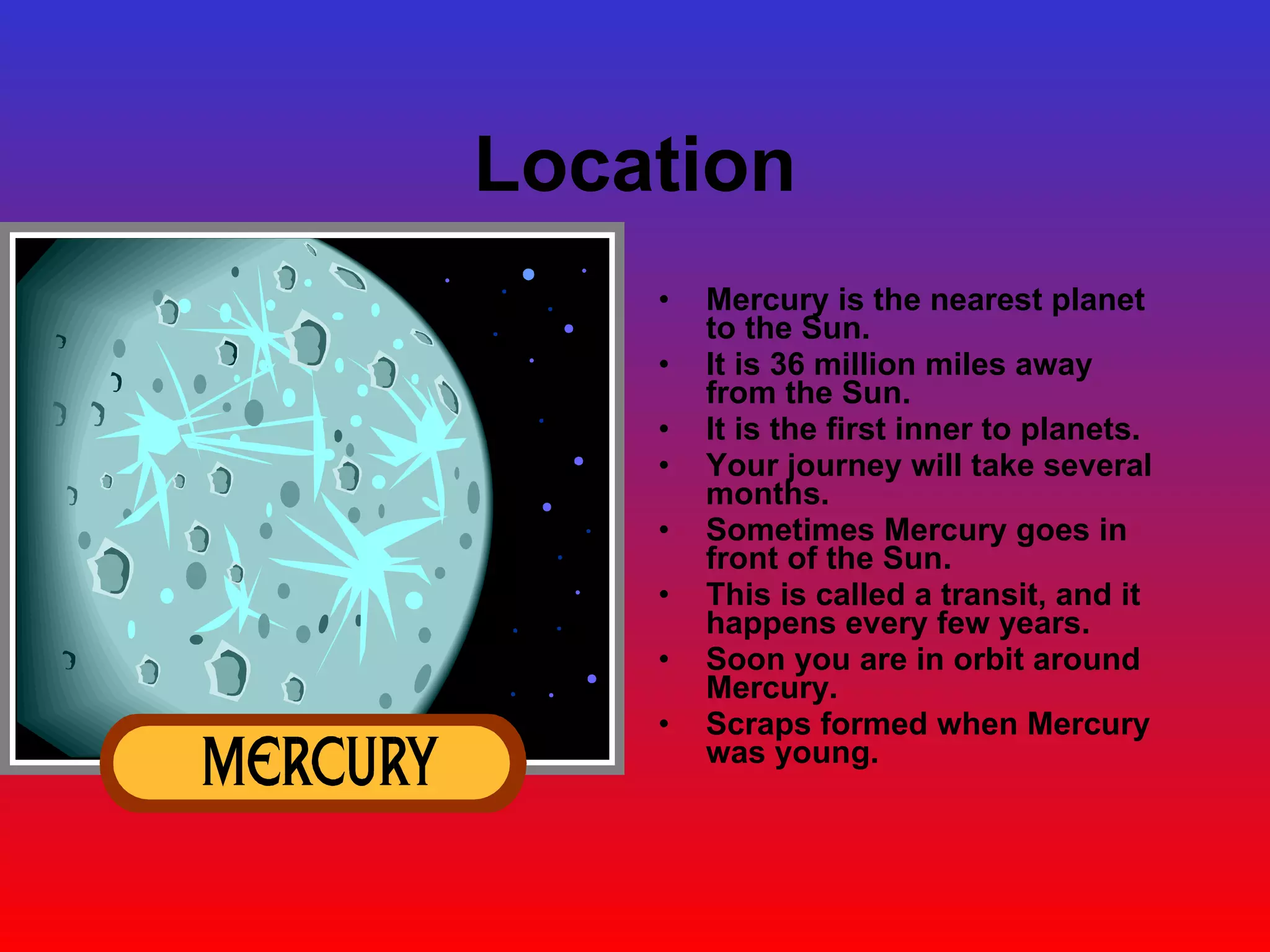
Location Mercury is the nearest planet to the Sun. It is 36 million miles away from the Sun. It is the first inner to planets. Your journey will take several months. Sometimes Mercury goes in front of the Sun. This is called a transit, and it happens every few years. Soon you are in orbit around Mercury.  Scraps formed when Mercury was young.
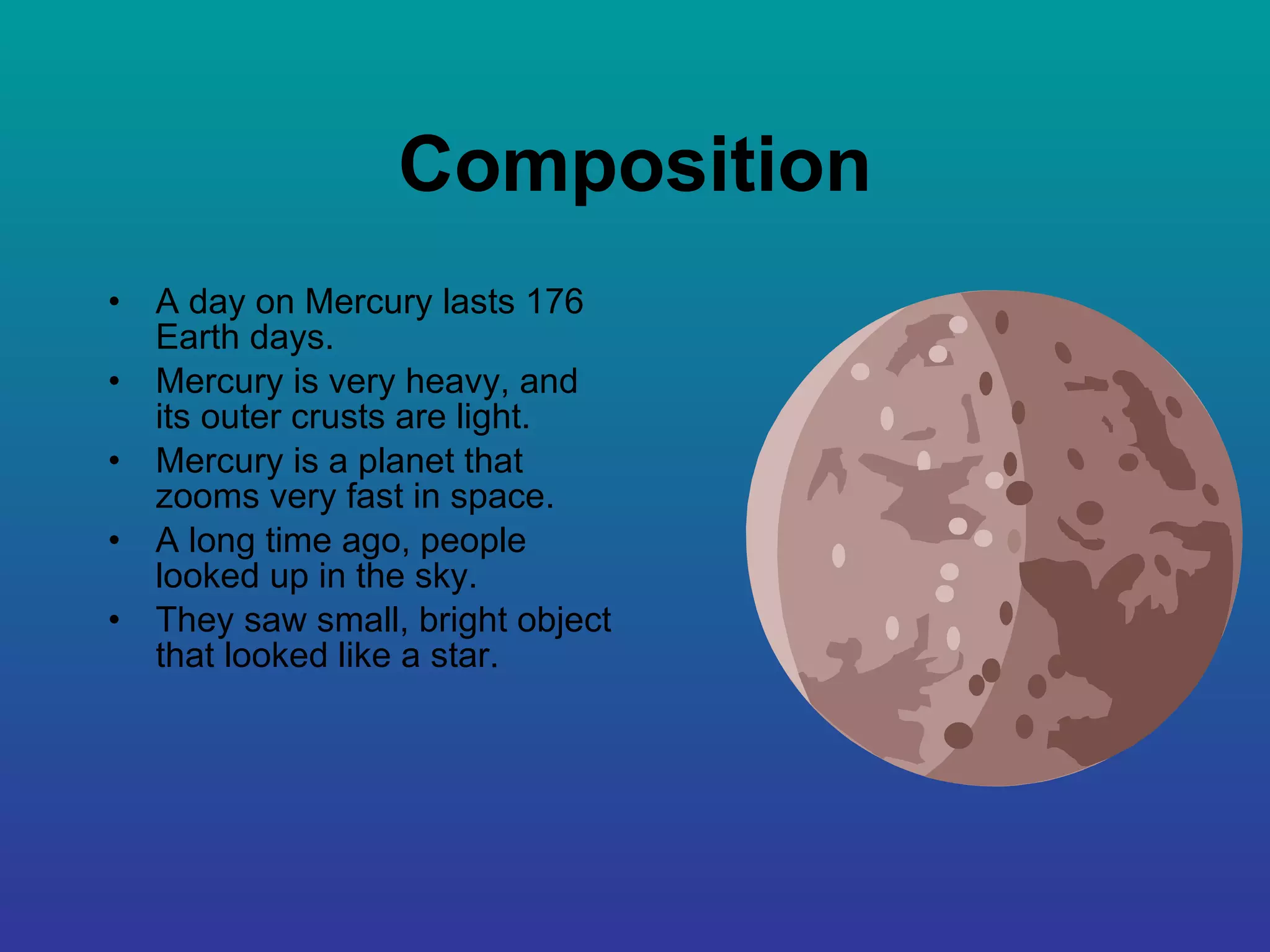
Composition A day on Mercury lasts 176 Earth days. Mercury is very heavy, and its outer crusts are light. Mercury is a planet that zooms very fast in space. A long time ago, people looked up in the sky. They saw small, bright object that looked like a star.
Unique Facts Mercury spins like a top in the sky.  It never stops spinning.  Nothing can move Mercury from its spot. Mercury has no moons.  Only half of Mercury faces the Sun at a time. Mercury is the first planet. Mercury has bugs on it.  There are ants, bees, butterflies, and spiders.
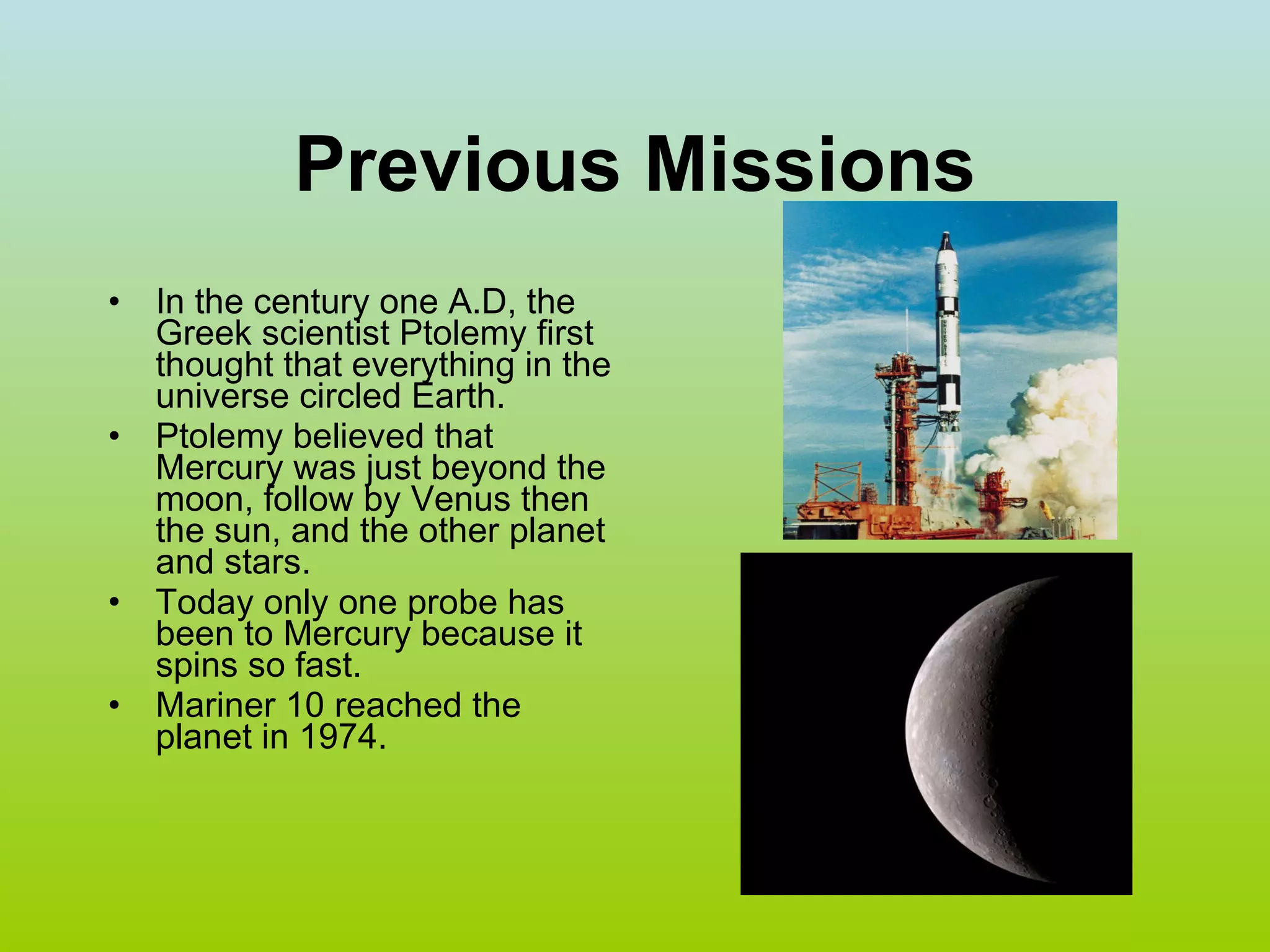
Previous Missions In the century one A.D, the Greek scientist Ptolemy first thought that everything in the universe circled Earth. Ptolemy believed that Mercury was just beyond the moon, follow by Venus then the sun, and the other planet and stars. Today only one probe has been to Mercury because it spins so fast.  Mariner 10 reached the planet in 1974.
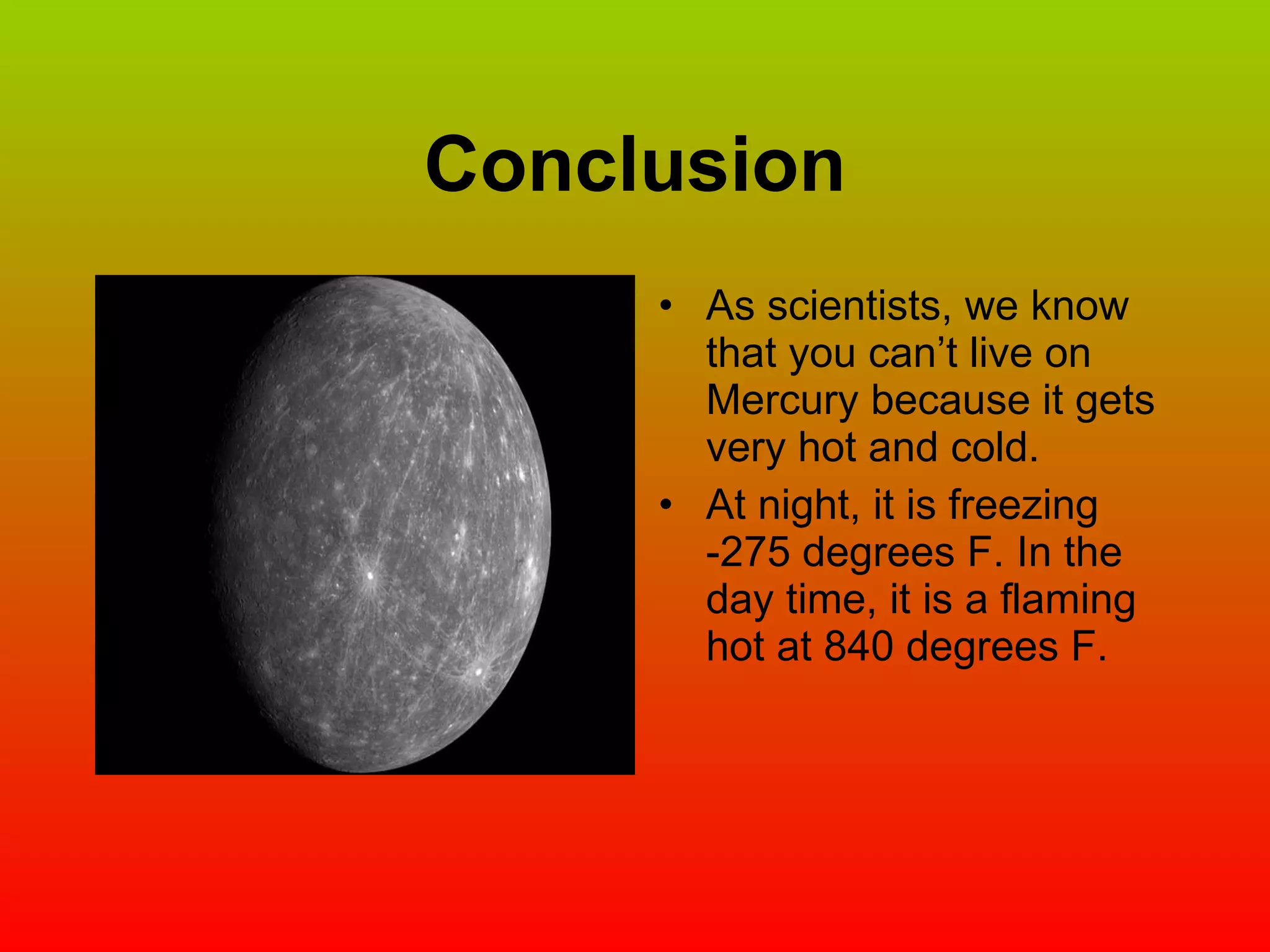
Conclusion As scientists, we know that you can’t live on Mercury because it gets very hot and cold. At night, it is freezing -275 degrees F. In the day time, it is a flaming hot at 840 degrees F.
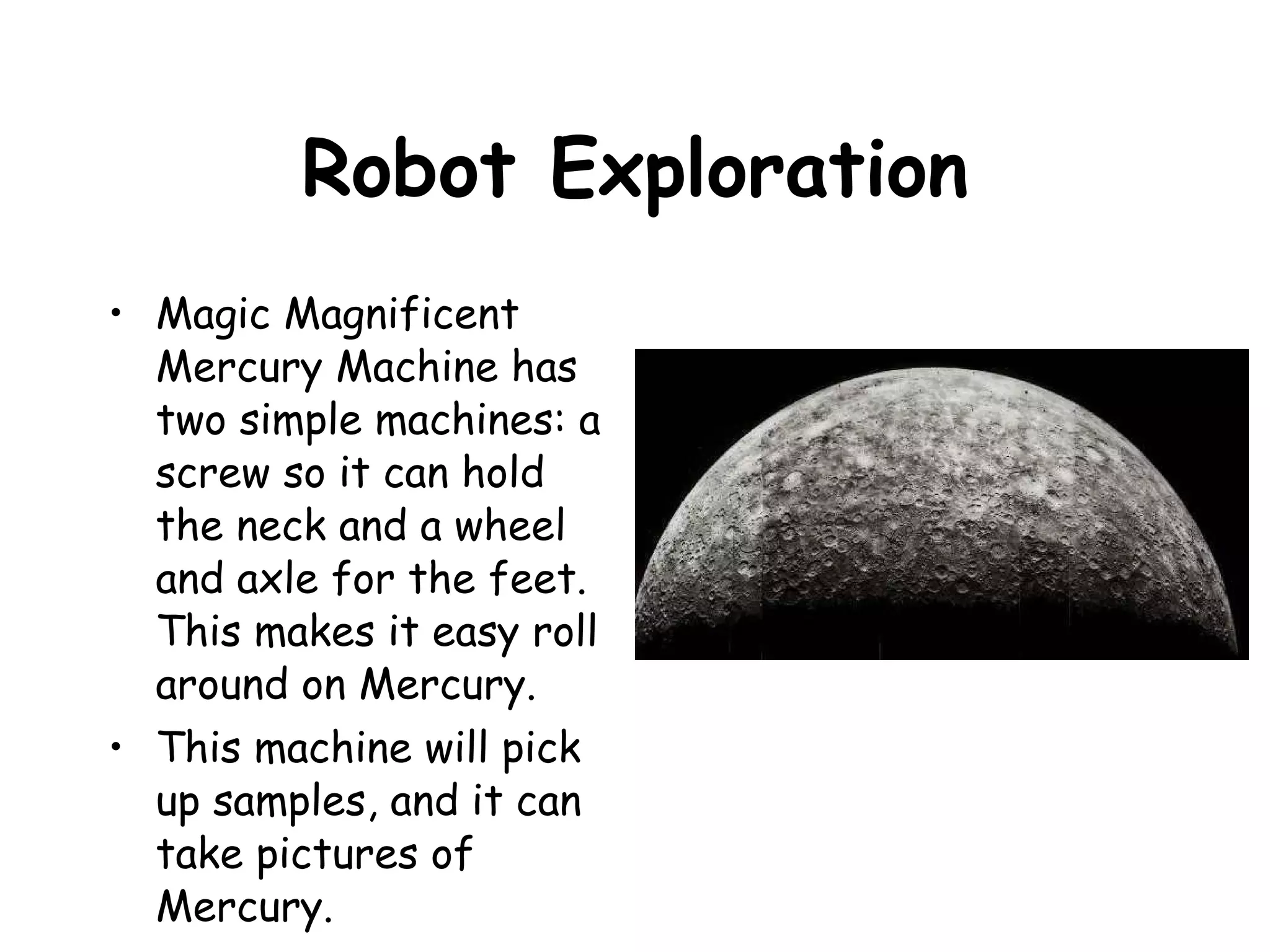
Robot Exploration Magic Magnificent Mercury Machine has two simple machines: a screw so it can hold the neck and a wheel and axle for the feet.  This makes it easy roll around on Mercury. This machine will pick up samples, and it can take pictures of Mercury.
Mrs. Stone’s class  MONIA, JOHNTRELL, DAIJA
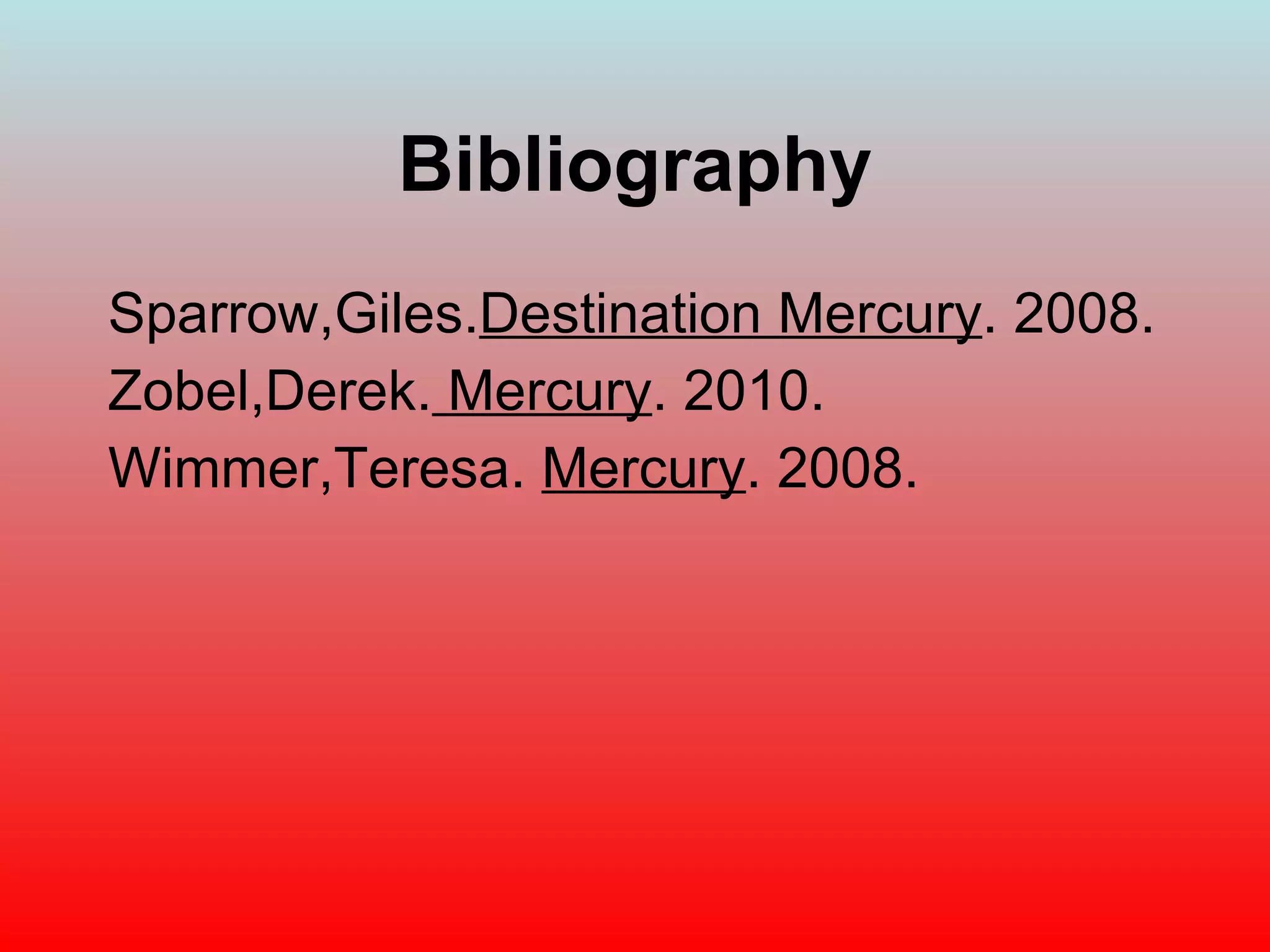
Bibliography Sparrow,Giles. Destination Mercury . 2008. Zobel,Derek.  Mercury . 2010. Wimmer,Teresa.  Mercury . 2008.

Mission mercury

  • 1.
    Researched by Monia,Daija, and Johntrell Team Earth Presents Mission Mercury
  • 2.
    Location Mercury isthe nearest planet to the Sun. It is 36 million miles away from the Sun. It is the first inner to planets. Your journey will take several months. Sometimes Mercury goes in front of the Sun. This is called a transit, and it happens every few years. Soon you are in orbit around Mercury. Scraps formed when Mercury was young.
  • 3.
    Composition A dayon Mercury lasts 176 Earth days. Mercury is very heavy, and its outer crusts are light. Mercury is a planet that zooms very fast in space. A long time ago, people looked up in the sky. They saw small, bright object that looked like a star.
  • 4.
    Unique Facts Mercuryspins like a top in the sky. It never stops spinning. Nothing can move Mercury from its spot. Mercury has no moons. Only half of Mercury faces the Sun at a time. Mercury is the first planet. Mercury has bugs on it. There are ants, bees, butterflies, and spiders.
  • 5.
    Previous Missions Inthe century one A.D, the Greek scientist Ptolemy first thought that everything in the universe circled Earth. Ptolemy believed that Mercury was just beyond the moon, follow by Venus then the sun, and the other planet and stars. Today only one probe has been to Mercury because it spins so fast. Mariner 10 reached the planet in 1974.
  • 6.
    Conclusion As scientists,we know that you can’t live on Mercury because it gets very hot and cold. At night, it is freezing -275 degrees F. In the day time, it is a flaming hot at 840 degrees F.
  • 7.
    Robot Exploration MagicMagnificent Mercury Machine has two simple machines: a screw so it can hold the neck and a wheel and axle for the feet. This makes it easy roll around on Mercury. This machine will pick up samples, and it can take pictures of Mercury.
  • 8.
    Mrs. Stone’s class MONIA, JOHNTRELL, DAIJA
  • 9.
    Bibliography Sparrow,Giles. DestinationMercury . 2008. Zobel,Derek. Mercury . 2010. Wimmer,Teresa. Mercury . 2008.