Jin Wai Goh, Yoona Choung, Aloysius Davin Oetomo
School of Chemical & Biomolecular Engineering, Georgia Institute of Technology
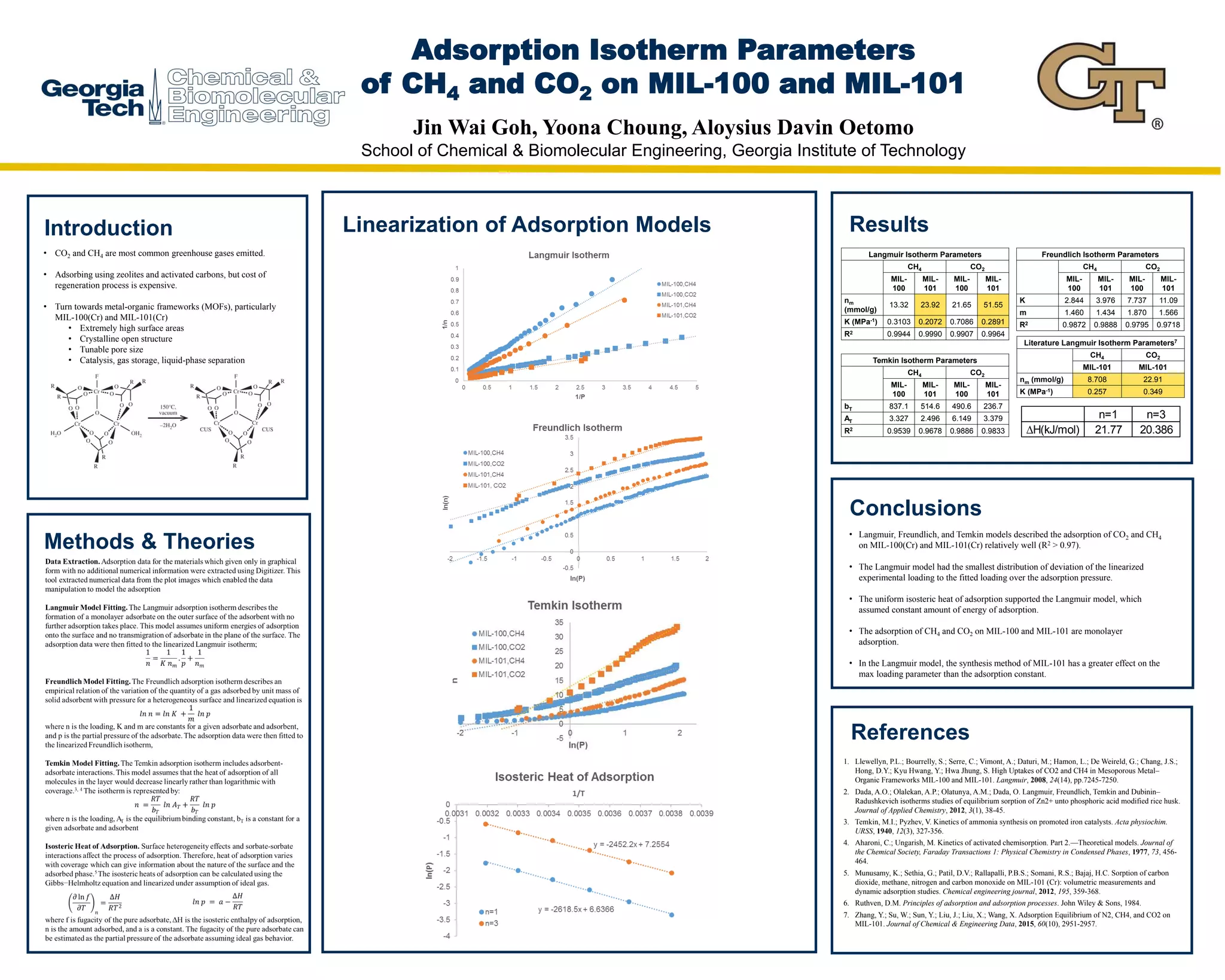
Linearization of Adsorption Models
Methods & Theories
Introduction
• CO2 and CH4 are most common greenhouse gases emitted.
• Adsorbing using zeolites and activated carbons, but cost of
regeneration process is expensive.
• Turn towards metal-organic frameworks (MOFs), particularly
MIL-100(Cr) and MIL-101(Cr)
• Extremely high surface areas
• Crystalline open structure
• Tunable pore size
• Catalysis, gas storage, liquid-phase separation
References
1. Llewellyn, P.L.; Bourrelly, S.; Serre, C.; Vimont, A.; Daturi, M.; Hamon, L.; De Weireld, G.; Chang, J.S.;
Hong, D.Y.; Kyu Hwang, Y.; Hwa Jhung, S. High Uptakes of CO2 and CH4 in Mesoporous Metal–
Organic Frameworks MIL-100 and MIL-101. Langmuir, 2008, 24(14), pp.7245-7250.
2. Dada, A.O.; Olalekan, A.P.; Olatunya, A.M.; Dada, O. Langmuir, Freundlich, Temkin and Dubinin–
Radushkevich isotherms studies of equilibrium sorption of Zn2+ unto phosphoric acid modified rice husk.
Journal of Applied Chemistry, 2012, 3(1), 38-45.
3. Temkin, M.I.; Pyzhev, V. Kinetics of ammonia synthesis on promoted iron catalysts. Acta physiochim.
URSS, 1940, 12(3), 327-356.
4. Aharoni, C.; Ungarish, M. Kinetics of activated chemisorption. Part 2.—Theoretical models. Journal of
the Chemical Society, Faraday Transactions 1: Physical Chemistry in Condensed Phases, 1977, 73, 456-
464.
5. Munusamy, K.; Sethia, G.; Patil, D.V.; Rallapalli, P.B.S.; Somani, R.S.; Bajaj, H.C. Sorption of carbon
dioxide, methane, nitrogen and carbon monoxide on MIL-101 (Cr): volumetric measurements and
dynamic adsorption studies. Chemical engineering journal, 2012, 195, 359-368.
6. Ruthven, D.M. Principles of adsorption and adsorption processes. John Wiley & Sons, 1984.
7. Zhang, Y.; Su, W.; Sun, Y.; Liu, J.; Liu, X.; Wang, X. Adsorption Equilibrium of N2, CH4, and CO2 on
MIL-101. Journal of Chemical & Engineering Data, 2015, 60(10), 2951-2957.
Results
Conclusions
Adsorption Isotherm Parameters
of CH4 and CO2 on MIL-100 and MIL-101
n=1 n=3
∆H(kJ/mol) 21.77 20.386
• Langmuir, Freundlich, and Temkin models described the adsorption of CO2 and CH4
on MIL-100(Cr) and MIL-101(Cr) relatively well (R2 > 0.97).
• The Langmuir model had the smallest distribution of deviation of the linearized
experimental loading to the fitted loading over the adsorption pressure.
• The uniform isosteric heat of adsorption supported the Langmuir model, which
assumed constant amount of energy of adsorption.
• The adsorption of CH4 and CO2 on MIL-100 and MIL-101 are monolayer
adsorption.
• In the Langmuir model, the synthesis method of MIL-101 has a greater effect on the
max loading parameter than the adsorption constant.
Langmuir Isotherm Parameters
CH4 CO2
MIL-
100
MIL-
101
MIL-
100
MIL-
101
nm
(mmol/g)
13.32 23.92 21.65 51.55
K (MPa-1) 0.3103 0.2072 0.7086 0.2891
R2 0.9944 0.9990 0.9907 0.9964
Freundlich Isotherm Parameters
CH4 CO2
MIL-
100
MIL-
101
MIL-
100
MIL-
101
K 2.844 3.976 7.737 11.09
m 1.460 1.434 1.870 1.566
R2 0.9872 0.9888 0.9795 0.9718
Temkin Isotherm Parameters
CH4 CO2
MIL-
100
MIL-
101
MIL-
100
MIL-
101
bT 837.1 514.6 490.6 236.7
AT 3.327 2.496 6.149 3.379
R2 0.9539 0.9678 0.9886 0.9833
Literature Langmuir Isotherm Parameters7
CH4 CO2
MIL-101 MIL-101
nm (mmol/g) 8.708 22.91
K (MPa-1) 0.257 0.349

Adsorption Isotherm Parameters of CH4 and CO2 on MIL-100 and MIL-101

  • 1.
    Jin Wai Goh,Yoona Choung, Aloysius Davin Oetomo School of Chemical & Biomolecular Engineering, Georgia Institute of Technology Linearization of Adsorption Models Methods & Theories Introduction • CO2 and CH4 are most common greenhouse gases emitted. • Adsorbing using zeolites and activated carbons, but cost of regeneration process is expensive. • Turn towards metal-organic frameworks (MOFs), particularly MIL-100(Cr) and MIL-101(Cr) • Extremely high surface areas • Crystalline open structure • Tunable pore size • Catalysis, gas storage, liquid-phase separation References 1. Llewellyn, P.L.; Bourrelly, S.; Serre, C.; Vimont, A.; Daturi, M.; Hamon, L.; De Weireld, G.; Chang, J.S.; Hong, D.Y.; Kyu Hwang, Y.; Hwa Jhung, S. High Uptakes of CO2 and CH4 in Mesoporous Metal– Organic Frameworks MIL-100 and MIL-101. Langmuir, 2008, 24(14), pp.7245-7250. 2. Dada, A.O.; Olalekan, A.P.; Olatunya, A.M.; Dada, O. Langmuir, Freundlich, Temkin and Dubinin– Radushkevich isotherms studies of equilibrium sorption of Zn2+ unto phosphoric acid modified rice husk. Journal of Applied Chemistry, 2012, 3(1), 38-45. 3. Temkin, M.I.; Pyzhev, V. Kinetics of ammonia synthesis on promoted iron catalysts. Acta physiochim. URSS, 1940, 12(3), 327-356. 4. Aharoni, C.; Ungarish, M. Kinetics of activated chemisorption. Part 2.—Theoretical models. Journal of the Chemical Society, Faraday Transactions 1: Physical Chemistry in Condensed Phases, 1977, 73, 456- 464. 5. Munusamy, K.; Sethia, G.; Patil, D.V.; Rallapalli, P.B.S.; Somani, R.S.; Bajaj, H.C. Sorption of carbon dioxide, methane, nitrogen and carbon monoxide on MIL-101 (Cr): volumetric measurements and dynamic adsorption studies. Chemical engineering journal, 2012, 195, 359-368. 6. Ruthven, D.M. Principles of adsorption and adsorption processes. John Wiley & Sons, 1984. 7. Zhang, Y.; Su, W.; Sun, Y.; Liu, J.; Liu, X.; Wang, X. Adsorption Equilibrium of N2, CH4, and CO2 on MIL-101. Journal of Chemical & Engineering Data, 2015, 60(10), 2951-2957. Results Conclusions Adsorption Isotherm Parameters of CH4 and CO2 on MIL-100 and MIL-101 n=1 n=3 ∆H(kJ/mol) 21.77 20.386 • Langmuir, Freundlich, and Temkin models described the adsorption of CO2 and CH4 on MIL-100(Cr) and MIL-101(Cr) relatively well (R2 > 0.97). • The Langmuir model had the smallest distribution of deviation of the linearized experimental loading to the fitted loading over the adsorption pressure. • The uniform isosteric heat of adsorption supported the Langmuir model, which assumed constant amount of energy of adsorption. • The adsorption of CH4 and CO2 on MIL-100 and MIL-101 are monolayer adsorption. • In the Langmuir model, the synthesis method of MIL-101 has a greater effect on the max loading parameter than the adsorption constant. Langmuir Isotherm Parameters CH4 CO2 MIL- 100 MIL- 101 MIL- 100 MIL- 101 nm (mmol/g) 13.32 23.92 21.65 51.55 K (MPa-1) 0.3103 0.2072 0.7086 0.2891 R2 0.9944 0.9990 0.9907 0.9964 Freundlich Isotherm Parameters CH4 CO2 MIL- 100 MIL- 101 MIL- 100 MIL- 101 K 2.844 3.976 7.737 11.09 m 1.460 1.434 1.870 1.566 R2 0.9872 0.9888 0.9795 0.9718 Temkin Isotherm Parameters CH4 CO2 MIL- 100 MIL- 101 MIL- 100 MIL- 101 bT 837.1 514.6 490.6 236.7 AT 3.327 2.496 6.149 3.379 R2 0.9539 0.9678 0.9886 0.9833 Literature Langmuir Isotherm Parameters7 CH4 CO2 MIL-101 MIL-101 nm (mmol/g) 8.708 22.91 K (MPa-1) 0.257 0.349