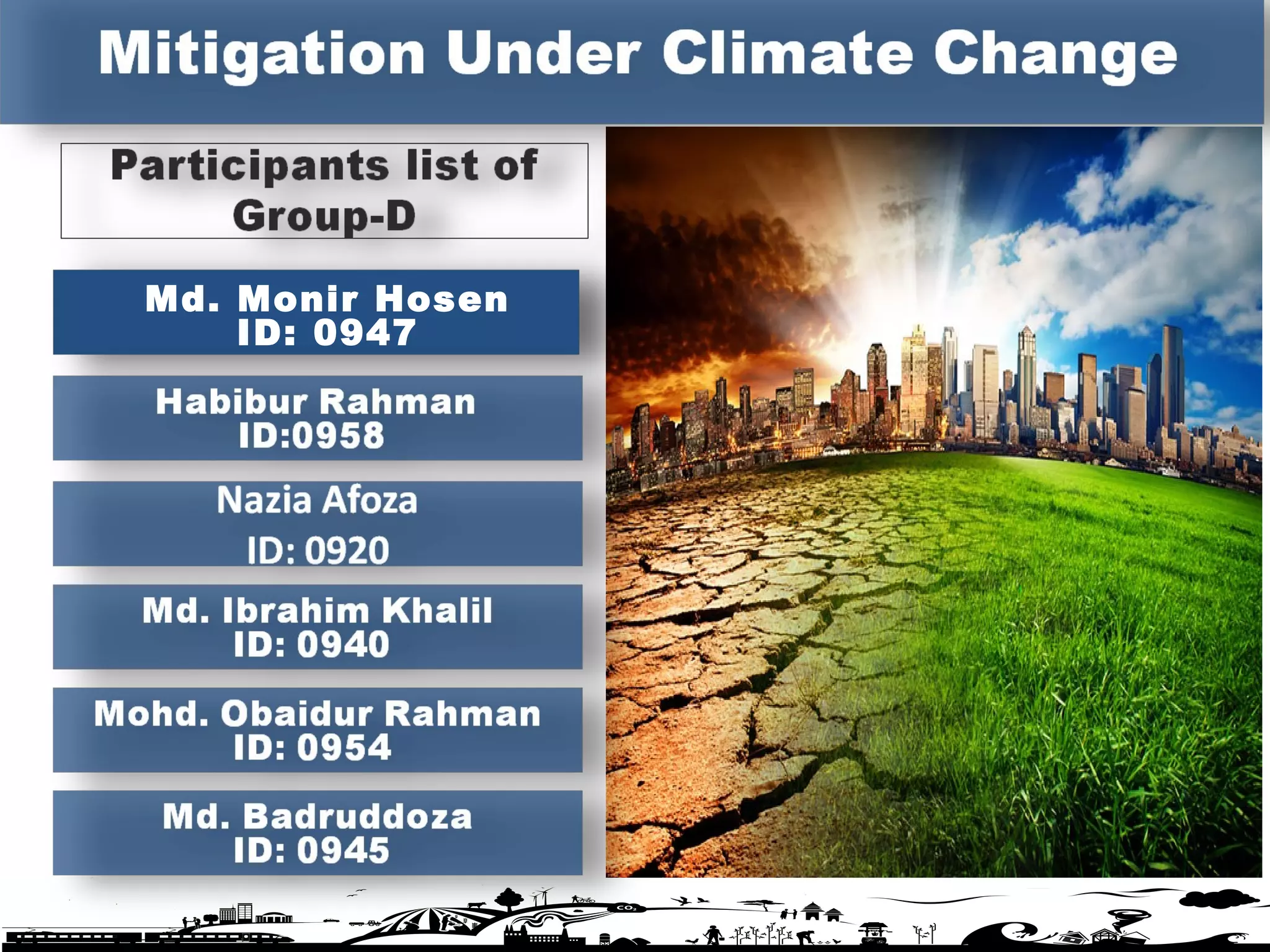
Md. Monir Hosen
ID: 0947
How much climate change?
In 2013, the daily level of carbon dioxide in the
atmosphere surpassed 400 parts per million for
the first time in human history. Climate change is
determined by how our emissions continue and
also exactly how our climate system responds to
those emissions.
What is Climate Change?
Climate change is one of the most complex issues
facing us today. It involves many dimensions –
science, economics, society, politics and moral and
ethical questions – and is a global problem, felt on
local scales, that will be around for decades and
centuries to come.
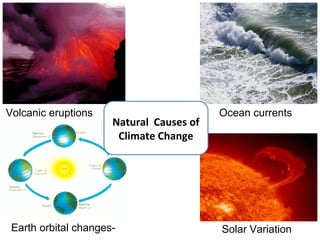
Volcanic eruptions Ocean currents
Earth orbital changes- Solar Variation
Natural Causes of
Climate Change
Man-made or Anthropogenic causes
Greenhousegases
Carbon dioxide CO2: Human activities have contributed substantially
to climate change by adding CO2. When fossil fuels - coal, oil and
natural gas - are burnt they release CO2 into the atmosphere. These
greenhouse gas emissions have increased the greenhouse effect and
caused Earth’s surface temperature to rise.
Methane CH4: The most significant sources of Methane come from the
decomposition of organic matter e.g. in landfills and in agriculture.
Another large source is from the digestion of ruminants (cows, goats
etc). Methane is a stronger GHG than CO2 because it can absorb more
heat, however it is much less abundant in the atmosphere.
Nitrous oxide N2O: A very powerful greenhouse gas which is
heavily produced in the agriculture sector, specifically in the production
and use of organic fertilizers. It is also produced when burning fossil
fuels.
Chlorofluorocarbons (CFCs). These man-made compounds were
produced for industrial use, mainly in refrigerants and air conditioners.
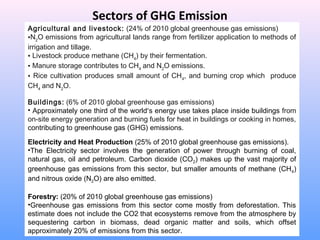
Sectors of GHG Emission
Agricultural and livestock: (24% of 2010 global greenhouse gas emissions)
•N2
O emissions from agricultural lands range from fertilizer application to methods of
irrigation and tillage.
• Livestock produce methane (CH4
) by their fermentation.
• Manure storage contributes to CH4
 and N2
O emissions.
• Rice cultivation produces small amount of CH4
, and burning crop which produce
CH4
 and N2
O.
Buildings: (6% of 2010 global greenhouse gas emissions)
• Approximately one third of the world’s energy use takes place inside buildings from
on-site energy generation and burning fuels for heat in buildings or cooking in homes,
contributing to greenhouse gas (GHG) emissions.
Electricity and Heat Production (25% of 2010 global greenhouse gas emissions).
•The Electricity sector involves the generation of power through burning of coal,
natural gas, oil and petroleum. Carbon dioxide (CO2) makes up the vast majority of
greenhouse gas emissions from this sector, but smaller amounts of methane (CH4)
and nitrous oxide (N2O) are also emitted.
Forestry: (20% of 2010 global greenhouse gas emissions)
•Greenhouse gas emissions from this sector come mostly from deforestation. This
estimate does not include the CO2 that ecosystems remove from the atmosphere by
sequestering carbon in biomass, dead organic matter and soils, which offset
approximately 20% of emissions from this sector.
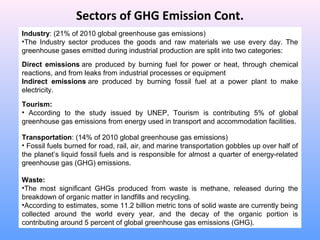
Sectors of GHG Emission Cont.
Industry: (21% of 2010 global greenhouse gas emissions)
•The Industry sector produces the goods and raw materials we use every day. The
greenhouse gases emitted during industrial production are split into two categories:  
Direct  emissions are produced by burning fuel for power or heat, through chemical
reactions, and from leaks from industrial processes or equipment
Indirect  emissions are produced by burning fossil fuel at a power plant to make
electricity.
Tourism:
• According to the study issued by UNEP, Tourism is contributing 5% of global
greenhouse gas emissions from energy used in transport and accommodation facilities.
Transportation: (14% of 2010 global greenhouse gas emissions)
• Fossil fuels burned for road, rail, air, and marine transportation gobbles up over half of
the planet’s liquid fossil fuels and is responsible for almost a quarter of energy-related
greenhouse gas (GHG) emissions.
Waste: 
•The most significant GHGs produced from waste is methane, released during the
breakdown of organic matter in landfills and recycling.
•According to estimates, some 11.2 billion metric tons of solid waste are currently being
collected around the world every year, and the decay of the organic portion is
contributing around 5 percent of global greenhouse gas emissions (GHG).
7
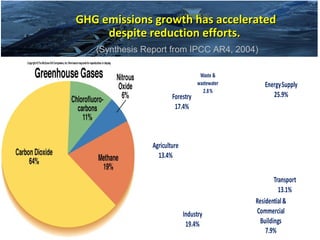
EnergySupply
25.9%
Transport
13.1%
Residential&
Commercial
Buildings
7.9%
Industry
19.4%
Agriculture
13.4%
Forestry
17.4%
Waste &
wastewater
2.8%
GHG emissions growth has acceleratedGHG emissions growth has accelerated
despite reduction efforts.despite reduction efforts.
(Synthesis Report from IPCC AR4, 2004)
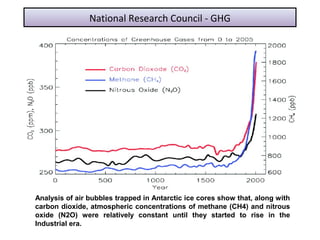
National Research Council - GHG
Analysis of air bubbles trapped in Antarctic ice cores show that, along with 
carbon dioxide, atmospheric concentrations of methane (CH4) and nitrous 
oxide  (N2O)  were  relatively  constant  until  they  started  to  rise  in  the 
Industrial era. 
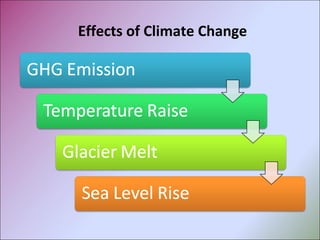
Effects of Climate Change
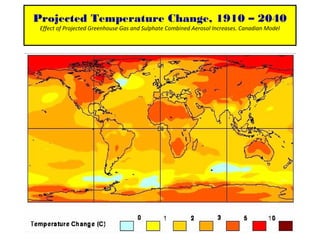
Projected Temperature Change, 1910 – 2040
Effect of Projected Greenhouse Gas and Sulphate Combined Aerosol Increases. Canadian Model
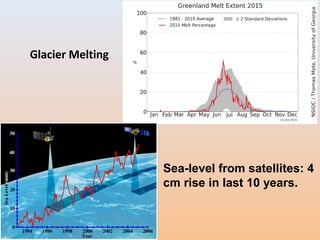
Glacier Melting
Sea-level from satellites: 4
cm rise in last 10 years.
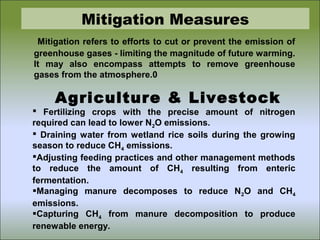
Mitigation Measures
Mitigation refers to efforts to cut or prevent the emission of
greenhouse gases - limiting the magnitude of future warming.
It may also encompass attempts to remove greenhouse
gases from the atmosphere.0
Agriculture & Livestock
 Fertilizing crops with the precise amount of nitrogen
required can lead to lower N2O emissions.
 Draining water from wetland rice soils during the growing
season to reduce CH4 emissions.
Adjusting feeding practices and other management methods
to reduce the amount of CH4 resulting from enteric
fermentation.
Managing manure decomposes to reduce N2O and CH4
emissions.
Capturing CH4 from manure decomposition to produce
renewable energy.
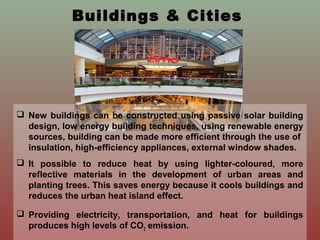
Buildings & Cities
 New buildings can be constructed using passive solar building
design, low energy building techniques, using renewable energy
sources, building can be made more efficient through the use of
insulation, high-efficiency appliances, external window shades.
 It possible to reduce heat by using lighter-coloured, more
reflective materials in the development of urban areas and
planting trees. This saves energy because it cools buildings and
reduces the urban heat island effect.
 Providing electricity, transportation, and heat for buildings
produces high levels of CO2 emission.
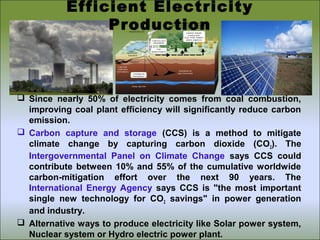
 Since nearly 50% of electricity comes from coal combustion,
improving coal plant efficiency will significantly reduce carbon
emission.
 Carbon capture and storage (CCS) is a method to mitigate
climate change by capturing carbon dioxide (CO2). The
Intergovernmental Panel on Climate Change says CCS could
contribute between 10% and 55% of the cumulative worldwide
carbon-mitigation effort over the next 90 years. The
International Energy Agency says CCS is "the most important
single new technology for CO2 savings" in power generation
and industry.
 Alternative ways to produce electricity like Solar power system,
Nuclear system or Hydro electric power plant.
Efficient Electricity
Production
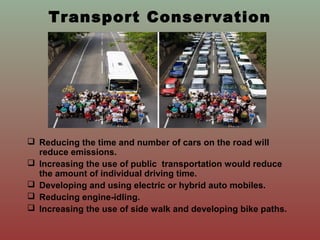
Transport Conservation
 Reducing the time and number of cars on the road will
reduce emissions.
 Increasing the use of public transportation would reduce
the amount of individual driving time.
 Developing and using electric or hybrid auto mobiles.
 Reducing engine-idling.
 Increasing the use of side walk and developing bike paths.
Reduce waste
•Recycle and buy recycled products.
•Choose products that have less packaging.
•Reuse, repair, or donate.
•Don’t buy it unless you really need it.
•Carry cloth bags when shopping.
•Use a refillable travel mug or water bottle.
•Give your time instead of material gifts, or
donate to a charity in the recipient’s name.
Thank you for your kind attention
Group-D

Mitigation under climate change.

  • 1.
  • 2.
    How much climatechange? In 2013, the daily level of carbon dioxide in the atmosphere surpassed 400 parts per million for the first time in human history. Climate change is determined by how our emissions continue and also exactly how our climate system responds to those emissions. What is Climate Change? Climate change is one of the most complex issues facing us today. It involves many dimensions – science, economics, society, politics and moral and ethical questions – and is a global problem, felt on local scales, that will be around for decades and centuries to come.
  • 3.
    Volcanic eruptions Oceancurrents Earth orbital changes- Solar Variation Natural Causes of Climate Change
  • 4.
    Man-made or Anthropogeniccauses Greenhousegases Carbon dioxide CO2: Human activities have contributed substantially to climate change by adding CO2. When fossil fuels - coal, oil and natural gas - are burnt they release CO2 into the atmosphere. These greenhouse gas emissions have increased the greenhouse effect and caused Earth’s surface temperature to rise. Methane CH4: The most significant sources of Methane come from the decomposition of organic matter e.g. in landfills and in agriculture. Another large source is from the digestion of ruminants (cows, goats etc). Methane is a stronger GHG than CO2 because it can absorb more heat, however it is much less abundant in the atmosphere. Nitrous oxide N2O: A very powerful greenhouse gas which is heavily produced in the agriculture sector, specifically in the production and use of organic fertilizers. It is also produced when burning fossil fuels. Chlorofluorocarbons (CFCs). These man-made compounds were produced for industrial use, mainly in refrigerants and air conditioners.
  • 5.
    Sectors of GHGEmission Agricultural and livestock: (24% of 2010 global greenhouse gas emissions) •N2 O emissions from agricultural lands range from fertilizer application to methods of irrigation and tillage. • Livestock produce methane (CH4 ) by their fermentation. • Manure storage contributes to CH4  and N2 O emissions. • Rice cultivation produces small amount of CH4 , and burning crop which produce CH4  and N2 O. Buildings: (6% of 2010 global greenhouse gas emissions) • Approximately one third of the world’s energy use takes place inside buildings from on-site energy generation and burning fuels for heat in buildings or cooking in homes, contributing to greenhouse gas (GHG) emissions. Electricity and Heat Production (25% of 2010 global greenhouse gas emissions). •The Electricity sector involves the generation of power through burning of coal, natural gas, oil and petroleum. Carbon dioxide (CO2) makes up the vast majority of greenhouse gas emissions from this sector, but smaller amounts of methane (CH4) and nitrous oxide (N2O) are also emitted. Forestry: (20% of 2010 global greenhouse gas emissions) •Greenhouse gas emissions from this sector come mostly from deforestation. This estimate does not include the CO2 that ecosystems remove from the atmosphere by sequestering carbon in biomass, dead organic matter and soils, which offset approximately 20% of emissions from this sector.
  • 6.
    Sectors of GHGEmission Cont. Industry: (21% of 2010 global greenhouse gas emissions) •The Industry sector produces the goods and raw materials we use every day. The greenhouse gases emitted during industrial production are split into two categories:   Direct  emissions are produced by burning fuel for power or heat, through chemical reactions, and from leaks from industrial processes or equipment Indirect  emissions are produced by burning fossil fuel at a power plant to make electricity. Tourism: • According to the study issued by UNEP, Tourism is contributing 5% of global greenhouse gas emissions from energy used in transport and accommodation facilities. Transportation: (14% of 2010 global greenhouse gas emissions) • Fossil fuels burned for road, rail, air, and marine transportation gobbles up over half of the planet’s liquid fossil fuels and is responsible for almost a quarter of energy-related greenhouse gas (GHG) emissions. Waste:  •The most significant GHGs produced from waste is methane, released during the breakdown of organic matter in landfills and recycling. •According to estimates, some 11.2 billion metric tons of solid waste are currently being collected around the world every year, and the decay of the organic portion is contributing around 5 percent of global greenhouse gas emissions (GHG).
  • 7.
    7 EnergySupply 25.9% Transport 13.1% Residential& Commercial Buildings 7.9% Industry 19.4% Agriculture 13.4% Forestry 17.4% Waste & wastewater 2.8% GHG emissionsgrowth has acceleratedGHG emissions growth has accelerated despite reduction efforts.despite reduction efforts. (Synthesis Report from IPCC AR4, 2004)
  • 8.
    National Research Council- GHG Analysis of air bubbles trapped in Antarctic ice cores show that, along with  carbon dioxide, atmospheric concentrations of methane (CH4) and nitrous  oxide  (N2O)  were  relatively  constant  until  they  started  to  rise  in  the  Industrial era. 
  • 9.
  • 10.
    Projected Temperature Change,1910 – 2040 Effect of Projected Greenhouse Gas and Sulphate Combined Aerosol Increases. Canadian Model
  • 11.
    Glacier Melting Sea-level fromsatellites: 4 cm rise in last 10 years.
  • 12.
    Mitigation Measures Mitigation refersto efforts to cut or prevent the emission of greenhouse gases - limiting the magnitude of future warming. It may also encompass attempts to remove greenhouse gases from the atmosphere.0 Agriculture & Livestock  Fertilizing crops with the precise amount of nitrogen required can lead to lower N2O emissions.  Draining water from wetland rice soils during the growing season to reduce CH4 emissions. Adjusting feeding practices and other management methods to reduce the amount of CH4 resulting from enteric fermentation. Managing manure decomposes to reduce N2O and CH4 emissions. Capturing CH4 from manure decomposition to produce renewable energy.
  • 13.
    Buildings & Cities New buildings can be constructed using passive solar building design, low energy building techniques, using renewable energy sources, building can be made more efficient through the use of insulation, high-efficiency appliances, external window shades.  It possible to reduce heat by using lighter-coloured, more reflective materials in the development of urban areas and planting trees. This saves energy because it cools buildings and reduces the urban heat island effect.  Providing electricity, transportation, and heat for buildings produces high levels of CO2 emission.
  • 14.
     Since nearly50% of electricity comes from coal combustion, improving coal plant efficiency will significantly reduce carbon emission.  Carbon capture and storage (CCS) is a method to mitigate climate change by capturing carbon dioxide (CO2). The Intergovernmental Panel on Climate Change says CCS could contribute between 10% and 55% of the cumulative worldwide carbon-mitigation effort over the next 90 years. The International Energy Agency says CCS is "the most important single new technology for CO2 savings" in power generation and industry.  Alternative ways to produce electricity like Solar power system, Nuclear system or Hydro electric power plant. Efficient Electricity Production
  • 15.
    Transport Conservation  Reducingthe time and number of cars on the road will reduce emissions.  Increasing the use of public transportation would reduce the amount of individual driving time.  Developing and using electric or hybrid auto mobiles.  Reducing engine-idling.  Increasing the use of side walk and developing bike paths.
  • 16.
    Reduce waste •Recycle andbuy recycled products. •Choose products that have less packaging. •Reuse, repair, or donate. •Don’t buy it unless you really need it. •Carry cloth bags when shopping. •Use a refillable travel mug or water bottle. •Give your time instead of material gifts, or donate to a charity in the recipient’s name.
  • 17.
    Thank you foryour kind attention Group-D