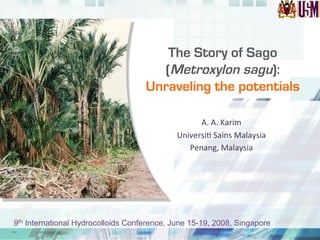
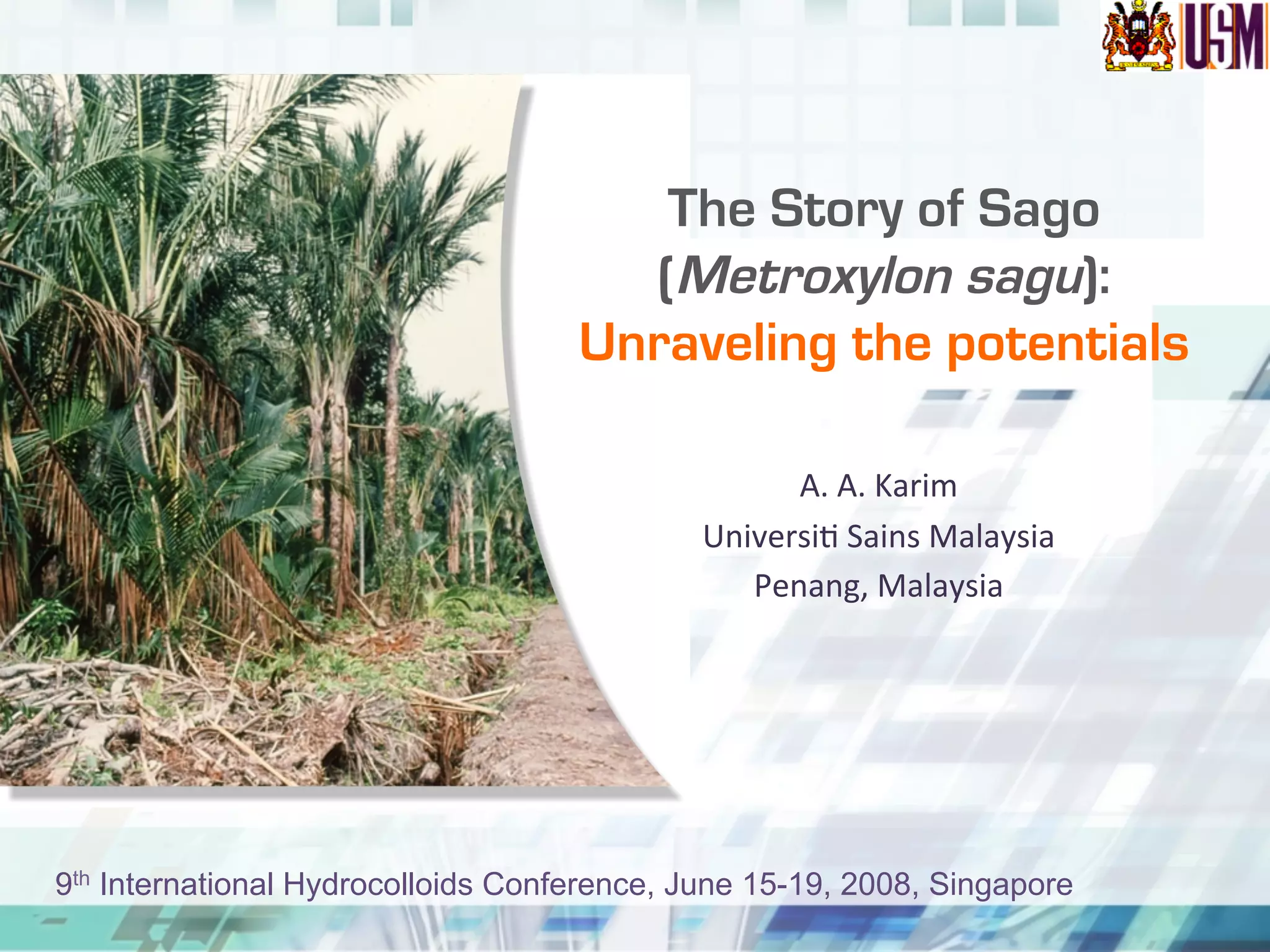
The Story of Sago
(Metroxylon sagu):
Unraveling the potentials
A.	
  A.	
  Karim	
  
Universi.	
  Sains	
  Malaysia	
  
Penang,	
  Malaysia	
  
9th International Hydrocolloids Conference, June 15-19, 2008, Singapore
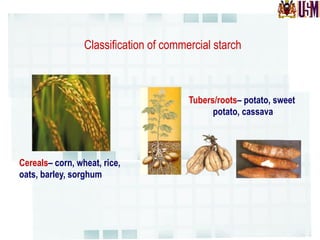
Classification of commercial starch
Tubers/roots– potato, sweet
potato, cassava
Cereals– corn, wheat, rice,
oats, barley, sorghum
Classification of commercial starch
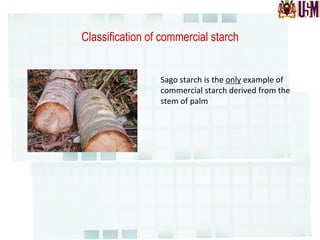
Sago	
  starch	
  is	
  the	
  only	
  example	
  of	
  
commercial	
  starch	
  derived	
  from	
  the	
  
stem	
  of	
  palm	
  
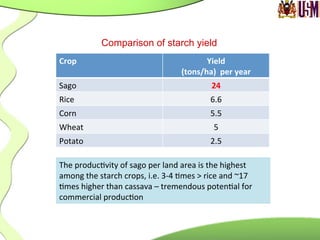
Comparison of starch yield
Crop	
   Yield	
  	
  
(tons/ha)	
  	
  per	
  year	
  
Sago	
   24	
  
Rice	
   6.6	
  
Corn	
   5.5	
  
Wheat	
   5	
  
Potato	
   2.5	
  
The	
  produc.vity	
  of	
  sago	
  per	
  land	
  area	
  is	
  the	
  highest	
  
among	
  the	
  starch	
  crops,	
  i.e.	
  3-­‐4	
  .mes	
  >	
  rice	
  and	
  ~17	
  
.mes	
  higher	
  than	
  cassava	
  –	
  tremendous	
  poten.al	
  for	
  
commercial	
  produc.on	
  
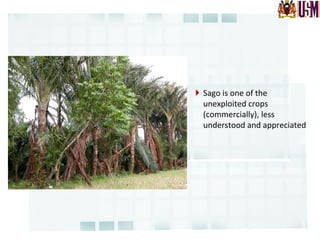
}  Sago	
  is	
  one	
  of	
  the	
  
unexploited	
  crops	
  	
  
(commercially),	
  less	
  
understood	
  and	
  appreciated	
  
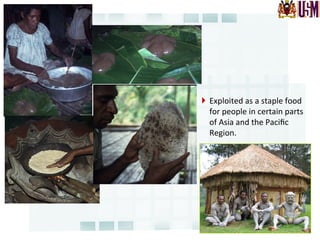
}  Exploited	
  as	
  a	
  staple	
  food	
  
for	
  people	
  in	
  certain	
  parts	
  
of	
  Asia	
  and	
  the	
  Pacific	
  
Region.
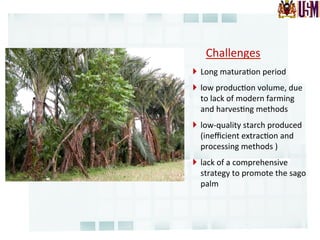
}  Long	
  matura.on	
  period	
  
}  low	
  produc.on	
  volume,	
  due	
  
to	
  lack	
  of	
  modern	
  farming	
  
and	
  harves.ng	
  methods	
  	
  
}  low-­‐quality	
  starch	
  produced	
  
(inefficient	
  extrac.on	
  and	
  
processing	
  methods	
  )	
  
}  lack	
  of	
  a	
  comprehensive	
  
strategy	
  to	
  promote	
  the	
  sago	
  
palm	
  
Challenges	
  
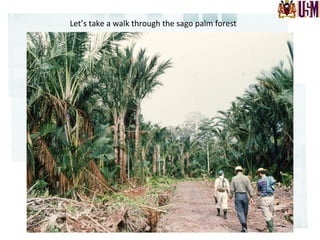
Let’s	
  take	
  a	
  walk	
  through	
  the	
  sago	
  palm	
  forest	


Sago	
  palm	
  in	
  the	
  wild	
  
Photo	
  credit:	
  M.	
  Okazaki,	
  A.B.	
  Loreto,	
  M.T.P.	
  Loreto,	
  M.A.	
  Quevedo	
  (le]);	
  Dulce	
  Flores	
  (right)	
  	
  
}  Sago	
  palm	
  is	
  found	
  growing	
  wild	
  in	
  the	
  
marshlands	
  where	
  other	
  crops	
  cannot	
  
thrive.	
  
}  Sago	
  palm	
  thrives	
  in	
  wetland,	
  swampy	
  
area,	
  and	
  other	
  areas	
  where	
  water	
  is	
  
abundant.	
  
Sago	
  palm	
  –	
  the	
  robust	
  crop	
  
Photo	
  credit:	
  M.	
  Okazaki,	
  A.B.	
  Loreto,	
  M.T.P.	
  Loreto,	
  M.A.	
  Quevedo	
  (le]);	
  Dulce	
  Flores	
  (right)	
  	
  
}  Sago	
  palm	
  is	
  tolerant	
  of	
  low	
  pH,	
  high	
  
levels	
  of	
  Al,	
  Fe,	
  and	
  Mn	
  in	
  the	
  soil,	
  soil	
  
salinity,	
  as	
  well	
  as	
  heavy	
  impervious	
  clays	
  	
  
}  Hence,	
  it	
  has	
  a	
  strong	
  advantage	
  for	
  
cul.va.on	
  in	
  underu.lized	
  wet	
  and	
  peat	
  
swamp	
  rain	
  forests	
  for	
  increasing	
  
agricultural	
  produc.on	
  
Geographical	
  distribu.on	
  of	
  sago	
  palms	
  
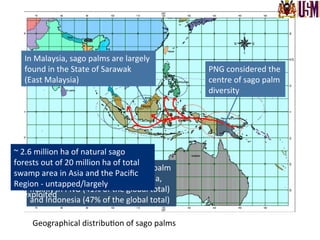
Most	
  of	
  the	
  2.6	
  million	
  ha	
  of	
  sago	
  palm	
  
in	
  the	
  world	
  is	
  found	
  in	
  tropical	
  Asia,	
  
mainly	
  in	
  PNG	
  (41%	
  of	
  the	
  global	
  total)	
  
and	
  Indonesia	
  (47%	
  of	
  the	
  global	
  total)	
  
~	
  2.6	
  million	
  ha	
  of	
  natural	
  sago	
  
forests	
  out	
  of	
  20	
  million	
  ha	
  of	
  total	
  
swamp	
  area	
  in	
  Asia	
  and	
  the	
  Pacific	
  
Region	
  -­‐	
  untapped/largely	
  
unexploited	
  
PNG	
  considered	
  the	
  
centre	
  of	
  sago	
  palm	
  
diversity	
  
In	
  Malaysia,	
  sago	
  palms	
  are	
  largely	
  	
  
found	
  in	
  the	
  State	
  of	
  Sarawak	
  	
  
(East	
  Malaysia)	
  
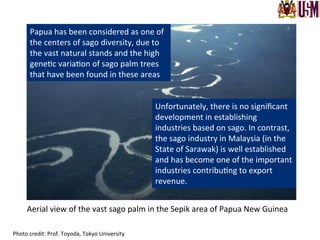
Aerial	
  view	
  of	
  the	
  vast	
  sago	
  palm	
  in	
  the	
  Sepik	
  area	
  of	
  Papua	
  New	
  Guinea	
  
Photo	
  credit:	
  Prof.	
  Toyoda,	
  Tokyo	
  University	
  
Papua	
  has	
  been	
  considered	
  as	
  one	
  of	
  
the	
  centers	
  of	
  sago	
  diversity,	
  due	
  to	
  
the	
  vast	
  natural	
  stands	
  and	
  the	
  high	
  
gene.c	
  varia.on	
  of	
  sago	
  palm	
  trees	
  
that	
  have	
  been	
  found	
  in	
  these	
  areas	
  
Unfortunately,	
  there	
  is	
  no	
  significant	
  
development	
  in	
  establishing	
  
industries	
  based	
  on	
  sago.	
  In	
  contrast,	
  
the	
  sago	
  industry	
  in	
  Malaysia	
  (in	
  the	
  
State	
  of	
  Sarawak)	
  is	
  well	
  established	
  
and	
  has	
  become	
  one	
  of	
  the	
  important	
  
industries	
  contribu.ng	
  to	
  export	
  
revenue.	
  
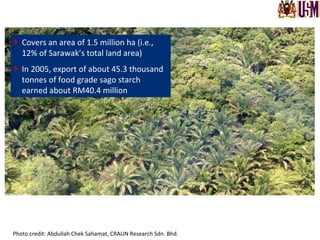
}  Covers	
  an	
  area	
  of	
  1.5	
  million	
  ha	
  (i.e.,	
  
12%	
  of	
  Sarawak’s	
  total	
  land	
  area)	
  
}  In	
  2005,	
  export	
  of	
  about	
  45.3	
  thousand	
  
tonnes	
  of	
  food	
  grade	
  sago	
  starch	
  
earned	
  about	
  RM40.4	
  million	
  
Photo	
  credit:	
  Abdullah	
  Chek	
  Sahamat,	
  CRAUN	
  Research	
  Sdn.	
  Bhd.	
  
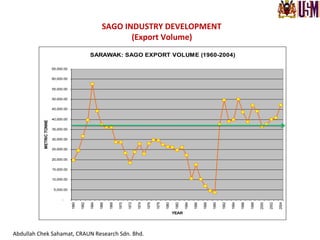
SARAWAK: SAGO EXPORT VOLUME (1960-2004)
-
5,000.00
10,000.00
15,000.00
20,000.00
25,000.00
30,000.00
35,000.00
40,000.00
45,000.00
50,000.00
55,000.00
60,000.00
65,000.00
1960
1962
1964
1966
1968
1970
1972
1974
1976
1978
1980
1982
1984
1986
1988
1990
1992
1994
1996
1998
2000
2002
2004
YEAR
METRICTONNE
SAGO	
  INDUSTRY	
  DEVELOPMENT	
  
(Export	
  Volume)	
  
Abdullah	
  Chek	
  Sahamat,	
  CRAUN	
  Research	
  Sdn.	
  Bhd.	
  
Sago	
  planta.on	
  development	
  by	
  LCDA,	
  Sarawak	
  
Photo	
  credit:	
  Abdullah	
  Chek	
  Sahamat,	
  CRAUN	
  Research	
  Sdn.	
  Bhd.	
  
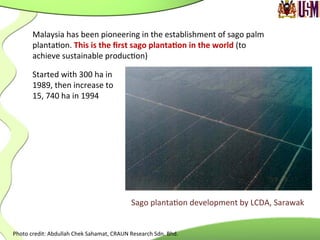
Malaysia	
  has	
  been	
  pioneering	
  in	
  the	
  establishment	
  of	
  sago	
  palm	
  
planta.on.	
  This	
  is	
  the	
  first	
  sago	
  plantaJon	
  in	
  the	
  world	
  (to	
  
achieve	
  sustainable	
  produc.on)	


Started	
  with	
  300	
  ha	
  in	
  
1989,	
  then	
  increase	
  to	
  
15,	
  740	
  ha	
  in	
  1994	
  
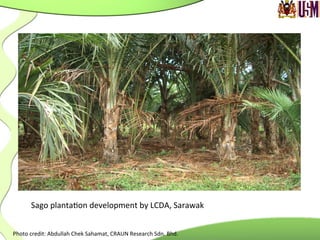
Sago	
  planta.on	
  development	
  by	
  LCDA,	
  Sarawak	
  
Photo	
  credit:	
  Abdullah	
  Chek	
  Sahamat,	
  CRAUN	
  Research	
  Sdn.	
  Bhd.	
  
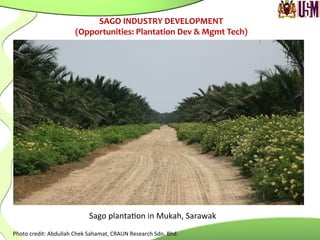
Sago	
  planta.on	
  in	
  Mukah,	
  Sarawak	
  
Photo	
  credit:	
  Abdullah	
  Chek	
  Sahamat,	
  CRAUN	
  Research	
  Sdn.	
  Bhd.	
  
SAGO	
  INDUSTRY	
  DEVELOPMENT	
  
(Opportunities:	
  Plantation	
  Dev	
  &	
  Mgmt	
  Tech)	
  
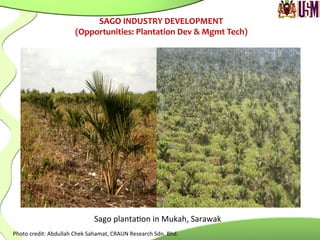
Sago	
  planta.on	
  in	
  Mukah,	
  Sarawak	
  
Photo	
  credit:	
  Abdullah	
  Chek	
  Sahamat,	
  CRAUN	
  Research	
  Sdn.	
  Bhd.	
  
SAGO	
  INDUSTRY	
  DEVELOPMENT	
  
(Opportunities:	
  Plantation	
  Dev	
  &	
  Mgmt	
  Tech)	
  
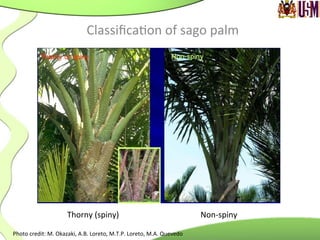
Classifica.on	
  of	
  sago	
  palm	
  
Thorny	
  (spiny)	


Non-­‐spiny	


  Photo	
  credit:	
  M.	
  Okazaki,	
  A.B.	
  Loreto,	
  M.T.P.	
  Loreto,	
  M.A.	
  Quevedo	
  	
  
The	
  Sago	
  palm	
  
Photo	
  credit:	
  M.	
  Okazaki,	
  A.B.	
  Loreto,	
  M.T.P.	
  Loreto,	
  M.A.	
  Quevedo	
  	
  
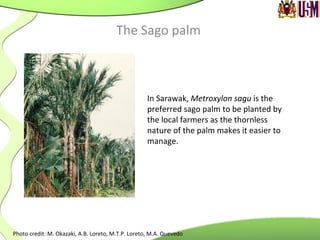
In	
  Sarawak,	
  Metroxylon	
  sagu	
  is	
  the	
  
preferred	
  sago	
  palm	
  to	
  be	
  planted	
  by	
  
the	
  local	
  farmers	
  as	
  the	
  thornless	
  
nature	
  of	
  the	
  palm	
  makes	
  it	
  easier	
  to	
  
manage.	
  
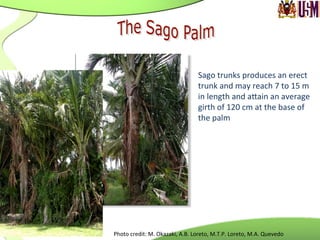
Sago	
  trunks	
  produces	
  an	
  erect	
  
trunk	
  and	
  may	
  reach	
  7	
  to	
  15	
  m	
  
in	
  length	
  and	
  akain	
  an	
  average	
  
girth	
  of	
  120	
  cm	
  at	
  the	
  base	
  of	
  
the	
  palm	


Photo	
  credit:	
  M.	
  Okazaki,	
  A.B.	
  Loreto,	
  M.T.P.	
  Loreto,	
  M.A.	
  Quevedo	
  	
  
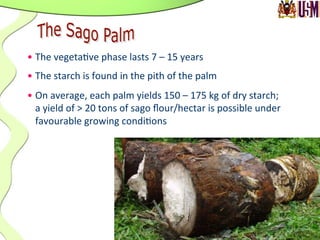
• The	
  vegeta.ve	
  phase	
  lasts	
  7	
  –	
  15	
  years	
  
• The	
  starch	
  is	
  found	
  in	
  the	
  pith	
  of	
  the	
  palm	
  
• On	
  average,	
  each	
  palm	
  yields	
  150	
  –	
  175	
  kg	
  of	
  dry	
  starch;	
  
a	
  yield	
  of	
  >	
  20	
  tons	
  of	
  sago	
  flour/hectar	
  is	
  possible	
  under	
  
favourable	
  growing	
  condi.ons	
  	
  
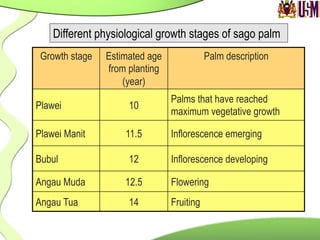
Growth stage Estimated age
from planting
(year)
Palm description
Plawei 10
Palms that have reached
maximum vegetative growth
Plawei Manit 11.5 Inflorescence emerging
Bubul 12 Inflorescence developing
Angau Muda 12.5 Flowering
Angau Tua 14 Fruiting
Different physiological growth stages of sago palm
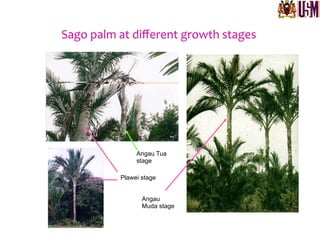
Sago	
  palm	
  at	
  different	
  growth	
  stages	
  
Angau Tua
stage
Plawei stage
Angau
Muda stage
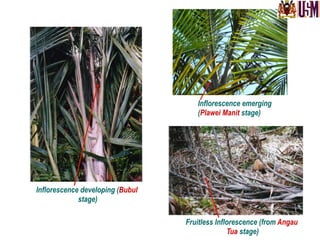
Inflorescence emerging
(Plawei Manit stage)
Fruitless Inflorescence (from Angau
Tua stage)
Inflorescence developing (Bubul
stage)
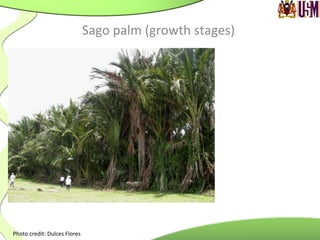
Sago	
  palm	
  (growth	
  stages)	
  
Photo	
  credit:	
  Dulces	
  Flores	
  
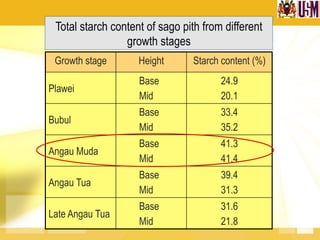
Total starch content of sago pith from different
growth stages
Growth stage Height Starch content (%)
Plawei
Base
Mid
24.9
20.1
Bubul
Base
Mid
33.4
35.2
Angau Muda
Base
Mid
41.3
41.4
Angau Tua
Base
Mid
39.4
31.3
Late Angau Tua
Base
Mid
31.6
21.8
Photo	
  credit:	
  Dulce	
  Flores	
  
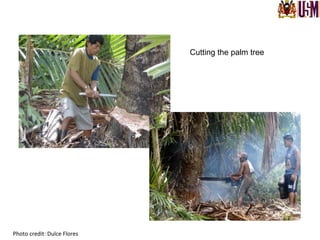
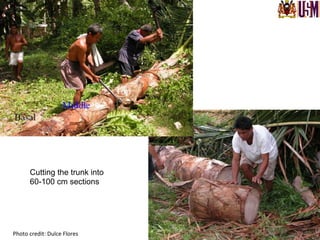
Cutting the palm tree
Photo	
  credit:	
  Dulce	
  Flores	
  
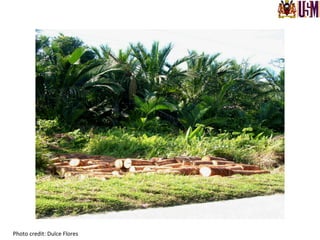
Cutting the trunk into
60-100 cm sections
Photo	
  credit:	
  Dulce	
  Flores	
  
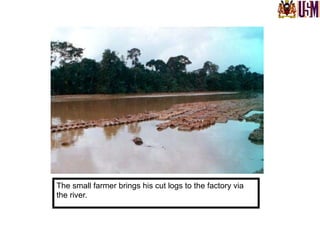
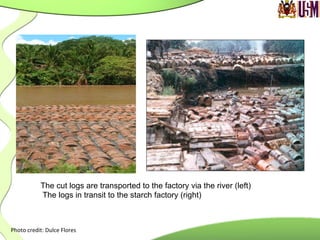
The small farmer brings his cut logs to the factory via
the river.
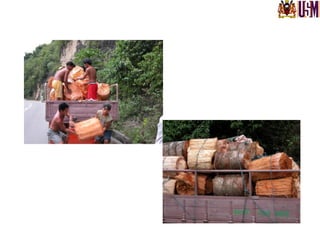
The cut logs are transported to the factory via the river (left)
The logs in transit to the starch factory (right)
Photo	
  credit:	
  Dulce	
  Flores	


Photo	
  credit:	
  Prof.	
  Toyoda,	
  Tokyo	
  University	


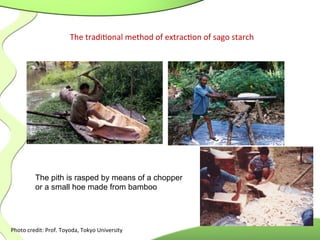
The	
  tradi.onal	
  method	
  of	
  extrac.on	
  of	
  sago	
  starch	
  
The pith is rasped by means of a chopper
or a small hoe made from bamboo
Photo	
  credit:	
  Prof.	
  Toyoda,	
  Tokyo	
  University	


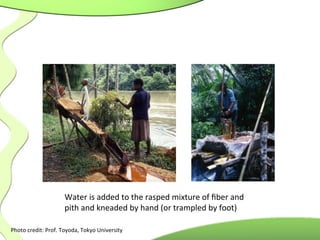
Water	
  is	
  added	
  to	
  the	
  rasped	
  mixture	
  of	
  fiber	
  and	
  
pith	
  and	
  kneaded	
  by	
  hand	
  (or	
  trampled	
  by	
  foot)	
  
Photo	
  credit:	
  Prof.	
  Toyoda,	
  Tokyo	
  University	


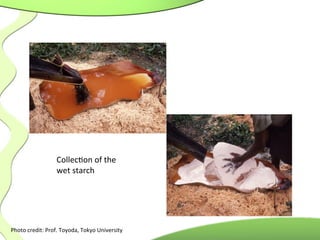
Collec.on	
  of	
  the	
  
wet	
  starch	
  
Photo	
  credit:	
  Dulce	
  Flores	


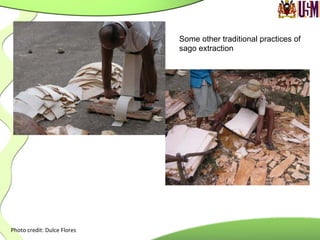
Some other traditional practices of
sago extraction
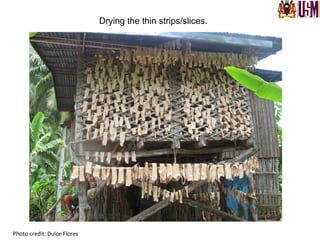
Drying the thin strips/slices.
Photo	
  credit:	
  Dulce	
  Flores	
  
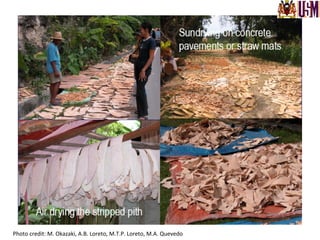
Drying	
  stripped	
  pith	
  
Photo	
  credit:	
  M.	
  Okazaki,	
  A.B.	
  Loreto,	
  M.T.P.	
  Loreto,	
  M.A.	
  Quevedo	
  	
  
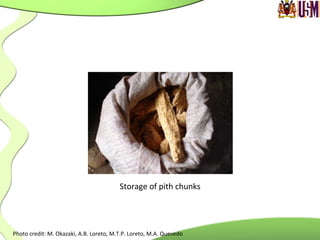
Storage	
  of	
  pith	
  chunks	
  
Photo	
  credit:	
  M.	
  Okazaki,	
  A.B.	
  Loreto,	
  M.T.P.	
  Loreto,	
  M.A.	
  Quevedo	
  	
  
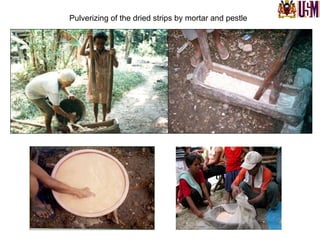
Pulverizing of the dried strips by mortar and pestle
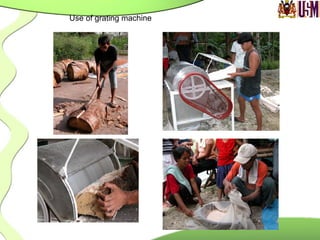
Use of grating machine
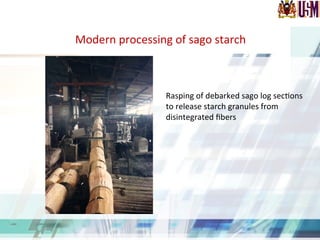
Rasping	
  of	
  debarked	
  sago	
  log	
  sec.ons	
  
to	
  release	
  starch	
  granules	
  from	
  
disintegrated	
  fibers	
  
Modern	
  processing	
  of	
  sago	
  starch	
  
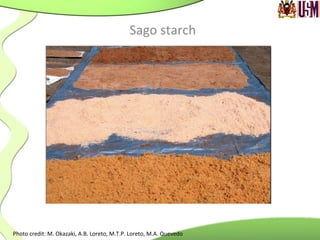
Sago	
  starch	
  
Sago	
  palm	
  thrives	
  in	
  wetland,	
  swampy	
  area,	
  and	
  other	
  areas	
  
where	
  water	
  is	
  abundant.	


Photo	
  credit:	
  M.	
  Okazaki,	
  A.B.	
  Loreto,	
  M.T.P.	
  Loreto,	
  M.A.	
  Quevedo	
  	
  
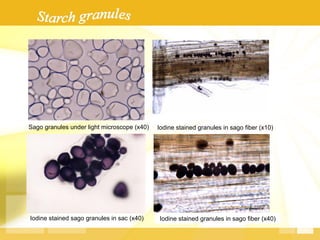
Sago granules under light microscope (x40) Iodine stained granules in sago fiber (x10)
Iodine stained sago granules in sac (x40) Iodine stained granules in sago fiber (x40)
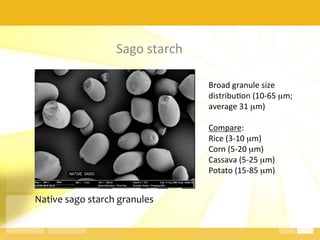
Sago	
  starch	
  
Native	
  sago	
  starch	
  granules	


Broad	
  granule	
  size	
  
distribu.on	
  (10-­‐65	
  µm;	
  
average	
  31	
  µm)	


Compare:	
  
Rice	
  (3-­‐10	
  µm)	
  
Corn	
  (5-­‐20	
  µm)	
  
Cassava	
  (5-­‐25	
  µm)	
  
Potato	
  (15-­‐85	
  µm)	
  
Comparison	
  of	
  some	
  starch	
  proper.es	
  
}  Amylose	
  content:	
  26	
  –	
  30%	
  (sago);	
  28%	
  (corn),	
  34%	
  mung	
  
bean,	
  22%	
  potato,	
  18-­‐20%	
  cassava	
  
}  X-­‐ray	
  pakern:	
  C-­‐type;	
  corn	
  (A-­‐type);	
  potato	
  (B-­‐type)	
  
}  Pas.ng:	
  Similar	
  gela.niza.on	
  proper.es	
  to	
  that	
  of	
  potato	
  
starch	
  
}  Retrograda.on:	
  resembles	
  corn	
  and	
  mungbean	
  
}  Swelling	
  power	
  &	
  solubility:	
  higher	
  than	
  corn,	
  close	
  to	
  sweet	
  
potato	
  or	
  cassava	
  but	
  lower	
  than	
  potato	
  
}  Whiteness:	
  L=79	
  (sago);	
  potato,	
  corn,	
  mungbean,	
  cassava	
  
(90-­‐93)	
  
}  Acid/enzyme	
  suscep.bility:	
  Sago	
  is	
  most	
  resistant	
  compared	
  
to	
  other	
  starches	
  
Comparison	
  of	
  some	
  starch	
  proper.es	
  
S.	
  Takahashi,	
  Sago’85	
  
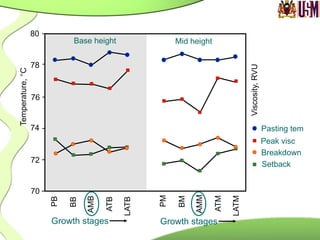
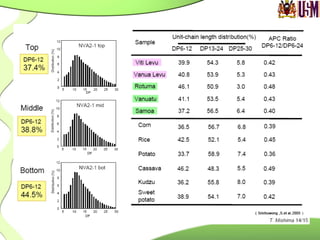
Pasting Profile of Sago Starch from Different
Growth Stages
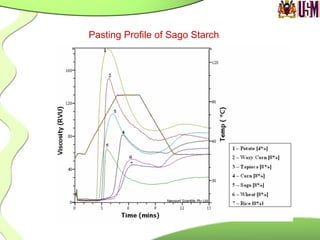
Pasting Profile of Sago Starch
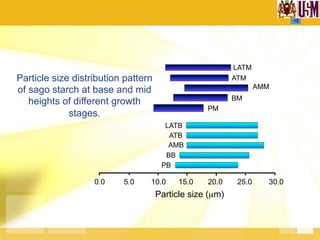
Particle size distribution pattern
of sago starch at base and mid
heights of different growth
stages.
0.0 5.0 10.0 15.0 20.0 25.0 30.0
LATM
ATM
AMM
BM
PM
LATB
ATB
AMB
BB
PB
Particle size (µm)
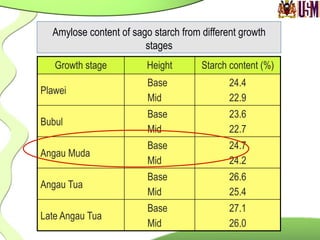
Amylose content of sago starch from different growth
stages
Growth stage Height Starch content (%)
Plawei
Base
Mid
24.4
22.9
Bubul
Base
Mid
23.6
22.7
Angau Muda
Base
Mid
24.7
24.2
Angau Tua
Base
Mid
26.6
25.4
Late Angau Tua
Base
Mid
27.1
26.0
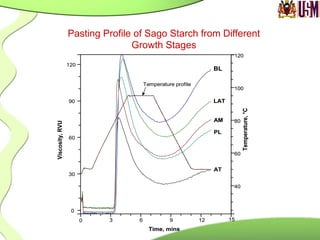
Pasting Profile of Sago Starch from Different
Growth Stages
0
30
60
90
120
40
60
80
100
120
0 3 6 9 12 15
Time, mins
Viscosity,RVU
Temperature,°C
BL
LAT
AM
PL
AT
Temperature profile
0
30
60
90
120
40
60
80
100
120
0 3 6 9 12 15
Time, mins
Viscosity,RVU
Temperature,°C
BL
LAT
AM
PL
AT
Temperature profile
Viscosity,RVU
Temperature,°C
PM
BM
AMM
ATM
LATM
PB
BB
AMB
ATB
LATB
70
72
74
76
78
80
Base height Mid height
Pasting tem
Peak visc
Breakdown
Setback
Growth stages Growth stages
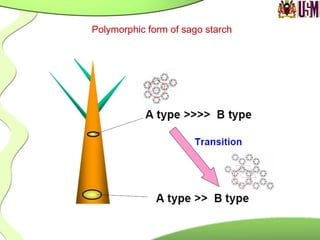
Polymorphic form of sago starch
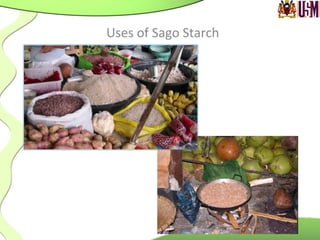
Uses	
  of	
  Sago	
  Starch	
  
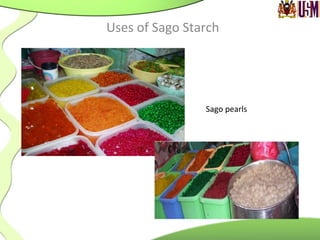
Uses	
  of	
  Sago	
  Starch	
  
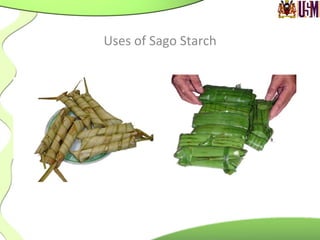
Sago	
  pearls	
  
Uses	
  of	
  Sago	
  Starch	
  
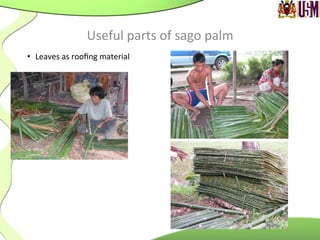
•  Leaves	
  as	
  roofing	
  material	


Useful	
  parts	
  of	
  sago	
  palm	
  
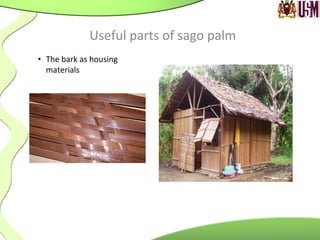
•  The	
  bark	
  as	
  housing	
  
materials	


Useful	
  parts	
  of	
  sago	
  palm	
  
Conclusion	
  
}  In	
  view	
  of	
  the	
  significantly	
  high	
  yield	
  and	
  century-­‐long	
  
economic	
  life	
  span	
  of	
  sago	
  palm,	
  sago	
  starch	
  should	
  be	
  in	
  
a	
  very	
  strong	
  posi.on	
  to	
  compete	
  with	
  starch	
  produced	
  
from	
  annual	
  crops	
  	
  
}  If	
  sufficient	
  sago	
  starch	
  of	
  suitable	
  quan.ty	
  were	
  
produced,	
  it	
  should	
  be	
  able	
  to	
  penetrate	
  and	
  compete	
  
favourably	
  in	
  the	
  current	
  world	
  starch	
  market.	
  
Acknowledgement	
  
}  CRAUN	
  Research	
  Sdn.	
  Bhd.,	
  Sarawak,	
  Malaysia	
  
}  Ministry	
  of	
  Science,	
  Technology	
  &	
  Innova.on	
  
}  Japan	
  Sago	
  Society	
  
}  Japan	
  Society	
  for	
  Promo.on	
  of	
  Science	
  (JSPS)	
  
}  Professor	
  Toyoda,	
  University	
  of	
  Tokyo,	
  Japan	
  
}  Dr	
  Dulce	
  Flores,	
  U.P.	
  Mindanao,	
  Philiphine	
  
}  Dr	
  Okazaki	
  et	
  al.,	
  Tokyo	
  University	
  of	
  Agriculture	
  &	
  
Technology,	
  Japan	
  
}  Dr	
  T.	
  Noda,	
  NARCH,	
  Hokkaido,	
  Japan	
  
}  Prof.	
  Takeda,	
  University	
  of	
  Kagoshima,	
  Japan
Thank	
  you	
  for	
  your	
  aken.on	
  

Getting to know sago (palm and starch)

  • 1.
    The Story ofSago (Metroxylon sagu): Unraveling the potentials A.  A.  Karim   Universi.  Sains  Malaysia   Penang,  Malaysia   9th International Hydrocolloids Conference, June 15-19, 2008, Singapore
  • 3.
    Classification of commercialstarch Tubers/roots– potato, sweet potato, cassava Cereals– corn, wheat, rice, oats, barley, sorghum
  • 4.
    Classification of commercialstarch Sago  starch  is  the  only  example  of   commercial  starch  derived  from  the   stem  of  palm  
  • 5.
    Comparison of starchyield Crop   Yield     (tons/ha)    per  year   Sago   24   Rice   6.6   Corn   5.5   Wheat   5   Potato   2.5   The  produc.vity  of  sago  per  land  area  is  the  highest   among  the  starch  crops,  i.e.  3-­‐4  .mes  >  rice  and  ~17   .mes  higher  than  cassava  –  tremendous  poten.al  for   commercial  produc.on  
  • 6.
    }  Sago  is  one  of  the   unexploited  crops     (commercially),  less   understood  and  appreciated  
  • 7.
    }  Exploited  as  a  staple  food   for  people  in  certain  parts   of  Asia  and  the  Pacific   Region.
  • 8.
    }  Long  matura.on  period   }  low  produc.on  volume,  due   to  lack  of  modern  farming   and  harves.ng  methods     }  low-­‐quality  starch  produced   (inefficient  extrac.on  and   processing  methods  )   }  lack  of  a  comprehensive   strategy  to  promote  the  sago   palm   Challenges  
  • 9.
    Let’s  take  a  walk  through  the  sago  palm  forest    
  • 10.
    Sago  palm  in  the  wild   Photo  credit:  M.  Okazaki,  A.B.  Loreto,  M.T.P.  Loreto,  M.A.  Quevedo  (le]);  Dulce  Flores  (right)     }  Sago  palm  is  found  growing  wild  in  the   marshlands  where  other  crops  cannot   thrive.   }  Sago  palm  thrives  in  wetland,  swampy   area,  and  other  areas  where  water  is   abundant.  
  • 11.
    Sago  palm  –  the  robust  crop   Photo  credit:  M.  Okazaki,  A.B.  Loreto,  M.T.P.  Loreto,  M.A.  Quevedo  (le]);  Dulce  Flores  (right)     }  Sago  palm  is  tolerant  of  low  pH,  high   levels  of  Al,  Fe,  and  Mn  in  the  soil,  soil   salinity,  as  well  as  heavy  impervious  clays     }  Hence,  it  has  a  strong  advantage  for   cul.va.on  in  underu.lized  wet  and  peat   swamp  rain  forests  for  increasing   agricultural  produc.on  
  • 12.
    Geographical  distribu.on  of  sago  palms   Most  of  the  2.6  million  ha  of  sago  palm   in  the  world  is  found  in  tropical  Asia,   mainly  in  PNG  (41%  of  the  global  total)   and  Indonesia  (47%  of  the  global  total)   ~  2.6  million  ha  of  natural  sago   forests  out  of  20  million  ha  of  total   swamp  area  in  Asia  and  the  Pacific   Region  -­‐  untapped/largely   unexploited   PNG  considered  the   centre  of  sago  palm   diversity   In  Malaysia,  sago  palms  are  largely     found  in  the  State  of  Sarawak     (East  Malaysia)  
  • 13.
    Aerial  view  of  the  vast  sago  palm  in  the  Sepik  area  of  Papua  New  Guinea   Photo  credit:  Prof.  Toyoda,  Tokyo  University   Papua  has  been  considered  as  one  of   the  centers  of  sago  diversity,  due  to   the  vast  natural  stands  and  the  high   gene.c  varia.on  of  sago  palm  trees   that  have  been  found  in  these  areas   Unfortunately,  there  is  no  significant   development  in  establishing   industries  based  on  sago.  In  contrast,   the  sago  industry  in  Malaysia  (in  the   State  of  Sarawak)  is  well  established   and  has  become  one  of  the  important   industries  contribu.ng  to  export   revenue.  
  • 14.
    }  Covers  an  area  of  1.5  million  ha  (i.e.,   12%  of  Sarawak’s  total  land  area)   }  In  2005,  export  of  about  45.3  thousand   tonnes  of  food  grade  sago  starch   earned  about  RM40.4  million   Photo  credit:  Abdullah  Chek  Sahamat,  CRAUN  Research  Sdn.  Bhd.  
  • 15.
    SARAWAK: SAGO EXPORTVOLUME (1960-2004) - 5,000.00 10,000.00 15,000.00 20,000.00 25,000.00 30,000.00 35,000.00 40,000.00 45,000.00 50,000.00 55,000.00 60,000.00 65,000.00 1960 1962 1964 1966 1968 1970 1972 1974 1976 1978 1980 1982 1984 1986 1988 1990 1992 1994 1996 1998 2000 2002 2004 YEAR METRICTONNE SAGO  INDUSTRY  DEVELOPMENT   (Export  Volume)   Abdullah  Chek  Sahamat,  CRAUN  Research  Sdn.  Bhd.  
  • 16.
    Sago  planta.on  development  by  LCDA,  Sarawak   Photo  credit:  Abdullah  Chek  Sahamat,  CRAUN  Research  Sdn.  Bhd.   Malaysia  has  been  pioneering  in  the  establishment  of  sago  palm   planta.on.  This  is  the  first  sago  plantaJon  in  the  world  (to   achieve  sustainable  produc.on)                                               Started  with  300  ha  in   1989,  then  increase  to   15,  740  ha  in  1994  
  • 17.
    Sago  planta.on  development  by  LCDA,  Sarawak   Photo  credit:  Abdullah  Chek  Sahamat,  CRAUN  Research  Sdn.  Bhd.  
  • 18.
    Sago  planta.on  in  Mukah,  Sarawak   Photo  credit:  Abdullah  Chek  Sahamat,  CRAUN  Research  Sdn.  Bhd.   SAGO  INDUSTRY  DEVELOPMENT   (Opportunities:  Plantation  Dev  &  Mgmt  Tech)  
  • 19.
    Sago  planta.on  in  Mukah,  Sarawak   Photo  credit:  Abdullah  Chek  Sahamat,  CRAUN  Research  Sdn.  Bhd.   SAGO  INDUSTRY  DEVELOPMENT   (Opportunities:  Plantation  Dev  &  Mgmt  Tech)  
  • 20.
    Classifica.on  of  sago  palm   Thorny  (spiny)         Non-­‐spiny        Photo  credit:  M.  Okazaki,  A.B.  Loreto,  M.T.P.  Loreto,  M.A.  Quevedo    
  • 21.
    The  Sago  palm   Photo  credit:  M.  Okazaki,  A.B.  Loreto,  M.T.P.  Loreto,  M.A.  Quevedo     In  Sarawak,  Metroxylon  sagu  is  the   preferred  sago  palm  to  be  planted  by   the  local  farmers  as  the  thornless   nature  of  the  palm  makes  it  easier  to   manage.  
  • 22.
    Sago  trunks  produces  an  erect   trunk  and  may  reach  7  to  15  m   in  length  and  akain  an  average   girth  of  120  cm  at  the  base  of   the  palm         Photo  credit:  M.  Okazaki,  A.B.  Loreto,  M.T.P.  Loreto,  M.A.  Quevedo    
  • 23.
    • The  vegeta.ve  phase  lasts  7  –  15  years   • The  starch  is  found  in  the  pith  of  the  palm   • On  average,  each  palm  yields  150  –  175  kg  of  dry  starch;   a  yield  of  >  20  tons  of  sago  flour/hectar  is  possible  under   favourable  growing  condi.ons    
  • 24.
    Growth stage Estimatedage from planting (year) Palm description Plawei 10 Palms that have reached maximum vegetative growth Plawei Manit 11.5 Inflorescence emerging Bubul 12 Inflorescence developing Angau Muda 12.5 Flowering Angau Tua 14 Fruiting Different physiological growth stages of sago palm
  • 25.
    Sago  palm  at  different  growth  stages   Angau Tua stage Plawei stage Angau Muda stage
  • 26.
    Inflorescence emerging (Plawei Manitstage) Fruitless Inflorescence (from Angau Tua stage) Inflorescence developing (Bubul stage)
  • 27.
    Sago  palm  (growth  stages)   Photo  credit:  Dulces  Flores  
  • 28.
    Total starch contentof sago pith from different growth stages Growth stage Height Starch content (%) Plawei Base Mid 24.9 20.1 Bubul Base Mid 33.4 35.2 Angau Muda Base Mid 41.3 41.4 Angau Tua Base Mid 39.4 31.3 Late Angau Tua Base Mid 31.6 21.8
  • 29.
    Photo  credit:  Dulce  Flores   Cutting the palm tree
  • 30.
    Photo  credit:  Dulce  Flores   Cutting the trunk into 60-100 cm sections
  • 31.
  • 33.
    The small farmerbrings his cut logs to the factory via the river.
  • 34.
    The cut logsare transported to the factory via the river (left) The logs in transit to the starch factory (right) Photo  credit:  Dulce  Flores    
  • 35.
    Photo  credit:  Prof.  Toyoda,  Tokyo  University     The  tradi.onal  method  of  extrac.on  of  sago  starch   The pith is rasped by means of a chopper or a small hoe made from bamboo
  • 36.
    Photo  credit:  Prof.  Toyoda,  Tokyo  University     Water  is  added  to  the  rasped  mixture  of  fiber  and   pith  and  kneaded  by  hand  (or  trampled  by  foot)  
  • 37.
    Photo  credit:  Prof.  Toyoda,  Tokyo  University     Collec.on  of  the   wet  starch  
  • 38.
    Photo  credit:  Dulce  Flores     Some other traditional practices of sago extraction
  • 39.
    Drying the thinstrips/slices. Photo  credit:  Dulce  Flores  
  • 40.
    Drying  stripped  pith   Photo  credit:  M.  Okazaki,  A.B.  Loreto,  M.T.P.  Loreto,  M.A.  Quevedo    
  • 41.
    Storage  of  pith  chunks   Photo  credit:  M.  Okazaki,  A.B.  Loreto,  M.T.P.  Loreto,  M.A.  Quevedo    
  • 42.
    Pulverizing of thedried strips by mortar and pestle
  • 43.
  • 44.
    Rasping  of  debarked  sago  log  sec.ons   to  release  starch  granules  from   disintegrated  fibers   Modern  processing  of  sago  starch  
  • 45.
    Sago  starch   Sago  palm  thrives  in  wetland,  swampy  area,  and  other  areas   where  water  is  abundant.       Photo  credit:  M.  Okazaki,  A.B.  Loreto,  M.T.P.  Loreto,  M.A.  Quevedo    
  • 46.
    Sago granules underlight microscope (x40) Iodine stained granules in sago fiber (x10) Iodine stained sago granules in sac (x40) Iodine stained granules in sago fiber (x40)
  • 47.
    Sago  starch   Native  sago  starch  granules         Broad  granule  size   distribu.on  (10-­‐65  µm;   average  31  µm)     Compare:   Rice  (3-­‐10  µm)   Corn  (5-­‐20  µm)   Cassava  (5-­‐25  µm)   Potato  (15-­‐85  µm)  
  • 48.
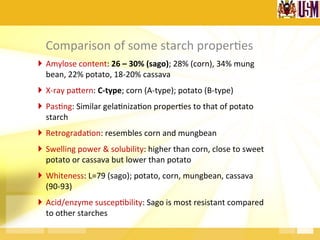
    Comparison  of  some  starch  proper.es   }  Amylose  content:  26  –  30%  (sago);  28%  (corn),  34%  mung   bean,  22%  potato,  18-­‐20%  cassava   }  X-­‐ray  pakern:  C-­‐type;  corn  (A-­‐type);  potato  (B-­‐type)   }  Pas.ng:  Similar  gela.niza.on  proper.es  to  that  of  potato   starch   }  Retrograda.on:  resembles  corn  and  mungbean   }  Swelling  power  &  solubility:  higher  than  corn,  close  to  sweet   potato  or  cassava  but  lower  than  potato   }  Whiteness:  L=79  (sago);  potato,  corn,  mungbean,  cassava   (90-­‐93)   }  Acid/enzyme  suscep.bility:  Sago  is  most  resistant  compared   to  other  starches  
  • 49.
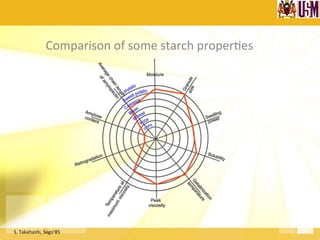
    Comparison  of  some  starch  proper.es   S.  Takahashi,  Sago’85  
  • 50.
    Pasting Profile ofSago Starch from Different Growth Stages
  • 51.
    Pasting Profile ofSago Starch
  • 52.
    Particle size distributionpattern of sago starch at base and mid heights of different growth stages. 0.0 5.0 10.0 15.0 20.0 25.0 30.0 LATM ATM AMM BM PM LATB ATB AMB BB PB Particle size (µm)
  • 53.
    Amylose content ofsago starch from different growth stages Growth stage Height Starch content (%) Plawei Base Mid 24.4 22.9 Bubul Base Mid 23.6 22.7 Angau Muda Base Mid 24.7 24.2 Angau Tua Base Mid 26.6 25.4 Late Angau Tua Base Mid 27.1 26.0
  • 54.
    Pasting Profile ofSago Starch from Different Growth Stages 0 30 60 90 120 40 60 80 100 120 0 3 6 9 12 15 Time, mins Viscosity,RVU Temperature,°C BL LAT AM PL AT Temperature profile 0 30 60 90 120 40 60 80 100 120 0 3 6 9 12 15 Time, mins Viscosity,RVU Temperature,°C BL LAT AM PL AT Temperature profile
  • 55.
    Viscosity,RVU Temperature,°C PM BM AMM ATM LATM PB BB AMB ATB LATB 70 72 74 76 78 80 Base height Midheight Pasting tem Peak visc Breakdown Setback Growth stages Growth stages
  • 56.
  • 57.
    Uses  of  Sago  Starch  
  • 58.
    Uses  of  Sago  Starch   Sago  pearls  
  • 59.
    Uses  of  Sago  Starch  
  • 60.
    •  Leaves  as  roofing  material       Useful  parts  of  sago  palm  
  • 61.
    •  The  bark  as  housing   materials       Useful  parts  of  sago  palm  
  • 62.
    Conclusion   }  In  view  of  the  significantly  high  yield  and  century-­‐long   economic  life  span  of  sago  palm,  sago  starch  should  be  in   a  very  strong  posi.on  to  compete  with  starch  produced   from  annual  crops     }  If  sufficient  sago  starch  of  suitable  quan.ty  were   produced,  it  should  be  able  to  penetrate  and  compete   favourably  in  the  current  world  starch  market.  
  • 64.
    Acknowledgement   }  CRAUN  Research  Sdn.  Bhd.,  Sarawak,  Malaysia   }  Ministry  of  Science,  Technology  &  Innova.on   }  Japan  Sago  Society   }  Japan  Society  for  Promo.on  of  Science  (JSPS)   }  Professor  Toyoda,  University  of  Tokyo,  Japan   }  Dr  Dulce  Flores,  U.P.  Mindanao,  Philiphine   }  Dr  Okazaki  et  al.,  Tokyo  University  of  Agriculture  &   Technology,  Japan   }  Dr  T.  Noda,  NARCH,  Hokkaido,  Japan   }  Prof.  Takeda,  University  of  Kagoshima,  Japan
  • 65.
    Thank  you  for  your  aken.on