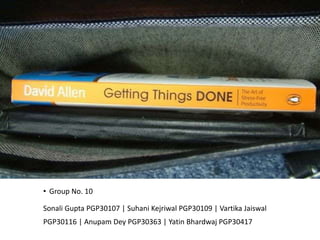
• Group No. 10
Sonali Gupta PGP30107 | Suhani Kejriwal PGP30109 | Vartika Jaiswal
PGP30116 | Anupam Dey PGP30363 | Yatin Bhardwaj PGP30417
What’s Your Biggest Problem???
Too much to do and so little time…
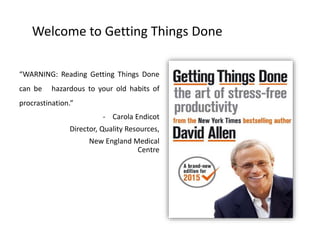
Welcome to Getting Things Done
“WARNING: Reading Getting Things Done
can be hazardous to your old habits of
procrastination.”
- Carola Endicot
Director, Quality Resources,
New England Medical
Centre
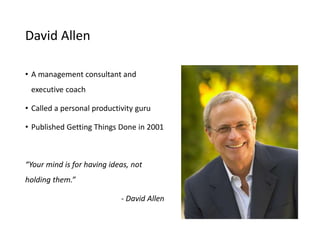
David Allen
• A management consultant and
executive coach
• Called a personal productivity guru
• Published Getting Things Done in 2001
“Your mind is for having ideas, not
holding them.”
- David Allen
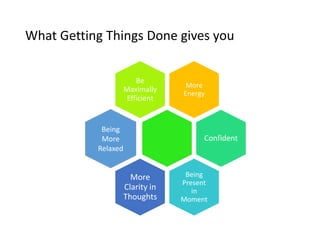
What Getting Things Done gives you
More
Energy
Be
Maximally
Efficient
Confident
Being
Present
in
Moment
More
Clarity in
Thoughts
Being
More
Relaxed
A New Practice for a New Reality
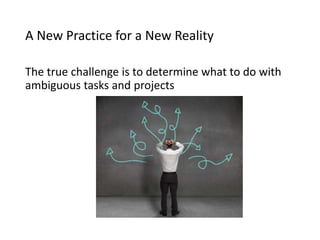
The true challenge is to determine what to do with
ambiguous tasks and projects
A New Practice for a New Reality
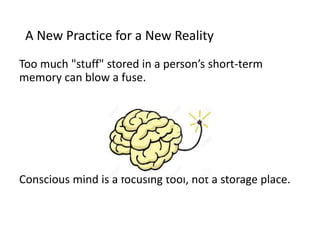
Too much "stuff" stored in a person’s short-term
memory can blow a fuse.
Conscious mind is a focusing tool, not a storage place.
A New Practice for a New Reality
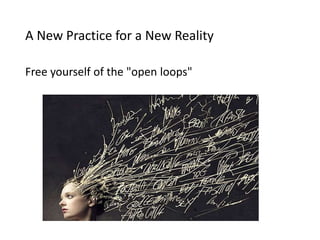
Free yourself of the "open loops"
A New Practice for a New Reality
David Allen says by “Horizontal focus”
A New Practice for a New Reality
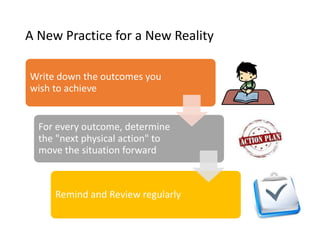
Write down the outcomes you
wish to achieve
For every outcome, determine
the "next physical action" to
move the situation forward
Remind and Review regularly
A New Practice for a New Reality
Make your “mind like water”, to get things done
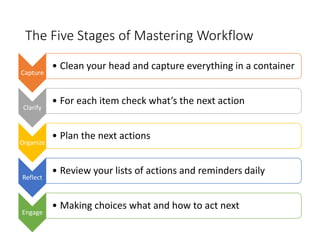
The Five Stages of Mastering Workflow
Capture
• Clean your head and capture everything in a container
Clarify
• For each item check what’s the next action
Organize
• Plan the next actions
Reflect
• Review your lists of actions and reminders daily
Engage
• Making choices what and how to act next
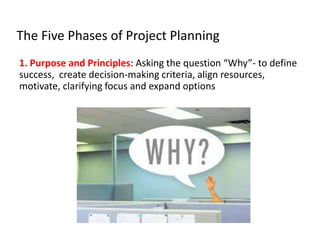
1. Purpose and Principles: Asking the question “Why”- to define
success, create decision-making criteria, align resources,
motivate, clarifying focus and expand options
The Five Phases of Project Planning
2. Envision an Outcome: Clarity and focus about ones vision and
outcomes helps ones brain’s reticular activating system (RAS) to
start making one aware of how it can happen
WHAT?
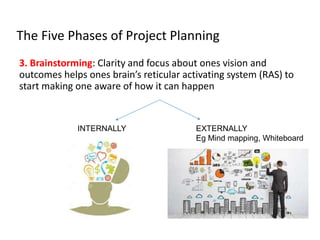
3. Brainstorming: Clarity and focus about ones vision and
outcomes helps ones brain’s reticular activating system (RAS) to
start making one aware of how it can happen
INTERNALLY EXTERNALLY
Eg Mind mapping, Whiteboard
The Five Phases of Project Planning
The Five Phases of Project Planning (cont…)
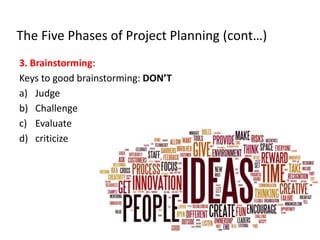
3. Brainstorming:
Keys to good brainstorming: DON’T
a) Judge
b) Challenge
c) Evaluate
d) criticize
The Five Phases of Project Planning (cont…)
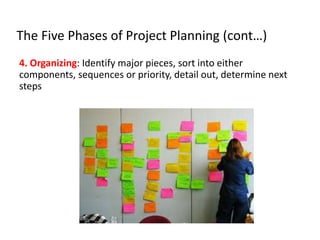
4. Organizing: Identify major pieces, sort into either
components, sequences or priority, detail out, determine next
steps
The Five Phases of Project Planning (cont…)
5. Next Actions: Identify actions to be taken now leaving aside
the dependent ones
Setting Up Time, Space and Tools
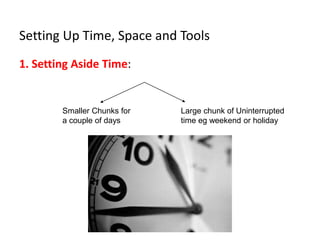
1. Setting Aside Time:
Smaller Chunks for
a couple of days
Large chunk of Uninterrupted
time eg weekend or holiday
Setting Up Time, Space and Tools
2. Setting up the Space: Set up space at home, work
and in transit.
Central Cockpit of Control
a) Writing Surface
b) Room
c) Phone
d) Computer
e) Stacking Trays
f) Working file drawers
g) Paper
h) Writing Instrument
Setting Up Time, Space and Tools
3. Tools:
THINGS REQUIRED
a) Stacking paper tray
b) Plain paper
c) Paper-handling
supplies
d) Automatic labeler
e) File folders
f) Calendar
g) Trash/recycling bins
h) Planner
Setting Up Time, Space and Tools
4. Filing System
Filling
system at
hand
distance
from
workplace
Only one
filling
system
“Where could item
be?” Should have 2-
3 possible answers
only
Quick item
filling, less
than a minute
Purge filling
system once
a year
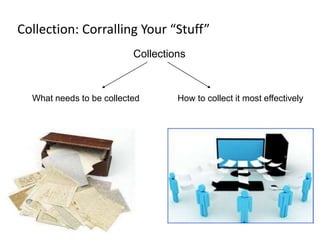
Collection: Corralling Your “Stuff”
What needs to be collected How to collect it most effectively
Collections
Collection: Corralling Your “Stuff”
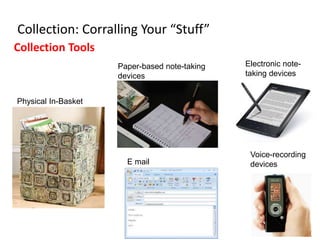
Collection Tools
Physical In-Basket
Paper-based note-taking
devices
E mail
Electronic note-
taking devices
Voice-recording
devices
Collection: Corralling Your “Stuff”
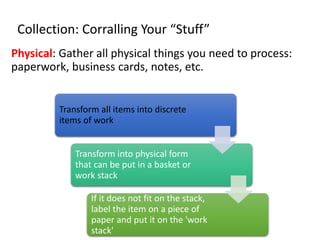
Physical: Gather all physical things you need to process:
paperwork, business cards, notes, etc.
Transform all items into discrete
items of work
Transform into physical form
that can be put in a basket or
work stack
If it does not fit on the stack,
label the item on a piece of
paper and put it on the 'work
stack'
Collection: Corralling Your “Stuff”
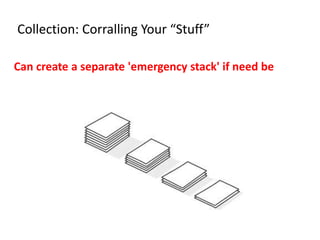
Can create a separate 'emergency stack' if need be
Collection: Corralling Your “Stuff”
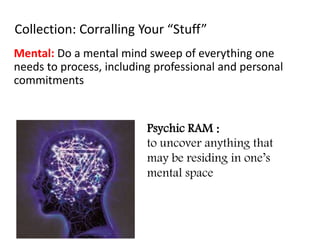
Mental: Do a mental mind sweep of everything one
needs to process, including professional and personal
commitments
Psychic RAM :
to uncover anything that
may be residing in one’s
mental space
Clarifying: Getting “In” to Empty
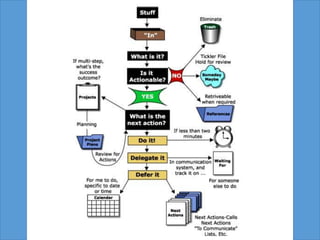
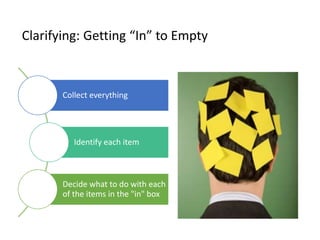
Collect everything
Identify each item
Decide what to do with each
of the items in the "in" box
Clarifying: Getting “In” to Empty
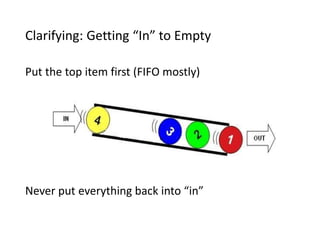
Put the top item first (FIFO mostly)
Never put everything back into “in”
Clarifying: Getting “In” to Empty
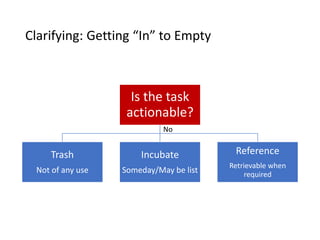
Is the task
actionable?
Trash
Not of any use
Incubate
Someday/May be list
Reference
Retrievable when
required
No
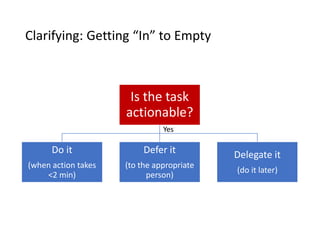
Clarifying: Getting “In” to Empty
Is the task
actionable?
Do it
(when action takes
<2 min)
Defer it
(to the appropriate
person)
Delegate it
(do it later)
Yes
Clarifying: Getting “In” to Empty
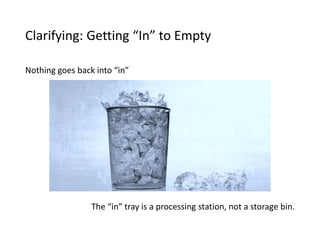
Nothing goes back into “in”
The “in” tray is a processing station, not a storage bin.
7 basic categories of things to keep track
A Projects List
A single place to review all projects for needed actions.
Calendared Actions and Information
• Actions that must be done on a
specific day or time
•Put it On Calendar
•Triggers for
• Activating projects,
• Events one might want to participate
in
• Decision catalysts
Next actions: To-Do List
• Record Next and Scheduled actions
• Utilize Contexts
• Errands
• Computer
• Online
• Home
• Calls
• May Assign project/Tags
• Accessible from anywhere
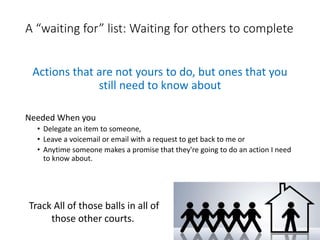
A “waiting for” list: Waiting for others to complete
Actions that are not yours to do, but ones that you
still need to know about
Needed When you
• Delegate an item to someone,
• Leave a voicemail or email with a request to get back to me or
• Anytime someone makes a promise that they're going to do an action I need
to know about.
Track All of those balls in all of
those other courts.
Someday/Maybe list
Eg.
• CD’s to buy
• Websites to visit
• Recipes to cook etc
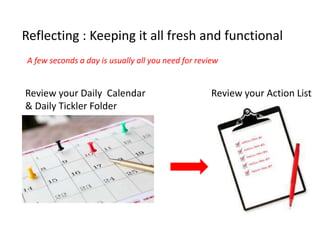
Review your Daily Calendar
& Daily Tickler Folder
Review your Action List
Reflecting : Keeping it all fresh and functional
A few seconds a day is usually all you need for review
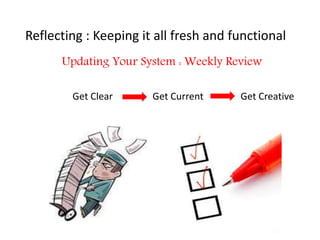
Reflecting : Keeping it all fresh and functional
Updating Your System : Weekly Review
Get Clear Get Current Get Creative
Reflecting : Keeping it all fresh and functional
THE BIGGER PICTURE REVIEWS
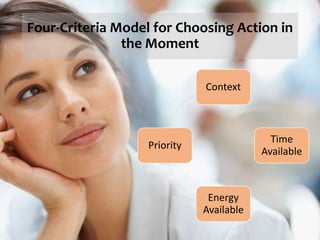
Four-Criteria Model for Choosing Action in
the Moment
Context
Time
Available
Energy
Available
Priority
1. CONTEXT
You Have Freedom When You
Are Easy In Your Harness
2. TIME AVAILABLE
Having A Sense Of Time Is Not
A Gift But A Conscious Effort To
Use It Effectively
3. ENERGY AVAILABLE
We All Have Times When We
Think More Effectively And
Times When We Should Not Be
Thinking At All
4. PRIORITY
It Is Impossible To Feel Good
About Your Choices Unless You
Are Clear What Your Work
Clearly Is
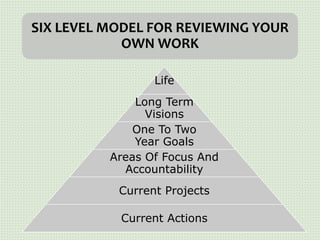
SIX LEVEL MODEL FOR REVIEWING YOUR
OWN WORK
Life
Long Term
Visions
One To Two
Year Goals
Areas Of Focus And
Accountability
Current Projects
Current Actions
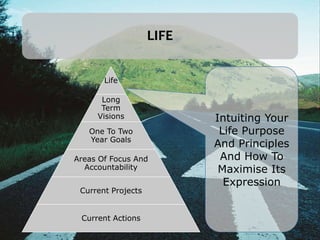
LIFE
Life
Long
Term
Visions
One To Two
Year Goals
Areas Of Focus And
Accountability
Current Projects
Current Actions
Intuiting Your
Life Purpose
And Principles
And How To
Maximise Its
Expression
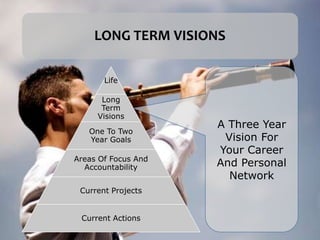
LONG TERM VISIONS
Life
Long
Term
Visions
One To Two
Year Goals
Areas Of Focus And
Accountability
Current Projects
Current Actions
A Three Year
Vision For
Your Career
And Personal
Network
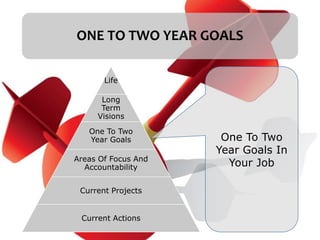
ONE TO TWO YEAR GOALS
Life
Long
Term
Visions
One To Two
Year Goals
Areas Of Focus And
Accountability
Current Projects
Current Actions
One To Two
Year Goals In
Your Job
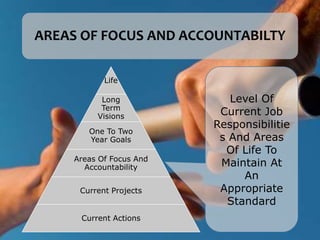
AREAS OF FOCUS AND ACCOUNTABILTY
Life
Long
Term
Visions
One To Two
Year Goals
Areas Of Focus And
Accountability
Current Projects
Current Actions
Level Of
Current Job
Responsibilitie
s And Areas
Of Life To
Maintain At
An
Appropriate
Standard
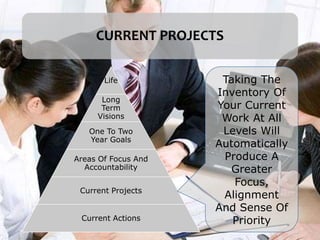
CURRENT PROJECTS
Life
Long
Term
Visions
One To Two
Year Goals
Areas Of Focus And
Accountability
Current Projects
Current Actions
Taking The
Inventory Of
Your Current
Work At All
Levels Will
Automatically
Produce A
Greater
Focus,
Alignment
And Sense Of
Priority
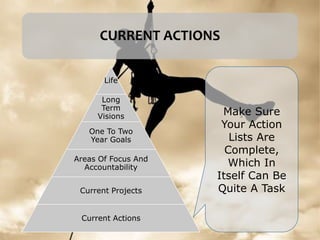
CURRENT ACTIONS
Life
Long
Term
Visions
One To Two
Year Goals
Areas Of Focus And
Accountability
Current Projects
Current Actions
Make Sure
Your Action
Lists Are
Complete,
Which In
Itself Can Be
Quite A Task
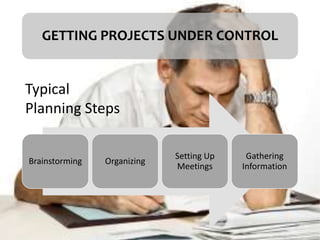
GETTING PROJECTS UNDER CONTROL
Brainstorming Organizing
Setting Up
Meetings
Gathering
Information
Typical
Planning Steps
TOOLS AND STRUCTURES THAT SUPPORT
PROJECT THINKING
Thinking Tools
Paper & pads
Essels and Whiteboards
Digital Tools
Support Structures
File Folders or Loose-Leaf Pages
Paper & Digital
Software Tools
WHAT IS THE MAIN SOURCE OF NEGATIVE
FEELINGS?
Broken
Agreements With
Yourself Are One
Of The Biggest
Source Of
Negative Feelings
HOW TO PREVENT BROKEN AGREEMENTS
WITH YOURSELF
• Don’t make the agreement –
Maintaining an objective and
complete inventory of your work,
regularly reviewed, makes it much
easier to say no with integrity
• Complete the agreement – Finish
the work that needs to be done
• Renegotiate the agreement – It is
the act of forgiveness that opens
up the only possible way to think
WHY BRIGHT PEOPLE PROCRASTINATE
THE MOST
Their sensitivity and creativity give
them the capability to produce in
their minds lurid nightmare scenarios
about what might be involved in
doing the project and all the
negative consequences that might
occur if it not done perfectly
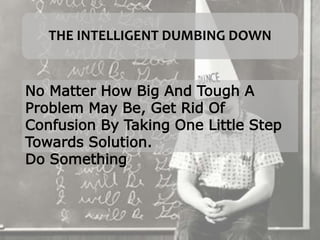
THE INTELLIGENT DUMBING DOWN
No Matter How Big And Tough A
Problem May Be, Get Rid Of
Confusion By Taking One Little Step
Towards Solution.
Do Something
VALUE OF A NEXT ACTION DECISION
MAKING STANDARD
The question, “What is the next
action” forces:-
• Clarity
• Accountability
• Productivity
• Empowerment
GETTING THINGS DONE AND COGNITIVE
SCIENCE
Research conducted in the field of
Cognitive Science has emerged
within several frameworks and
categories
1. POSITIVE PSYCHOLOGY
• Relevant aspects of positive
psychology include happiness,
psychological well being, strength,
character and virtue
• This is relevant to GTD as it is
more concerned with meaningful
work, mindful living and
psychological well being than
2. VALUE OF AN EXTERNAL MIND
• If we use our memory as our
organizing system, our mind
becomes incompetent because of
the demand of intense work
• GTD helps in focused attention and
mindful thinking at the right time
3. RELIVING THE COGNITIVE LOAD OF
INCOMPLETIONS
• Uncompleted task take up room in
the mind which limits clarity and
focus
• GTD helps in giving a trusted plan
that ensures forward engagement
will happen
4. FLOW THEORIES
You can only put your conscious
attention to one thing at a time. If
that’s all that has your attention, you
are in flow
5. SELF LEADERSHIP THEORY
Providing yourself the right cues,
which you will notice at the right
time, about the right things
6. GOAL STRIVING
• Goals are a vital part of life
• GTD serves to facilitate both
personal and professional goals
7. PSYCHOLOGICAL CAPITAL
It consists of four definable aspects
• Self efficacy
• Optimism
• Hope
• Relilience
THREE TIRES OF MASTERY
Over the years people who adopted
the GTD methodology have
demonstrated three stages of
maturity
1
Employing the fundamentals of
managing workflow
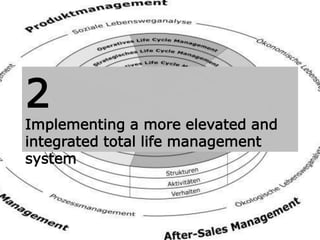
2
Implementing a more elevated and
integrated total life management
system
3
Leveraging skills to create clear
space and get things done for an
ever-expansive expression and
manifestation
THANK YOU

Getting Things Done Review and Summary

  • 1.
    • Group No.10 Sonali Gupta PGP30107 | Suhani Kejriwal PGP30109 | Vartika Jaiswal PGP30116 | Anupam Dey PGP30363 | Yatin Bhardwaj PGP30417
  • 2.
  • 3.
    Too much todo and so little time…
  • 8.
    Welcome to GettingThings Done “WARNING: Reading Getting Things Done can be hazardous to your old habits of procrastination.” - Carola Endicot Director, Quality Resources, New England Medical Centre
  • 9.
    David Allen • Amanagement consultant and executive coach • Called a personal productivity guru • Published Getting Things Done in 2001 “Your mind is for having ideas, not holding them.” - David Allen
  • 10.
    What Getting ThingsDone gives you More Energy Be Maximally Efficient Confident Being Present in Moment More Clarity in Thoughts Being More Relaxed
  • 11.
    A New Practicefor a New Reality The true challenge is to determine what to do with ambiguous tasks and projects
  • 12.
    A New Practicefor a New Reality Too much "stuff" stored in a person’s short-term memory can blow a fuse. Conscious mind is a focusing tool, not a storage place.
  • 13.
    A New Practicefor a New Reality Free yourself of the "open loops"
  • 14.
    A New Practicefor a New Reality David Allen says by “Horizontal focus”
  • 15.
    A New Practicefor a New Reality Write down the outcomes you wish to achieve For every outcome, determine the "next physical action" to move the situation forward Remind and Review regularly
  • 16.
    A New Practicefor a New Reality Make your “mind like water”, to get things done
  • 17.
    The Five Stagesof Mastering Workflow Capture • Clean your head and capture everything in a container Clarify • For each item check what’s the next action Organize • Plan the next actions Reflect • Review your lists of actions and reminders daily Engage • Making choices what and how to act next
  • 19.
    1. Purpose andPrinciples: Asking the question “Why”- to define success, create decision-making criteria, align resources, motivate, clarifying focus and expand options The Five Phases of Project Planning
  • 20.
    The Five Phasesof Project Planning 2. Envision an Outcome: Clarity and focus about ones vision and outcomes helps ones brain’s reticular activating system (RAS) to start making one aware of how it can happen WHAT?
  • 21.
    3. Brainstorming: Clarityand focus about ones vision and outcomes helps ones brain’s reticular activating system (RAS) to start making one aware of how it can happen INTERNALLY EXTERNALLY Eg Mind mapping, Whiteboard The Five Phases of Project Planning
  • 22.
    The Five Phasesof Project Planning (cont…) 3. Brainstorming: Keys to good brainstorming: DON’T a) Judge b) Challenge c) Evaluate d) criticize
  • 23.
    The Five Phasesof Project Planning (cont…) 4. Organizing: Identify major pieces, sort into either components, sequences or priority, detail out, determine next steps
  • 24.
    The Five Phasesof Project Planning (cont…) 5. Next Actions: Identify actions to be taken now leaving aside the dependent ones
  • 25.
    Setting Up Time,Space and Tools 1. Setting Aside Time: Smaller Chunks for a couple of days Large chunk of Uninterrupted time eg weekend or holiday
  • 26.
    Setting Up Time,Space and Tools 2. Setting up the Space: Set up space at home, work and in transit. Central Cockpit of Control a) Writing Surface b) Room c) Phone d) Computer e) Stacking Trays f) Working file drawers g) Paper h) Writing Instrument
  • 27.
    Setting Up Time,Space and Tools 3. Tools: THINGS REQUIRED a) Stacking paper tray b) Plain paper c) Paper-handling supplies d) Automatic labeler e) File folders f) Calendar g) Trash/recycling bins h) Planner
  • 28.
    Setting Up Time,Space and Tools 4. Filing System Filling system at hand distance from workplace Only one filling system “Where could item be?” Should have 2- 3 possible answers only Quick item filling, less than a minute Purge filling system once a year
  • 29.
    Collection: Corralling Your“Stuff” What needs to be collected How to collect it most effectively Collections
  • 30.
    Collection: Corralling Your“Stuff” Collection Tools Physical In-Basket Paper-based note-taking devices E mail Electronic note- taking devices Voice-recording devices
  • 31.
    Collection: Corralling Your“Stuff” Physical: Gather all physical things you need to process: paperwork, business cards, notes, etc. Transform all items into discrete items of work Transform into physical form that can be put in a basket or work stack If it does not fit on the stack, label the item on a piece of paper and put it on the 'work stack'
  • 32.
    Collection: Corralling Your“Stuff” Can create a separate 'emergency stack' if need be
  • 33.
    Collection: Corralling Your“Stuff” Mental: Do a mental mind sweep of everything one needs to process, including professional and personal commitments Psychic RAM : to uncover anything that may be residing in one’s mental space
  • 34.
    Clarifying: Getting “In”to Empty Collect everything Identify each item Decide what to do with each of the items in the "in" box
  • 36.
    Clarifying: Getting “In”to Empty Put the top item first (FIFO mostly) Never put everything back into “in”
  • 37.
    Clarifying: Getting “In”to Empty Is the task actionable? Trash Not of any use Incubate Someday/May be list Reference Retrievable when required No
  • 38.
    Clarifying: Getting “In”to Empty Is the task actionable? Do it (when action takes <2 min) Defer it (to the appropriate person) Delegate it (do it later) Yes
  • 39.
    Clarifying: Getting “In”to Empty Nothing goes back into “in” The “in” tray is a processing station, not a storage bin.
  • 40.
    7 basic categoriesof things to keep track A Projects List A single place to review all projects for needed actions.
  • 41.
    Calendared Actions andInformation • Actions that must be done on a specific day or time •Put it On Calendar •Triggers for • Activating projects, • Events one might want to participate in • Decision catalysts
  • 42.
    Next actions: To-DoList • Record Next and Scheduled actions • Utilize Contexts • Errands • Computer • Online • Home • Calls • May Assign project/Tags • Accessible from anywhere
  • 43.
    A “waiting for”list: Waiting for others to complete Actions that are not yours to do, but ones that you still need to know about Needed When you • Delegate an item to someone, • Leave a voicemail or email with a request to get back to me or • Anytime someone makes a promise that they're going to do an action I need to know about. Track All of those balls in all of those other courts.
  • 44.
    Someday/Maybe list Eg. • CD’sto buy • Websites to visit • Recipes to cook etc
  • 45.
    Review your DailyCalendar & Daily Tickler Folder Review your Action List Reflecting : Keeping it all fresh and functional A few seconds a day is usually all you need for review
  • 46.
    Reflecting : Keepingit all fresh and functional Updating Your System : Weekly Review Get Clear Get Current Get Creative
  • 47.
    Reflecting : Keepingit all fresh and functional THE BIGGER PICTURE REVIEWS
  • 49.
    Four-Criteria Model forChoosing Action in the Moment Context Time Available Energy Available Priority
  • 50.
    1. CONTEXT You HaveFreedom When You Are Easy In Your Harness
  • 51.
    2. TIME AVAILABLE HavingA Sense Of Time Is Not A Gift But A Conscious Effort To Use It Effectively
  • 52.
    3. ENERGY AVAILABLE WeAll Have Times When We Think More Effectively And Times When We Should Not Be Thinking At All
  • 53.
    4. PRIORITY It IsImpossible To Feel Good About Your Choices Unless You Are Clear What Your Work Clearly Is
  • 54.
    SIX LEVEL MODELFOR REVIEWING YOUR OWN WORK Life Long Term Visions One To Two Year Goals Areas Of Focus And Accountability Current Projects Current Actions
  • 55.
    LIFE Life Long Term Visions One To Two YearGoals Areas Of Focus And Accountability Current Projects Current Actions Intuiting Your Life Purpose And Principles And How To Maximise Its Expression
  • 56.
    LONG TERM VISIONS Life Long Term Visions OneTo Two Year Goals Areas Of Focus And Accountability Current Projects Current Actions A Three Year Vision For Your Career And Personal Network
  • 57.
    ONE TO TWOYEAR GOALS Life Long Term Visions One To Two Year Goals Areas Of Focus And Accountability Current Projects Current Actions One To Two Year Goals In Your Job
  • 58.
    AREAS OF FOCUSAND ACCOUNTABILTY Life Long Term Visions One To Two Year Goals Areas Of Focus And Accountability Current Projects Current Actions Level Of Current Job Responsibilitie s And Areas Of Life To Maintain At An Appropriate Standard
  • 59.
    CURRENT PROJECTS Life Long Term Visions One ToTwo Year Goals Areas Of Focus And Accountability Current Projects Current Actions Taking The Inventory Of Your Current Work At All Levels Will Automatically Produce A Greater Focus, Alignment And Sense Of Priority
  • 60.
    CURRENT ACTIONS Life Long Term Visions One ToTwo Year Goals Areas Of Focus And Accountability Current Projects Current Actions Make Sure Your Action Lists Are Complete, Which In Itself Can Be Quite A Task
  • 61.
    GETTING PROJECTS UNDERCONTROL Brainstorming Organizing Setting Up Meetings Gathering Information Typical Planning Steps
  • 62.
    TOOLS AND STRUCTURESTHAT SUPPORT PROJECT THINKING Thinking Tools Paper & pads Essels and Whiteboards Digital Tools Support Structures File Folders or Loose-Leaf Pages Paper & Digital Software Tools
  • 63.
    WHAT IS THEMAIN SOURCE OF NEGATIVE FEELINGS? Broken Agreements With Yourself Are One Of The Biggest Source Of Negative Feelings
  • 64.
    HOW TO PREVENTBROKEN AGREEMENTS WITH YOURSELF • Don’t make the agreement – Maintaining an objective and complete inventory of your work, regularly reviewed, makes it much easier to say no with integrity • Complete the agreement – Finish the work that needs to be done • Renegotiate the agreement – It is the act of forgiveness that opens up the only possible way to think
  • 65.
    WHY BRIGHT PEOPLEPROCRASTINATE THE MOST Their sensitivity and creativity give them the capability to produce in their minds lurid nightmare scenarios about what might be involved in doing the project and all the negative consequences that might occur if it not done perfectly
  • 66.
    THE INTELLIGENT DUMBINGDOWN No Matter How Big And Tough A Problem May Be, Get Rid Of Confusion By Taking One Little Step Towards Solution. Do Something
  • 67.
    VALUE OF ANEXT ACTION DECISION MAKING STANDARD The question, “What is the next action” forces:- • Clarity • Accountability • Productivity • Empowerment
  • 68.
    GETTING THINGS DONEAND COGNITIVE SCIENCE Research conducted in the field of Cognitive Science has emerged within several frameworks and categories
  • 69.
    1. POSITIVE PSYCHOLOGY •Relevant aspects of positive psychology include happiness, psychological well being, strength, character and virtue • This is relevant to GTD as it is more concerned with meaningful work, mindful living and psychological well being than
  • 70.
    2. VALUE OFAN EXTERNAL MIND • If we use our memory as our organizing system, our mind becomes incompetent because of the demand of intense work • GTD helps in focused attention and mindful thinking at the right time
  • 71.
    3. RELIVING THECOGNITIVE LOAD OF INCOMPLETIONS • Uncompleted task take up room in the mind which limits clarity and focus • GTD helps in giving a trusted plan that ensures forward engagement will happen
  • 72.
    4. FLOW THEORIES Youcan only put your conscious attention to one thing at a time. If that’s all that has your attention, you are in flow
  • 73.
    5. SELF LEADERSHIPTHEORY Providing yourself the right cues, which you will notice at the right time, about the right things
  • 74.
    6. GOAL STRIVING •Goals are a vital part of life • GTD serves to facilitate both personal and professional goals
  • 75.
    7. PSYCHOLOGICAL CAPITAL Itconsists of four definable aspects • Self efficacy • Optimism • Hope • Relilience
  • 76.
    THREE TIRES OFMASTERY Over the years people who adopted the GTD methodology have demonstrated three stages of maturity
  • 77.
    1 Employing the fundamentalsof managing workflow
  • 78.
    2 Implementing a moreelevated and integrated total life management system
  • 79.
    3 Leveraging skills tocreate clear space and get things done for an ever-expansive expression and manifestation
  • 80.