Getting better at detecting
anomalies by using ensembles
Sevvandi Kandanaarachchi
ANZIAM 2022
February 7 2022
Suppose
• After years of scanning the skies we
find intelligent life on a planet far, far,
away . . .
• This is an anomaly. A very interesting
anomaly . . . .
• We want to know about this anomaly.
• What kind of life forms?
• What kind of technology?
• Do they use Maths and Stats?
Why anomalies?
• They tell a different story
• Fraudulent credit card transactions amongst billions of
legitimate transactions
• Computer network intrusions
• Astronomical anomalies – solar flares
• Training a model on certain fraud/intrusions/cyber attacks is
not optimal, because there are new types of fraud/attacks,
always!
• You want to be alerted when weird things happen.
• Anomaly detection is used in these applications.
3
Overview
• Anomaly Detection Ensembles
• Item Response Theory
• Mapping IRT to anomaly detection ensembles
• Fitting the IRT model
• Some Results
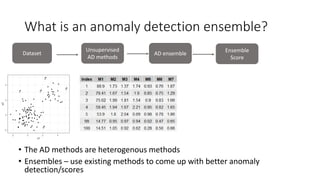
What is an anomaly detection ensemble?
Dataset
Unsupervised
AD methods
• The AD methods are heterogenous methods
• Ensembles – use existing methods to come up with better anomaly
detection/scores
AD ensemble
Ensemble
Score
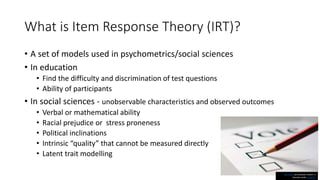
What is Item Response Theory (IRT)?
• A set of models used in psychometrics/social sciences
• In education
• Find the difficulty and discrimination of test questions
• Ability of participants
• In social sciences - unobservable characteristics and observed outcomes
• Verbal or mathematical ability
• Racial prejudice or stress proneness
• Political inclinations
• Intrinsic “quality” that cannot be measured directly
• Latent trait modelling
This Photo by Unknown Author is
licensed under CC BY-SA
IRT in education
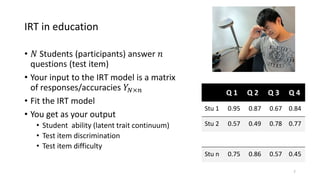
• 𝑁 Students (participants) answer 𝑛
questions (test item)
• Your input to the IRT model is a matrix
of responses/accuracies 𝑌𝑁×𝑛
• Fit the IRT model
• You get as your output
• Student ability (latent trait continuum)
• Test item discrimination
• Test item difficulty
7
Q 1 Q 2 Q 3 Q 4
Stu 1 0.95 0.87 0.67 0.84
Stu 2 0.57 0.49 0.78 0.77
Stu n 0.75 0.86 0.57 0.45
IRT in psychometrics (e.g. racial prejudice)
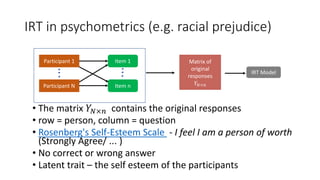
• The matrix 𝑌𝑁×𝑛 contains the original responses
• row = person, column = question
• Rosenberg's Self-Esteem Scale - I feel I am a person of worth
(Strongly Agree/ ... )
• No correct or wrong answer
• Latent trait – the self esteem of the participants
Participant 1
Participant N
Item 1
Item n
Matrix of
original
responses
𝑌𝑁×𝑛
IRT Model
IRT ensemble for anomaly detection
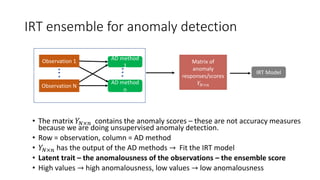
• The matrix 𝑌𝑁×𝑛 contains the anomaly scores – these are not accuracy measures
because we are doing unsupervised anomaly detection.
• Row = observation, column = AD method
• 𝑌𝑁×𝑛 has the output of the AD methods → Fit the IRT model
• Latent trait – the anomalousness of the observations – the ensemble score
• High values → high anomalousness, low values → low anomalousness
Observation 1
Observation N
AD method
1
AD method
n
Matrix of
anomaly
responses/scores
𝑌𝑁×𝑛
IRT Model
Fitting the IRT model
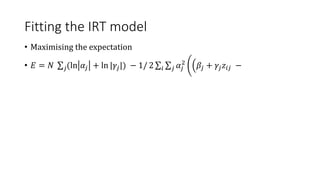
• Maximising the expectation
• 𝐸 = 𝑁 𝑗(ln 𝛼𝑗 + ln |𝛾𝑗|) − 1/ 2 𝑖 𝑗 𝛼𝑗
2
𝛽𝑗 + 𝛾𝑗𝑧𝑖𝑗 −
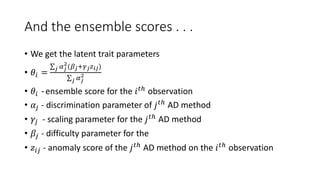
And the ensemble scores . . .
• We get the latent trait parameters
• 𝜃𝑖 =
𝑗 𝛼𝑗
2
(𝛽𝑗+𝛾𝑗𝑧𝑖𝑗)
𝑗 𝛼𝑗
2
• 𝜃𝑖 - ensemble score for the 𝑖𝑡ℎ observation
• 𝛼𝑗 - discrimination parameter of 𝑗𝑡ℎ AD method
• 𝛾𝑗 - scaling parameter for the 𝑗𝑡ℎ AD method
• 𝛽𝑗 - difficulty parameter for the
• 𝑧𝑖𝑗 - anomaly score of the 𝑗𝑡ℎ AD method on the 𝑖𝑡ℎ observation
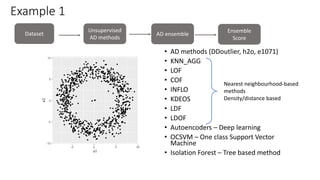
Example 1
• AD methods (DDoutlier, h2o, e1071)
• KNN_AGG
• LOF
• COF
• INFLO
• KDEOS
• LDF
• LDOF
• Autoencoders – Deep learning
• OCSVM – One class Support Vector
Machine
• Isolation Forest – Tree based method
Nearest neighbourhood-based
methods
Density/distance based
Dataset
Unsupervised
AD methods
AD ensemble
Ensemble
Score
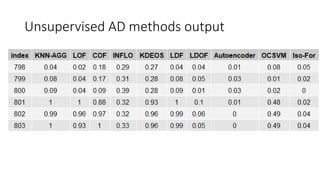
Unsupervised AD methods output
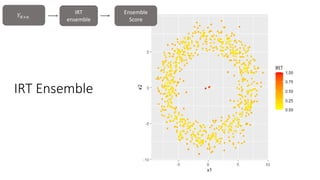
IRT Ensemble
14
𝑌𝑁×𝑛
IRT
ensemble
Ensemble
Score
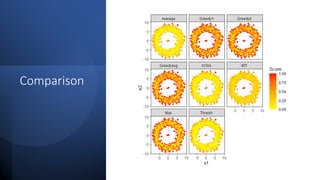
Comparison
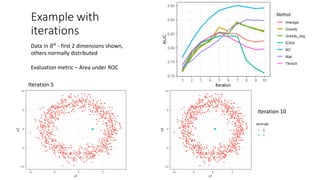
Example with
iterations
Data in 𝑅6
- first 2 dimensions shown,
others normally distributed
Evaluation metric – Area under ROC
Iteration 5
Iteration 10
Summary
• Anomaly detection in many applications
• IRT – used in social sciences/psychometrics
• Use IRT for AD ensembles
• Tests on real datasets - good results
• More details on the paper - https://arxiv.org/abs/2106.06243-
@Information Sciences
• R package – outlierensembles – on CRAN - extends R package EstCRM
for IRT
18
On ArXiv - https://arxiv.org/abs/2106.06243

Getting better at detecting anomalies by using ensembles

  • 1.
    Getting better atdetecting anomalies by using ensembles Sevvandi Kandanaarachchi ANZIAM 2022 February 7 2022
  • 2.
    Suppose • After yearsof scanning the skies we find intelligent life on a planet far, far, away . . . • This is an anomaly. A very interesting anomaly . . . . • We want to know about this anomaly. • What kind of life forms? • What kind of technology? • Do they use Maths and Stats?
  • 3.
    Why anomalies? • Theytell a different story • Fraudulent credit card transactions amongst billions of legitimate transactions • Computer network intrusions • Astronomical anomalies – solar flares • Training a model on certain fraud/intrusions/cyber attacks is not optimal, because there are new types of fraud/attacks, always! • You want to be alerted when weird things happen. • Anomaly detection is used in these applications. 3
  • 4.
    Overview • Anomaly DetectionEnsembles • Item Response Theory • Mapping IRT to anomaly detection ensembles • Fitting the IRT model • Some Results
  • 5.
    What is ananomaly detection ensemble? Dataset Unsupervised AD methods • The AD methods are heterogenous methods • Ensembles – use existing methods to come up with better anomaly detection/scores AD ensemble Ensemble Score
  • 6.
    What is ItemResponse Theory (IRT)? • A set of models used in psychometrics/social sciences • In education • Find the difficulty and discrimination of test questions • Ability of participants • In social sciences - unobservable characteristics and observed outcomes • Verbal or mathematical ability • Racial prejudice or stress proneness • Political inclinations • Intrinsic “quality” that cannot be measured directly • Latent trait modelling This Photo by Unknown Author is licensed under CC BY-SA
  • 7.
    IRT in education •𝑁 Students (participants) answer 𝑛 questions (test item) • Your input to the IRT model is a matrix of responses/accuracies 𝑌𝑁×𝑛 • Fit the IRT model • You get as your output • Student ability (latent trait continuum) • Test item discrimination • Test item difficulty 7 Q 1 Q 2 Q 3 Q 4 Stu 1 0.95 0.87 0.67 0.84 Stu 2 0.57 0.49 0.78 0.77 Stu n 0.75 0.86 0.57 0.45
  • 8.
    IRT in psychometrics(e.g. racial prejudice) • The matrix 𝑌𝑁×𝑛 contains the original responses • row = person, column = question • Rosenberg's Self-Esteem Scale - I feel I am a person of worth (Strongly Agree/ ... ) • No correct or wrong answer • Latent trait – the self esteem of the participants Participant 1 Participant N Item 1 Item n Matrix of original responses 𝑌𝑁×𝑛 IRT Model
  • 9.
    IRT ensemble foranomaly detection • The matrix 𝑌𝑁×𝑛 contains the anomaly scores – these are not accuracy measures because we are doing unsupervised anomaly detection. • Row = observation, column = AD method • 𝑌𝑁×𝑛 has the output of the AD methods → Fit the IRT model • Latent trait – the anomalousness of the observations – the ensemble score • High values → high anomalousness, low values → low anomalousness Observation 1 Observation N AD method 1 AD method n Matrix of anomaly responses/scores 𝑌𝑁×𝑛 IRT Model
  • 10.
    Fitting the IRTmodel • Maximising the expectation • 𝐸 = 𝑁 𝑗(ln 𝛼𝑗 + ln |𝛾𝑗|) − 1/ 2 𝑖 𝑗 𝛼𝑗 2 𝛽𝑗 + 𝛾𝑗𝑧𝑖𝑗 −
  • 11.
    And the ensemblescores . . . • We get the latent trait parameters • 𝜃𝑖 = 𝑗 𝛼𝑗 2 (𝛽𝑗+𝛾𝑗𝑧𝑖𝑗) 𝑗 𝛼𝑗 2 • 𝜃𝑖 - ensemble score for the 𝑖𝑡ℎ observation • 𝛼𝑗 - discrimination parameter of 𝑗𝑡ℎ AD method • 𝛾𝑗 - scaling parameter for the 𝑗𝑡ℎ AD method • 𝛽𝑗 - difficulty parameter for the • 𝑧𝑖𝑗 - anomaly score of the 𝑗𝑡ℎ AD method on the 𝑖𝑡ℎ observation
  • 12.
    Example 1 • ADmethods (DDoutlier, h2o, e1071) • KNN_AGG • LOF • COF • INFLO • KDEOS • LDF • LDOF • Autoencoders – Deep learning • OCSVM – One class Support Vector Machine • Isolation Forest – Tree based method Nearest neighbourhood-based methods Density/distance based Dataset Unsupervised AD methods AD ensemble Ensemble Score
  • 13.
  • 14.
  • 15.
  • 16.
    Example with iterations Data in𝑅6 - first 2 dimensions shown, others normally distributed Evaluation metric – Area under ROC Iteration 5 Iteration 10
  • 17.
    Summary • Anomaly detectionin many applications • IRT – used in social sciences/psychometrics • Use IRT for AD ensembles • Tests on real datasets - good results • More details on the paper - https://arxiv.org/abs/2106.06243- @Information Sciences • R package – outlierensembles – on CRAN - extends R package EstCRM for IRT
  • 18.
    18 On ArXiv -https://arxiv.org/abs/2106.06243