Statistics Seminar, University of Sydney, 30 September 2024
Sevvandi Kandanaarachchi, Cheng Soon Ong
CSIRO’s Data61
Graphons of Line Graphs
Growing graphs/networks
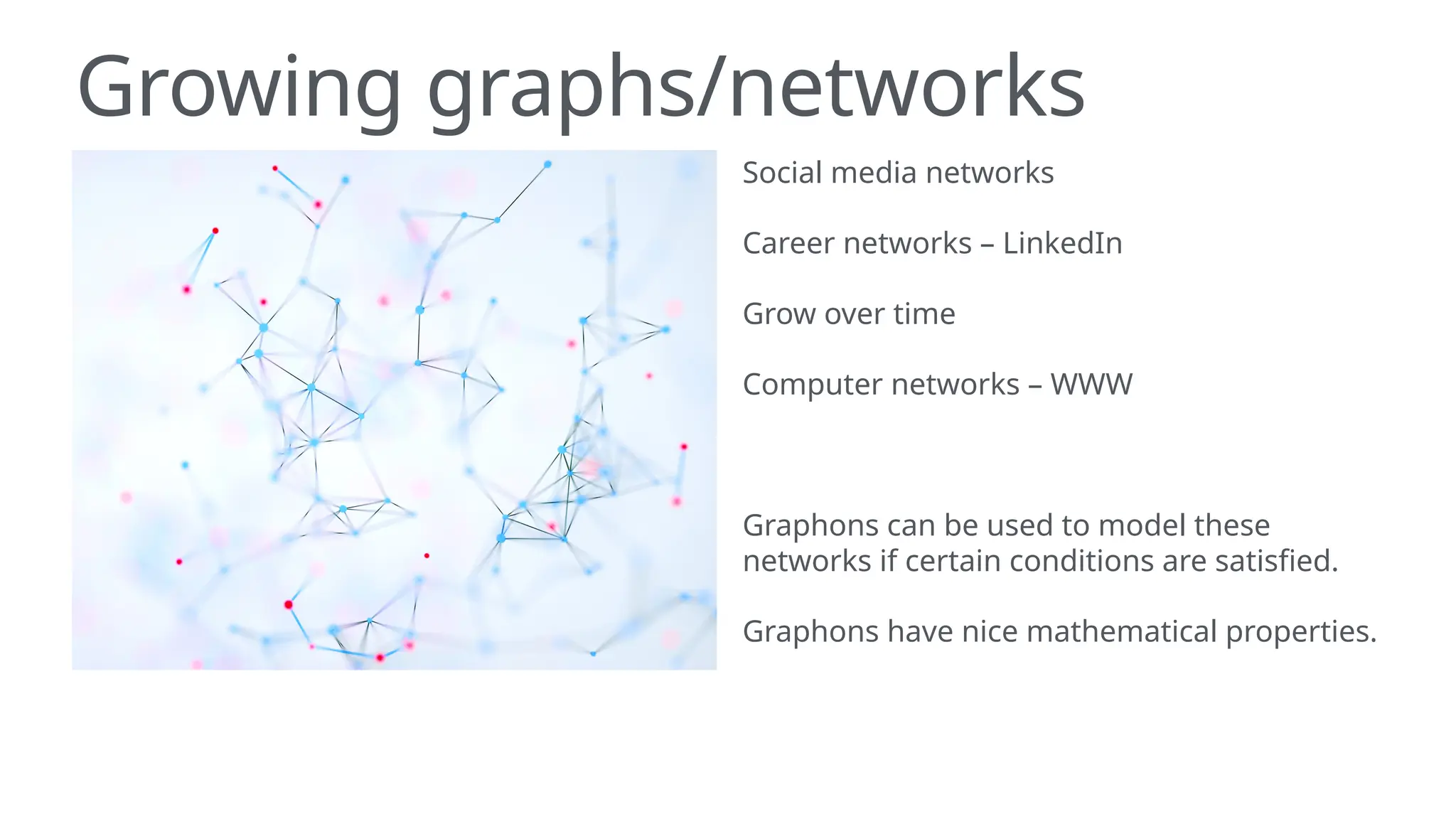
Social media networks
Career networks – LinkedIn
Grow over time
Computer networks – WWW
Graphons can be used to model these
networks if certain conditions are satisfied.
Graphons have nice mathematical properties.
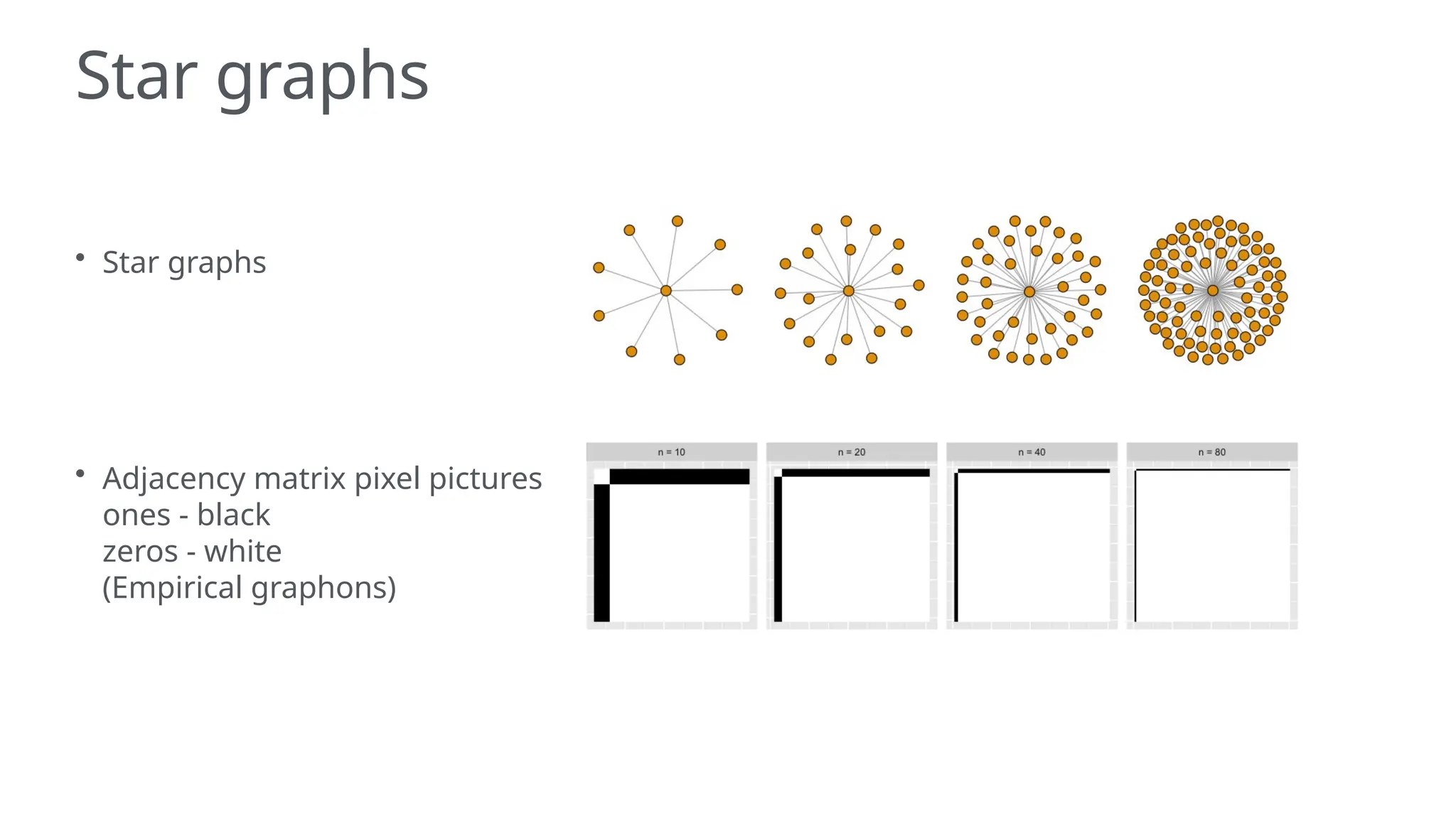
Star graphs
• Star graphs
• Adjacency matrix pixel pictures
ones - black
zeros - white
(Empirical graphons)
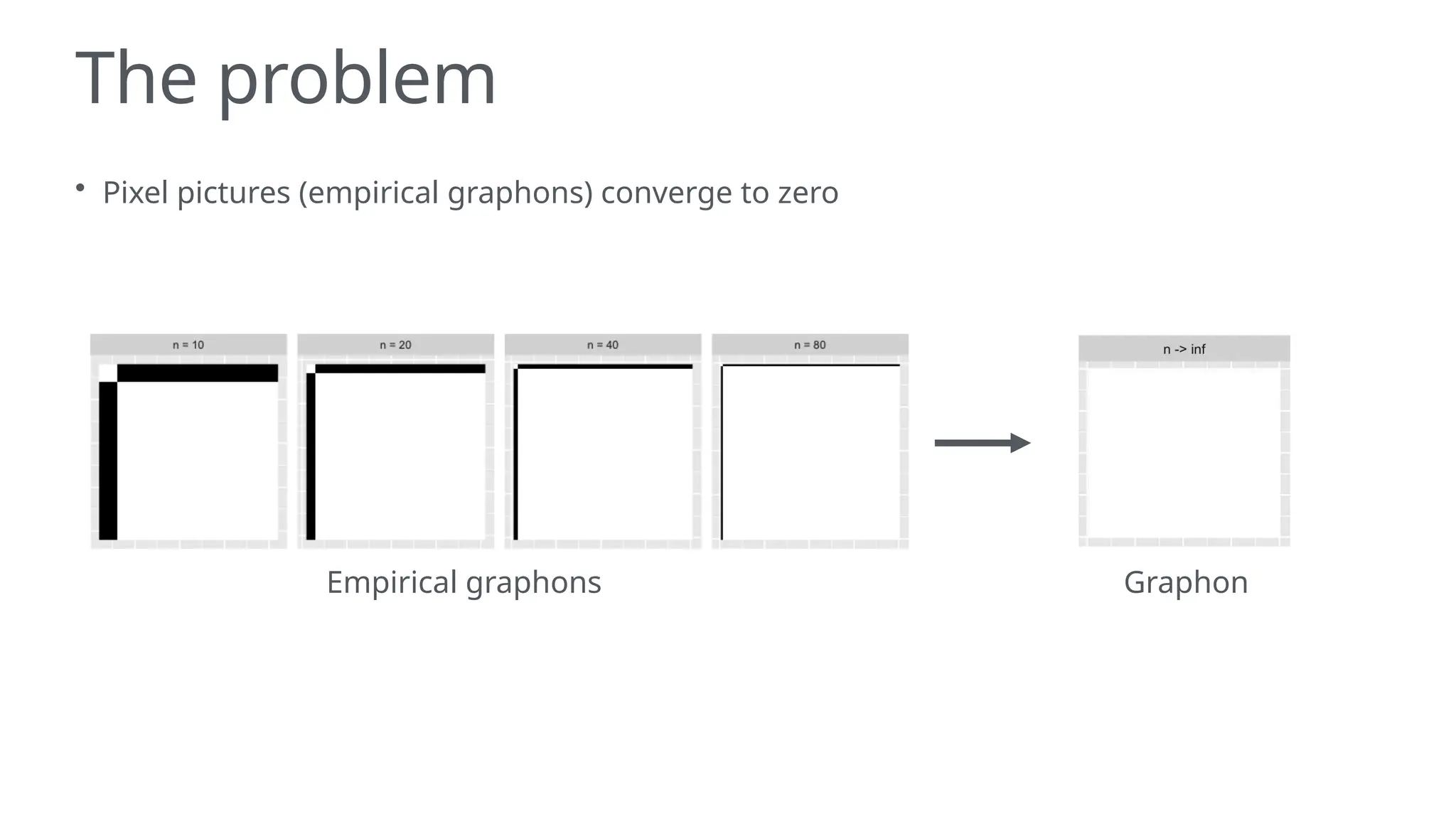
The problem
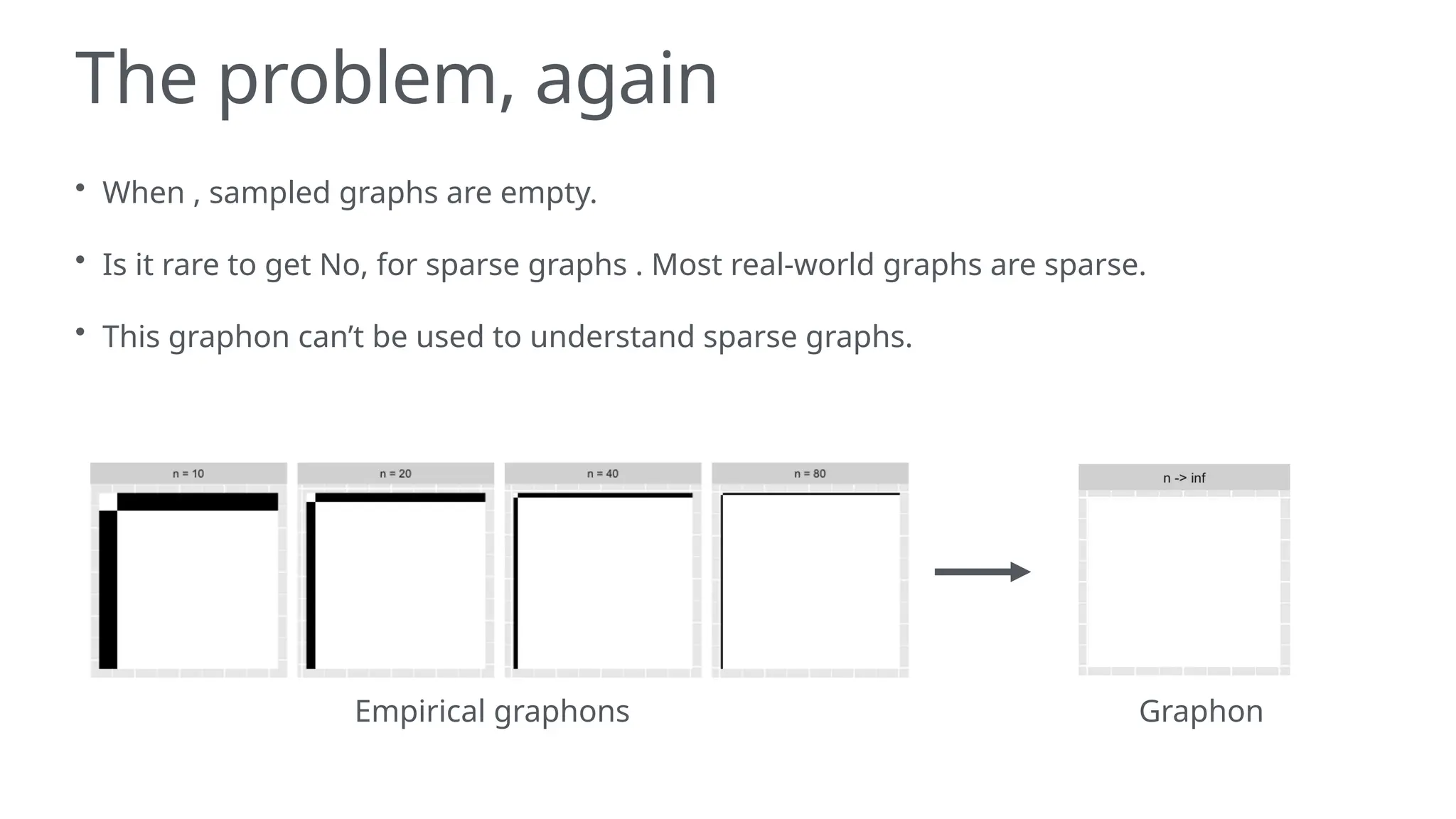
• Pixel pictures (empirical graphons) converge to zero
Empirical graphons Graphon
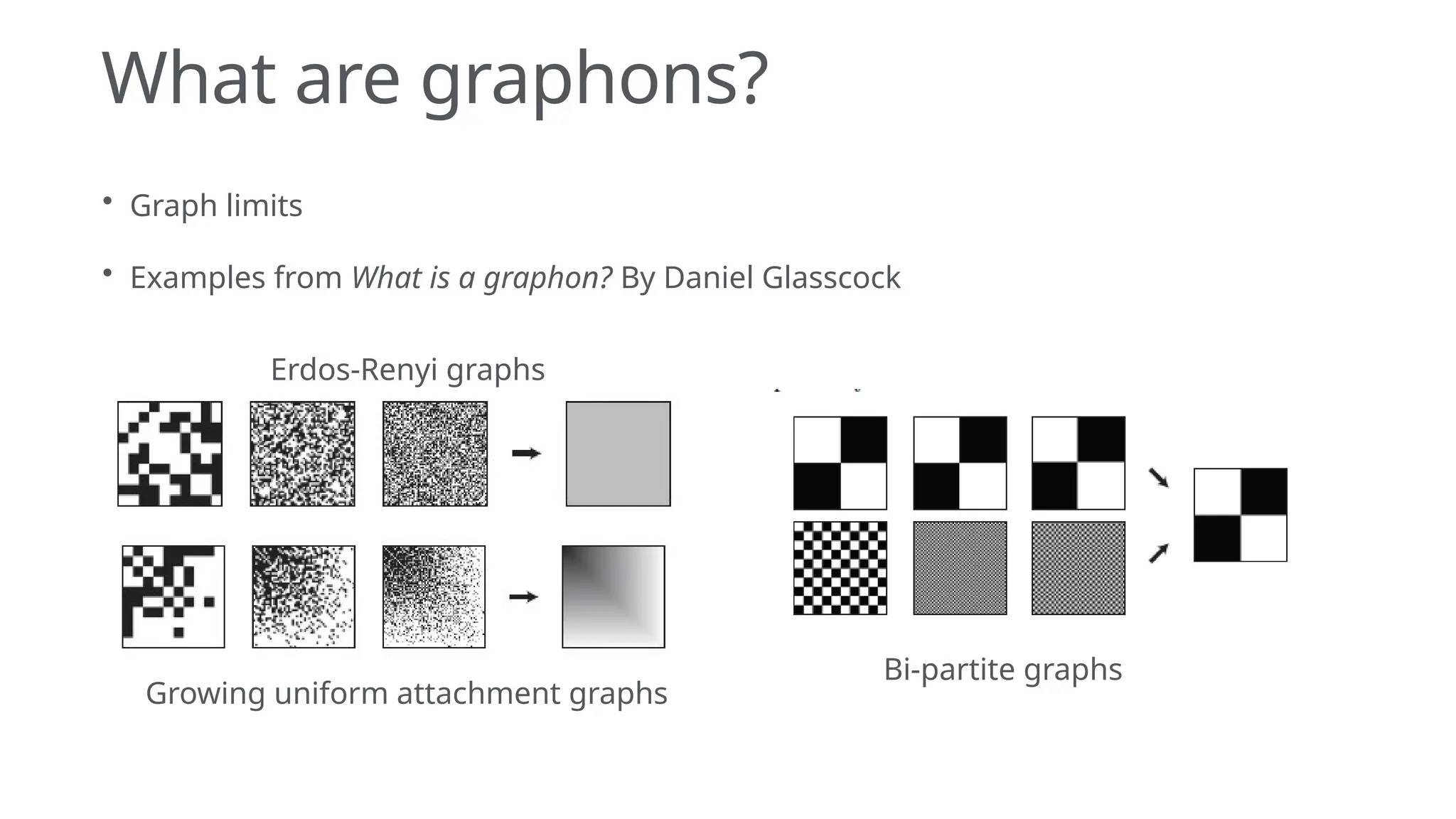
What are graphons?
• Graph limits
• Examples from What is a graphon? By Daniel Glasscock
Erdos-Renyi graphs
Growing uniform attachment graphs
Bi-partite graphs
Mathematically what is a graphon?
• Graphon is a symmetric measurable function
• A function defined on a unit square
• Empirical graphon: when you colour in the squares of the adjacency matrix and scale it to
[0, 1]
• Empirical graphon of graph , is .
• Graphs converging to graphons
• How is convergence defined?
• Graph homomorphisms and homomorphism densities
Empirical graphons Graphon
Graph homomorphism - convergence
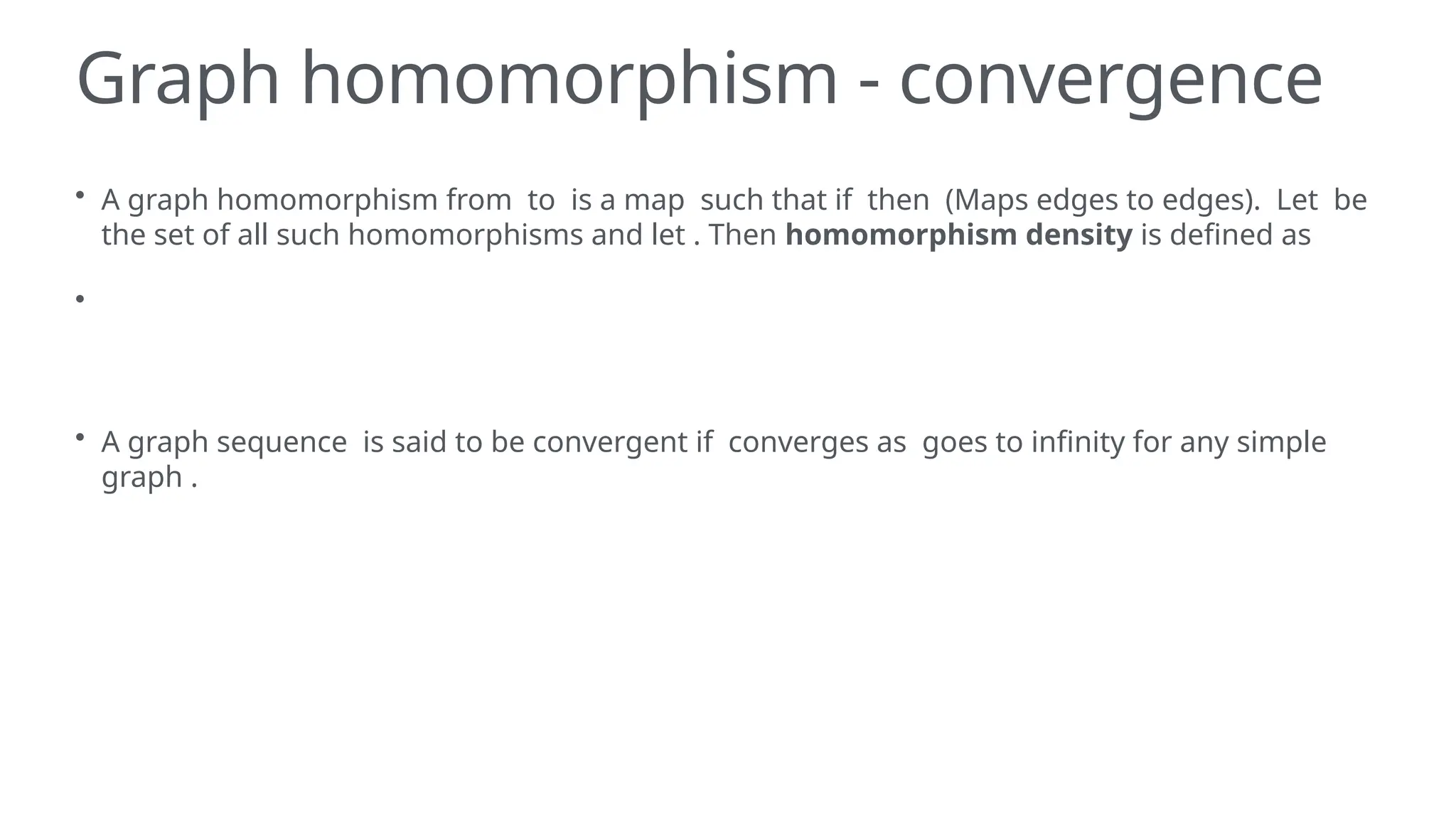
• A graph homomorphism from to is a map such that if then (Maps edges to edges). Let be
the set of all such homomorphisms and let . Then homomorphism density is defined as
•
• A graph sequence is said to be convergent if converges as goes to infinity for any simple
graph .
Convergence - cut metric
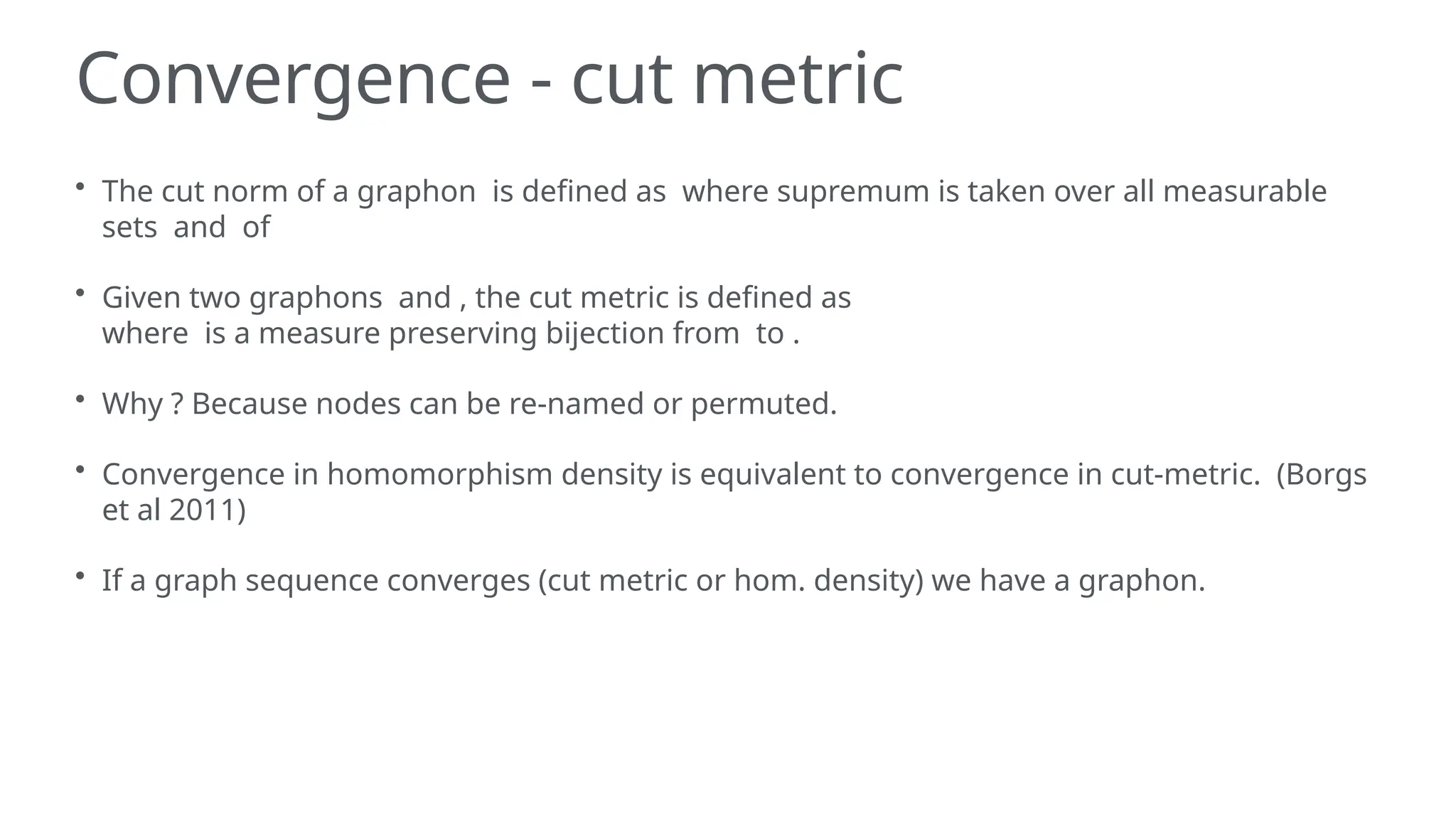
• The cut norm of a graphon is defined as where supremum is taken over all measurable
sets and of
• Given two graphons and , the cut metric is defined as
where is a measure preserving bijection from to .
• Why ? Because nodes can be re-named or permuted.
• Convergence in homomorphism density is equivalent to convergence in cut-metric. (Borgs
et al 2011)
• If a graph sequence converges (cut metric or hom. density) we have a graphon.
How can we use graphons?
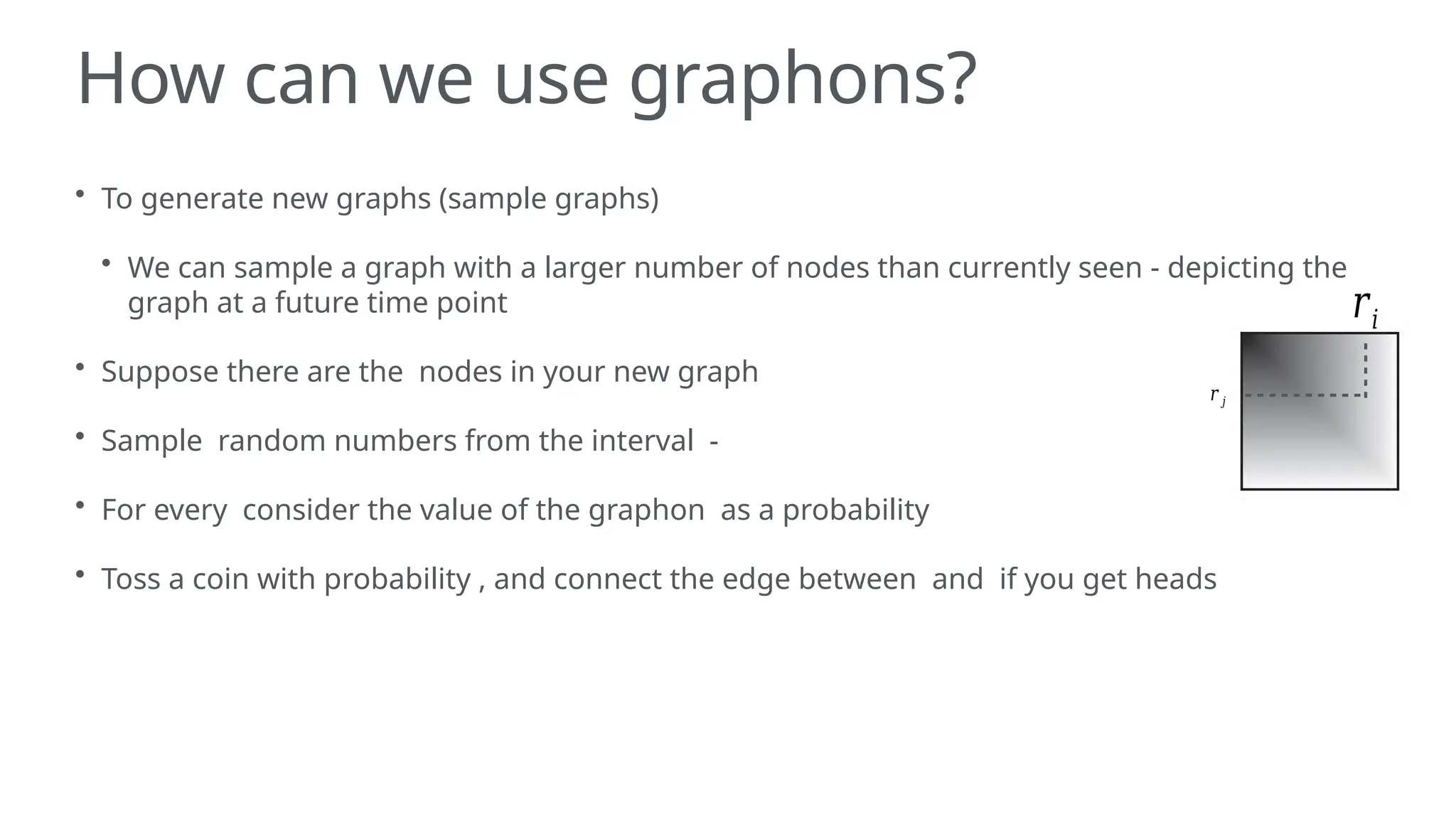
• To generate new graphs (sample graphs)
• We can sample a graph with a larger number of nodes than currently seen - depicting the
graph at a future time point
• Suppose there are the nodes in your new graph
• Sample random numbers from the interval -
• For every consider the value of the graphon as a probability
• Toss a coin with probability , and connect the edge between and if you get heads
𝑟𝑖
𝑟 𝑗
The problem, again
• When , sampled graphs are empty.
• Is it rare to get No, for sparse graphs . Most real-world graphs are sparse.
• This graphon can’t be used to understand sparse graphs.
Empirical graphons Graphon
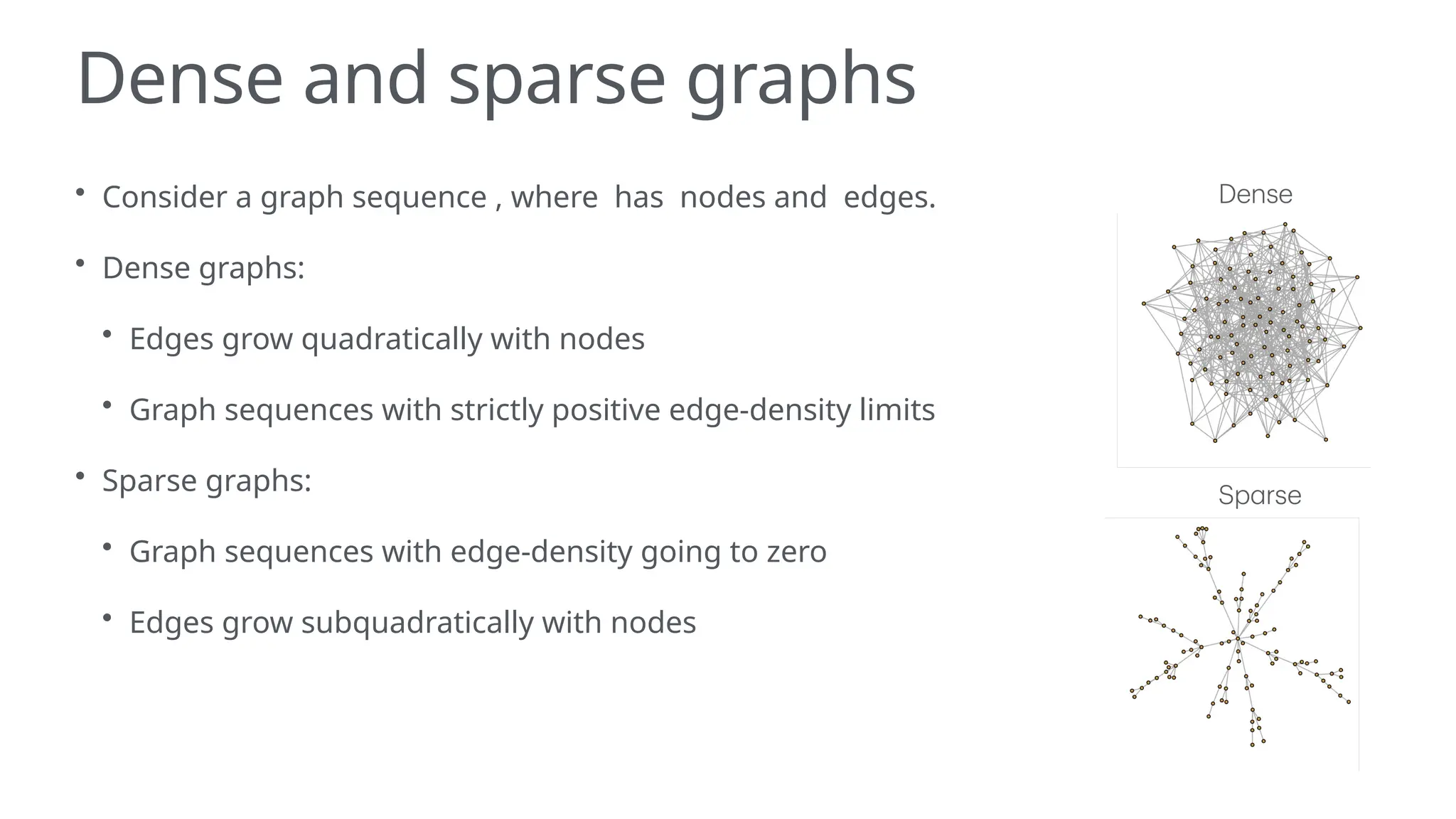
Dense and sparse graphs
• Consider a graph sequence , where has nodes and edges.
• Dense graphs:
• Edges grow quadratically with nodes
• Graph sequences with strictly positive edge-density limits
• Sparse graphs:
• Graph sequences with edge-density going to zero
• Edges grow subquadratically with nodes
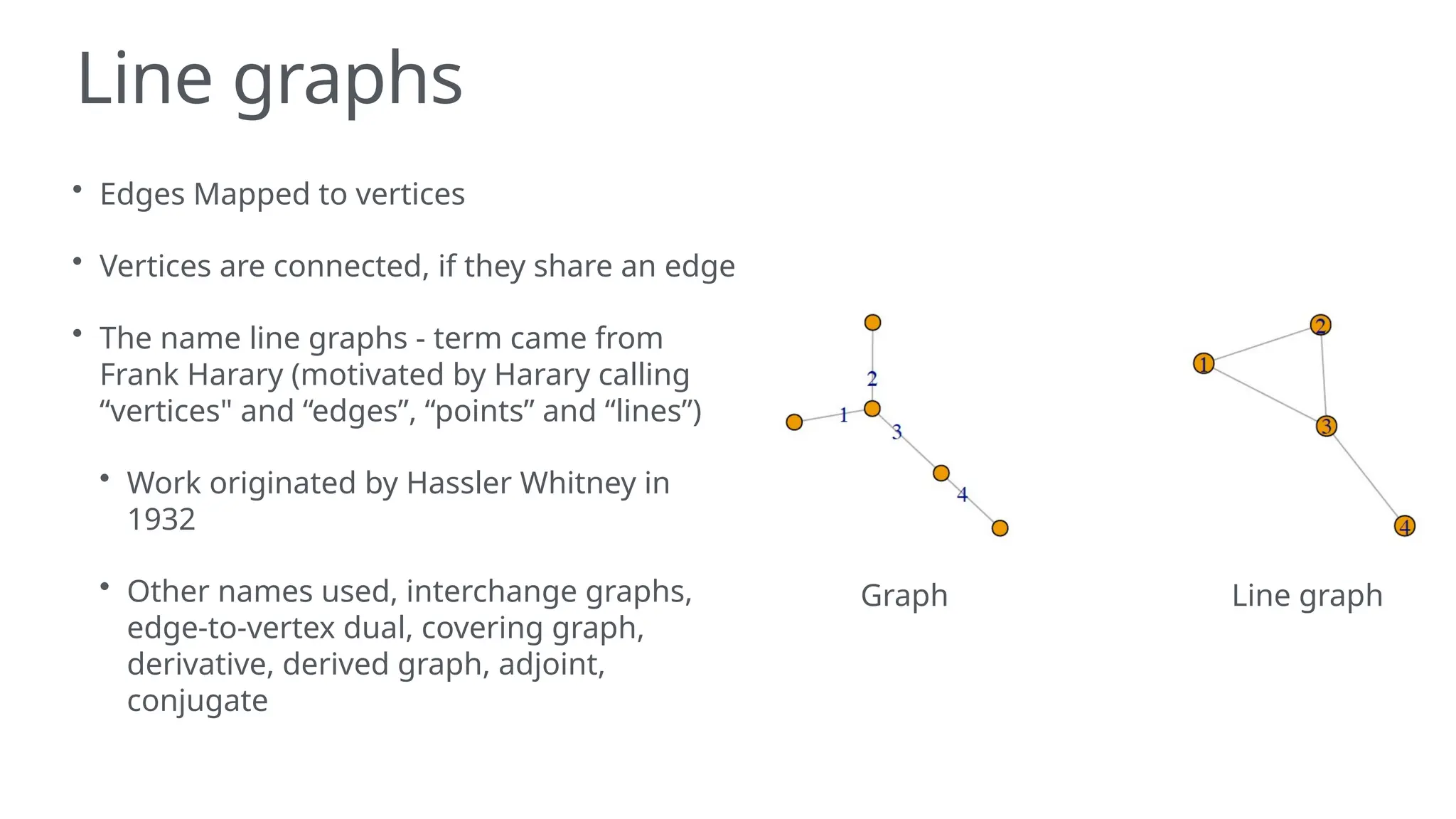
Line graphs
• Edges Mapped to vertices
• Vertices are connected, if they share an edge
• The name line graphs - term came from
Frank Harary (motivated by Harary calling
“vertices" and “edges”, “points” and “lines”)
• Work originated by Hassler Whitney in
1932
• Other names used, interchange graphs,
edge-to-vertex dual, covering graph,
derivative, derived graph, adjoint,
conjugate
Graph Line graph
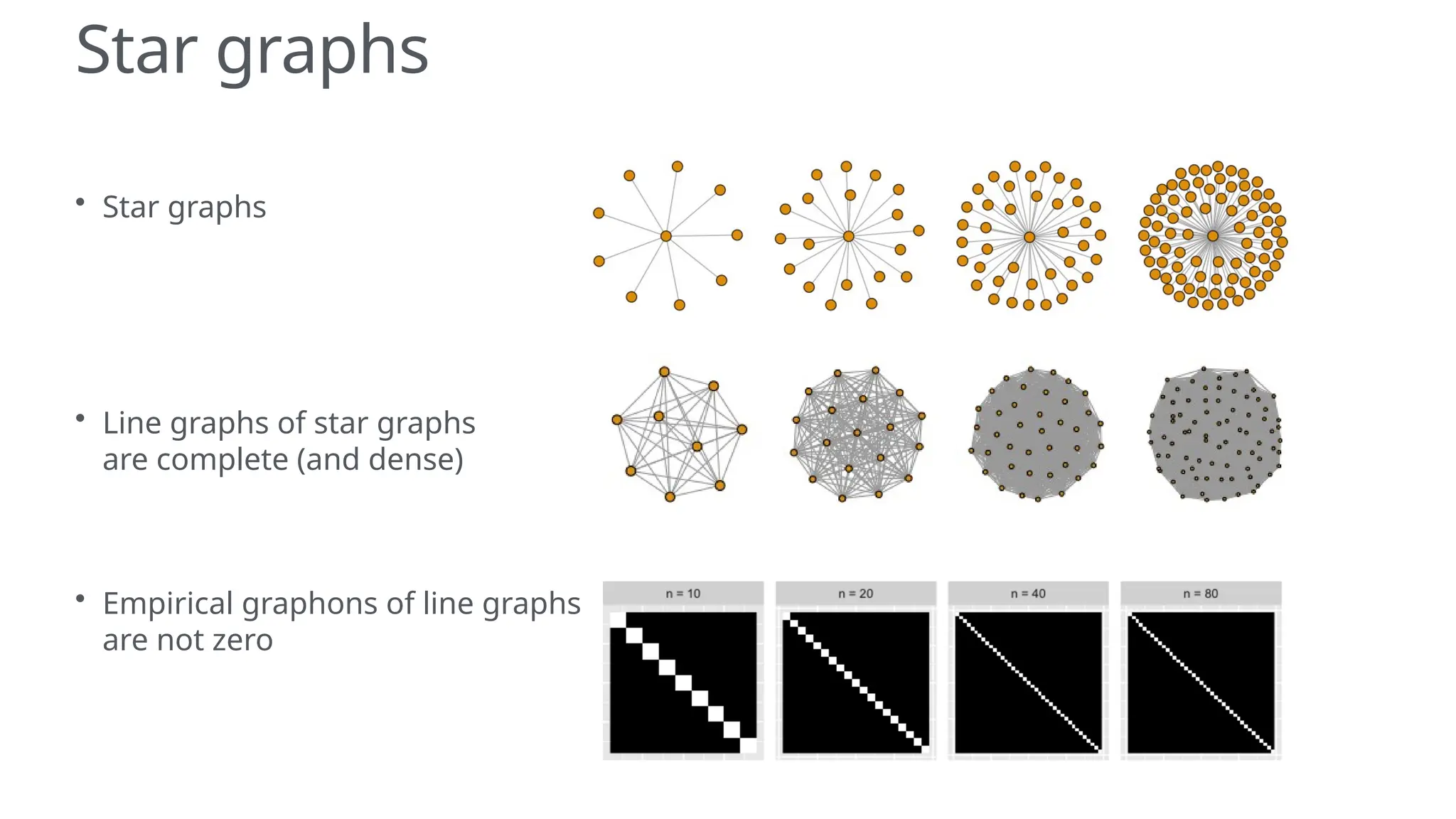
Star graphs
• Star graphs
• Line graphs of star graphs
are complete (and dense)
• Empirical graphons of line graphs
are not zero
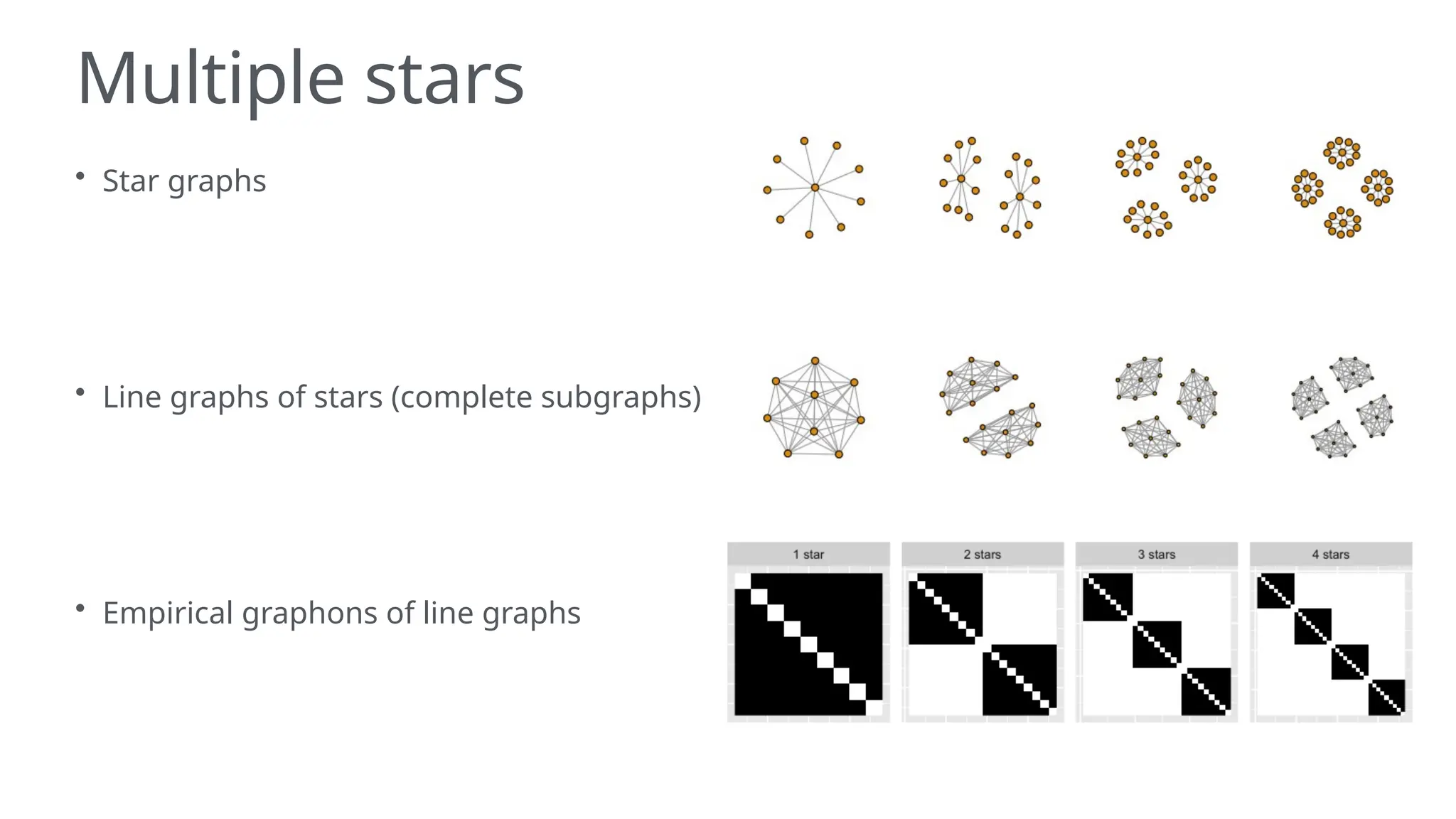
Multiple stars
• Star graphs
• Line graphs of stars (complete subgraphs)
• Empirical graphons of line graphs
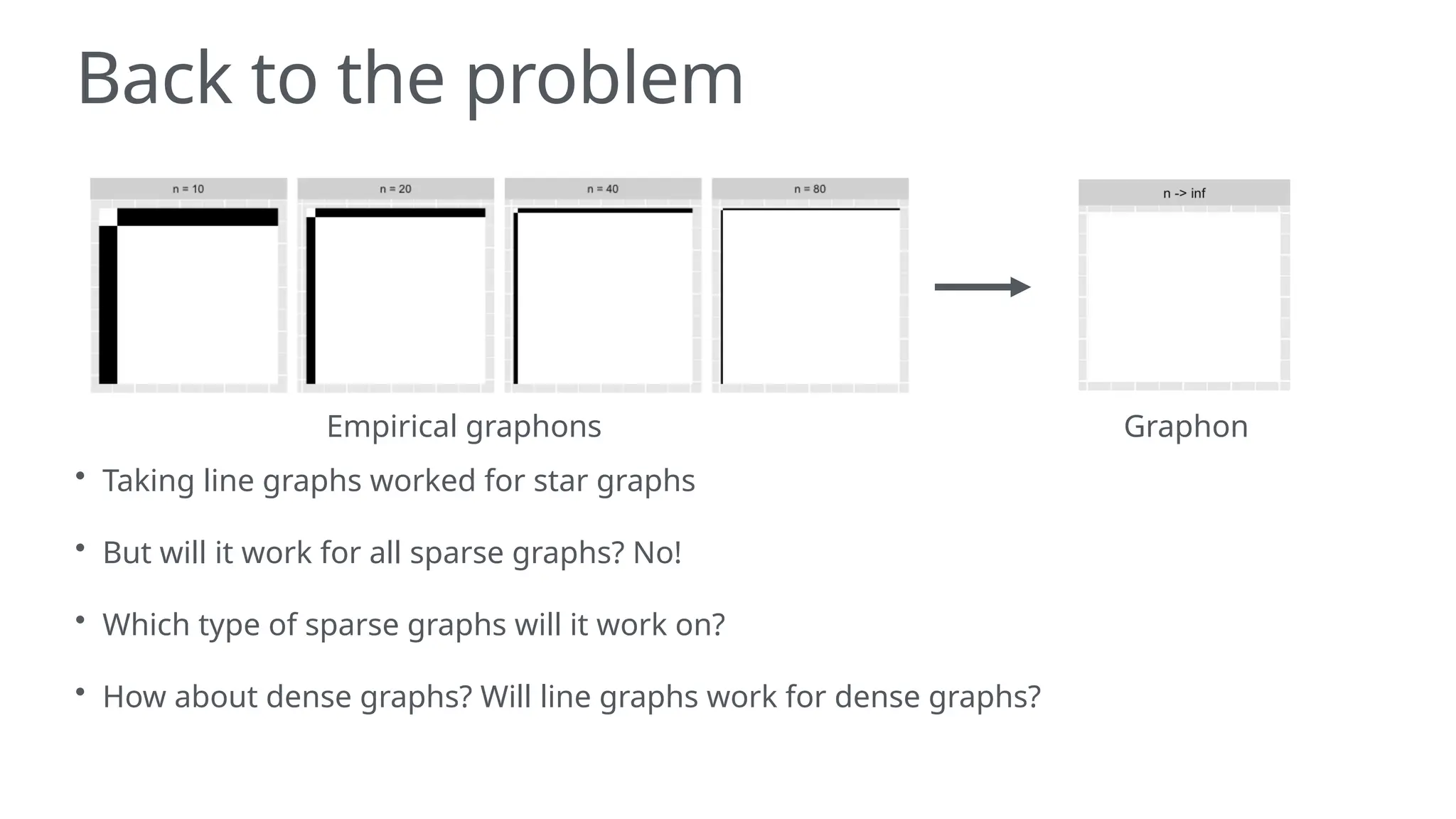
Back to the problem
• Taking line graphs worked for star graphs
• But will it work for all sparse graphs? No!
• Which type of sparse graphs will it work on?
• How about dense graphs? Will line graphs work for dense graphs?
Empirical graphons Graphon
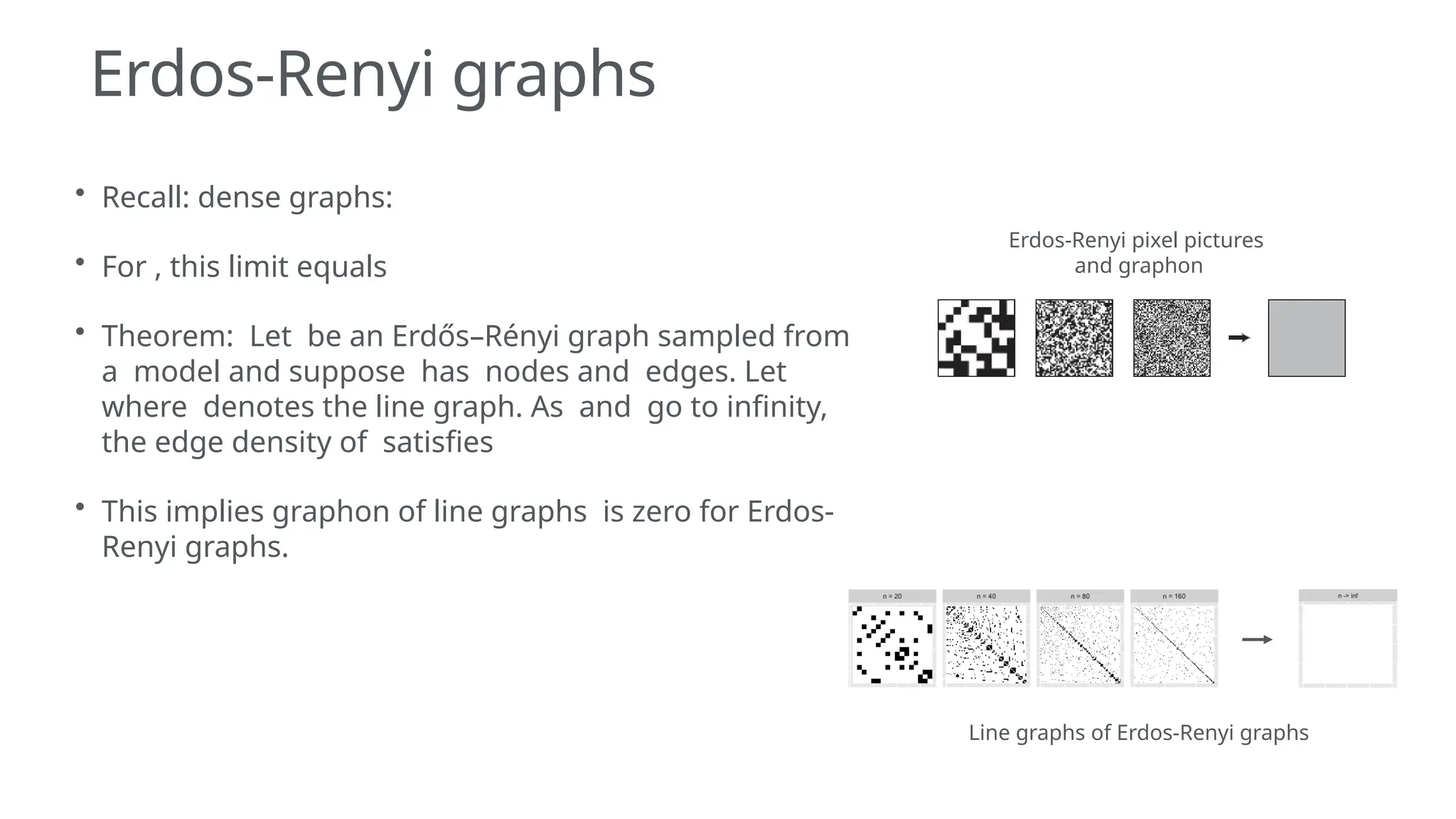
Erdos-Renyi graphs
• Recall: dense graphs:
• For , this limit equals
• Theorem: Let be an Erdős–Rényi graph sampled from
a model and suppose has nodes and edges. Let
where denotes the line graph. As and go to infinity,
the edge density of satisfies
• This implies graphon of line graphs is zero for Erdos-
Renyi graphs.
Erdos-Renyi pixel pictures
and graphon
Line graphs of Erdos-Renyi graphs
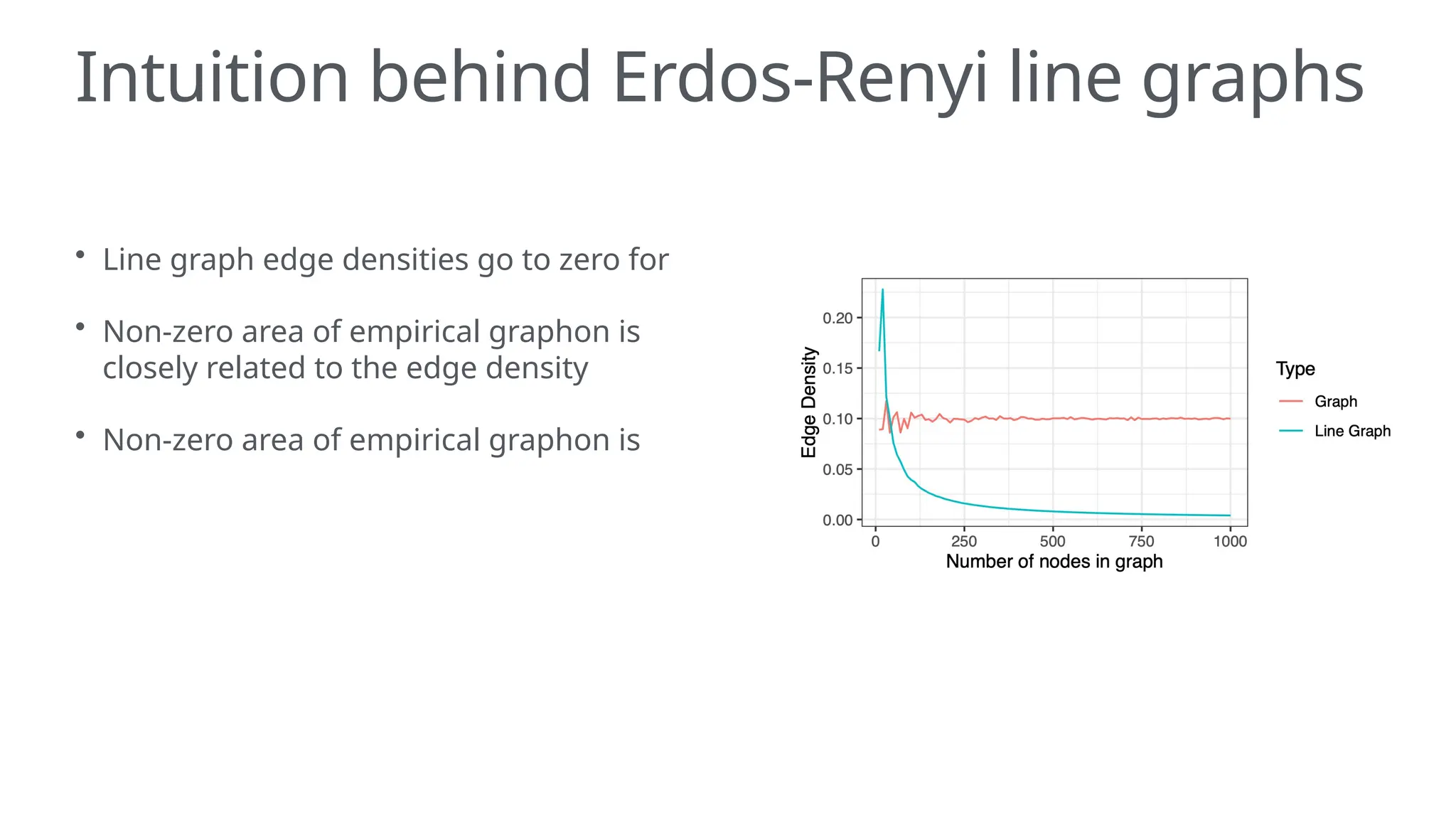
Intuition behind Erdos-Renyi line graphs
• Line graph edge densities go to zero for
• Non-zero area of empirical graphon is
closely related to the edge density
• Non-zero area of empirical graphon is
Back to the problem
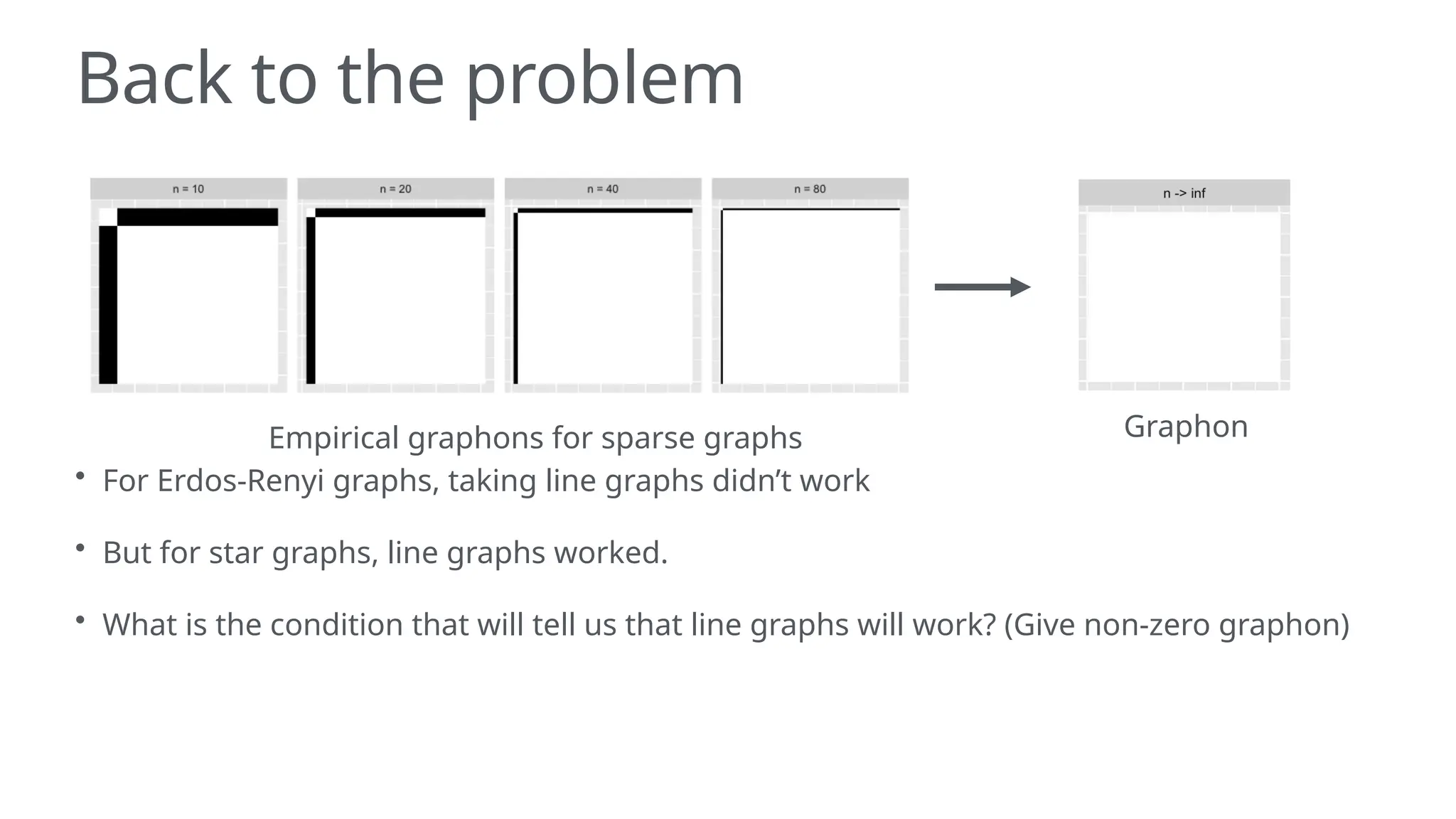
• For Erdos-Renyi graphs, taking line graphs didn’t work
• But for star graphs, line graphs worked.
• What is the condition that will tell us that line graphs will work? (Give non-zero graphon)
Empirical graphons for sparse graphs Graphon
Square-degree property
• (Sum of degree squares) (square of sum of degrees) for and
• Let denote a sequence of graphs. We say that exhibits the square-degree property if
there exists some and such that for all we have
• We denote the set of graph sequences satisfying the square-degree property by
Where does square-degree come from?
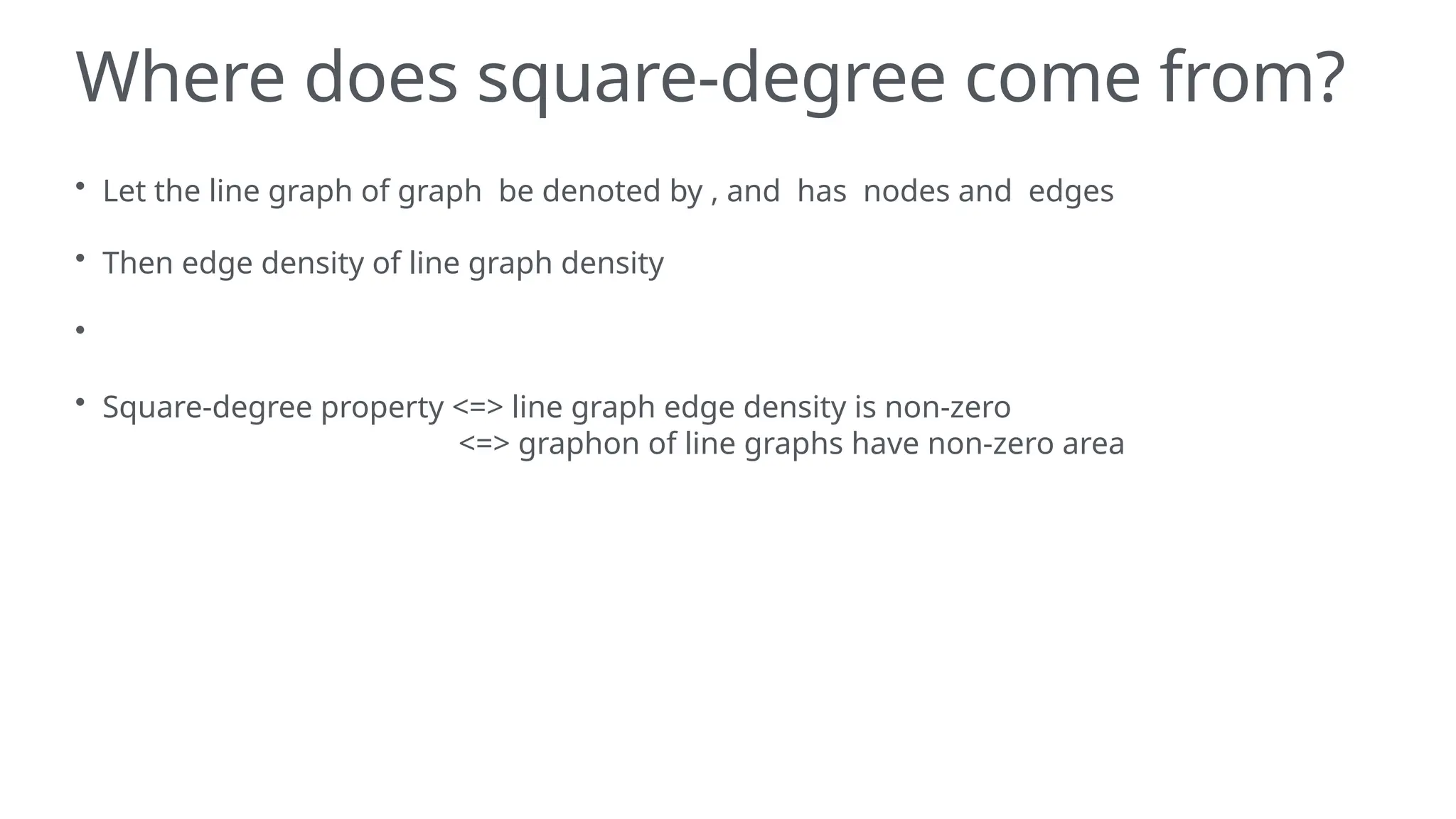
• Let the line graph of graph be denoted by , and has nodes and edges
• Then edge density of line graph density
•
• Square-degree property <=> line graph edge density is non-zero
<=> graphon of line graphs have non-zero area
What kind of graphs are square-degree?
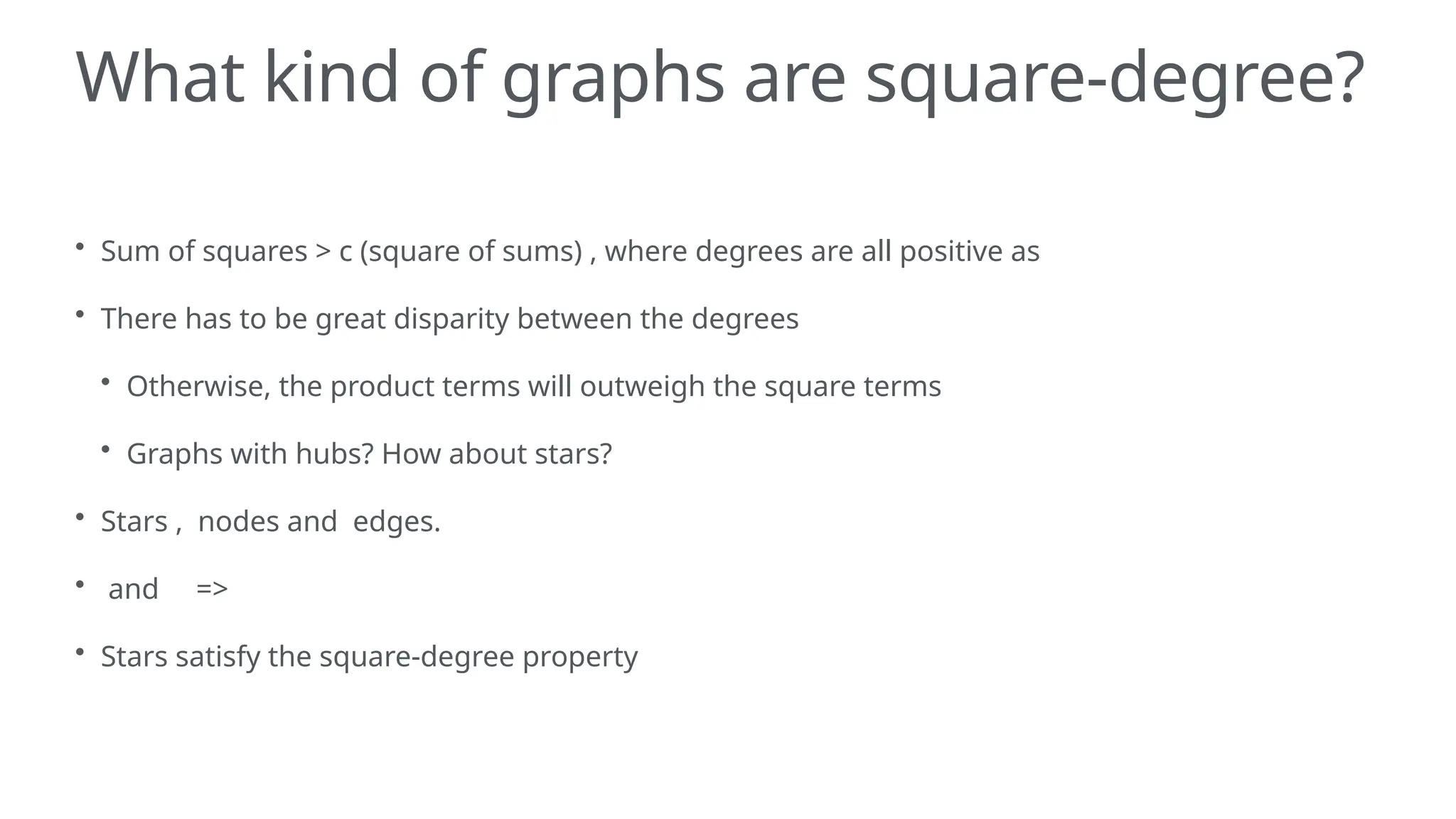
• Sum of squares > c (square of sums) , where degrees are all positive as
• There has to be great disparity between the degrees
• Otherwise, the product terms will outweigh the square terms
• Graphs with hubs? How about stars?
• Stars , nodes and edges.
• and =>
• Stars satisfy the square-degree property
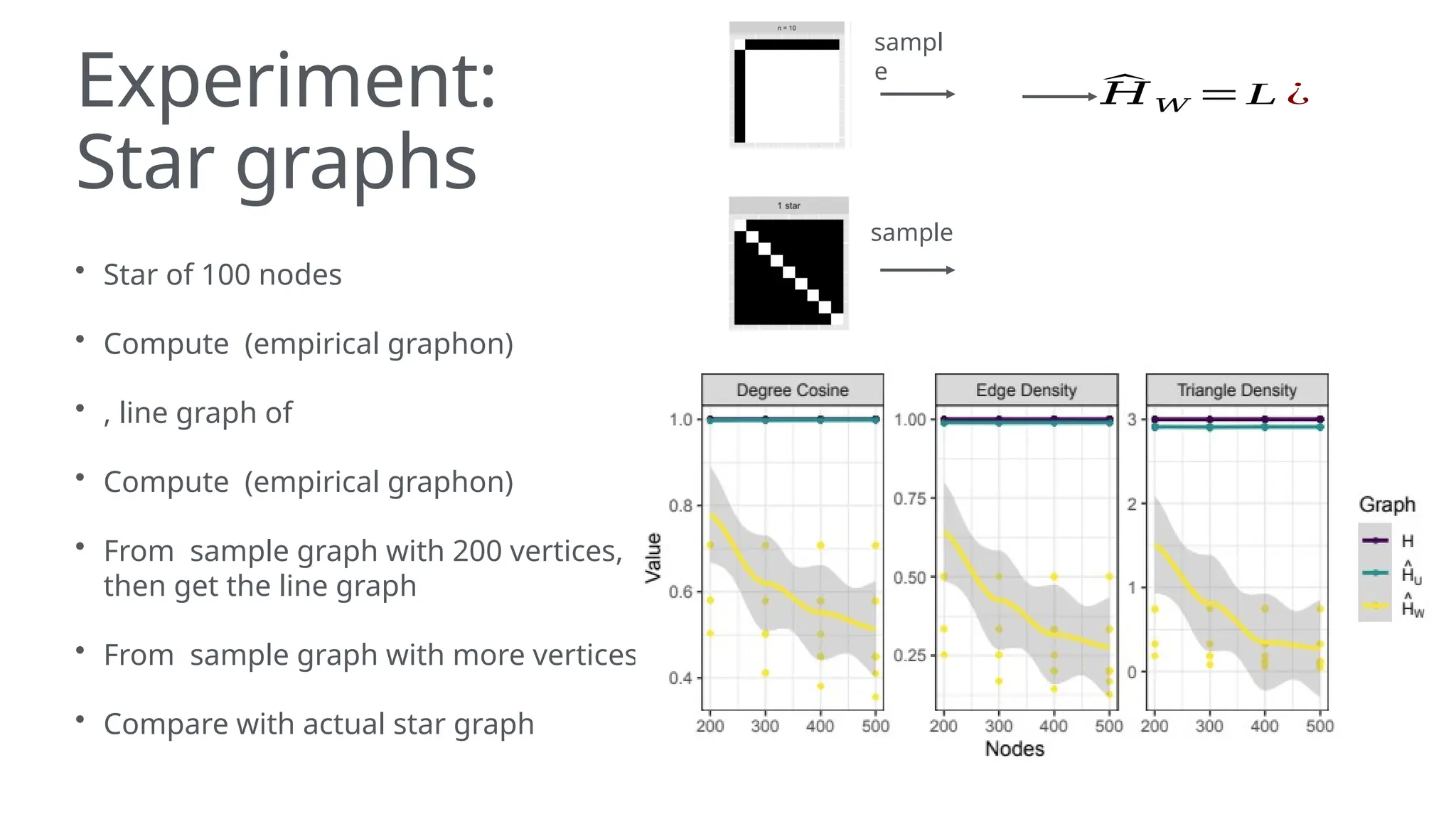
Experiment:
Star graphs
• Star of 100 nodes
• Compute (empirical graphon)
• , line graph of
• Compute (empirical graphon)
• From sample graph with 200 vertices,
then get the line graph
• From sample graph with more vertices
• Compare with actual star graph
^
𝐻𝑊 = L ¿
sampl
e
sample
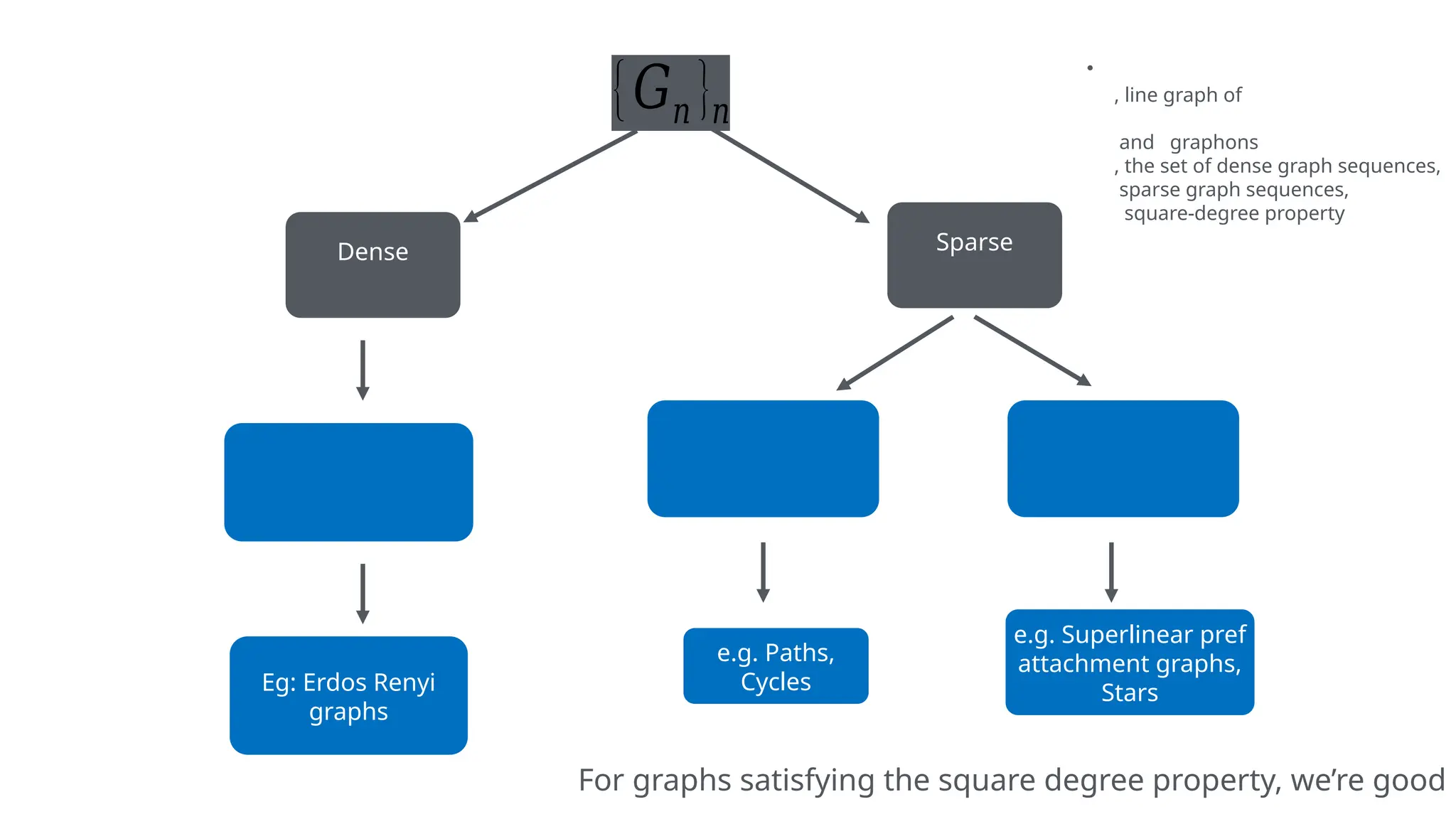
{𝐺𝑛 }𝑛
Dense
Eg: Erdos Renyi
graphs
e.g. Paths,
Cycles
e.g. Superlinear pref
attachment graphs,
Stars
Sparse
•
, line graph of
and graphons
, the set of dense graph sequences,
sparse graph sequences,
square-degree property
For graphs satisfying the square degree property, we’re good
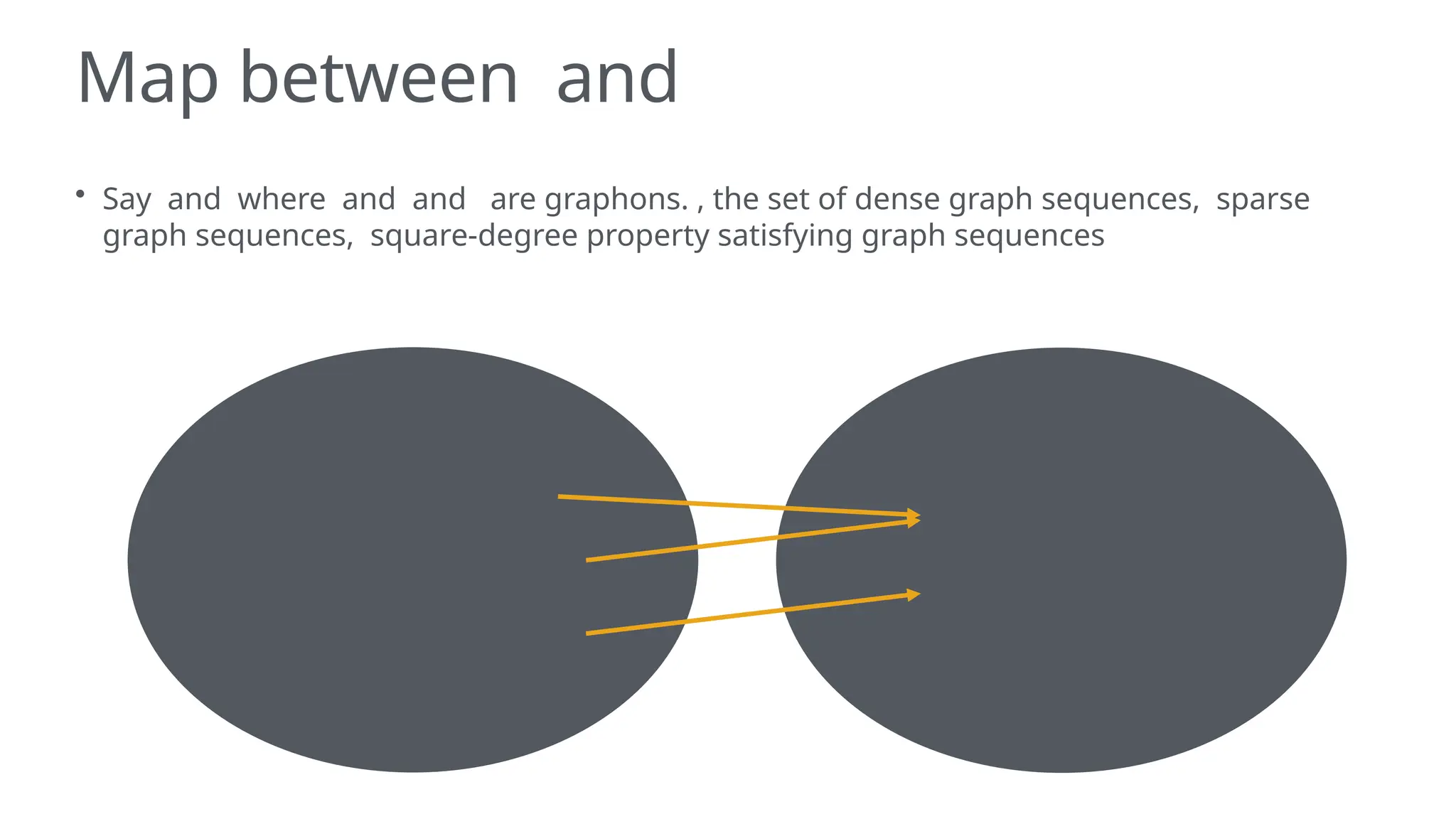
Map between and
• Say and where and and are graphons. , the set of dense graph sequences, sparse
graph sequences, square-degree property satisfying graph sequences
Bird’s-eye view
• Graphons for Sparse graphs
• Work by Caron and Fox
• Many methods led by Borgs and Chayes
• Work by Janson and others
• These methods have complex mathematical machinery
• Why? Because standard construction for sparse graphs give graphons with point masses
with measure zero
• The difference in our work
• Line graphs enable us to use the standard path for dense graphons
Thank you!
Preprint:
https://web3.arxiv.org/
abs/2409.01656
Extra slides
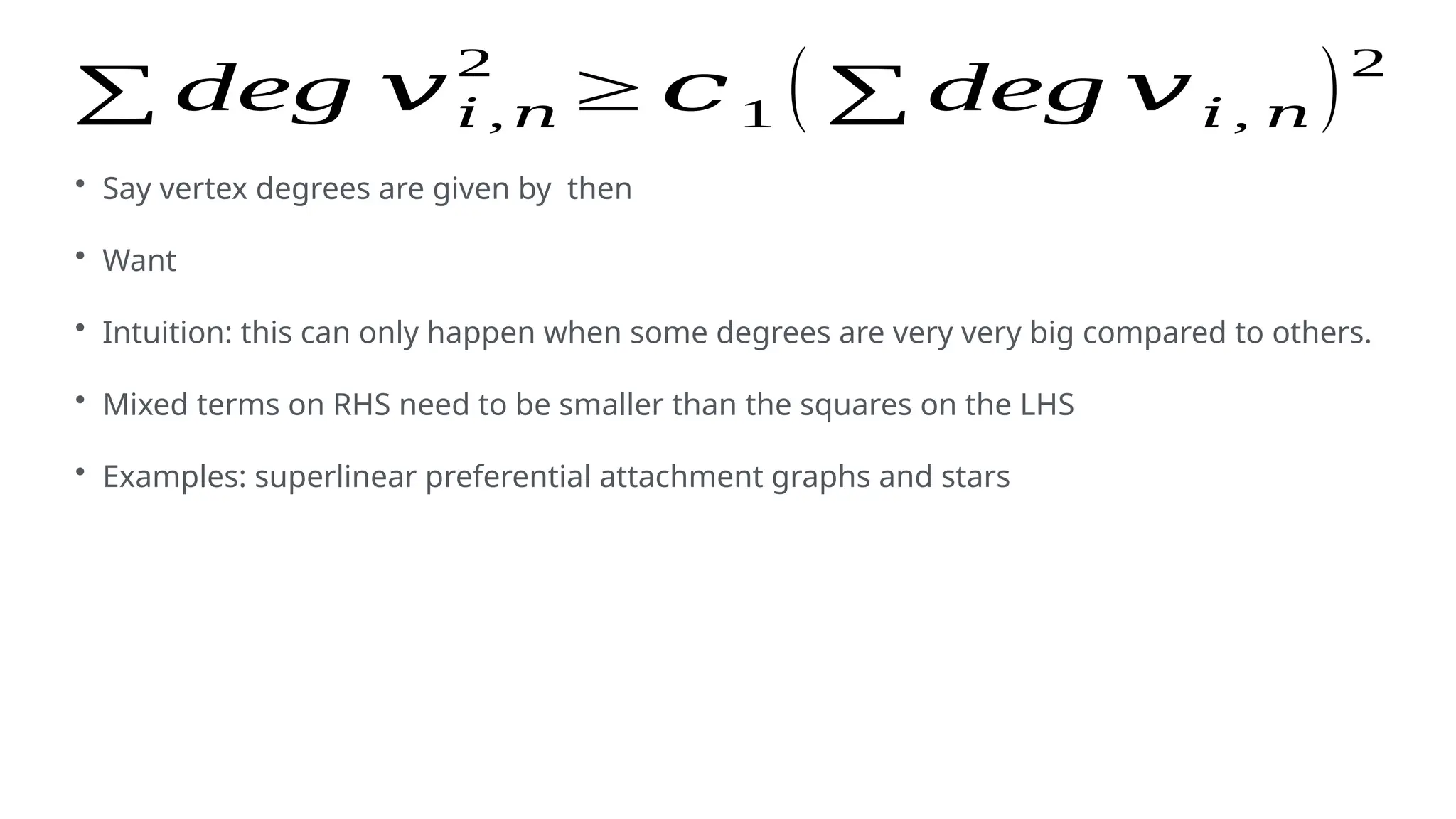
∑ deg 𝑣𝑖 ,𝑛
2
≥ 𝑐1 ( ∑ deg 𝑣𝑖 , 𝑛 )2
• Say vertex degrees are given by then
• Want
• Intuition: this can only happen when some degrees are very very big compared to others.
• Mixed terms on RHS need to be smaller than the squares on the LHS
• Examples: superlinear preferential attachment graphs and stars
Limitations of the graphon
• Graphs sampled from the graphon are either dense or empty graphs (consequence of
Aldous-Hoover theorem)
• If non-zero area of graphon > 0
• Sampled graphs are dense
• If non-zero area of graphon = 0 (graphon )
• Graphs are empty
Existing work on sparse graphs
• Work by Caron and Fox
• Kallenberg exchangeability and Levy measures
• Many methods led by Borgs and Chayes
• Rescaled and stretched graphons, Graphexes
• Work by Janson and others
• Edge exchangeable graphs
• These methods have complex mathematical machinery
How does the graphon come in?
• Theorem (Borgs et al. 2008)
• converges iff there is a such that .
• And for every there is a convergent sequence of graphs like above.
Borgs, C., Chayes, J. T., Lovász, L., Sós, V. T., & Vesztergombi, K. (2008). Convergent sequences of
dense graphs I: Subgraph frequencies, metric properties and testing. Advances in Mathematics,
219(6), 1801–1851. https://doi.org/10.1016/j.aim.2008.07.008
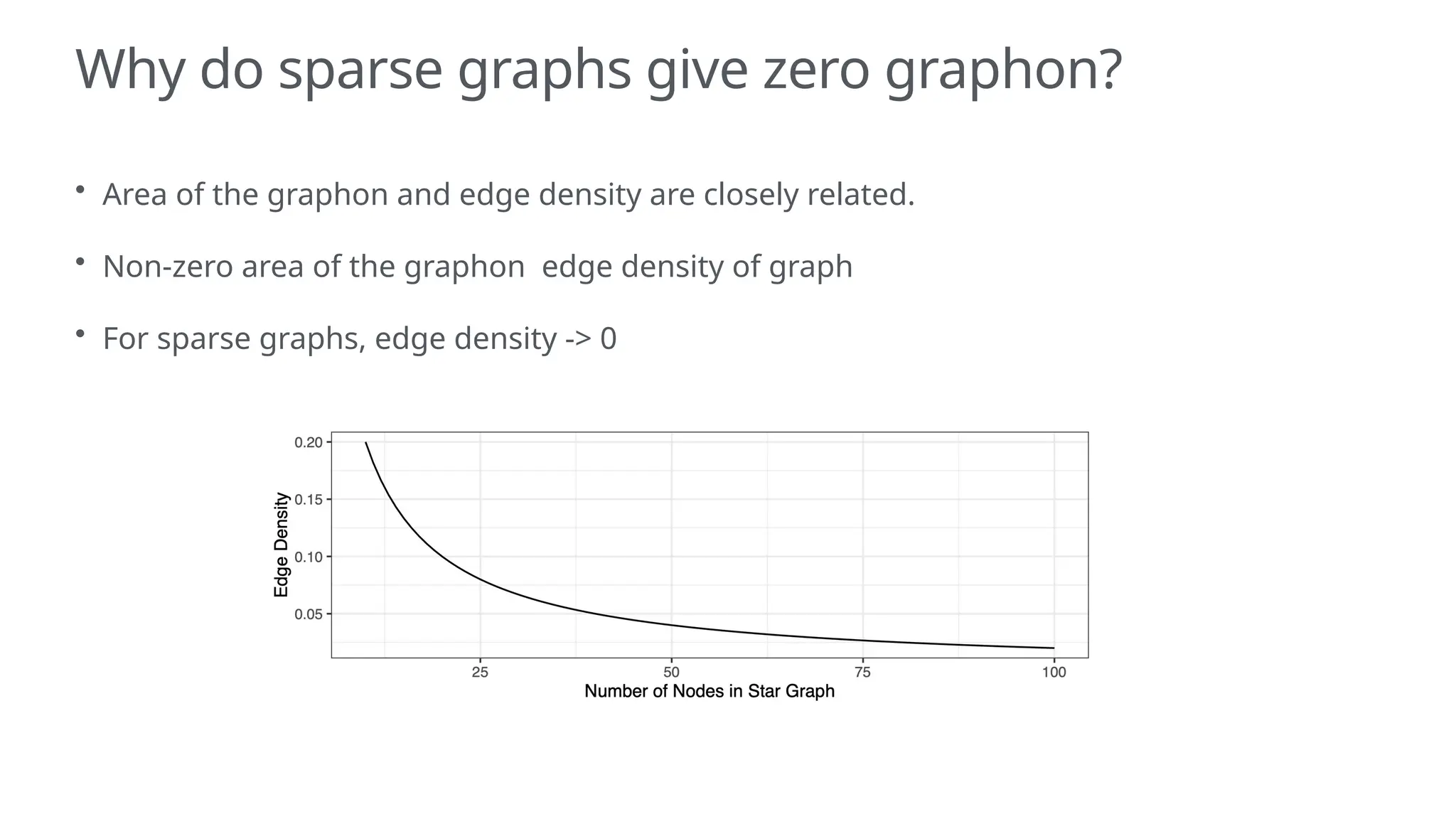
Why do sparse graphs give zero graphon?
• Area of the graphon and edge density are closely related.
• Non-zero area of the graphon edge density of graph
• For sparse graphs, edge density -> 0
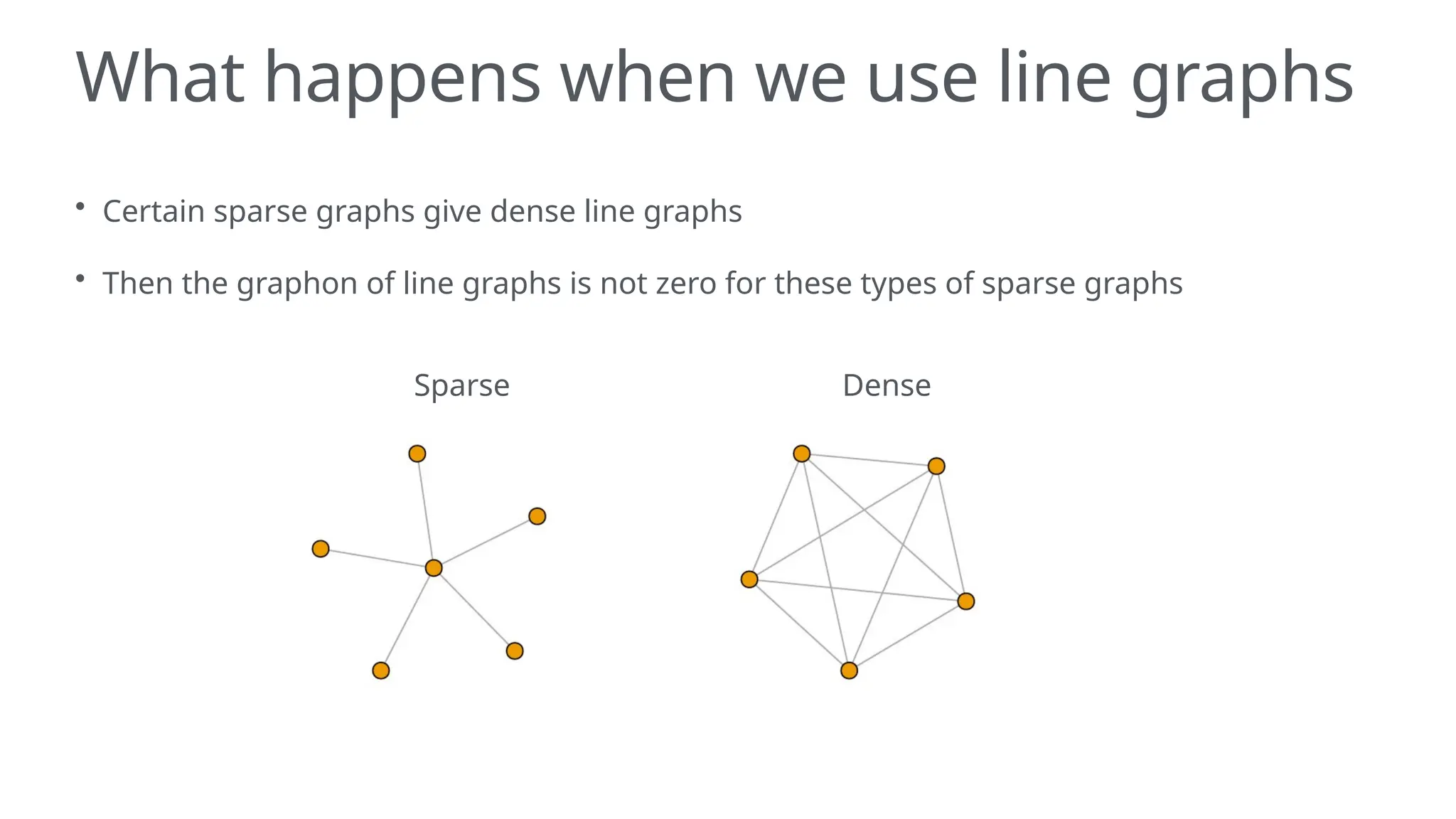
What happens when we use line graphs
• Certain sparse graphs give dense line graphs
• Then the graphon of line graphs is not zero for these types of sparse graphs
Sparse Dense
Square-degree graphs are sparse
• This implies (definition of Sparse)
Are all sparse graphs square-degree?
• No! Paths, Cycles, r-regular graph sequences.
• If is dense, then
Dense
graphs Square-
degree
Sparse graphs
Square-degree result
• Theorem: Let be a sparse graph sequence. Let be the corresponding sequence of line
graphs with . Then , i.e., satisfies if and only if is dense.
• - the set of sparse graph sequences
• - the set of square-degree graph sequences
• - the set of dense graph sequences
• - square-degree condition
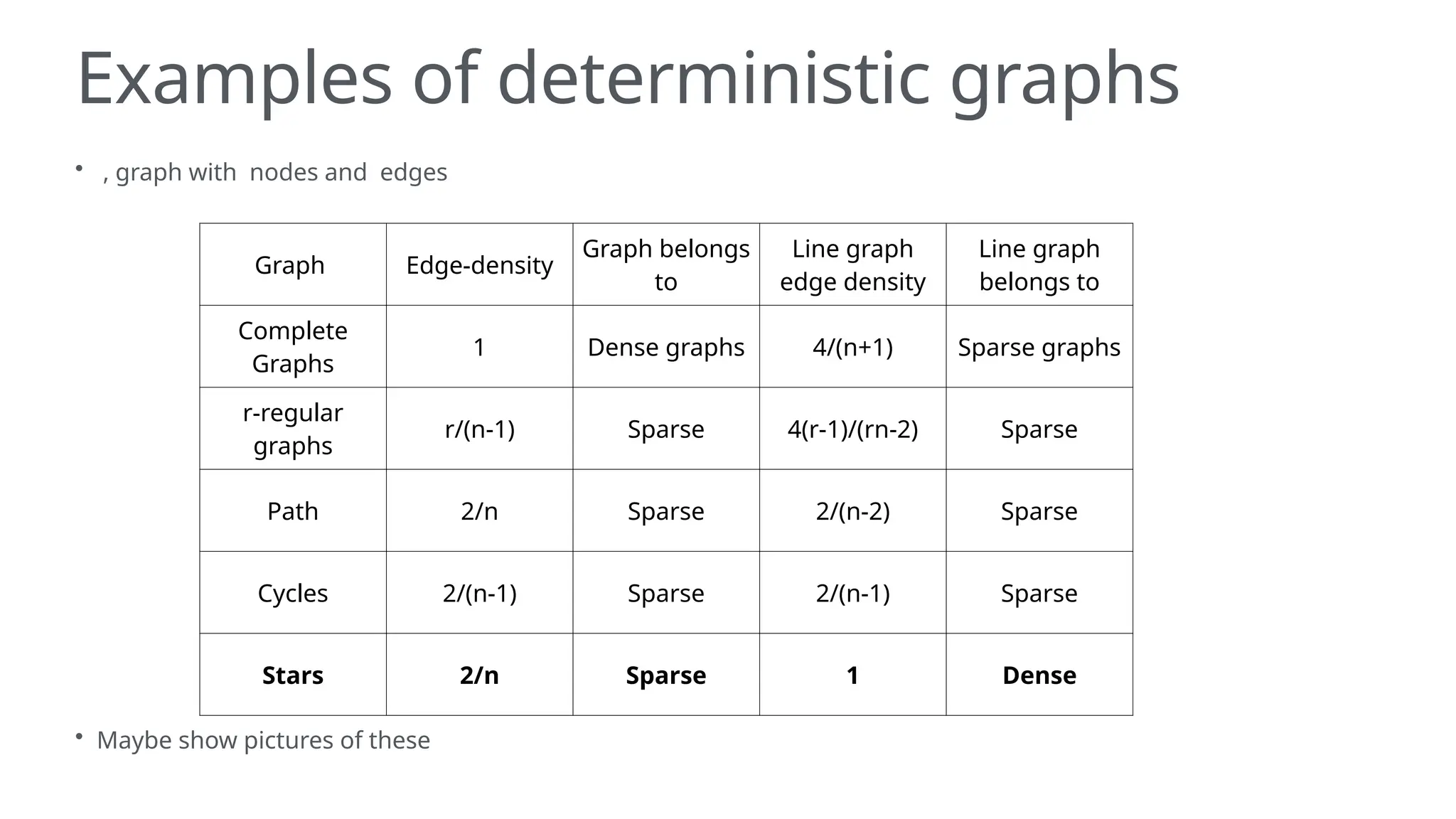
Examples of deterministic graphs
• , graph with nodes and edges
• Maybe show pictures of these
Graph Edge-density
Graph belongs
to
Line graph
edge density
Line graph
belongs to
Complete
Graphs
1 Dense graphs 4/(n+1) Sparse graphs
r-regular
graphs
r/(n-1) Sparse 4(r-1)/(rn-2) Sparse
Path 2/n Sparse 2/(n-2) Sparse
Cycles 2/(n-1) Sparse 2/(n-1) Sparse
Stars 2/n Sparse 1 Dense
Preferential Attachment Graphs
• New nodes connect to more connected nodes
• The probability that a new node connects to node , which has degree is given by
• Maximum degree
• Three regimes of : sublinear , linear , and superlinear
• Sethuraman & Venkataramani (2019) show that for ,
Sethuraman, S., & Venkataramani, S. C. (2019). On the Growth of a Superlinear Preferential Attachment Scheme. Springer Proceedings in Mathematics
and Statistics, 283, 243–265. https://doi.org/10.1007/978-3-030-15338-0_9
Superlinear pref. attachment
• Using this result we show
• Lemma: Let denote a sequence of graphs growing by superlinear preferential
attachment with . Then almost surely.
• Say and where and and are graphons.
• If is a superlinear pref. attachment graph sequence, then
Thank you!

Graphons of Line Graphs Talk at Uni Sydney

  • 1.
    Statistics Seminar, Universityof Sydney, 30 September 2024 Sevvandi Kandanaarachchi, Cheng Soon Ong CSIRO’s Data61 Graphons of Line Graphs
  • 2.
    Growing graphs/networks Social medianetworks Career networks – LinkedIn Grow over time Computer networks – WWW Graphons can be used to model these networks if certain conditions are satisfied. Graphons have nice mathematical properties.
  • 3.
    Star graphs • Stargraphs • Adjacency matrix pixel pictures ones - black zeros - white (Empirical graphons)
  • 4.
    The problem • Pixelpictures (empirical graphons) converge to zero Empirical graphons Graphon
  • 5.
    What are graphons? •Graph limits • Examples from What is a graphon? By Daniel Glasscock Erdos-Renyi graphs Growing uniform attachment graphs Bi-partite graphs
  • 6.
    Mathematically what isa graphon? • Graphon is a symmetric measurable function • A function defined on a unit square • Empirical graphon: when you colour in the squares of the adjacency matrix and scale it to [0, 1] • Empirical graphon of graph , is . • Graphs converging to graphons • How is convergence defined? • Graph homomorphisms and homomorphism densities Empirical graphons Graphon
  • 7.
    Graph homomorphism -convergence • A graph homomorphism from to is a map such that if then (Maps edges to edges). Let be the set of all such homomorphisms and let . Then homomorphism density is defined as • • A graph sequence is said to be convergent if converges as goes to infinity for any simple graph .
  • 8.
    Convergence - cutmetric • The cut norm of a graphon is defined as where supremum is taken over all measurable sets and of • Given two graphons and , the cut metric is defined as where is a measure preserving bijection from to . • Why ? Because nodes can be re-named or permuted. • Convergence in homomorphism density is equivalent to convergence in cut-metric. (Borgs et al 2011) • If a graph sequence converges (cut metric or hom. density) we have a graphon.
  • 9.
    How can weuse graphons? • To generate new graphs (sample graphs) • We can sample a graph with a larger number of nodes than currently seen - depicting the graph at a future time point • Suppose there are the nodes in your new graph • Sample random numbers from the interval - • For every consider the value of the graphon as a probability • Toss a coin with probability , and connect the edge between and if you get heads 𝑟𝑖 𝑟 𝑗
  • 10.
    The problem, again •When , sampled graphs are empty. • Is it rare to get No, for sparse graphs . Most real-world graphs are sparse. • This graphon can’t be used to understand sparse graphs. Empirical graphons Graphon
  • 11.
    Dense and sparsegraphs • Consider a graph sequence , where has nodes and edges. • Dense graphs: • Edges grow quadratically with nodes • Graph sequences with strictly positive edge-density limits • Sparse graphs: • Graph sequences with edge-density going to zero • Edges grow subquadratically with nodes
  • 12.
    Line graphs • EdgesMapped to vertices • Vertices are connected, if they share an edge • The name line graphs - term came from Frank Harary (motivated by Harary calling “vertices" and “edges”, “points” and “lines”) • Work originated by Hassler Whitney in 1932 • Other names used, interchange graphs, edge-to-vertex dual, covering graph, derivative, derived graph, adjoint, conjugate Graph Line graph
  • 13.
    Star graphs • Stargraphs • Line graphs of star graphs are complete (and dense) • Empirical graphons of line graphs are not zero
  • 14.
    Multiple stars • Stargraphs • Line graphs of stars (complete subgraphs) • Empirical graphons of line graphs
  • 15.
    Back to theproblem • Taking line graphs worked for star graphs • But will it work for all sparse graphs? No! • Which type of sparse graphs will it work on? • How about dense graphs? Will line graphs work for dense graphs? Empirical graphons Graphon
  • 16.
    Erdos-Renyi graphs • Recall:dense graphs: • For , this limit equals • Theorem: Let be an Erdős–Rényi graph sampled from a model and suppose has nodes and edges. Let where denotes the line graph. As and go to infinity, the edge density of satisfies • This implies graphon of line graphs is zero for Erdos- Renyi graphs. Erdos-Renyi pixel pictures and graphon Line graphs of Erdos-Renyi graphs
  • 17.
    Intuition behind Erdos-Renyiline graphs • Line graph edge densities go to zero for • Non-zero area of empirical graphon is closely related to the edge density • Non-zero area of empirical graphon is
  • 18.
    Back to theproblem • For Erdos-Renyi graphs, taking line graphs didn’t work • But for star graphs, line graphs worked. • What is the condition that will tell us that line graphs will work? (Give non-zero graphon) Empirical graphons for sparse graphs Graphon
  • 19.
    Square-degree property • (Sumof degree squares) (square of sum of degrees) for and • Let denote a sequence of graphs. We say that exhibits the square-degree property if there exists some and such that for all we have • We denote the set of graph sequences satisfying the square-degree property by
  • 20.
    Where does square-degreecome from? • Let the line graph of graph be denoted by , and has nodes and edges • Then edge density of line graph density • • Square-degree property <=> line graph edge density is non-zero <=> graphon of line graphs have non-zero area
  • 21.
    What kind ofgraphs are square-degree? • Sum of squares > c (square of sums) , where degrees are all positive as • There has to be great disparity between the degrees • Otherwise, the product terms will outweigh the square terms • Graphs with hubs? How about stars? • Stars , nodes and edges. • and => • Stars satisfy the square-degree property
  • 22.
    Experiment: Star graphs • Starof 100 nodes • Compute (empirical graphon) • , line graph of • Compute (empirical graphon) • From sample graph with 200 vertices, then get the line graph • From sample graph with more vertices • Compare with actual star graph ^ 𝐻𝑊 = L ¿ sampl e sample
  • 23.
    {𝐺𝑛 }𝑛 Dense Eg: ErdosRenyi graphs e.g. Paths, Cycles e.g. Superlinear pref attachment graphs, Stars Sparse • , line graph of and graphons , the set of dense graph sequences, sparse graph sequences, square-degree property For graphs satisfying the square degree property, we’re good
  • 24.
    Map between and •Say and where and and are graphons. , the set of dense graph sequences, sparse graph sequences, square-degree property satisfying graph sequences
  • 25.
    Bird’s-eye view • Graphonsfor Sparse graphs • Work by Caron and Fox • Many methods led by Borgs and Chayes • Work by Janson and others • These methods have complex mathematical machinery • Why? Because standard construction for sparse graphs give graphons with point masses with measure zero • The difference in our work • Line graphs enable us to use the standard path for dense graphons
  • 26.
  • 27.
  • 28.
    ∑ deg 𝑣𝑖,𝑛 2 ≥ 𝑐1 ( ∑ deg 𝑣𝑖 , 𝑛 )2 • Say vertex degrees are given by then • Want • Intuition: this can only happen when some degrees are very very big compared to others. • Mixed terms on RHS need to be smaller than the squares on the LHS • Examples: superlinear preferential attachment graphs and stars
  • 29.
    Limitations of thegraphon • Graphs sampled from the graphon are either dense or empty graphs (consequence of Aldous-Hoover theorem) • If non-zero area of graphon > 0 • Sampled graphs are dense • If non-zero area of graphon = 0 (graphon ) • Graphs are empty
  • 30.
    Existing work onsparse graphs • Work by Caron and Fox • Kallenberg exchangeability and Levy measures • Many methods led by Borgs and Chayes • Rescaled and stretched graphons, Graphexes • Work by Janson and others • Edge exchangeable graphs • These methods have complex mathematical machinery
  • 31.
    How does thegraphon come in? • Theorem (Borgs et al. 2008) • converges iff there is a such that . • And for every there is a convergent sequence of graphs like above. Borgs, C., Chayes, J. T., Lovász, L., Sós, V. T., & Vesztergombi, K. (2008). Convergent sequences of dense graphs I: Subgraph frequencies, metric properties and testing. Advances in Mathematics, 219(6), 1801–1851. https://doi.org/10.1016/j.aim.2008.07.008
  • 32.
    Why do sparsegraphs give zero graphon? • Area of the graphon and edge density are closely related. • Non-zero area of the graphon edge density of graph • For sparse graphs, edge density -> 0
  • 33.
    What happens whenwe use line graphs • Certain sparse graphs give dense line graphs • Then the graphon of line graphs is not zero for these types of sparse graphs Sparse Dense
  • 34.
    Square-degree graphs aresparse • This implies (definition of Sparse)
  • 35.
    Are all sparsegraphs square-degree? • No! Paths, Cycles, r-regular graph sequences. • If is dense, then Dense graphs Square- degree Sparse graphs
  • 36.
    Square-degree result • Theorem:Let be a sparse graph sequence. Let be the corresponding sequence of line graphs with . Then , i.e., satisfies if and only if is dense. • - the set of sparse graph sequences • - the set of square-degree graph sequences • - the set of dense graph sequences • - square-degree condition
  • 37.
    Examples of deterministicgraphs • , graph with nodes and edges • Maybe show pictures of these Graph Edge-density Graph belongs to Line graph edge density Line graph belongs to Complete Graphs 1 Dense graphs 4/(n+1) Sparse graphs r-regular graphs r/(n-1) Sparse 4(r-1)/(rn-2) Sparse Path 2/n Sparse 2/(n-2) Sparse Cycles 2/(n-1) Sparse 2/(n-1) Sparse Stars 2/n Sparse 1 Dense
  • 38.
    Preferential Attachment Graphs •New nodes connect to more connected nodes • The probability that a new node connects to node , which has degree is given by • Maximum degree • Three regimes of : sublinear , linear , and superlinear • Sethuraman & Venkataramani (2019) show that for , Sethuraman, S., & Venkataramani, S. C. (2019). On the Growth of a Superlinear Preferential Attachment Scheme. Springer Proceedings in Mathematics and Statistics, 283, 243–265. https://doi.org/10.1007/978-3-030-15338-0_9
  • 39.
    Superlinear pref. attachment •Using this result we show • Lemma: Let denote a sequence of graphs growing by superlinear preferential attachment with . Then almost surely. • Say and where and and are graphons. • If is a superlinear pref. attachment graph sequence, then
  • 40.