Comparison of geostatistical
methods for spatial data
Sevvandi Kandanaarachchi, Spencer Wong, Jennifer Flegg, Nick Golding
AASC 2022
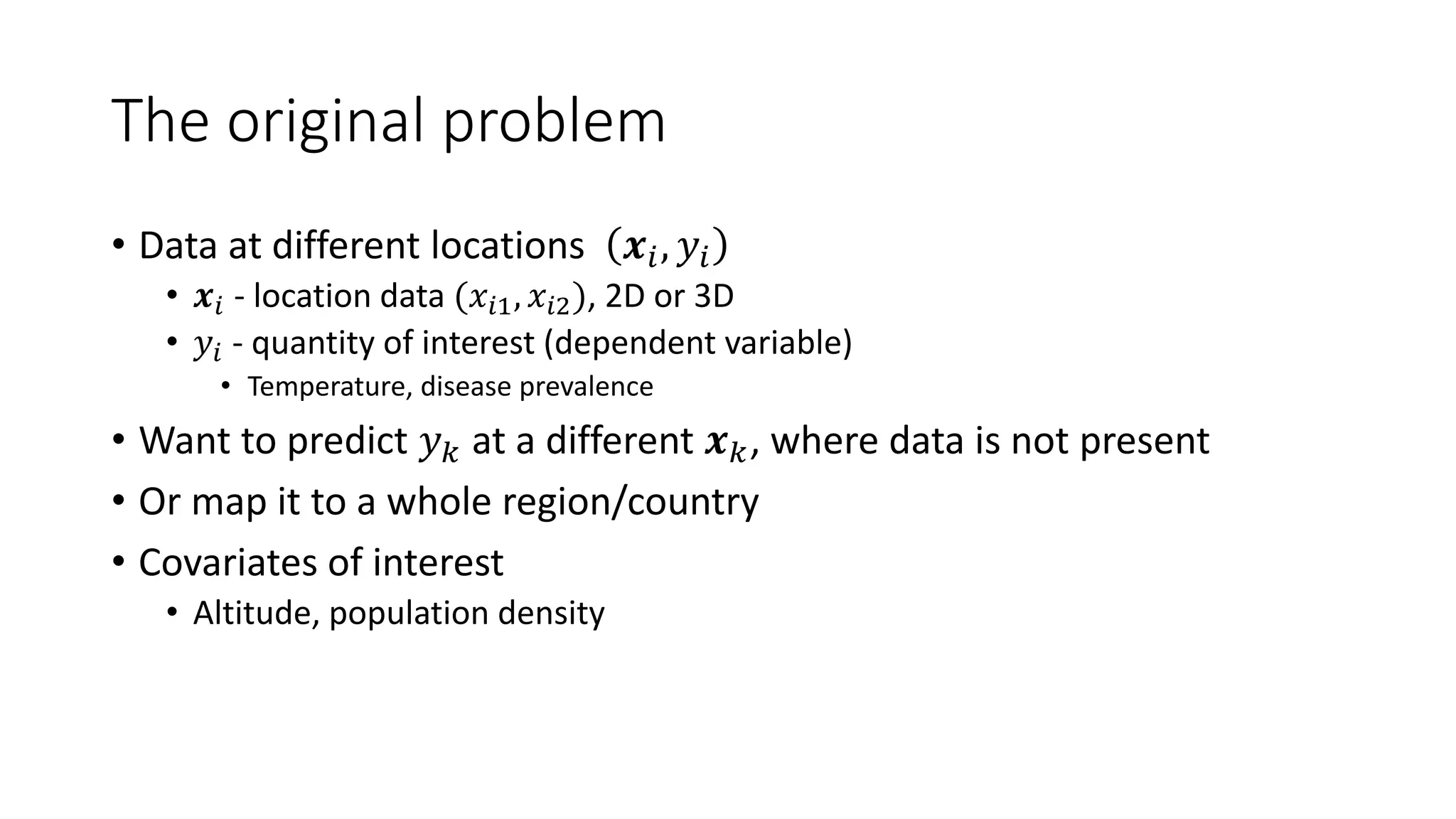
Geospatial data
is everywhere
• Climate
• Disease
• Energy
• Satellite data
Vegetation Index (NASA)
Land surface temperature anomalies(NASA)
Vegetation Index (NASA)
Land surface temperature anomaly (NASA)
The original problem
• Data at different locations 𝒙𝑖, 𝑦𝑖
• 𝒙𝑖 - location data (𝑥𝑖1, 𝑥𝑖2), 2D or 3D
• 𝑦𝑖 - quantity of interest (dependent variable)
• Temperature, disease prevalence
• Want to predict 𝑦𝑘 at a different 𝒙𝑘, where data is not present
• Or map it to a whole region/country
• Covariates of interest
• Altitude, population density
The original problem
• 𝑦𝑖 = 𝑓(𝑥𝑖, 𝑢𝑖, 𝜖𝑖)
• 𝑢𝑖 - covariates
• 𝜖𝑖 - error term
• Methods adopt certain assumptions and approximations
• General principle – Tobler – “everything is related to everything else,
but near things are more related than distant things”
Methods we compare
• INLA – Integrated Nested Laplace Approximations
• SpRF – Spatial Random Forests
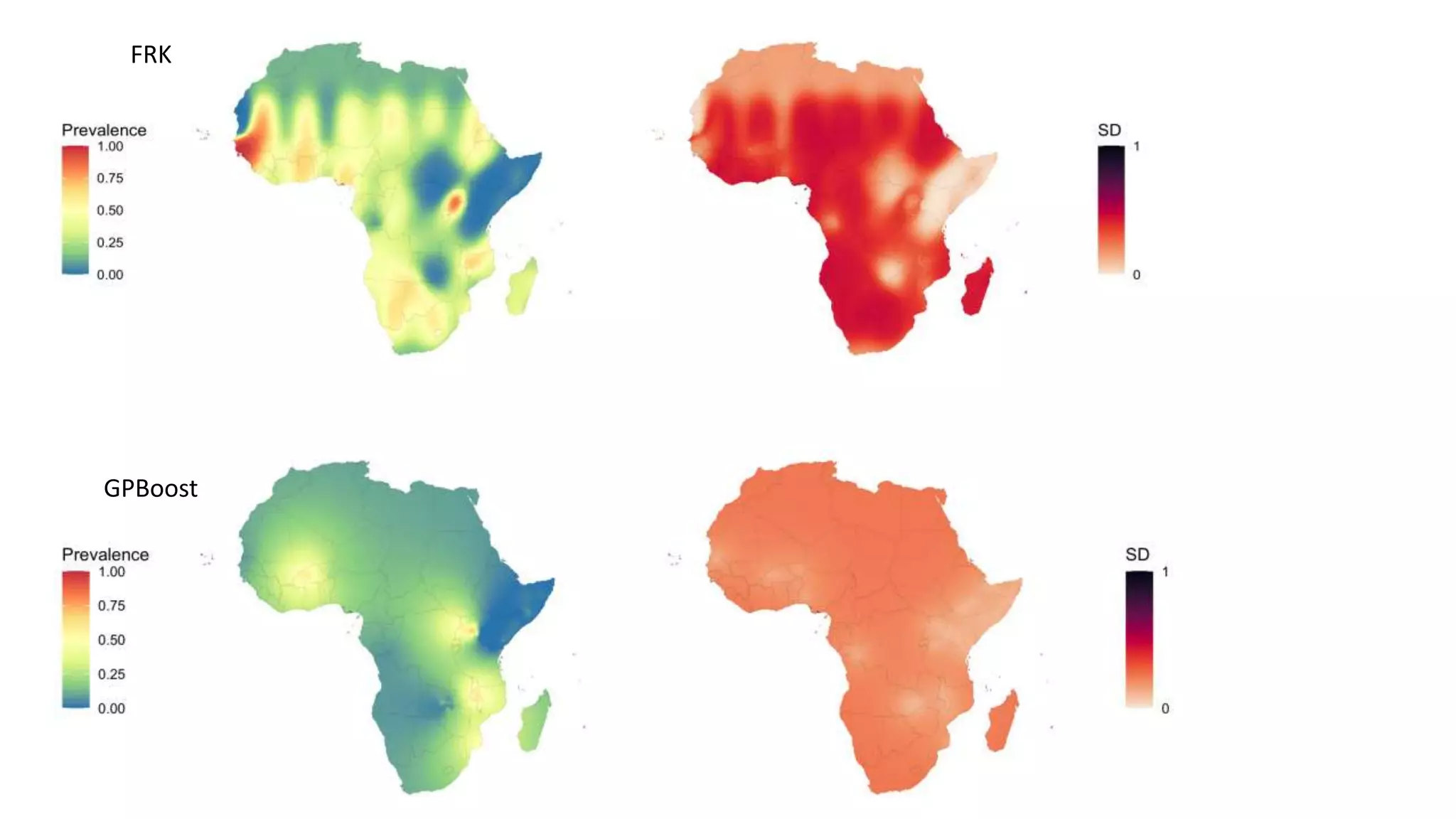
• FRK – Fixed Rank Kriging
• GPBoost – Tree boosting with Gaussian Processes
• Standard parameters for all methods
Computation
• Data – latitude, longitude, number of people tested, number of
people positive
• Prevalence = number positive/number tested
• Kenya data in 2009
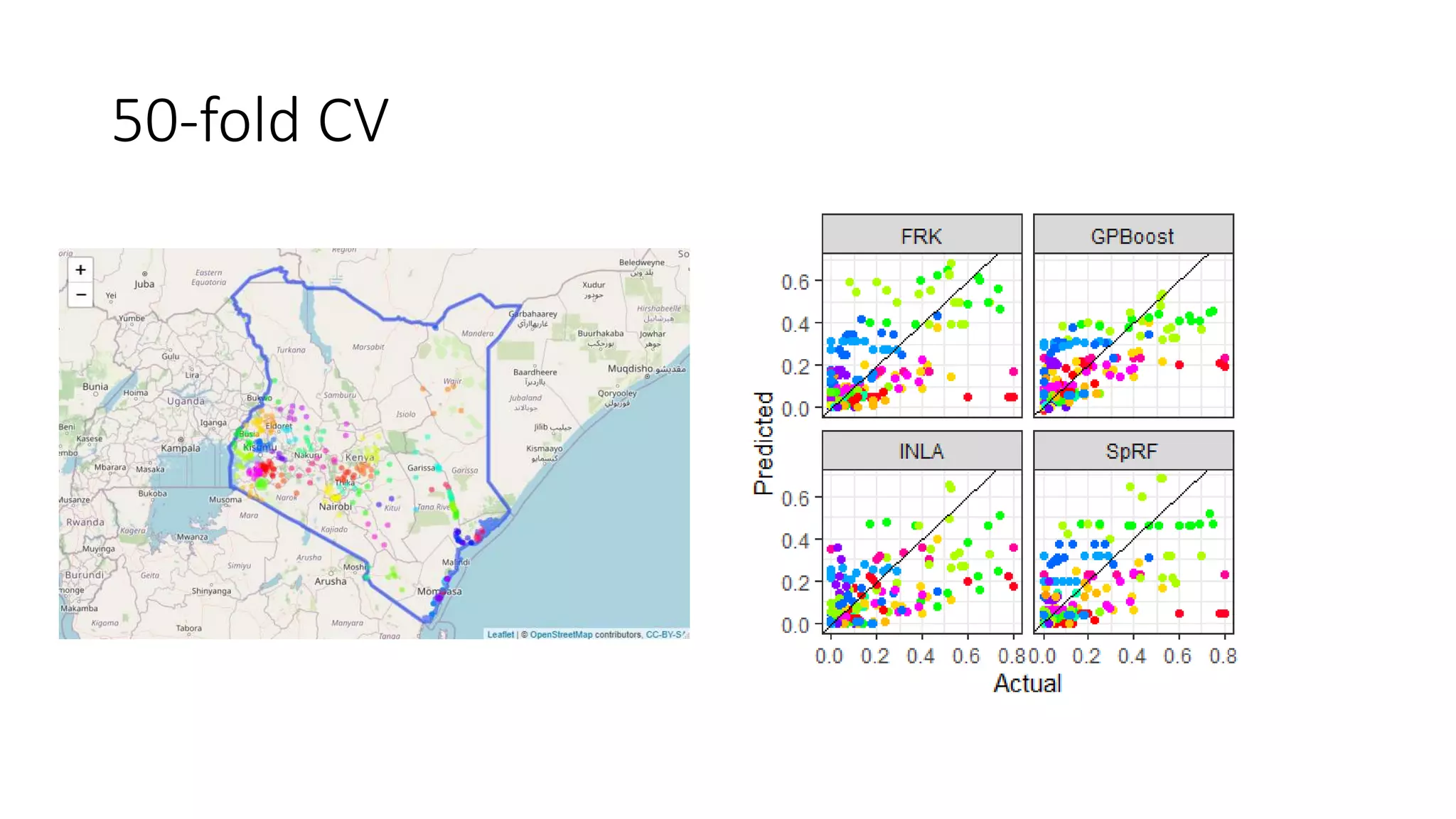
• 10 and 50-fold CV
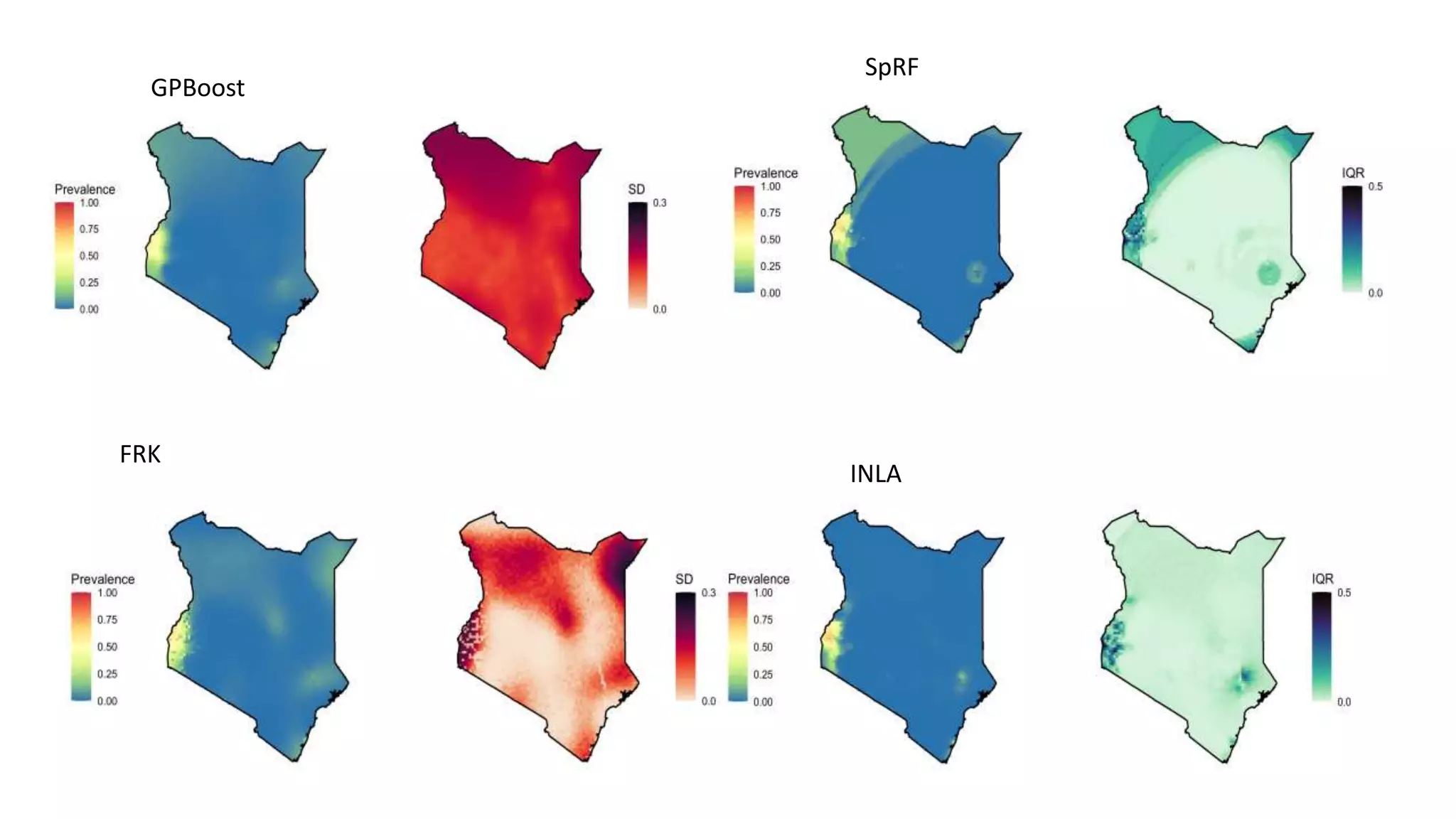
• Map of Kenya
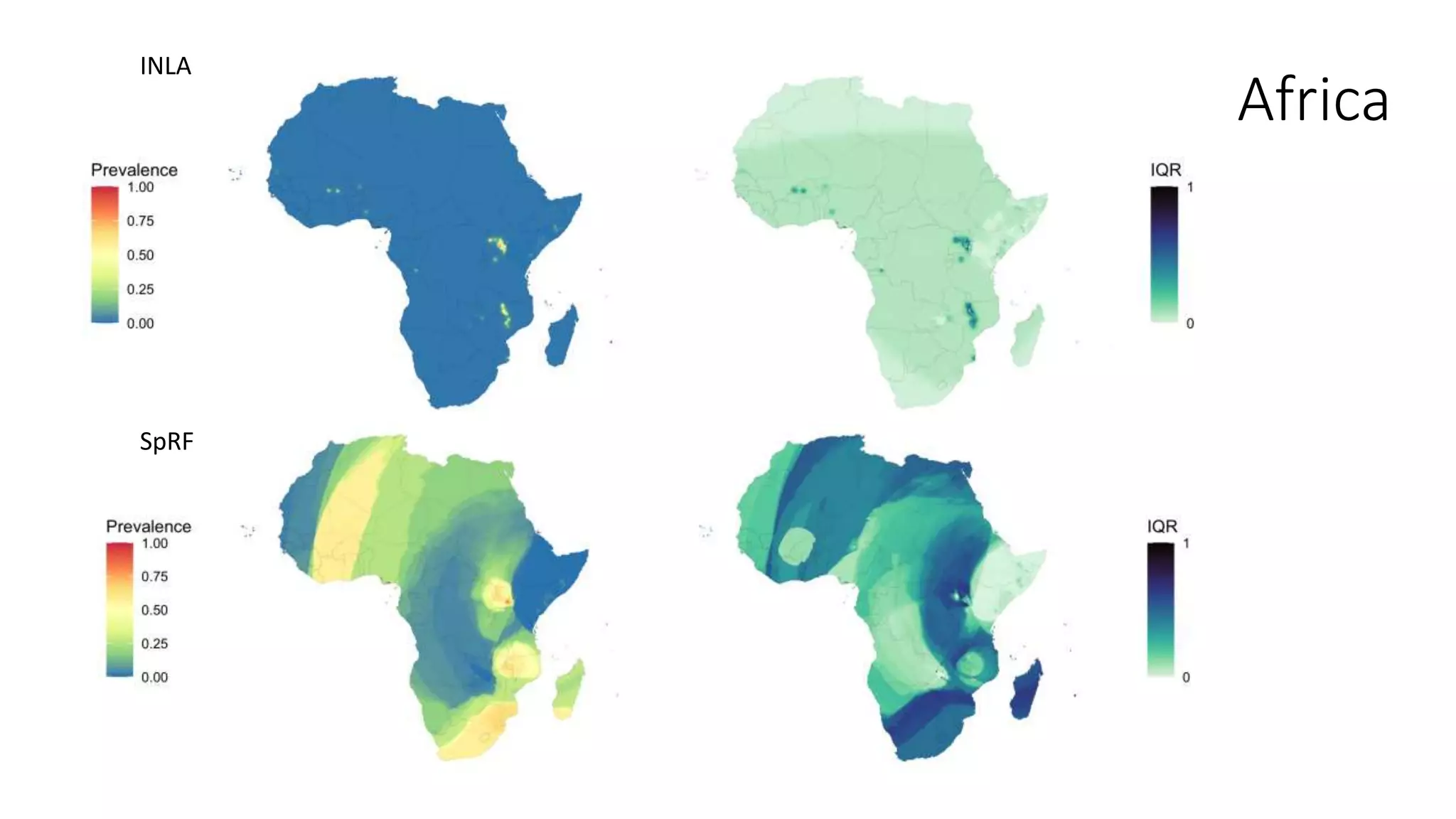
• Africa
• Africa maps
10-fold CV
50-fold CV
GPBoost
SpRF
FRK
INLA
Africa
INLA
SpRF
FRK
GPBoost
Reflections
• Maps get a bit messier when we model Africa
• Need to tune the parameters
• Sparsity of points
• See the artefacts of the methods more when you go for bigger scales
• For bigger scale maps – users need to understand the methods more
• Not off the shelf– at this point for bigger regions!
Thank you!
Questions?

Comparison of geostatistical methods for spatial data

  • 1.
    Comparison of geostatistical methodsfor spatial data Sevvandi Kandanaarachchi, Spencer Wong, Jennifer Flegg, Nick Golding AASC 2022
  • 2.
    Geospatial data is everywhere •Climate • Disease • Energy • Satellite data Vegetation Index (NASA) Land surface temperature anomalies(NASA) Vegetation Index (NASA) Land surface temperature anomaly (NASA)
  • 3.
    The original problem •Data at different locations 𝒙𝑖, 𝑦𝑖 • 𝒙𝑖 - location data (𝑥𝑖1, 𝑥𝑖2), 2D or 3D • 𝑦𝑖 - quantity of interest (dependent variable) • Temperature, disease prevalence • Want to predict 𝑦𝑘 at a different 𝒙𝑘, where data is not present • Or map it to a whole region/country • Covariates of interest • Altitude, population density
  • 4.
    The original problem •𝑦𝑖 = 𝑓(𝑥𝑖, 𝑢𝑖, 𝜖𝑖) • 𝑢𝑖 - covariates • 𝜖𝑖 - error term • Methods adopt certain assumptions and approximations • General principle – Tobler – “everything is related to everything else, but near things are more related than distant things”
  • 5.
    Methods we compare •INLA – Integrated Nested Laplace Approximations • SpRF – Spatial Random Forests • FRK – Fixed Rank Kriging • GPBoost – Tree boosting with Gaussian Processes • Standard parameters for all methods
  • 6.
    Computation • Data –latitude, longitude, number of people tested, number of people positive • Prevalence = number positive/number tested • Kenya data in 2009 • 10 and 50-fold CV • Map of Kenya • Africa • Africa maps
  • 7.
  • 8.
  • 9.
  • 10.
  • 11.
  • 12.
    Reflections • Maps geta bit messier when we model Africa • Need to tune the parameters • Sparsity of points • See the artefacts of the methods more when you go for bigger scales • For bigger scale maps – users need to understand the methods more • Not off the shelf– at this point for bigger regions!
  • 13.