Data Mining
Anomaly Detection
Lecture Notes for Chapter 10
Introduction to Data Mining
by
Tan, Steinbach, Kumar
© Tan,Steinbach, Kumar Introduction to Data Mining
4/18/2004 *
Anomaly/Outlier DetectionWhat are anomalies/outliers?The set
of data points that are considerably different than the remainder
of the dataVariants of Anomaly/Outlier Detection
anomaly scores greater than some threshold tGiven a database
-n largest
anomaly scores f(x)Given a database D, containing mostly
normal (but unlabeled) data points, and a test point x, compute
the anomaly score of x with respect to DApplications: Credit
card fraud detection, telecommunication fraud detection,
network intrusion detection, fault detection
Importance of Anomaly Detection
Ozone Depletion HistoryIn 1985 three researchers (Farman,
Gardinar and Shanklin) were puzzled by data gathered by the
British Antarctic Survey showing that ozone levels for
Antarctica had dropped 10% below normal levels
Why did the Nimbus 7 satellite, which had instruments aboard
for recording ozone levels, not record similarly low ozone
concentrations?
The ozone concentrations recorded by the satellite were so low
they were being treated as outliers by a computer program and
discarded!
Sources:
http://exploringdata.cqu.edu.au/ozone.html
http://www.epa.gov/ozone/science/hole/size.html
Anomaly DetectionChallengesHow many outliers are there in
the data?Method is unsupervised Validation can be quite
challenging (just like for clustering)Finding needle in a
haystack
Working assumption:There are considerably more “normal”
observations than “abnormal” observations (outliers/anomalies)
in the data
Anomaly Detection Schemes General StepsBuild a profile of the
“normal” behaviorProfile can be patterns or summary statistics
for the overall populationUse the “normal” profile to detect
anomaliesAnomalies are observations whose characteristics
differ significantly from the normal profile
Types of anomaly detection
schemesGraphical & Statistical-basedDistance-basedModel-
based
Graphical ApproachesBoxplot (1-D), Scatter plot (2-D), Spin
plot (3-D)
LimitationsTime consumingSubjective
Convex Hull MethodExtreme points are assumed to be
outliersUse convex hull method to detect extreme values
What if the outlier occurs in the middle of the data?
Statistical ApproachesAssume a parametric model describing
the distribution of the data (e.g., normal distribution)
Apply a statistical test that depends on Data
distributionParameter of distribution (e.g., mean,
variance)Number of expected outliers (confidence limit)
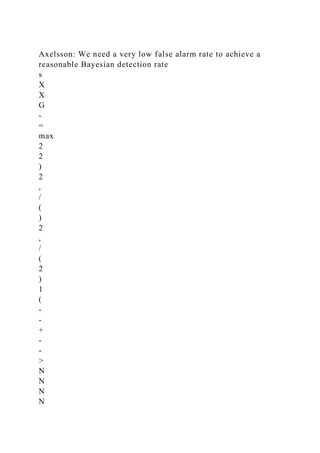
Grubbs’ TestDetect outliers in univariate dataAssume data
comes from normal distributionDetects one outlier at a time,
remove the outlier, and repeatH0: There is no outlier in dataHA:
There is at least one outlierGrubbs’ test statistic:
Reject H0 if:
Statistical-based – Likelihood ApproachAssume the data set D
contains samples from a mixture of two probability
distributions: M (majority distribution) A (anomalous
distribution)General Approach:Initially, assume all the data
points belong to MLet Lt(D) be the log likelihood of D at time
tFor each point xt that belongs to M, move it to A Let Lt+1 (D)
–
anomaly and moved permanently from M to A
Statistical-based – Likelihood ApproachData distribution, D =
(1 –
dataCan be based on any modeling method (naïve Bayes,
maximum entropy, etc)A is initially assumed to be uniform
distributionLikelihood at time t:
Limitations of Statistical Approaches Most of the tests are for a
single attribute
In many cases, data distribution may not be known
For high dimensional data, it may be difficult to estimate the
true distribution
Distance-based ApproachesData is represented as a vector of
features
Three major approachesNearest-neighbor basedDensity
basedClustering based
Nearest-Neighbor Based ApproachApproach:Compute the
distance between every pair of data points
There are various ways to define outliers:Data points for which
there are fewer than p neighboring points within a distance D
The top n data points whose distance to the kth nearest neighbor
is greatest
The top n data points whose average distance to the k nearest
neighbors is greatest
Outliers in Lower Dimensional ProjectionIn high-dimensional
space, data is sparse and notion of proximity becomes
meaninglessEvery point is an almost equally good outlier from
the perspective of proximity-based definitions
Lower-dimensional projection methodsA point is an outlier if in
some lower dimensional projection, it is present in a local
region of abnormally low density
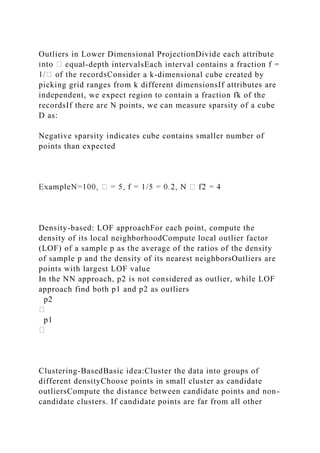
Outliers in Lower Dimensional ProjectionDivide each attribute
-depth intervalsEach interval contains a fraction f =
nsider a k-dimensional cube created by
picking grid ranges from k different dimensionsIf attributes are
independent, we expect region to contain a fraction fk of the
recordsIf there are N points, we can measure sparsity of a cube
D as:
Negative sparsity indicates cube contains smaller number of
points than expected
Density-based: LOF approachFor each point, compute the
density of its local neighborhoodCompute local outlier factor
(LOF) of a sample p as the average of the ratios of the density
of sample p and the density of its nearest neighborsOutliers are
points with largest LOF value
In the NN approach, p2 is not considered as outlier, while LOF
approach find both p1 and p2 as outliers
p2
p1
Clustering-BasedBasic idea:Cluster the data into groups of
different densityChoose points in small cluster as candidate
outliersCompute the distance between candidate points and non-
candidate clusters. If candidate points are far from all other
non-candidate points, they are outliers
Base Rate FallacyBayes theorem:
More generally:
Base Rate Fallacy (Axelsson, 1999)
Base Rate Fallacy
Even though the test is 99% certain, your chance of having the
disease is 1/100, because the population of healthy people is
much larger than sick people
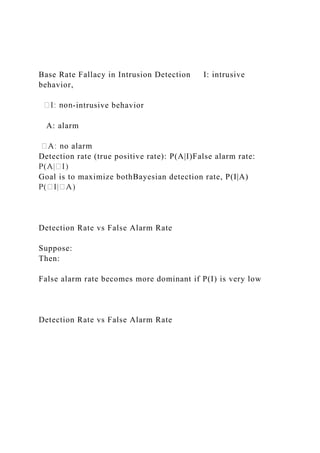
Base Rate Fallacy in Intrusion Detection I: intrusive
behavior,
-intrusive behavior
A: alarm
Detection rate (true positive rate): P(A|I)False alarm rate:
Goal is to maximize bothBayesian detection rate, P(I|A)
Detection Rate vs False Alarm Rate
Suppose:
Then:
False alarm rate becomes more dominant if P(I) is very low
Detection Rate vs False Alarm Rate
Axelsson: We need a very low false alarm rate to achieve a
reasonable Bayesian detection rate
s
X
X
G
-
=
max
2
2
)
2
,
/
(
)
2
,
/
(
2
)
1
(
-
-
+
-
-
>
N
N
N
N
t
N
t
N
N
G
a
a
å
å
Õ
Õ
Õ
Î
Î
Î
Î
=
+
+
+
-
=
÷
÷
ø
ö
ç
ç
è
æ
÷
÷
ø
ö
ç
ç
è
æ
-
=
=
t
i
t
t
i
t
t
i
t
t
t
i
t
t
A
x
i
A
t
M
x
i
M
t
t
A
x
i
A
A
M
x
i
M
M
N
i
i
D
t
x
P
A
x
P
M
D
LL
x
P
x
P
x
P
D
L
)
(
log
log
)
(
log
)
1
log(
)
(
)
(
)
(
)
1
(
)
(
)
(
|
|
|
|
1
l
l
l
l

Data Mining Anomaly DetectionLecture Notes for Chapt.docx

  • 1.
    Data Mining Anomaly Detection LectureNotes for Chapter 10 Introduction to Data Mining by Tan, Steinbach, Kumar © Tan,Steinbach, Kumar Introduction to Data Mining 4/18/2004 * Anomaly/Outlier DetectionWhat are anomalies/outliers?The set of data points that are considerably different than the remainder of the dataVariants of Anomaly/Outlier Detection anomaly scores greater than some threshold tGiven a database -n largest anomaly scores f(x)Given a database D, containing mostly normal (but unlabeled) data points, and a test point x, compute
  • 2.
    the anomaly scoreof x with respect to DApplications: Credit card fraud detection, telecommunication fraud detection, network intrusion detection, fault detection Importance of Anomaly Detection Ozone Depletion HistoryIn 1985 three researchers (Farman, Gardinar and Shanklin) were puzzled by data gathered by the British Antarctic Survey showing that ozone levels for Antarctica had dropped 10% below normal levels Why did the Nimbus 7 satellite, which had instruments aboard for recording ozone levels, not record similarly low ozone concentrations? The ozone concentrations recorded by the satellite were so low they were being treated as outliers by a computer program and discarded! Sources: http://exploringdata.cqu.edu.au/ozone.html http://www.epa.gov/ozone/science/hole/size.html Anomaly DetectionChallengesHow many outliers are there in the data?Method is unsupervised Validation can be quite challenging (just like for clustering)Finding needle in a haystack Working assumption:There are considerably more “normal” observations than “abnormal” observations (outliers/anomalies) in the data Anomaly Detection Schemes General StepsBuild a profile of the
  • 3.
    “normal” behaviorProfile canbe patterns or summary statistics for the overall populationUse the “normal” profile to detect anomaliesAnomalies are observations whose characteristics differ significantly from the normal profile Types of anomaly detection schemesGraphical & Statistical-basedDistance-basedModel- based Graphical ApproachesBoxplot (1-D), Scatter plot (2-D), Spin plot (3-D) LimitationsTime consumingSubjective Convex Hull MethodExtreme points are assumed to be outliersUse convex hull method to detect extreme values What if the outlier occurs in the middle of the data? Statistical ApproachesAssume a parametric model describing the distribution of the data (e.g., normal distribution)
  • 4.
    Apply a statisticaltest that depends on Data distributionParameter of distribution (e.g., mean, variance)Number of expected outliers (confidence limit) Grubbs’ TestDetect outliers in univariate dataAssume data comes from normal distributionDetects one outlier at a time, remove the outlier, and repeatH0: There is no outlier in dataHA: There is at least one outlierGrubbs’ test statistic: Reject H0 if: Statistical-based – Likelihood ApproachAssume the data set D contains samples from a mixture of two probability distributions: M (majority distribution) A (anomalous distribution)General Approach:Initially, assume all the data points belong to MLet Lt(D) be the log likelihood of D at time tFor each point xt that belongs to M, move it to A Let Lt+1 (D) – anomaly and moved permanently from M to A Statistical-based – Likelihood ApproachData distribution, D = (1 – dataCan be based on any modeling method (naïve Bayes, maximum entropy, etc)A is initially assumed to be uniform distributionLikelihood at time t:
  • 5.
    Limitations of StatisticalApproaches Most of the tests are for a single attribute In many cases, data distribution may not be known For high dimensional data, it may be difficult to estimate the true distribution Distance-based ApproachesData is represented as a vector of features Three major approachesNearest-neighbor basedDensity basedClustering based Nearest-Neighbor Based ApproachApproach:Compute the distance between every pair of data points There are various ways to define outliers:Data points for which there are fewer than p neighboring points within a distance D The top n data points whose distance to the kth nearest neighbor is greatest The top n data points whose average distance to the k nearest neighbors is greatest Outliers in Lower Dimensional ProjectionIn high-dimensional space, data is sparse and notion of proximity becomes meaninglessEvery point is an almost equally good outlier from the perspective of proximity-based definitions Lower-dimensional projection methodsA point is an outlier if in some lower dimensional projection, it is present in a local region of abnormally low density
  • 6.
    Outliers in LowerDimensional ProjectionDivide each attribute -depth intervalsEach interval contains a fraction f = nsider a k-dimensional cube created by picking grid ranges from k different dimensionsIf attributes are independent, we expect region to contain a fraction fk of the recordsIf there are N points, we can measure sparsity of a cube D as: Negative sparsity indicates cube contains smaller number of points than expected Density-based: LOF approachFor each point, compute the density of its local neighborhoodCompute local outlier factor (LOF) of a sample p as the average of the ratios of the density of sample p and the density of its nearest neighborsOutliers are points with largest LOF value In the NN approach, p2 is not considered as outlier, while LOF approach find both p1 and p2 as outliers p2 p1 Clustering-BasedBasic idea:Cluster the data into groups of different densityChoose points in small cluster as candidate outliersCompute the distance between candidate points and non- candidate clusters. If candidate points are far from all other
  • 7.
    non-candidate points, theyare outliers Base Rate FallacyBayes theorem: More generally: Base Rate Fallacy (Axelsson, 1999) Base Rate Fallacy Even though the test is 99% certain, your chance of having the disease is 1/100, because the population of healthy people is much larger than sick people
  • 8.
    Base Rate Fallacyin Intrusion Detection I: intrusive behavior, -intrusive behavior A: alarm Detection rate (true positive rate): P(A|I)False alarm rate: Goal is to maximize bothBayesian detection rate, P(I|A) Detection Rate vs False Alarm Rate Suppose: Then: False alarm rate becomes more dominant if P(I) is very low Detection Rate vs False Alarm Rate
  • 9.
    Axelsson: We needa very low false alarm rate to achieve a reasonable Bayesian detection rate s X X G - = max 2 2 ) 2 , / ( ) 2 , / ( 2 ) 1 ( - - + - - > N N N N
  • 10.
  • 11.
  • 12.
  • 13.