By Miguel Villegas
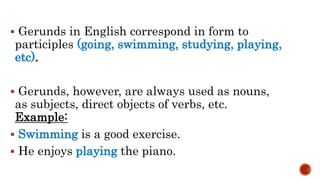
 Gerunds in English correspond in form to
participles (going, swimming, studying, playing,
etc).
 Gerunds, however, are always used as nouns,
as subjects, direct objects of verbs, etc.
Example:
 Swimming is a good exercise.
 He enjoys playing the piano.
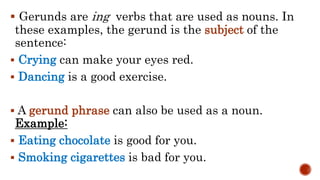
 Gerunds are ing verbs that are used as nouns. In
these examples, the gerund is the subject of the
sentence:
 Crying can make your eyes red.
 Dancing is a good exercise.
 A gerund phrase can also be used as a noun.
Example:
 Eating chocolate is good for you.
 Smoking cigarettes is bad for you.
 Certain verbs in English are always followed by
gerunds and never by infinitives. These verbs are:
enjoy, mind, stop, avoid, consider, finish, deny,
admit, and risk. Example:
 We are considering taking a trip to Chicago.
He has stopped studying English.
 A number of verbs in English may be followed
by either a gerung or an infinitive. The
following verbs are of this group: begin,
continue, like, intend, prefer, hate, etc.
Example:
 He likes to study with us.
 He likes studying with us.
 Since gerunds are always used as nouns, they
frequendly used in English as objects of
prepositions. Example:
 Helen is fond of dancing.
 He instisted on going.
 It is a question of finding the right book.
Gerunds

Gerunds

  • 2.
  • 3.
     Gerunds inEnglish correspond in form to participles (going, swimming, studying, playing, etc).  Gerunds, however, are always used as nouns, as subjects, direct objects of verbs, etc. Example:  Swimming is a good exercise.  He enjoys playing the piano.
  • 4.
     Gerunds areing verbs that are used as nouns. In these examples, the gerund is the subject of the sentence:  Crying can make your eyes red.  Dancing is a good exercise.  A gerund phrase can also be used as a noun. Example:  Eating chocolate is good for you.  Smoking cigarettes is bad for you.
  • 5.
     Certain verbsin English are always followed by gerunds and never by infinitives. These verbs are: enjoy, mind, stop, avoid, consider, finish, deny, admit, and risk. Example:  We are considering taking a trip to Chicago. He has stopped studying English.  A number of verbs in English may be followed by either a gerung or an infinitive. The following verbs are of this group: begin, continue, like, intend, prefer, hate, etc.
  • 6.
    Example:  He likesto study with us.  He likes studying with us.  Since gerunds are always used as nouns, they frequendly used in English as objects of prepositions. Example:  Helen is fond of dancing.  He instisted on going.  It is a question of finding the right book.