Gerunds
Gerunds
and
and
Infinitives
Infinitives
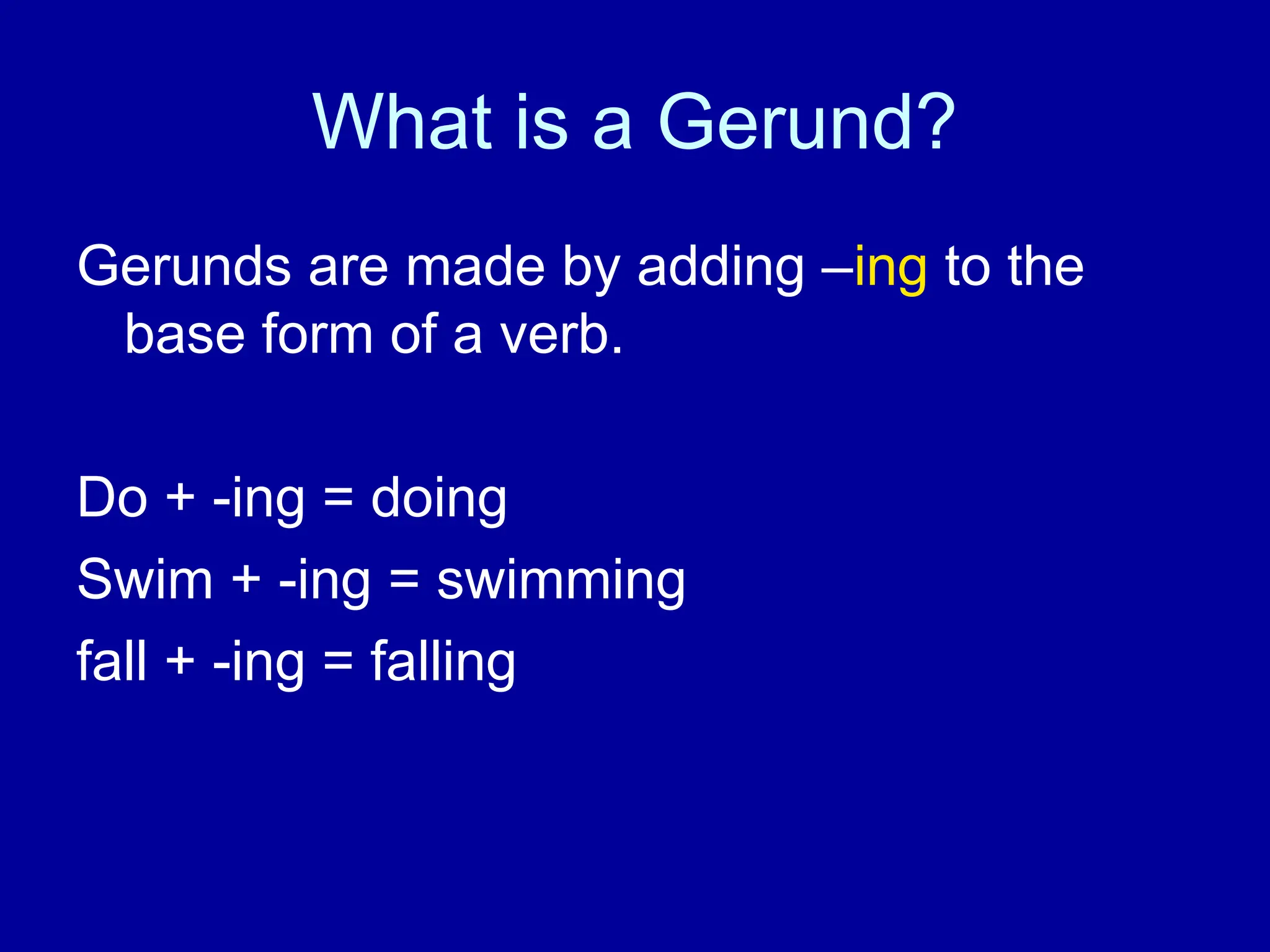
What is a Gerund?
Gerunds are made by adding –ing to the
base form of a verb.
Do + -ing = doing
Swim + -ing = swimming
fall + -ing = falling
Gerund as NOUNS
Sometimes gerunds work like nouns in a
sentence.
Examples
1. Smoking is dangerous.
2. Swimming is healthy.
3. I like shopping.
4. She hates running.
In sentences 1 and 2, the gerund is the subject of the
sentence.
In Sentences 3 and 4, the gerund is the object of the verb.
Gerunds after a PREPOSITION
The gerund is the only form verbs take after
a preposition (on, in, by, with, under, through,
at, after, before, as, of, off, etc.…).
• Water is needed for growing plants.
• We passed the exam by working hard.
• I am tired of working so many hours.
When do you use Gerunds after
verbs?
There are no patterns for this rule.
You must memorize which verbs are
followed by gerunds and which are
followed by infinitives (which we will get to
in a moment)
Verbs that are followed by Gerunds
acknowledge delay excuse mind recall
admit deny fancy (UK) miss recollect
anticipate detest finish postpone regret
appreciate dispute imagine practice resist
avoid dislike involve prevent risk
can’t stand enjoy keep propose suggest
celebrate escape make quit understand
consider report recommend
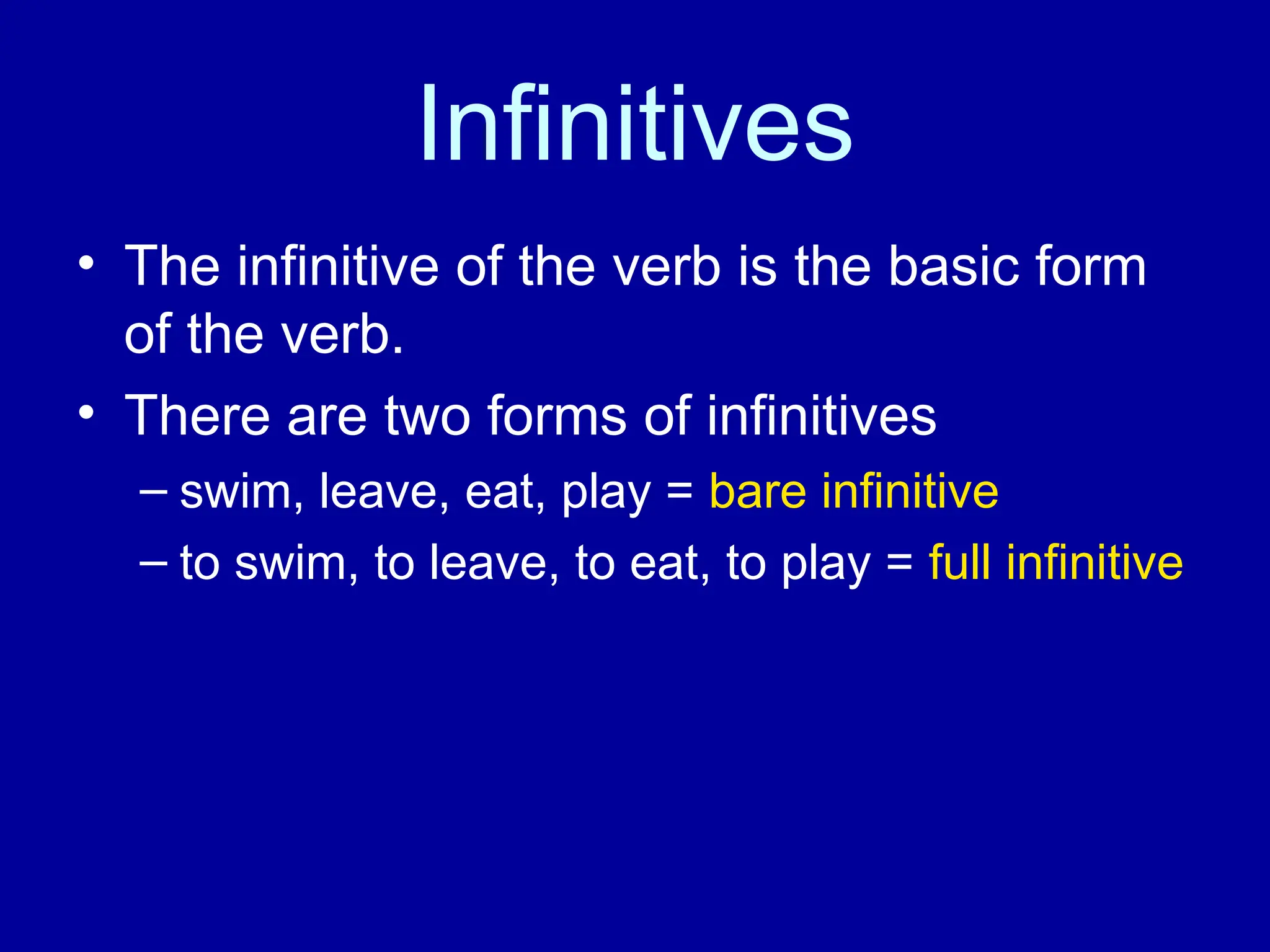
Infinitives
• The infinitive of the verb is the basic form
of the verb.
• There are two forms of infinitives
– swim, leave, eat, play = bare infinitive
– to swim, to leave, to eat, to play = full infinitive
Infinitives after ADJECTIVES
We use the full infinitive after adjectives.
Examples
I am happy to see my friends.
We were surprised to get first place.
Infinitive as a Delayed Subject
We also use the infinitive as a delayed
subject (where it usually comes after an
adjective):
Examples:
It is healthy to swim.
It is dangerous to smoke.
Contrast:
Swimming is healthy.
VERBS that are followed by Infinitives
afford choose hurry pay seem
agree consent intend plan want
appear decide invite prepare warn
arrange demand learn pretend wish
ask deserve manage promise would like
attempt expect mean refuse Claim
can’t afford fail need remind hesitate
can’t wait hope offer request swear
Infinitives and Modals
• The modal verbs are:
– can, could, have to, must, might, should, ought
to
• These verbs always take the bare infinitive
– Examples
• We mustn’t be late for class.
• We had to write an essay this morning.
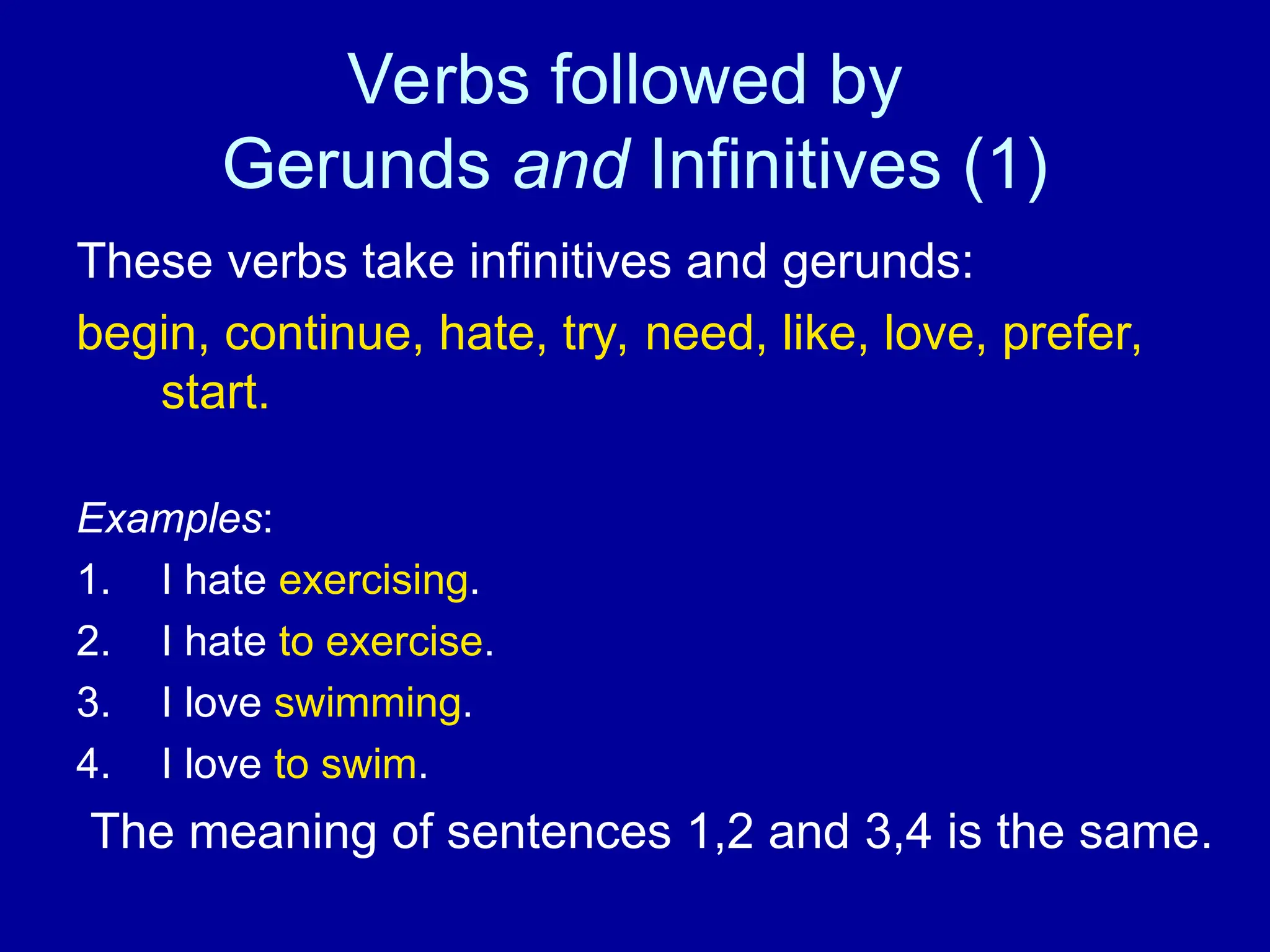
Verbs followed by
Gerunds and Infinitives (1)
These verbs take infinitives and gerunds:
begin, continue, hate, try, need, like, love, prefer,
start.
Examples:
1. I hate exercising.
2. I hate to exercise.
3. I love swimming.
4. I love to swim.
The meaning of sentences 1,2 and 3,4 is the same.
Verbs followed by
Gerunds and Infinitives (2)
These verbs are followed by gerunds and
infinitives:
remember, stop, forget.
BUT
BUT the meaning changes if the verb is
followed by an infinitive or a gerund….
Examples of Verbs followed by Gerunds and
Infinitives with changes in meaning
1. Frank remembered mailing
mailing the letter.
(Frank had a memory that he mailed the letter. He saw it in his
mind)
2. Frank remembered to mail
to mail the letter.
(First he remembered that he needed to mail the letter. Then he
did it: he mailed the letter. He didn’t forget to mail the letter)
3. Sonia stopped eating
eating ice cream.
(She doesn’t eat ice cream anymore)
4. Sonia stopped to eat
to eat ice cream.
(She stopped another activity to eat ice cream)
5. Jane forgot to meet
to meet John.
(Jane had planned to meet John, but she didn’t meet him because
she forgot about the plan)
6. Jane forgot meeting
meeting John.
(Jane met John, but afterwards she didn’t remember that.)

knowledge about Gerunds and infinitives in english

  • 1.
  • 2.
    What is aGerund? Gerunds are made by adding –ing to the base form of a verb. Do + -ing = doing Swim + -ing = swimming fall + -ing = falling
  • 3.
    Gerund as NOUNS Sometimesgerunds work like nouns in a sentence. Examples 1. Smoking is dangerous. 2. Swimming is healthy. 3. I like shopping. 4. She hates running. In sentences 1 and 2, the gerund is the subject of the sentence. In Sentences 3 and 4, the gerund is the object of the verb.
  • 4.
    Gerunds after aPREPOSITION The gerund is the only form verbs take after a preposition (on, in, by, with, under, through, at, after, before, as, of, off, etc.…). • Water is needed for growing plants. • We passed the exam by working hard. • I am tired of working so many hours.
  • 5.
    When do youuse Gerunds after verbs? There are no patterns for this rule. You must memorize which verbs are followed by gerunds and which are followed by infinitives (which we will get to in a moment)
  • 6.
    Verbs that arefollowed by Gerunds acknowledge delay excuse mind recall admit deny fancy (UK) miss recollect anticipate detest finish postpone regret appreciate dispute imagine practice resist avoid dislike involve prevent risk can’t stand enjoy keep propose suggest celebrate escape make quit understand consider report recommend
  • 7.
    Infinitives • The infinitiveof the verb is the basic form of the verb. • There are two forms of infinitives – swim, leave, eat, play = bare infinitive – to swim, to leave, to eat, to play = full infinitive
  • 8.
    Infinitives after ADJECTIVES Weuse the full infinitive after adjectives. Examples I am happy to see my friends. We were surprised to get first place.
  • 9.
    Infinitive as aDelayed Subject We also use the infinitive as a delayed subject (where it usually comes after an adjective): Examples: It is healthy to swim. It is dangerous to smoke. Contrast: Swimming is healthy.
  • 10.
    VERBS that arefollowed by Infinitives afford choose hurry pay seem agree consent intend plan want appear decide invite prepare warn arrange demand learn pretend wish ask deserve manage promise would like attempt expect mean refuse Claim can’t afford fail need remind hesitate can’t wait hope offer request swear
  • 11.
    Infinitives and Modals •The modal verbs are: – can, could, have to, must, might, should, ought to • These verbs always take the bare infinitive – Examples • We mustn’t be late for class. • We had to write an essay this morning.
  • 12.
    Verbs followed by Gerundsand Infinitives (1) These verbs take infinitives and gerunds: begin, continue, hate, try, need, like, love, prefer, start. Examples: 1. I hate exercising. 2. I hate to exercise. 3. I love swimming. 4. I love to swim. The meaning of sentences 1,2 and 3,4 is the same.
  • 13.
    Verbs followed by Gerundsand Infinitives (2) These verbs are followed by gerunds and infinitives: remember, stop, forget. BUT BUT the meaning changes if the verb is followed by an infinitive or a gerund….
  • 14.
    Examples of Verbsfollowed by Gerunds and Infinitives with changes in meaning 1. Frank remembered mailing mailing the letter. (Frank had a memory that he mailed the letter. He saw it in his mind) 2. Frank remembered to mail to mail the letter. (First he remembered that he needed to mail the letter. Then he did it: he mailed the letter. He didn’t forget to mail the letter) 3. Sonia stopped eating eating ice cream. (She doesn’t eat ice cream anymore) 4. Sonia stopped to eat to eat ice cream. (She stopped another activity to eat ice cream) 5. Jane forgot to meet to meet John. (Jane had planned to meet John, but she didn’t meet him because she forgot about the plan) 6. Jane forgot meeting meeting John. (Jane met John, but afterwards she didn’t remember that.)