PRESENT
SIMPLE
Routines, habits, facts
Present Simple
Present Simple
• A dog has four legs
• My husband has black eyes
• For repeated or regular actions in the present time period.
Fact, Habits, Repeated
or regular actions
The simple present tense in English is used to
describe an action that is regular, true or normal.
We use the present tense:
• She takes the bus at five o'clock
• I eat vegetables every day
• For facts
• For habits
• She gets up early every day
• He buys his breakfast at night
• For things that are always true/generally true
• It rains a lot in winter
• He speaks Spanish at home
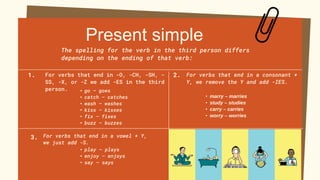
Present simple
For verbs that end in a consonant +
Y, we remove the Y and add -IES.
For verbs that end in a vowel + Y,
we just add -S.
• play – plays
• enjoy – enjoys
• say – says
For verbs that end in -O, -CH, -SH, -
SS, -X, or -Z we add -ES in the third
person.
1.
3.
The spelling for the verb in the third person differs
depending on the ending of that verb:
• go – goes
• catch – catches
• wash – washes
• kiss – kisses
• fix – fixes
• buzz – buzzes
• marry – marries
• study – studies
• carry – carries
• worry – worries
2.
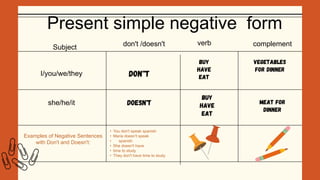
Present simple negative form
don''t
buy
have
eat
Vegetables
for dinner
doesn't
buy
have
eat
meat for
dinner
complement
I/you/we/they
she/he/it
don't /doesn't verb
Subject
Examples of Negative Sentences
with Don't and Doesn't:
• You don't speak spanish
• Maria doesn't speak
• spanish
• She doesn't have
• time to study
• They don't have time to study
SEE THE NEXT VIDEO
ABOUT PRESENT
SIMPLE

Present simple

  • 1.
  • 2.
    Present Simple • Adog has four legs • My husband has black eyes • For repeated or regular actions in the present time period. Fact, Habits, Repeated or regular actions The simple present tense in English is used to describe an action that is regular, true or normal. We use the present tense: • She takes the bus at five o'clock • I eat vegetables every day • For facts • For habits • She gets up early every day • He buys his breakfast at night • For things that are always true/generally true • It rains a lot in winter • He speaks Spanish at home
  • 3.
    Present simple For verbsthat end in a consonant + Y, we remove the Y and add -IES. For verbs that end in a vowel + Y, we just add -S. • play – plays • enjoy – enjoys • say – says For verbs that end in -O, -CH, -SH, - SS, -X, or -Z we add -ES in the third person. 1. 3. The spelling for the verb in the third person differs depending on the ending of that verb: • go – goes • catch – catches • wash – washes • kiss – kisses • fix – fixes • buzz – buzzes • marry – marries • study – studies • carry – carries • worry – worries 2.
  • 4.
    Present simple negativeform don''t buy have eat Vegetables for dinner doesn't buy have eat meat for dinner complement I/you/we/they she/he/it don't /doesn't verb Subject Examples of Negative Sentences with Don't and Doesn't: • You don't speak spanish • Maria doesn't speak • spanish • She doesn't have • time to study • They don't have time to study
  • 5.
    SEE THE NEXTVIDEO ABOUT PRESENT SIMPLE