Germany
The German Education
System
Kindergarten
At the age of 3, children enter
kindergarten
Kindergarten is not a requirement
There is a cost for kindergarten
Student will stay in kindergarten until
the age of 6
Elementary School
 1st
– 4th
grade
 All students are
integrated in one
school
 Sonderschule or
Förderschule – for
severe learning and
physical disabilities
Schultüte – Schoolcone
(For the very first day of school)
 Once upon a time in Germany, children who were
about to start school were told the legend of the
tree that grows in every teacher’s garden.
 It was said that this tree grew bags filled with all
types of Süßigkeiten (sweets), toys and many
goodies. These bags are known as Schultüten
(school cones).
https://www.youtube.com/watch?v=YC2N4gElS8E&list=PL371379C16F4E9AA3
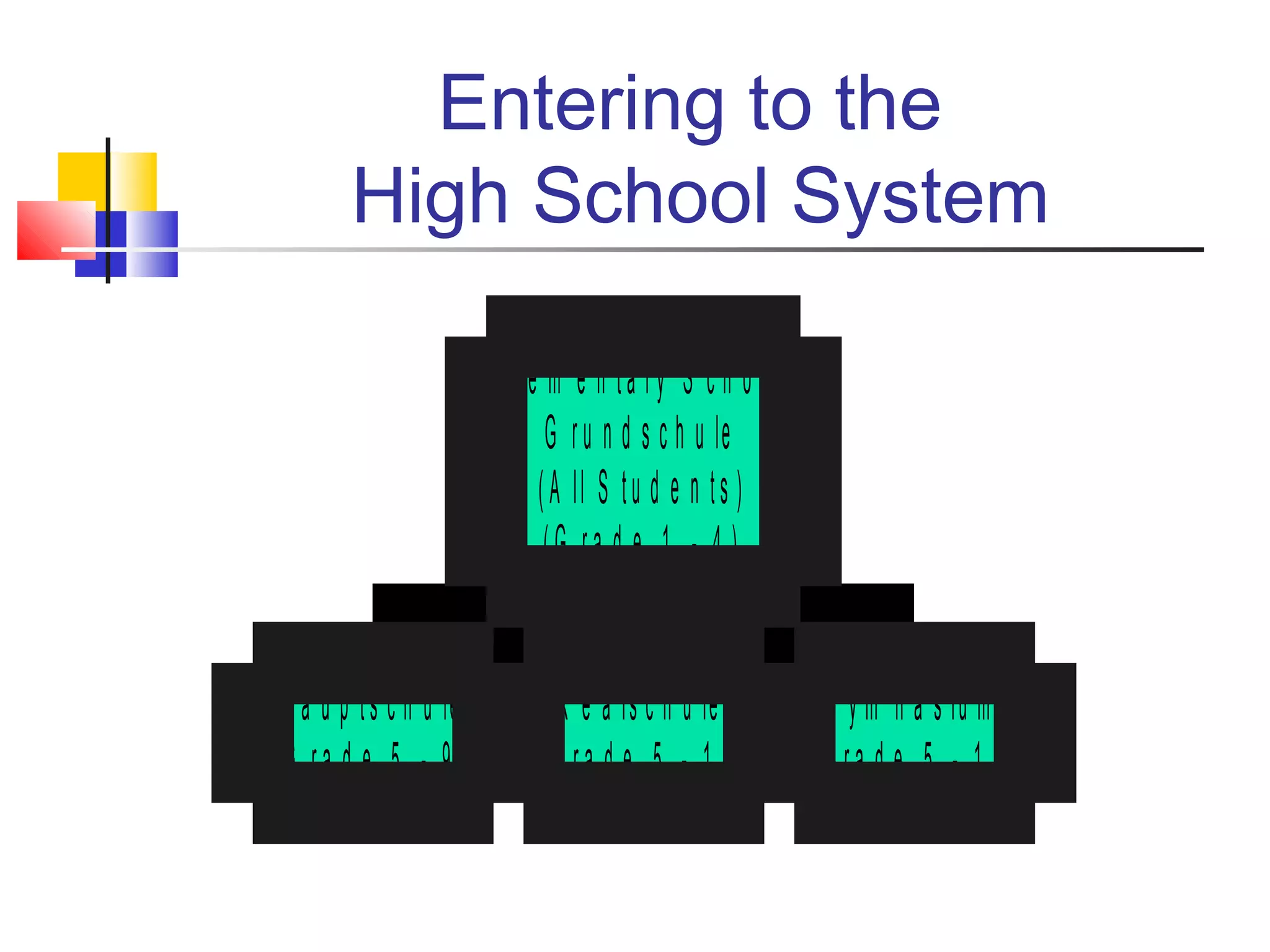
Entering to the
High School System
H a u p ts c h u le
(G ra d e 5 - 9 )
R e a ls c h u le
(G ra d e 5 - 1 0 )
G y m n a s iu m
(G ra d e 5 - 1 3 )
E le m e n ta ry S c h o o l
G ru n d s c h u le
(A ll S tu d e n ts )
(G ra d e 1 - 4 )
Hauptschule
(Regular High School - Grade 5 - 9)
 Students with average grades and
abilities will enter the Hauptschule
 Grade 5 and 6 are the
“Orientierungs - Stufen”, this gives
students a chance to improve and
move up
 Graduating students will enter an
apprenticeship and continue their
education, or will enter continuing
education schools
Realschule
(Midlevel High School – Grade 5 - 10)
 Students with greater abilities will
enter the Realschule
 Grade 5 and 6 are the
“Orientierungs - Stufen”, where
students may be placed in other
schools
 Graduating students may enter
an apprenticeship or continue
their education in more advanced
schools.
Gymnasium
(Highest level High School – Grade 5 – 13)
 Gifted Students will enter the
gymnasium
 Grade 5 and 6 are the
“Orientierungs - Stufen”, where
students may be placed in lower
level schools
 Graduating students receive an
“Abitur” or Diploma, which is
equal to an associates degree in
the U.S.A.
 Students may start an
apprenticeship or enter a
university
Students can achieve the highest level
of education, even if they start at the
lowest High School level.
The system is not closed, but it can be
difficult for students to achieve higher
levels of education. Generally there is a
freedom to choose among educational
paths
Gesamtschule
(High schools for all academic levels Grades 5 – 13)
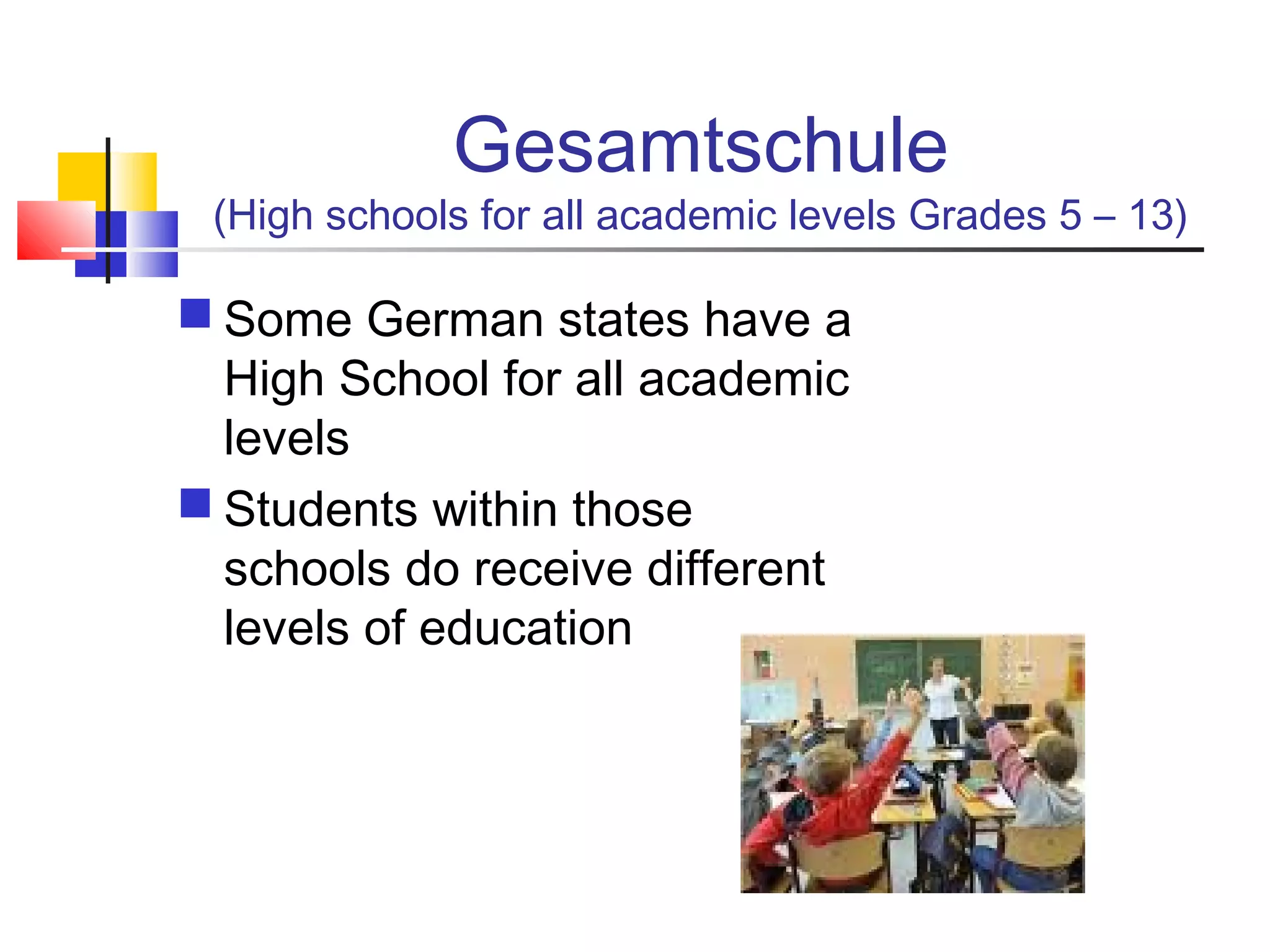
 Some German states have a
High School for all academic
levels
 Students within those
schools do receive different
levels of education
Interesting Facts
Elementary school:
 Pupils learn cursive writing
before printing
 In second grade students will
write with a fountain pen
 Foreign languages, such as
English and French are
introduced to students
 School starts at 8:00 and
ends at 11:30 – max 1:00
 There is no lunch served in
school
High school:
 Foreign language is a core
subject and it is a graduation
requirement
 Schools have no Saturday
classes
 The school year has 38
weeks
 Extra curriculum activities
are offered through the
communities and are not
part of the school curriculum
 School starts at 8:00 and
often ends at 4:00
 There is no lunch served in
school
Continuing Education
Hauptschule Realschule Gymnasium Gesamtschul
e
Apprenticeship
2-3 years
(equal to an associates
degree in US) or
continuing education to
receive the Abitur, which
allows you to enter the
University (to receive
advanced degrees in
theory studies such as law,
education, medicine,…)
Apprenticeship
2-3 years
(equal to an associates
degree in US) or
continuing education to
receive the Abitur, which
allows you to enter the
University (to receive
advanced degrees in
theory studies such as law,
education, medicine,…)
University
with the completed Abitur
entering, or
Fachhochschule, or
Apprenticeship
2-3 years (equal to an
associates degree in US),
Meister Brief
Apprenticeship
2-3 years
(equal to an associates
degree in US)
Meister Brief or
Fachhochschule
or, with the completed
Abitur entering the
University
Meister Brief
(Master in your field, allows
you to train students) or
Fachhochschule
(Technical Universities to
receive an advanced
degree)
Meister Brief
(Master in your field, allows
you to train students) or
Fachhochschule
(Technical Universities to
receive an advanced
degree)
University
(to receive advanced
degrees in theory studies
such as law, education,
medicine,…)
University
(to receive advanced
degrees in theory studies
such as law, education,
medicine,…)

Germany education system

  • 1.
  • 2.
    Kindergarten At the ageof 3, children enter kindergarten Kindergarten is not a requirement There is a cost for kindergarten Student will stay in kindergarten until the age of 6
  • 3.
    Elementary School  1st –4th grade  All students are integrated in one school  Sonderschule or Förderschule – for severe learning and physical disabilities
  • 4.
    Schultüte – Schoolcone (Forthe very first day of school)  Once upon a time in Germany, children who were about to start school were told the legend of the tree that grows in every teacher’s garden.  It was said that this tree grew bags filled with all types of Süßigkeiten (sweets), toys and many goodies. These bags are known as Schultüten (school cones). https://www.youtube.com/watch?v=YC2N4gElS8E&list=PL371379C16F4E9AA3
  • 5.
    Entering to the HighSchool System H a u p ts c h u le (G ra d e 5 - 9 ) R e a ls c h u le (G ra d e 5 - 1 0 ) G y m n a s iu m (G ra d e 5 - 1 3 ) E le m e n ta ry S c h o o l G ru n d s c h u le (A ll S tu d e n ts ) (G ra d e 1 - 4 )
  • 6.
    Hauptschule (Regular High School- Grade 5 - 9)  Students with average grades and abilities will enter the Hauptschule  Grade 5 and 6 are the “Orientierungs - Stufen”, this gives students a chance to improve and move up  Graduating students will enter an apprenticeship and continue their education, or will enter continuing education schools
  • 7.
    Realschule (Midlevel High School– Grade 5 - 10)  Students with greater abilities will enter the Realschule  Grade 5 and 6 are the “Orientierungs - Stufen”, where students may be placed in other schools  Graduating students may enter an apprenticeship or continue their education in more advanced schools.
  • 8.
    Gymnasium (Highest level HighSchool – Grade 5 – 13)  Gifted Students will enter the gymnasium  Grade 5 and 6 are the “Orientierungs - Stufen”, where students may be placed in lower level schools  Graduating students receive an “Abitur” or Diploma, which is equal to an associates degree in the U.S.A.  Students may start an apprenticeship or enter a university
  • 9.
    Students can achievethe highest level of education, even if they start at the lowest High School level. The system is not closed, but it can be difficult for students to achieve higher levels of education. Generally there is a freedom to choose among educational paths
  • 10.
    Gesamtschule (High schools forall academic levels Grades 5 – 13)  Some German states have a High School for all academic levels  Students within those schools do receive different levels of education
  • 11.
    Interesting Facts Elementary school: Pupils learn cursive writing before printing  In second grade students will write with a fountain pen  Foreign languages, such as English and French are introduced to students  School starts at 8:00 and ends at 11:30 – max 1:00  There is no lunch served in school High school:  Foreign language is a core subject and it is a graduation requirement  Schools have no Saturday classes  The school year has 38 weeks  Extra curriculum activities are offered through the communities and are not part of the school curriculum  School starts at 8:00 and often ends at 4:00  There is no lunch served in school
  • 12.
    Continuing Education Hauptschule RealschuleGymnasium Gesamtschul e Apprenticeship 2-3 years (equal to an associates degree in US) or continuing education to receive the Abitur, which allows you to enter the University (to receive advanced degrees in theory studies such as law, education, medicine,…) Apprenticeship 2-3 years (equal to an associates degree in US) or continuing education to receive the Abitur, which allows you to enter the University (to receive advanced degrees in theory studies such as law, education, medicine,…) University with the completed Abitur entering, or Fachhochschule, or Apprenticeship 2-3 years (equal to an associates degree in US), Meister Brief Apprenticeship 2-3 years (equal to an associates degree in US) Meister Brief or Fachhochschule or, with the completed Abitur entering the University Meister Brief (Master in your field, allows you to train students) or Fachhochschule (Technical Universities to receive an advanced degree) Meister Brief (Master in your field, allows you to train students) or Fachhochschule (Technical Universities to receive an advanced degree) University (to receive advanced degrees in theory studies such as law, education, medicine,…) University (to receive advanced degrees in theory studies such as law, education, medicine,…)