The educational system of Germany
General overview
Primary education – Grundschule from the age of 6 first compulsory school transfer to secondary schools after 4th grade Specific requirements   goals: preparation for secondary schools social education basic knowledge interests and abilities
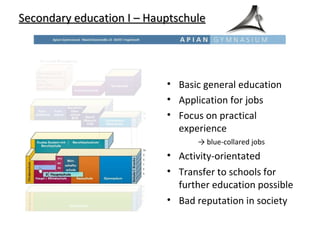
Secondary education I – Hauptschule Basic general education Application for jobs  Focus on practical experience ->  blue-collared jobs Activity-orientated Transfer to schools for further education possible Bad reputation in society
Secondary education II - Realschule Medium  general   education Basic knowledge in job oriented subjects Basis for a practical career Transfer to further education possible  ->  after 6th grade: Gymnasium ->  FOS ->  even university degrees Degree: Mittlerer Schulabschluss (~ GCSE)
Secondary education III - Gymnasium High general education Wide range of subjects / Courses: Focus on language and arts Focus on science and technolgy Focus on social studies At least two languages  obligatory
Secondary education III - Gymnasium Point system -> Marks 12 th  year: Final exams ->  Abitur (~ A-levels)    required for access to university Course system ->  Bavaria:  Abolition ->  other states: Lks/Gks  No central regulation of Abitur
- comprehensive school - three-tier system NOT throughout Germany ->  comprehensive school system e.g. in NRW - Gesamtschulen: ->  degrees according to level of course ->  pupils choose courses according to their skills Secondary education IV - Gesamtschule
Either after or alongside  apprenticeship Certificate of Intermediate Education possible Secondary education V – vocational training
FOS advanced technical college entrance qualification Courses:  engineering , agricultural economy, business, law, social studies, art also „normal“ Abitur BOS almost similar to FOS completion of an   apprenticeship Secondary education VI
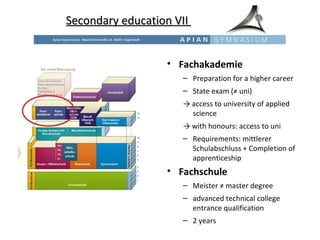
Fachakademie Preparation for a higher career State exam (≠ uni) ->  access to university of applied science  ->  with honours: access to uni Requirements: mittlerer Schulabschluss + Completion of apprenticeship Fachschule Meister ≠ master degree advanced technical college entrance qualification 2 years Secondary education VII
From cradle  to secondary education
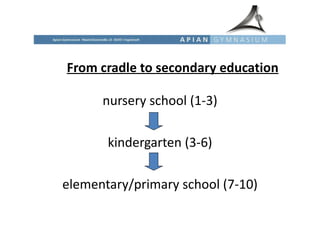
From cradle to secondary education nursery school (1-3) kindergarten (3-6) elementary/primary school (7-10)
Nursery school education and care costs: 70-425 € / month, depending on place of residence and income political debate  historical background: care centers in GDR (all-day, no costs for parents, being part of the collective > most children attended care centers)  changes in society (more women working)    future: care centers for 750.000 small children by 2013
Kindergarten legal right for each child to get a half-day service in a kindergarten (children age 3 – when they start school) some restrictions (e.g. parents not working) there are also private kindergartens pre-school child programs
Primary/elementary school (1) compulsory schooling – homeschooling not allowed.. all children who are 6 years old before Sep 30th start school in Sep > children born in Oct, Nov, Dec CAN start school  BUT: if children not suitable for school yet, they go to kindergarten for one more year
Primary/elementary school (2) Subjects: German, maths, local geography and history music, arts, physical education, handicrafts religion/ethics  foreign languages (English: years 3 & 4)
Primary/elementary school (3) Year 4: selection..  Gymnasium:  2,33 in maths/German/local geography and history + recommendation letter OR  entry exam Realschule/Wirtschaftsschule:  2,66 in maths/German/local geography and history + recommendation letter OR  entry exam also possible: probation period
Mittelschule & Realschule
Mittelschule (former Hauptschule) school for people who will be trained in blue-collared jobs secondary modern school covering years 5 to 9/10    nine-year degree/certificate main objective: prepare students for their entry into the world of work
Mittelschule  In Bavaria: possible transfer to Realschule or Gymnasium after 5 th  or 6 th  grade if grades are good  enough In some states: Mittelschule & Realschule combined in Mittel- or Regelschule
Mittelschule – nine-year-degree/certificate (I) The successful Mittelschul-degree > after 9 th  grade > grade average 4,0 or better > not more than 3 E's (= 5,0; F counts as 2 E's)
Mittelschule – nine-year-degree/certificate (II) The qualifying Mittelschul-degree > after 9 th  grade; voluntary > grade average 3,0 or better > maths, German, English, economics & law...
Mittelschule – nine-year-degree/certificate (III) GCSE/ten-year-degree via the M-Zug (same degree as intermediate school, but less prestigious/respected) > M-Zug: starts in 7 th  grade; voluntary > degree after 10 th  grade > grade average in federal test 4,0 or better
after Mittelschule  start work  ->  further education in the vocational training school  (Berufsausbildung & Berufsschule)
Intermediate school (Realschule) four years (grades 7-10) six years (grades 5-10) Broad general education and vocationally-oriented education -> students with vocational skills and interests who also show interest in theory
Intermediate school (Realschule) more vocationally-oriented than Gymnasium  in Bavaria: possible transfer to Gymnasium after 6 th  or 10 th  grade Ten-year-degree/GCSE
Intermediate school – different directions of study (I) Compulsory courses / electives group I  Focus:  maths, natural sciences, technical   areas  Final exam:  German, English, maths, physics   For students who want to work in a technical job  or continue their education at a technical secondary school (FOS – technical sector)
Intermediate school – different directions of study (II) Compulsory courses / electives group II  Focus:  economics  Final exam:  German, English, maths II, business studies & accounting   For students who want to work in a in the public service industry, banks or insurance companies  or continue their education at a business secondary school
Intermediate school – different directions of study (IIIa) Compulsory courses / electives group IIIa  Focus:  2 nd  foreign language Final exam:  German, English, maths II, French (Spanish, Italian...)   For students who want to work in the tourist industry, the public service industry, banks or insurance companies  or continue their education at  Gymnasium
Intermediate school – different directions of study (IIIb) Compulsory courses / electives group IIIb Focus:  arts, handicrafts, housekeeping or social studies Final exam:  German, English, maths II, specialized course (see above)   For students who want to work in a in the social or manual-creative sector  or continue their education at a social/arts secondary school
after   intermediate school work (e.g. in the public service at secretarial and executive level) -> social/technical/economic/arts secondary school (BOS) further education at social/technical/economic/arts secondary school (FOS) -> if successful: university of applied sciences (= Fachhochschule, FH)
Higher Secondary Vocational Schools/Berufliche Oberschulen
Post-Secondary Non Tertiary Education requirements : acquisition of a general education qualification  general aim : to prepare the students for their studies    alternative to upper classes at Academic High Schools!
Courses : two-three-year courses at: Fachoberschule beginning with 11 th  grade no previous vocational education required B erufsoberschule beginning with 12 th  grade previous vocational education required
Curricula :  Liberal education Subject-specific theory Practical education (in selected businesses) Subjects:  General subjects : German, English, math… Specific faculties : technology, economics, social services, agricultural economics, design    Strong focus on practical experience!
Qualifications :  Two-year-courses: technical diploma  admission  to  University of Applied Sciences  Three-year-courses: subject-linked university entrance qualification     admission to university  (to certain faculties only!) higher education entrance qualification   (proof of  sufficient competence in a second foreign language necessary!)     admission to university  (to all faculties!)
The  Gymnasium  – The German grammar school
primary school  ->  secondary school ->  Mittelschulen (secondary modern school) Realschulen (intermediate school) or Gymnasium (grammar school)
G9-system ->   G8-system Abitur after grade 13 Abitur after grade 12
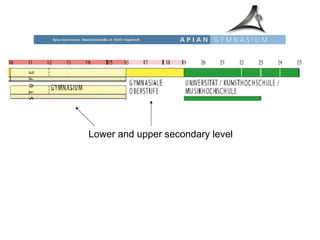
Lower and upper secondary level
The subjects:
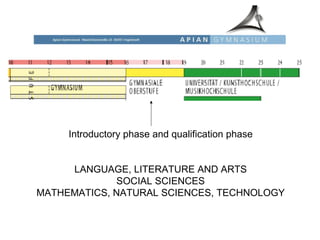
Introductory phase and qualification phase LANGUAGE, LITERATURE AND ARTS SOCIAL SCIENCES MATHEMATICS, NATURAL SCIENCES, TECHNOLOGY
 
University Tertiary Education
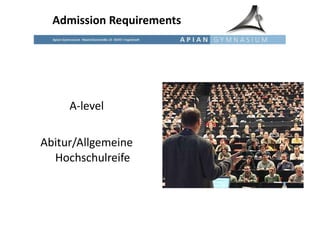
Admission Requirements A-level Abitur/Allgemeine Hochschulreife
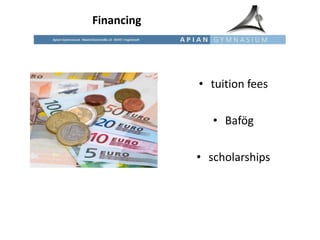
Financing tuition fees Bafög scholarships
Certification Bachelor Master Diploma Magister Staatsexamen
Teachers Training Bachelor/Master of Education 1. Staatsexamen Referendariat 2. Staatsexamen
Thank you  for  your attention
Sources www.wikipedia.org http://www.km.bayern.de/ http://www.meinbildungsweg.de/ http://eacea.ec.europa.eu/education/eurydice/eurybase_de.php http://www.uni-heidelberg.de/imperia/md/images/jrc/1007/bafoeg_i.jpg http://www.trendsderzukunft.de/wp-content/uploads/2009/01/hoersaal_rwth_400q.jpg http://steinbeis-fuer-telekom.de/typo3temp/pics/d608743204.jpg http://1.bp.blogspot.com/-vFd9MgSjCF8/TkJIfzeL0ZI/AAAAAAAACx0/h-2fFciIfzU/s1600/Lehrer+Lmpel+ts.png

Ppp comenius educgermany

  • 1.
  • 2.
  • 3.
    Primary education –Grundschule from the age of 6 first compulsory school transfer to secondary schools after 4th grade Specific requirements goals: preparation for secondary schools social education basic knowledge interests and abilities
  • 4.
    Secondary education I– Hauptschule Basic general education Application for jobs Focus on practical experience -> blue-collared jobs Activity-orientated Transfer to schools for further education possible Bad reputation in society
  • 5.
    Secondary education II- Realschule Medium general education Basic knowledge in job oriented subjects Basis for a practical career Transfer to further education possible -> after 6th grade: Gymnasium -> FOS -> even university degrees Degree: Mittlerer Schulabschluss (~ GCSE)
  • 6.
    Secondary education III- Gymnasium High general education Wide range of subjects / Courses: Focus on language and arts Focus on science and technolgy Focus on social studies At least two languages obligatory
  • 7.
    Secondary education III- Gymnasium Point system -> Marks 12 th year: Final exams -> Abitur (~ A-levels)  required for access to university Course system -> Bavaria: Abolition -> other states: Lks/Gks No central regulation of Abitur
  • 8.
    - comprehensive school- three-tier system NOT throughout Germany -> comprehensive school system e.g. in NRW - Gesamtschulen: -> degrees according to level of course -> pupils choose courses according to their skills Secondary education IV - Gesamtschule
  • 9.
    Either after oralongside apprenticeship Certificate of Intermediate Education possible Secondary education V – vocational training
  • 10.
    FOS advanced technicalcollege entrance qualification Courses: engineering , agricultural economy, business, law, social studies, art also „normal“ Abitur BOS almost similar to FOS completion of an apprenticeship Secondary education VI
  • 11.
    Fachakademie Preparation fora higher career State exam (≠ uni) -> access to university of applied science -> with honours: access to uni Requirements: mittlerer Schulabschluss + Completion of apprenticeship Fachschule Meister ≠ master degree advanced technical college entrance qualification 2 years Secondary education VII
  • 12.
    From cradle to secondary education
  • 13.
    From cradle tosecondary education nursery school (1-3) kindergarten (3-6) elementary/primary school (7-10)
  • 14.
    Nursery school educationand care costs: 70-425 € / month, depending on place of residence and income political debate historical background: care centers in GDR (all-day, no costs for parents, being part of the collective > most children attended care centers) changes in society (more women working)  future: care centers for 750.000 small children by 2013
  • 15.
    Kindergarten legal rightfor each child to get a half-day service in a kindergarten (children age 3 – when they start school) some restrictions (e.g. parents not working) there are also private kindergartens pre-school child programs
  • 16.
    Primary/elementary school (1)compulsory schooling – homeschooling not allowed.. all children who are 6 years old before Sep 30th start school in Sep > children born in Oct, Nov, Dec CAN start school BUT: if children not suitable for school yet, they go to kindergarten for one more year
  • 17.
    Primary/elementary school (2)Subjects: German, maths, local geography and history music, arts, physical education, handicrafts religion/ethics foreign languages (English: years 3 & 4)
  • 18.
    Primary/elementary school (3)Year 4: selection.. Gymnasium: 2,33 in maths/German/local geography and history + recommendation letter OR entry exam Realschule/Wirtschaftsschule: 2,66 in maths/German/local geography and history + recommendation letter OR entry exam also possible: probation period
  • 19.
  • 20.
    Mittelschule (former Hauptschule)school for people who will be trained in blue-collared jobs secondary modern school covering years 5 to 9/10  nine-year degree/certificate main objective: prepare students for their entry into the world of work
  • 21.
    Mittelschule InBavaria: possible transfer to Realschule or Gymnasium after 5 th or 6 th grade if grades are good enough In some states: Mittelschule & Realschule combined in Mittel- or Regelschule
  • 22.
    Mittelschule – nine-year-degree/certificate(I) The successful Mittelschul-degree > after 9 th grade > grade average 4,0 or better > not more than 3 E's (= 5,0; F counts as 2 E's)
  • 23.
    Mittelschule – nine-year-degree/certificate(II) The qualifying Mittelschul-degree > after 9 th grade; voluntary > grade average 3,0 or better > maths, German, English, economics & law...
  • 24.
    Mittelschule – nine-year-degree/certificate(III) GCSE/ten-year-degree via the M-Zug (same degree as intermediate school, but less prestigious/respected) > M-Zug: starts in 7 th grade; voluntary > degree after 10 th grade > grade average in federal test 4,0 or better
  • 25.
    after Mittelschule start work -> further education in the vocational training school (Berufsausbildung & Berufsschule)
  • 26.
    Intermediate school (Realschule)four years (grades 7-10) six years (grades 5-10) Broad general education and vocationally-oriented education -> students with vocational skills and interests who also show interest in theory
  • 27.
    Intermediate school (Realschule)more vocationally-oriented than Gymnasium in Bavaria: possible transfer to Gymnasium after 6 th or 10 th grade Ten-year-degree/GCSE
  • 28.
    Intermediate school –different directions of study (I) Compulsory courses / electives group I Focus: maths, natural sciences, technical areas Final exam: German, English, maths, physics For students who want to work in a technical job or continue their education at a technical secondary school (FOS – technical sector)
  • 29.
    Intermediate school –different directions of study (II) Compulsory courses / electives group II Focus: economics Final exam: German, English, maths II, business studies & accounting For students who want to work in a in the public service industry, banks or insurance companies or continue their education at a business secondary school
  • 30.
    Intermediate school –different directions of study (IIIa) Compulsory courses / electives group IIIa Focus: 2 nd foreign language Final exam: German, English, maths II, French (Spanish, Italian...) For students who want to work in the tourist industry, the public service industry, banks or insurance companies or continue their education at Gymnasium
  • 31.
    Intermediate school –different directions of study (IIIb) Compulsory courses / electives group IIIb Focus: arts, handicrafts, housekeeping or social studies Final exam: German, English, maths II, specialized course (see above) For students who want to work in a in the social or manual-creative sector or continue their education at a social/arts secondary school
  • 32.
    after intermediate school work (e.g. in the public service at secretarial and executive level) -> social/technical/economic/arts secondary school (BOS) further education at social/technical/economic/arts secondary school (FOS) -> if successful: university of applied sciences (= Fachhochschule, FH)
  • 33.
    Higher Secondary VocationalSchools/Berufliche Oberschulen
  • 34.
    Post-Secondary Non TertiaryEducation requirements : acquisition of a general education qualification general aim : to prepare the students for their studies  alternative to upper classes at Academic High Schools!
  • 35.
    Courses : two-three-yearcourses at: Fachoberschule beginning with 11 th grade no previous vocational education required B erufsoberschule beginning with 12 th grade previous vocational education required
  • 36.
    Curricula : Liberal education Subject-specific theory Practical education (in selected businesses) Subjects: General subjects : German, English, math… Specific faculties : technology, economics, social services, agricultural economics, design  Strong focus on practical experience!
  • 37.
    Qualifications : Two-year-courses: technical diploma admission to University of Applied Sciences Three-year-courses: subject-linked university entrance qualification  admission to university (to certain faculties only!) higher education entrance qualification (proof of sufficient competence in a second foreign language necessary!)  admission to university (to all faculties!)
  • 38.
    The Gymnasium – The German grammar school
  • 39.
    primary school -> secondary school -> Mittelschulen (secondary modern school) Realschulen (intermediate school) or Gymnasium (grammar school)
  • 40.
    G9-system -> G8-system Abitur after grade 13 Abitur after grade 12
  • 41.
    Lower and uppersecondary level
  • 42.
  • 43.
    Introductory phase andqualification phase LANGUAGE, LITERATURE AND ARTS SOCIAL SCIENCES MATHEMATICS, NATURAL SCIENCES, TECHNOLOGY
  • 44.
  • 45.
  • 46.
    Admission Requirements A-levelAbitur/Allgemeine Hochschulreife
  • 47.
    Financing tuition feesBafög scholarships
  • 48.
    Certification Bachelor MasterDiploma Magister Staatsexamen
  • 49.
    Teachers Training Bachelor/Masterof Education 1. Staatsexamen Referendariat 2. Staatsexamen
  • 50.
    Thank you for your attention
  • 51.
    Sources www.wikipedia.org http://www.km.bayern.de/http://www.meinbildungsweg.de/ http://eacea.ec.europa.eu/education/eurydice/eurybase_de.php http://www.uni-heidelberg.de/imperia/md/images/jrc/1007/bafoeg_i.jpg http://www.trendsderzukunft.de/wp-content/uploads/2009/01/hoersaal_rwth_400q.jpg http://steinbeis-fuer-telekom.de/typo3temp/pics/d608743204.jpg http://1.bp.blogspot.com/-vFd9MgSjCF8/TkJIfzeL0ZI/AAAAAAAACx0/h-2fFciIfzU/s1600/Lehrer+Lmpel+ts.png

Editor's Notes

  • #3 Full time education compulsory from 6-15 Free of charge