JAPANESE EDUCATION SYSTEM
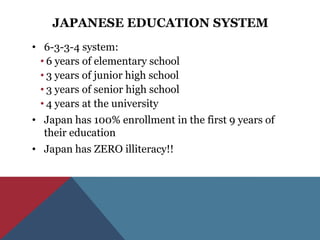
• 6-3-3-4 system:
  • 6 years of elementary school
  • 3 years of junior high school
  • 3 years of senior high school
  • 4 years at the university
• Japan has 100% enrollment in the first 9 years of
  their education
• Japan has ZERO illiteracy!!
JAPANESE EDUCATION SYSTEM
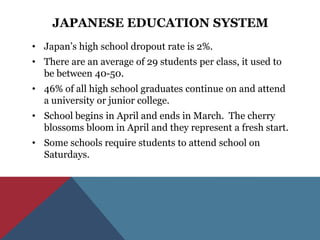
• Japan’s high school dropout rate is 2%.
• There are an average of 29 students per class, it used to
  be between 40-50.
• 46% of all high school graduates continue on and attend
  a university or junior college.
• School begins in April and ends in March. The cherry
  blossoms bloom in April and they represent a fresh start.
• Some schools require students to attend school on
  Saturdays.
JAPANESE ELEMENTARY SCHOOL
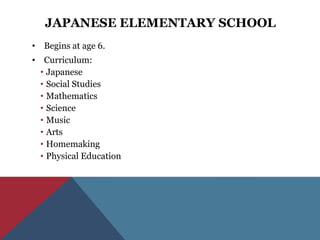
• Begins at age 6.
• Curriculum:
  • Japanese
  • Social Studies
  • Mathematics
  • Science
  • Music
  • Arts
  • Homemaking
  • Physical Education
JAPANESE ELEMENTARY SCHOOL
• Once a week, children have moral education
  classes.
• Classes are part of “whole-person” education, which
  is the main task of the elementary school system.
• Moral education is also evident during the school’s
  class-cleaning and school lunch activities.
JAPANESE JUNIOR HIGH SCHOOL
• Curriculum:
  • Japanese
  • Mathematics
  • Social Studies
  • Science
  • English
  • Music
  • Art
  • Physical Education
• Students also have homeroom time, clubs and field trips.
JAPANESE JUNIOR HIGH SCHOOL
• Students receive their instruction from specialized
  teachers for each subject area.
• The pace in junior high school is very quick.
• The education is very text-book oriented, teachers
  have a lot of information to cover in order to have
  students ready for their senior high school entrance
  exams.
JAPANESE SENIOR HIGH SCHOOL
• Types of high schools:
  • Elite academic high schools – collect top students
    who usually attend top universities.
  • Non-elite academic high schools – prepare
    students for less-prestigious universities or junior
    colleges. They also send many students to private
    specialized schools (subjects such as
    bookkeeping, languages and computer
    programming.)
JAPANESE SENIOR HIGH SCHOOL
• Types of high schools (cont.)
  • Vocational high schools – offers courses in
    commerce, technical
    subjects, agriculture, homescience, nursing and
    fishing.
  • Correspondence high schools – flexible form of
    schooling for 1.6% of students who missed out on
    high schooling for different reasons.
  • Evening high school – offer classes to poor but
    ambitious students who worked while trying to
    remedy their educational deficiencies.

Education in Japan

  • 2.
    JAPANESE EDUCATION SYSTEM •6-3-3-4 system: • 6 years of elementary school • 3 years of junior high school • 3 years of senior high school • 4 years at the university • Japan has 100% enrollment in the first 9 years of their education • Japan has ZERO illiteracy!!
  • 3.
    JAPANESE EDUCATION SYSTEM •Japan’s high school dropout rate is 2%. • There are an average of 29 students per class, it used to be between 40-50. • 46% of all high school graduates continue on and attend a university or junior college. • School begins in April and ends in March. The cherry blossoms bloom in April and they represent a fresh start. • Some schools require students to attend school on Saturdays.
  • 4.
    JAPANESE ELEMENTARY SCHOOL •Begins at age 6. • Curriculum: • Japanese • Social Studies • Mathematics • Science • Music • Arts • Homemaking • Physical Education
  • 5.
    JAPANESE ELEMENTARY SCHOOL •Once a week, children have moral education classes. • Classes are part of “whole-person” education, which is the main task of the elementary school system. • Moral education is also evident during the school’s class-cleaning and school lunch activities.
  • 6.
    JAPANESE JUNIOR HIGHSCHOOL • Curriculum: • Japanese • Mathematics • Social Studies • Science • English • Music • Art • Physical Education • Students also have homeroom time, clubs and field trips.
  • 7.
    JAPANESE JUNIOR HIGHSCHOOL • Students receive their instruction from specialized teachers for each subject area. • The pace in junior high school is very quick. • The education is very text-book oriented, teachers have a lot of information to cover in order to have students ready for their senior high school entrance exams.
  • 8.
    JAPANESE SENIOR HIGHSCHOOL • Types of high schools: • Elite academic high schools – collect top students who usually attend top universities. • Non-elite academic high schools – prepare students for less-prestigious universities or junior colleges. They also send many students to private specialized schools (subjects such as bookkeeping, languages and computer programming.)
  • 9.
    JAPANESE SENIOR HIGHSCHOOL • Types of high schools (cont.) • Vocational high schools – offers courses in commerce, technical subjects, agriculture, homescience, nursing and fishing. • Correspondence high schools – flexible form of schooling for 1.6% of students who missed out on high schooling for different reasons. • Evening high school – offer classes to poor but ambitious students who worked while trying to remedy their educational deficiencies.