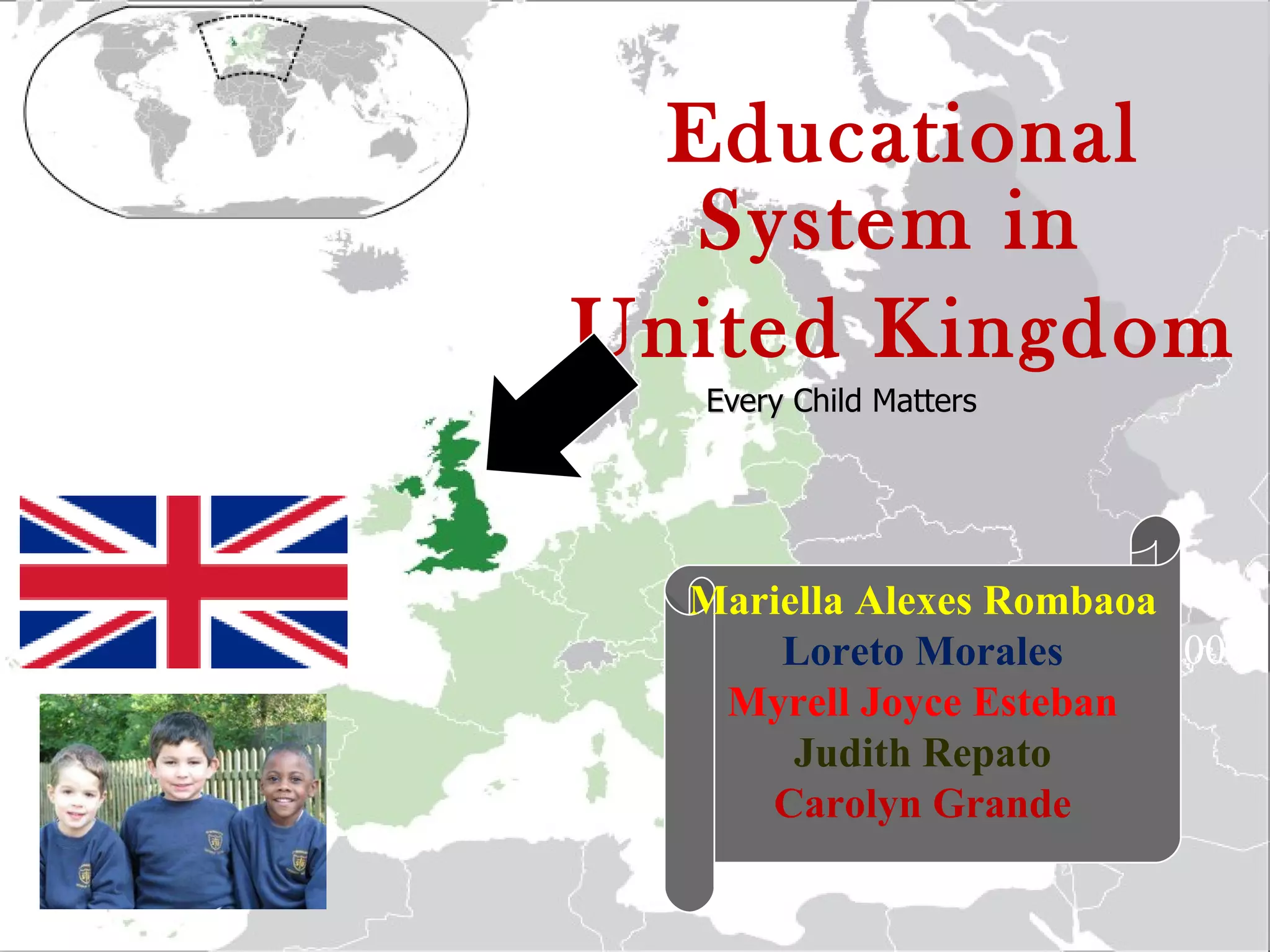
Every Child Matters Educational System in  United Kingdom Vicky Gough May 2009  Mariella Alexes Rombaoa Loreto Morales Myrell Joyce Esteban Judith Repato Carolyn Grande
Facts & Figures Map of United Kingdom  Sovereign:  Queen Elizabeth II (1952) Prime Minister:  David Cameron (2010) Land area:  93,278 sq mi (241,590 sq km); total area: 94,526 sq mi (244,820 sq km) Population (2010 est.):  61,284,806 (growth rate: 0.2%); birth rate: 10.6/1000; infant mortality rate: 4.7/1000; life expectancy: 79.1; density per sq km: 246 Capital and largest city (2003 est.):  London, 7,615,000 (metro. area), 7,429,200 (city proper) Other large cities:  Glasgow, 1,099,400; Birmingham, 971,800; Liverpool, 461,900; Edinburgh, 460,000; Leeds, 417,000; Bristol, 406,500; Manchester, 390,700; Bradford, 288,400
United Kingdom The  United Kingdom of Great Britain and Northern Ireland (commonly known as the  United Kingdom , the  UK  or  Britain ) is a sovereign state located off the north-western coast of continental Europe.  The country includes the island of Great Britain, the north-eastern part of the island of Ireland and many smaller islands. Northern Ireland is the only part of the UK that shares a land border with another sovereign state—the Republic of Ireland. Apart from this land border the UK is surrounded by the Atlantic Ocean the North Sea, the English Channel and the Irish Sea. The UK is a developed country and has the world's sixth-largest economy by nominal GDP and seventh-largest economy by purchasing power parity. It was the world's first industrialised country and the world's foremost power during the 19th and early 20th centuries. The UK remains a great power with leading economic, cultural, military, scientific and political influence. It is a recognised nuclear weapons state and its military expenditure ranks third or fourth in the world. The UK has been a permanent member of the United Nations Security Council since its first session in 1946.
Structure of Basic Education in United Kingdom
Structure of HIGHER Education in United Kingdom
 
key facts  8.3 million pupils 25300 schools Primary Secondary % pupils eligible for free meals 16.9%  (includes nursery) 14% % ethnic minorities 19.3% 15.9% % first language other than English 11.6% 9% average class size 26.2 21.7
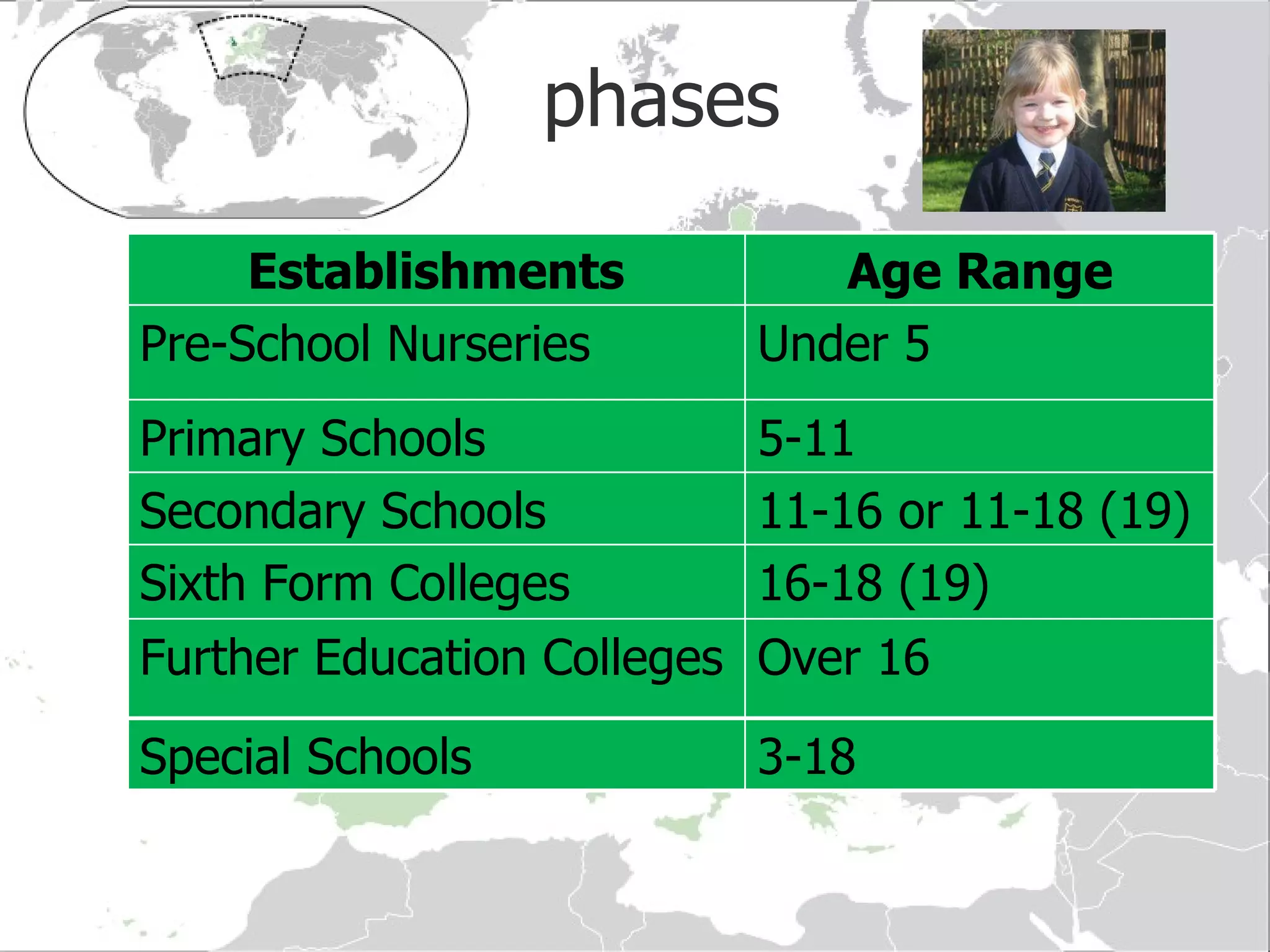
phases Establishments Age Range Pre-School Nurseries Under 5 Primary Schools 5-11 Secondary Schools 11-16 or 11-18 (19) Sixth Form Colleges 16-18 (19) Further Education Colleges Over 16 Special Schools 3-18
phases and testing GCSE – General Certificate of Secondary Education AS – first year of Advanced Level course A2 – second/final year of Advanced Level Establishments Key Stage(s) Main Assessments Primary Schools Foundation Stage 1 2 National Tests (11) Secondary Schools 3 4 GCSE  (16) Sixth Form Colleges 5 AS A2
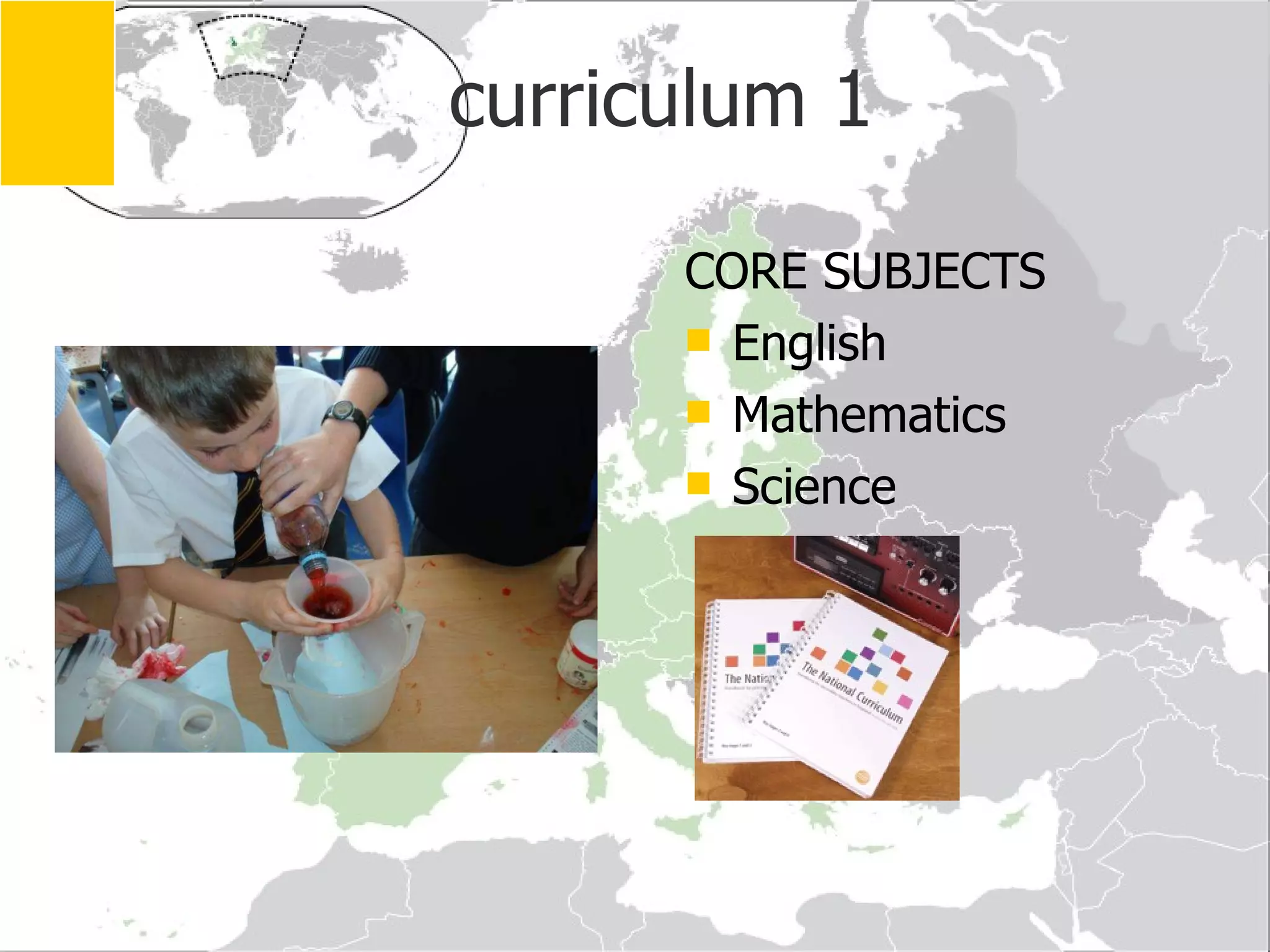
curriculum 1 CORE SUBJECTS English Mathematics Science
curriculum 2 Art Geography History Music Design and Technology Information and Communications Technology Physical Education Religious Education Sex and Relationship Education Careers Education Citizenship
curriculum 3: Key Stage 4 Students aged 14-16  compulsory subjects, e.g. Mathematics entitlement subjects, e.g. Modern Foreign Language ‘ options’ – examples: Business Studies Media Studies Dance Drama
curriculum 4: new diplomas Introduction of new diplomas (vocational education) in September 2008 pupils 14-19
 

educational System of United Kingdom

  • 1.
    Every Child MattersEducational System in United Kingdom Vicky Gough May 2009 Mariella Alexes Rombaoa Loreto Morales Myrell Joyce Esteban Judith Repato Carolyn Grande
  • 2.
    Facts & FiguresMap of United Kingdom Sovereign: Queen Elizabeth II (1952) Prime Minister: David Cameron (2010) Land area: 93,278 sq mi (241,590 sq km); total area: 94,526 sq mi (244,820 sq km) Population (2010 est.): 61,284,806 (growth rate: 0.2%); birth rate: 10.6/1000; infant mortality rate: 4.7/1000; life expectancy: 79.1; density per sq km: 246 Capital and largest city (2003 est.): London, 7,615,000 (metro. area), 7,429,200 (city proper) Other large cities: Glasgow, 1,099,400; Birmingham, 971,800; Liverpool, 461,900; Edinburgh, 460,000; Leeds, 417,000; Bristol, 406,500; Manchester, 390,700; Bradford, 288,400
  • 3.
    United Kingdom The United Kingdom of Great Britain and Northern Ireland (commonly known as the United Kingdom , the UK or Britain ) is a sovereign state located off the north-western coast of continental Europe. The country includes the island of Great Britain, the north-eastern part of the island of Ireland and many smaller islands. Northern Ireland is the only part of the UK that shares a land border with another sovereign state—the Republic of Ireland. Apart from this land border the UK is surrounded by the Atlantic Ocean the North Sea, the English Channel and the Irish Sea. The UK is a developed country and has the world's sixth-largest economy by nominal GDP and seventh-largest economy by purchasing power parity. It was the world's first industrialised country and the world's foremost power during the 19th and early 20th centuries. The UK remains a great power with leading economic, cultural, military, scientific and political influence. It is a recognised nuclear weapons state and its military expenditure ranks third or fourth in the world. The UK has been a permanent member of the United Nations Security Council since its first session in 1946.
  • 4.
    Structure of BasicEducation in United Kingdom
  • 5.
    Structure of HIGHEREducation in United Kingdom
  • 6.
  • 7.
    key facts 8.3 million pupils 25300 schools Primary Secondary % pupils eligible for free meals 16.9% (includes nursery) 14% % ethnic minorities 19.3% 15.9% % first language other than English 11.6% 9% average class size 26.2 21.7
  • 8.
    phases Establishments AgeRange Pre-School Nurseries Under 5 Primary Schools 5-11 Secondary Schools 11-16 or 11-18 (19) Sixth Form Colleges 16-18 (19) Further Education Colleges Over 16 Special Schools 3-18
  • 9.
    phases and testingGCSE – General Certificate of Secondary Education AS – first year of Advanced Level course A2 – second/final year of Advanced Level Establishments Key Stage(s) Main Assessments Primary Schools Foundation Stage 1 2 National Tests (11) Secondary Schools 3 4 GCSE (16) Sixth Form Colleges 5 AS A2
  • 10.
    curriculum 1 CORESUBJECTS English Mathematics Science
  • 11.
    curriculum 2 ArtGeography History Music Design and Technology Information and Communications Technology Physical Education Religious Education Sex and Relationship Education Careers Education Citizenship
  • 12.
    curriculum 3: KeyStage 4 Students aged 14-16 compulsory subjects, e.g. Mathematics entitlement subjects, e.g. Modern Foreign Language ‘ options’ – examples: Business Studies Media Studies Dance Drama
  • 13.
    curriculum 4: newdiplomas Introduction of new diplomas (vocational education) in September 2008 pupils 14-19
  • 14.

Editor's Notes

  • #13 Entitlement Subjects: these are subjects that must be available to students even if they themselves elect not to take them.
  • #14 Level 1, equivalent to four or five GCSEs Level 2, equivalent to six GCSEs At levels 1 and 2 students study the core curriculum plus the diploma. Level 1, equivalent to four or five GCSEs Level 2, equivalent to six GCSEs At levels 1 and 2 students study the core curriculum plus the diploma. Level 1, equivalent to four or five GCSEs Level 2, equivalent to six GCSEs At levels 1 and 2 students study the core curriculum plus the diploma.