Elisaveta Stoitseva, 54.СУ“Св.Иван Рилски“, София
Ages and stages
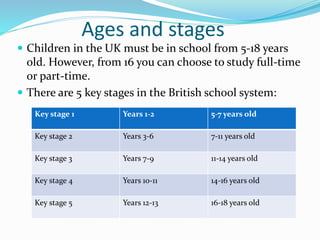
 Children in the UK must be in school from 5-18 years
old. However, from 16 you can choose to study full-time
or part-time.
 There are 5 key stages in the British school system:
Key stage 1 Years 1-2 5-7 years old
Key stage 2 Years 3-6 7-11 years old
Key stage 3 Years 7-9 11-14 years old
Key stage 4 Years 10-11 14-16 years old
Key stage 5 Years 12-13 16-18 years old
Types of school
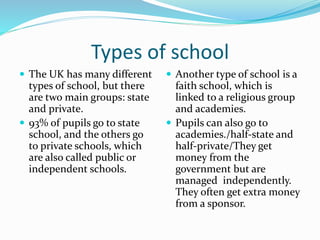
 The UK has many different
types of school, but there
are two main groups: state
and private.
 93% of pupils go to state
school, and the others go
to private schools, which
are also called public or
independent schools.
 Another type of school is a
faith school, which is
linked to a religious group
and academies.
 Pupils can also go to
academies./half-state and
half-private/They get
money from the
government but are
managed independently.
They often get extra money
from a sponsor.
Holidays
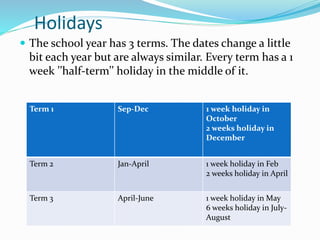
 The school year has 3 terms. The dates change a little
bit each year but are always similar. Every term has a 1
week ’’half-term’’ holiday in the middle of it.
Term 1 Sep-Dec 1 week holiday in
October
2 weeks holiday in
December
Term 2 Jan-April 1 week holiday in Feb
2 weeks holiday in April
Term 3 April-June 1 week holiday in May
6 weeks holiday in July-
August
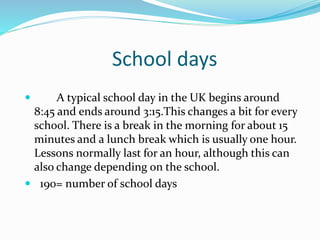
School days
 A typical school day in the UK begins around
8:45 and ends around 3:15.This changes a bit for every
school. There is a break in the morning for about 15
minutes and a lunch break which is usually one hour.
Lessons normally last for an hour, although this can
also change depending on the school.
 190= number of school days
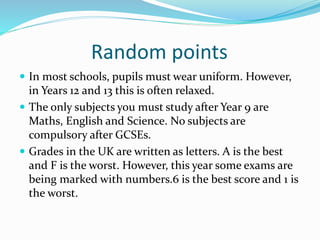
Random points
 In most schools, pupils must wear uniform. However,
in Years 12 and 13 this is often relaxed.
 The only subjects you must study after Year 9 are
Maths, English and Science. No subjects are
compulsory after GCSEs.
 Grades in the UK are written as letters. A is the best
and F is the worst. However, this year some exams are
being marked with numbers.6 is the best score and 1 is
the worst.
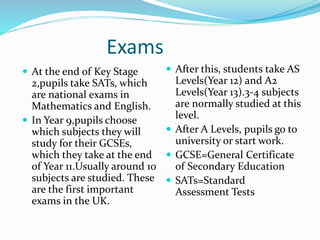
Exams
 At the end of Key Stage
2,pupils take SATs, which
are national exams in
Mathematics and English.
 In Year 9,pupils choose
which subjects they will
study for their GCSEs,
which they take at the end
of Year 11.Usually around 10
subjects are studied. These
are the first important
exams in the UK.
 After this, students take AS
Levels(Year 12) and A2
Levels(Year 13).3-4 subjects
are normally studied at this
level.
 After A Levels, pupils go to
university or start work.
 GCSE=General Certificate
of Secondary Education
 SATs=Standard
Assessment Tests
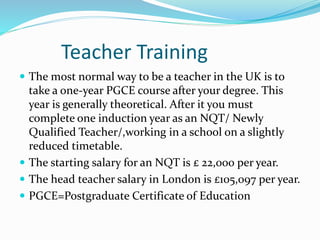
Teacher Training
 The most normal way to be a teacher in the UK is to
take a one-year PGCE course after your degree. This
year is generally theoretical. After it you must
complete one induction year as an NQT/ Newly
Qualified Teacher/,working in a school on a slightly
reduced timetable.
 The starting salary for an NQT is £ 22,000 per year.
 The head teacher salary in London is £105,097 per year.
 PGCE=Postgraduate Certificate of Education

The British education system

  • 1.
  • 2.
    Ages and stages Children in the UK must be in school from 5-18 years old. However, from 16 you can choose to study full-time or part-time.  There are 5 key stages in the British school system: Key stage 1 Years 1-2 5-7 years old Key stage 2 Years 3-6 7-11 years old Key stage 3 Years 7-9 11-14 years old Key stage 4 Years 10-11 14-16 years old Key stage 5 Years 12-13 16-18 years old
  • 3.
    Types of school The UK has many different types of school, but there are two main groups: state and private.  93% of pupils go to state school, and the others go to private schools, which are also called public or independent schools.  Another type of school is a faith school, which is linked to a religious group and academies.  Pupils can also go to academies./half-state and half-private/They get money from the government but are managed independently. They often get extra money from a sponsor.
  • 4.
    Holidays  The schoolyear has 3 terms. The dates change a little bit each year but are always similar. Every term has a 1 week ’’half-term’’ holiday in the middle of it. Term 1 Sep-Dec 1 week holiday in October 2 weeks holiday in December Term 2 Jan-April 1 week holiday in Feb 2 weeks holiday in April Term 3 April-June 1 week holiday in May 6 weeks holiday in July- August
  • 5.
    School days  Atypical school day in the UK begins around 8:45 and ends around 3:15.This changes a bit for every school. There is a break in the morning for about 15 minutes and a lunch break which is usually one hour. Lessons normally last for an hour, although this can also change depending on the school.  190= number of school days
  • 6.
    Random points  Inmost schools, pupils must wear uniform. However, in Years 12 and 13 this is often relaxed.  The only subjects you must study after Year 9 are Maths, English and Science. No subjects are compulsory after GCSEs.  Grades in the UK are written as letters. A is the best and F is the worst. However, this year some exams are being marked with numbers.6 is the best score and 1 is the worst.
  • 7.
    Exams  At theend of Key Stage 2,pupils take SATs, which are national exams in Mathematics and English.  In Year 9,pupils choose which subjects they will study for their GCSEs, which they take at the end of Year 11.Usually around 10 subjects are studied. These are the first important exams in the UK.  After this, students take AS Levels(Year 12) and A2 Levels(Year 13).3-4 subjects are normally studied at this level.  After A Levels, pupils go to university or start work.  GCSE=General Certificate of Secondary Education  SATs=Standard Assessment Tests
  • 8.
    Teacher Training  Themost normal way to be a teacher in the UK is to take a one-year PGCE course after your degree. This year is generally theoretical. After it you must complete one induction year as an NQT/ Newly Qualified Teacher/,working in a school on a slightly reduced timetable.  The starting salary for an NQT is £ 22,000 per year.  The head teacher salary in London is £105,097 per year.  PGCE=Postgraduate Certificate of Education