Education System of UK
Karma Tenzin & Passang Tshering
Introduction
 Education is compulsory between age 5-16
 But attending school is not compulsory (Home
schooling)
 The School year runs from September to July (39
weeks)
 Most schools require students to wear school
uniform
Primary School
 5-11 year olds
 One teacher
 Close to home
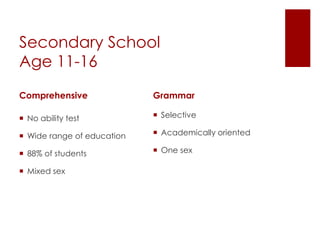
Secondary School
Age 11-16
Comprehensive
 No ability test
 Wide range of education
 88% of students
 Mixed sex
Grammar
 Selective
 Academically oriented
 One sex
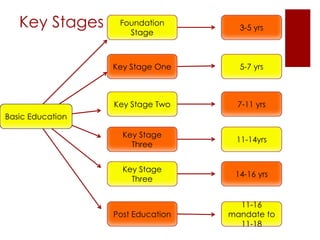
Key Stages
Post Education
Key Stage
Three
Key Stage
Three
Key Stage Two
Key Stage One
Foundation
Stage
11-16
mandate to
11-18
14-16 yrs
11-14yrs
7-11 yrs
5-7 yrs
3-5 yrs
Basic Education
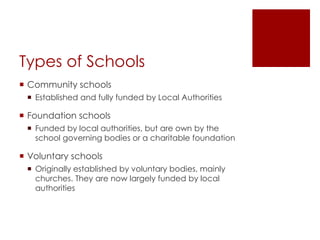
Types of Schools
 Community schools
 Established and fully funded by Local Authorities
 Foundation schools
 Funded by local authorities, but are own by the
school governing bodies or a charitable foundation
 Voluntary schools
 Originally established by voluntary bodies, mainly
churches. They are now largely funded by local
authorities
Home Schooling
 Attending school is not compulsory
 The only demand is that every student receives
an “efficient full-time education suitable to this
age, ability and aptitude, either by regular
attendance at school or otherwise
 Over 50,000 students are home schooled each
year, and is increasing (17%)
Curriculum
 CORE SUBJECTS
 English
 Mathematics
 Science
 Art
 Geography
 History
 Music
 Design and Technology
 Information and Communications Technology
 Physical Education
 Religious Education
 Sex and Relationship Education
 Careers Education
 Citizenship
Examinations
 SAT
 11+
 GCSE
 AS-levels
 A-levels
Fee-paying Schools
 Public schools
 Common Entrance exam
 Prep school
 Preparation for public school
Higher education
 30% of the 18 to 19 year olds
 Two A-levels
 Grade E or above is required
 Oxbridge universities
Higher education
 It is provided by three types of institutions:
 universities, colleges and institutions of higher
education and art and music colleges.
 All universities are autonomous institutions and
they determine their own admissions policy and
requirements.
 Non-university level post-secondary studies:
 technical/vocational
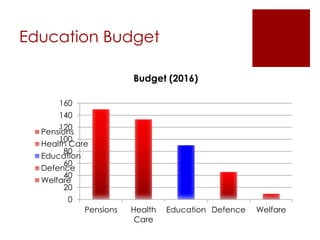
Education Budget
0
20
40
60
80
100
120
140
160
Pensions Health
Care
Education Defence Welfare
Budget (2016)
Pensions
Health Care
Education
Defence
Welfare
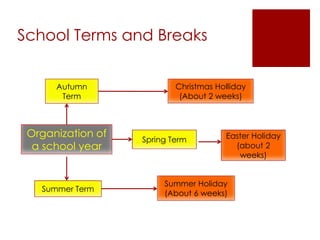
School Terms and Breaks
Organization of
a school year
Spring Term
Autumn
Term
Summer Term
Summer Holiday
(About 6 weeks)
Christmas Holliday
(About 2 weeks)
Easter Holiday
(about 2
weeks)
School Timing
School Day
School lasts from 9am until 3.20pm
Lessons are 1 hour and 15 minutes long.
There is a break in the morning at 11.40am which lasts 20
minutes.
At break time, students usually eat a snack.
Lunch
Lunch is at 1.15 until 2 pm.
Students stay in school and they either bring their own lunch in a
lunch box OR they can buy lunch from the school canteen.
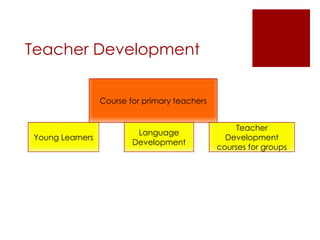
Teacher Development
Course for primary teachers
Language
Development
Teacher
Development
courses for groups
Young Learners
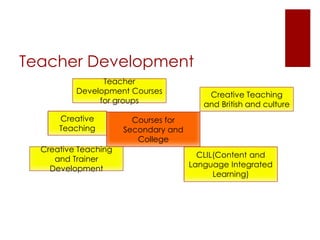
Teacher Development
Creative Teaching
and British and culture
Creative
Teaching
Courses for
Secondary and
College
CLIL(Content and
Language Integrated
Learning)
Creative Teaching
and Trainer
Development
Teacher
Development Courses
for groups
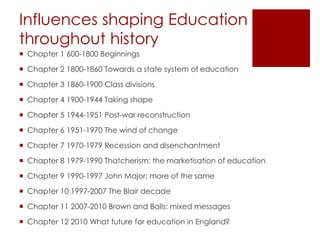
Influences shaping Education
throughout history
 Chapter 1 600-1800 Beginnings
 Chapter 2 1800-1860 Towards a state system of education
 Chapter 3 1860-1900 Class divisions
 Chapter 4 1900-1944 Taking shape
 Chapter 5 1944-1951 Post-war reconstruction
 Chapter 6 1951-1970 The wind of change
 Chapter 7 1970-1979 Recession and disenchantment
 Chapter 8 1979-1990 Thatcherism: the marketisation of education
 Chapter 9 1990-1997 John Major: more of the same
 Chapter 10 1997-2007 The Blair decade
 Chapter 11 2007-2010 Brown and Balls: mixed messages
 Chapter 12 2010 What future for education in England?
Takeaway
 Home Schooling
 11+ Exam to decide future
 Grammar School
 School timings
Thank You
Passang Tshering

Uk education system

  • 1.
    Education System ofUK Karma Tenzin & Passang Tshering
  • 2.
    Introduction  Education iscompulsory between age 5-16  But attending school is not compulsory (Home schooling)  The School year runs from September to July (39 weeks)  Most schools require students to wear school uniform
  • 3.
    Primary School  5-11year olds  One teacher  Close to home
  • 4.
    Secondary School Age 11-16 Comprehensive No ability test  Wide range of education  88% of students  Mixed sex Grammar  Selective  Academically oriented  One sex
  • 5.
    Key Stages Post Education KeyStage Three Key Stage Three Key Stage Two Key Stage One Foundation Stage 11-16 mandate to 11-18 14-16 yrs 11-14yrs 7-11 yrs 5-7 yrs 3-5 yrs Basic Education
  • 6.
    Types of Schools Community schools  Established and fully funded by Local Authorities  Foundation schools  Funded by local authorities, but are own by the school governing bodies or a charitable foundation  Voluntary schools  Originally established by voluntary bodies, mainly churches. They are now largely funded by local authorities
  • 7.
    Home Schooling  Attendingschool is not compulsory  The only demand is that every student receives an “efficient full-time education suitable to this age, ability and aptitude, either by regular attendance at school or otherwise  Over 50,000 students are home schooled each year, and is increasing (17%)
  • 8.
    Curriculum  CORE SUBJECTS English  Mathematics  Science  Art  Geography  History  Music  Design and Technology  Information and Communications Technology  Physical Education  Religious Education  Sex and Relationship Education  Careers Education  Citizenship
  • 9.
    Examinations  SAT  11+ GCSE  AS-levels  A-levels
  • 10.
    Fee-paying Schools  Publicschools  Common Entrance exam  Prep school  Preparation for public school
  • 11.
    Higher education  30%of the 18 to 19 year olds  Two A-levels  Grade E or above is required  Oxbridge universities
  • 12.
    Higher education  Itis provided by three types of institutions:  universities, colleges and institutions of higher education and art and music colleges.  All universities are autonomous institutions and they determine their own admissions policy and requirements.  Non-university level post-secondary studies:  technical/vocational
  • 13.
    Education Budget 0 20 40 60 80 100 120 140 160 Pensions Health Care EducationDefence Welfare Budget (2016) Pensions Health Care Education Defence Welfare
  • 14.
    School Terms andBreaks Organization of a school year Spring Term Autumn Term Summer Term Summer Holiday (About 6 weeks) Christmas Holliday (About 2 weeks) Easter Holiday (about 2 weeks)
  • 15.
    School Timing School Day Schoollasts from 9am until 3.20pm Lessons are 1 hour and 15 minutes long. There is a break in the morning at 11.40am which lasts 20 minutes. At break time, students usually eat a snack. Lunch Lunch is at 1.15 until 2 pm. Students stay in school and they either bring their own lunch in a lunch box OR they can buy lunch from the school canteen.
  • 16.
    Teacher Development Course forprimary teachers Language Development Teacher Development courses for groups Young Learners
  • 17.
    Teacher Development Creative Teaching andBritish and culture Creative Teaching Courses for Secondary and College CLIL(Content and Language Integrated Learning) Creative Teaching and Trainer Development Teacher Development Courses for groups
  • 18.
    Influences shaping Education throughouthistory  Chapter 1 600-1800 Beginnings  Chapter 2 1800-1860 Towards a state system of education  Chapter 3 1860-1900 Class divisions  Chapter 4 1900-1944 Taking shape  Chapter 5 1944-1951 Post-war reconstruction  Chapter 6 1951-1970 The wind of change  Chapter 7 1970-1979 Recession and disenchantment  Chapter 8 1979-1990 Thatcherism: the marketisation of education  Chapter 9 1990-1997 John Major: more of the same  Chapter 10 1997-2007 The Blair decade  Chapter 11 2007-2010 Brown and Balls: mixed messages  Chapter 12 2010 What future for education in England?
  • 19.
    Takeaway  Home Schooling 11+ Exam to decide future  Grammar School  School timings
  • 20.