1
2 
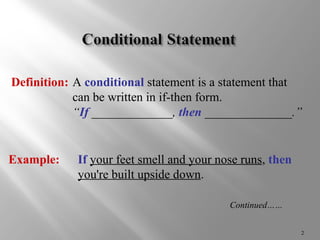
Definition: A conditional statement is a statement that 
can be written in if-then form. 
“If _____________, then ______________.” 
Example: If your feet smell and your nose runs, then 
you're built upside down. 
Continued……
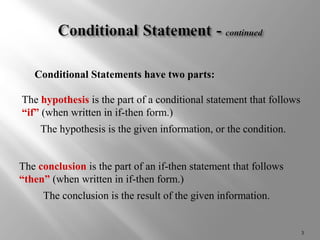
Conditional Statements have two parts: 
3 
The hypothesis is the part of a conditional statement that follows 
“if” (when written in if-then form.) 
The hypothesis is the given information, or the condition. 
The conclusion is the part of an if-then statement that follows 
“then” (when written in if-then form.) 
The conclusion is the result of the given information.
4 
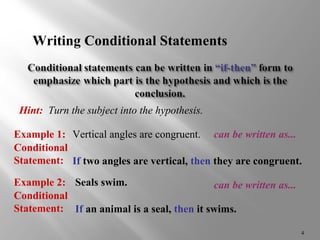
Writing Conditional Statements 
Hint: Turn the subject into the hypothesis. 
Example 1: Vertical angles are congruent. can be written as... 
Conditional 
Statement: 
Example 2: Seals swim. can be written as... 
Conditional 
Statement: If an animal is a seal, then it swims. 
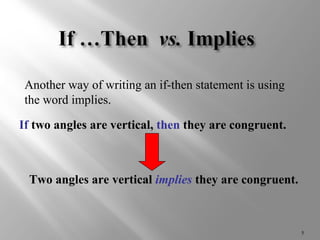
If two angles are vertical, then they are congruent.
Two angles are vertical implies they are congruent. 
5 
Another way of writing an if-then statement is using 
the word implies. 
If two angles are vertical, then they are congruent.
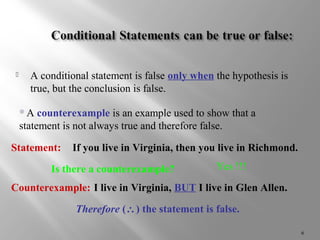
 A conditional statement is false only when the hypothesis is 
true, but the conclusion is false. 
6 
A counterexample is an example used to show that a 
statement is not always true and therefore false. 
If you live in Virginia, th Statement: en you live in Richmond. 
Is there a counterexample? 
Yes !!! 
Counterexample: I live in Virginia, BUT I live in Glen Allen. 
Therefore () the statement is false.
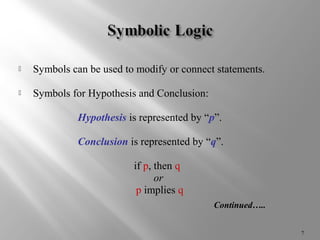
 Symbols can be used to modify or connect statements. 
 Symbols for Hypothesis and Conclusion: 
Hypothesis is represented by “p”. 
Conclusion is represented by “q”. 
if p, then q 
or 
p implies q 
7 
Continued…..
if p, then q 
or 
p implies q 
8 
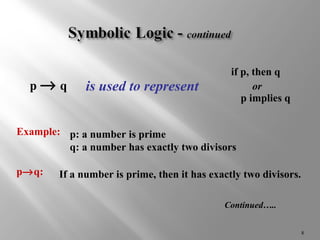
p ® q is used to represent 
Example: p: a number is prime 
q: a number has exactly two divisors 
p®q: If a number is prime, then it has exactly two divisors. 
Continued…..
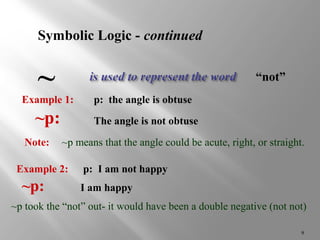
~p: 
Note: 
Example 2: p: I am not happy 
~p: I am happy 
~p took the “not” out- it would have been a double negative (not not) 
9 
Symbolic Logic - continued 
~ “not” 
Example 1: p: the angle is obtuse 
The angle is not obtuse 
~p means that the angle could be acute, right, or straight.
10 
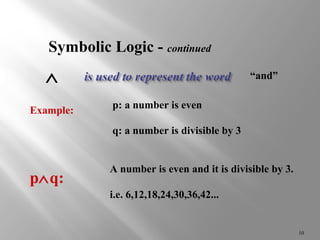
Symbolic Logic - continued 
Ù “and” 
Example: p: a number is even 
q: a number is divisible by 3 
A number is even and it is divisible by 3. 
i.e. 6,12,18,24,30,36,42... 
pÙq:
11 
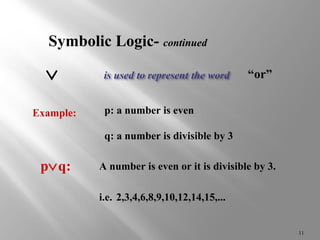
Symbolic Logic- continued 
Ú “or” 
Example: p: a number is even 
q: a number is divisible by 3 
pÚq: A number is even or it is divisible by 3. 
i.e. 2,3,4,6,8,9,10,12,14,15,...
12 
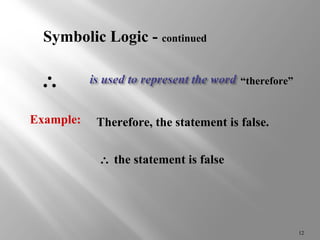
“therefore” 
Symbolic Logic - continued 
 
Example: Therefore, the statement is false. 
 the statement is false
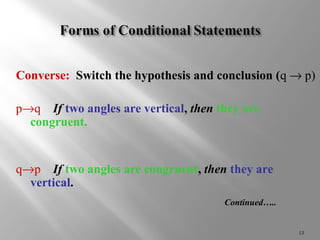
Converse: Switch the hypothesis and conclusion (q ® p) 
p®q If two angles are vertical, then they are 
congruent. 
q®p If two angles are congruent, then they are 
vertical. 
13 
Continued…..
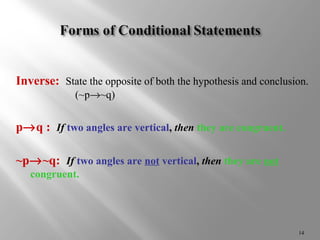
Inverse: State the opposite of both the hypothesis and conclusion. 
(~p®~q) 
p®q : If two angles are vertical, then they are congruent. 
~p®~q: If two angles are not vertical, then they are not 
congruent. 
14
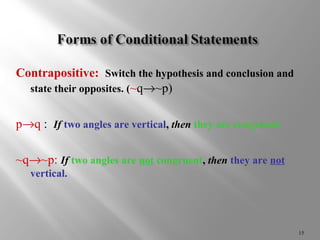
Contrapositive: Switch the hypothesis and conclusion and 
state their opposites. (~q®~p) 
p®q : If two angles are vertical, then they are congruent. 
~q®~p: If two angles are not congruent, then they are not 
vertical. 
15
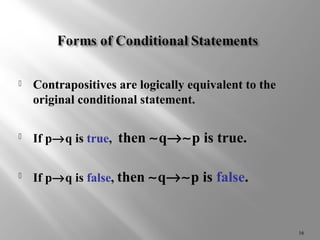
 Contrapositives are logically equivalent to the 
original conditional statement. 
 If p®q is true, then ~q®~p is true. 
 If p®q is false, then ~q®~p is false. 
16
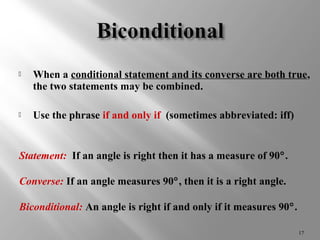
 When a conditional statement and its converse are both true, 
the two statements may be combined. 
 Use the phrase if and only if (sometimes abbreviated: iff) 
17 
Statement: If an angle is right then it has a measure of 90°. 
Converse: If an angle measures 90°, then it is a right angle. 
Biconditional: An angle is right if and only if it measures 90°.
All rights belong to their respective owners. 
Copyright Disclaimer Under Section 107 of 
the Copyright Act 1976, allowance is made 
for "fair use" for purposes such as criticism, 
comment, news reporting, TEACHING, 
scholarship, and research. 
Fair use is a use permitted by copyright 
statute that might otherwise be infringing. 
Non-profit, EDUCATIONAL or personal 
use tips the balance in favor of fair use. 
18

Geometry unit 2.2

  • 1.
  • 2.
    2 Definition: Aconditional statement is a statement that can be written in if-then form. “If _____________, then ______________.” Example: If your feet smell and your nose runs, then you're built upside down. Continued……
  • 3.
    Conditional Statements havetwo parts: 3 The hypothesis is the part of a conditional statement that follows “if” (when written in if-then form.) The hypothesis is the given information, or the condition. The conclusion is the part of an if-then statement that follows “then” (when written in if-then form.) The conclusion is the result of the given information.
  • 4.
    4 Writing ConditionalStatements Hint: Turn the subject into the hypothesis. Example 1: Vertical angles are congruent. can be written as... Conditional Statement: Example 2: Seals swim. can be written as... Conditional Statement: If an animal is a seal, then it swims. If two angles are vertical, then they are congruent.
  • 5.
    Two angles arevertical implies they are congruent. 5 Another way of writing an if-then statement is using the word implies. If two angles are vertical, then they are congruent.
  • 6.
     A conditionalstatement is false only when the hypothesis is true, but the conclusion is false. 6 A counterexample is an example used to show that a statement is not always true and therefore false. If you live in Virginia, th Statement: en you live in Richmond. Is there a counterexample? Yes !!! Counterexample: I live in Virginia, BUT I live in Glen Allen. Therefore () the statement is false.
  • 7.
     Symbols canbe used to modify or connect statements.  Symbols for Hypothesis and Conclusion: Hypothesis is represented by “p”. Conclusion is represented by “q”. if p, then q or p implies q 7 Continued…..
  • 8.
    if p, thenq or p implies q 8 p ® q is used to represent Example: p: a number is prime q: a number has exactly two divisors p®q: If a number is prime, then it has exactly two divisors. Continued…..
  • 9.
    ~p: Note: Example2: p: I am not happy ~p: I am happy ~p took the “not” out- it would have been a double negative (not not) 9 Symbolic Logic - continued ~ “not” Example 1: p: the angle is obtuse The angle is not obtuse ~p means that the angle could be acute, right, or straight.
  • 10.
    10 Symbolic Logic- continued Ù “and” Example: p: a number is even q: a number is divisible by 3 A number is even and it is divisible by 3. i.e. 6,12,18,24,30,36,42... pÙq:
  • 11.
    11 Symbolic Logic-continued Ú “or” Example: p: a number is even q: a number is divisible by 3 pÚq: A number is even or it is divisible by 3. i.e. 2,3,4,6,8,9,10,12,14,15,...
  • 12.
    12 “therefore” SymbolicLogic - continued Example: Therefore, the statement is false. the statement is false
  • 13.
    Converse: Switch thehypothesis and conclusion (q ® p) p®q If two angles are vertical, then they are congruent. q®p If two angles are congruent, then they are vertical. 13 Continued…..
  • 14.
    Inverse: State theopposite of both the hypothesis and conclusion. (~p®~q) p®q : If two angles are vertical, then they are congruent. ~p®~q: If two angles are not vertical, then they are not congruent. 14
  • 15.
    Contrapositive: Switch thehypothesis and conclusion and state their opposites. (~q®~p) p®q : If two angles are vertical, then they are congruent. ~q®~p: If two angles are not congruent, then they are not vertical. 15
  • 16.
     Contrapositives arelogically equivalent to the original conditional statement.  If p®q is true, then ~q®~p is true.  If p®q is false, then ~q®~p is false. 16
  • 17.
     When aconditional statement and its converse are both true, the two statements may be combined.  Use the phrase if and only if (sometimes abbreviated: iff) 17 Statement: If an angle is right then it has a measure of 90°. Converse: If an angle measures 90°, then it is a right angle. Biconditional: An angle is right if and only if it measures 90°.
  • 18.
    All rights belongto their respective owners. Copyright Disclaimer Under Section 107 of the Copyright Act 1976, allowance is made for "fair use" for purposes such as criticism, comment, news reporting, TEACHING, scholarship, and research. Fair use is a use permitted by copyright statute that might otherwise be infringing. Non-profit, EDUCATIONAL or personal use tips the balance in favor of fair use. 18