Lesson 2-1 Conditional
Statements
1
Lesson 2-1
Conditional
Statements
Lesson 2-1 Conditional
Statements
2
Conditional Statement
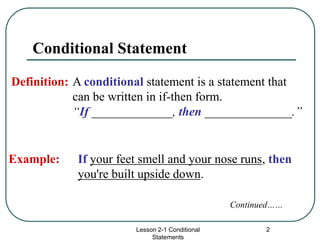
Definition: A conditional statement is a statement that
can be written in if-then form.
“If _____________, then ______________.”
Example: If your feet smell and your nose runs, then
you're built upside down.
Continued……
Lesson 2-1 Conditional
Statements
3
Conditional Statement - continued
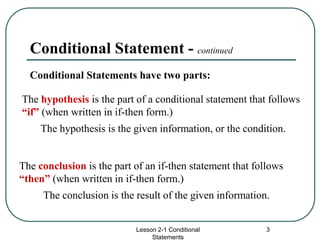
Conditional Statements have two parts:
The hypothesis is the part of a conditional statement that follows
“if” (when written in if-then form.)
The conclusion is the part of an if-then statement that follows
“then” (when written in if-then form.)
The hypothesis is the given information, or the condition.
The conclusion is the result of the given information.
Lesson 2-1 Conditional
Statements
4
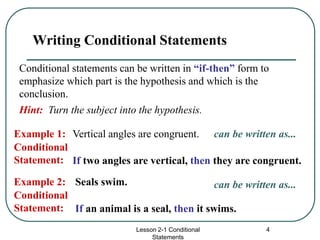
Conditional statements can be written in “if-then” form to
emphasize which part is the hypothesis and which is the
conclusion.
Writing Conditional Statements
Hint: Turn the subject into the hypothesis.
Example 1: Vertical angles are congruent. can be written as...
If two angles are vertical, then they are congruent.
Conditional
Statement:
Example 2: Seals swim. can be written as...
Conditional
Statement: If an animal is a seal, then it swims.
Lesson 2-1 Conditional
Statements
5
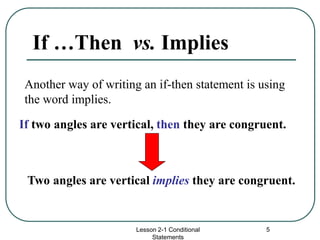
If …Then vs. Implies
Two angles are vertical implies they are congruent.
Another way of writing an if-then statement is using
the word implies.
If two angles are vertical, then they are congruent.
Lesson 2-1 Conditional
Statements
6
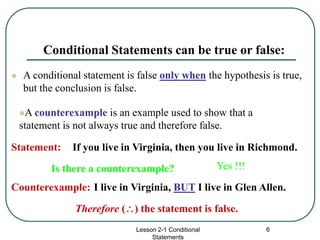
Conditional Statements can be true or false:
 A conditional statement is false only when the hypothesis is true,
but the conclusion is false.
A counterexample is an example used to show that a
statement is not always true and therefore false.
If you live in Virginia, then you live in Richmond.
Statement:
Counterexample: I live in Virginia, BUT I live in Glen Allen.
Is there a counterexample?
Therefore () the statement is false.
Yes !!!
Lesson 2-1 Conditional
Statements
7
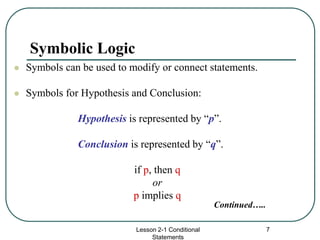
Symbolic Logic
 Symbols can be used to modify or connect statements.
 Symbols for Hypothesis and Conclusion:
Hypothesis is represented by “p”.
Conclusion is represented by “q”.
if p, then q
or
p implies q
Continued…..
Lesson 2-1 Conditional
Statements
8
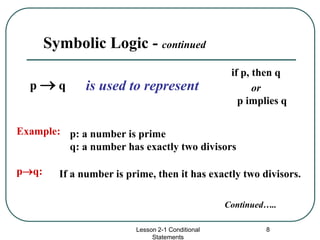
Symbolic Logic - continued
if p, then q
or
p implies q
is used to represent
p  q
Example: p: a number is prime
q: a number has exactly two divisors
If a number is prime, then it has exactly two divisors.
pq:
Continued…..
Lesson 2-1 Conditional
Statements
9
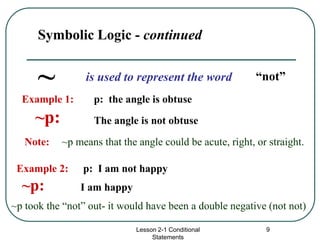
is used to represent the word “not”
~
Symbolic Logic - continued
Example 1: p: the angle is obtuse
The angle is not obtuse
~p means that the angle could be acute, right, or straight.
~p:
Note:
Example 2: p: I am not happy
~p: I am happy
~p took the “not” out- it would have been a double negative (not not)
Lesson 2-1 Conditional
Statements
10
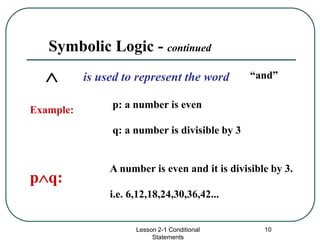
is used to represent the word
Symbolic Logic - continued
“and”

Example:
p: a number is even
q: a number is divisible by 3
A number is even and it is divisible by 3.
i.e. 6,12,18,24,30,36,42...
pq:
Lesson 2-1 Conditional
Statements
11
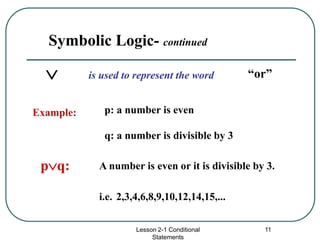
is used to represent the word
Symbolic Logic- continued
“or”

Example: p: a number is even
q: a number is divisible by 3
pq: A number is even or it is divisible by 3.
i.e. 2,3,4,6,8,9,10,12,14,15,...
Lesson 2-1 Conditional
Statements
12
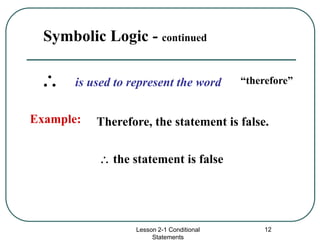
is used to represent the word “therefore”
Symbolic Logic - continued

Example: Therefore, the statement is false.
 the statement is false
Lesson 2-1 Conditional
Statements
13
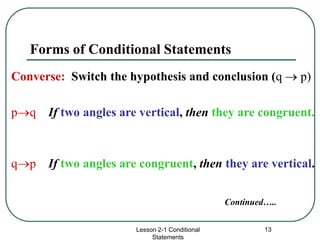
Forms of Conditional Statements
Converse: Switch the hypothesis and conclusion (q  p)
pq If two angles are vertical, then they are congruent.
qp If two angles are congruent, then they are vertical.
Continued…..
Lesson 2-1 Conditional
Statements
14
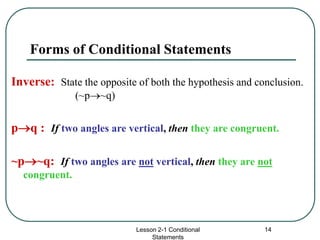
Forms of Conditional Statements
Inverse: State the opposite of both the hypothesis and conclusion.
(~p~q)
pq : If two angles are vertical, then they are congruent.
~p~q: If two angles are not vertical, then they are not
congruent.
Lesson 2-1 Conditional
Statements
15
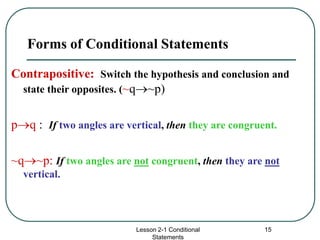
Forms of Conditional Statements
Contrapositive: Switch the hypothesis and conclusion and
state their opposites. (~q~p)
pq : If two angles are vertical, then they are congruent.
~q~p: If two angles are not congruent, then they are not
vertical.
Lesson 2-1 Conditional
Statements
16
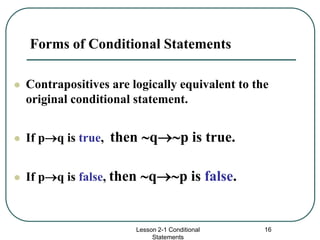
Forms of Conditional Statements
 Contrapositives are logically equivalent to the
original conditional statement.
 If pq is true, then qp is true.
 If pq is false, then qp is false.
Lesson 2-1 Conditional
Statements
17
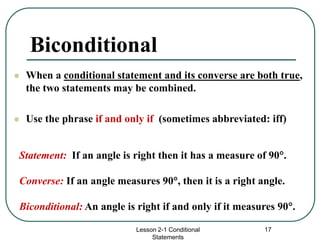
Biconditional
 When a conditional statement and its converse are both true,
the two statements may be combined.
 Use the phrase if and only if (sometimes abbreviated: iff)
Statement: If an angle is right then it has a measure of 90.
Converse: If an angle measures 90, then it is a right angle.
Biconditional: An angle is right if and only if it measures 90.

lecture conditional statements .ppt

  • 1.
  • 2.
    Lesson 2-1 Conditional Statements 2 ConditionalStatement Definition: A conditional statement is a statement that can be written in if-then form. “If _____________, then ______________.” Example: If your feet smell and your nose runs, then you're built upside down. Continued……
  • 3.
    Lesson 2-1 Conditional Statements 3 ConditionalStatement - continued Conditional Statements have two parts: The hypothesis is the part of a conditional statement that follows “if” (when written in if-then form.) The conclusion is the part of an if-then statement that follows “then” (when written in if-then form.) The hypothesis is the given information, or the condition. The conclusion is the result of the given information.
  • 4.
    Lesson 2-1 Conditional Statements 4 Conditionalstatements can be written in “if-then” form to emphasize which part is the hypothesis and which is the conclusion. Writing Conditional Statements Hint: Turn the subject into the hypothesis. Example 1: Vertical angles are congruent. can be written as... If two angles are vertical, then they are congruent. Conditional Statement: Example 2: Seals swim. can be written as... Conditional Statement: If an animal is a seal, then it swims.
  • 5.
    Lesson 2-1 Conditional Statements 5 If…Then vs. Implies Two angles are vertical implies they are congruent. Another way of writing an if-then statement is using the word implies. If two angles are vertical, then they are congruent.
  • 6.
    Lesson 2-1 Conditional Statements 6 ConditionalStatements can be true or false:  A conditional statement is false only when the hypothesis is true, but the conclusion is false. A counterexample is an example used to show that a statement is not always true and therefore false. If you live in Virginia, then you live in Richmond. Statement: Counterexample: I live in Virginia, BUT I live in Glen Allen. Is there a counterexample? Therefore () the statement is false. Yes !!!
  • 7.
    Lesson 2-1 Conditional Statements 7 SymbolicLogic  Symbols can be used to modify or connect statements.  Symbols for Hypothesis and Conclusion: Hypothesis is represented by “p”. Conclusion is represented by “q”. if p, then q or p implies q Continued…..
  • 8.
    Lesson 2-1 Conditional Statements 8 SymbolicLogic - continued if p, then q or p implies q is used to represent p  q Example: p: a number is prime q: a number has exactly two divisors If a number is prime, then it has exactly two divisors. pq: Continued…..
  • 9.
    Lesson 2-1 Conditional Statements 9 isused to represent the word “not” ~ Symbolic Logic - continued Example 1: p: the angle is obtuse The angle is not obtuse ~p means that the angle could be acute, right, or straight. ~p: Note: Example 2: p: I am not happy ~p: I am happy ~p took the “not” out- it would have been a double negative (not not)
  • 10.
    Lesson 2-1 Conditional Statements 10 isused to represent the word Symbolic Logic - continued “and”  Example: p: a number is even q: a number is divisible by 3 A number is even and it is divisible by 3. i.e. 6,12,18,24,30,36,42... pq:
  • 11.
    Lesson 2-1 Conditional Statements 11 isused to represent the word Symbolic Logic- continued “or”  Example: p: a number is even q: a number is divisible by 3 pq: A number is even or it is divisible by 3. i.e. 2,3,4,6,8,9,10,12,14,15,...
  • 12.
    Lesson 2-1 Conditional Statements 12 isused to represent the word “therefore” Symbolic Logic - continued  Example: Therefore, the statement is false.  the statement is false
  • 13.
    Lesson 2-1 Conditional Statements 13 Formsof Conditional Statements Converse: Switch the hypothesis and conclusion (q  p) pq If two angles are vertical, then they are congruent. qp If two angles are congruent, then they are vertical. Continued…..
  • 14.
    Lesson 2-1 Conditional Statements 14 Formsof Conditional Statements Inverse: State the opposite of both the hypothesis and conclusion. (~p~q) pq : If two angles are vertical, then they are congruent. ~p~q: If two angles are not vertical, then they are not congruent.
  • 15.
    Lesson 2-1 Conditional Statements 15 Formsof Conditional Statements Contrapositive: Switch the hypothesis and conclusion and state their opposites. (~q~p) pq : If two angles are vertical, then they are congruent. ~q~p: If two angles are not congruent, then they are not vertical.
  • 16.
    Lesson 2-1 Conditional Statements 16 Formsof Conditional Statements  Contrapositives are logically equivalent to the original conditional statement.  If pq is true, then qp is true.  If pq is false, then qp is false.
  • 17.
    Lesson 2-1 Conditional Statements 17 Biconditional When a conditional statement and its converse are both true, the two statements may be combined.  Use the phrase if and only if (sometimes abbreviated: iff) Statement: If an angle is right then it has a measure of 90. Converse: If an angle measures 90, then it is a right angle. Biconditional: An angle is right if and only if it measures 90.