Can I have your attention. Please!
• Would you allow me to play a song for
you?
• While listening, you should take note the
song lyrics.
• You may proceed to your group now.
• I will give you 5 minutes to do the task.
• Shall we post your work now?
Objectives
Identify modals and its
function in a sentence
Use correct modals in a
sentence
Modal, Modal Verbs,
Modal Auxiliaries or
Modal Auxiliary Verbs
-helping verbs
-used to convey different kinds of
meaning.
- cannot be used on their own, as they
are not complete by themselves. We
have to use them with other verbs,
which must be in the simple present
tense.
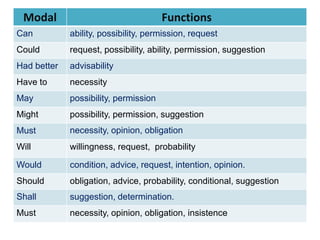
Modal Functions
Can ability, possibility, permission, request
Could request, possibility, ability, permission, suggestion
Had better advisability
Have to necessity
May possibility, permission
Might possibility, permission, suggestion
Must necessity, opinion, obligation
Will willingness, request, probability
Would condition, advice, request, intention, opinion.
Should obligation, advice, probability, conditional, suggestion
Shall suggestion, determination.
Must necessity, opinion, obligation, insistence
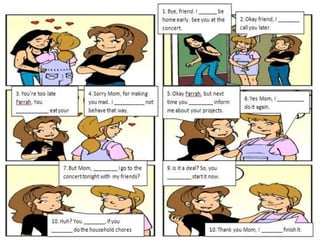
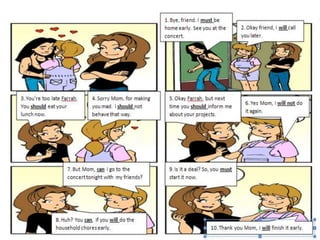
• Were the characters in the
comic strip being polite?
• Were they talking about
abilities and skills?
• What are they talking about?
• How they use modals in their
conversation?
Which one of the pair
expresses an ability?
a. Can I lift that for you?
b. I can lift that easily.
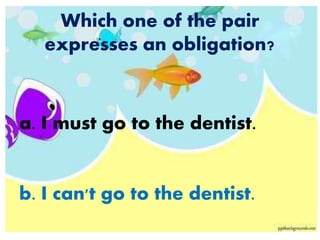
Which one of the pair
expresses an obligation?
a. I must go to the dentist.
b. I can't go to the dentist.
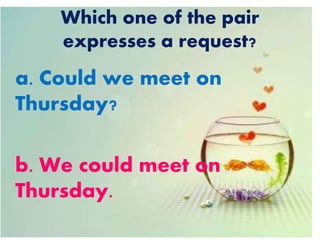
Which one of the pair
expresses a request?
a. Could we meet on
Thursday?
b. We could meet on
Thursday.
Can you give
some more
sentences?
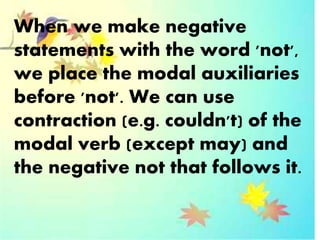
When we make negative
statements with the word 'not',
we place the modal auxiliaries
before 'not'. We can use
contraction (e.g. couldn't) of the
modal verb (except may) and
the negative not that follows it.
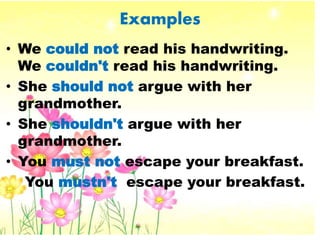
Examples
• We could not read his handwriting.
We couldn't read his handwriting.
• She should not argue with her
grandmother.
• She shouldn't argue with her
grandmother.
• You must not escape your breakfast.
You mustn't escape your breakfast.
Think of your daily
conversation :
Are you using modals?
What are those?
Cite any situation were you
have it.
If you were a modal verb, what
would you prefer? Why?
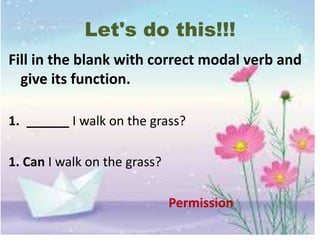
Let's do this!!!
Fill in the blank with correct modal verb and
give its function.
1. ______ I walk on the grass?
1. Can I walk on the grass?
Permission
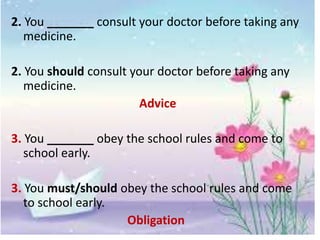
2. You _______ consult your doctor before taking any
medicine.
2. You should consult your doctor before taking any
medicine.
Advice
3. You _______ obey the school rules and come to
school early.
3. You must/should obey the school rules and come
to school early.
Obligation
3. ______ you take my dog out for a walk?
3. Will you take my dog out for a walk?
Request
4. The heavy rain today ______ cause a flood
tonight.
4. The heavy rain today might cause a flood
tonight. Possibility
5. He ______ dance budots.
5. He can dance budots.
Ability
Modals

Modals

  • 1.
    Can I haveyour attention. Please! • Would you allow me to play a song for you? • While listening, you should take note the song lyrics. • You may proceed to your group now. • I will give you 5 minutes to do the task. • Shall we post your work now?
  • 2.
    Objectives Identify modals andits function in a sentence Use correct modals in a sentence
  • 3.
    Modal, Modal Verbs, ModalAuxiliaries or Modal Auxiliary Verbs -helping verbs -used to convey different kinds of meaning. - cannot be used on their own, as they are not complete by themselves. We have to use them with other verbs, which must be in the simple present tense.
  • 4.
    Modal Functions Can ability,possibility, permission, request Could request, possibility, ability, permission, suggestion Had better advisability Have to necessity May possibility, permission Might possibility, permission, suggestion Must necessity, opinion, obligation Will willingness, request, probability Would condition, advice, request, intention, opinion. Should obligation, advice, probability, conditional, suggestion Shall suggestion, determination. Must necessity, opinion, obligation, insistence
  • 7.
    • Were thecharacters in the comic strip being polite? • Were they talking about abilities and skills? • What are they talking about? • How they use modals in their conversation?
  • 8.
    Which one ofthe pair expresses an ability? a. Can I lift that for you? b. I can lift that easily.
  • 9.
    Which one ofthe pair expresses an obligation? a. I must go to the dentist. b. I can't go to the dentist.
  • 10.
    Which one ofthe pair expresses a request? a. Could we meet on Thursday? b. We could meet on Thursday.
  • 11.
    Can you give somemore sentences?
  • 12.
    When we makenegative statements with the word 'not', we place the modal auxiliaries before 'not'. We can use contraction (e.g. couldn't) of the modal verb (except may) and the negative not that follows it.
  • 13.
    Examples • We couldnot read his handwriting. We couldn't read his handwriting. • She should not argue with her grandmother. • She shouldn't argue with her grandmother. • You must not escape your breakfast. You mustn't escape your breakfast.
  • 14.
    Think of yourdaily conversation : Are you using modals? What are those? Cite any situation were you have it. If you were a modal verb, what would you prefer? Why?
  • 15.
    Let's do this!!! Fillin the blank with correct modal verb and give its function. 1. ______ I walk on the grass? 1. Can I walk on the grass? Permission
  • 16.
    2. You _______consult your doctor before taking any medicine. 2. You should consult your doctor before taking any medicine. Advice 3. You _______ obey the school rules and come to school early. 3. You must/should obey the school rules and come to school early. Obligation
  • 17.
    3. ______ youtake my dog out for a walk? 3. Will you take my dog out for a walk? Request 4. The heavy rain today ______ cause a flood tonight. 4. The heavy rain today might cause a flood tonight. Possibility
  • 18.
    5. He ______dance budots. 5. He can dance budots. Ability