Conditional Statement
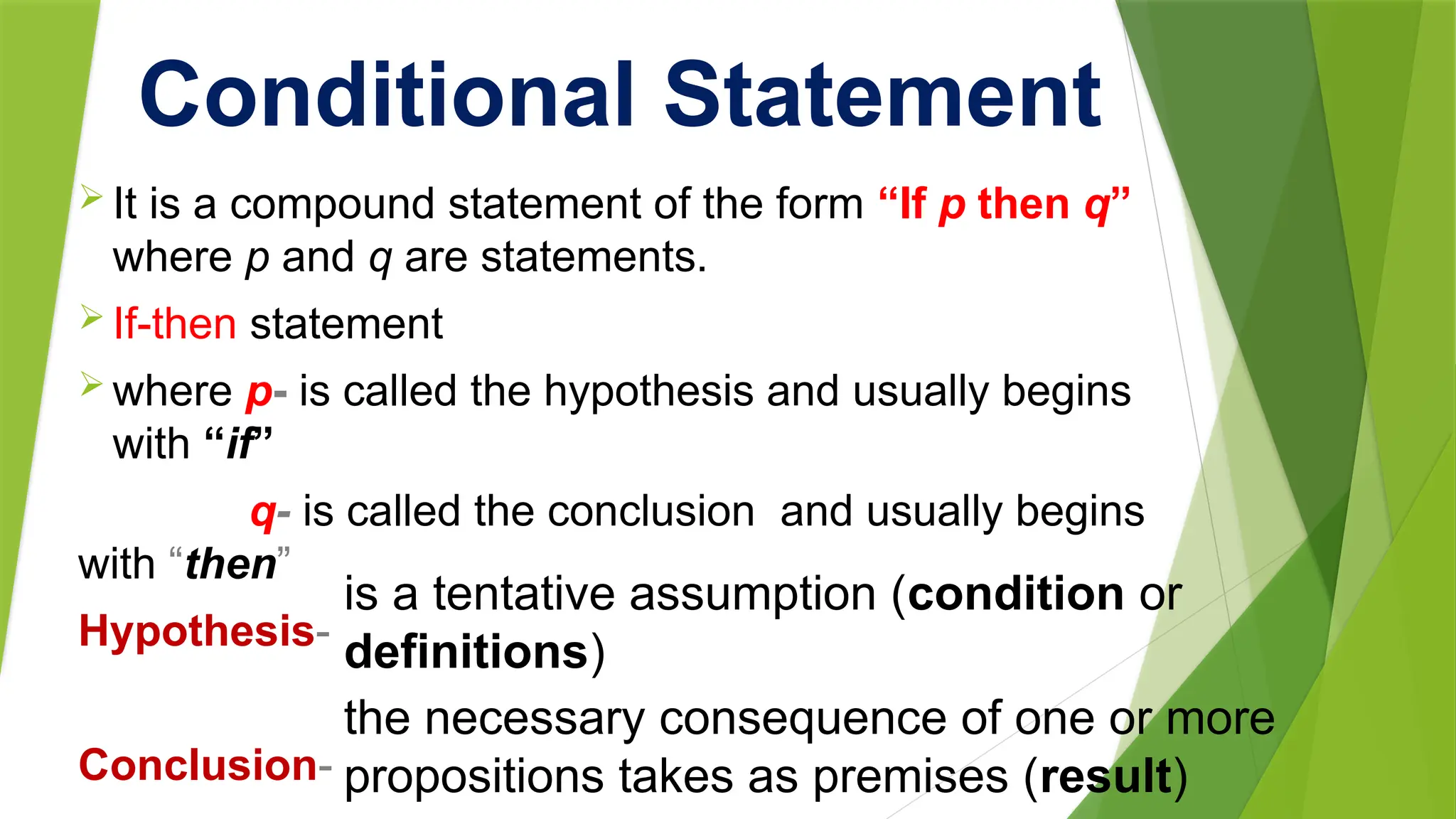
Itis a compound statement of the form “If p then q”
where p and q are statements.
If-then statement
where p- is called the hypothesis and usually begins
with “if”
q- is called the conclusion and usually begins
with “then”
Hypothesis-
Conclusion-
is a tentative assumption (condition or
definitions)
the necessary consequence of one or more
propositions takes as premises (result)
2.
A. Identifying Hypothesisand
Conclusion
Let’s Try!
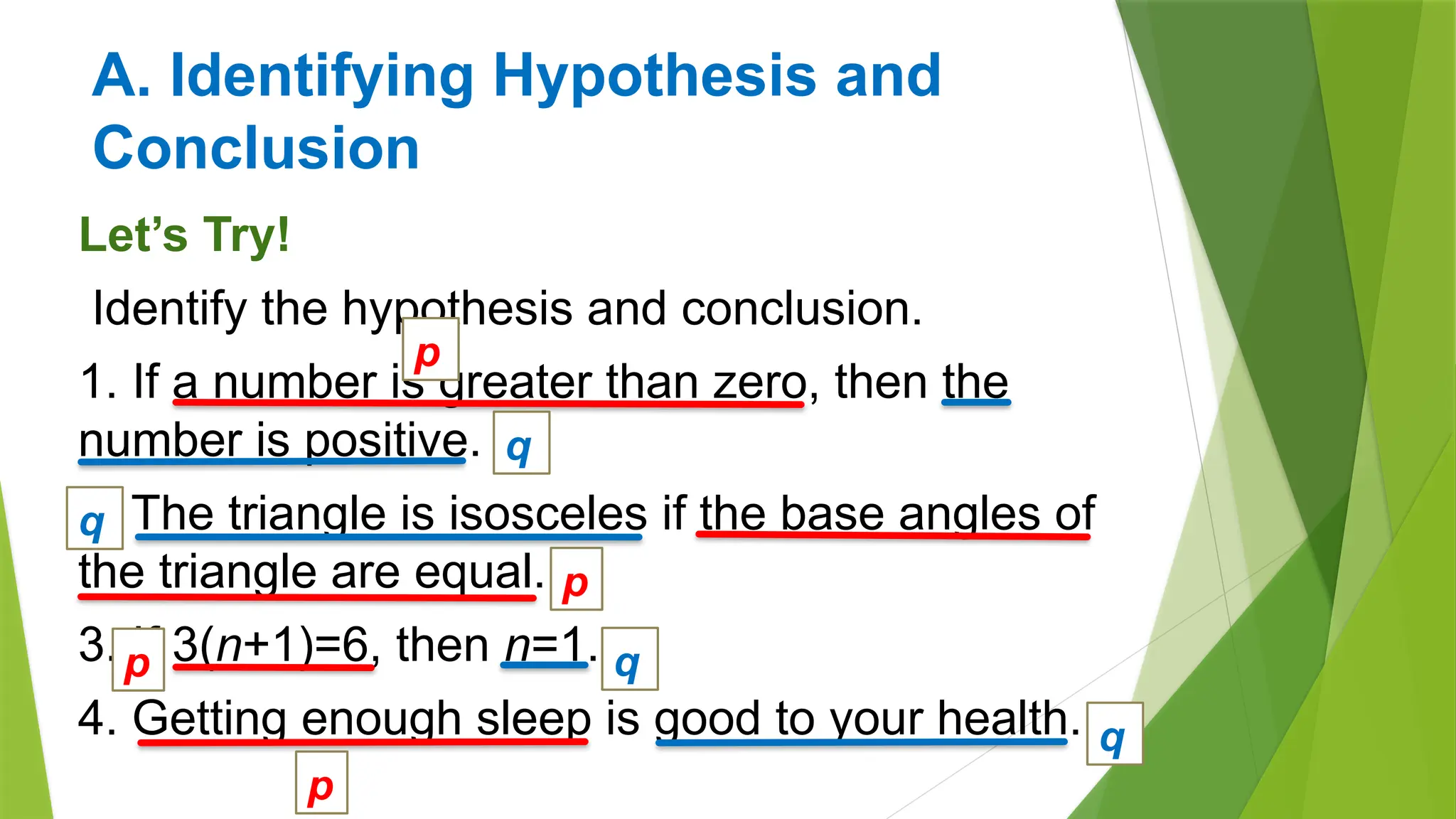
Identify the hypothesis and conclusion.
1. If a number is greater than zero, then the
number is positive.
2. The triangle is isosceles if the base angles of
the triangle are equal.
3. If 3(n+1)=6, then n=1.
4. Getting enough sleep is good to your health.
p
q
q
p
q
p
p
q
3.
5. An integerthat ends in 1, 3, 5, 7 and 9 is an
odd integer.
6. All prime number are numbers with no
other factor aside from 1 and itself.
7. You have a fever if your body temperature
is above 37.6 degrees.
8. You will accomplish your goal if you will do
your best.
9. Collinear points are points that lie on the
same line.
4.
You Try!
Underline thehypothesis and box the conclusion
of each of the following conditional statements.
1. Eating a balance diet makes you healthy.
2. If an obtuse angle is bisected, then two acute
angle are obtained.
3. If 2k is an integer, then 2k + 1 is an odd integer.
4. You will pass the test if you will study hard.
5. Points A, B, and C are collinear if AB + BC = AC.
5.
B. Transforming astatement into
If-then form.
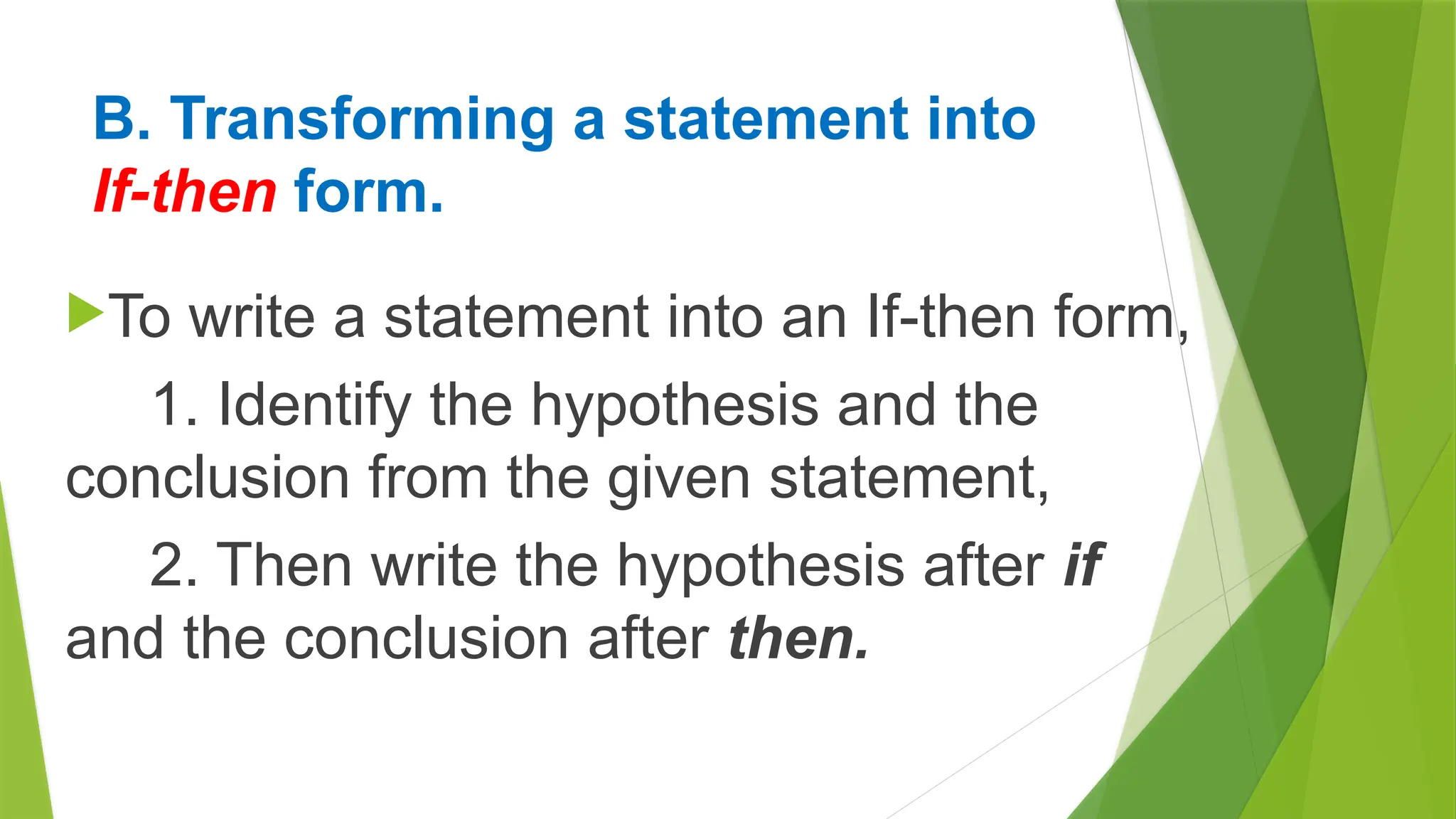
To write a statement into an If-then form,
1. Identify the hypothesis and the
conclusion from the given statement,
2. Then write the hypothesis after if
and the conclusion after then.
6.
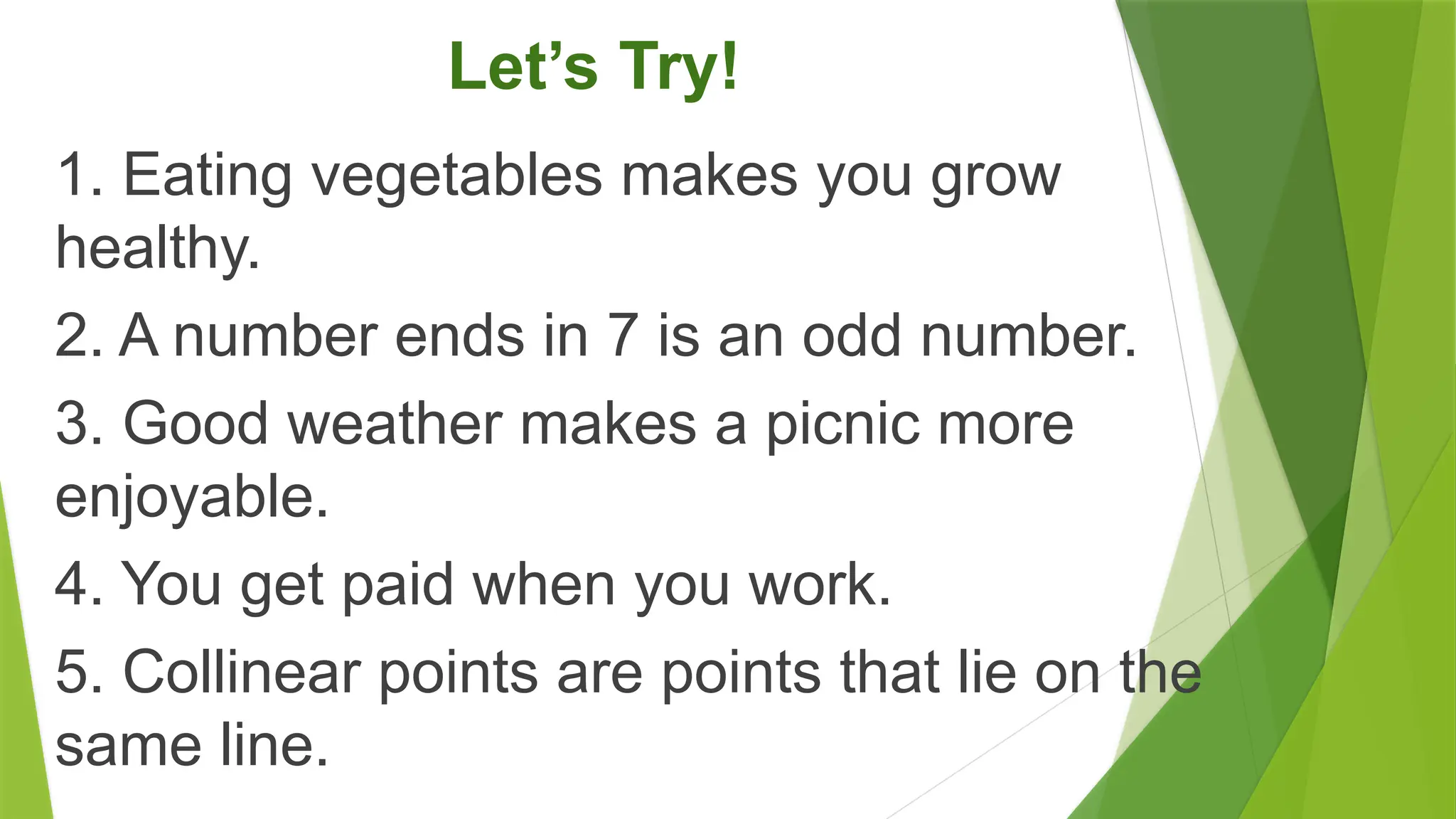
Let’s Try!
1. Eatingvegetables makes you grow
healthy.
2. A number ends in 7 is an odd number.
3. Good weather makes a picnic more
enjoyable.
4. You get paid when you work.
5. Collinear points are points that lie on the
same line.
7.
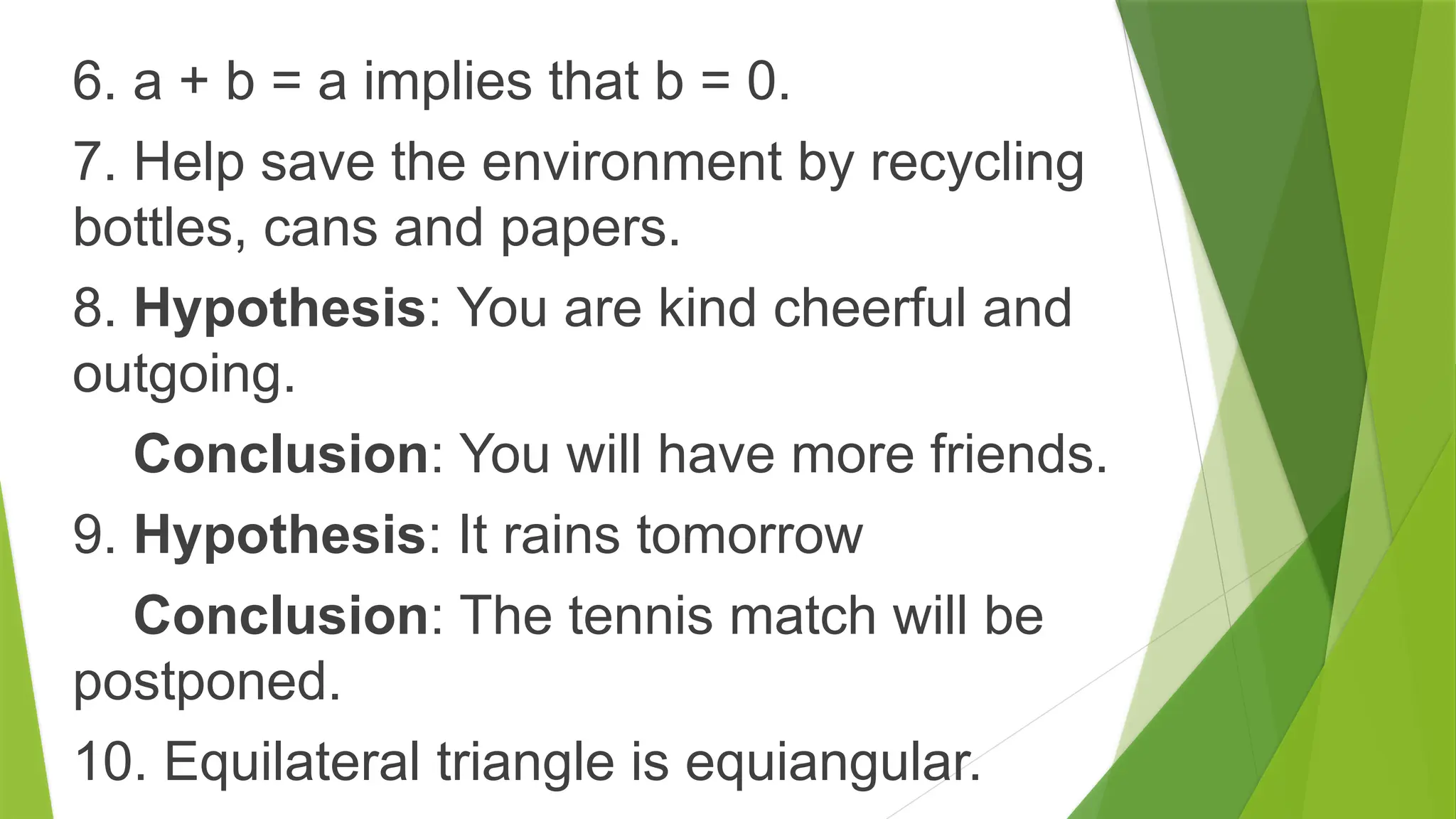
6. a +b = a implies that b = 0.
7. Help save the environment by recycling
bottles, cans and papers.
8. Hypothesis: You are kind cheerful and
outgoing.
Conclusion: You will have more friends.
9. Hypothesis: It rains tomorrow
Conclusion: The tennis match will be
postponed.
10. Equilateral triangle is equiangular.
8.
You Try!
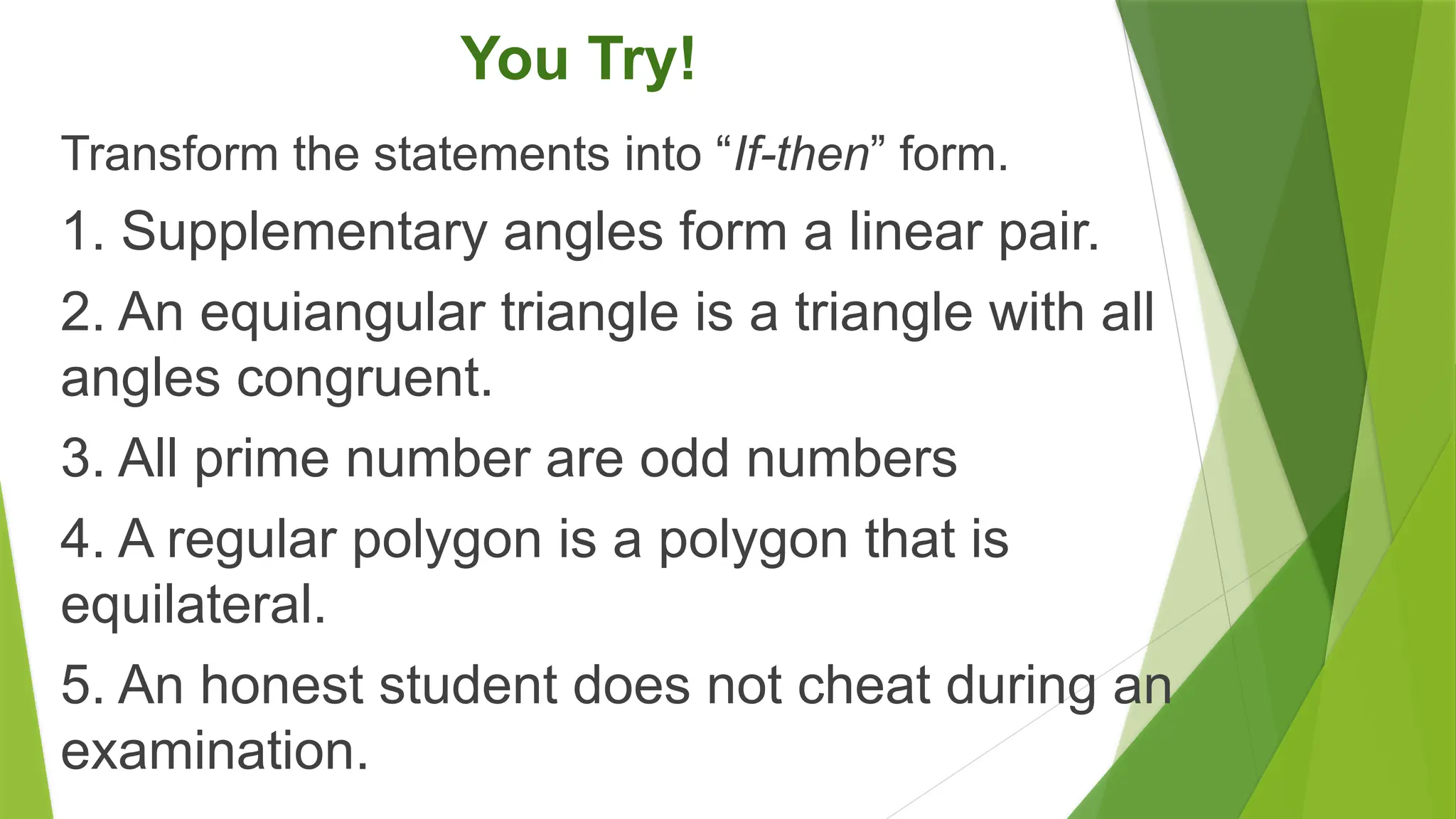
Transform thestatements into “If-then” form.
1. Supplementary angles form a linear pair.
2. An equiangular triangle is a triangle with all
angles congruent.
3. All prime number are odd numbers
4. A regular polygon is a polygon that is
equilateral.
5. An honest student does not cheat during an
examination.