Geometry
 MELL 2010
           July 08, 2010 
Texas State University, San Marcos 
           Dr. Beth Bos 
Activity #1 
Cut out all the shapes on handout #1 and 
  organize them in a way that makes sense to 
  you. Then be prepared to describe your 
  method for organizing the shapes. 
van Hiele Levels 
•  Developed by Pierre M. van Hiele and his wife 
   Dina van Hiele‐Geldof  
•  The Van Hiele levels of geometric reasoning are 
    sequential. Students must pass through all prior levels to 
    arrive at any specific level.  

 •  These levels are not age‐dependent in the way Piaget 
    described development.  

 •  Geometric experiences have the greatest influence on 
    advancement through the levels.  
 •  Instruction and language at a level higher than the level 
    of the student may inhibit learning.  
John A. Van de Walle, Elementary and Middle School Mathematics: Teaching 
Developmentally, 4th ed. (New York: Addison Wesley Longman, 2001), pp. 310‐11.  
Level 0‐‐Basic 
            Visualization 
•  The student identifies, names, compares and 
   operates on geometric figures (e.g., triangles, 
   angles, intersecting or parallel lines) according to 
   their appearance as a whole. 
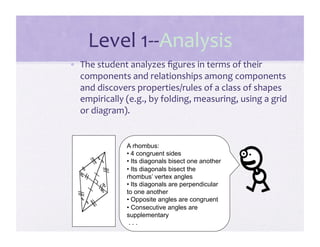
Level 1‐‐Analysis 
•  The student analyzes figures in terms of their 
   components and relationships among components 
   and discovers properties/rules of a class of shapes 
   empirically (e.g., by folding, measuring, using a grid 
   or diagram). 


               A rhombus:
               •  4 congruent sides
               •  Its diagonals bisect one another
               •  Its diagonals bisect the
               rhombus’ vertex angles
               •  Its diagonals are perpendicular
               to one another
               •  Opposite angles are congruent
               •  Consecutive angles are
               supplementary
                ...
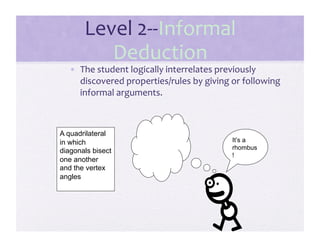
Level 2‐‐Informal 
          Deduction  
  •  The student logically interrelates previously 
     discovered properties/rules by giving or following 
     informal arguments. 


A quadrilateral
in which                                   It’s a
                                           rhombus
diagonals bisect
                                           !
one another
and the vertex
angles
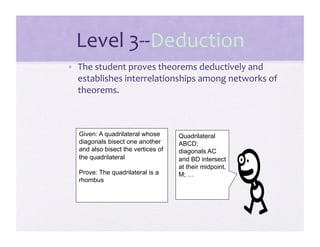
Level 3‐‐Deduction 
•  The student proves theorems deductively and 
   establishes interrelationships among networks of 
   theorems. 


  Given: A quadrilateral whose      Quadrilateral
  diagonals bisect one another      ABCD;
  and also bisect the vertices of   diagonals AC
  the quadrilateral                 and BD intersect
                                    at their midpoint,
  Prove: The quadrilateral is a     M; …
  rhombus
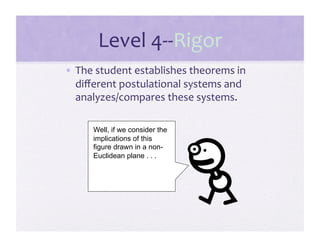
Level 4‐‐Rigor 
•  The student establishes theorems in 
   different postulational systems and 
   analyzes/compares these systems. 

      Well, if we consider the
      implications of this
      figure drawn in a non-
      Euclidean plane . . .
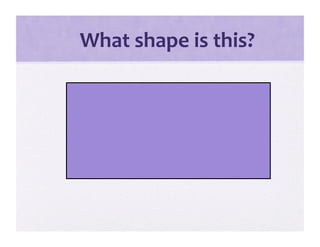
   What shape is this? 
Match the response to the van Hiele level 
•  It is a rectangle because it is a quadrilateral with 
   four right angles, the opposites are parallel, and 
   consecutive sides are perpendicular. 
•  I can prove it’s a rectangle if it’s a parallelogram 
   with one right angle. 
•  I know it’s a rectangle if it’s a quadrilateral with four 
   right angles. 

•  It is a rectangle because it looks like a door. 
•  Well, if I draw that rectangle on a sphere . . . 
•  Recent research on how students learn
   mathematics indicates students should
   •  Be doing hands-on activities with
      emphasis on exploring relationships and
      seeing patterns rather than on calculating
      answers
   •  Working in cooperative groups settings
    •  to learn to communicate about mathematics,
    •  to see various approaches to problems and
    •  to learn to support each other in a learning
       atmosphere
  •  Be engaged in problem-solving lessons
  •  Be asked to justify their answers
  •  Engage with constructive assessments.
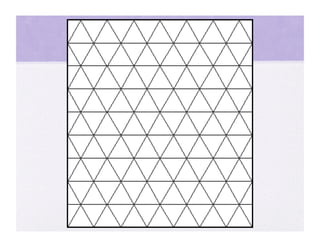
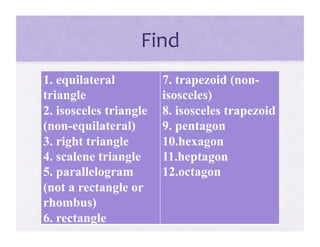
Find 
1. equilateral          7. trapezoid (non-
triangle                isosceles)
2. isosceles triangle   8. isosceles trapezoid
(non-equilateral)       9. pentagon
3. right triangle       10.hexagon
4. scalene triangle     11.heptagon
5. parallelogram        12.octagon
(not a rectangle or
rhombus)
6. rectangle
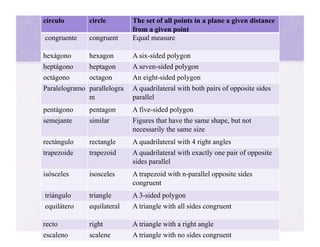
círculo       circle         The set of all points in a plane a given distance
                             from a given point
congruente    congruent      Equal measure

hexágono      hexagon        A six-sided polygon
heptágono     heptagon       A seven-sided polygon
octágono      octagon        An eight-sided polygon
Paralelogramo parallelogra   A quadrilateral with both pairs of opposite sides
              m              parallel
pentágono     pentagon       A five-sided polygon
semejante     similar        Figures that have the same shape, but not
                             necessarily the same size
rectángulo    rectangle      A quadrilateral with 4 right angles
trapezoide    trapezoid      A quadrilateral with exactly one pair of opposite
                             sides parallel
isósceles     isosceles      A trapezoid with n-parallel opposite sides
                             congruent
triángulo     triangle       A 3-sided polygon
equilátero    equilateral    A triangle with all sides congruent

recto         right          A triangle with a right angle
escaleno      scalene        A triangle with no sides congruent
Investigating with
   Patty Paper
Patty Paper
Constructions
Patty Paper 
      Constructions 
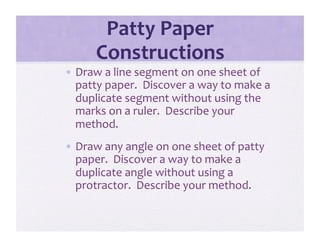
•  Draw a line segment on one sheet of 
   patty paper.  Discover a way to make a 
   duplicate segment without using the 
   marks on a ruler.  Describe your 
   method. 
•  Draw any angle on one sheet of patty 
   paper.  Discover a way to make a 
   duplicate angle without using a 
   protractor.  Describe your method.  
Patty Paper 
           Constructions 
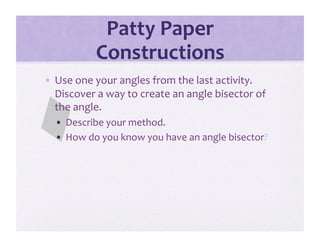
•  Use one your angles from the last activity.  
   Discover a way to create an angle bisector of 
   the angle.   
  •  Describe your method.   
  •  How do you know you have an angle bisector? 
Patty Paper 
           Constructions 
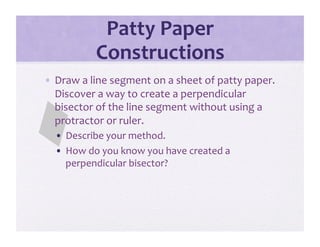
•  Draw a line segment on a sheet of patty paper.  
   Discover a way to create a perpendicular 
   bisector of the line segment without using a 
   protractor or ruler.   
  •  Describe your method. 
  •  How do you know you have created a 
     perpendicular bisector? 
Patty Paper 
           Constructions 
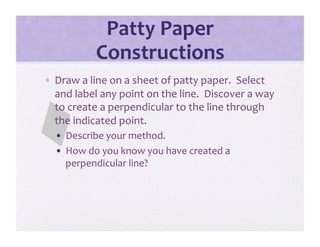
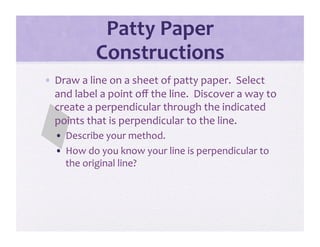
•  Draw a line on a sheet of patty paper.  Select 
   and label any point on the line.  Discover a way 
   to create a perpendicular to the line through 
   the indicated point.   
  •  Describe your method. 
  •  How do you know you have created a 
     perpendicular line? 
Patty Paper 
           Constructions 
•  Draw a line on a sheet of patty paper.  Select 
   and label a point off the line.  Discover a way to 
   create a perpendicular through the indicated 
   points that is perpendicular to the line.    
  •  Describe your method. 
  •  How do you know your line is perpendicular to 
     the original line? 
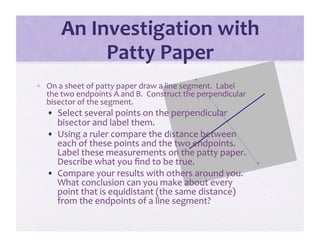
An Investigation with 
            Patty Paper 
•  On a sheet of patty paper draw a line segment.  Label 
   the two endpoints A and B.  Construct the perpendicular 
   bisector of the segment. 
   •  Select several points on the perpendicular 
      bisector and label them. 
   •  Using a ruler compare the distance between 
      each of these points and the two endpoints.  
      Label these measurements on the patty paper.  
      Describe what you find to be true. 
   •  Compare your results with others around you.  
      What conclusion can you make about every 
      point that is equidistant (the same distance) 
      from the endpoints of a line segment? 
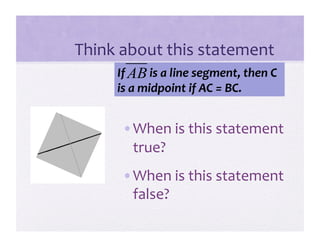
Think about this statement 
     If         is a line segment, then C 
     is a midpoint if AC = BC. 


      • When is this statement 
        true?  
      • When is this statement 
        false?  
Creating Points of
  Concurrency
•  Work in groups: 

•  Each person will draw a different triangle 
  •  scalene acute triangle 
  •  scalene obtuse triangle 
  •  scalene right triangle 

•   Make three copies of your triangle 
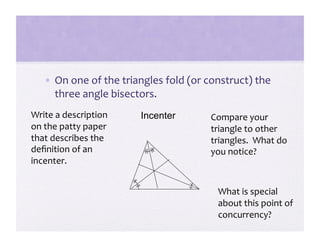
•  On one of the triangles fold (or construct) the 
      three angle bisectors. 
Write a description     Incenter        Compare your 
on the patty paper                      triangle to other 
that describes the                      triangles.  What do 
definition of an                         you notice? 
incenter. 


                                         What is special 
                                         about this point of 
                                         concurrency? 
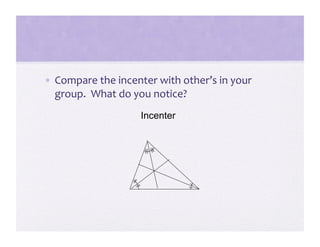
•  Compare the incenter with other’s in your 
   group.  What do you notice? 
                    Incenter
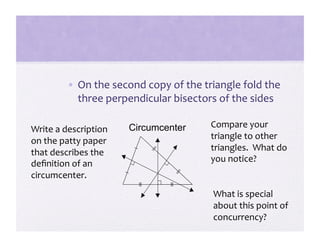
•  On the second copy of the triangle fold the 
            three perpendicular bisectors of the sides 

                       Circumcenter     Compare your 
Write a description 
                                        triangle to other 
on the patty paper 
                                        triangles.  What do 
that describes the 
                                        you notice? 
definition of an 
circumcenter. 
                                        What is special 
                                        about this point of 
                                        concurrency? 
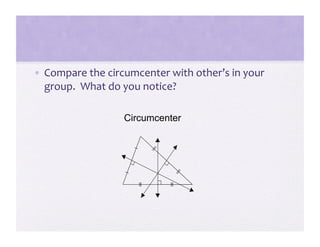
•  Compare the circumcenter with other’s in your 
   group.  What do you notice? 

                   Circumcenter
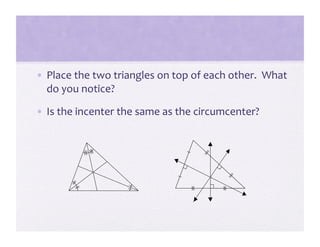
•  Place the two triangles on top of each other.  What 
   do you notice? 

•  Is the incenter the same as the circumcenter?    
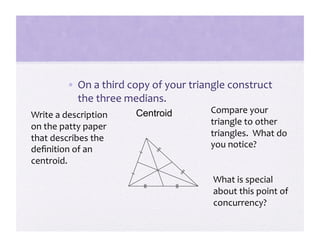
•  On a third copy of your triangle construct 
            the three medians. 
                        Centroid        Compare your 
Write a description 
                                        triangle to other 
on the patty paper 
that describes the                      triangles.  What do 
                                        you notice? 
definition of an 
centroid. 
                                         What is special 
                                         about this point of 
                                         concurrency? 
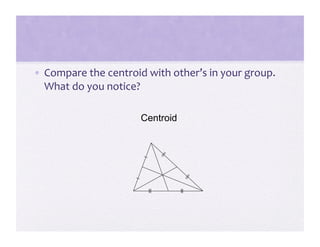
•  Compare the centroid with other’s in your group.  
   What do you notice? 

                       Centroid
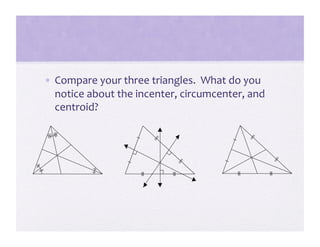
•  Compare your three triangles.  What do you 
   notice about the incenter, circumcenter, and 
   centroid? 
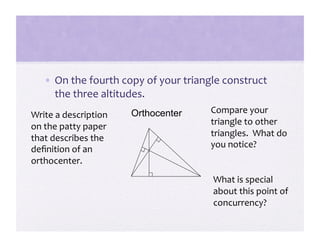
•  On the fourth copy of your triangle construct 
      the three altitudes. 
                       Orthocenter     Compare your 
Write a description 
                                       triangle to other 
on the patty paper 
that describes the                     triangles.  What do 
                                       you notice? 
definition of an 
orthocenter. 
                                       What is special 
                                       about this point of 
                                       concurrency? 
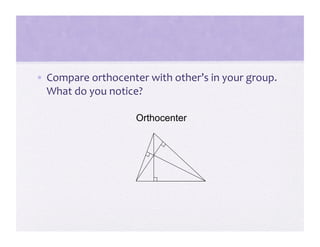
•  Compare orthocenter with other’s in your group.  
   What do you notice? 

                     Orthocenter
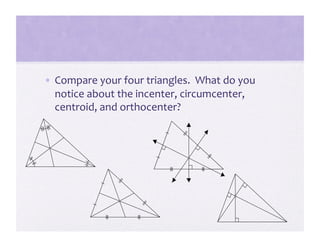
•  Compare your four triangles.  What do you 
   notice about the incenter, circumcenter, 
   centroid, and orthocenter? 
GeoGebra 
•  www. geogebra.org/en/wiki/index.php/English 
Sketchup 
•  http://sketchup.google.com 

Geometry mell2010

  • 1.
    Geometry MELL 2010 July 08, 2010  Texas State University, San Marcos  Dr. Beth Bos 
  • 2.
    Activity #1  Cut out all the shapes on handout #1 and  organize them in a way that makes sense to  you. Then be prepared to describe your  method for organizing the shapes. 
  • 3.
  • 4.
    •  The Van Hiele levels of geometric reasoning are  sequential. Students must pass through all prior levels to  arrive at any specific level.   •  These levels are not age‐dependent in the way Piaget  described development.   •  Geometric experiences have the greatest influence on  advancement through the levels.   •  Instruction and language at a level higher than the level  of the student may inhibit learning.   John A. Van de Walle, Elementary and Middle School Mathematics: Teaching  Developmentally, 4th ed. (New York: Addison Wesley Longman, 2001), pp. 310‐11.  
  • 5.
    Level 0‐‐Basic  Visualization  •  The student identifies, names, compares and  operates on geometric figures (e.g., triangles,  angles, intersecting or parallel lines) according to  their appearance as a whole. 
  • 6.
    Level 1‐‐Analysis  •  The student analyzes figures in terms of their  components and relationships among components  and discovers properties/rules of a class of shapes  empirically (e.g., by folding, measuring, using a grid  or diagram).  A rhombus: •  4 congruent sides •  Its diagonals bisect one another •  Its diagonals bisect the rhombus’ vertex angles •  Its diagonals are perpendicular to one another •  Opposite angles are congruent •  Consecutive angles are supplementary ...
  • 7.
    Level 2‐‐Informal  Deduction   •  The student logically interrelates previously  discovered properties/rules by giving or following  informal arguments.  A quadrilateral in which It’s a rhombus diagonals bisect ! one another and the vertex angles
  • 8.
    Level 3‐‐Deduction  •  The student proves theorems deductively and  establishes interrelationships among networks of  theorems.  Given: A quadrilateral whose Quadrilateral diagonals bisect one another ABCD; and also bisect the vertices of diagonals AC the quadrilateral and BD intersect at their midpoint, Prove: The quadrilateral is a M; … rhombus
  • 9.
    Level 4‐‐Rigor  •  The student establishes theorems in  different postulational systems and  analyzes/compares these systems.  Well, if we consider the implications of this figure drawn in a non- Euclidean plane . . .
  • 10.
  • 11.
    Match the response to the van Hiele level  •  It is a rectangle because it is a quadrilateral with  four right angles, the opposites are parallel, and  consecutive sides are perpendicular.  •  I can prove it’s a rectangle if it’s a parallelogram  with one right angle.  •  I know it’s a rectangle if it’s a quadrilateral with four  right angles.  •  It is a rectangle because it looks like a door.  •  Well, if I draw that rectangle on a sphere . . . 
  • 12.
    •  Recent researchon how students learn mathematics indicates students should •  Be doing hands-on activities with emphasis on exploring relationships and seeing patterns rather than on calculating answers •  Working in cooperative groups settings •  to learn to communicate about mathematics, •  to see various approaches to problems and •  to learn to support each other in a learning atmosphere •  Be engaged in problem-solving lessons •  Be asked to justify their answers •  Engage with constructive assessments.
  • 14.
    Find  1. equilateral 7. trapezoid (non- triangle isosceles) 2. isosceles triangle 8. isosceles trapezoid (non-equilateral) 9. pentagon 3. right triangle 10.hexagon 4. scalene triangle 11.heptagon 5. parallelogram 12.octagon (not a rectangle or rhombus) 6. rectangle
  • 15.
    círculo circle The set of all points in a plane a given distance from a given point congruente congruent Equal measure hexágono hexagon A six-sided polygon heptágono heptagon A seven-sided polygon octágono octagon An eight-sided polygon Paralelogramo parallelogra A quadrilateral with both pairs of opposite sides m parallel pentágono pentagon A five-sided polygon semejante similar Figures that have the same shape, but not necessarily the same size rectángulo rectangle A quadrilateral with 4 right angles trapezoide trapezoid A quadrilateral with exactly one pair of opposite sides parallel isósceles isosceles A trapezoid with n-parallel opposite sides congruent triángulo triangle A 3-sided polygon equilátero equilateral A triangle with all sides congruent recto right A triangle with a right angle escaleno scalene A triangle with no sides congruent
  • 16.
  • 17.
  • 18.
    Patty Paper  Constructions  •  Draw a line segment on one sheet of  patty paper.  Discover a way to make a  duplicate segment without using the  marks on a ruler.  Describe your  method.  •  Draw any angle on one sheet of patty  paper.  Discover a way to make a  duplicate angle without using a  protractor.  Describe your method.  
  • 19.
    Patty Paper  Constructions  •  Use one your angles from the last activity.   Discover a way to create an angle bisector of  the angle.    •  Describe your method.    •  How do you know you have an angle bisector? 
  • 20.
    Patty Paper  Constructions  •  Draw a line segment on a sheet of patty paper.   Discover a way to create a perpendicular  bisector of the line segment without using a  protractor or ruler.    •  Describe your method.  •  How do you know you have created a  perpendicular bisector? 
  • 21.
    Patty Paper  Constructions  •  Draw a line on a sheet of patty paper.  Select  and label any point on the line.  Discover a way  to create a perpendicular to the line through  the indicated point.    •  Describe your method.  •  How do you know you have created a  perpendicular line? 
  • 22.
    Patty Paper  Constructions  •  Draw a line on a sheet of patty paper.  Select  and label a point off the line.  Discover a way to  create a perpendicular through the indicated  points that is perpendicular to the line.     •  Describe your method.  •  How do you know your line is perpendicular to  the original line? 
  • 23.
    An Investigation with  Patty Paper  •  On a sheet of patty paper draw a line segment.  Label  the two endpoints A and B.  Construct the perpendicular  bisector of the segment.  •  Select several points on the perpendicular  bisector and label them.  •  Using a ruler compare the distance between  each of these points and the two endpoints.   Label these measurements on the patty paper.   Describe what you find to be true.  •  Compare your results with others around you.   What conclusion can you make about every  point that is equidistant (the same distance)  from the endpoints of a line segment? 
  • 24.
    Think about this statement  If         is a line segment, then C  is a midpoint if AC = BC.  • When is this statement  true?   • When is this statement  false?  
  • 25.
  • 26.
    •  Work in groups:  •  Each person will draw a different triangle  •  scalene acute triangle  •  scalene obtuse triangle  •  scalene right triangle  •   Make three copies of your triangle 
  • 27.
    •  On one of the triangles fold (or construct) the  three angle bisectors.  Write a description  Incenter Compare your  on the patty paper  triangle to other  that describes the  triangles.  What do  definition of an  you notice?  incenter.  What is special  about this point of  concurrency? 
  • 28.
    •  Compare the incenter with other’s in your  group.  What do you notice?  Incenter
  • 29.
    •  On the second copy of the triangle fold the  three perpendicular bisectors of the sides  Circumcenter Compare your  Write a description  triangle to other  on the patty paper  triangles.  What do  that describes the  you notice?  definition of an  circumcenter.  What is special  about this point of  concurrency? 
  • 30.
    •  Compare the circumcenter with other’s in your  group.  What do you notice?  Circumcenter
  • 31.
    •  Place the two triangles on top of each other.  What  do you notice?  •  Is the incenter the same as the circumcenter?    
  • 32.
    •  On a third copy of your triangle construct  the three medians.  Centroid Compare your  Write a description  triangle to other  on the patty paper  that describes the  triangles.  What do  you notice?  definition of an  centroid.  What is special  about this point of  concurrency? 
  • 33.
  • 34.
    •  Compare your three triangles.  What do you  notice about the incenter, circumcenter, and  centroid? 
  • 35.
    •  On the fourth copy of your triangle construct  the three altitudes.  Orthocenter Compare your  Write a description  triangle to other  on the patty paper  that describes the  triangles.  What do  you notice?  definition of an  orthocenter.  What is special  about this point of  concurrency? 
  • 36.
  • 37.
    •  Compare your four triangles.  What do you  notice about the incenter, circumcenter,  centroid, and orthocenter? 
  • 38.
  • 39.