GRAPHOF
NON-LINEARFUNCTIONS
𝒚 = 𝒂𝒙𝒏
𝑦 = 𝑎𝑥𝑛
𝑛 = −1, −2, +3
𝑎 is a constant.
 𝑦 =
𝑎
𝑥
 𝑦 =
𝑎
𝑥2
 𝑦 = 𝑎𝑥3
LET’S DRAW SOME
GRAPHS!
𝒚 = 𝒂𝒙𝟑
, 𝒂 is a constant.
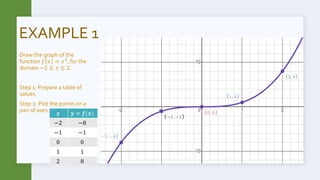
EXAMPLE 1
Draw the graph of the
function 𝑓 𝑥 = 𝑥3
, for the
domain −2 ≤ 𝑥 ≤ 2.
Step 1: Prepare a table of
values.
Step 2: Plot the points on a
pair of axes.
𝒙 𝒚 = 𝒇(𝒙)
−2 −8
−1 −1
0 0
1 1
2 8
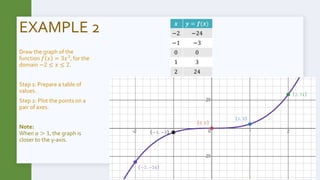
EXAMPLE 2
Draw the graph of the
function 𝑓 𝑥 = 3𝑥3, for the
domain −2 ≤ 𝑥 ≤ 2.
Step 1: Prepare a table of
values.
Step 2: Plot the points on a
pair of axes.
Note:
When 𝑎 > 1, the graph is
closer to the y-axis.
𝒙 𝒚 = 𝒇(𝒙)
−2 −24
−1 −3
0 0
1 3
2 24
EXAMPLE 3
Draw the graph of the
function 𝑓 𝑥 = −2𝑥3
,
for the domain −2 ≤
𝑥 ≤ 2.
Step 1: Prepare a table of
values.
Step 2: Plot the points on
a pair of axes.
𝒙 𝒚 = 𝒇(𝒙)
−2 16
−1 2
0 0
1 −2
2 −16
Note:
When 𝑎 < 0, the graph is reflected in the y-axis.
𝒚 = 𝒂𝒙−𝟐
=
𝒂
𝒙𝟐 , 𝒂 is a constant.
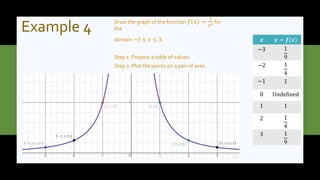
Example 4 Draw the graph of the function 𝑓 𝑥 =
1
𝑥2 for
the
domain −3 ≤ 𝑥 ≤ 3.
Step 1: Prepare a table of values.
Step 2: Plot the points on a pair of axes.
𝒙 𝒚 = 𝒇(𝒙)
−3 1
9
−2 1
4
−1 1
0 Undefined
1 1
2 1
4
3 1
9
Example 5
Draw the graph of the function 𝑓 𝑥 =
2
𝑥2 for the domain −3 ≤ 𝑥 ≤ 3.
Step 1: Prepare a table of values.
Step 2: Plot the points on a pair of axes.
NOTE:
When 𝑎 > 1, the graph is spread further away from the origin.
𝒙 𝒚 = 𝒇(𝒙)
−3 2
9
−2 1
2
−1 2
0 Undefined
1 2
2 1
2
3 2
9
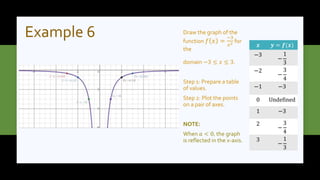
Example 6 Draw the graph of the
function 𝑓 𝑥 =
−3
𝑥2 for
the
domain −3 ≤ 𝑥 ≤ 3.
Step 1: Prepare a table
of values.
Step 2: Plot the points
on a pair of axes.
NOTE:
When 𝑎 < 0, the graph
is reflected in the x-axis.
𝒙 𝒚 = 𝒇(𝒙)
−3
−
1
3
−2
−
3
4
−1 −3
0 Undefined
1 −3
2
−
3
4
3
−
1
3
𝒚 = 𝒂𝒙−𝟏
=
𝒂
𝒙
, 𝒂 is a constant.
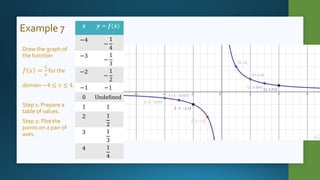
Example 7
Draw the graph of
the function
𝑓 𝑥 =
1
𝑥
for the
domain −4 ≤ 𝑥 ≤ 4.
Step 1: Prepare a
table of values.
Step 2: Plot the
points on a pair of
axes.
𝒙 𝒚 = 𝒇(𝒙)
−4
−
1
4
−3
−
1
3
−2
−
1
2
−1 −1
0 Undefined
1 1
2 1
2
3 1
3
4 1
4
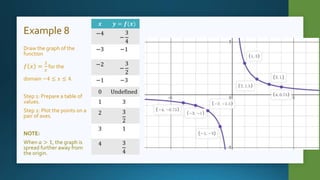
Example 8
Draw the graph of the
function
𝑓 𝑥 =
3
𝑥
for the
domain −4 ≤ 𝑥 ≤ 4.
Step 1: Prepare a table of
values.
Step 2: Plot the points on a
pair of axes.
NOTE:
When 𝑎 > 1, the graph is
spread further away from
the origin.
𝒙 𝒚 = 𝒇(𝒙)
−4
−
3
4
−3 −1
−2
−
3
2
−1 −3
0 Undefined
1 3
2 3
2
3 1
4 3
4
Example 9
Draw the graph of the
function
𝑓 𝑥 =
−2
𝑥
for the
domain −4 ≤ 𝑥 ≤ 4.
Step 1: Prepare a table of
values.
Step 2: Plot the points on a
pair of axes.
NOTE:
When 𝑎 < 0, the graph is
reflected in the y-axis.
𝒙 𝒚 = 𝒇(𝒙)
−4 1
2
−3 2
3
−2 1
−1 2
0 Undefined
1 −2
2 −1
3
−
2
3
4
−
1
2
The End.

Graph of non-linear.pptx

  • 1.
  • 2.
    𝑦 = 𝑎𝑥𝑛 𝑛= −1, −2, +3 𝑎 is a constant.  𝑦 = 𝑎 𝑥  𝑦 = 𝑎 𝑥2  𝑦 = 𝑎𝑥3
  • 3.
  • 4.
    𝒚 = 𝒂𝒙𝟑 ,𝒂 is a constant.
  • 5.
    EXAMPLE 1 Draw thegraph of the function 𝑓 𝑥 = 𝑥3 , for the domain −2 ≤ 𝑥 ≤ 2. Step 1: Prepare a table of values. Step 2: Plot the points on a pair of axes. 𝒙 𝒚 = 𝒇(𝒙) −2 −8 −1 −1 0 0 1 1 2 8
  • 6.
    EXAMPLE 2 Draw thegraph of the function 𝑓 𝑥 = 3𝑥3, for the domain −2 ≤ 𝑥 ≤ 2. Step 1: Prepare a table of values. Step 2: Plot the points on a pair of axes. Note: When 𝑎 > 1, the graph is closer to the y-axis. 𝒙 𝒚 = 𝒇(𝒙) −2 −24 −1 −3 0 0 1 3 2 24
  • 7.
    EXAMPLE 3 Draw thegraph of the function 𝑓 𝑥 = −2𝑥3 , for the domain −2 ≤ 𝑥 ≤ 2. Step 1: Prepare a table of values. Step 2: Plot the points on a pair of axes. 𝒙 𝒚 = 𝒇(𝒙) −2 16 −1 2 0 0 1 −2 2 −16 Note: When 𝑎 < 0, the graph is reflected in the y-axis.
  • 8.
  • 9.
    Example 4 Drawthe graph of the function 𝑓 𝑥 = 1 𝑥2 for the domain −3 ≤ 𝑥 ≤ 3. Step 1: Prepare a table of values. Step 2: Plot the points on a pair of axes. 𝒙 𝒚 = 𝒇(𝒙) −3 1 9 −2 1 4 −1 1 0 Undefined 1 1 2 1 4 3 1 9
  • 10.
    Example 5 Draw thegraph of the function 𝑓 𝑥 = 2 𝑥2 for the domain −3 ≤ 𝑥 ≤ 3. Step 1: Prepare a table of values. Step 2: Plot the points on a pair of axes. NOTE: When 𝑎 > 1, the graph is spread further away from the origin. 𝒙 𝒚 = 𝒇(𝒙) −3 2 9 −2 1 2 −1 2 0 Undefined 1 2 2 1 2 3 2 9
  • 11.
    Example 6 Drawthe graph of the function 𝑓 𝑥 = −3 𝑥2 for the domain −3 ≤ 𝑥 ≤ 3. Step 1: Prepare a table of values. Step 2: Plot the points on a pair of axes. NOTE: When 𝑎 < 0, the graph is reflected in the x-axis. 𝒙 𝒚 = 𝒇(𝒙) −3 − 1 3 −2 − 3 4 −1 −3 0 Undefined 1 −3 2 − 3 4 3 − 1 3
  • 12.
  • 13.
    Example 7 Draw thegraph of the function 𝑓 𝑥 = 1 𝑥 for the domain −4 ≤ 𝑥 ≤ 4. Step 1: Prepare a table of values. Step 2: Plot the points on a pair of axes. 𝒙 𝒚 = 𝒇(𝒙) −4 − 1 4 −3 − 1 3 −2 − 1 2 −1 −1 0 Undefined 1 1 2 1 2 3 1 3 4 1 4
  • 14.
    Example 8 Draw thegraph of the function 𝑓 𝑥 = 3 𝑥 for the domain −4 ≤ 𝑥 ≤ 4. Step 1: Prepare a table of values. Step 2: Plot the points on a pair of axes. NOTE: When 𝑎 > 1, the graph is spread further away from the origin. 𝒙 𝒚 = 𝒇(𝒙) −4 − 3 4 −3 −1 −2 − 3 2 −1 −3 0 Undefined 1 3 2 3 2 3 1 4 3 4
  • 15.
    Example 9 Draw thegraph of the function 𝑓 𝑥 = −2 𝑥 for the domain −4 ≤ 𝑥 ≤ 4. Step 1: Prepare a table of values. Step 2: Plot the points on a pair of axes. NOTE: When 𝑎 < 0, the graph is reflected in the y-axis. 𝒙 𝒚 = 𝒇(𝒙) −4 1 2 −3 2 3 −2 1 −1 2 0 Undefined 1 −2 2 −1 3 − 2 3 4 − 1 2
  • 16.