Created by: NIDIYA DWIAHENDI DARYANA
                                 IX D
In this unit we'll study three types of space
figures that are not polyhedrons. These figures
have curved surfaces, not flat faces. A cylinder is
similar to a prism, but its two bases are circles,
not polygons. Also, the sides of a cylinder are
curved, not flat. A cone has one circular base and
a vertex that is not on the base. The sphere is a
space figure having all its points an equal
distance from the center point.
Move your mouse cursor over the objects to learn
more.
In this lesson, we study some common space
figures that are not polyhedra. These figures
have some things in common with polyhedra,
but they all have some curved surfaces, while
the surfaces of a polyhedron are always flat.
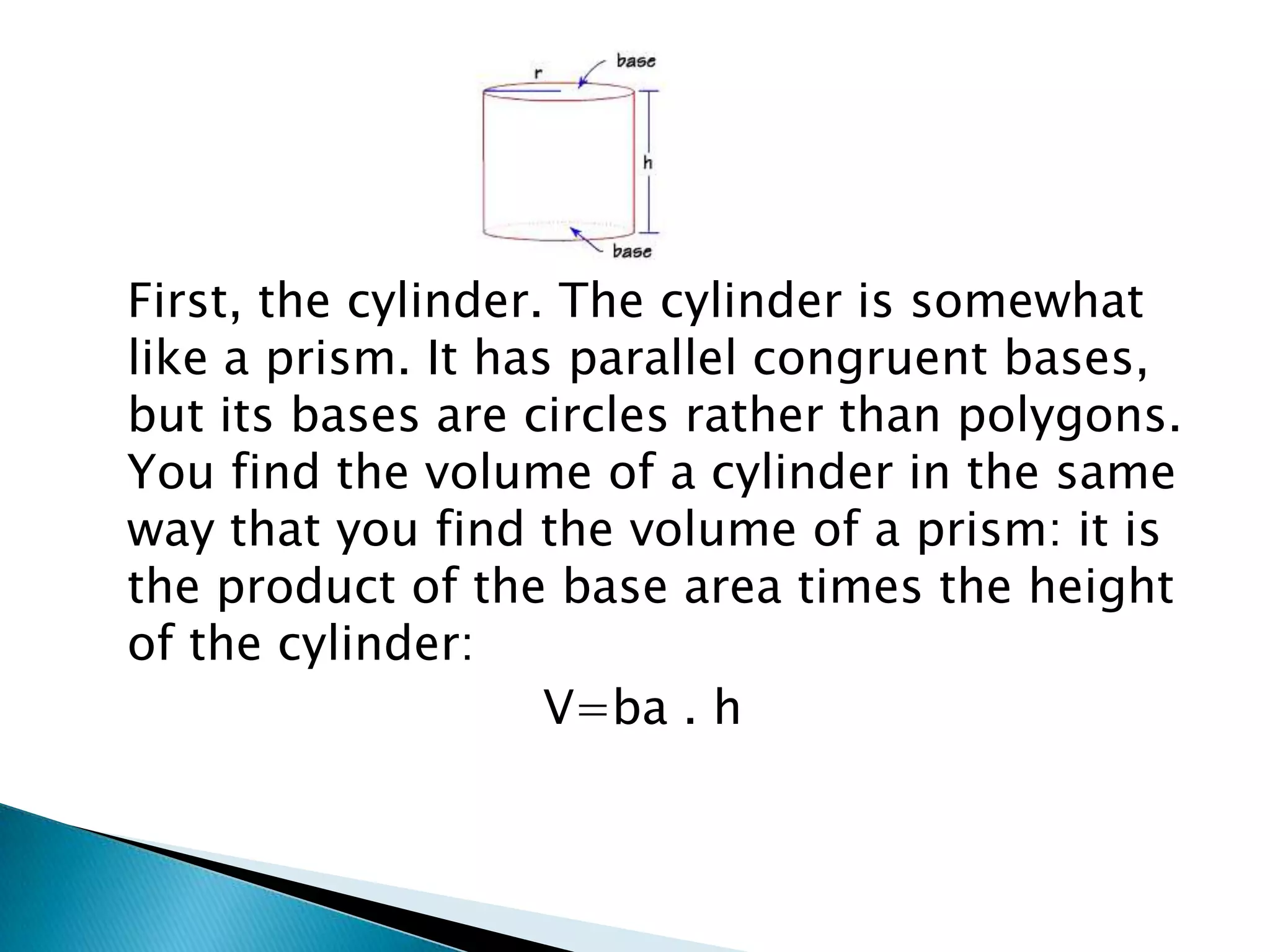
First, the cylinder. The cylinder is somewhat
like a prism. It has parallel congruent bases,
but its bases are circles rather than polygons.
You find the volume of a cylinder in the same
way that you find the volume of a prism: it is
the product of the base area times the height
of the cylinder:
                    V=ba . h
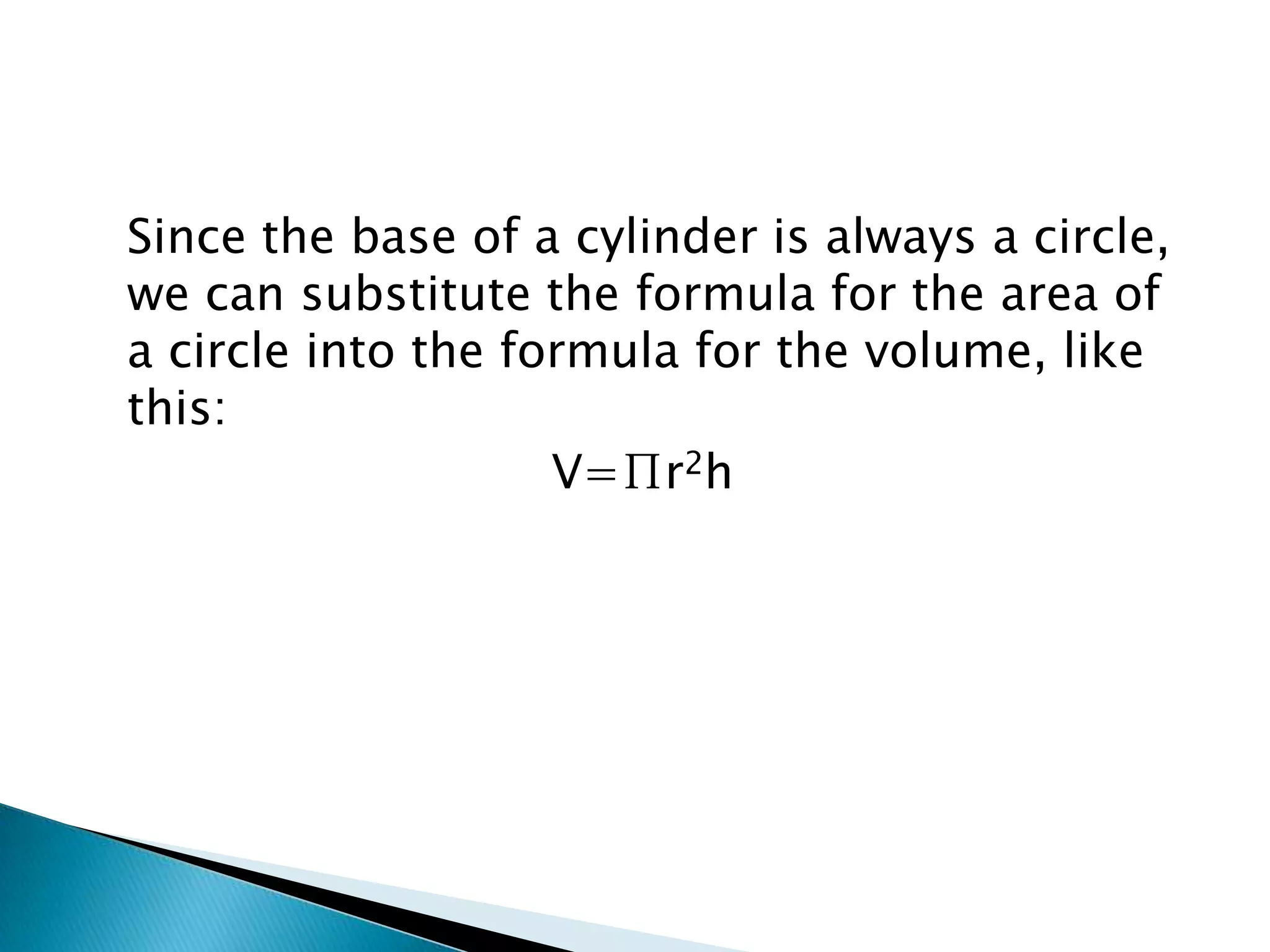
Since the base of a cylinder is always a circle,
we can substitute the formula for the area of
a circle into the formula for the volume, like
this:
                    V=∏r2h
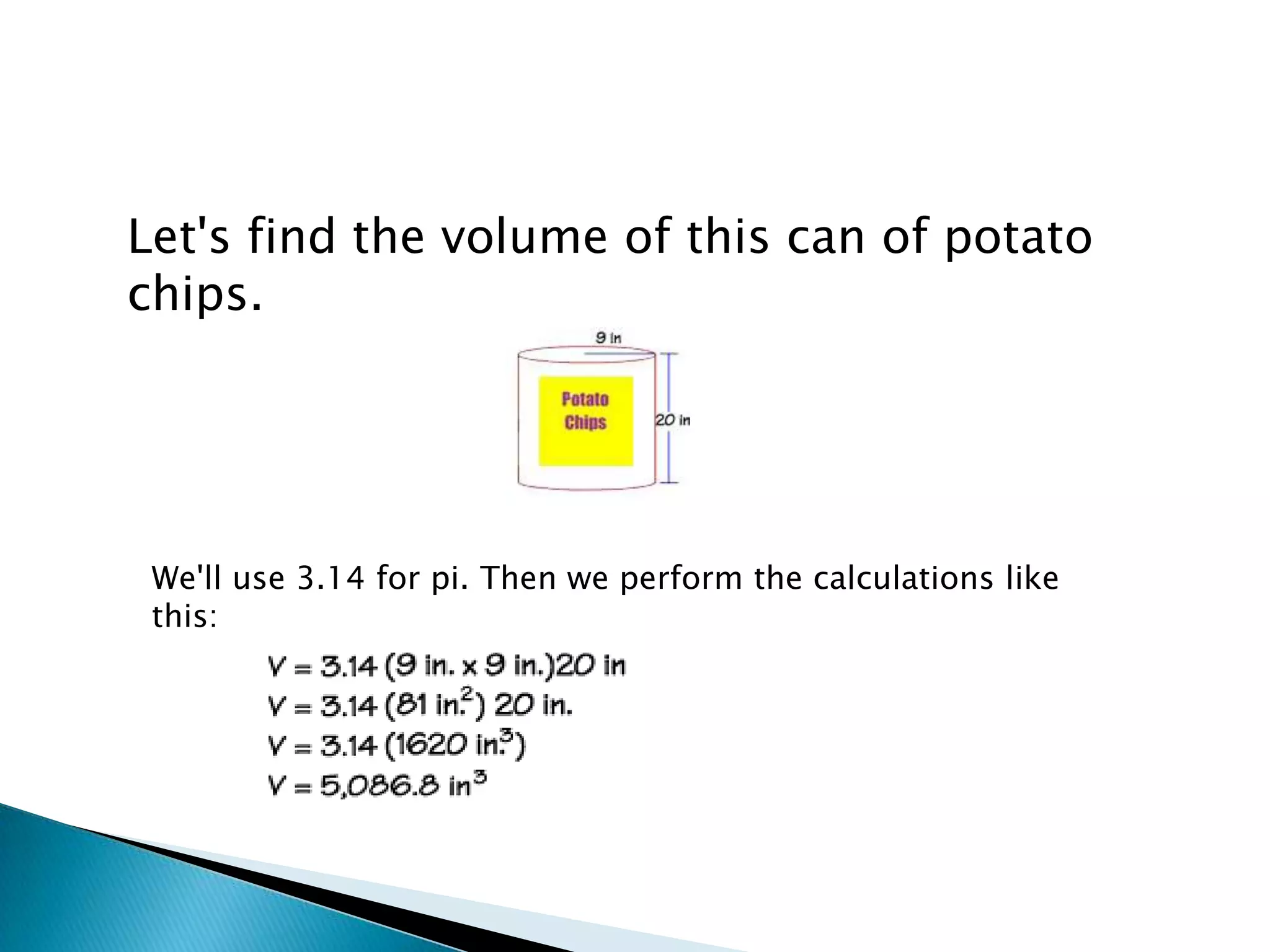
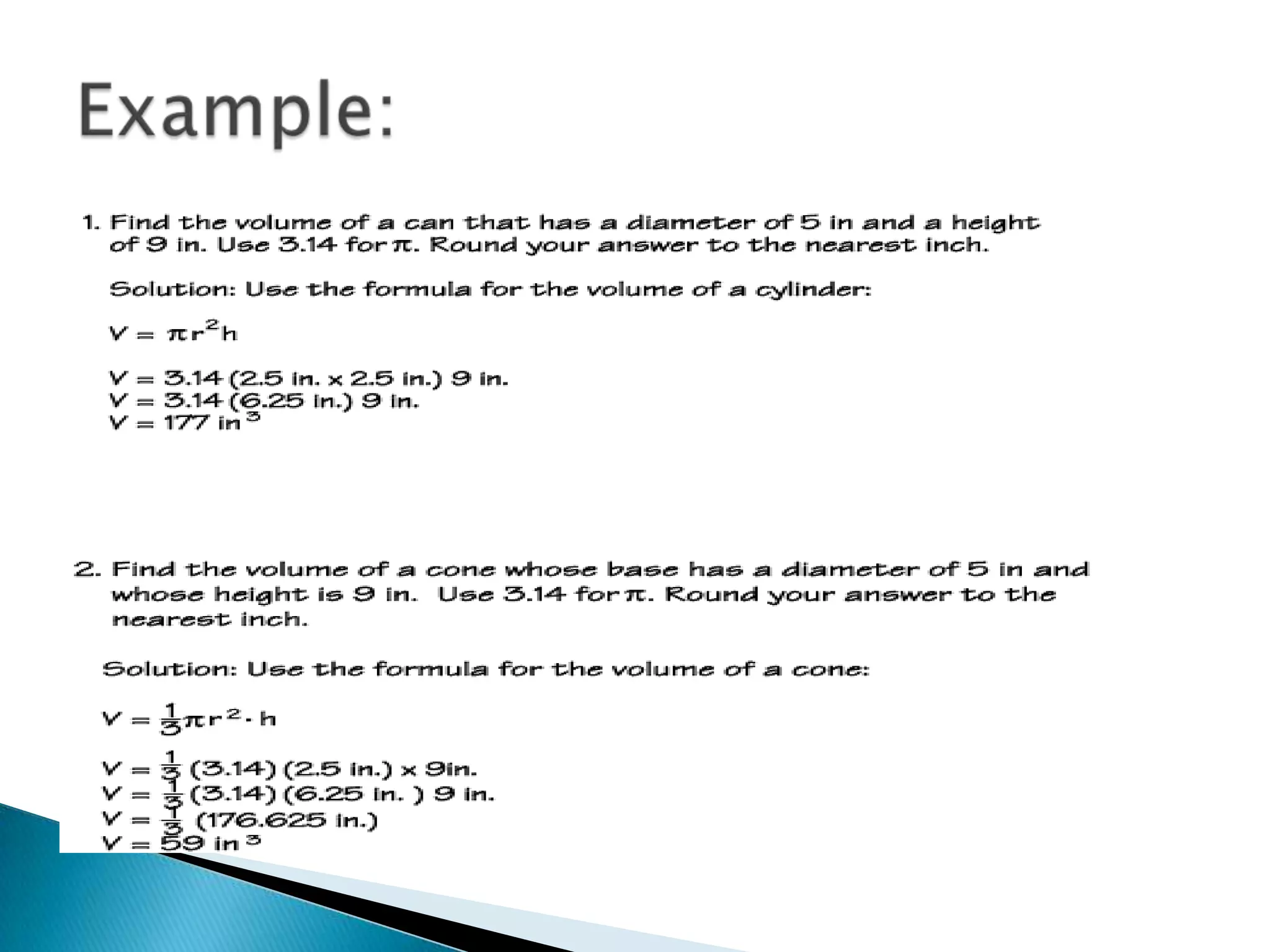
Let's find the volume of this can of potato
chips.


 We'll use 3.14 for pi. Then we perform the calculations like
 this:
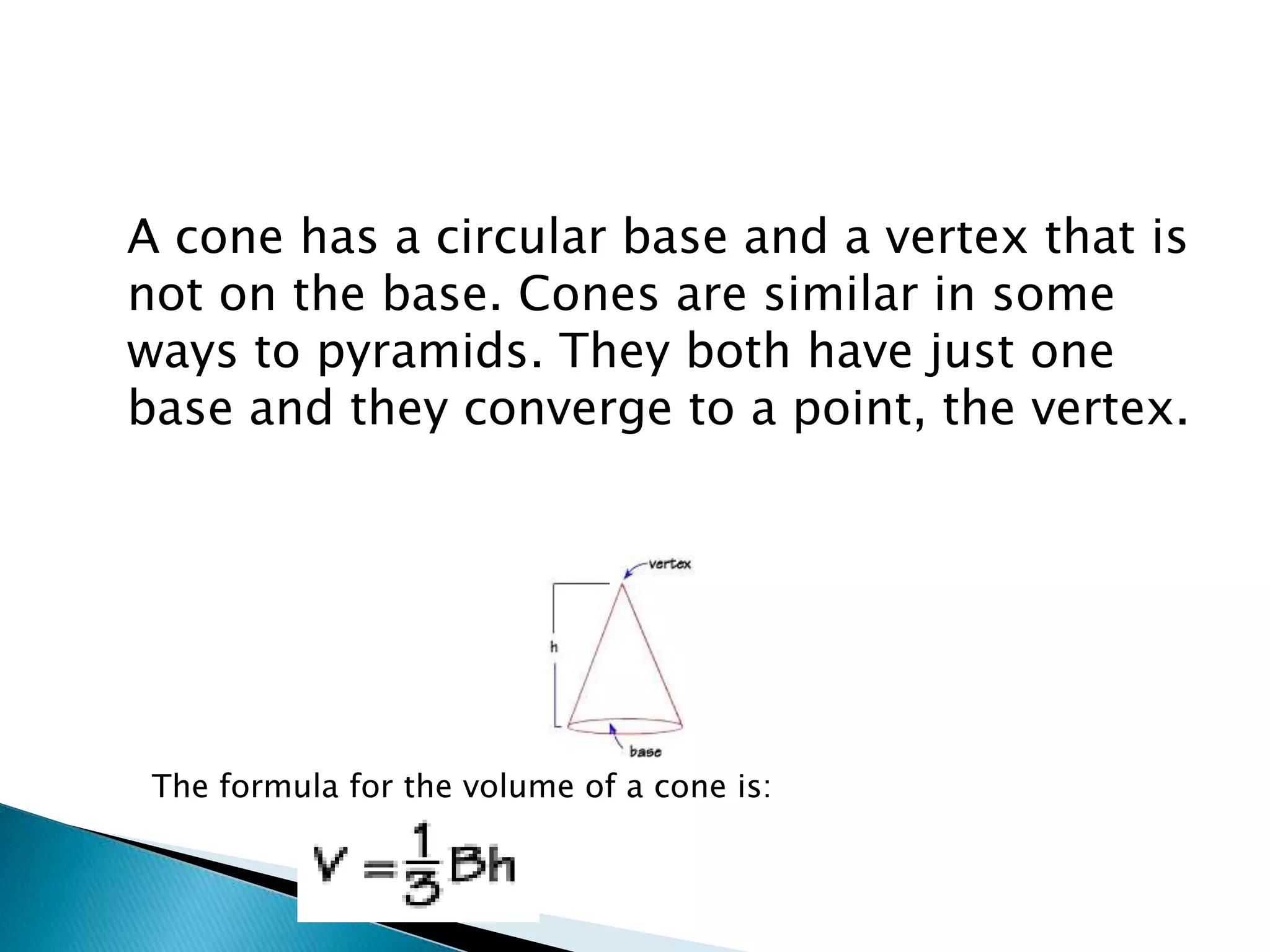
A cone has a circular base and a vertex that is
not on the base. Cones are similar in some
ways to pyramids. They both have just one
base and they converge to a point, the vertex.


 The formula for the volume of a cone is:
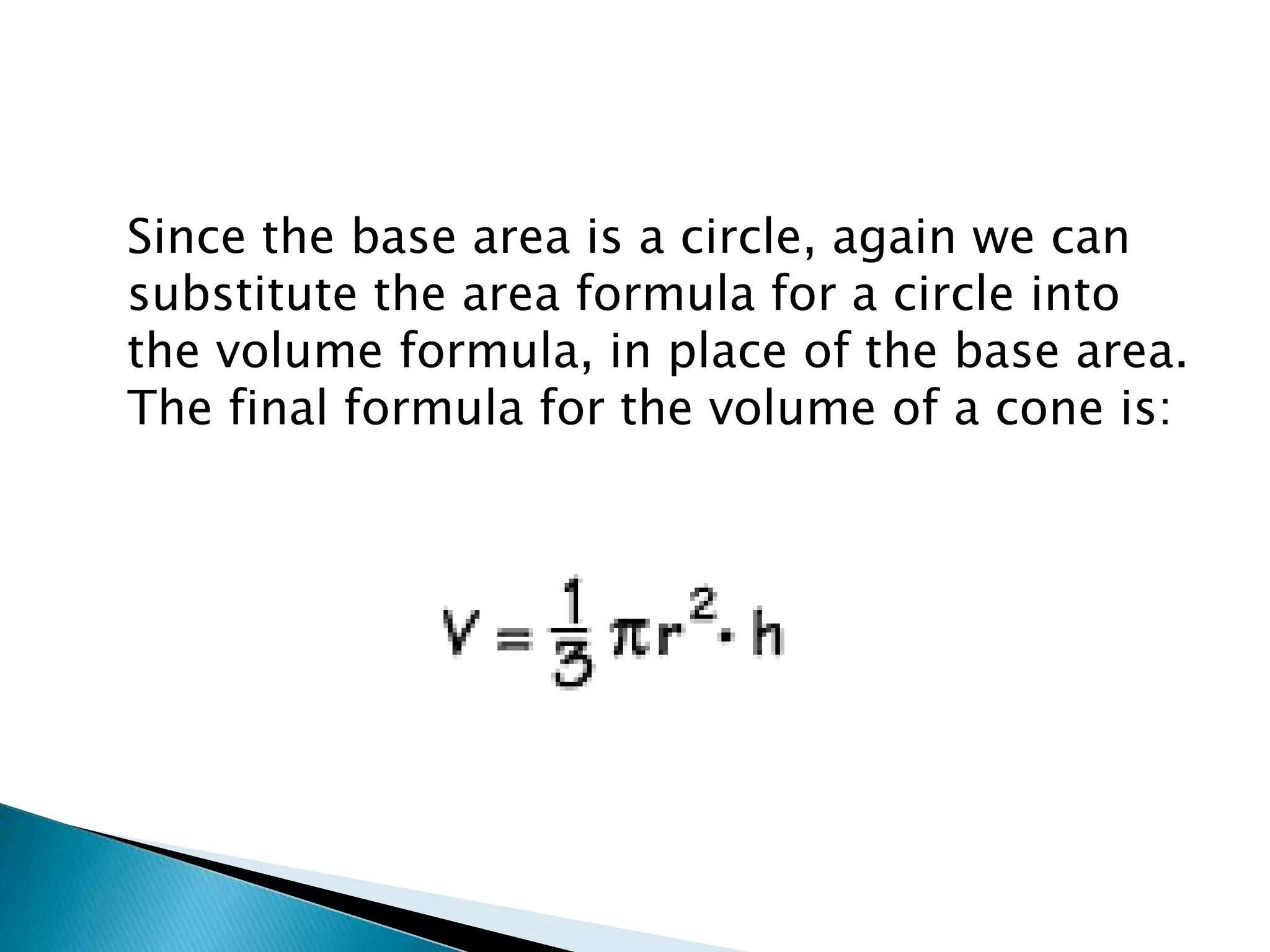
Since the base area is a circle, again we can
substitute the area formula for a circle into
the volume formula, in place of the base area.
The final formula for the volume of a cone is:
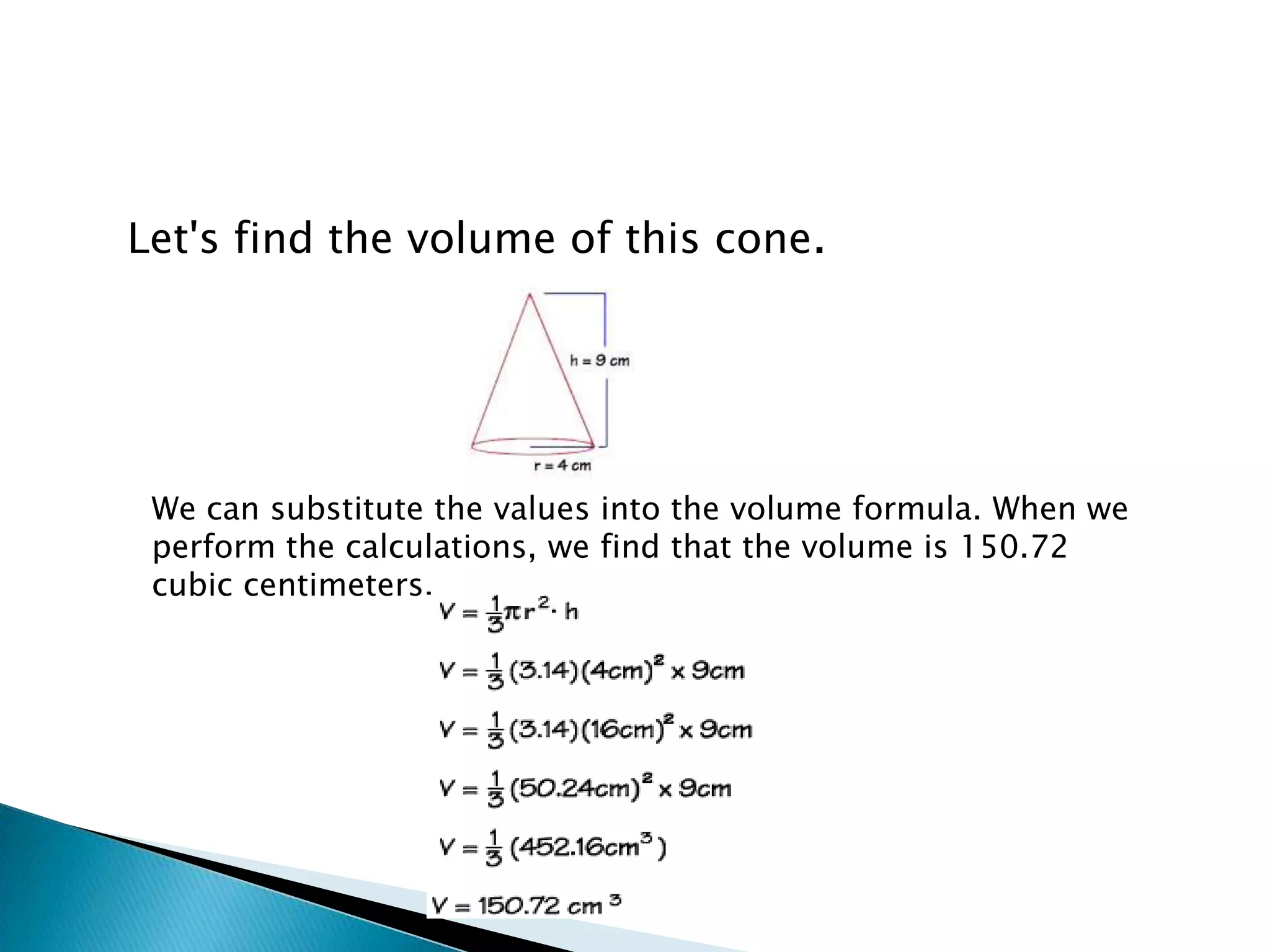
Let's find the volume of this cone.


 We can substitute the values into the volume formula. When we
 perform the calculations, we find that the volume is 150.72
 cubic centimeters.
Finally, we'll examine the sphere, a space
shape defined by all the points that are the
same distance from the center point. Like a
circle, a sphere has a radius and a diameter.
The shape of the earth is like a large sphere -
- it has radius of about 4000 miles. A tennis
ball is a sphere with a radius of about 2.5
inches.
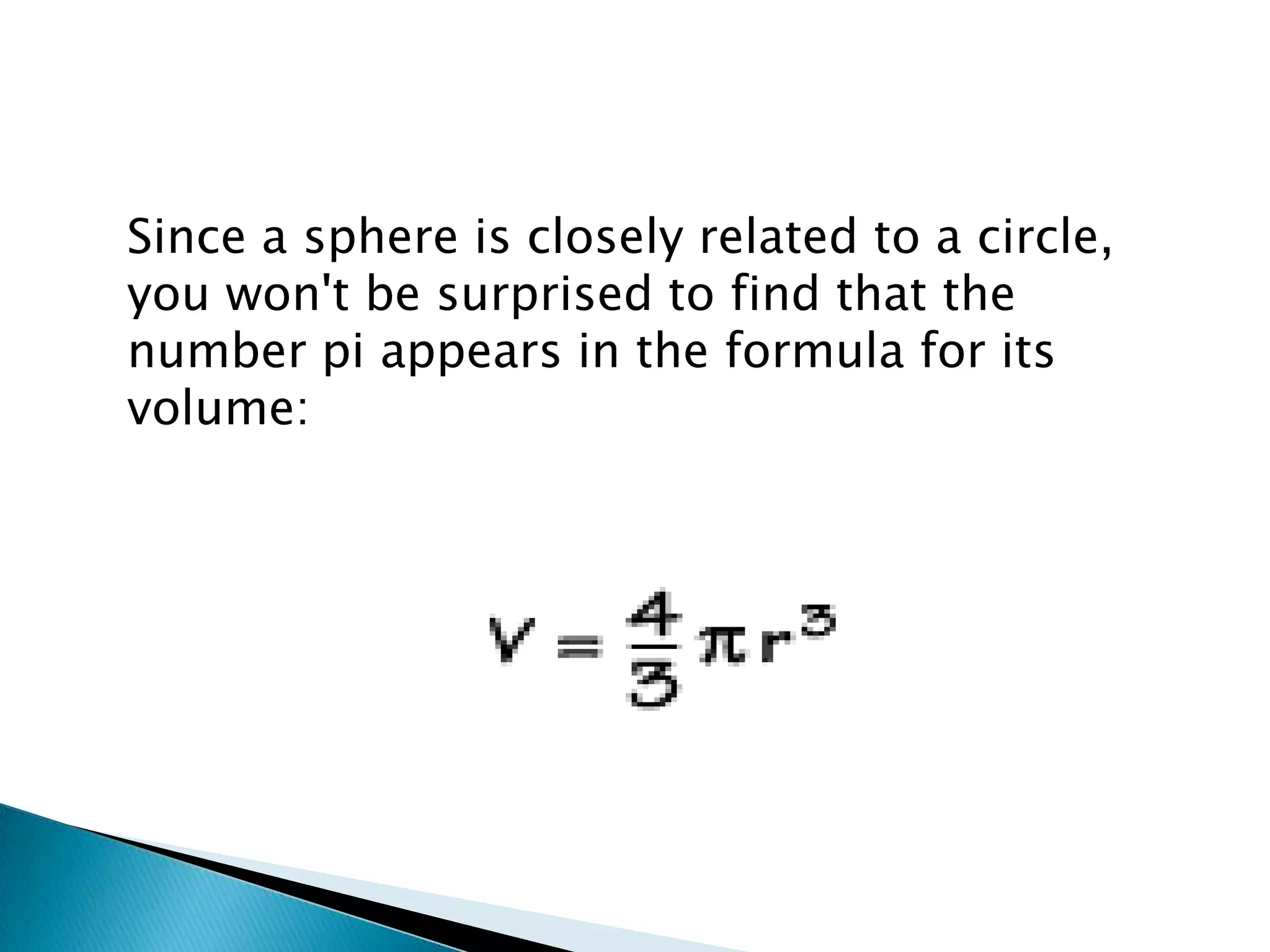
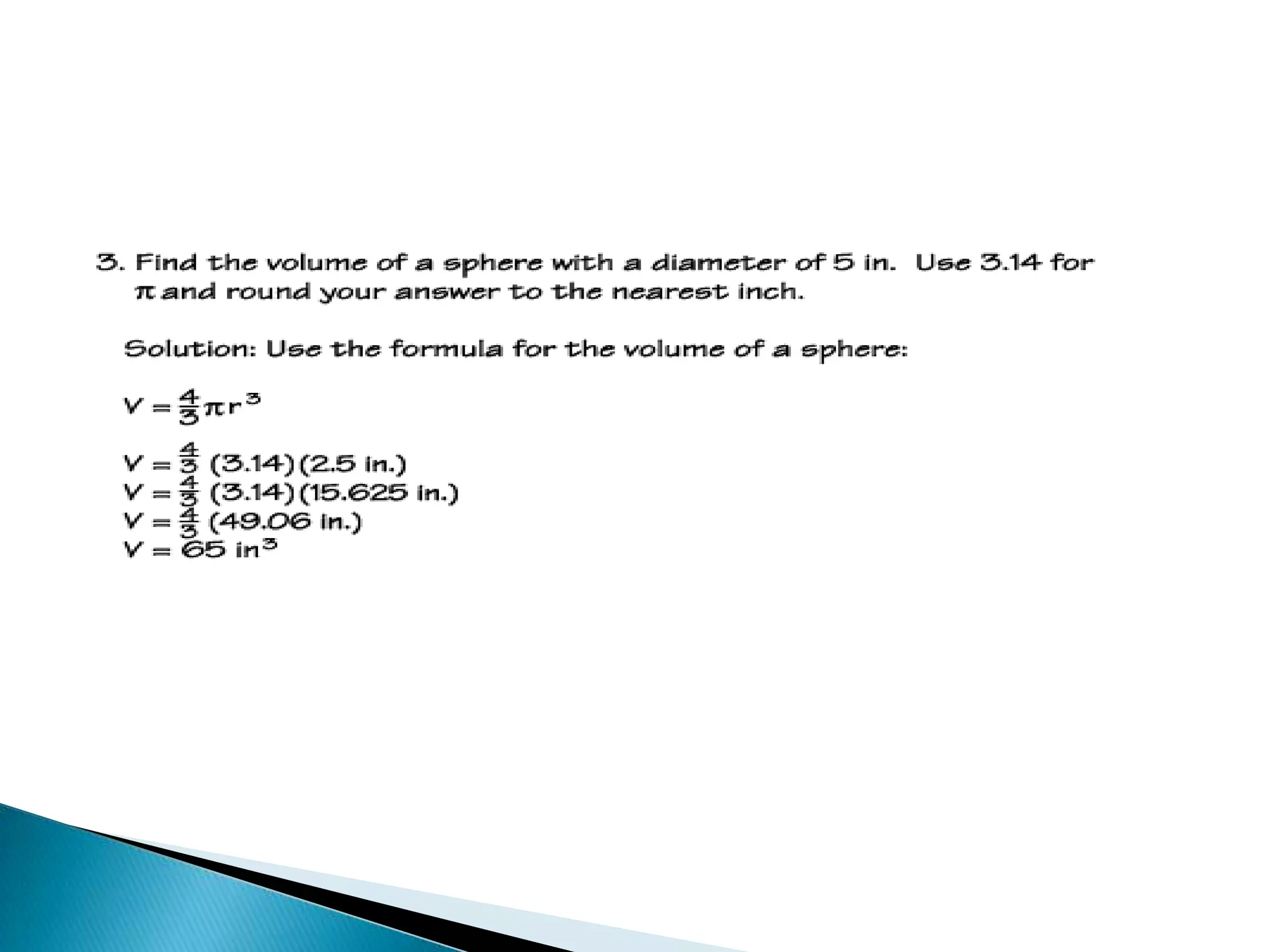
Since a sphere is closely related to a circle,
you won't be surprised to find that the
number pi appears in the formula for its
volume:
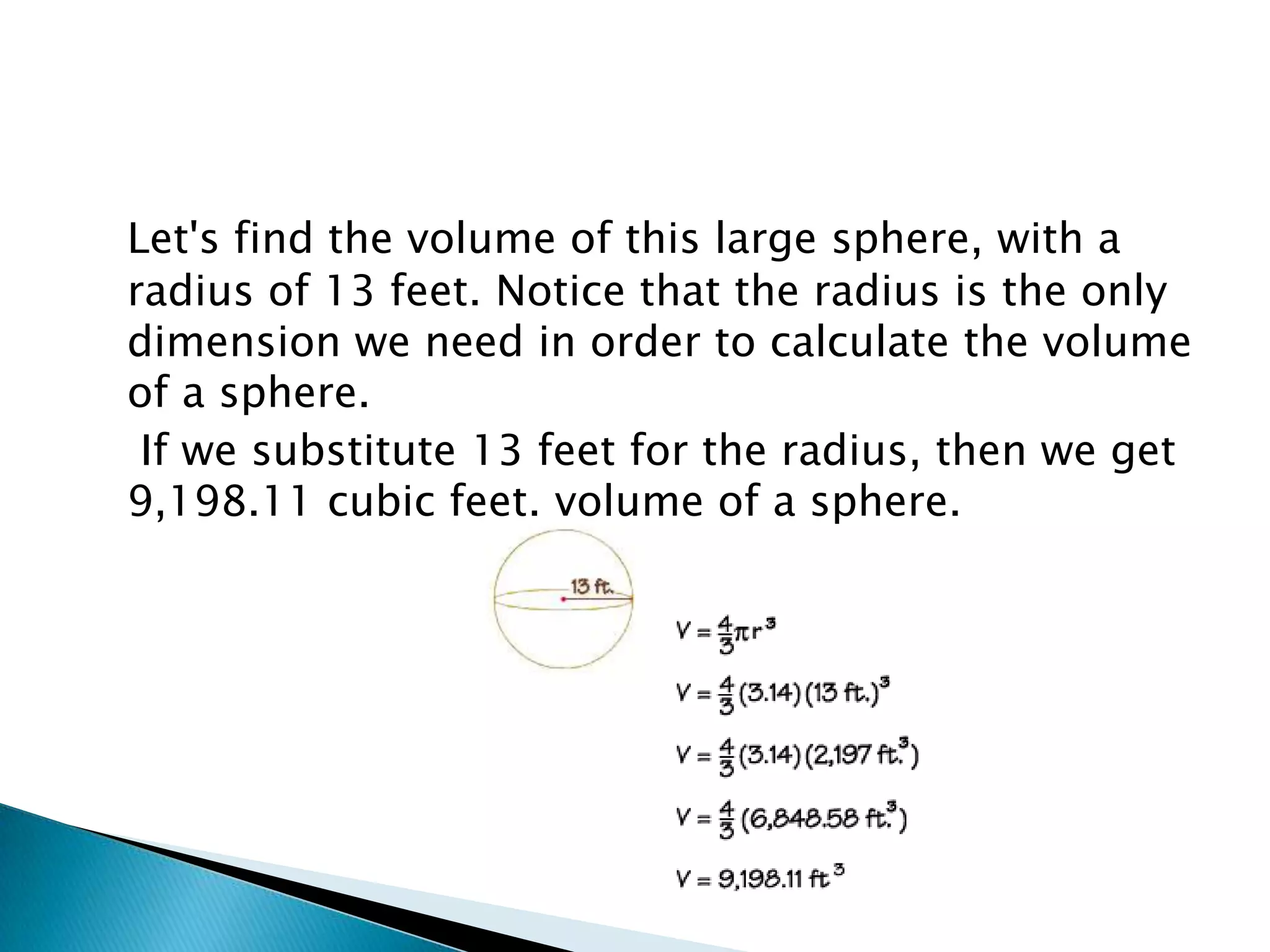
Let's find the volume of this large sphere, with a
radius of 13 feet. Notice that the radius is the only
dimension we need in order to calculate the volume
of a sphere.
 If we substitute 13 feet for the radius, then we get
9,198.11 cubic feet. volume of a sphere.
Cylinders, cones and spheres

Cylinders, cones and spheres

  • 1.
    Created by: NIDIYADWIAHENDI DARYANA IX D
  • 2.
    In this unitwe'll study three types of space figures that are not polyhedrons. These figures have curved surfaces, not flat faces. A cylinder is similar to a prism, but its two bases are circles, not polygons. Also, the sides of a cylinder are curved, not flat. A cone has one circular base and a vertex that is not on the base. The sphere is a space figure having all its points an equal distance from the center point. Move your mouse cursor over the objects to learn more.
  • 4.
    In this lesson,we study some common space figures that are not polyhedra. These figures have some things in common with polyhedra, but they all have some curved surfaces, while the surfaces of a polyhedron are always flat.
  • 5.
    First, the cylinder.The cylinder is somewhat like a prism. It has parallel congruent bases, but its bases are circles rather than polygons. You find the volume of a cylinder in the same way that you find the volume of a prism: it is the product of the base area times the height of the cylinder: V=ba . h
  • 6.
    Since the baseof a cylinder is always a circle, we can substitute the formula for the area of a circle into the formula for the volume, like this: V=∏r2h
  • 7.
    Let's find thevolume of this can of potato chips. We'll use 3.14 for pi. Then we perform the calculations like this:
  • 8.
    A cone hasa circular base and a vertex that is not on the base. Cones are similar in some ways to pyramids. They both have just one base and they converge to a point, the vertex. The formula for the volume of a cone is:
  • 9.
    Since the basearea is a circle, again we can substitute the area formula for a circle into the volume formula, in place of the base area. The final formula for the volume of a cone is:
  • 10.
    Let's find thevolume of this cone. We can substitute the values into the volume formula. When we perform the calculations, we find that the volume is 150.72 cubic centimeters.
  • 11.
    Finally, we'll examinethe sphere, a space shape defined by all the points that are the same distance from the center point. Like a circle, a sphere has a radius and a diameter. The shape of the earth is like a large sphere - - it has radius of about 4000 miles. A tennis ball is a sphere with a radius of about 2.5 inches.
  • 12.
    Since a sphereis closely related to a circle, you won't be surprised to find that the number pi appears in the formula for its volume:
  • 13.
    Let's find thevolume of this large sphere, with a radius of 13 feet. Notice that the radius is the only dimension we need in order to calculate the volume of a sphere. If we substitute 13 feet for the radius, then we get 9,198.11 cubic feet. volume of a sphere.