Geomatics Department
King AbdulAziz University
Faculty of Environmental Design
‫اﻟﺠﯿﻮﻣﺎﺗﻜﺲ‬ ‫ﻗﺴﻢ‬
Introduction to Photogrammetry
Introduction to Geomatics
GEOM 101
Ahmad Baik, Ph.D.
Email: abaik@kau.edu.sa
Week 8
‫اﻟﺠﯿﻮﻣﺎﺗﻜﺲ‬ ‫ﻗﺴﻢ‬
Summary
Lecture 5: Introduction to
Photogrammetry
I. What is Photogrammetry
II. Principles of Human Vision
III. Branches of Photogrammetry
IV. Principles of Photogrammetry
‫اﻟﺠﯿﻮﻣﺎﺗﻜﺲ‬ ‫ﻗﺴﻢ‬
What is Photogrammetry
Etymology
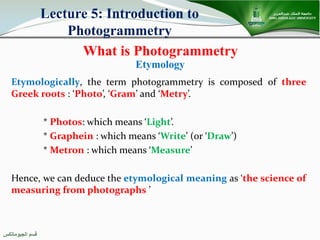
Etymologically, the term photogrammetry is composed of three
Greek roots : ‘Photo’, ‘Gram’ and ‘Metry’.
* Photos: which means ‘Light’.
* Graphein : which means ‘Write’ (or ‘Draw’)
* Metron : which means ‘Measure’
Hence, we can deduce the etymological meaning as ‘the science of
measuring from photographs ’
Lecture 5: Introduction to
Photogrammetry
‫اﻟﺠﯿﻮﻣﺎﺗﻜﺲ‬ ‫ﻗﺴﻢ‬
What is Photogrammetry
ASPRS Definition
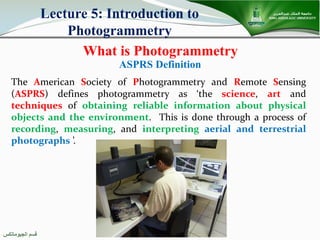
The American Society of Photogrammetry and Remote Sensing
(ASPRS) defines photogrammetry as ‘the science, art and
techniques of obtaining reliable information about physical
objects and the environment. This is done through a process of
recording, measuring, and interpreting aerial and terrestrial
photographs ’.
Lecture 5: Introduction to
Photogrammetry
‫اﻟﺠﯿﻮﻣﺎﺗﻜﺲ‬ ‫ﻗﺴﻢ‬
What is Photogrammetry
Photogrammetry Workflow
Lecture 5: Introduction to
Photogrammetry
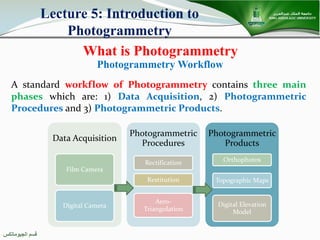
A standard workflow of Photogrammetry contains three main
phases which are: 1) Data Acquisition, 2) Photogrammetric
Procedures and 3) Photogrammetric Products.
Data Acquisition
Film Camera
Digital Camera
Photogrammetric
Procedures
Rectification
Restitution
Aero-
Triangulation
Photogrammetric
Products
Orthophotos
Topographic Maps
Digital Elevation
Model
‫اﻟﺠﯿﻮﻣﺎﺗﻜﺲ‬ ‫ﻗﺴﻢ‬
Principles of Human Vision
Lecture 5: Introduction to
Photogrammetry
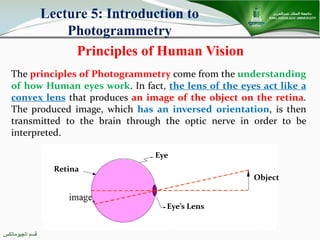
The principles of Photogrammetry come from the understanding
of how Human eyes work. In fact, the lens of the eyes act like a
convex lens that produces an image of the object on the retina.
The produced image, which has an inversed orientation, is then
transmitted to the brain through the optic nerve in order to be
interpreted.
Object
Retina
Eye’s Lens
Eye
‫اﻟﺠﯿﻮﻣﺎﺗﻜﺲ‬ ‫ﻗﺴﻢ‬
Principles of Human Vision
Lecture 5: Introduction to
Photogrammetry
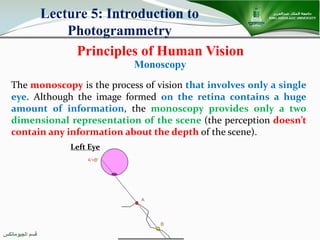
The monoscopy is the process of vision that involves only a single
eye. Although the image formed on the retina contains a huge
amount of information, the monoscopy provides only a two
dimensional representation of the scene (the perception doesn’t
contain any information about the depth of the scene).
Monoscopy
Left Eye
‫اﻟﺠﯿﻮﻣﺎﺗﻜﺲ‬ ‫ﻗﺴﻢ‬
Principles of Human Vision
Lecture 5: Introduction to
Photogrammetry
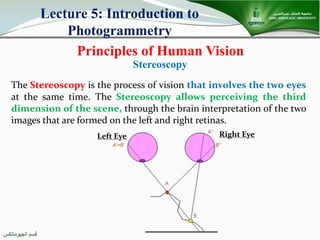
The Stereoscopy is the process of vision that involves the two eyes
at the same time. The Stereoscopy allows perceiving the third
dimension of the scene, through the brain interpretation of the two
images that are formed on the left and right retinas.
Stereoscopy
Left Eye Right Eye
‫اﻟﺠﯿﻮﻣﺎﺗﻜﺲ‬ ‫ﻗﺴﻢ‬
Principles of Human Vision
Lecture 5: Introduction to
Photogrammetry
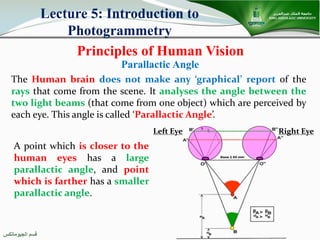
The Human brain does not make any ‘graphical’ report of the
rays that come from the scene. It analyses the angle between the
two light beams (that come from one object) which are perceived by
each eye. This angle is called ‘Parallactic Angle’.
Parallactic Angle
A point which is closer to the
human eyes has a large
parallactic angle, and point
which is farther has a smaller
parallactic angle.
Left Eye Right Eye
‫اﻟﺠﯿﻮﻣﺎﺗﻜﺲ‬ ‫ﻗﺴﻢ‬
Branches of Photogrammetry
Lecture 5: Introduction to
Photogrammetry
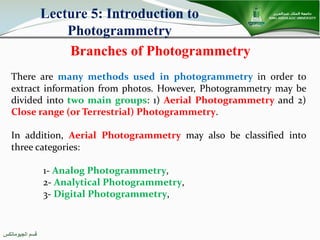
There are many methods used in photogrammetry in order to
extract information from photos. However, Photogrammetry may be
divided into two main groups: 1) Aerial Photogrammetry and 2)
Close range (or Terrestrial) Photogrammetry.
In addition, Aerial Photogrammetry may also be classified into
three categories:
1- Analog Photogrammetry,
2- Analytical Photogrammetry,
3- Digital Photogrammetry,
‫اﻟﺠﯿﻮﻣﺎﺗﻜﺲ‬ ‫ﻗﺴﻢ‬
Branches of Photogrammetry
Lecture 5: Introduction to
Photogrammetry
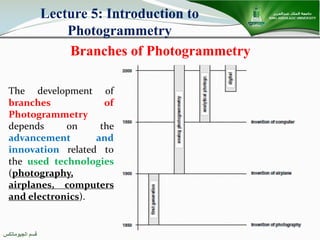
The development of
branches of
Photogrammetry
depends on the
advancement and
innovation related t0
the used technologies
(photography,
airplanes, computers
and electronics).
‫اﻟﺠﯿﻮﻣﺎﺗﻜﺲ‬ ‫ﻗﺴﻢ‬
Branches of Photogrammetry
Lecture 5: Introduction to
Photogrammetry
Analog Photogrammetry is the branch of Photogrammetry that
includes all methods and techniques to extract information from
analog photos based on mechanical and optical methods or their
combination.
The Principle of Analog Photogrammetry is to produce in the
laboratory, and on a smaller scale, the configuration of the
camera when taking pictures in two positions. This
configuration is reconstructed by using optical and mechanical
instruments.
Analog Photogrammetry
‫اﻟﺠﯿﻮﻣﺎﺗﻜﺲ‬ ‫ﻗﺴﻢ‬
Branches of Photogrammetry
Lecture 5: Introduction to
Photogrammetry
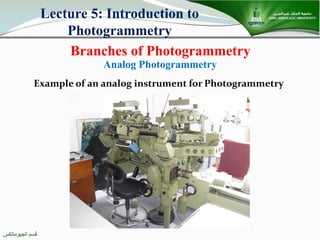
Example of an analog instrument for Photogrammetry
Analog Photogrammetry
‫اﻟﺠﯿﻮﻣﺎﺗﻜﺲ‬ ‫ﻗﺴﻢ‬
Branches of Photogrammetry
Lecture 5: Introduction to
Photogrammetry
Analytical Photogrammetry is also based on the reconstruction of
camera’s positions during the flight mission. However, the
reconstruction is not performed mechanically.
Although the used photos are analog, the principle of Analytical
Photogrammetry is to reconstruct mathematically the
configuration of cameras during the flight using computers.
Analytical Photogrammetry
‫اﻟﺠﯿﻮﻣﺎﺗﻜﺲ‬ ‫ﻗﺴﻢ‬
Branches of Photogrammetry
Lecture 5: Introduction to
Photogrammetry
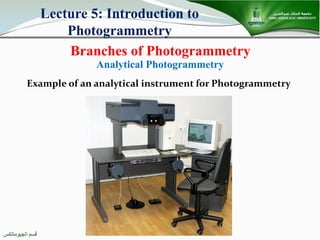
Example of an analytical instrument for Photogrammetry
Analytical Photogrammetry
‫اﻟﺠﯿﻮﻣﺎﺗﻜﺲ‬ ‫ﻗﺴﻢ‬
Branches of Photogrammetry
Lecture 5: Introduction to
Photogrammetry
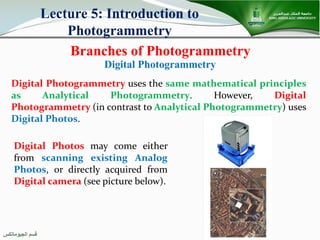
Digital Photogrammetry uses the same mathematical principles
as Analytical Photogrammetry. However, Digital
Photogrammetry (in contrast to Analytical Photogrammetry) uses
Digital Photos.
Digital Photogrammetry
Digital Photos may come either
from scanning existing Analog
Photos, or directly acquired from
Digital camera (see picture below).
‫اﻟﺠﯿﻮﻣﺎﺗﻜﺲ‬ ‫ﻗﺴﻢ‬
Branches of Photogrammetry
Lecture 5: Introduction to
Photogrammetry
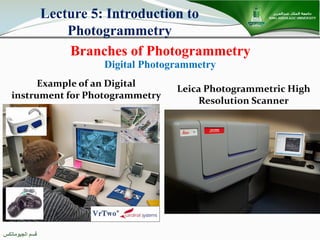
Example of an Digital
instrument for Photogrammetry
Digital Photogrammetry
Leica Photogrammetric High
Resolution Scanner
‫اﻟﺠﯿﻮﻣﺎﺗﻜﺲ‬ ‫ﻗﺴﻢ‬
Branches of Photogrammetry
Lecture 5: Introduction to
Photogrammetry
Close –range (Terrestrial)
Photogrammetry
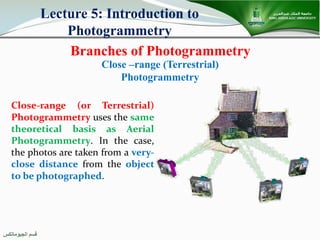
Close-range (or Terrestrial)
Photogrammetry uses the same
theoretical basis as Aerial
Photogrammetry. In the case,
the photos are taken from a very-
close distance from the object
to be photographed.
‫اﻟﺠﯿﻮﻣﺎﺗﻜﺲ‬ ‫ﻗﺴﻢ‬
Principles of Photogrammetry
Lecture 5: Introduction to
Photogrammetry
Characteristics aerial photography
Marginal data of aerial photography
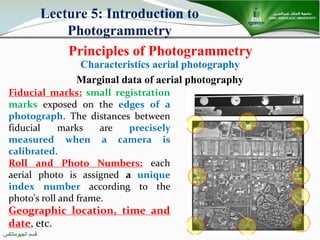
Fiducial marks: small registration
marks exposed on the edges of a
photograph. The distances between
fiducial marks are precisely
measured when a camera is
calibrated.
Roll and Photo Numbers: each
aerial photo is assigned a unique
index number according to the
photo's roll and frame.
Geographic location, time and
date, etc.
‫اﻟﺠﯿﻮﻣﺎﺗﻜﺲ‬ ‫ﻗﺴﻢ‬
Principles of Photogrammetry
Lecture 5: Introduction to
Photogrammetry
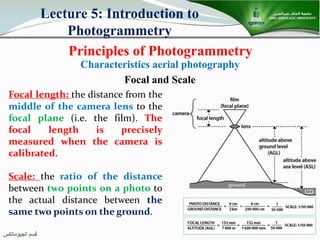
Focal and Scale
Focal length: the distance from the
middle of the camera lens to the
focal plane (i.e. the film). The
focal length is precisely
measured when the camera is
calibrated.
Scale: the ratio of the distance
between two points on a photo to
the actual distance between the
same two points on the ground.
Characteristics aerial photography
‫اﻟﺠﯿﻮﻣﺎﺗﻜﺲ‬ ‫ﻗﺴﻢ‬
Principles of Photogrammetry
Lecture 5: Introduction to
Photogrammetry
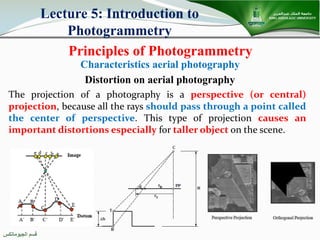
Distortion on aerial photography
The projection of a photography is a perspective (or central)
projection, because all the rays should pass through a point called
the center of perspective. This type of projection causes an
important distortions especially for taller object on the scene.
Characteristics aerial photography
‫اﻟﺠﯿﻮﻣﺎﺗﻜﺲ‬ ‫ﻗﺴﻢ‬
Principles of Photogrammetry
Lecture 5: Introduction to
Photogrammetry
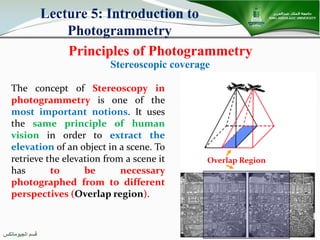
Stereoscopic coverage
The concept of Stereoscopy in
photogrammetry is one of the
most important notions. It uses
the same principle of human
vision in order to extract the
elevation of an object in a scene. To
retrieve the elevation from a scene it
has to be necessary
photographed from to different
perspectives (Overlap region).
Overlap Region
‫اﻟﺠﯿﻮﻣﺎﺗﻜﺲ‬ ‫ﻗﺴﻢ‬
Principles of Photogrammetry
Lecture 5: Introduction to
Photogrammetry
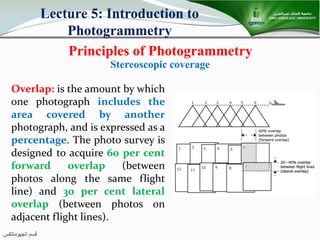
Stereoscopic coverage
Overlap: is the amount by which
one photograph includes the
area covered by another
photograph, and is expressed as a
percentage. The photo survey is
designed to acquire 60 per cent
forward overlap (between
photos along the same flight
line) and 30 per cent lateral
overlap (between photos on
adjacent flight lines).
‫اﻟﺠﯿﻮﻣﺎﺗﻜﺲ‬ ‫ﻗﺴﻢ‬
Principles of Photogrammetry
Lecture 5: Introduction to
Photogrammetry
Stereoscopic restitution
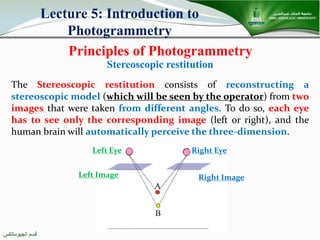
The Stereoscopic restitution consists of reconstructing a
stereoscopic model (which will be seen by the operator) from two
images that were taken from different angles. To do so, each eye
has to see only the corresponding image (left or right), and the
human brain will automatically perceive the three-dimension.
Left Eye Right Eye
Left Image Right Image
‫اﻟﺠﯿﻮﻣﺎﺗﻜﺲ‬ ‫ﻗﺴﻢ‬
Principles of Photogrammetry
Lecture 5: Introduction to
Photogrammetry
Stereoscopic restitution
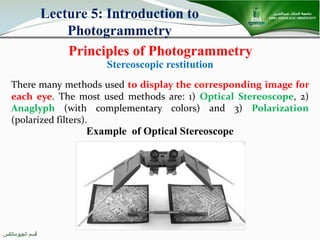
There many methods used to display the corresponding image for
each eye. The most used methods are: 1) Optical Stereoscope, 2)
Anaglyph (with complementary colors) and 3) Polarization
(polarized filters).
Example of Optical Stereoscope
‫اﻟﺠﯿﻮﻣﺎﺗﻜﺲ‬ ‫ﻗﺴﻢ‬
Principles of Photogrammetry
Lecture 5: Introduction to
Photogrammetry
Stereoscopic restitution
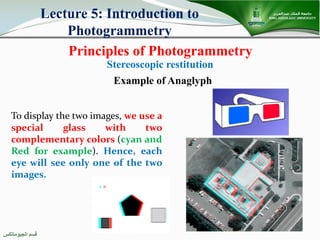
To display the two images, we use a
special glass with two
complementary colors (cyan and
Red for example). Hence, each
eye will see only one of the two
images.
Example of Anaglyph
‫اﻟﺠﯿﻮﻣﺎﺗﻜﺲ‬ ‫ﻗﺴﻢ‬
Principles of Photogrammetry
Lecture 5: Introduction to
Photogrammetry
Stereoscopic restitution
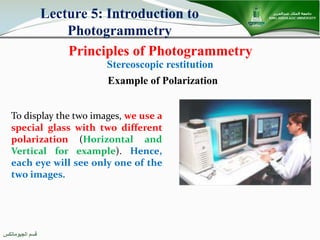
To display the two images, we use a
special glass with two different
polarization (Horizontal and
Vertical for example). Hence,
each eye will see only one of the
two images.
Example of Polarization
‫اﻟﺠﯿﻮﻣﺎﺗﻜﺲ‬ ‫ﻗﺴﻢ‬
Principles of Photogrammetry
Lecture 5: Introduction to
Photogrammetry
Stereoscopic restitution
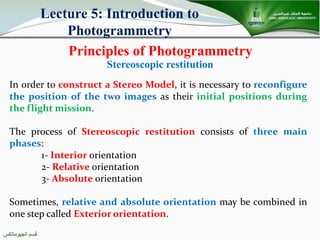
In order to construct a Stereo Model, it is necessary to reconfigure
the position of the two images as their initial positions during
the flight mission.
The process of Stereoscopic restitution consists of three main
phases:
1- Interior orientation
2- Relative orientation
3- Absolute orientation
Sometimes, relative and absolute orientation may be combined in
one step called Exterior orientation.
‫اﻟﺠﯿﻮﻣﺎﺗﻜﺲ‬ ‫ﻗﺴﻢ‬
Principles of Photogrammetry
Lecture 5: Introduction to
Photogrammetry
Stereoscopic restitution
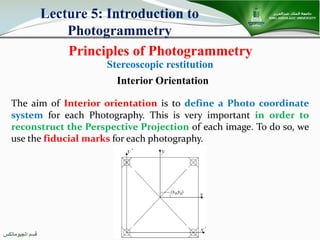
The aim of Interior orientation is to define a Photo coordinate
system for each Photography. This is very important in order to
reconstruct the Perspective Projection of each image. To do so, we
use the fiducial marks for each photography.
Interior Orientation
‫اﻟﺠﯿﻮﻣﺎﺗﻜﺲ‬ ‫ﻗﺴﻢ‬
Principles of Photogrammetry
Lecture 5: Introduction to
Photogrammetry
Stereoscopic restitution
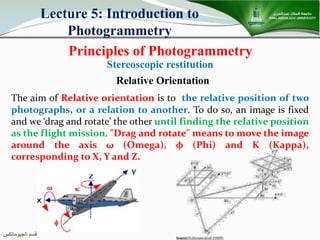
The aim of Relative orientation is to the relative position of two
photographs, or a relation to another. To do so, an image is fixed
and we ‘drag and rotate’ the other until finding the relative position
as the flight mission. "Drag and rotate" means to move the image
around the axis ω (Omega), φ (Phi) and K (Kappa),
corresponding to X, Y and Z.
Relative Orientation
‫اﻟﺠﯿﻮﻣﺎﺗﻜﺲ‬ ‫ﻗﺴﻢ‬
Principles of Photogrammetry
Lecture 5: Introduction to
Photogrammetry
Stereoscopic restitution
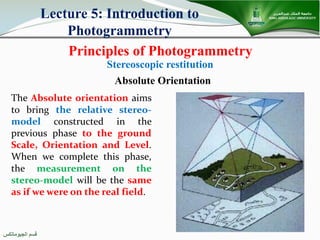
The Absolute orientation aims
to bring the relative stereo-
model constructed in the
previous phase to the ground
Scale, Orientation and Level.
When we complete this phase,
the measurement on the
stereo-model will be the same
as if we were on the real field.
Absolute Orientation
‫اﻟﺠﯿﻮﻣﺎﺗﻜﺲ‬ ‫ﻗﺴﻢ‬
Lecture 5: Introduction to
Photogrammetry
‫اﻟﺠﯿﻮﻣﺎﺗﻜﺲ‬ ‫ﻗﺴﻢ‬
Introduction to GPS
Introduction to Geomatics
GEOM 101
Reda Yaagoubi, Ph.D.
Email: ryaagoubi@kau.edu.sa
Week 9

GEOM101 _ Lecture 5 - Photogrammetry.pdf

  • 1.
    Geomatics Department King AbdulAzizUniversity Faculty of Environmental Design ‫اﻟﺠﯿﻮﻣﺎﺗﻜﺲ‬ ‫ﻗﺴﻢ‬ Introduction to Photogrammetry Introduction to Geomatics GEOM 101 Ahmad Baik, Ph.D. Email: abaik@kau.edu.sa Week 8
  • 2.
    ‫اﻟﺠﯿﻮﻣﺎﺗﻜﺲ‬ ‫ﻗﺴﻢ‬ Summary Lecture 5:Introduction to Photogrammetry I. What is Photogrammetry II. Principles of Human Vision III. Branches of Photogrammetry IV. Principles of Photogrammetry
  • 3.
    ‫اﻟﺠﯿﻮﻣﺎﺗﻜﺲ‬ ‫ﻗﺴﻢ‬ What isPhotogrammetry Etymology Etymologically, the term photogrammetry is composed of three Greek roots : ‘Photo’, ‘Gram’ and ‘Metry’. * Photos: which means ‘Light’. * Graphein : which means ‘Write’ (or ‘Draw’) * Metron : which means ‘Measure’ Hence, we can deduce the etymological meaning as ‘the science of measuring from photographs ’ Lecture 5: Introduction to Photogrammetry
  • 4.
    ‫اﻟﺠﯿﻮﻣﺎﺗﻜﺲ‬ ‫ﻗﺴﻢ‬ What isPhotogrammetry ASPRS Definition The American Society of Photogrammetry and Remote Sensing (ASPRS) defines photogrammetry as ‘the science, art and techniques of obtaining reliable information about physical objects and the environment. This is done through a process of recording, measuring, and interpreting aerial and terrestrial photographs ’. Lecture 5: Introduction to Photogrammetry
  • 5.
    ‫اﻟﺠﯿﻮﻣﺎﺗﻜﺲ‬ ‫ﻗﺴﻢ‬ What isPhotogrammetry Photogrammetry Workflow Lecture 5: Introduction to Photogrammetry A standard workflow of Photogrammetry contains three main phases which are: 1) Data Acquisition, 2) Photogrammetric Procedures and 3) Photogrammetric Products. Data Acquisition Film Camera Digital Camera Photogrammetric Procedures Rectification Restitution Aero- Triangulation Photogrammetric Products Orthophotos Topographic Maps Digital Elevation Model
  • 6.
    ‫اﻟﺠﯿﻮﻣﺎﺗﻜﺲ‬ ‫ﻗﺴﻢ‬ Principles ofHuman Vision Lecture 5: Introduction to Photogrammetry The principles of Photogrammetry come from the understanding of how Human eyes work. In fact, the lens of the eyes act like a convex lens that produces an image of the object on the retina. The produced image, which has an inversed orientation, is then transmitted to the brain through the optic nerve in order to be interpreted. Object Retina Eye’s Lens Eye
  • 7.
    ‫اﻟﺠﯿﻮﻣﺎﺗﻜﺲ‬ ‫ﻗﺴﻢ‬ Principles ofHuman Vision Lecture 5: Introduction to Photogrammetry The monoscopy is the process of vision that involves only a single eye. Although the image formed on the retina contains a huge amount of information, the monoscopy provides only a two dimensional representation of the scene (the perception doesn’t contain any information about the depth of the scene). Monoscopy Left Eye
  • 8.
    ‫اﻟﺠﯿﻮﻣﺎﺗﻜﺲ‬ ‫ﻗﺴﻢ‬ Principles ofHuman Vision Lecture 5: Introduction to Photogrammetry The Stereoscopy is the process of vision that involves the two eyes at the same time. The Stereoscopy allows perceiving the third dimension of the scene, through the brain interpretation of the two images that are formed on the left and right retinas. Stereoscopy Left Eye Right Eye
  • 9.
    ‫اﻟﺠﯿﻮﻣﺎﺗﻜﺲ‬ ‫ﻗﺴﻢ‬ Principles ofHuman Vision Lecture 5: Introduction to Photogrammetry The Human brain does not make any ‘graphical’ report of the rays that come from the scene. It analyses the angle between the two light beams (that come from one object) which are perceived by each eye. This angle is called ‘Parallactic Angle’. Parallactic Angle A point which is closer to the human eyes has a large parallactic angle, and point which is farther has a smaller parallactic angle. Left Eye Right Eye
  • 10.
    ‫اﻟﺠﯿﻮﻣﺎﺗﻜﺲ‬ ‫ﻗﺴﻢ‬ Branches ofPhotogrammetry Lecture 5: Introduction to Photogrammetry There are many methods used in photogrammetry in order to extract information from photos. However, Photogrammetry may be divided into two main groups: 1) Aerial Photogrammetry and 2) Close range (or Terrestrial) Photogrammetry. In addition, Aerial Photogrammetry may also be classified into three categories: 1- Analog Photogrammetry, 2- Analytical Photogrammetry, 3- Digital Photogrammetry,
  • 11.
    ‫اﻟﺠﯿﻮﻣﺎﺗﻜﺲ‬ ‫ﻗﺴﻢ‬ Branches ofPhotogrammetry Lecture 5: Introduction to Photogrammetry The development of branches of Photogrammetry depends on the advancement and innovation related t0 the used technologies (photography, airplanes, computers and electronics).
  • 12.
    ‫اﻟﺠﯿﻮﻣﺎﺗﻜﺲ‬ ‫ﻗﺴﻢ‬ Branches ofPhotogrammetry Lecture 5: Introduction to Photogrammetry Analog Photogrammetry is the branch of Photogrammetry that includes all methods and techniques to extract information from analog photos based on mechanical and optical methods or their combination. The Principle of Analog Photogrammetry is to produce in the laboratory, and on a smaller scale, the configuration of the camera when taking pictures in two positions. This configuration is reconstructed by using optical and mechanical instruments. Analog Photogrammetry
  • 13.
    ‫اﻟﺠﯿﻮﻣﺎﺗﻜﺲ‬ ‫ﻗﺴﻢ‬ Branches ofPhotogrammetry Lecture 5: Introduction to Photogrammetry Example of an analog instrument for Photogrammetry Analog Photogrammetry
  • 14.
    ‫اﻟﺠﯿﻮﻣﺎﺗﻜﺲ‬ ‫ﻗﺴﻢ‬ Branches ofPhotogrammetry Lecture 5: Introduction to Photogrammetry Analytical Photogrammetry is also based on the reconstruction of camera’s positions during the flight mission. However, the reconstruction is not performed mechanically. Although the used photos are analog, the principle of Analytical Photogrammetry is to reconstruct mathematically the configuration of cameras during the flight using computers. Analytical Photogrammetry
  • 15.
    ‫اﻟﺠﯿﻮﻣﺎﺗﻜﺲ‬ ‫ﻗﺴﻢ‬ Branches ofPhotogrammetry Lecture 5: Introduction to Photogrammetry Example of an analytical instrument for Photogrammetry Analytical Photogrammetry
  • 16.
    ‫اﻟﺠﯿﻮﻣﺎﺗﻜﺲ‬ ‫ﻗﺴﻢ‬ Branches ofPhotogrammetry Lecture 5: Introduction to Photogrammetry Digital Photogrammetry uses the same mathematical principles as Analytical Photogrammetry. However, Digital Photogrammetry (in contrast to Analytical Photogrammetry) uses Digital Photos. Digital Photogrammetry Digital Photos may come either from scanning existing Analog Photos, or directly acquired from Digital camera (see picture below).
  • 17.
    ‫اﻟﺠﯿﻮﻣﺎﺗﻜﺲ‬ ‫ﻗﺴﻢ‬ Branches ofPhotogrammetry Lecture 5: Introduction to Photogrammetry Example of an Digital instrument for Photogrammetry Digital Photogrammetry Leica Photogrammetric High Resolution Scanner
  • 18.
    ‫اﻟﺠﯿﻮﻣﺎﺗﻜﺲ‬ ‫ﻗﺴﻢ‬ Branches ofPhotogrammetry Lecture 5: Introduction to Photogrammetry Close –range (Terrestrial) Photogrammetry Close-range (or Terrestrial) Photogrammetry uses the same theoretical basis as Aerial Photogrammetry. In the case, the photos are taken from a very- close distance from the object to be photographed.
  • 19.
    ‫اﻟﺠﯿﻮﻣﺎﺗﻜﺲ‬ ‫ﻗﺴﻢ‬ Principles ofPhotogrammetry Lecture 5: Introduction to Photogrammetry Characteristics aerial photography Marginal data of aerial photography Fiducial marks: small registration marks exposed on the edges of a photograph. The distances between fiducial marks are precisely measured when a camera is calibrated. Roll and Photo Numbers: each aerial photo is assigned a unique index number according to the photo's roll and frame. Geographic location, time and date, etc.
  • 20.
    ‫اﻟﺠﯿﻮﻣﺎﺗﻜﺲ‬ ‫ﻗﺴﻢ‬ Principles ofPhotogrammetry Lecture 5: Introduction to Photogrammetry Focal and Scale Focal length: the distance from the middle of the camera lens to the focal plane (i.e. the film). The focal length is precisely measured when the camera is calibrated. Scale: the ratio of the distance between two points on a photo to the actual distance between the same two points on the ground. Characteristics aerial photography
  • 21.
    ‫اﻟﺠﯿﻮﻣﺎﺗﻜﺲ‬ ‫ﻗﺴﻢ‬ Principles ofPhotogrammetry Lecture 5: Introduction to Photogrammetry Distortion on aerial photography The projection of a photography is a perspective (or central) projection, because all the rays should pass through a point called the center of perspective. This type of projection causes an important distortions especially for taller object on the scene. Characteristics aerial photography
  • 22.
    ‫اﻟﺠﯿﻮﻣﺎﺗﻜﺲ‬ ‫ﻗﺴﻢ‬ Principles ofPhotogrammetry Lecture 5: Introduction to Photogrammetry Stereoscopic coverage The concept of Stereoscopy in photogrammetry is one of the most important notions. It uses the same principle of human vision in order to extract the elevation of an object in a scene. To retrieve the elevation from a scene it has to be necessary photographed from to different perspectives (Overlap region). Overlap Region
  • 23.
    ‫اﻟﺠﯿﻮﻣﺎﺗﻜﺲ‬ ‫ﻗﺴﻢ‬ Principles ofPhotogrammetry Lecture 5: Introduction to Photogrammetry Stereoscopic coverage Overlap: is the amount by which one photograph includes the area covered by another photograph, and is expressed as a percentage. The photo survey is designed to acquire 60 per cent forward overlap (between photos along the same flight line) and 30 per cent lateral overlap (between photos on adjacent flight lines).
  • 24.
    ‫اﻟﺠﯿﻮﻣﺎﺗﻜﺲ‬ ‫ﻗﺴﻢ‬ Principles ofPhotogrammetry Lecture 5: Introduction to Photogrammetry Stereoscopic restitution The Stereoscopic restitution consists of reconstructing a stereoscopic model (which will be seen by the operator) from two images that were taken from different angles. To do so, each eye has to see only the corresponding image (left or right), and the human brain will automatically perceive the three-dimension. Left Eye Right Eye Left Image Right Image
  • 25.
    ‫اﻟﺠﯿﻮﻣﺎﺗﻜﺲ‬ ‫ﻗﺴﻢ‬ Principles ofPhotogrammetry Lecture 5: Introduction to Photogrammetry Stereoscopic restitution There many methods used to display the corresponding image for each eye. The most used methods are: 1) Optical Stereoscope, 2) Anaglyph (with complementary colors) and 3) Polarization (polarized filters). Example of Optical Stereoscope
  • 26.
    ‫اﻟﺠﯿﻮﻣﺎﺗﻜﺲ‬ ‫ﻗﺴﻢ‬ Principles ofPhotogrammetry Lecture 5: Introduction to Photogrammetry Stereoscopic restitution To display the two images, we use a special glass with two complementary colors (cyan and Red for example). Hence, each eye will see only one of the two images. Example of Anaglyph
  • 27.
    ‫اﻟﺠﯿﻮﻣﺎﺗﻜﺲ‬ ‫ﻗﺴﻢ‬ Principles ofPhotogrammetry Lecture 5: Introduction to Photogrammetry Stereoscopic restitution To display the two images, we use a special glass with two different polarization (Horizontal and Vertical for example). Hence, each eye will see only one of the two images. Example of Polarization
  • 28.
    ‫اﻟﺠﯿﻮﻣﺎﺗﻜﺲ‬ ‫ﻗﺴﻢ‬ Principles ofPhotogrammetry Lecture 5: Introduction to Photogrammetry Stereoscopic restitution In order to construct a Stereo Model, it is necessary to reconfigure the position of the two images as their initial positions during the flight mission. The process of Stereoscopic restitution consists of three main phases: 1- Interior orientation 2- Relative orientation 3- Absolute orientation Sometimes, relative and absolute orientation may be combined in one step called Exterior orientation.
  • 29.
    ‫اﻟﺠﯿﻮﻣﺎﺗﻜﺲ‬ ‫ﻗﺴﻢ‬ Principles ofPhotogrammetry Lecture 5: Introduction to Photogrammetry Stereoscopic restitution The aim of Interior orientation is to define a Photo coordinate system for each Photography. This is very important in order to reconstruct the Perspective Projection of each image. To do so, we use the fiducial marks for each photography. Interior Orientation
  • 30.
    ‫اﻟﺠﯿﻮﻣﺎﺗﻜﺲ‬ ‫ﻗﺴﻢ‬ Principles ofPhotogrammetry Lecture 5: Introduction to Photogrammetry Stereoscopic restitution The aim of Relative orientation is to the relative position of two photographs, or a relation to another. To do so, an image is fixed and we ‘drag and rotate’ the other until finding the relative position as the flight mission. "Drag and rotate" means to move the image around the axis ω (Omega), φ (Phi) and K (Kappa), corresponding to X, Y and Z. Relative Orientation
  • 31.
    ‫اﻟﺠﯿﻮﻣﺎﺗﻜﺲ‬ ‫ﻗﺴﻢ‬ Principles ofPhotogrammetry Lecture 5: Introduction to Photogrammetry Stereoscopic restitution The Absolute orientation aims to bring the relative stereo- model constructed in the previous phase to the ground Scale, Orientation and Level. When we complete this phase, the measurement on the stereo-model will be the same as if we were on the real field. Absolute Orientation
  • 32.
  • 33.
    ‫اﻟﺠﯿﻮﻣﺎﺗﻜﺲ‬ ‫ﻗﺴﻢ‬ Introduction toGPS Introduction to Geomatics GEOM 101 Reda Yaagoubi, Ph.D. Email: ryaagoubi@kau.edu.sa Week 9