N
S
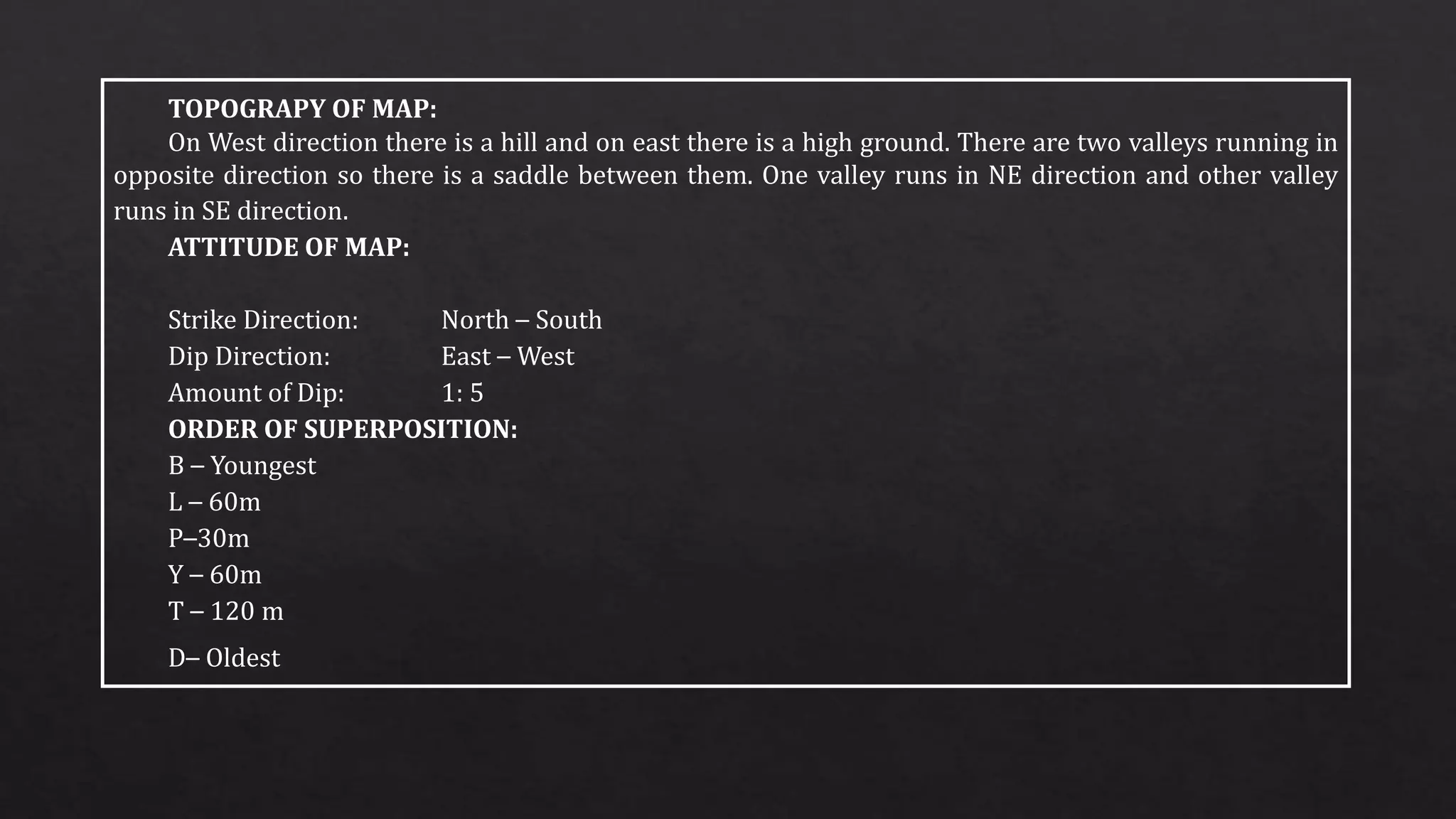
TOPOGRAPY OF MAP:
On West direction there is a hill and on east there is a high ground. There are two valleys running in
opposite direction so there is a saddle between them. One valley runs in NE direction and other valley
runs in SE direction.
ATTITUDE OF MAP:
Strike Direction: North – South
Dip Direction: East – West
Amount of Dip: 1: 5
ORDER OF SUPERPOSITION:
B – Youngest
L – 60m
P–30m
Y – 60m
T – 120 m
D– Oldest
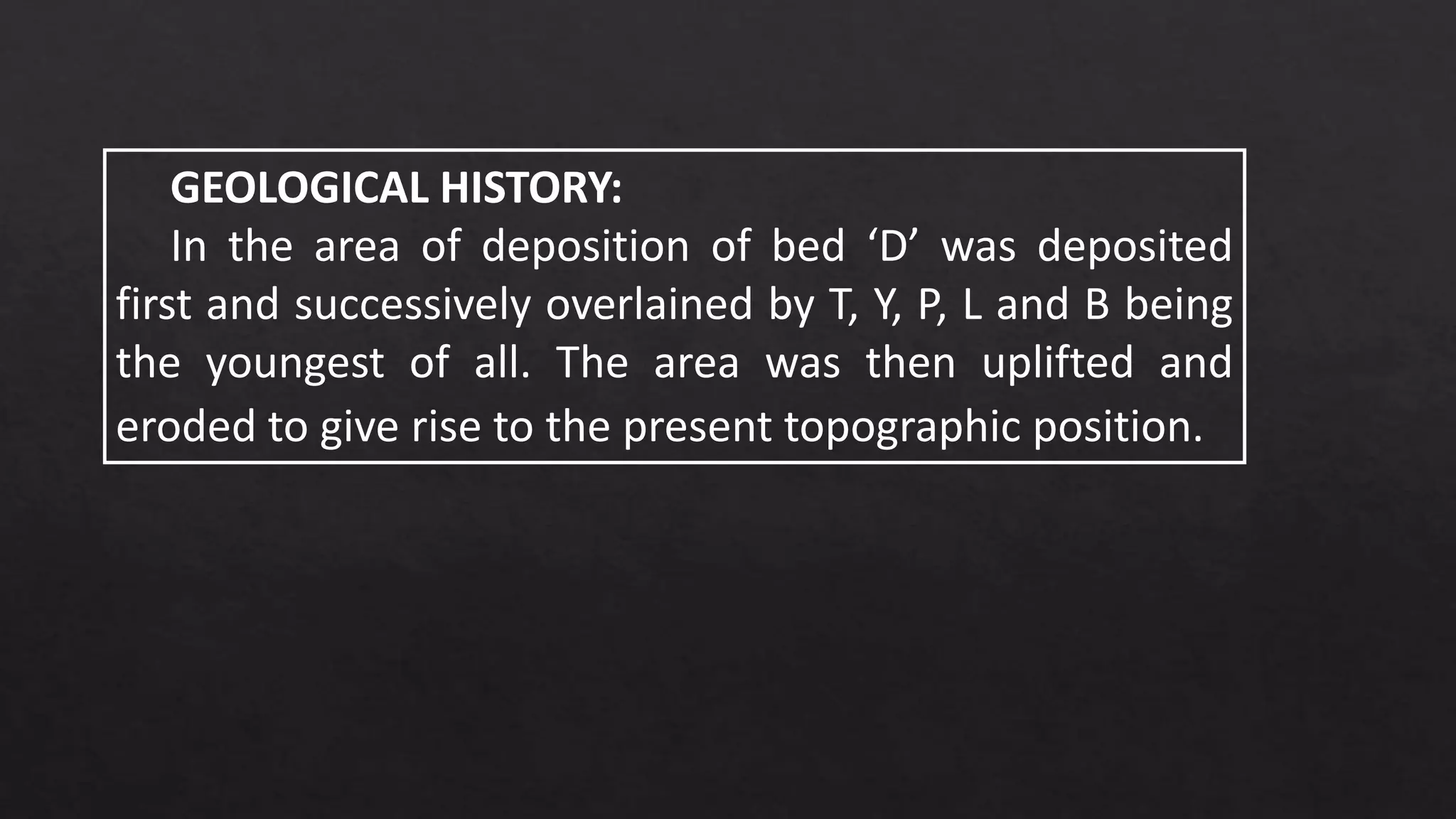
GEOLOGICAL HISTORY:
In the area of deposition of bed ‘D’ was deposited
first and successively overlained by T, Y, P, L and B being
the youngest of all. The area was then uplifted and
eroded to give rise to the present topographic position.
SECTIONAL VIEW OF MAP NO. 1
N
S
TOPOGRAPY OF MAP:
1. There is a valley in the South – West Direction.
2. There are two high grounds:
1st Ground in the Direction of North – West.
2nd Ground in the Direction of East – South.
ATTITUDE OF MAP:
Strike Direction: North West – South East
Dip Direction: South – West
Amount of Dip: 1: 5
ORDER OF SUPERPOSITION:
T – Youngest
A – 60 m
P – 45 m
L – Oldest
-------------------- Unconfirmity.
G – Youngest
O – 60 m
N – 30 m
Y – Oldest.
GEOLOGY:
Series 1: TAPL
There are no strike lines or dip in the series.
Series 2: GONY
Strike lines are in NW to SE and dip direction towards SW.
GEOLOGICAL HISTORY:
There are two series:
SERIES 1:
This series is Horizontal series TAPL. L bed being oldest and T bed is the Youngest.
SERIES 2:
‘Y’ being the Oldest bed and ‘G’ being the Youngest bed. Series 2 was deposited first
in the geological time scale. The there was a gap of interval for depositing the bed
series. i.e. Unconformity. The there was a upliftment of beds. i.e. the beds were
completely over turned hence the oldest bed Y is near to the second series and the
Youngest bed is at the last.
SECTIONAL VIEW OF MAP NO. 2
N
S
TOPOGRAPY OF MAP:
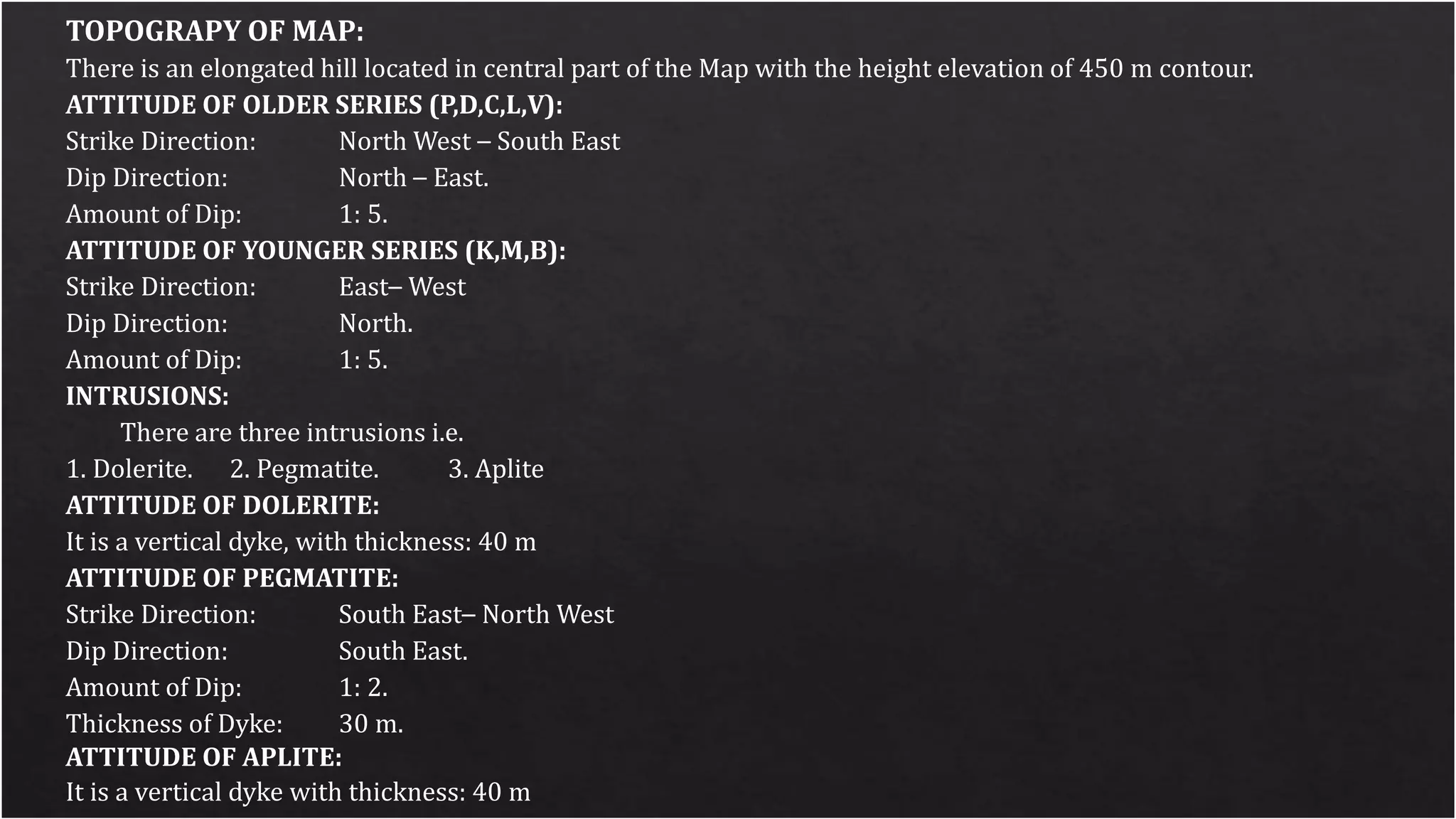
There is an elongated hill located in central part of the Map with the height elevation of 450 m contour.
ATTITUDE OF OLDER SERIES (P,D,C,L,V):
Strike Direction: North West – South East
Dip Direction: North – East.
Amount of Dip: 1: 5.
ATTITUDE OF YOUNGER SERIES (K,M,B):
Strike Direction: East– West
Dip Direction: North.
Amount of Dip: 1: 5.
INTRUSIONS:
There are three intrusions i.e.
1. Dolerite. 2. Pegmatite. 3. Aplite
ATTITUDE OF DOLERITE:
It is a vertical dyke, with thickness: 40 m
ATTITUDE OF PEGMATITE:
Strike Direction: South East– North West
Dip Direction: South East.
Amount of Dip: 1: 2.
Thickness of Dyke: 30 m.
ATTITUDE OF APLITE:
It is a vertical dyke with thickness: 40 m
ORDER OF SUPERPOSITION:
B – Youngest
M – 60 m
K – Oldest.
-------------------- Unconformity.
V – Youngest
L – 60 m
C – 60 m
D – 60 m
P – Oldest
GEOLOGICAL HISTORY:
In this basin of deposition bed P was deposited firstly and successively overlained by the beds P, D, C, L and V. The
series was intruded by the vertical dyke of Dolerite. The area was then uplifted and eroded, this period of deposition
of beds and erosion is marked by the unconformity. After unconformity the deposition of younger series took place in
which K deposited firstly followed by M and B bed. Then there was a intrusion of Aplite followed by the Pegmatite
dyke. Pegmatite dyke is inclined dyke while Aplite dyke is the vertical dyke.
N
S
TOPOGRAPY OF MAP:
There is circulated hill situated at the centre of the map.
ATTITUDE OF MAP:
Strike Direction: East – West
Dip Direction: South
Amount of Dip: 1: 3
ORDER OF SUPERPOSITION:
P - Youngest
M - 20 m
T - 20 m
B - 20 m
L - Oldest
GEOLOGICAL HISTORY:
There is only one series. The order of deposition of beds is P, M, T, B, and L. There are two different
faults i.e. Vertical Fault parallel to each other.
ATTITUDE OF FAULTS:
There are two vertical faults. The down throw amount for
Fault 1: 10 m
Fault 2: 10 m
SOLUTION OF ENGINEERING PROBLEM:
Alternative 1:
A road along 65 m contour on the northern slope, along 65 m contour on the southern slope, the dip
of the beds and slope of the strata are in the same direction. Hence risk of slide (Land) is more. However on
the northern slope dip is towards South and the strata slope is in opposite direction. Hence constructing a
road along 65 m contour on the northern slope is more feasible.
Alternative 2:
Constructing a tunnel with the invert of 65 m and crown of 71 m has a problem. There are two
vertical faults, F1 and F2, if the tunnel is constructed as give above due to the faults there is a possibility of
dislocation of the beds, due to faulting the chances of seepage of water through the fault plane is more. Hence
the given site location for constructing a tunnel is rejected.
N
S
TOPOGRAPY OF MAP:
There is a position of high ground in North Western portion of the map as well as in the
South Western part too with contour value of 350 m. there is a valley flowing east and
extends towards west.
GEOLOGY OF AREA:
There is a confirmable series of beds Y, O, L and D. The series is affected by a vertical dip
fault.
ATTITUDE OF MAP:
Strike Direction: North – South
Dip Direction: Towards West
Amount of Dip: 1: 10
ORDER OF SUPERPOSITION:
Y – Youngest
O – 60 m
L – 30 m
D – Oldest
GEOLOGICAL HISTORY:
In the basin of deposition bed D was deposited first and successively
overlained by L, O and Y bed. The area was then uplifted and eroded. The series
was uplifted by a vertical dip fault with displacement amount of about 150 m.
finally erosion of the surface takes place giving rise to present topography.
N
S
TOPOGRAPY OF MAP:
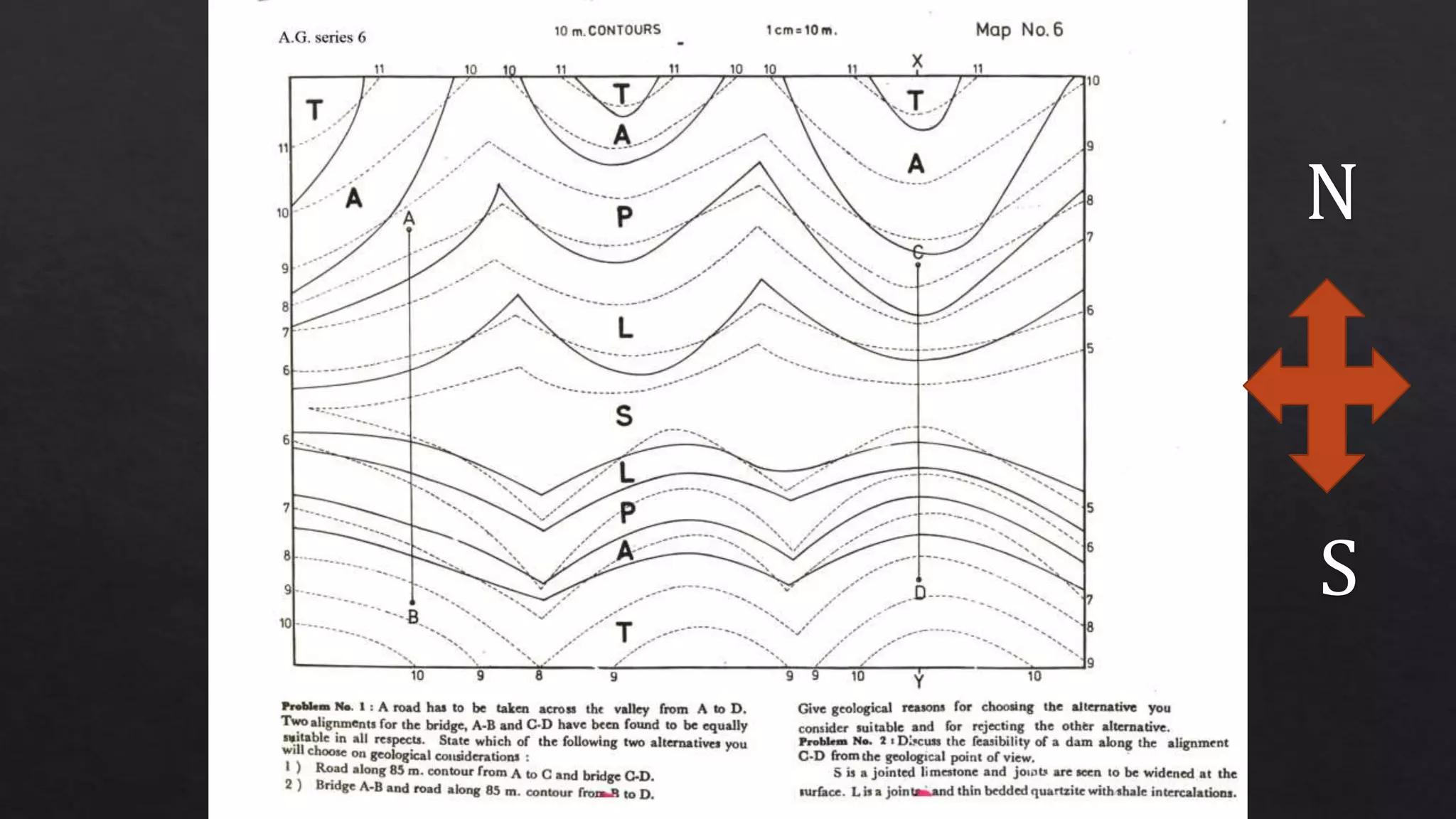
There are 6 high grounds with one valley, also there is 1 saddle.
Valley V1 running towards North direction.
Valley V2 running towards South direction.
ATTITUDE OF MAP:
Strike Direction: East – West
Dip Direction: South
Amount of Dip: 1: 5
ORDER OF SUPERPOSITION:
T- Youngest
A - 10 m
P - 10 m
L - 10 m
S – Oldest
GEOLOGICAL HISTORY:
In the basin of deposition ‘S’ was deposited first successively overlained by beds L, P,
A and T forming the youngest bed. The area was then uplifted and tilted and finally
eroded to give the present topography.
SOLUTION OF ENGINEERING PROBLEM:
Alternative 1:
A ground is constructed along 85 m contour from A to C with bridge at C to D. In
this case the geological and topographical slope is in the same direction and possibility
of landslide is more. If the road is constructed along 85 contour from B to D with bridge
at A to B then that will the best alternative.
Alternative 2:
Constructing of CD dam, as the beds dip towards south if the wall of dam is at C. it
could be subjected to high pressure of the reservoir. As the given lithology consist of a
jointed limestone which does not have high bearing capacity and presence of joints does
not favor the construction of the dam.
Quartzite though is a rock with high compressive strength, it is also jointed. Also
the Shells occurring at the site can swell due to absorption of water.
Due to above reasons construction of the dam at CD location is rejected.
N
S
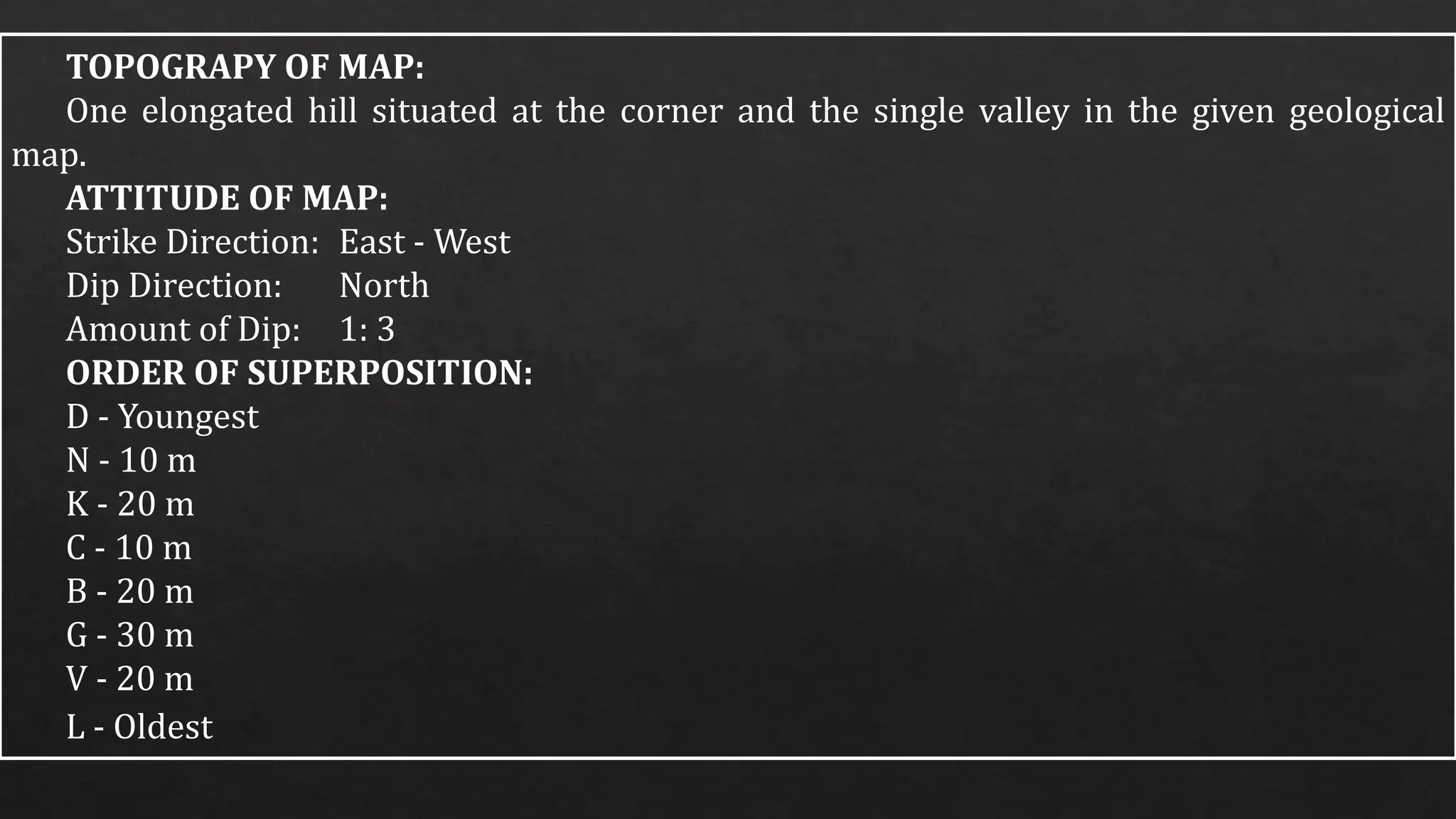
TOPOGRAPY OF MAP:
One elongated hill situated at the corner and the single valley in the given geological
map.
ATTITUDE OF MAP:
Strike Direction: East - West
Dip Direction: North
Amount of Dip: 1: 3
ORDER OF SUPERPOSITION:
D - Youngest
N - 10 m
K - 20 m
C - 10 m
B - 20 m
G - 30 m
V - 20 m
L - Oldest
GEOLOGICAL HISTORY:
The bed ‘L’ was deposited firstly in the basin of the deposition successively followed by
the beds V, G, B, C, K, N and D. The area was then uplifted due to tectonic activity and due to
erosion the present topography exists.
SOLUTION OF ENGINEERING PROBLEM:
The 3 sites given for construction of dam are O – P, Q – R and S – T
In case of O – P, the catchments area is more than the other two sites. Though there is
a possibility of seepage in some parts it can only be resulted in reduction of storage capacity
of the reservoir.
In case of Q – R, the dam will be constructed in comparatively younger beds with less
catchments area, hence rejected for constructing a dam.
In case of S – T, the slope occurs along the dip direction and hence the pressure which
is created will affect the dam. Hence from the 3 sites, Site O – P is the most suitable site for
the construction of the dam and the capacity of the reservoir catchments will be more
compared to other two.
N
S
TOPOGRAPY OF MAP:
There is a valley running towards West and East side of the given
geological Map.
ATTITUDE OF MAP:
Strike Direction: North – South
Dip Direction: In West part of Map dip is towards West direction
In East part of Map dip is towards East direction.
Amount of Dip: 1: 4
ORDER OF SUPERPOSITION:
S – Youngest
D – 60 m
O – 30 m
J – 60 m
C –Oldest
GEOLOGICAL HISTORY:
There is a Fold present with anticline and syncline type as indicated
by the dip direction.
Any Questions

Geological Section maps

  • 8.
  • 9.
    TOPOGRAPY OF MAP: OnWest direction there is a hill and on east there is a high ground. There are two valleys running in opposite direction so there is a saddle between them. One valley runs in NE direction and other valley runs in SE direction. ATTITUDE OF MAP: Strike Direction: North – South Dip Direction: East – West Amount of Dip: 1: 5 ORDER OF SUPERPOSITION: B – Youngest L – 60m P–30m Y – 60m T – 120 m D– Oldest
  • 10.
    GEOLOGICAL HISTORY: In thearea of deposition of bed ‘D’ was deposited first and successively overlained by T, Y, P, L and B being the youngest of all. The area was then uplifted and eroded to give rise to the present topographic position.
  • 11.
  • 12.
  • 13.
    TOPOGRAPY OF MAP: 1.There is a valley in the South – West Direction. 2. There are two high grounds: 1st Ground in the Direction of North – West. 2nd Ground in the Direction of East – South. ATTITUDE OF MAP: Strike Direction: North West – South East Dip Direction: South – West Amount of Dip: 1: 5 ORDER OF SUPERPOSITION: T – Youngest A – 60 m P – 45 m L – Oldest -------------------- Unconfirmity. G – Youngest O – 60 m N – 30 m Y – Oldest. GEOLOGY: Series 1: TAPL There are no strike lines or dip in the series. Series 2: GONY Strike lines are in NW to SE and dip direction towards SW.
  • 14.
    GEOLOGICAL HISTORY: There aretwo series: SERIES 1: This series is Horizontal series TAPL. L bed being oldest and T bed is the Youngest. SERIES 2: ‘Y’ being the Oldest bed and ‘G’ being the Youngest bed. Series 2 was deposited first in the geological time scale. The there was a gap of interval for depositing the bed series. i.e. Unconformity. The there was a upliftment of beds. i.e. the beds were completely over turned hence the oldest bed Y is near to the second series and the Youngest bed is at the last.
  • 15.
  • 16.
  • 17.
    TOPOGRAPY OF MAP: Thereis an elongated hill located in central part of the Map with the height elevation of 450 m contour. ATTITUDE OF OLDER SERIES (P,D,C,L,V): Strike Direction: North West – South East Dip Direction: North – East. Amount of Dip: 1: 5. ATTITUDE OF YOUNGER SERIES (K,M,B): Strike Direction: East– West Dip Direction: North. Amount of Dip: 1: 5. INTRUSIONS: There are three intrusions i.e. 1. Dolerite. 2. Pegmatite. 3. Aplite ATTITUDE OF DOLERITE: It is a vertical dyke, with thickness: 40 m ATTITUDE OF PEGMATITE: Strike Direction: South East– North West Dip Direction: South East. Amount of Dip: 1: 2. Thickness of Dyke: 30 m. ATTITUDE OF APLITE: It is a vertical dyke with thickness: 40 m
  • 18.
    ORDER OF SUPERPOSITION: B– Youngest M – 60 m K – Oldest. -------------------- Unconformity. V – Youngest L – 60 m C – 60 m D – 60 m P – Oldest GEOLOGICAL HISTORY: In this basin of deposition bed P was deposited firstly and successively overlained by the beds P, D, C, L and V. The series was intruded by the vertical dyke of Dolerite. The area was then uplifted and eroded, this period of deposition of beds and erosion is marked by the unconformity. After unconformity the deposition of younger series took place in which K deposited firstly followed by M and B bed. Then there was a intrusion of Aplite followed by the Pegmatite dyke. Pegmatite dyke is inclined dyke while Aplite dyke is the vertical dyke.
  • 20.
  • 21.
    TOPOGRAPY OF MAP: Thereis circulated hill situated at the centre of the map. ATTITUDE OF MAP: Strike Direction: East – West Dip Direction: South Amount of Dip: 1: 3 ORDER OF SUPERPOSITION: P - Youngest M - 20 m T - 20 m B - 20 m L - Oldest
  • 22.
    GEOLOGICAL HISTORY: There isonly one series. The order of deposition of beds is P, M, T, B, and L. There are two different faults i.e. Vertical Fault parallel to each other. ATTITUDE OF FAULTS: There are two vertical faults. The down throw amount for Fault 1: 10 m Fault 2: 10 m SOLUTION OF ENGINEERING PROBLEM: Alternative 1: A road along 65 m contour on the northern slope, along 65 m contour on the southern slope, the dip of the beds and slope of the strata are in the same direction. Hence risk of slide (Land) is more. However on the northern slope dip is towards South and the strata slope is in opposite direction. Hence constructing a road along 65 m contour on the northern slope is more feasible. Alternative 2: Constructing a tunnel with the invert of 65 m and crown of 71 m has a problem. There are two vertical faults, F1 and F2, if the tunnel is constructed as give above due to the faults there is a possibility of dislocation of the beds, due to faulting the chances of seepage of water through the fault plane is more. Hence the given site location for constructing a tunnel is rejected.
  • 23.
  • 24.
    TOPOGRAPY OF MAP: Thereis a position of high ground in North Western portion of the map as well as in the South Western part too with contour value of 350 m. there is a valley flowing east and extends towards west. GEOLOGY OF AREA: There is a confirmable series of beds Y, O, L and D. The series is affected by a vertical dip fault. ATTITUDE OF MAP: Strike Direction: North – South Dip Direction: Towards West Amount of Dip: 1: 10 ORDER OF SUPERPOSITION: Y – Youngest O – 60 m L – 30 m D – Oldest
  • 25.
    GEOLOGICAL HISTORY: In thebasin of deposition bed D was deposited first and successively overlained by L, O and Y bed. The area was then uplifted and eroded. The series was uplifted by a vertical dip fault with displacement amount of about 150 m. finally erosion of the surface takes place giving rise to present topography.
  • 26.
  • 27.
    TOPOGRAPY OF MAP: Thereare 6 high grounds with one valley, also there is 1 saddle. Valley V1 running towards North direction. Valley V2 running towards South direction. ATTITUDE OF MAP: Strike Direction: East – West Dip Direction: South Amount of Dip: 1: 5 ORDER OF SUPERPOSITION: T- Youngest A - 10 m P - 10 m L - 10 m S – Oldest
  • 28.
    GEOLOGICAL HISTORY: In thebasin of deposition ‘S’ was deposited first successively overlained by beds L, P, A and T forming the youngest bed. The area was then uplifted and tilted and finally eroded to give the present topography. SOLUTION OF ENGINEERING PROBLEM: Alternative 1: A ground is constructed along 85 m contour from A to C with bridge at C to D. In this case the geological and topographical slope is in the same direction and possibility of landslide is more. If the road is constructed along 85 contour from B to D with bridge at A to B then that will the best alternative. Alternative 2: Constructing of CD dam, as the beds dip towards south if the wall of dam is at C. it could be subjected to high pressure of the reservoir. As the given lithology consist of a jointed limestone which does not have high bearing capacity and presence of joints does not favor the construction of the dam. Quartzite though is a rock with high compressive strength, it is also jointed. Also the Shells occurring at the site can swell due to absorption of water. Due to above reasons construction of the dam at CD location is rejected.
  • 29.
  • 30.
    TOPOGRAPY OF MAP: Oneelongated hill situated at the corner and the single valley in the given geological map. ATTITUDE OF MAP: Strike Direction: East - West Dip Direction: North Amount of Dip: 1: 3 ORDER OF SUPERPOSITION: D - Youngest N - 10 m K - 20 m C - 10 m B - 20 m G - 30 m V - 20 m L - Oldest
  • 31.
    GEOLOGICAL HISTORY: The bed‘L’ was deposited firstly in the basin of the deposition successively followed by the beds V, G, B, C, K, N and D. The area was then uplifted due to tectonic activity and due to erosion the present topography exists. SOLUTION OF ENGINEERING PROBLEM: The 3 sites given for construction of dam are O – P, Q – R and S – T In case of O – P, the catchments area is more than the other two sites. Though there is a possibility of seepage in some parts it can only be resulted in reduction of storage capacity of the reservoir. In case of Q – R, the dam will be constructed in comparatively younger beds with less catchments area, hence rejected for constructing a dam. In case of S – T, the slope occurs along the dip direction and hence the pressure which is created will affect the dam. Hence from the 3 sites, Site O – P is the most suitable site for the construction of the dam and the capacity of the reservoir catchments will be more compared to other two.
  • 32.
  • 33.
    TOPOGRAPY OF MAP: Thereis a valley running towards West and East side of the given geological Map. ATTITUDE OF MAP: Strike Direction: North – South Dip Direction: In West part of Map dip is towards West direction In East part of Map dip is towards East direction. Amount of Dip: 1: 4 ORDER OF SUPERPOSITION: S – Youngest D – 60 m O – 30 m J – 60 m C –Oldest
  • 34.
    GEOLOGICAL HISTORY: There isa Fold present with anticline and syncline type as indicated by the dip direction.
  • 35.