Engineering Considerations for
Geologic Structures
ENGINEERING GEOLOGY
Effects and Civil Engineering
Importance of:
o Folds
o Faults
o Joints
o Unconformities
2
1. Effects of Folding
o Change in attitude
o Shattering of rocks
o Weak in strength parameters
o Porous and pervious in nature
o Strained nature
3
Importance in Civil Engineering
1. Location of dams
2. Location of reservoirs
3. Location of tunnels
4. Quarrying
5. Ground water occurrence
6. Laying roads and railway tracks along hill
slopes
7. Oil, gas and ore deposits
4
1. Location of Dams
2. Location of Reservoirs
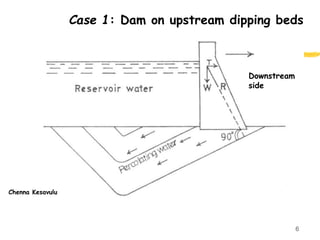
1. Dam on upstream dipping beds
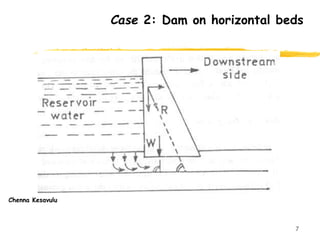
2. Dam on horizontal beds
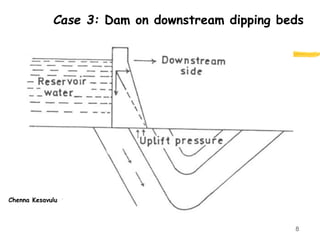
3. Dam on downstream dipping beds
5
6
Case 1: Dam on upstream dipping beds
Chenna Kesavulu
Downstream
side
7
Case 2: Dam on horizontal beds
Chenna Kesavulu
8
Case 3: Dam on downstream dipping beds
Chenna Kesavulu
3. Location of Tunnels
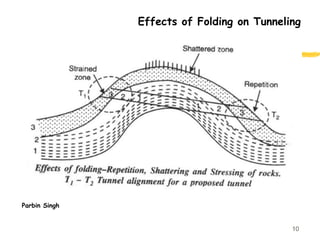
o Folded rocks are greatly strained, their removal,
for tunneling can cause rock explosions
o Along crests of folds, the rocks are in tension,
therefore highly unstable
o Along the troughs, rocks are highly compressed,
hence tough, offer greater resistance to
excavation for tunneling
o Tunneling can be done along the limbs
9
10
Effects of Folding on Tunneling
Parbin Singh
4. Quarrying
Should be done along the limbs:
o Better quality of rocks available
o Fractures associated with crests and troughs are
absent along the limbs
o Seepage problems along the crests and troughs
can be avoided
11
5. Ground water Occurrence
o Synclines often furnish excellent conditions to
tap ground water
o Artesian wells and springs originate from
synclines
o Fractures present in folded strata act as
channels for ground water movement
12
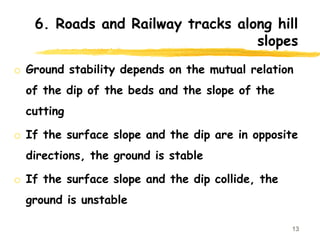
6. Roads and Railway tracks along hill
slopes
o Ground stability depends on the mutual relation
of the dip of the beds and the slope of the
cutting
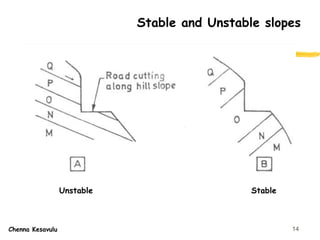
o If the surface slope and the dip are in opposite
directions, the ground is stable
o If the surface slope and the dip collide, the
ground is unstable
13
14
Stable and Unstable slopes
Chenna Kesavulu
Unstable Stable
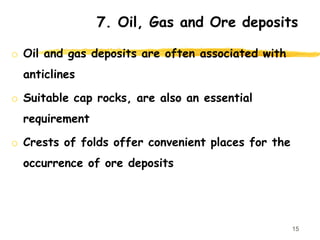
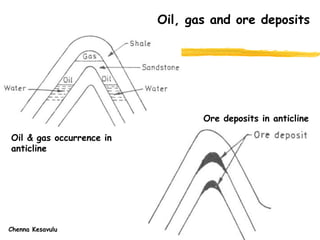
7. Oil, Gas and Ore deposits
o Oil and gas deposits are often associated with
anticlines
o Suitable cap rocks, are also an essential
requirement
o Crests of folds offer convenient places for the
occurrence of ore deposits
15
16
Oil & gas occurrence in
anticline
Oil, gas and ore deposits
Ore deposits in anticline
Chenna Kesavulu
2. Effects of Faulting
o Fracture and shattering of rocks along fault
zones
o Serves as pathways for water, causes leakage
o Fault zone lubricated with water are potential
sites for further movements
o Gouge and breccia causes problems
o Faults bring together, different rocks, hence
homogeneity is lost
17
Faulting considerations
o What are the effects of faulting on the rocks
in the site?
o Is it possible to build safe structures, with or
without ground treatment?
o What is the factor of safety to be adopted,
if there is no alternative available?
18
1. Location of dams
2. Location of reservoirs
3. Location of tunnels
4. Quarrying
5. Ground water occurrence
6. Laying roads and railway tracks along hill
slopes
7. Oil, gas and ore deposits
19
Importance in Civil Engineering
20Chenna Kesavulu
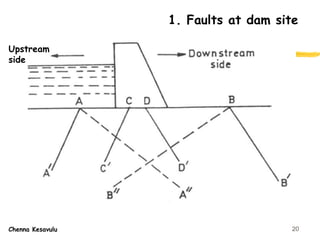
1. Faults at dam site
Upstream
side
2. Location of reservoirs
o Faults cause leakage of water, if present in the
reservoir basin
o Downstream dipping faults cause excess uplift
pressure
o Fault zone occurring in the upstream of the
river, leads to erosion and accelerated reservoir
silting
21
3. Location of Tunnels
o Faults zones, being heavily fractured, makes
tunneling unstable
o Ground water associated problems are likely to
occur
o Renewed faulting can lead to ground
displacement
22
4. Quarrying
o Quarrying in fault zones produce inferior
materials, quantitatively and qualitatively
23
5. Roads & Railway tracks along slopes
o Fault zones are highly undesirable for
construction of roads and railway, due to the
possibility of landslides
6. Ground water occurrence
o Faults zones, being heavily fractured, makes
provides space for storage of ground water and
permits their movement
24
7. Ore minerals
o Faults zones, are often rich in minerals
o They favor different process that eventually
lead to mineral formation
Construction in faulted regions
1. Ascertain the presence of faults, their type,
nature, extent and effects
2. Study the seismic history of the region
3. Introduce a factor of safety in the design
25
o Sources of weakness in rocks, pathways for
seepage of water
o Jointed rocks, lubricated by the presence of
water, are susceptible to motion
o Joints are usually treated by grouting
o Only a well jointed and porous rock can become
a good aquifer or an oil and gas reservoir
26
3. Effects of Joints
1. Location of dams and reservoirs
2. Occurrence of landslides
3. Quarrying
4. Tunneling
27
Importance in Civil Engineering
o Too many joints in a site, will render it
unsuitable for construction of dams
o They act as avenues for serious leakage of
water
o Upstream dipping joints are less harmful
28
1. Location of dams and reservoirs
o Landslides take place, when the surface slope of
the hills and the dip of the beds are in the
same direction
o Joints facilitate the heavy percolation of water
o This water comes in contact with clayey
material below the ground, producing fine
lubricating materials, which causes the slipping
of over lying rocks
29
2. Occurrence of Landslides
o Depending on conditions, joints can play a
helpful or harmful role in quarrying
o Joints cut in situ rocks, which can be easily
extracted, without the use of explosives
o Too many joints, on the other hand, render
quarrying useless, due to excessive decay of
rocks
30
3. Quarrying
o Joints can severely hamper the strength of rocks
o They may cause rocks to fall from the roof of
the tunnel
o Joints can cause the ground to be saturated with
water, decreasing the strength of the rocks
o They may act as sites for the development of
solution cavities in limestone terrain
31
4. Tunneling
4. Engineering considerations for
Unconformities
o They allow the percolation of water
o Unconformity indicates a break in the
sequence of rocks, and hence, their
engineering properties
o Hence, exhaustive studies have to be done, to
analyze the mechanical properties of rocks in
the vicinity of an unconformity
32

Engineering considerations

  • 1.
    Engineering Considerations for GeologicStructures ENGINEERING GEOLOGY
  • 2.
    Effects and CivilEngineering Importance of: o Folds o Faults o Joints o Unconformities 2
  • 3.
    1. Effects ofFolding o Change in attitude o Shattering of rocks o Weak in strength parameters o Porous and pervious in nature o Strained nature 3
  • 4.
    Importance in CivilEngineering 1. Location of dams 2. Location of reservoirs 3. Location of tunnels 4. Quarrying 5. Ground water occurrence 6. Laying roads and railway tracks along hill slopes 7. Oil, gas and ore deposits 4
  • 5.
    1. Location ofDams 2. Location of Reservoirs 1. Dam on upstream dipping beds 2. Dam on horizontal beds 3. Dam on downstream dipping beds 5
  • 6.
    6 Case 1: Damon upstream dipping beds Chenna Kesavulu Downstream side
  • 7.
    7 Case 2: Damon horizontal beds Chenna Kesavulu
  • 8.
    8 Case 3: Damon downstream dipping beds Chenna Kesavulu
  • 9.
    3. Location ofTunnels o Folded rocks are greatly strained, their removal, for tunneling can cause rock explosions o Along crests of folds, the rocks are in tension, therefore highly unstable o Along the troughs, rocks are highly compressed, hence tough, offer greater resistance to excavation for tunneling o Tunneling can be done along the limbs 9
  • 10.
    10 Effects of Foldingon Tunneling Parbin Singh
  • 11.
    4. Quarrying Should bedone along the limbs: o Better quality of rocks available o Fractures associated with crests and troughs are absent along the limbs o Seepage problems along the crests and troughs can be avoided 11
  • 12.
    5. Ground waterOccurrence o Synclines often furnish excellent conditions to tap ground water o Artesian wells and springs originate from synclines o Fractures present in folded strata act as channels for ground water movement 12
  • 13.
    6. Roads andRailway tracks along hill slopes o Ground stability depends on the mutual relation of the dip of the beds and the slope of the cutting o If the surface slope and the dip are in opposite directions, the ground is stable o If the surface slope and the dip collide, the ground is unstable 13
  • 14.
    14 Stable and Unstableslopes Chenna Kesavulu Unstable Stable
  • 15.
    7. Oil, Gasand Ore deposits o Oil and gas deposits are often associated with anticlines o Suitable cap rocks, are also an essential requirement o Crests of folds offer convenient places for the occurrence of ore deposits 15
  • 16.
    16 Oil & gasoccurrence in anticline Oil, gas and ore deposits Ore deposits in anticline Chenna Kesavulu
  • 17.
    2. Effects ofFaulting o Fracture and shattering of rocks along fault zones o Serves as pathways for water, causes leakage o Fault zone lubricated with water are potential sites for further movements o Gouge and breccia causes problems o Faults bring together, different rocks, hence homogeneity is lost 17
  • 18.
    Faulting considerations o Whatare the effects of faulting on the rocks in the site? o Is it possible to build safe structures, with or without ground treatment? o What is the factor of safety to be adopted, if there is no alternative available? 18
  • 19.
    1. Location ofdams 2. Location of reservoirs 3. Location of tunnels 4. Quarrying 5. Ground water occurrence 6. Laying roads and railway tracks along hill slopes 7. Oil, gas and ore deposits 19 Importance in Civil Engineering
  • 20.
    20Chenna Kesavulu 1. Faultsat dam site Upstream side
  • 21.
    2. Location ofreservoirs o Faults cause leakage of water, if present in the reservoir basin o Downstream dipping faults cause excess uplift pressure o Fault zone occurring in the upstream of the river, leads to erosion and accelerated reservoir silting 21
  • 22.
    3. Location ofTunnels o Faults zones, being heavily fractured, makes tunneling unstable o Ground water associated problems are likely to occur o Renewed faulting can lead to ground displacement 22
  • 23.
    4. Quarrying o Quarryingin fault zones produce inferior materials, quantitatively and qualitatively 23 5. Roads & Railway tracks along slopes o Fault zones are highly undesirable for construction of roads and railway, due to the possibility of landslides
  • 24.
    6. Ground wateroccurrence o Faults zones, being heavily fractured, makes provides space for storage of ground water and permits their movement 24 7. Ore minerals o Faults zones, are often rich in minerals o They favor different process that eventually lead to mineral formation
  • 25.
    Construction in faultedregions 1. Ascertain the presence of faults, their type, nature, extent and effects 2. Study the seismic history of the region 3. Introduce a factor of safety in the design 25
  • 26.
    o Sources ofweakness in rocks, pathways for seepage of water o Jointed rocks, lubricated by the presence of water, are susceptible to motion o Joints are usually treated by grouting o Only a well jointed and porous rock can become a good aquifer or an oil and gas reservoir 26 3. Effects of Joints
  • 27.
    1. Location ofdams and reservoirs 2. Occurrence of landslides 3. Quarrying 4. Tunneling 27 Importance in Civil Engineering
  • 28.
    o Too manyjoints in a site, will render it unsuitable for construction of dams o They act as avenues for serious leakage of water o Upstream dipping joints are less harmful 28 1. Location of dams and reservoirs
  • 29.
    o Landslides takeplace, when the surface slope of the hills and the dip of the beds are in the same direction o Joints facilitate the heavy percolation of water o This water comes in contact with clayey material below the ground, producing fine lubricating materials, which causes the slipping of over lying rocks 29 2. Occurrence of Landslides
  • 30.
    o Depending onconditions, joints can play a helpful or harmful role in quarrying o Joints cut in situ rocks, which can be easily extracted, without the use of explosives o Too many joints, on the other hand, render quarrying useless, due to excessive decay of rocks 30 3. Quarrying
  • 31.
    o Joints canseverely hamper the strength of rocks o They may cause rocks to fall from the roof of the tunnel o Joints can cause the ground to be saturated with water, decreasing the strength of the rocks o They may act as sites for the development of solution cavities in limestone terrain 31 4. Tunneling
  • 32.
    4. Engineering considerationsfor Unconformities o They allow the percolation of water o Unconformity indicates a break in the sequence of rocks, and hence, their engineering properties o Hence, exhaustive studies have to be done, to analyze the mechanical properties of rocks in the vicinity of an unconformity 32