Lecture (2)Lecture (2)
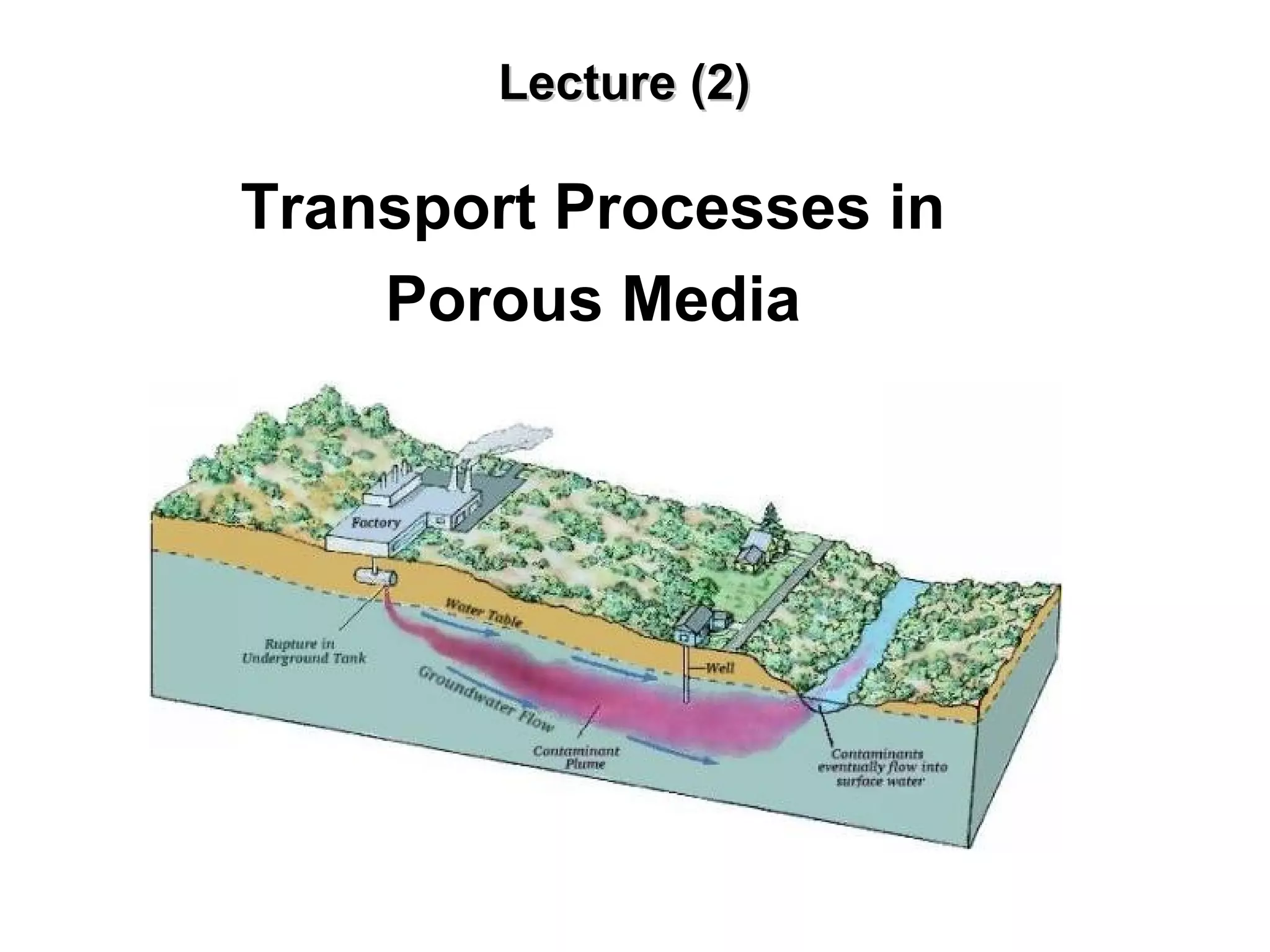
Transport Processes in
Porous Media
Lecture (2)Lecture (2)
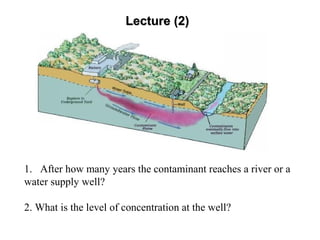
1. After how many years the contaminant reaches a river or a
water supply well?
2. What is the level of concentration at the well?
Layout of the LectureLayout of the Lecture
• Transport Processes in Porous Media.Transport Processes in Porous Media.
• Derivation of The Transport Equation (ADE).Derivation of The Transport Equation (ADE).
• Methods of Solution.Methods of Solution.
• Effect of Heterogeneity on Transport:Effect of Heterogeneity on Transport:
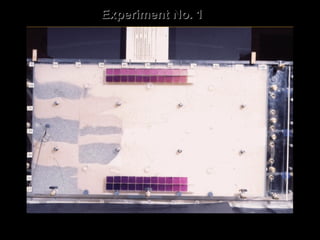
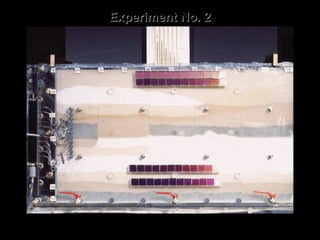
Laboratory Experiments (movie).Laboratory Experiments (movie).
Transport ProcessesTransport Processes
1)1) Physical :Physical :
Advection-Diffusion-DispersionAdvection-Diffusion-Dispersion
2) Chemical:2) Chemical:
Adsorption- Ion Exchange- etc.Adsorption- Ion Exchange- etc.
3) Biological:3) Biological:
Micro-organisms ActivityMicro-organisms Activity
(Bacteria&Microbes)(Bacteria&Microbes)
4) Decay:4) Decay:
Radioactive Decay-Natural Attenuation.Radioactive Decay-Natural Attenuation.
Physical ProcessesPhysical Processes
1. Advection
2. Molecular Diffusion
3. Mechanical Dispersion
4. Hydrodynamic Dispersion
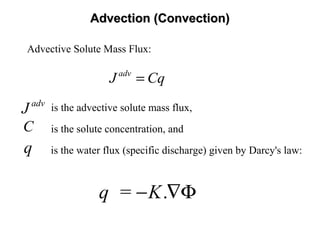
Advection (Convection)Advection (Convection)
adv
J Cq=
Advective Solute Mass Flux:
.q = K− ∇Φ
is the advective solute mass flux,
is the solute concentration, and
is the water flux (specific discharge) given by Darcy's law:
C
q
adv
J
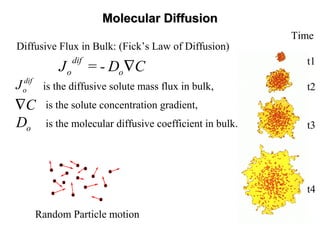
Molecular DiffusionMolecular Diffusion
Diffusive Flux in Bulk: (Fick’s Law of Diffusion)
is the diffusive solute mass flux in bulk,
dif
o oJ = - D C∇
dif
oJ
is the solute concentration gradient,C∇
is the molecular diffusive coefficient in bulk.oD
Random Particle motion
Time
t1
t2
t3
t4
Molecular Diffusion (Cont.)Molecular Diffusion (Cont.)
dif
effJ = - D C∇
τ
O
eff
D
D =
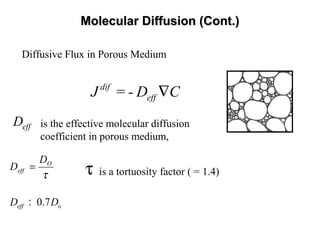
Diffusive Flux in Porous Medium
is the effective molecular diffusion
coefficient in porous medium,
effD
τ is a tortuosity factor ( = 1.4)
0.7eff oD D:
Mechanical DispersionMechanical Dispersion
dis
J = - Cε ∇.D
Depressive Flux in Porous Media (Fick’s Law):
is the depressive solute mass flux,
is the solute concentration gradient,
is the dispersion tensor,
is the effective porosity
dis
J
ε
C∇
D
xx xy xz
yx yy yz
zx zy zz
D D D
D D D
D D D
 
 
=  
 
 
D
[after Kinzelbach, 1986]
Causes of Mechanical Dispersion
Hydrodynamic DispersionHydrodynamic Dispersion
( ) ( ) i j
ij efft ij l t
v v
= |v|+ + -D D
|v|
α δ α α
_hydo dis
J = - Cε ∇.D
Hydrodynamic Depressive Flux in Porous Media (Fick’s Law):
The components of the dispersion tensor in isotropic soil
is given by [Bear, 1972],
is Kronecker delta, =1 for i=j and =0 for i≠ j,ijδ
are velocity components in two perpendicular directions,i jv v
is the magnitude of the resultant velocity,v 2 2 2
i j kv v v v= + +
is the longitudinal pore-(micro-) scale dispersivity, andlα
tα is the transverse pore-(micro-) scale dispersivity
ijδ ijδ
Hydrodynamic Dispersion (Cont.)Hydrodynamic Dispersion (Cont.)
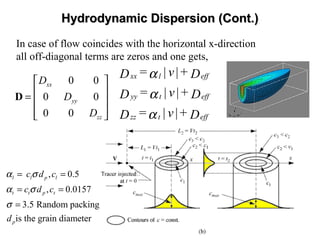
In case of flow coincides with the horizontal x-direction
all off-diagonal terms are zeros and one gets,
0 0
0 0
0 0
xx
yy
zz
D
D
D
 
 =  
  
D
xx effl
yy efft
zz efft
= |v|+D D
= |v|+D D
= |v|+D D
α
α
α
, 0.5
, 0.0157
3.5 Random packing
is the grain diameter
l l p l
t t p t
p
c d c
c d c
d
α σ
α σ
σ
= =
= =
=
Dispersion Regimes at Micro-ScaleDispersion Regimes at Micro-Scale
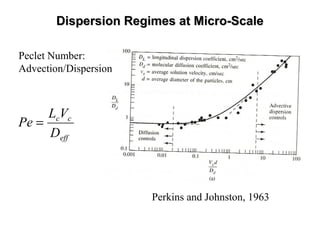
D
VL
Pe
eff
cc
=
Peclet Number:
Advection/Dispersion
Perkins and Johnston, 1963
Chemical ProcessesChemical Processes
• Sorption & De-sorption.Sorption & De-sorption.
• Ion Exchange.Ion Exchange.
• Retardation.Retardation.
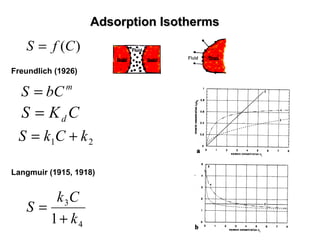
Adsorption IsothermsAdsorption Isotherms
)(CfS =
m
bCS =
CKS d=
21 kCkS +=
4
3
1 k
Ck
S
+
=
Freundlich (1926)
Langmuir (1915, 1918)
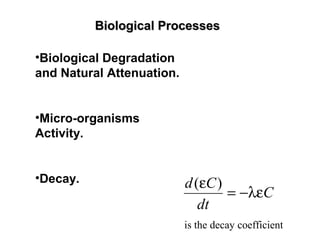
Biological ProcessesBiological Processes
•Biological Degradation
and Natural Attenuation.
•Micro-organisms
Activity.
•Decay.
C
dt
Cd
λε−=
ε )(
is the decay coefficient
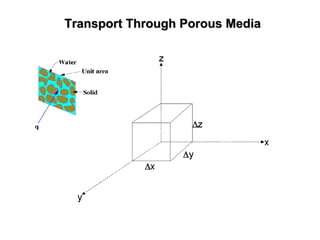
Transport Through Porous MediaTransport Through Porous Media
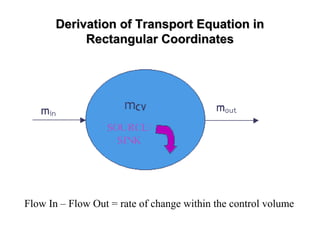
Derivation of Transport Equation inDerivation of Transport Equation in
Rectangular CoordinatesRectangular Coordinates
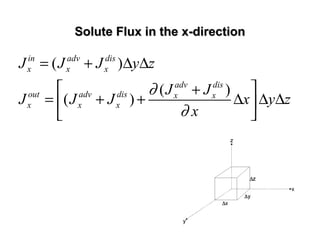
Flow In – Flow Out = rate of change within the control volume
Solute Flux in the x-directionSolute Flux in the x-direction
( )
( )
( )
in adv dis
x x x
adv dis
out adv dis x x
x x x
J J J y z
J J
J J J x y z
x
∂
∂
= + ∆ ∆
 +
= + + ∆ ∆ ∆ 
 
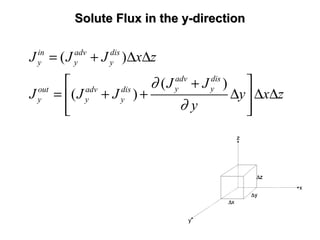
Solute Flux in the y-directionSolute Flux in the y-direction
( )
( )
( )
in adv dis
y y y
adv dis
y yout adv dis
y y y
J J J x z
J J
J J J y x z
y
∂
∂
= + ∆ ∆
 +
= + + ∆ ∆ ∆ 
  
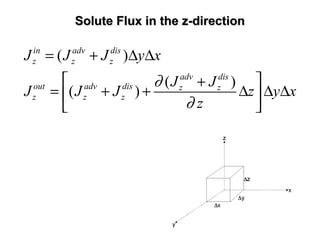
Solute Flux in the z-directionSolute Flux in the z-direction
( )
( )
( )
in adv dis
z z z
adv dis
out adv dis z z
z z z
J J J y x
J J
J J J z y x
z
∂
∂
= + ∆ ∆
 +
= + + ∆ ∆ ∆ 
 
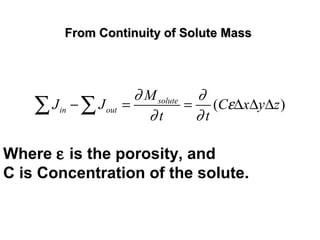
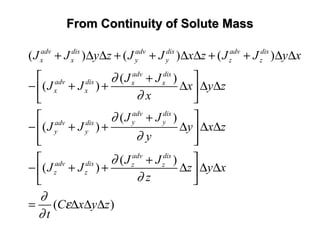
From Continuity of Solute MassFrom Continuity of Solute Mass
( )solute
in out
M
J J C x y z
t t
∂ ∂
ε
∂ ∂
− = = ∆ ∆ ∆∑ ∑
Where ε is the porosity, and
C is Concentration of the solute.
From Continuity of Solute MassFrom Continuity of Solute Mass
( ) ( ) ( )
( )
( )
( )
( )
( )
( )
( )
adv dis adv dis adv dis
x x y y z z
adv dis
adv dis x x
x x
adv dis
y yadv dis
y y
adv dis
adv dis z z
z z
J J y z J J x z J J y x
J J
J J x y z
x
J J
J J y x z
y
J J
J J z y x
z
C x y z
t
∂
∂
∂
∂
∂
∂
∂
ε
∂
+ ∆ ∆ + + ∆ ∆ + + ∆ ∆
 +
− + + ∆ ∆ ∆ 
 
 +
− + + ∆ ∆ ∆ 
  
 +
− + + ∆ ∆ ∆ 
 
= ∆ ∆ ∆
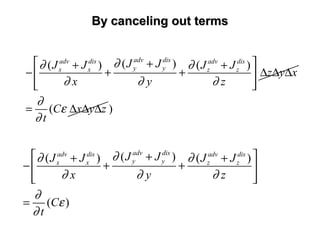
By canceling out termsBy canceling out terms
( )( ) ( )
adv disadv dis adv dis
y yx x z z
J JJ J J J
z y x
x y z
∂∂ ∂
∂ ∂ ∂
 ++ +
− + + ∆ ∆ ∆ 
  
(C x y z
t
∂
ε
∂
= ∆ ∆ ∆ )
( )( ) ( )
( )
adv disadv dis adv dis
y yx x z z
J JJ J J J
x y z
C
t
∂∂ ∂
∂ ∂ ∂
∂
ε
∂
 ++ +
− + + 
  
=
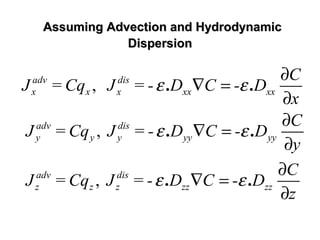
Assuming Advection and HydrodynamicAssuming Advection and Hydrodynamic
DispersionDispersion
,
,
,
adv dis
x x x xx xx
adv dis
y y y yy yy
adv dis
z z z zz zz
C
J = Cq J = - D C - D
x
C
J = Cq J = - D C - D
y
C
J = Cq J = - D C - D
z
ε ε
ε ε
ε ε
∂
∇ =
∂
∂
∇ =
∂
∂
∇ =
∂
. .
. .
. .
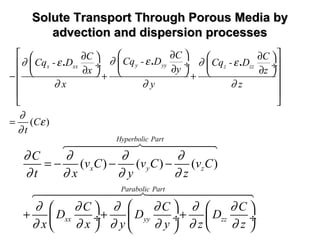
Solute Transport Through Porous Media bySolute Transport Through Porous Media by
advection and dispersion processesadvection and dispersion processes
( )
y yyx xx z zz
CC C
Cq - DCq - D Cq - D
yx z
x y z
C
t
∂ ε∂ ε ∂ ε
∂ ∂ ∂
∂
ε
∂
  ∂∂ ∂   
  ÷ ÷  ÷∂∂ ∂      − + +
 
 
 
=
.. .
( ) ( ) ( )
Hyperbolic Part
x y z
Parabolic Part
xx yy zz
C
v C v C v C
t x y z
C C C
D D D
x x y y z z
∂ ∂ ∂ ∂
∂ ∂ ∂ ∂
∂ ∂ ∂ ∂ ∂ ∂
∂ ∂ ∂ ∂ ∂ ∂
= − − −
    
+ + + ÷ ÷  ÷
    
644444474444448
644444444474444444448
General Form of The Transport EquationGeneral Form of The Transport Equation
 
[ ]
}
}
/
( ')
Dispersion Diffusion
Advection Source SinkChemical reaction
Decay
ij i
i j i
C C S C C W
v C + Q CD
t x x x
λ
ε ε
−
−
 ∂ ∂ ∂ ∂ −
= − − + 
∂ ∂ ∂ ∂  
6447448 64748 64748
where
C is the concentration field at time t,
Dij
is the hydrodynamic dispersion tensor,
Q is the volumetric flow rate per unit volume of the source or sink,
S is solute concentration of species in the source or sink fluid,
i, j are counters,
C’ is the concentration of the dissolved solutes in a source or sink,
W is a general term for source or sink and
vi
is the component of the Eulerian interstitial velocity in xi
direction
defined as follows,
 
          
ij
i
j
K
= -v
xε
∂Φ
∂
where
Kij
is the hydraulic conductivity tensor, and ε is the porosity of the medium.
Schematic Description of ProcessesSchematic Description of Processes
Figure 7. Schematic Description of the Effects of Advection, Dispersion, Adsorption, and Degradation on Pollution
Transport [after Kinzelbach, 1986].
Advection+Dispersion
Advection
Advection+Dispersion+Adsorption
Advection+Dispersion+Adsorption+Degradation
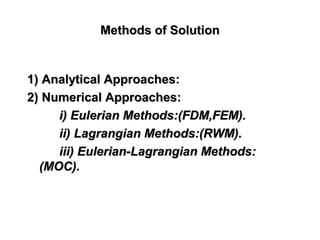
Methods of SolutionMethods of Solution
1) Analytical Approaches:1) Analytical Approaches:
2) Numerical Approaches:2) Numerical Approaches:
i)i) Eulerian Methods:(FDM,FEM).Eulerian Methods:(FDM,FEM).
ii) Lagrangian Methods:(RWM).ii) Lagrangian Methods:(RWM).
iii) Eulerian-Lagrangian Methods:iii) Eulerian-Lagrangian Methods:
(MOC).(MOC).
Pulse versus Continuous InjectionPulse versus Continuous Injection
Concentration Distribution in case of Pulse and Continuous Injections in a 2D Field
[after Kinzelbach, 1986].






tV4
)Y-(y
+
tV4
)tV-X-(x
-
tV4tV4
H)/(M
=t)y,C(x,
xt
2
o
xl
2
xo
xtxl
o
αααπαπ
ε
exp ( )
d
tV4
Y-y
+
tV4
tV-X-x
-
tV4
HM=ty,x,C
t
xt
2
o
xl
2
xo
tlx
o
∫ 





−−
−
−
•
0
)(
)(
)(
)((
exp
1)(/
)( τ
τατα
τ
τααπ
ε
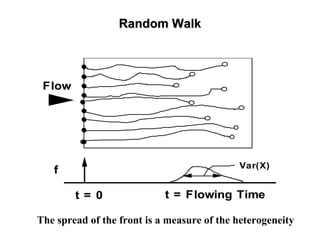
Flow
t = 0
f
t = Flowing Time
Var(X)
The spread of the front is a measure of the heterogeneity
Random WalkRandom Walk
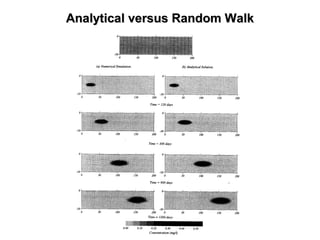
Analytical versus Random WalkAnalytical versus Random Walk
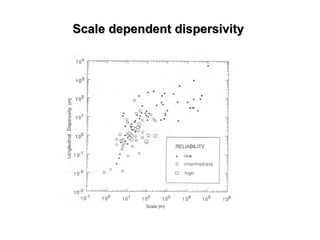
Scale dependent dispersivityScale dependent dispersivity
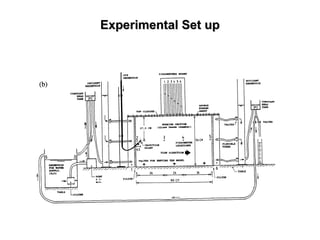
Experimental Set upExperimental Set up
Experiment No. 1Experiment No. 1
Experiment No. 2Experiment No. 2

Geohydrology ii (2)

  • 1.
    Lecture (2)Lecture (2) TransportProcesses in Porous Media
  • 2.
    Lecture (2)Lecture (2) 1.After how many years the contaminant reaches a river or a water supply well? 2. What is the level of concentration at the well?
  • 3.
    Layout of theLectureLayout of the Lecture • Transport Processes in Porous Media.Transport Processes in Porous Media. • Derivation of The Transport Equation (ADE).Derivation of The Transport Equation (ADE). • Methods of Solution.Methods of Solution. • Effect of Heterogeneity on Transport:Effect of Heterogeneity on Transport: Laboratory Experiments (movie).Laboratory Experiments (movie).
  • 4.
    Transport ProcessesTransport Processes 1)1)Physical :Physical : Advection-Diffusion-DispersionAdvection-Diffusion-Dispersion 2) Chemical:2) Chemical: Adsorption- Ion Exchange- etc.Adsorption- Ion Exchange- etc. 3) Biological:3) Biological: Micro-organisms ActivityMicro-organisms Activity (Bacteria&Microbes)(Bacteria&Microbes) 4) Decay:4) Decay: Radioactive Decay-Natural Attenuation.Radioactive Decay-Natural Attenuation.
  • 5.
    Physical ProcessesPhysical Processes 1.Advection 2. Molecular Diffusion 3. Mechanical Dispersion 4. Hydrodynamic Dispersion
  • 6.
    Advection (Convection)Advection (Convection) adv JCq= Advective Solute Mass Flux: .q = K− ∇Φ is the advective solute mass flux, is the solute concentration, and is the water flux (specific discharge) given by Darcy's law: C q adv J
  • 7.
    Molecular DiffusionMolecular Diffusion DiffusiveFlux in Bulk: (Fick’s Law of Diffusion) is the diffusive solute mass flux in bulk, dif o oJ = - D C∇ dif oJ is the solute concentration gradient,C∇ is the molecular diffusive coefficient in bulk.oD Random Particle motion Time t1 t2 t3 t4
  • 8.
    Molecular Diffusion (Cont.)MolecularDiffusion (Cont.) dif effJ = - D C∇ τ O eff D D = Diffusive Flux in Porous Medium is the effective molecular diffusion coefficient in porous medium, effD τ is a tortuosity factor ( = 1.4) 0.7eff oD D:
  • 9.
    Mechanical DispersionMechanical Dispersion dis J= - Cε ∇.D Depressive Flux in Porous Media (Fick’s Law): is the depressive solute mass flux, is the solute concentration gradient, is the dispersion tensor, is the effective porosity dis J ε C∇ D xx xy xz yx yy yz zx zy zz D D D D D D D D D     =       D [after Kinzelbach, 1986] Causes of Mechanical Dispersion
  • 10.
    Hydrodynamic DispersionHydrodynamic Dispersion () ( ) i j ij efft ij l t v v = |v|+ + -D D |v| α δ α α _hydo dis J = - Cε ∇.D Hydrodynamic Depressive Flux in Porous Media (Fick’s Law): The components of the dispersion tensor in isotropic soil is given by [Bear, 1972], is Kronecker delta, =1 for i=j and =0 for i≠ j,ijδ are velocity components in two perpendicular directions,i jv v is the magnitude of the resultant velocity,v 2 2 2 i j kv v v v= + + is the longitudinal pore-(micro-) scale dispersivity, andlα tα is the transverse pore-(micro-) scale dispersivity ijδ ijδ
  • 11.
    Hydrodynamic Dispersion (Cont.)HydrodynamicDispersion (Cont.) In case of flow coincides with the horizontal x-direction all off-diagonal terms are zeros and one gets, 0 0 0 0 0 0 xx yy zz D D D    =      D xx effl yy efft zz efft = |v|+D D = |v|+D D = |v|+D D α α α , 0.5 , 0.0157 3.5 Random packing is the grain diameter l l p l t t p t p c d c c d c d α σ α σ σ = = = = =
  • 12.
    Dispersion Regimes atMicro-ScaleDispersion Regimes at Micro-Scale D VL Pe eff cc = Peclet Number: Advection/Dispersion Perkins and Johnston, 1963
  • 13.
    Chemical ProcessesChemical Processes •Sorption & De-sorption.Sorption & De-sorption. • Ion Exchange.Ion Exchange. • Retardation.Retardation.
  • 14.
    Adsorption IsothermsAdsorption Isotherms )(CfS= m bCS = CKS d= 21 kCkS += 4 3 1 k Ck S + = Freundlich (1926) Langmuir (1915, 1918)
  • 15.
    Biological ProcessesBiological Processes •BiologicalDegradation and Natural Attenuation. •Micro-organisms Activity. •Decay. C dt Cd λε−= ε )( is the decay coefficient
  • 16.
    Transport Through PorousMediaTransport Through Porous Media
  • 17.
    Derivation of TransportEquation inDerivation of Transport Equation in Rectangular CoordinatesRectangular Coordinates Flow In – Flow Out = rate of change within the control volume
  • 18.
    Solute Flux inthe x-directionSolute Flux in the x-direction ( ) ( ) ( ) in adv dis x x x adv dis out adv dis x x x x x J J J y z J J J J J x y z x ∂ ∂ = + ∆ ∆  + = + + ∆ ∆ ∆   
  • 19.
    Solute Flux inthe y-directionSolute Flux in the y-direction ( ) ( ) ( ) in adv dis y y y adv dis y yout adv dis y y y J J J x z J J J J J y x z y ∂ ∂ = + ∆ ∆  + = + + ∆ ∆ ∆    
  • 20.
    Solute Flux inthe z-directionSolute Flux in the z-direction ( ) ( ) ( ) in adv dis z z z adv dis out adv dis z z z z z J J J y x J J J J J z y x z ∂ ∂ = + ∆ ∆  + = + + ∆ ∆ ∆   
  • 21.
    From Continuity ofSolute MassFrom Continuity of Solute Mass ( )solute in out M J J C x y z t t ∂ ∂ ε ∂ ∂ − = = ∆ ∆ ∆∑ ∑ Where ε is the porosity, and C is Concentration of the solute.
  • 22.
    From Continuity ofSolute MassFrom Continuity of Solute Mass ( ) ( ) ( ) ( ) ( ) ( ) ( ) ( ) ( ) ( ) adv dis adv dis adv dis x x y y z z adv dis adv dis x x x x adv dis y yadv dis y y adv dis adv dis z z z z J J y z J J x z J J y x J J J J x y z x J J J J y x z y J J J J z y x z C x y z t ∂ ∂ ∂ ∂ ∂ ∂ ∂ ε ∂ + ∆ ∆ + + ∆ ∆ + + ∆ ∆  + − + + ∆ ∆ ∆     + − + + ∆ ∆ ∆      + − + + ∆ ∆ ∆    = ∆ ∆ ∆
  • 23.
    By canceling outtermsBy canceling out terms ( )( ) ( ) adv disadv dis adv dis y yx x z z J JJ J J J z y x x y z ∂∂ ∂ ∂ ∂ ∂  ++ + − + + ∆ ∆ ∆     (C x y z t ∂ ε ∂ = ∆ ∆ ∆ ) ( )( ) ( ) ( ) adv disadv dis adv dis y yx x z z J JJ J J J x y z C t ∂∂ ∂ ∂ ∂ ∂ ∂ ε ∂  ++ + − + +     =
  • 24.
    Assuming Advection andHydrodynamicAssuming Advection and Hydrodynamic DispersionDispersion , , , adv dis x x x xx xx adv dis y y y yy yy adv dis z z z zz zz C J = Cq J = - D C - D x C J = Cq J = - D C - D y C J = Cq J = - D C - D z ε ε ε ε ε ε ∂ ∇ = ∂ ∂ ∇ = ∂ ∂ ∇ = ∂ . . . . . .
  • 25.
    Solute Transport ThroughPorous Media bySolute Transport Through Porous Media by advection and dispersion processesadvection and dispersion processes ( ) y yyx xx z zz CC C Cq - DCq - D Cq - D yx z x y z C t ∂ ε∂ ε ∂ ε ∂ ∂ ∂ ∂ ε ∂   ∂∂ ∂      ÷ ÷  ÷∂∂ ∂      − + +       = .. . ( ) ( ) ( ) Hyperbolic Part x y z Parabolic Part xx yy zz C v C v C v C t x y z C C C D D D x x y y z z ∂ ∂ ∂ ∂ ∂ ∂ ∂ ∂ ∂ ∂ ∂ ∂ ∂ ∂ ∂ ∂ ∂ ∂ ∂ ∂ = − − −      + + + ÷ ÷  ÷      644444474444448 644444444474444444448
  • 26.
    General Form ofThe Transport EquationGeneral Form of The Transport Equation   [ ] } } / ( ') Dispersion Diffusion Advection Source SinkChemical reaction Decay ij i i j i C C S C C W v C + Q CD t x x x λ ε ε − −  ∂ ∂ ∂ ∂ − = − − +  ∂ ∂ ∂ ∂   6447448 64748 64748 where C is the concentration field at time t, Dij is the hydrodynamic dispersion tensor, Q is the volumetric flow rate per unit volume of the source or sink, S is solute concentration of species in the source or sink fluid, i, j are counters, C’ is the concentration of the dissolved solutes in a source or sink, W is a general term for source or sink and vi is the component of the Eulerian interstitial velocity in xi direction defined as follows,              ij i j K = -v xε ∂Φ ∂ where Kij is the hydraulic conductivity tensor, and ε is the porosity of the medium.
  • 27.
    Schematic Description ofProcessesSchematic Description of Processes Figure 7. Schematic Description of the Effects of Advection, Dispersion, Adsorption, and Degradation on Pollution Transport [after Kinzelbach, 1986]. Advection+Dispersion Advection Advection+Dispersion+Adsorption Advection+Dispersion+Adsorption+Degradation
  • 28.
    Methods of SolutionMethodsof Solution 1) Analytical Approaches:1) Analytical Approaches: 2) Numerical Approaches:2) Numerical Approaches: i)i) Eulerian Methods:(FDM,FEM).Eulerian Methods:(FDM,FEM). ii) Lagrangian Methods:(RWM).ii) Lagrangian Methods:(RWM). iii) Eulerian-Lagrangian Methods:iii) Eulerian-Lagrangian Methods: (MOC).(MOC).
  • 29.
    Pulse versus ContinuousInjectionPulse versus Continuous Injection Concentration Distribution in case of Pulse and Continuous Injections in a 2D Field [after Kinzelbach, 1986].       tV4 )Y-(y + tV4 )tV-X-(x - tV4tV4 H)/(M =t)y,C(x, xt 2 o xl 2 xo xtxl o αααπαπ ε exp ( ) d tV4 Y-y + tV4 tV-X-x - tV4 HM=ty,x,C t xt 2 o xl 2 xo tlx o ∫       −− − − • 0 )( )( )( )(( exp 1)(/ )( τ τατα τ τααπ ε
  • 30.
    Flow t = 0 f t= Flowing Time Var(X) The spread of the front is a measure of the heterogeneity Random WalkRandom Walk
  • 31.
    Analytical versus RandomWalkAnalytical versus Random Walk
  • 32.
    Scale dependent dispersivityScaledependent dispersivity
  • 33.
  • 34.
  • 35.