Geographic Information System
Dr.N.S.R.Prasad
Assistant Professor
CGARD, NIRDPR
WHAT IS G I S ?
WHAT IS G I S ?
GEOGRAPHIC
Geography (from the Greek word Geo (γη)
means "Earth", and graphein (γραφειν)
meaning "to describe" or "to write“ or "to
map") is the study of the earth and its
features, inhabitants, and phenomena.
A literal translation would be "to describe or
write about the Earth". Features can be
calculated, in terms of Geographic
coordinates (Latitude, Longitude)
INFORMATION implies that the
data in a GIS are organized to yield
useful knowledge, often as colored
maps and images, but also as
statistical graphics, tables, and
various on-screen responses to
interactive queries.
SYSTEM
implies that a GIS is made up from
several inter-related and linked
components with different functions.
Thus, GIS have functional capabilities
for data capture, input, query, analysis,
modeling, manipulation, transformation,
visualization, combinations and output.
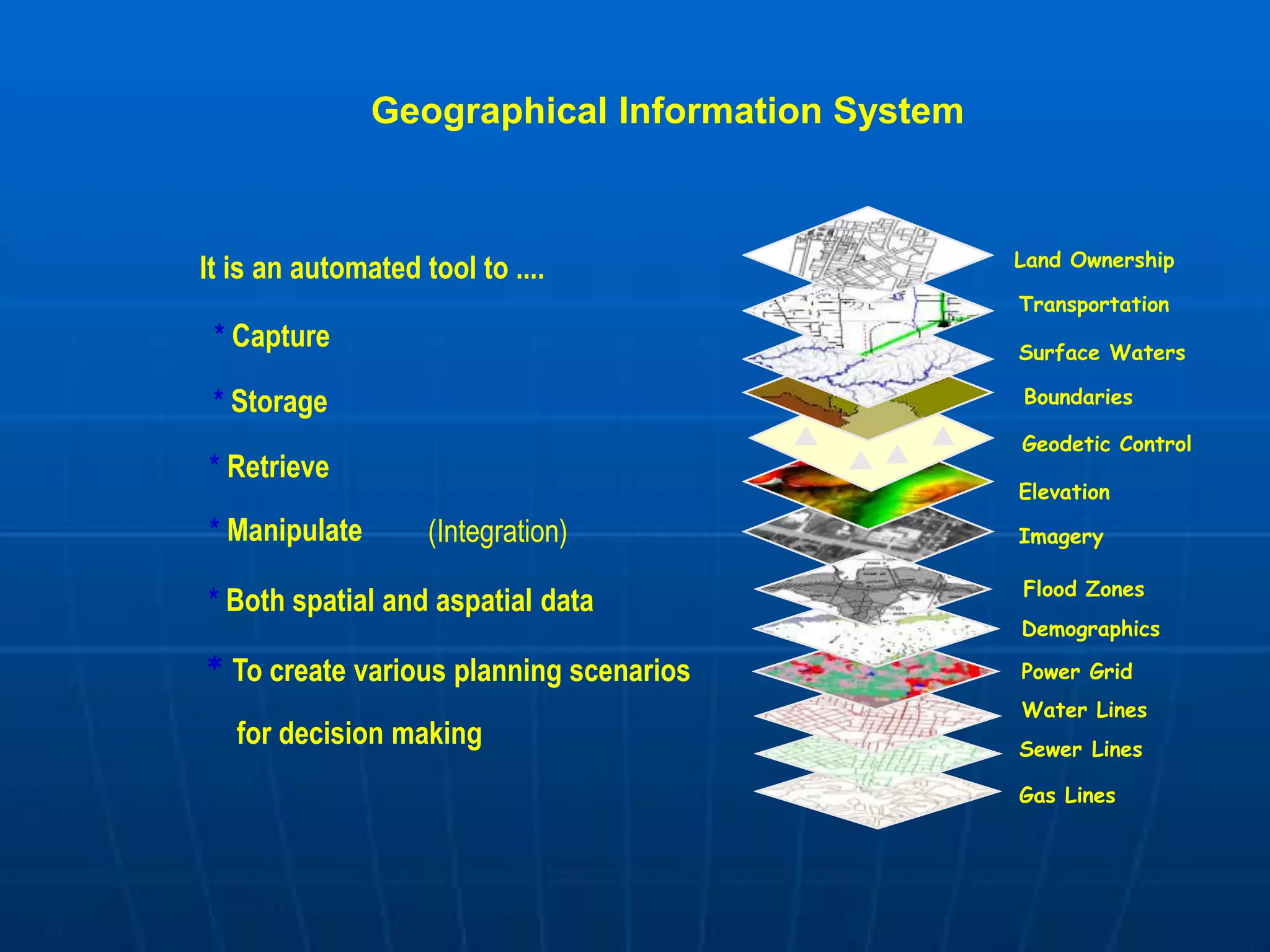
It is an automated tool to ....
* Capture
* Storage
* Retrieve
* Manipulate (Integration)
* Both spatial and aspatial data
* To create various planning scenarios
for decision making
Geographical Information System
Imagery
Elevation
Geodetic Control
Boundaries
Surface Waters
Transportation
Land Ownership
Gas Lines
Sewer Lines
Water Lines
Power Grid
Demographics
Flood Zones
Canada developed the first and really operational
GIS. It was called Canada Geographical
Information System or CGIS and was being used in
1960 to save, manipulate and study the data
gathered for Canada Land Inventory.
The computer mapping software gives researchers
the ability to scan, overlay and measure
geographical places.
The CGIS lasted up to the 90′s but was never
marketed as a product.
CGIS
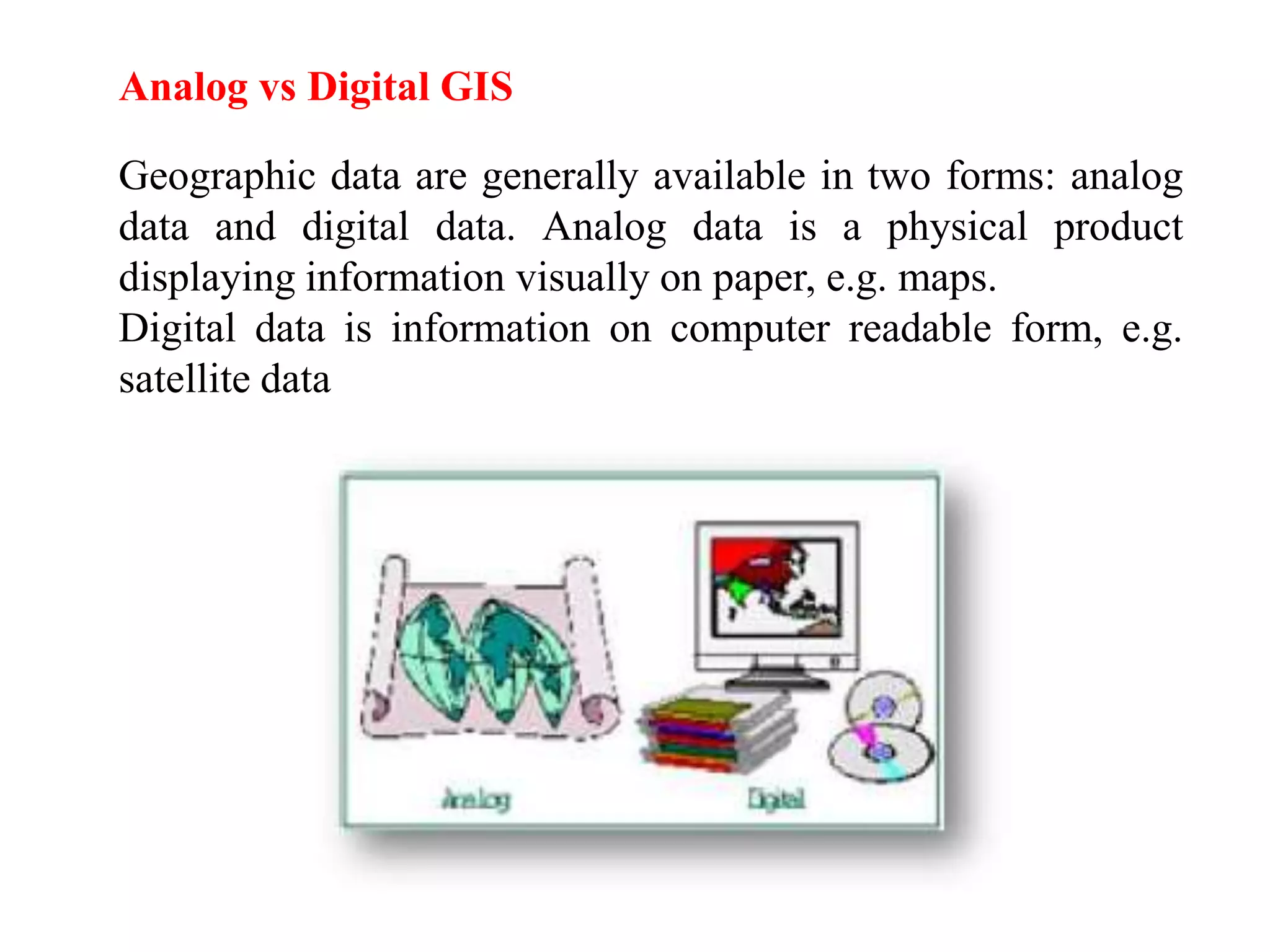
Analog vs Digital GIS
Geographic data are generally available in two forms: analog
data and digital data. Analog data is a physical product
displaying information visually on paper, e.g. maps.
Digital data is information on computer readable form, e.g.
satellite data
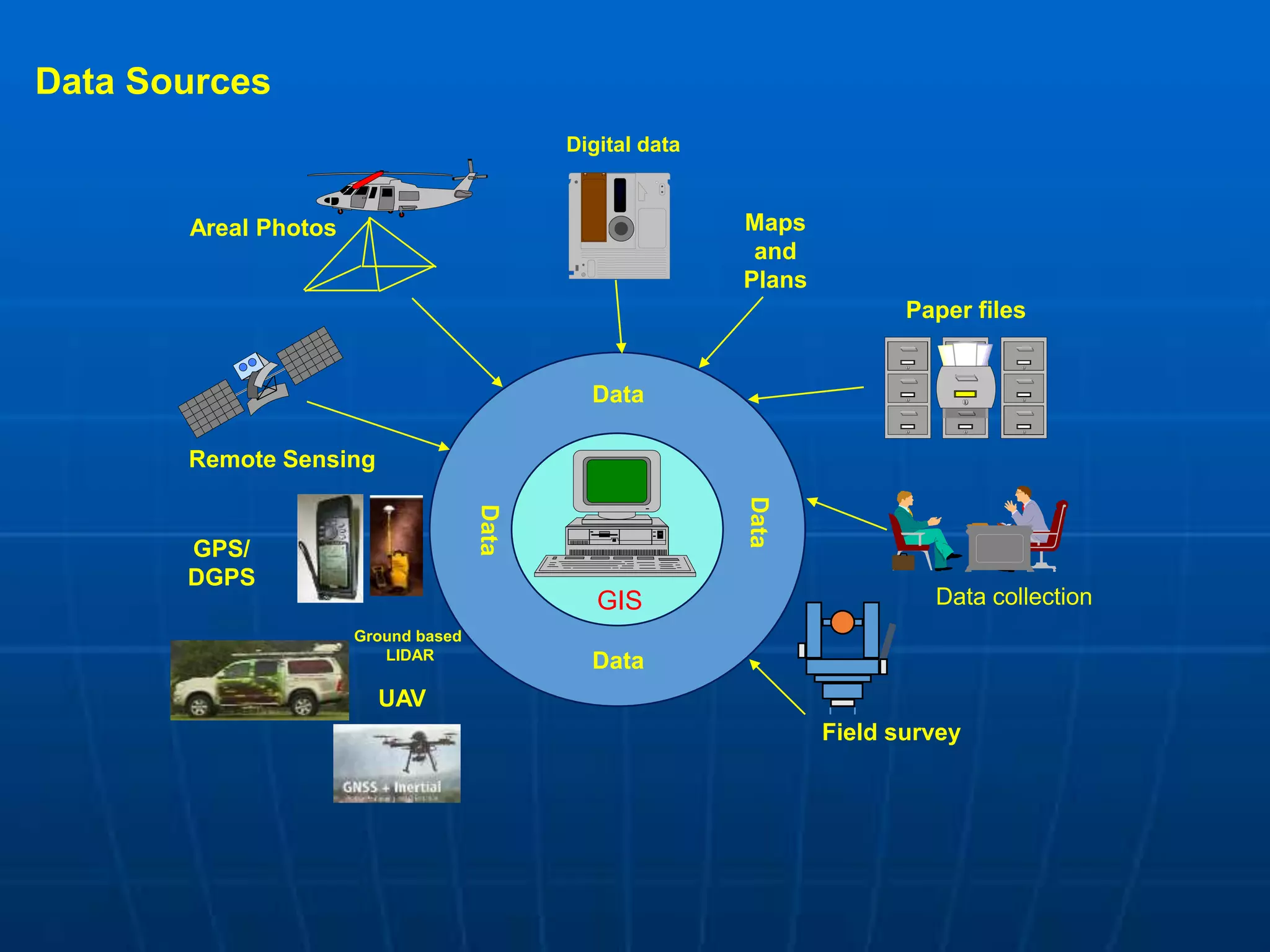
Digital data
Maps
and
Plans
Paper files
Areal Photos
Remote Sensing
Field survey
Data collection
Data Sources
Data
Data
GIS
UAV
GPS/
DGPS
Ground based
LIDAR
MAPS AND MAP ELEMENTS
Maps are graphic representation of our perception
of the world around us.
They represent cartographic interpretation
and simplification of reality.
Maps contains features such as
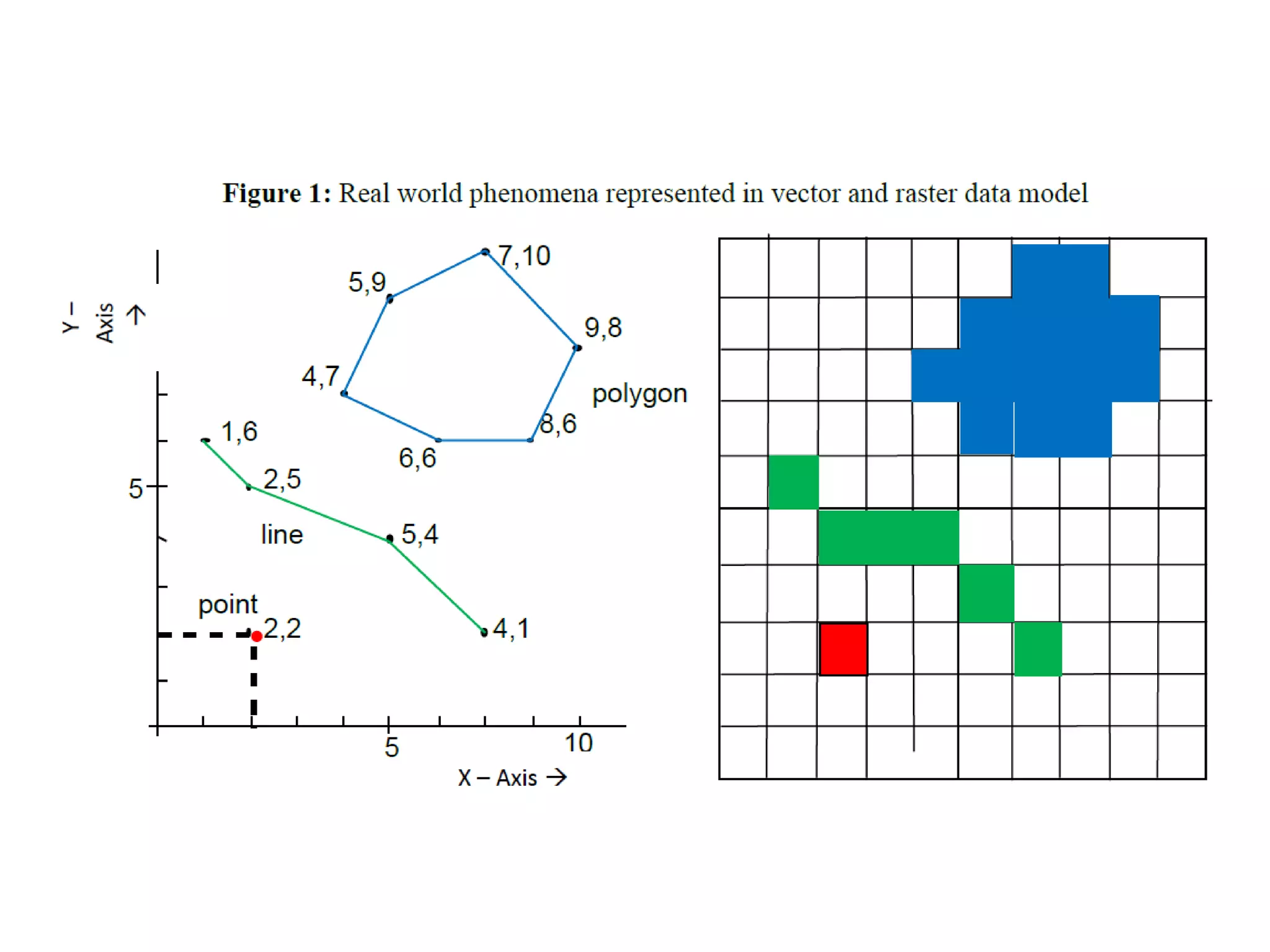
POINT
LINE
AREA
SURFACE
MAPS AND MAP ELEMENTS
Maps provide Location information:
Location information is graphically represented as points,
lines and Polygons.
Maps contain POINT features, LINE features and Polygon
features
- wells - Cart track - Abadi area
- control points - Metaled Road - Tank
- Temple - Streams - Parcel Bound
- Culvert/Bridge - Railway lines - forest areas
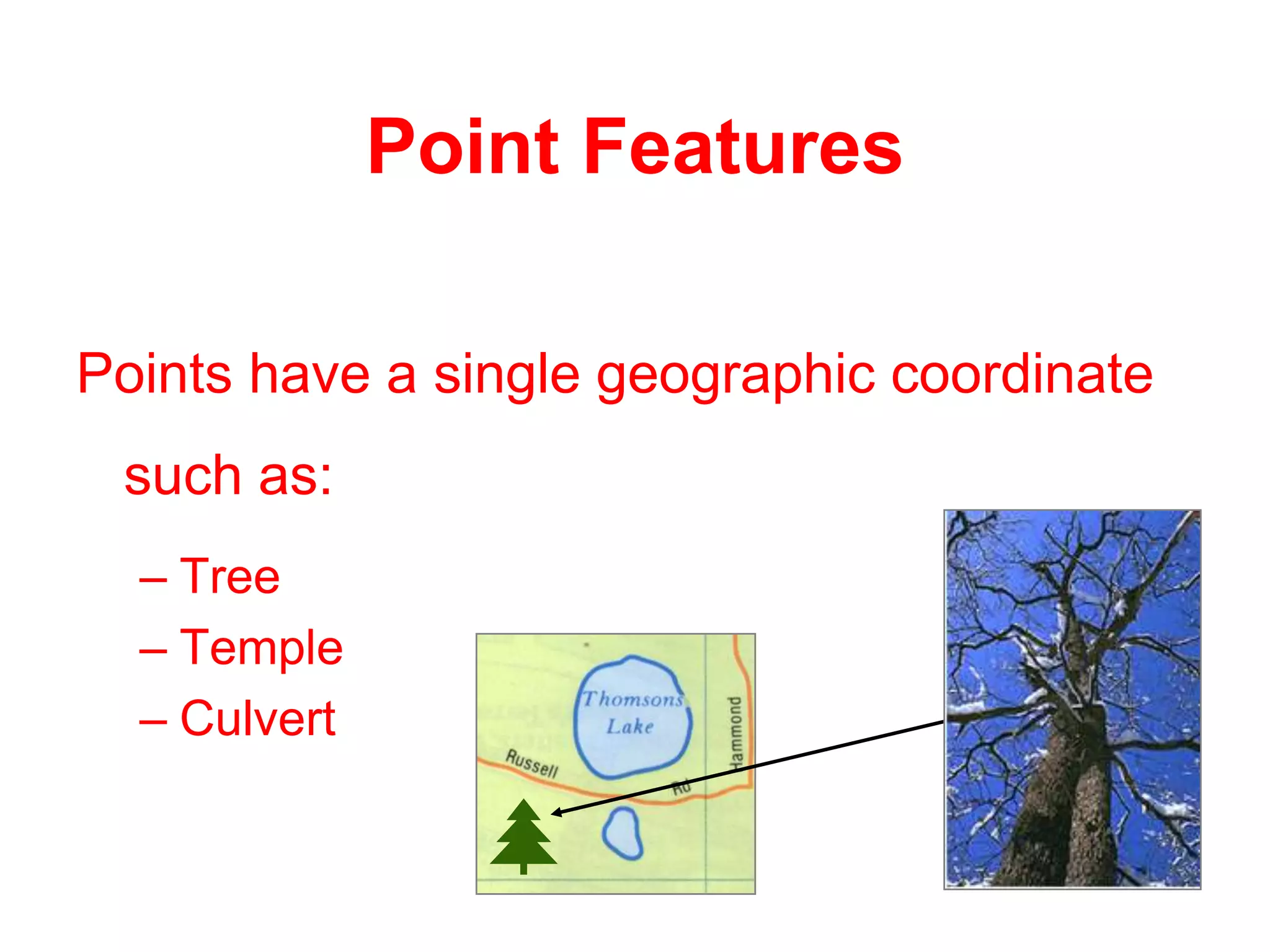
Point Features
Spatially distributed entities, activities or
Points have a single geographic coordinate
such as:
– Tree
– Temple
– Culvert
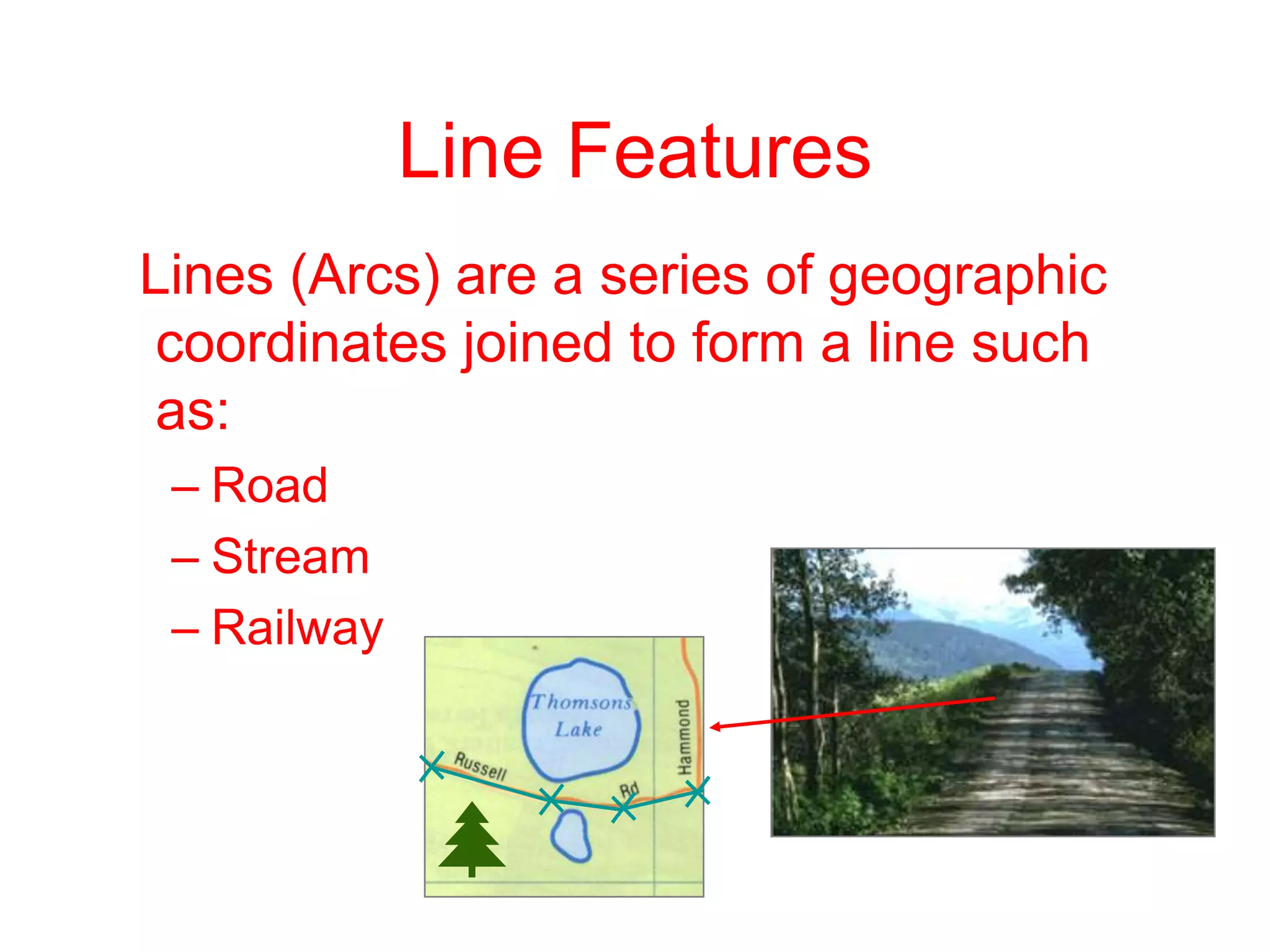
Line Features
nLines (Arcs) are a series of geographic
coordinates joined to form a line such
as:
– Road
– Stream
– Railway
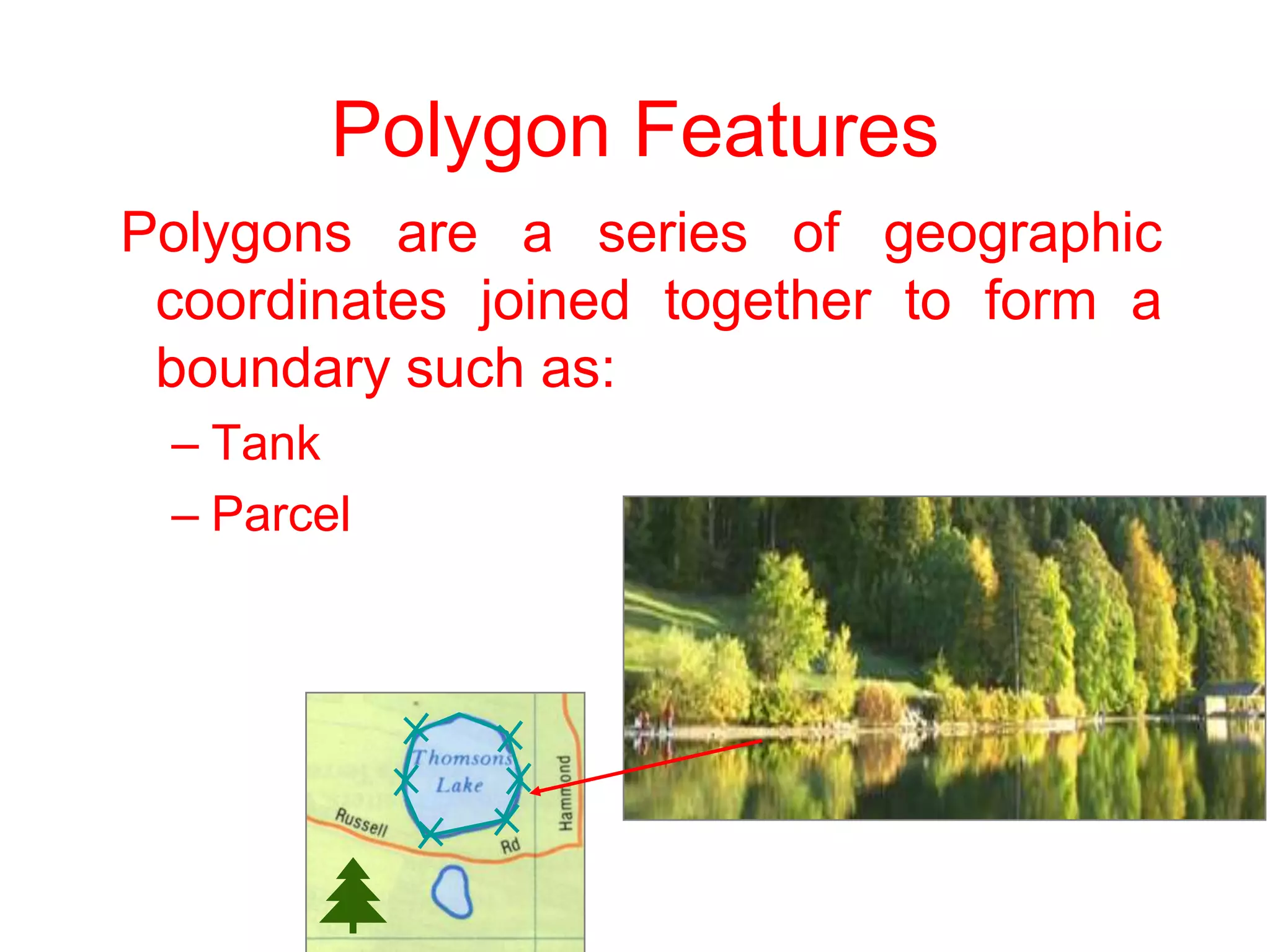
Polygon Features
iPolygons are a series of geographic
coordinates joined together to form a
boundary such as:
– Tank
– Parcel
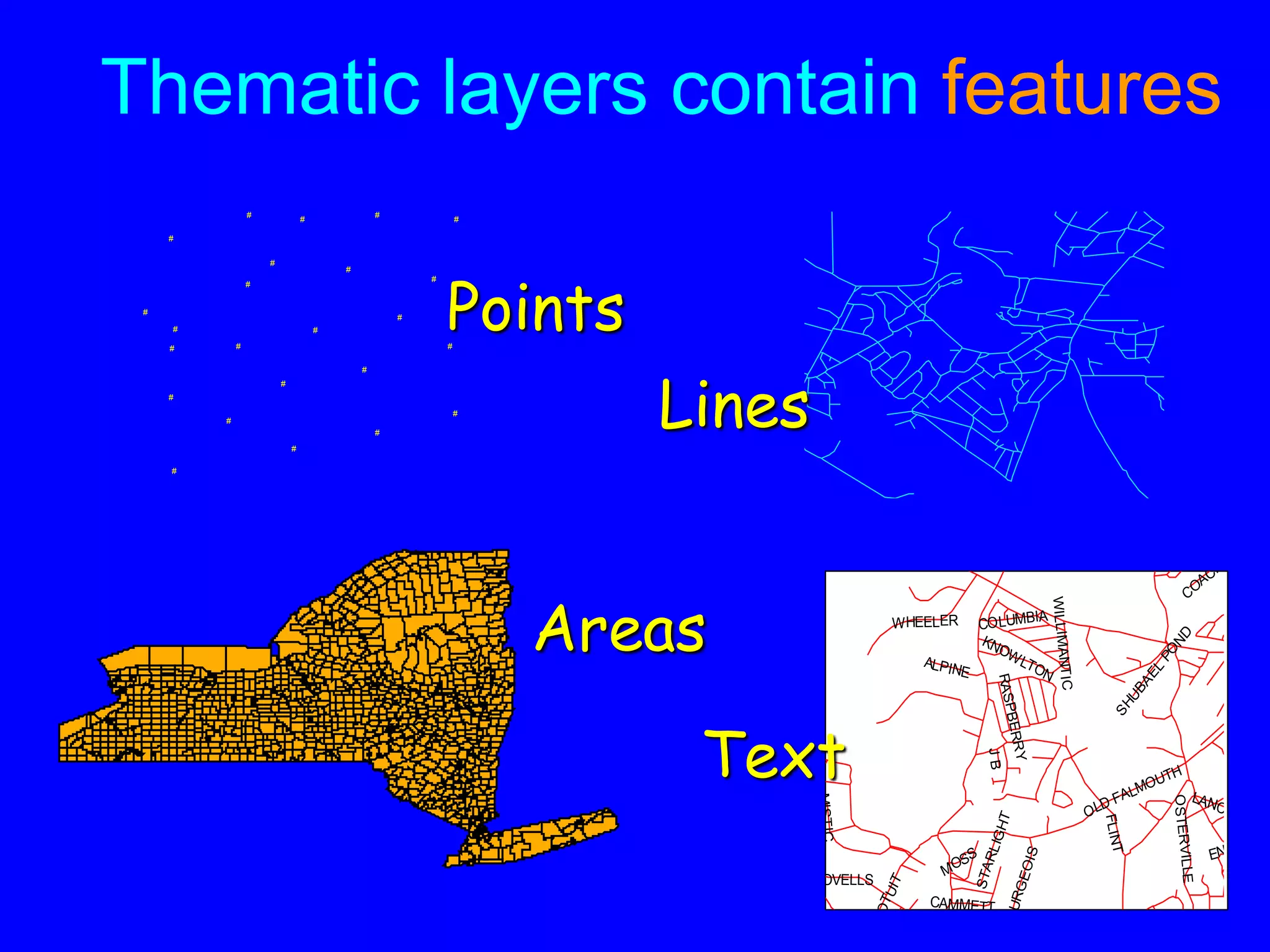
Thematic layers contain features
# #
# #
#
#
#
#
#
#
#
#
#
#
#
#
#
#
#
#
#
#
#
#
Points
Lines
Areas
F
L
I
N
T
OLD FALMOUTH
M
IS
T
IC
WHEELER
OS
T
E
R
V
IL
LE
COACHMAN
ALPINE
B
O
U
R
G
E
O
I
S
CAMMETT
J
B
LANCES
COLUMBIA
S
T
A
R
L
I
G
H
T
W
IL
L
IM
A
N
TI
C
KNOWLTON
MOSS
S
H
U
B
A
E
L
P
O
N
D
R
A
S
P
B
E
R
R
Y
ENSIGN
LOVELLS
C
O
T
U
I
T
Text
ATTRIBUTE DATA
Attributes can be numeric or alfa-numeric
data that is assigned to a point, line or
area spatial features
Example Attributes…
Survey No, Area (ha/acres) , Irrigated
area, Type of land, Tax, Source of
Irrigation, Khata No., Pattadar Name etc.,
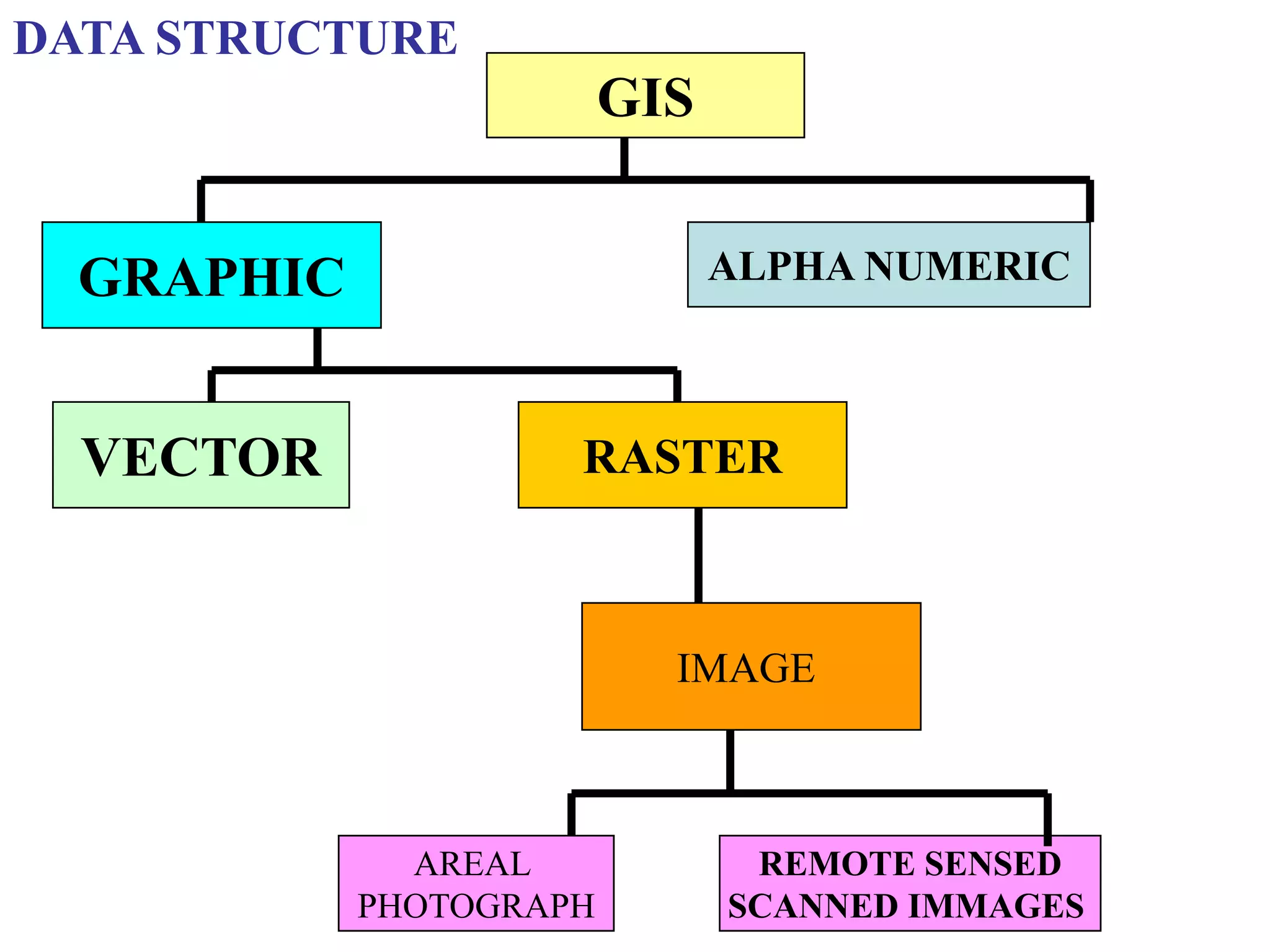
DATA STRUCTURE
GIS
GRAPHIC ALPHA NUMERIC
VECTOR RASTER
IMAGE
AREAL
PHOTOGRAPH
REMOTE SENSED
SCANNED IMMAGES
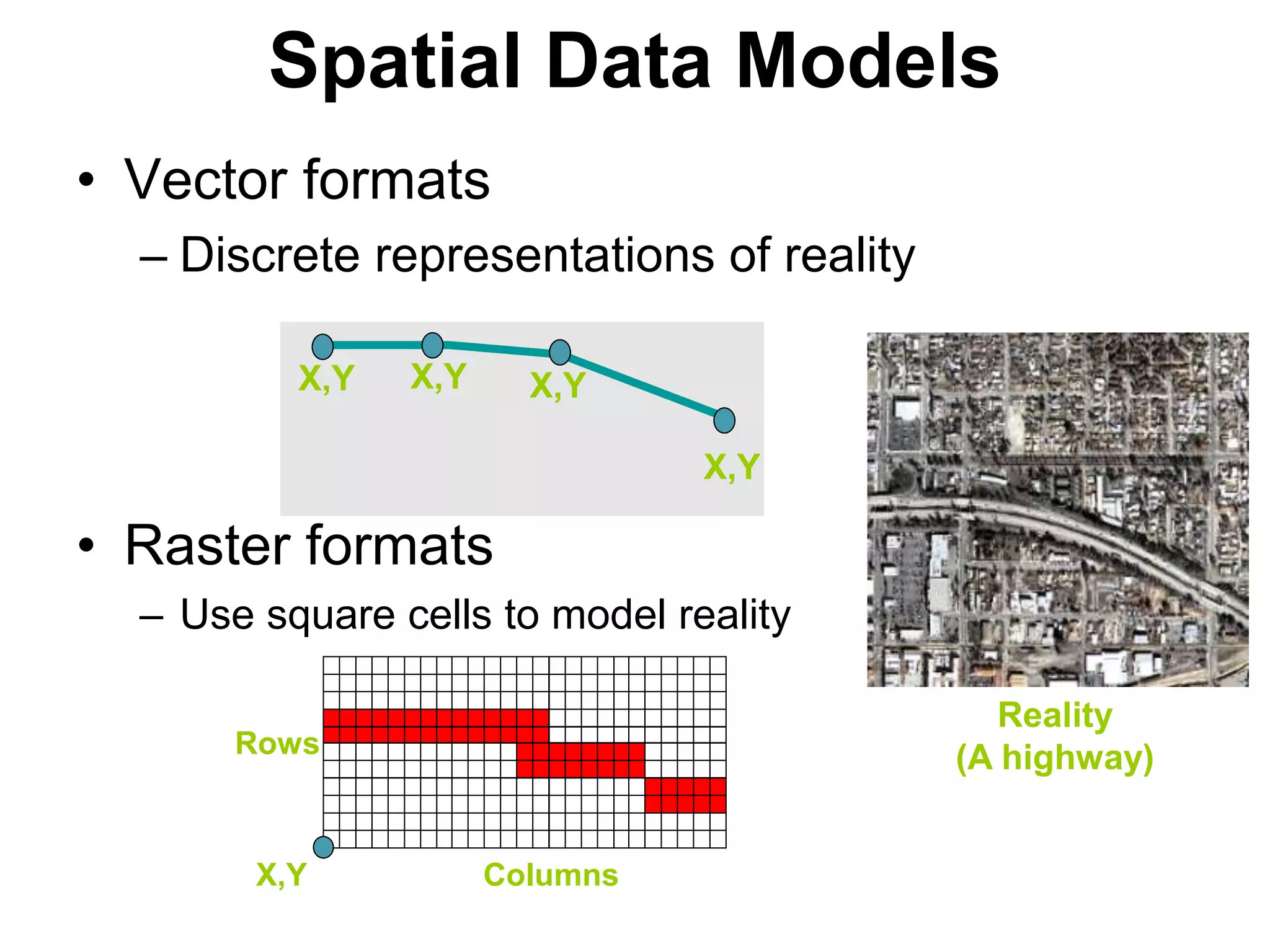
Spatial Data Models
• Vector formats
– Discrete representations of reality
• Raster formats
– Use square cells to model reality
Reality
(A highway)
X,Y
Rows
Columns
X,Y
X,Y X,Y X,Y
Advantages and Disadvantages
of Raster Data Model
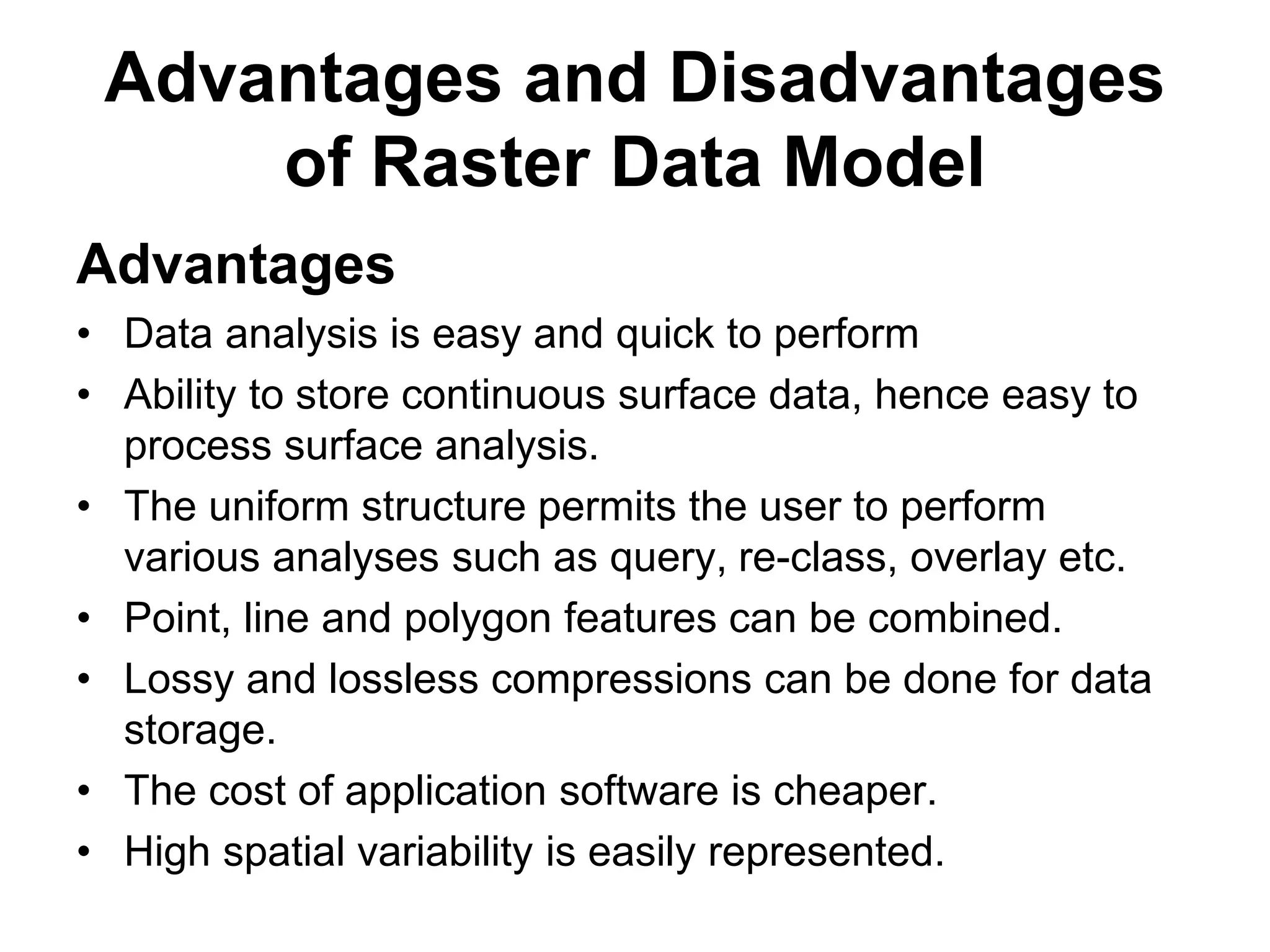
Advantages
• Data analysis is easy and quick to perform
• Ability to store continuous surface data, hence easy to
process surface analysis.
• The uniform structure permits the user to perform
various analyses such as query, re-class, overlay etc.
• Point, line and polygon features can be combined.
• Lossy and lossless compressions can be done for data
storage.
• The cost of application software is cheaper.
• High spatial variability is easily represented.
Disadvantages
• Datasets are larger in size
• Providing projection and transformation is tougher
• Topological representation cannot be done.
• Cell size determines the objects that can be shown
• Linear features are hard to represent and so
network analysis cannot be carried out in raster
data model.
• Stores only single attribute for a cell.
• Errors in perimeter and shape.
Advantages and Disadvantages
of Vector Data Model
Advantages
• Data will be represented in its original form.
• Since most of the hard copy maps such as SOI maps, represent the
data in vector form, it will be easy to show the data in vector format
than in raster.
• Correct geographic location of the data is maintained.
• Topological construction can be carried out easily for checking
adjacency, containment, analyzing the network etc.
• Occupies less storage space.
• One layer can consist of more attribute information. Hence it
occupies lesser memory space.
• Projection and transformation can be done easily to the vector data.
Disadvantages
Data structure is complex to build.
Analyses are hard to perform.
Needs higher end software for complex analysis.
Needs costly software and hardware for vector analysis
Point, line and polygon layers can be overlaid in a single
coordinate system.
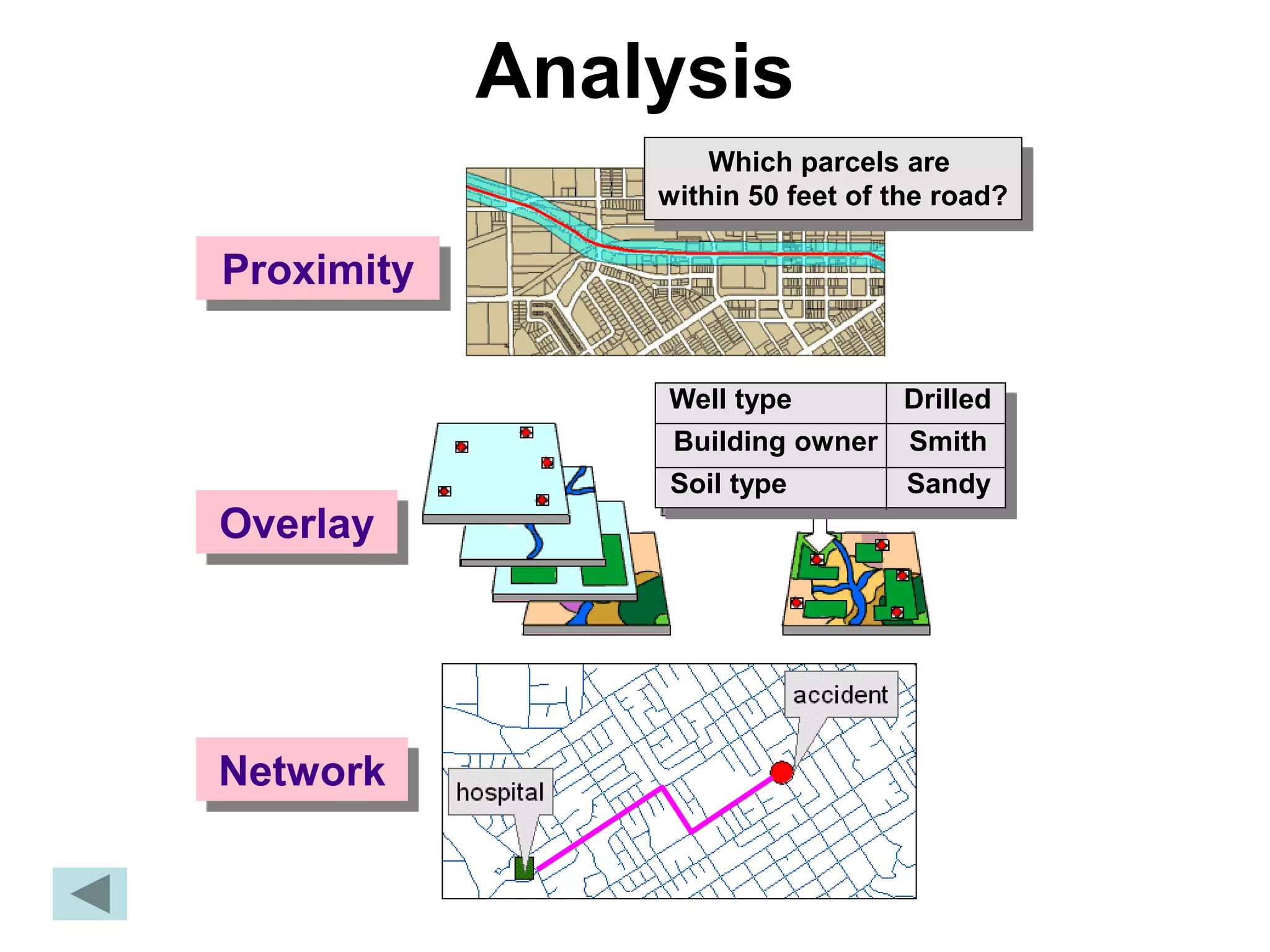
Analysis
Which parcels are
within 50 feet of the road?
Well type Drilled
Building owner Smith
Soil type Sandy
Proximity
Overlay
Network
Geo Spatial Software
• Overview of COTS & FOSS4G
• Geo Web Services & Mobile GIS
• GIS Portals
• Trends in GIS
COMMERCIAL OF THE SELF (COTS)
SOFTWARE
COTS refer to commercial-of-the-self, the
products under this category can be
purchased and are licensed for use by the
purchaser. The COTS software products are
developed and configured by the vendor for
a specific use.
Advantages of COTS
strength of COTS includes better reliability ,
maintenance by the use of proper
documentation, reduced delivery schedule,
higher quality and higher complexity with
simplified and user friendly usage, moreover
the products are developed as per market
need and are tried and tested by various
existing industries.
Software specific to GIS
There are many COTS packages available
in market for application of geospatial
domain. The GIS marketplace has four key
vendors that deliver "generic" platforms:
ESRI, Intergraph, Autodesk, and GE
Energy. Other software leaders include IBM,
Leica Geosystems, & MapInfo.
Free and Open Source Software
for GIS (FOSS4G)
Free Open Source software for GIS
(FOSS4G) refers to the software packages
available as freely downloadable from
internet along with the source code and
providing freedom of its usage and
reproducing and publishing it.
There is no single owner of FOSS4G
software packages, it is maintained by the
volunteers who offer their services free of
cost.
Software specific to GIS
There are many open source software for
GIS domain available for free download from
internet. Quantum GIS is one of the most
popular FOSS4G software package. Some
of the other packages under this category
are uDig, gvSIG, SAGA, Grass, Gram++,
OpenJump, TerraView and Kosmos etc.
Advantages of FOSS4G
One of the most striking package of FOS4G package is that
it available as free download along with the source code.
Apart from this the other advantages include decreasing
software cost with increasing security and stability along
with giving user the control over their own hardware.
It also provide freedom from the monopoly and
proprietorship of a particular vendor. Apart from this the
technical support group of open source is very vast. Also
notable is the transparency of the bug-reporting and fixing
process.
Disadvantages of FOSS4G
As far disadvantages are concerned there
are few, to list them it is required to know the
know-how of installation, drawback is also
the limited availability and consistency of
documentation and sometimes training costs
for users will emerge similar to proprietary
products.
To address the data interoperability issues
in GIS, the Open Geospatial Consortium
(OGC) has introduced standards by
publishing specifications for the GIS
services. In OGC web services
specifications, the GIS data is published in
various service specifications like Web Map
Services (WMS), Web Feature Services
(WFS), and Web Coverage Services (WFS)
etc.
GEO-WEB SERVICES AND MOBILE GIS
Mobile GIS
The Mobile GIS is an integration of three
technologies viz. Mobile computing, wireless
communication and GIS.
The major challenges in Mobile GIS
implementation includes availability of less
bandwidth in wireless network, diversity of
mobile devices, limited computation and
storage capability of mobile devices and
diversity in mobile platforms.
Applications of Mobile GIS
• Location Based Services (LBS)
• Real time mapping
• Crowdsourcing or public participation in
GIS
• Field data collection for GIS
• Situational awareness
• Real time traffic monitoring system
• Real time vehicle tracking and monitoring
system
GIS PORTALS
GIS based web portals provides a
centralized and uniform interface to access
the distributed and heterogeneous
resources and data services. These are
designed for specific theme and are targeted
to specific class of users.
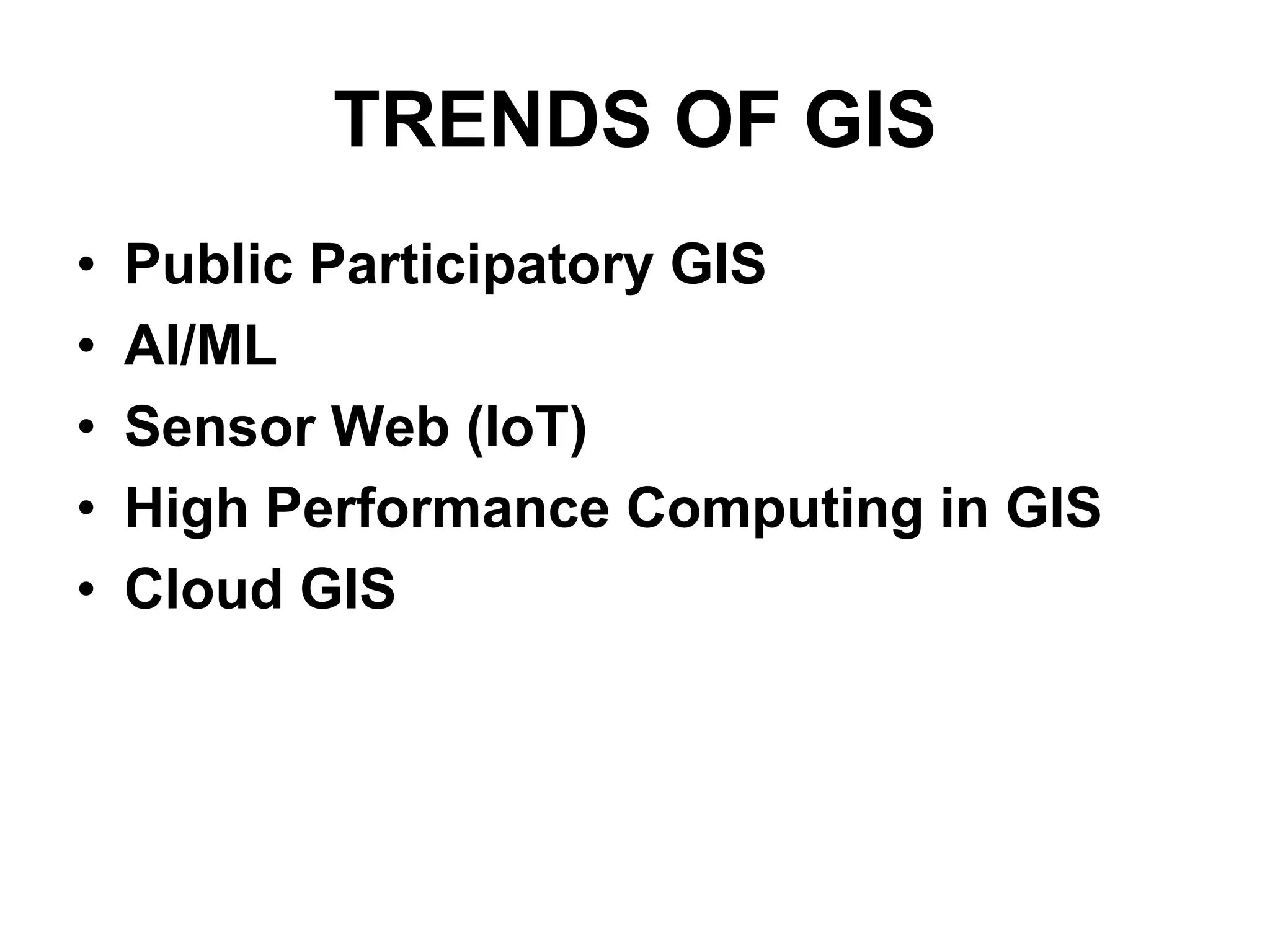
TRENDS OF GIS
• Public Participatory GIS
• AI/ML
• Sensor Web (IoT)
• High Performance Computing in GIS
• Cloud GIS
GIS APPLICATIONS
• LAND INFORMATION SYSTEM
• LAND USE AND THEMATIC MAPPING
• ENVIRONMENTAL IMPACT ASSESSMENTS
• FACILITY MANAGEMENT
• HEALTH CARE, DISEASE PROFILE
• FORESTRY AND WILD LIFE TRACKING
• WASTE LAND DEVELOPMENT
• GROUND WATER RESOURCES MANAGEMENT
• URBAN AND TOWN PLANNING
• BUSINESS AND RETAILS
• DEFENCE
Intro GIS.pptx

Intro GIS.pptx

  • 1.
  • 2.
    WHAT IS GI S ?
  • 3.
    WHAT IS GI S ? GEOGRAPHIC Geography (from the Greek word Geo (γη) means "Earth", and graphein (γραφειν) meaning "to describe" or "to write“ or "to map") is the study of the earth and its features, inhabitants, and phenomena. A literal translation would be "to describe or write about the Earth". Features can be calculated, in terms of Geographic coordinates (Latitude, Longitude)
  • 5.
    INFORMATION implies thatthe data in a GIS are organized to yield useful knowledge, often as colored maps and images, but also as statistical graphics, tables, and various on-screen responses to interactive queries.
  • 6.
    SYSTEM implies that aGIS is made up from several inter-related and linked components with different functions. Thus, GIS have functional capabilities for data capture, input, query, analysis, modeling, manipulation, transformation, visualization, combinations and output.
  • 7.
    It is anautomated tool to .... * Capture * Storage * Retrieve * Manipulate (Integration) * Both spatial and aspatial data * To create various planning scenarios for decision making Geographical Information System Imagery Elevation Geodetic Control Boundaries Surface Waters Transportation Land Ownership Gas Lines Sewer Lines Water Lines Power Grid Demographics Flood Zones
  • 8.
    Canada developed thefirst and really operational GIS. It was called Canada Geographical Information System or CGIS and was being used in 1960 to save, manipulate and study the data gathered for Canada Land Inventory. The computer mapping software gives researchers the ability to scan, overlay and measure geographical places. The CGIS lasted up to the 90′s but was never marketed as a product. CGIS
  • 9.
    Analog vs DigitalGIS Geographic data are generally available in two forms: analog data and digital data. Analog data is a physical product displaying information visually on paper, e.g. maps. Digital data is information on computer readable form, e.g. satellite data
  • 10.
    Digital data Maps and Plans Paper files ArealPhotos Remote Sensing Field survey Data collection Data Sources Data Data GIS UAV GPS/ DGPS Ground based LIDAR
  • 11.
    MAPS AND MAPELEMENTS Maps are graphic representation of our perception of the world around us. They represent cartographic interpretation and simplification of reality. Maps contains features such as POINT LINE AREA SURFACE
  • 12.
    MAPS AND MAPELEMENTS Maps provide Location information: Location information is graphically represented as points, lines and Polygons. Maps contain POINT features, LINE features and Polygon features - wells - Cart track - Abadi area - control points - Metaled Road - Tank - Temple - Streams - Parcel Bound - Culvert/Bridge - Railway lines - forest areas
  • 13.
    Point Features Spatially distributedentities, activities or Points have a single geographic coordinate such as: – Tree – Temple – Culvert
  • 14.
    Line Features nLines (Arcs)are a series of geographic coordinates joined to form a line such as: – Road – Stream – Railway
  • 15.
    Polygon Features iPolygons area series of geographic coordinates joined together to form a boundary such as: – Tank – Parcel
  • 16.
    Thematic layers containfeatures # # # # # # # # # # # # # # # # # # # # # # # # Points Lines Areas F L I N T OLD FALMOUTH M IS T IC WHEELER OS T E R V IL LE COACHMAN ALPINE B O U R G E O I S CAMMETT J B LANCES COLUMBIA S T A R L I G H T W IL L IM A N TI C KNOWLTON MOSS S H U B A E L P O N D R A S P B E R R Y ENSIGN LOVELLS C O T U I T Text
  • 17.
    ATTRIBUTE DATA Attributes canbe numeric or alfa-numeric data that is assigned to a point, line or area spatial features Example Attributes… Survey No, Area (ha/acres) , Irrigated area, Type of land, Tax, Source of Irrigation, Khata No., Pattadar Name etc.,
  • 18.
    DATA STRUCTURE GIS GRAPHIC ALPHANUMERIC VECTOR RASTER IMAGE AREAL PHOTOGRAPH REMOTE SENSED SCANNED IMMAGES
  • 19.
    Spatial Data Models •Vector formats – Discrete representations of reality • Raster formats – Use square cells to model reality Reality (A highway) X,Y Rows Columns X,Y X,Y X,Y X,Y
  • 21.
    Advantages and Disadvantages ofRaster Data Model Advantages • Data analysis is easy and quick to perform • Ability to store continuous surface data, hence easy to process surface analysis. • The uniform structure permits the user to perform various analyses such as query, re-class, overlay etc. • Point, line and polygon features can be combined. • Lossy and lossless compressions can be done for data storage. • The cost of application software is cheaper. • High spatial variability is easily represented.
  • 22.
    Disadvantages • Datasets arelarger in size • Providing projection and transformation is tougher • Topological representation cannot be done. • Cell size determines the objects that can be shown • Linear features are hard to represent and so network analysis cannot be carried out in raster data model. • Stores only single attribute for a cell. • Errors in perimeter and shape.
  • 23.
    Advantages and Disadvantages ofVector Data Model Advantages • Data will be represented in its original form. • Since most of the hard copy maps such as SOI maps, represent the data in vector form, it will be easy to show the data in vector format than in raster. • Correct geographic location of the data is maintained. • Topological construction can be carried out easily for checking adjacency, containment, analyzing the network etc. • Occupies less storage space. • One layer can consist of more attribute information. Hence it occupies lesser memory space. • Projection and transformation can be done easily to the vector data.
  • 24.
    Disadvantages Data structure iscomplex to build. Analyses are hard to perform. Needs higher end software for complex analysis. Needs costly software and hardware for vector analysis Point, line and polygon layers can be overlaid in a single coordinate system.
  • 25.
    Analysis Which parcels are within50 feet of the road? Well type Drilled Building owner Smith Soil type Sandy Proximity Overlay Network
  • 26.
    Geo Spatial Software •Overview of COTS & FOSS4G • Geo Web Services & Mobile GIS • GIS Portals • Trends in GIS
  • 27.
    COMMERCIAL OF THESELF (COTS) SOFTWARE COTS refer to commercial-of-the-self, the products under this category can be purchased and are licensed for use by the purchaser. The COTS software products are developed and configured by the vendor for a specific use.
  • 28.
    Advantages of COTS strengthof COTS includes better reliability , maintenance by the use of proper documentation, reduced delivery schedule, higher quality and higher complexity with simplified and user friendly usage, moreover the products are developed as per market need and are tried and tested by various existing industries.
  • 29.
    Software specific toGIS There are many COTS packages available in market for application of geospatial domain. The GIS marketplace has four key vendors that deliver "generic" platforms: ESRI, Intergraph, Autodesk, and GE Energy. Other software leaders include IBM, Leica Geosystems, & MapInfo.
  • 30.
    Free and OpenSource Software for GIS (FOSS4G) Free Open Source software for GIS (FOSS4G) refers to the software packages available as freely downloadable from internet along with the source code and providing freedom of its usage and reproducing and publishing it. There is no single owner of FOSS4G software packages, it is maintained by the volunteers who offer their services free of cost.
  • 31.
    Software specific toGIS There are many open source software for GIS domain available for free download from internet. Quantum GIS is one of the most popular FOSS4G software package. Some of the other packages under this category are uDig, gvSIG, SAGA, Grass, Gram++, OpenJump, TerraView and Kosmos etc.
  • 32.
    Advantages of FOSS4G Oneof the most striking package of FOS4G package is that it available as free download along with the source code. Apart from this the other advantages include decreasing software cost with increasing security and stability along with giving user the control over their own hardware. It also provide freedom from the monopoly and proprietorship of a particular vendor. Apart from this the technical support group of open source is very vast. Also notable is the transparency of the bug-reporting and fixing process.
  • 33.
    Disadvantages of FOSS4G Asfar disadvantages are concerned there are few, to list them it is required to know the know-how of installation, drawback is also the limited availability and consistency of documentation and sometimes training costs for users will emerge similar to proprietary products.
  • 34.
    To address thedata interoperability issues in GIS, the Open Geospatial Consortium (OGC) has introduced standards by publishing specifications for the GIS services. In OGC web services specifications, the GIS data is published in various service specifications like Web Map Services (WMS), Web Feature Services (WFS), and Web Coverage Services (WFS) etc. GEO-WEB SERVICES AND MOBILE GIS
  • 35.
    Mobile GIS The MobileGIS is an integration of three technologies viz. Mobile computing, wireless communication and GIS. The major challenges in Mobile GIS implementation includes availability of less bandwidth in wireless network, diversity of mobile devices, limited computation and storage capability of mobile devices and diversity in mobile platforms.
  • 36.
    Applications of MobileGIS • Location Based Services (LBS) • Real time mapping • Crowdsourcing or public participation in GIS • Field data collection for GIS • Situational awareness • Real time traffic monitoring system • Real time vehicle tracking and monitoring system
  • 37.
    GIS PORTALS GIS basedweb portals provides a centralized and uniform interface to access the distributed and heterogeneous resources and data services. These are designed for specific theme and are targeted to specific class of users.
  • 39.
    TRENDS OF GIS •Public Participatory GIS • AI/ML • Sensor Web (IoT) • High Performance Computing in GIS • Cloud GIS
  • 40.
    GIS APPLICATIONS • LANDINFORMATION SYSTEM • LAND USE AND THEMATIC MAPPING • ENVIRONMENTAL IMPACT ASSESSMENTS • FACILITY MANAGEMENT • HEALTH CARE, DISEASE PROFILE • FORESTRY AND WILD LIFE TRACKING • WASTE LAND DEVELOPMENT • GROUND WATER RESOURCES MANAGEMENT • URBAN AND TOWN PLANNING • BUSINESS AND RETAILS • DEFENCE